FIG 33 FIAT PALIO 2003 178 / 1.G India Version Service Manual
[x] Cancel search | Manufacturer: FIAT, Model Year: 2003, Model line: PALIO, Model: FIAT PALIO 2003 178 / 1.GPages: 156, PDF Size: 6.27 MB
Page 57 of 156
56
SLANT COMPENSATION
When the car is loaded, it slopes
backwards. This means that the head-
light beam rises. In this case, it is nec-
essary to return it to the correct po-
sition.
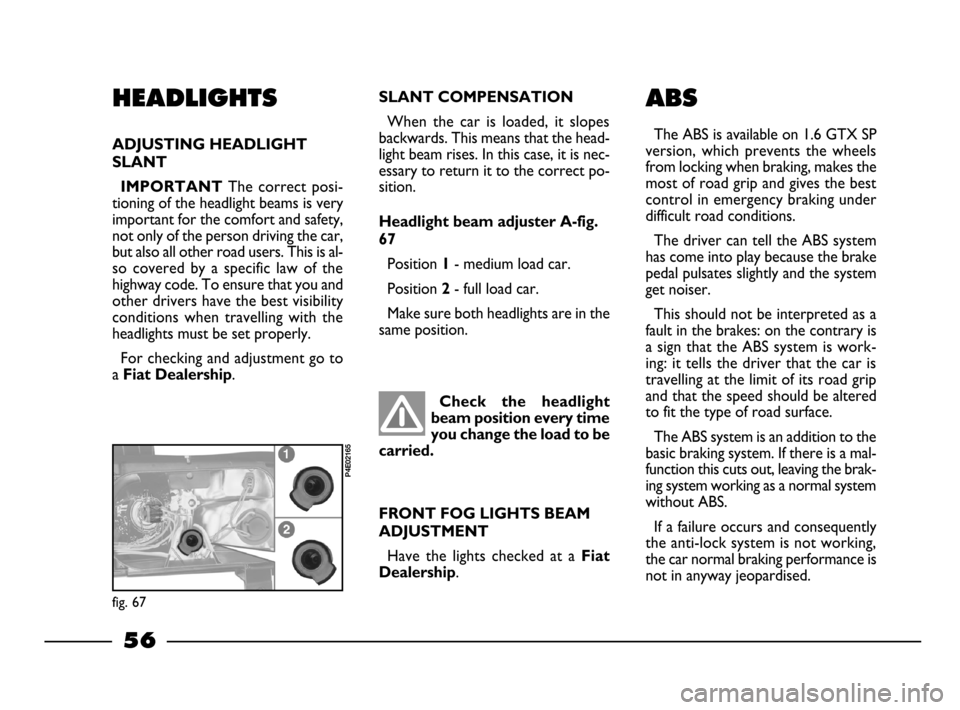
Headlight beam adjuster A-fig.
67
Position 1- medium load car.
Position
2- full load car.
Make sure both headlights are in the
same position.
Check the headlight
beam position every time
you change the load to be
carried.
FRONT FOG LIGHTS BEAM
ADJUSTMENT
Have the lights checked at a Fiat
Dealership
.
ABS
The ABS is available on 1.6 GTX SP
version, which prevents the wheels
from locking when braking, makes the
most of road grip and gives the best
control in emergency braking under
difficult road conditions.
The driver can tell the ABS system
has come into play because the brake
pedal pulsates slightly and the system
get noiser.
This should not be interpreted as a
fault in the brakes: on the contrary is
a sign that the ABS system is work-
ing: it tells the driver that the car is
travelling at the limit of its road grip
and that the speed should be altered
to fit the type of road surface.
The ABS system is an addition to the
basic braking system. If there is a mal-
function this cuts out, leaving the brak-
ing system working as a normal system
without ABS.
If a failure occurs and consequently
the anti-lock system is not working,
the car normal braking performance is
not in anyway jeopardised.
HEADLIGHTS
ADJUSTING HEADLIGHT
SLANT
IMPORTANT
The correct posi-
tioning of the headlight beams is very
important for the comfort and safety,
not only of the person driving the car,
but also all other road users. This is al-
so covered by a specific law of the
highway code. To ensure that you and
other drivers have the best visibility
conditions when travelling with the
headlights must be set properly.
For checking and adjustment go to
a
Fiat Dealership.
fig. 67
P4E02165
20-63 03/03/2003 06:03 PM Page 56
Page 59 of 156
58
The bag inflates instantly and acts as
a soft protective barrier between the
driver’s body and the structures that
could cause injury. The bag deflate im-
mediately afterwards.
A person not wearing the seat belt
may crash into the bag before it is ful-
ly inflated. In this case the protection
is considerably decreased.
As a consequence, the air bag is not
a replacement for the use of seat belts
but rather a complement. We rec-
ommend that seat belts are worn at all
times as prescribed by legislation in Eu-
rope and most other countries world-
wide.In the event of a less severe collision
(for which seat belts are sufficient pro-
tection) the airbag is not activated.
For impacts against very deformable
or mobile objects (traffic sign poles,
heaps of gravel or snow, parked vehi-
cles), side impacts, wedging under oth-
er vehicles or barriers (e.g. under a
track or guard rail), the airbag is not
necessary. In the event of frontal im-
pacts involving, for example, the mud-
guard against a guardrail, the airbags
are not triggered as they would not of-
fer additional protection with respect
to the seat belts.
Therefore, the fact that the airbag
does not inflate is not a sign of sys-
tem malfunction.AIR BAG
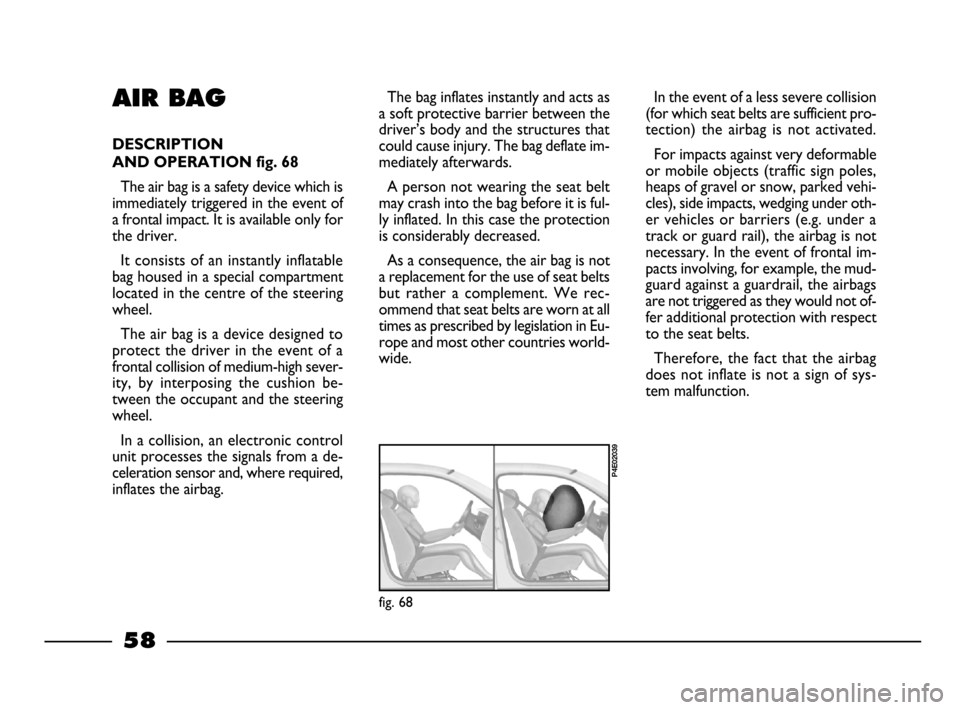
DESCRIPTION
AND OPERATION fig. 68
The air bag is a safety device which is
immediately triggered in the event of
a frontal impact. It is available only for
the driver.
It consists of an instantly inflatable
bag housed in a special compartment
located in the centre of the steering
wheel.
The air bag is a device designed to
protect the driver in the event of a
frontal collision of medium-high sever-
ity, by interposing the cushion be-
tween the occupant and the steering
wheel.
In a collision, an electronic control
unit processes the signals from a de-
celeration sensor and, where required,
inflates the airbag.
fig. 68
P4E02039
20-63 03/03/2003 06:03 PM Page 58
Page 62 of 156
61
STANDARD EQUIPMENT
The system consists of:
- radio power supply cables;
- cables for speakers and tweeters on
front doors;
- cables for rear speakers on lug-
gage cover supports.
- Aerial wire;
- radio housing;
- front speaker housing (on front
doors);
- rear speaker housing (on luggage
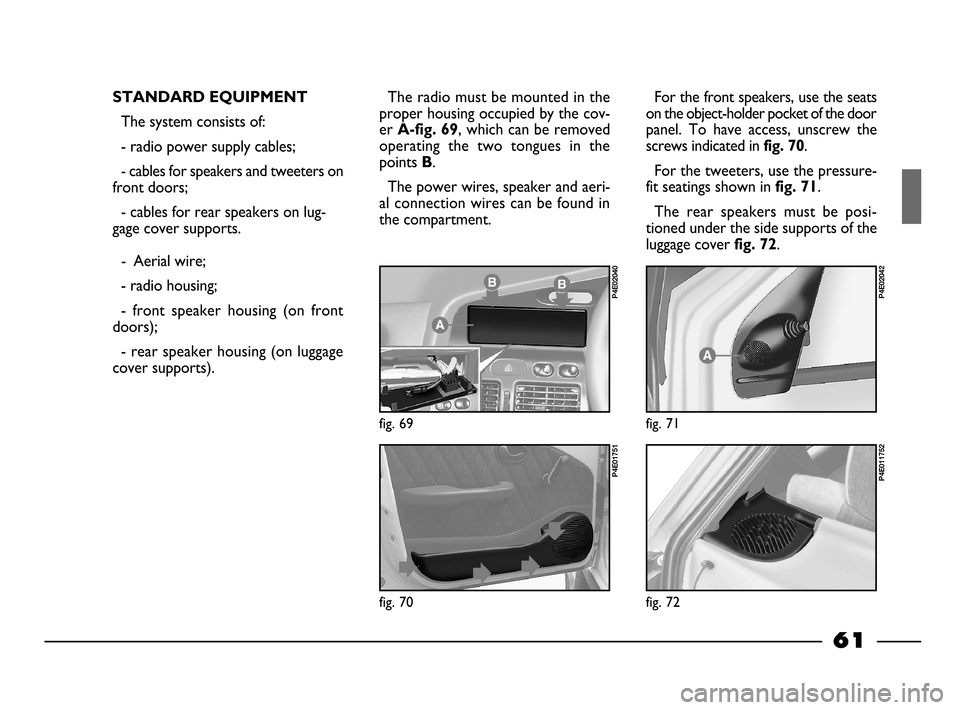
cover supports).The radio must be mounted in the
proper housing occupied by the cov-
er A-fig. 69, which can be removed
operating the two tongues in the
points
B.
The power wires, speaker and aeri-
al connection wires can be found in
the compartment.For the front speakers, use the seats
on the object-holder pocket of the door
panel. To have access, unscrew the
screws indicated in
fig. 70.
For the tweeters, use the pressure-
fit seatings shown in
fig. 71.
The rear speakers must be posi-
tioned under the side supports of the
luggage cover
fig. 72.
fig. 69
P4E02040
fig. 70
P4E01751
fig. 71
P4E02042
fig. 72
P4E011752
20-63 03/03/2003 06:03 PM Page 61
Page 63 of 156
62
AT THE FILLING STATION
An inefficient catalytic
converter will allow
harmful gases to be re-
leased in the atmosphere.Never put even the tini-
est amount of leaded fu-
el into the tank, even in
an emergency; you would dam-
age the catalytic converter be-
yond repair.
The pollution prevention devices of
Fiat Palio mean only unleaded petrol
can be used.
Use petrol with a research octane
number (R.O.N.) equal to 87.
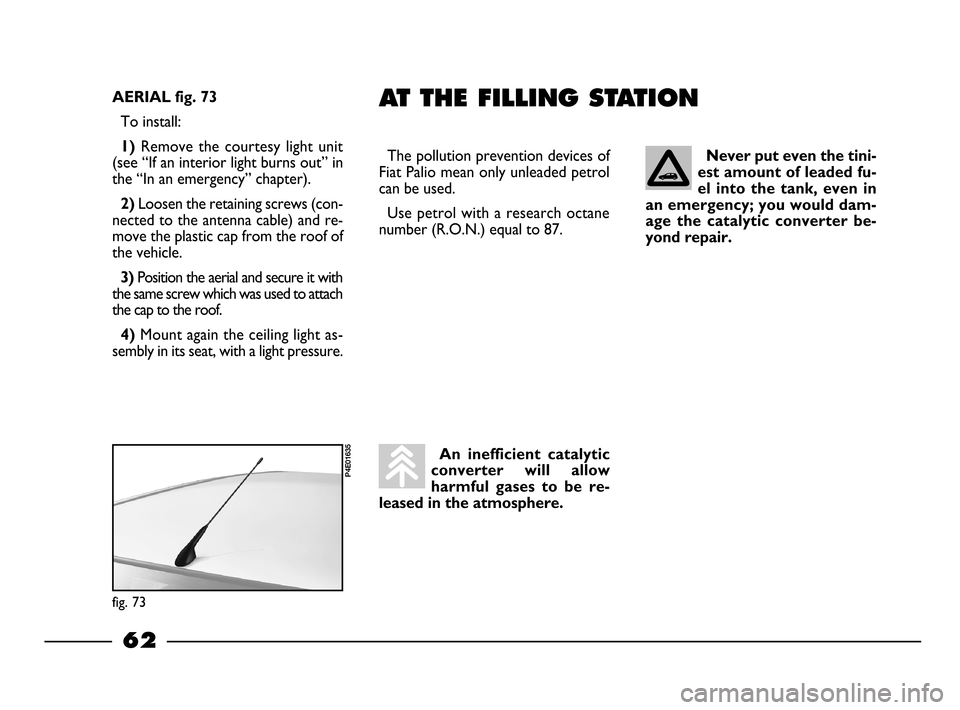
AERIAL fig. 73
To install:
1) Remove the courtesy light unit
(see “If an interior light burns out” in
the “In an emergency” chapter).
2) Loosen the retaining screws (con-
nected to the antenna cable) and re-
move the plastic cap from the roof of
the vehicle.
3) Position the aerial and secure it with
the same screw which was used to attach
the cap to the roof.
4) Mount again the ceiling light as-
sembly in its seat, with a light pressure.
fig. 73
P4E01635
20-63 03/03/2003 06:03 PM Page 62
Page 64 of 156
63
PROTECTING THE
ENVIRONMENT
Protecting the environment has been
the guiding principle in the design of the
Fiat Palio right from the start. The re-
sult is the use of materials and creation
of devices that can reduce or consid-
erably curtail harmful influences on the
environment.
The devices for curtailing emission
for petrol version are:
– a three-way catalytic converter;
– Lambda sensor;
– an anti evaporation system.
The devices for curtailing emission
for diesel version are:
– Catalytic converter;
– Exhaust gas recirculation.
As a consequence Fiat Palio is ready
to travel well ahead of the most strin-
gent international pollution control
standards.
fig. 74
P4E01945
IMPORTANT If required, replace
the fuel cap with another genuine cap
to avoid affecting the efficiency of the
fuel vapour recovery system.
NEVER go close to the
tank filler with naked
flames or lit cigarettes:
Also avoid going too close to
the fuel tank filler area, to avoid
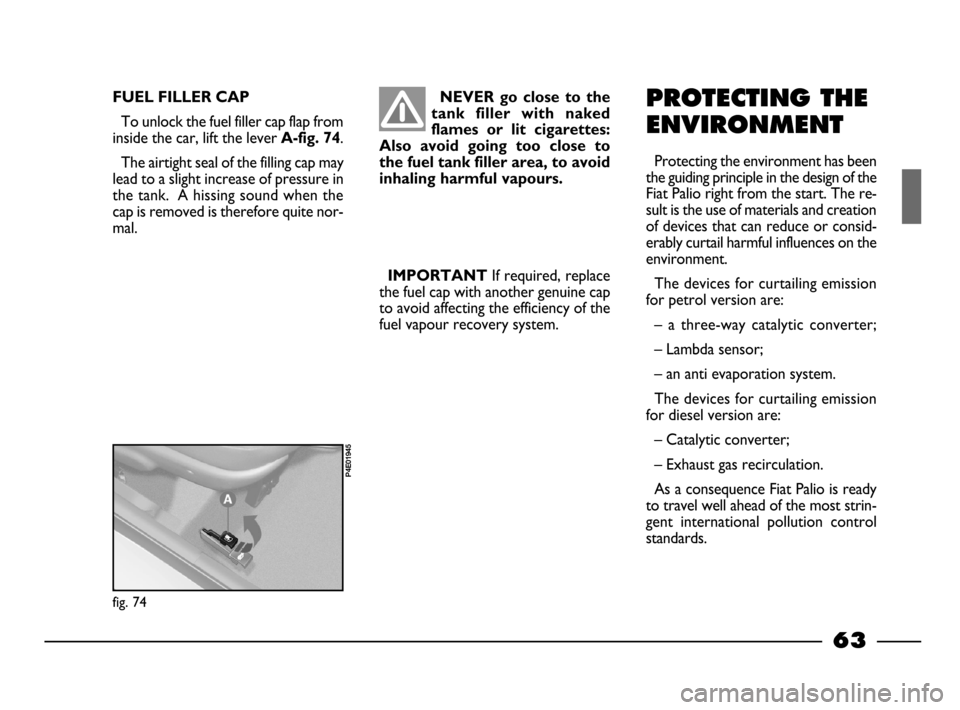
inhaling harmful vapours.FUEL FILLER CAP
To unlock the fuel filler cap flap from
inside the car, lift the lever
A-fig. 74.
The airtight seal of the filling cap may
lead to a slight increase of pressure in
the tank. A hissing sound when the
cap is removed is therefore quite nor-
mal.
20-63 03/03/2003 06:03 PM Page 63
Page 68 of 156
67
With handbrake engaged and igni-
tion key at
MAR, the instrument pan-
el warning light
x
comes on.
To disengage the handbrake:
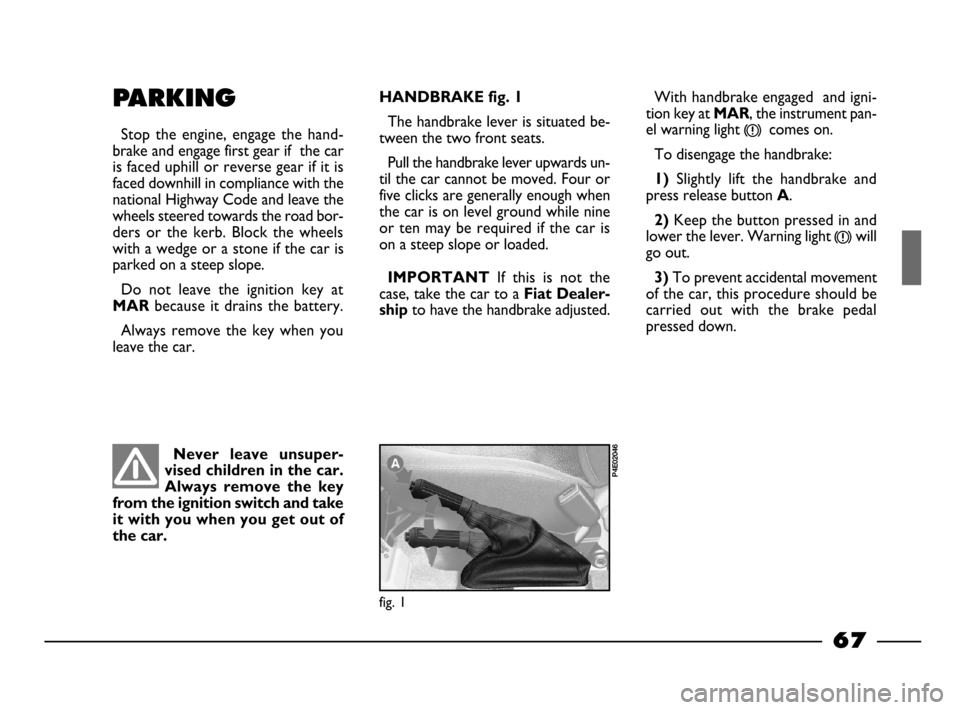
1)Slightly lift the handbrake and
press release button
A.
2)Keep the button pressed in and
lower the lever. Warning light
x
will
go out.
3)To prevent accidental movement
of the car, this procedure should be
carried out with the brake pedal
pressed down.
HANDBRAKE fig. 1
The handbrake lever is situated be-
tween the two front seats.
Pull the handbrake lever upwards un-
til the car cannot be moved. Four or
five clicks are generally enough when
the car is on level ground while nine
or ten may be required if the car is
on a steep slope or loaded.
IMPORTANTIf this is not the
case, take the car to a
Fiat Dealer-
ship
to have the handbrake adjusted.
Never leave unsuper-
vised children in the car.
Always remove the key
from the ignition switch and take
it with you when you get out of
the car.
fig. 1
P4E02046
PARKING
Stop the engine, engage the hand-
brake and engage first gear if the car
is faced uphill or reverse gear if it is
faced downhill in compliance with the
national Highway Code and leave the
wheels steered towards the road bor-
ders or the kerb. Block the wheels
with a wedge or a stone if the car is
parked on a steep slope.
Do not leave the ignition key at
MARbecause it drains the battery.
Always remove the key when you
leave the car.
64-79 03/03/2003 06:45 PM Page 67
Page 69 of 156
68
You must press the
clutch fully down to
change gear properly. It is
therefore essential that there is
nothing under the pedals. Make
sure that mats are lying flat and
do not get in the way of pedals.
SAFE DRIVING
In designing the Fiat Palio, Fiat made
every effort to offer a car able to pro-
vide driver and passengers with top
class levels of safety.
Nevertheless it is always the behav-
iour of the person at the wheel that
determines road safety.
Below you will find some simple tips
to help you travel in safety under dif-
ferent conditions.
You will no doubt be familiar with
many of them already but it will be
useful to read them all carefully.
USING THE
GEARBOX
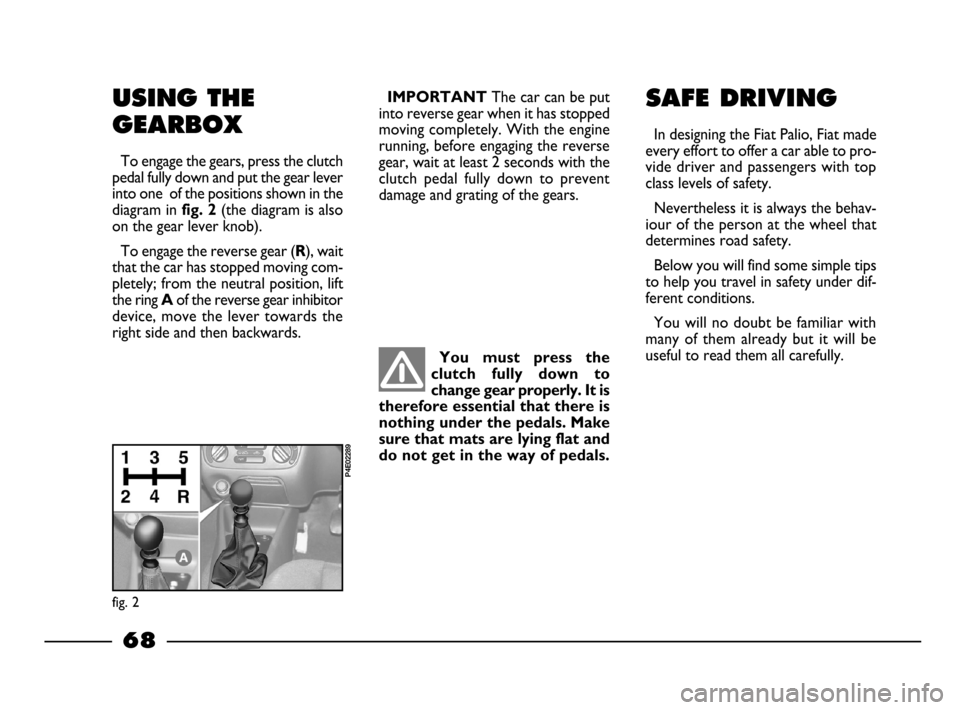
To engage the gears, press the clutch
pedal fully down and put the gear lever
into one of the positions shown in the
diagram in
fig. 2(the diagram is also
on the gear lever knob).
To engage the reverse gear (
R), wait
that the car has stopped moving com-
pletely; from the neutral position, lift
the ring
Aof the reverse gear inhibitor
device, move the lever towards the
right side and then backwards.
fig. 2
P4E02289
IMPORTANTThe car can be put
into reverse gear when it has stopped
moving completely. With the engine
running, before engaging the reverse
gear, wait at least 2 seconds with the
clutch pedal fully down to prevent
damage and grating of the gears.
64-79 03/03/2003 06:45 PM Page 68
Page 82 of 156
81
JUMP STARTING
If the battery is flat, you can use an-
other battery to start the engine. Its ca-
pacity must be the same or slightly
greater than the flat battery (see “Tech-
nical Specifications”).
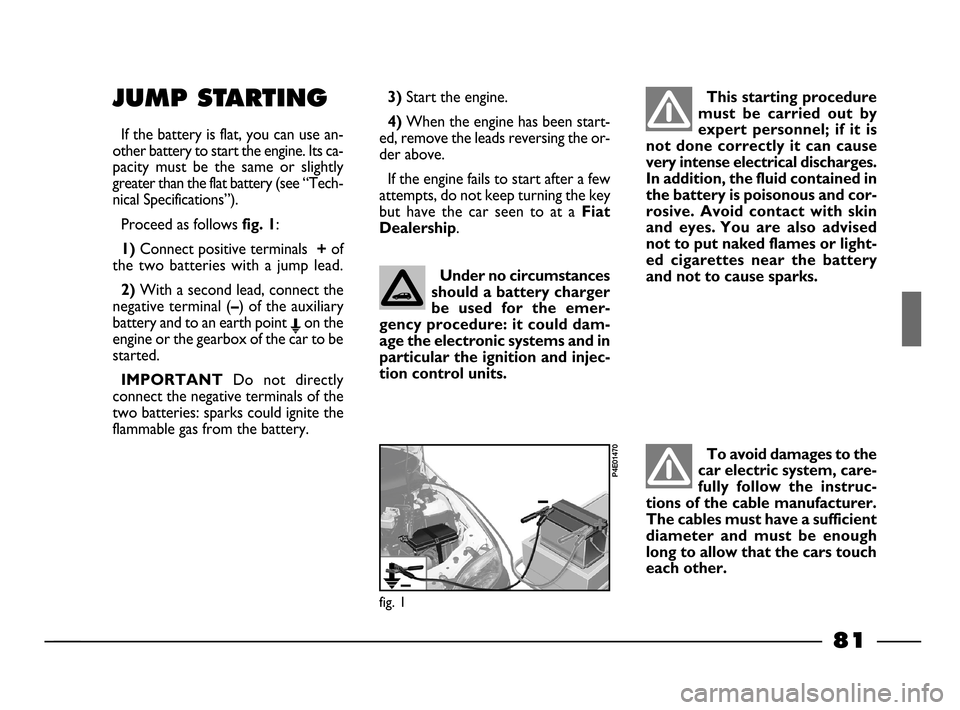
Proceed as follows
fig. 1:
1)Connect positive terminals +of
the two batteries with a jump lead.
2)With a second lead, connect the
negative terminal (
–) of the auxiliary
battery and to an earth point E
on the
engine or the gearbox of the car to be
started.
IMPORTANTDo not directly
connect the negative terminals of the
two batteries: sparks could ignite the
flammable gas from the battery.
3)Start the engine.
4)When the engine has been start-
ed, remove the leads reversing the or-
der above.
If the engine fails to start after a few
attempts, do not keep turning the key
but have the car seen to at a
Fiat
Dealership
.
fig. 1
P4E01470
This starting procedure
must be carried out by
expert personnel; if it is
not done correctly it can cause
very intense electrical discharges.
In addition, the fluid contained in
the battery is poisonous and cor-
rosive. Avoid contact with skin
and eyes. You are also advised
not to put naked flames or light-
ed cigarettes near the battery
and not to cause sparks.
Under no circumstances
should a battery charger
be used for the emer-
gency procedure: it could dam-
age the electronic systems and in
particular the ignition and injec-
tion control units.
To avoid damages to the
car electric system, care-
fully follow the instruc-
tions of the cable manufacturer.
The cables must have a sufficient
diameter and must be enough
long to allow that the cars touch
each other.
80-103 03/03/2003 06:49 PM Page 81
Page 84 of 156
83
1. STOP THE CAR
– Stop the car in a position that is not
dangerous for oncoming traffic where
you can change the wheel safely. The
ground should be flat and adequately
firm. If you have to change the wheel
at night, choose a lit area if possible.
– Turn the engine off and pull up the
handbrake.
– Engage first or reverse gear.
– Alert other drivers that the car is
stationary in compliance with local
regulations: hazard warning lights,
warning triangle etc.
Any passenger should get out and
wait as far away as possible from the
dangers of traffic.
If the road is sloping or bumpy, place
wedges or other suitable material un-
der the wheels to prevent the car from
moving.
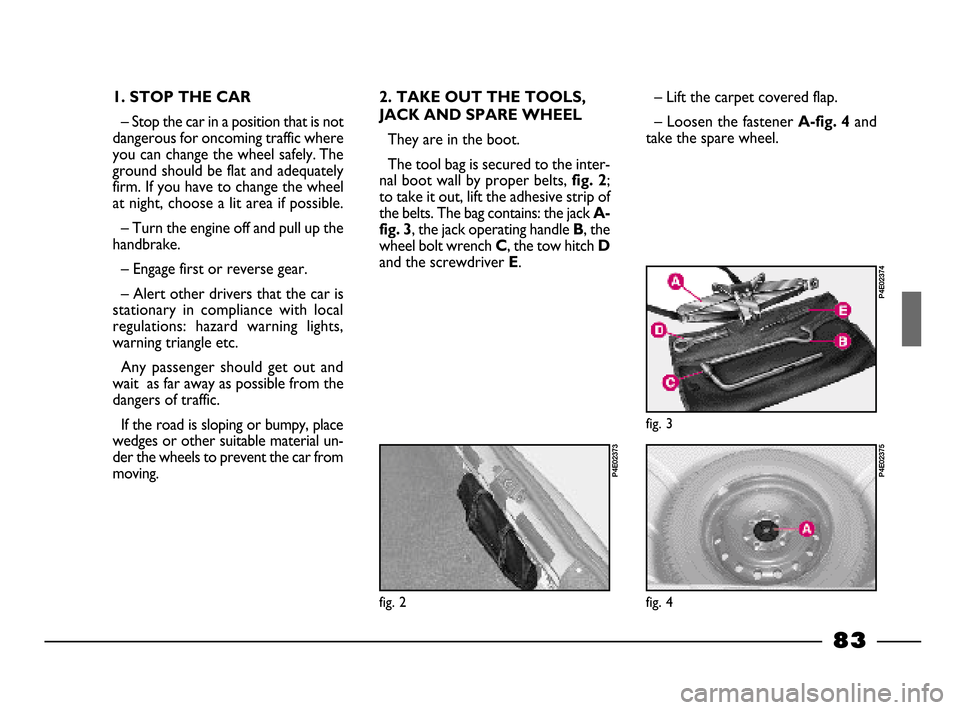
2. TAKE OUT THE TOOLS,
JACK AND SPARE WHEEL
They are in the boot.
The tool bag is secured to the inter-
nal boot wall by proper belts,
fig. 2;
to take it out, lift the adhesive strip of
the belts. The bag contains: the jack
A-
fig. 3
, the jack operating handle B, the
wheel bolt wrench
C, the tow hitch D
and the screwdriver E.
fig. 2
P4E02373
fig. 4
P4E02375
fig. 3
P4E02374
– Lift the carpet covered flap.
– Loosen the fastener
A-fig. 4and
take the spare wheel.
80-103 03/03/2003 06:49 PM Page 83
Page 85 of 156
5) Warn anyone nearby that the car
is about to be lifted. They must stay
clear and not touch the car until it is
back on the ground.
6)Fit the operating handle on the
jack and turn it until the wheel to be
changed lifts a few centimetres off the
ground. When turning the jack handle
make sure that it can be used easily
and take care not to scrape your hand
against the ground› . The moving parts
of the jack (screw and joints) may al-
so cause injury if touched. Clean off
any grease.
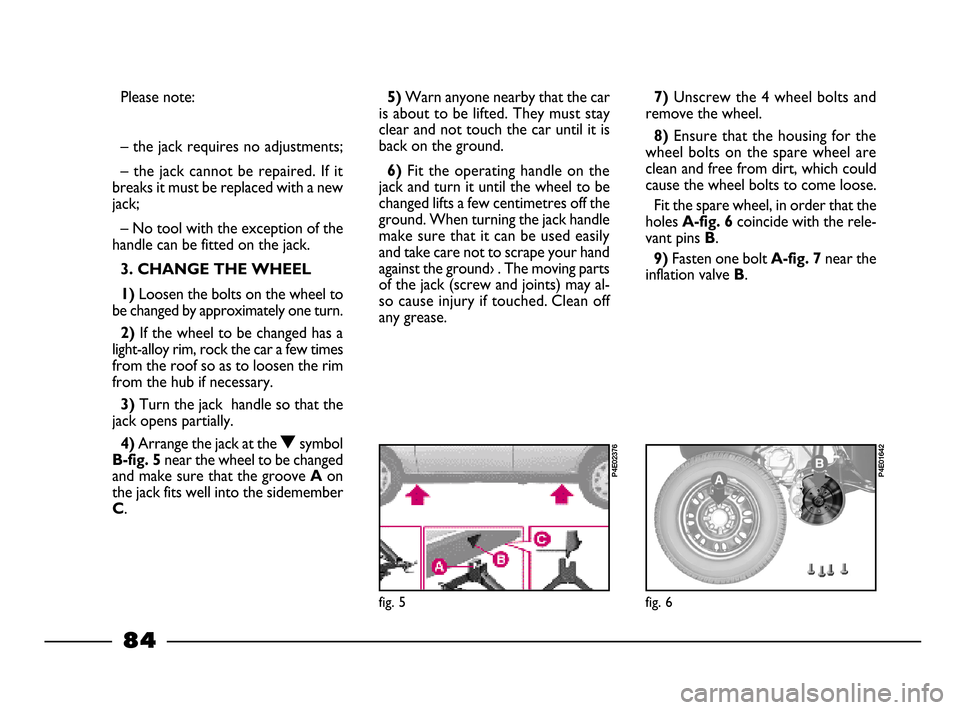
7)Unscrew the 4 wheel bolts and
remove the wheel.
8) Ensure that the housing for the
wheel bolts on the spare wheel are
clean and free from dirt, which could
cause the wheel bolts to come loose.
Fit the spare wheel, in order that the
holes
A-fig. 6coincide with the rele-
vant pins
B.
9) Fasten one bolt A-fig. 7near the
inflation valve
B.
fig. 6
P4E01642
fig. 5
P4E02376
84
Please note:
– the jack weighs 2.900 kg;
– the jack requires no adjustments;
– the jack cannot be repaired. If it
breaks it must be replaced with a new
jack;
– No tool with the exception of the
handle can be fitted on the jack.
3. CHANGE THE WHEEL
1)
Loosen the bolts on the wheel to
be changed by approximately one turn.
2) If the wheel to be changed has a
light-alloy rim, rock the car a few times
from the roof so as to loosen the rim
from the hub if necessary.
3) Turn the jack handle so that the
jack opens partially.
4)Arrange the jack at the Osymbol
B-fig. 5 near the wheel to be changed
and make sure that the groove
Aon
the jack fits well into the sidemember
C.
80-103 03/03/2003 06:49 PM Page 84