FIG 33 FIAT PALIO 2003 178 / 1.G India Version Manual PDF
[x] Cancel search | Manufacturer: FIAT, Model Year: 2003, Model line: PALIO, Model: FIAT PALIO 2003 178 / 1.GPages: 156, PDF Size: 6.27 MB
Page 114 of 156
113
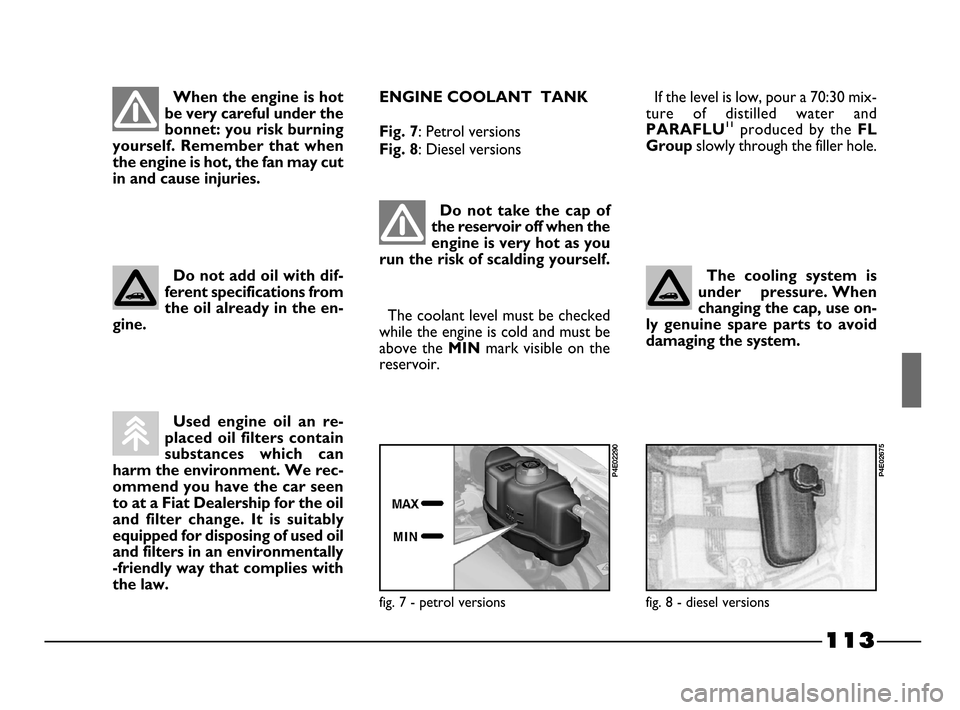
ENGINE COOLANT TANK
Fig. 7
: Petrol versions
Fig. 8: Diesel versionsIf the level is low, pour a 70:30 mix-
ture of distilled water and
PARAFLU11produced by the FL
Group
slowly through the filler hole.
fig. 7 - petrol versions
P4E02290
Do not take the cap of
the reservoir off when the
engine is very hot as you
run the risk of scalding yourself.
The coolant level must be checked
while the engine is cold and must be
above the
MIN mark visible on the
reservoir.
Do not add oil with dif-
ferent specifications from
the oil already in the en-
gine.
Used engine oil an re-
placed oil filters contain
substances which can
harm the environment. We rec-
ommend you have the car seen
to at a Fiat Dealership for the oil
and filter change. It is suitably
equipped for disposing of used oil
and filters in an environmentally
-friendly way that complies with
the law.
When the engine is hot
be very careful under the
bonnet: you risk burning
yourself. Remember that when
the engine is hot, the fan may cut
in and cause injuries.
The cooling system is
under pressure. When
changing the cap, use on-
ly genuine spare parts to avoid
damaging the system.
fig. 8 - diesel versions
P4E02675
104-127 03/03/2003 06:53 PM Page 113
Page 115 of 156
114
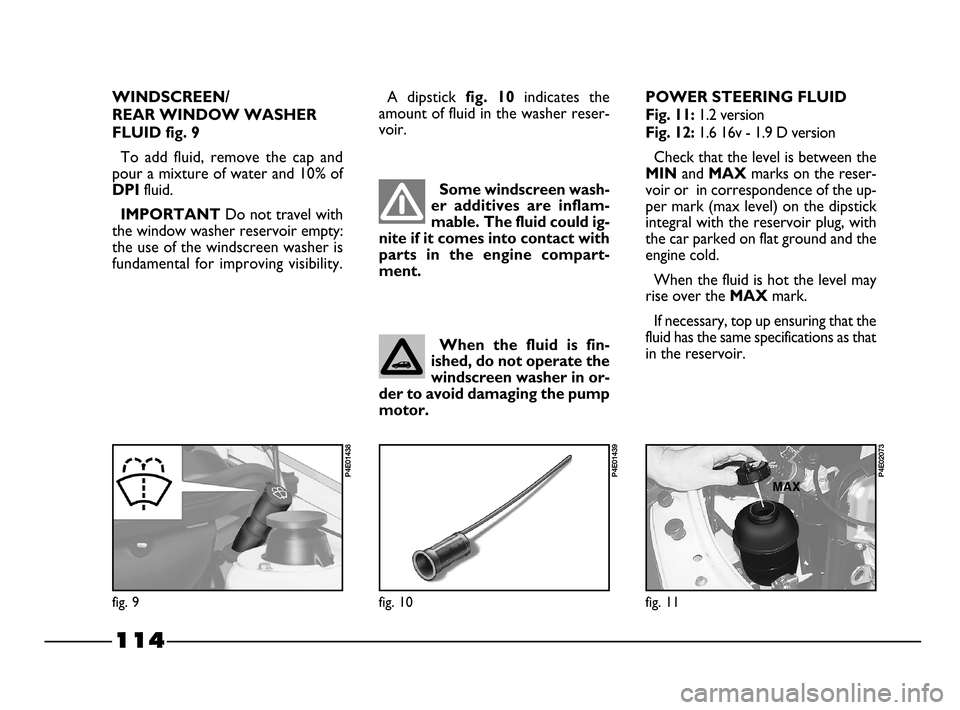
WINDSCREEN/
REAR WINDOW WASHER
FLUID fig. 9
To add fluid, remove the cap and
pour a mixture of water and 10% of
DPI fluid.
IMPORTANT Do not travel with
the window washer reservoir empty:
the use of the windscreen washer is
fundamental for improving visibility.
fig. 9
P4E01438
fig. 10
P4E01439
Some windscreen wash-
er additives are inflam-
mable. The fluid could ig-
nite if it comes into contact with
parts in the engine compart-
ment.
A dipstick fig. 10 indicates the
amount of fluid in the washer reser-
voir.
When the fluid is fin-
ished, do not operate the
windscreen washer in or-
der to avoid damaging the pump
motor.
fig. 11
P4E02073
POWER STEERING FLUID
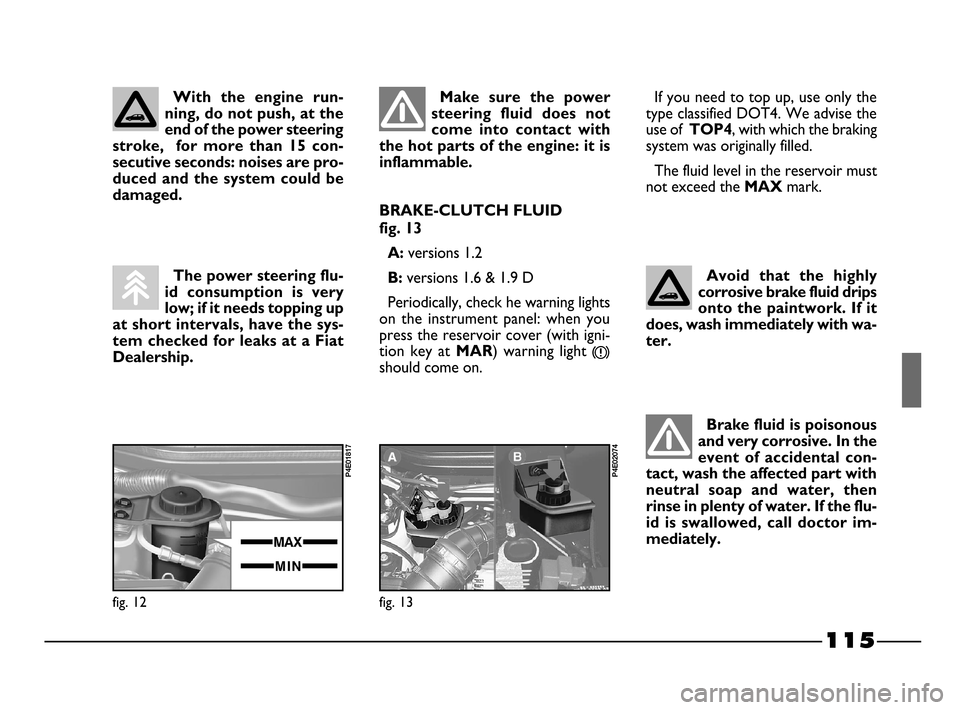
Fig. 11:
1.2 version
Fig. 12: 1.6 16v - 1.9 D version
Check that the level is between the
MINand MAXmarks on the reser-
voir or in correspondence of the up-
per mark (max level) on the dipstick
integral with the reservoir plug, with
the car parked on flat ground and the
engine cold.
When the fluid is hot the level may
rise over the
MAX mark.
If necessary, top up ensuring that the
fluid has the same specifications as that
in the reservoir.
104-127 03/03/2003 06:53 PM Page 114
Page 116 of 156
115
Avoid that the highly
corrosive brake fluid drips
onto the paintwork. If it
does, wash immediately with wa-
ter.
fig. 13
P4E02074
With the engine run-
ning, do not push, at the
end of the power steering
stroke, for more than 15 con-
secutive seconds: noises are pro-
duced and the system could be
damaged.
The power steering flu-
id consumption is very
low; if it needs topping up
at short intervals, have the sys-
tem checked for leaks at a Fiat
Dealership.Make sure the power
steering fluid does not
come into contact with
the hot parts of the engine: it is
inflammable.
BRAKE-CLUTCH FLUID
fig. 13
A:
versions 1.2
B: versions 1.6 & 1.9 D
Periodically, check he warning lights
on the instrument panel: when you
press the reservoir cover (with igni-
tion key at
MAR) warning light
x
should come on.
Brake fluid is poisonous
and very corrosive. In the
event of accidental con-
tact, wash the affected part with
neutral soap and water, then
rinse in plenty of water. If the flu-
id is swallowed, call doctor im-
mediately.
If you need to top up, use only the
type classified DOT4. We advise the
use of
TOP4, with which the braking
system was originally filled.
The fluid level in the reservoir must
not exceed the
MAX mark.
fig. 12
P4E01817
104-127 03/03/2003 06:53 PM Page 115
Page 117 of 156
116
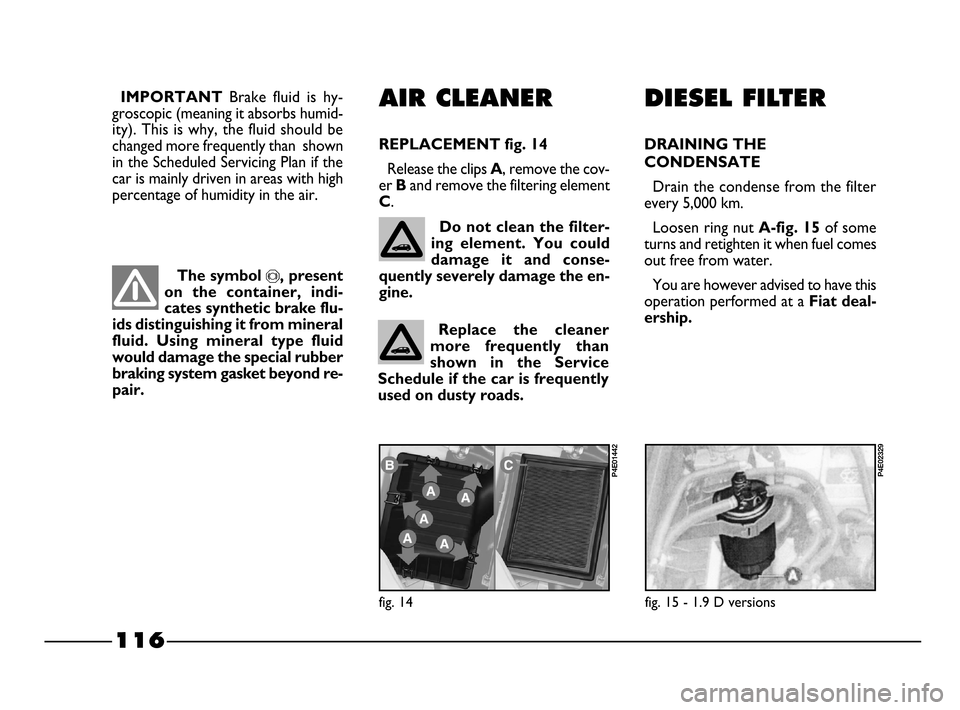
AIR CLEANER
REPLACEMENT fig. 14
Release the clips A, remove the cov-
er
Band remove the filtering element
C.
fig. 14
P4E01442
The symbol π, present
on the container, indi-
cates synthetic brake flu-
ids distinguishing it from mineral
fluid. Using mineral type fluid
would damage the special rubber
braking system gasket beyond re-
pair.
Do not clean the filter-
ing element. You could
damage it and conse-
quently severely damage the en-
gine.
Replace the cleaner
more frequently than
shown in the Service
Schedule if the car is frequently
used on dusty roads. IMPORTANT
Brake fluid is hy-
groscopic (meaning it absorbs humid-
ity). This is why, the fluid should be
changed more frequently than shown
in the Scheduled Servicing Plan if the
car is mainly driven in areas with high
percentage of humidity in the air.
fig. 15 - 1.9 D versions
P4E02329
DIESEL FILTER
DRAINING THE
CONDENSATE
Drain the condense from the filter
every 5,000 km.
Loosen ring nut
A-fig. 15of some
turns and retighten it when fuel comes
out free from water.
You are however advised to have this
operation performed at a
Fiat deal-
ership.
104-127 03/03/2003 06:53 PM Page 116
Page 118 of 156
117
BATTERY
The Fiat Palio battery is of the “lim-
ited maintenance” type: under normal
conditions it will not need to be
topped up with distilled water.
The level of the battery fluid(elec-
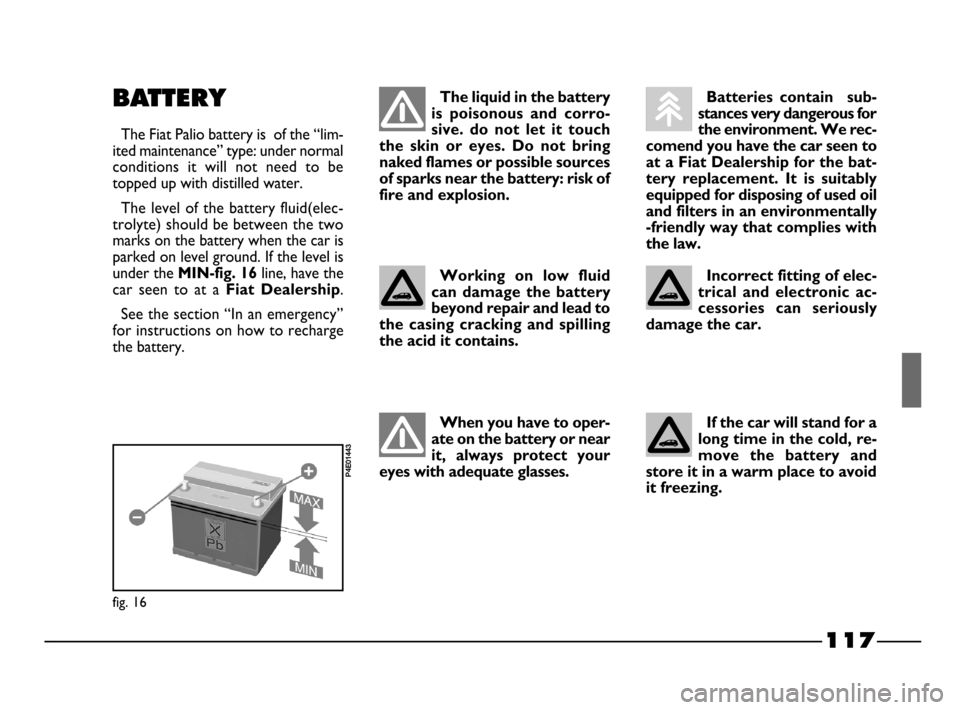
trolyte) should be between the two
marks on the battery when the car is
parked on level ground. If the level is
under the
MIN-fig. 16 line, have the
car seen to at a
Fiat Dealership.
See the section “In an emergency”
for instructions on how to recharge
the battery.
The liquid in the battery
is poisonous and corro-
sive. do not let it touch
the skin or eyes. Do not bring
naked flames or possible sources
of sparks near the battery: risk of
fire and explosion.
Working on low fluid
can damage the battery
beyond repair and lead to
the casing cracking and spilling
the acid it contains.
When you have to oper-
ate on the battery or near
it, always protect your
eyes with adequate glasses.
fig. 16
P4E01443
Batteries contain sub-
stances very dangerous for
the environment. We rec-
comend you have the car seen to
at a Fiat Dealership for the bat-
tery replacement. It is suitably
equipped for disposing of used oil
and filters in an environmentally
-friendly way that complies with
the law.
Incorrect fitting of elec-
trical and electronic ac-
cessories can seriously
damage the car.
If the car will stand for a
long time in the cold, re-
move the battery and
store it in a warm place to avoid
it freezing.
104-127 03/03/2003 06:53 PM Page 117
Page 120 of 156
Electrolyte
filling up
Insufficient
state of charge
Sufficient electrolyte lev-
el and state of chargeContact Fiat Dealership
Recharge (we suggest you
to contact
Fiat Dealership)
No action
119
If the indicator shows a light bright
coloration, or dark but without a
green central area, contact the
Fiat
Dealership
.
Checking the state of charge
Checking the state of charge of bat-
tery can be qualitatively carried out
through the optical indicator, with re-lation to coloration that the indicator
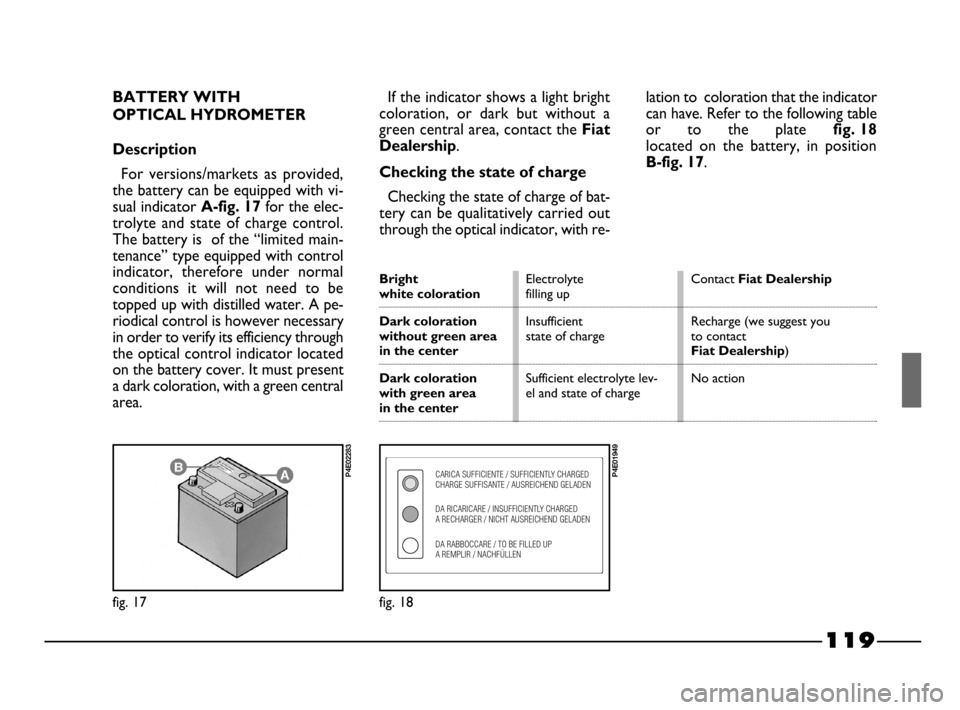
can have. Refer to the following table
or to the plate
fig. 18
located on the battery, in position
B-fig. 17.
fig. 18
P4E01949
BATTERY WITH
OPTICAL HYDROMETER
Description
For versions/markets as provided,
the battery can be equipped with vi-
sual indicator
A-fig. 17for the elec-
trolyte and state of charge control.
The battery is of the “limited main-
tenance” type equipped with control
indicator, therefore under normal
conditions it will not need to be
topped up with distilled water. A pe-
riodical control is however necessary
in order to verify its efficiency through
the optical control indicator located
on the battery cover. It must present
a dark coloration, with a green central
area.
Bright white coloration
Dark coloration
without green area
in the center
Dark coloration
with green area
in the center
fig. 17
P4E02283
104-127 03/03/2003 06:53 PM Page 119
Page 122 of 156
121
SPARK PLUGS
The cleanness and soundness of the
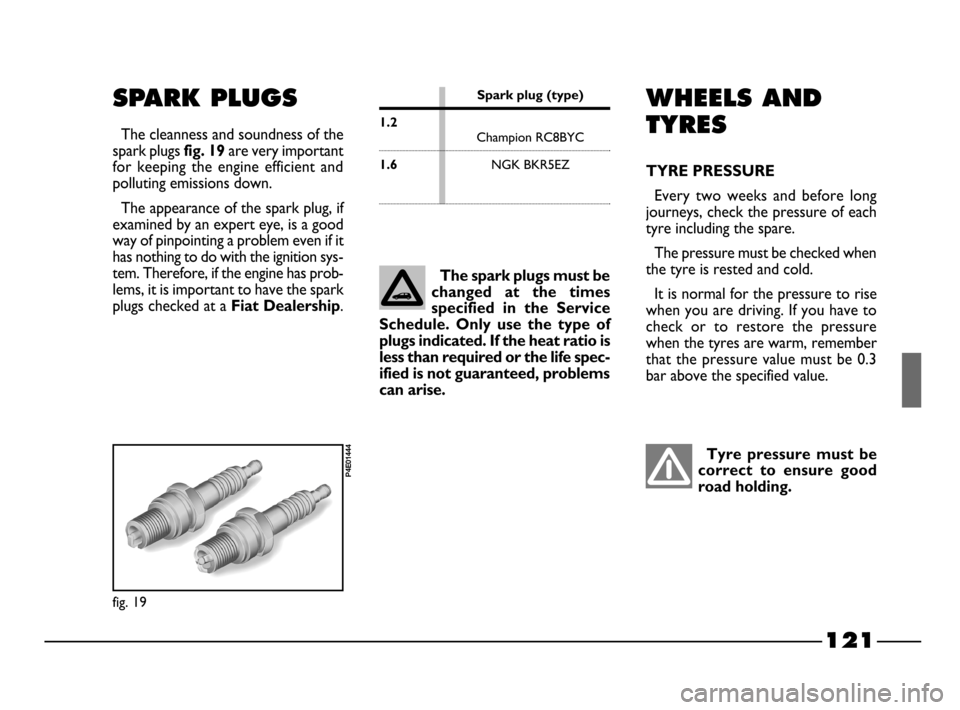
spark plugs
fig. 19 are very important
for keeping the engine efficient and
polluting emissions down.
The appearance of the spark plug, if
examined by an expert eye, is a good
way of pinpointing a problem even if it
has nothing to do with the ignition sys-
tem. Therefore, if the engine has prob-
lems, it is important to have the spark
plugs checked at a
Fiat Dealership.
The spark plugs must be
changed at the times
specified in the Service
Schedule. Only use the type of
plugs indicated. If the heat ratio is
less than required or the life spec-
ified is not guaranteed, problems
can arise.
Spark plug (type)
1.2
Champion RC7BMCChampion RC8BYC
1.6NGK BKR5EZ
Champion RC10YCC
Bosch FR8DE
fig. 19
P4E01444
WHEELS AND
TYRES
TYRE PRESSURE
Every two weeks and before long
journeys, check the pressure of each
tyre including the spare.
The pressure must be checked when
the tyre is rested and cold.
It is normal for the pressure to rise
when you are driving. If you have to
check or to restore the pressure
when the tyres are warm, remember
that the pressure value must be 0.3
bar above the specified value.
Tyre pressure must be
correct to ensure good
road holding.
104-127 03/03/2003 06:53 PM Page 121
Page 123 of 156
122
Do not change the tyres
over in criss-cross fashion
by moving a tyre from the
left hand side of the car to the
right and vice versa.
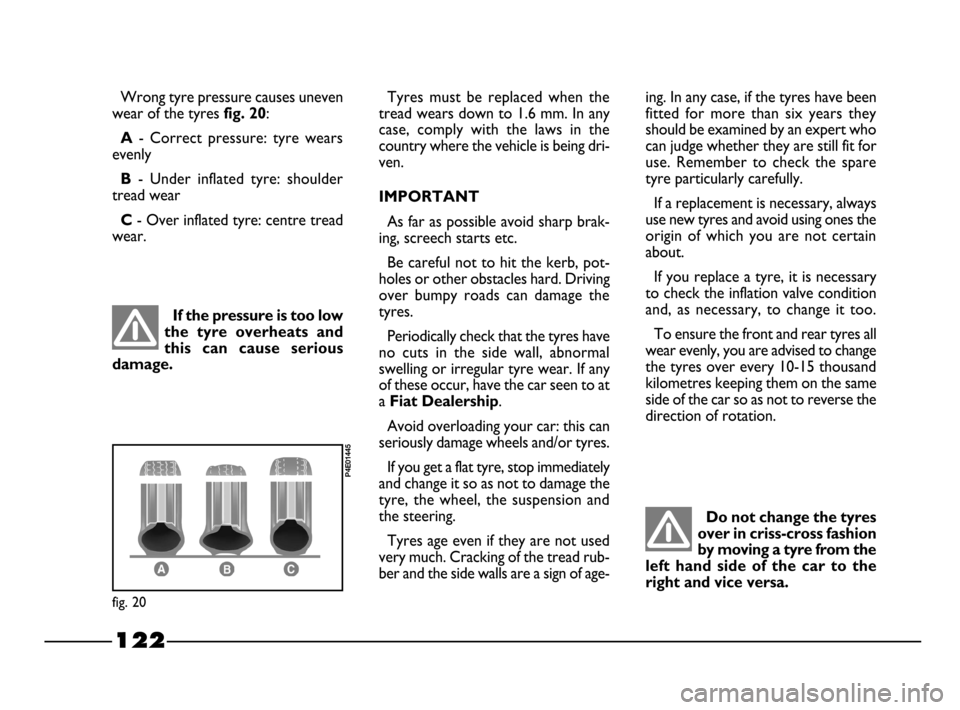
Wrong tyre pressure causes uneven
wear of the tyres
fig. 20:
A- Correct pressure: tyre wears
evenly
B- Under inflated tyre: shoulder
tread wear
C- Over inflated tyre: centre tread
wear. Tyres must be replaced when the
tread wears down to 1.6 mm. In any
case, comply with the laws in the
country where the vehicle is being dri-
ven.
IMPORTANT
As far as possible avoid sharp brak-
ing, screech starts etc.
Be careful not to hit the kerb, pot-
holes or other obstacles hard. Driving
over bumpy roads can damage the
tyres.
Periodically check that the tyres have
no cuts in the side wall, abnormal
swelling or irregular tyre wear. If any
of these occur, have the car seen to at
a
Fiat Dealership.
Avoid overloading your car: this can
seriously damage wheels and/or tyres.
If you get a flat tyre, stop immediately
and change it so as not to damage the
tyre, the wheel, the suspension and
the steering.
Tyres age even if they are not used
very much. Cracking of the tread rub-
ber and the side walls are a sign of age-
If the pressure is too low
the tyre overheats and
this can cause serious
damage.
fig. 20
P4E01445
ing. In any case, if the tyres have been
fitted for more than six years they
should be examined by an expert who
can judge whether they are still fit for
use. Remember to check the spare
tyre particularly carefully.
If a replacement is necessary, always
use new tyres and avoid using ones the
origin of which you are not certain
about.
If you replace a tyre, it is necessary
to check the inflation valve condition
and, as necessary, to change it too.
To ensure the front and rear tyres all
wear evenly, you are advised to change
the tyres over every 10-15 thousand
kilometres keeping them on the same
side of the car so as not to reverse the
direction of rotation.
104-127 03/03/2003 06:53 PM Page 122
Page 124 of 156
123
RUBBER TUBING
Follow the Service Schedule to the
letter as concerns supply line, power
steering and brake system rubber tub-
ing. Ozone, high temperatures and
long absence of fluid in the system can
in fact cause the hardening and crack-
ing of the pipes with possible loss of
fluid. A careful check is therefore es-
sential.
WINDSCREEN/
REAR WINDOW
WIPER
BLADES
Periodically clean the rubber part
with suitable products.
Change the blades if the rubber edge
is warped or worn out. You should in
any case change them approximately
once a year.– Remove any snow that has settled
on the glass: besides saving the blades
you will avoid straining the electric
windscreen wiper motor and causing
it to overheat.
– Do not operate the wind-
screen/rear window wipers on dry
glass.
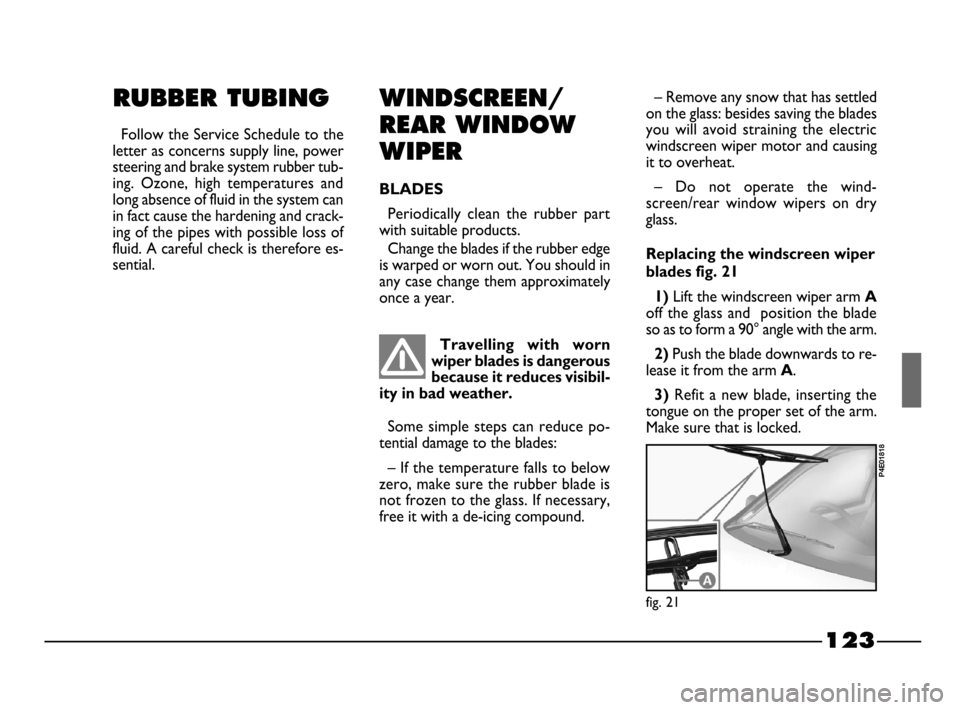
Replacing the windscreen wiper
blades fig. 21
1)
Lift the windscreen wiper arm A
off the glass and position the blade
so as to form a 90° angle with the arm.
2) Push the blade downwards to re-
lease it from the arm
A.
3) Refit a new blade, inserting the
tongue on the proper set of the arm.
Make sure that is locked.
Travelling with worn
wiper blades is dangerous
because it reduces visibil-
ity in bad weather.
Some simple steps can reduce po-
tential damage to the blades:
– If the temperature falls to below
zero, make sure the rubber blade is
not frozen to the glass. If necessary,
free it with a de-icing compound.
fig. 21
P4E01818
104-127 03/03/2003 06:53 PM Page 123
Page 125 of 156
124
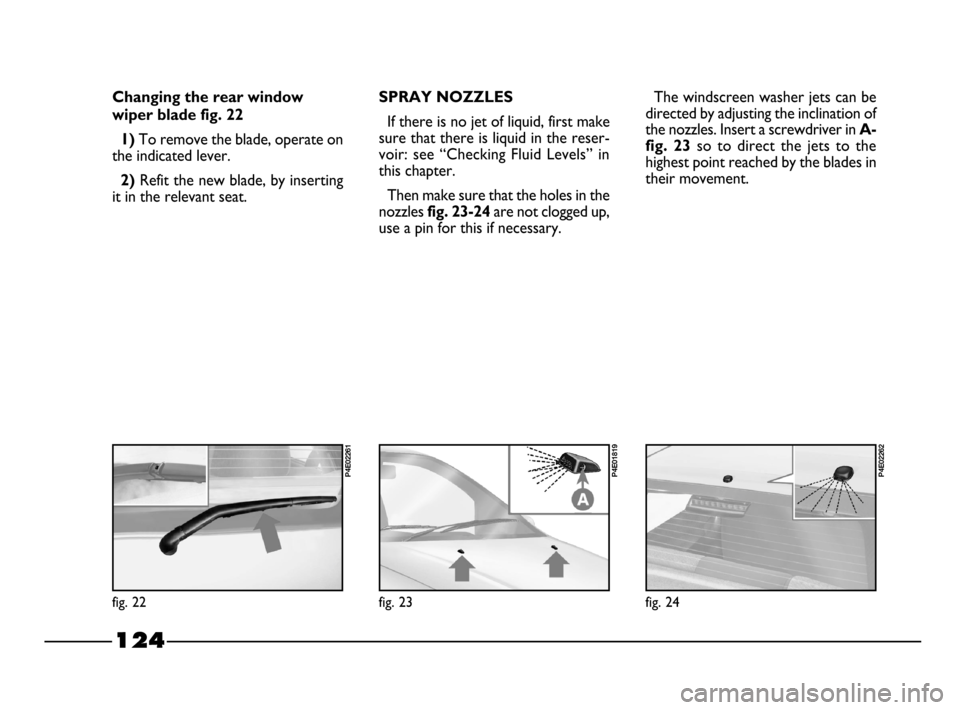
SPRAY NOZZLES
If there is no jet of liquid, first make
sure that there is liquid in the reser-
voir: see “Checking Fluid Levels” in
this chapter.
Then make sure that the holes in the
nozzles
fig. 23-24 are not clogged up,
use a pin for this if necessary.The windscreen washer jets can be
directed by adjusting the inclination of
the nozzles. Insert a screwdriver in
A-
fig. 23
so to direct the jets to the
highest point reached by the blades in
their movement.
fig. 23
P4E01819
fig. 24
P4E02262
Changing the rear window
wiper blade fig. 22
1)
To remove the blade, operate on
the indicated lever.
2) Refit the new blade, by inserting
it in the relevant seat.
fig. 22
P4E02261
104-127 03/03/2003 06:53 PM Page 124