light FIAT PALIO 2003 178 / 1.G India Version Workshop Manual
[x] Cancel search | Manufacturer: FIAT, Model Year: 2003, Model line: PALIO, Model: FIAT PALIO 2003 178 / 1.GPages: 156, PDF Size: 6.27 MB
Page 93 of 156
92
IF AN INTERIOR
LIGHT BURNS
OUT
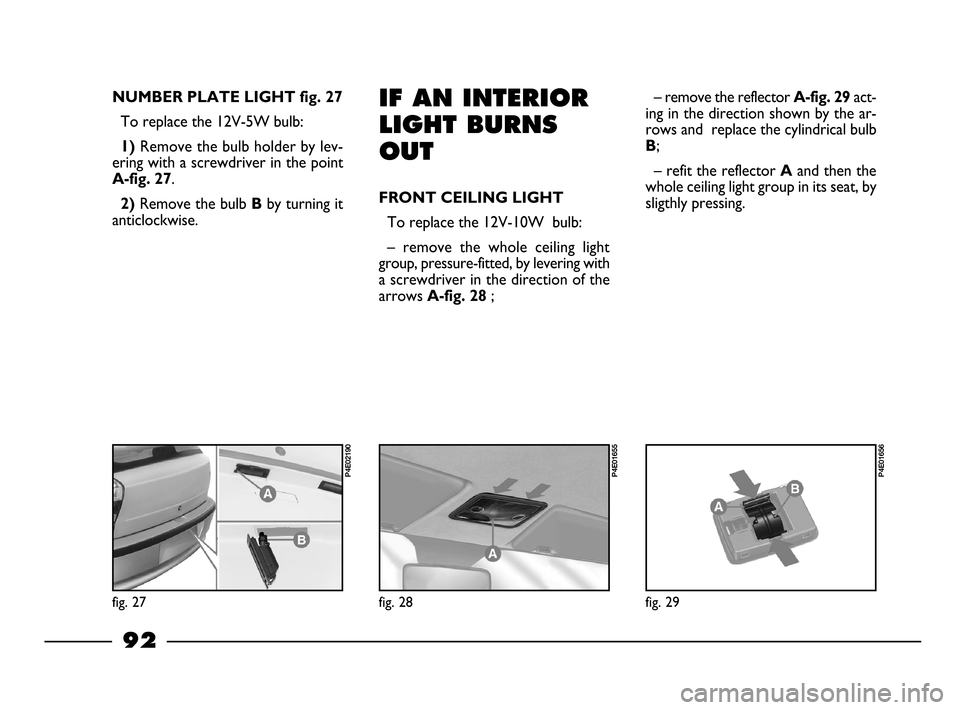
FRONT CEILING LIGHT
To replace the 12V-10W bulb:
– remove the whole ceiling light
group, pressure-fitted, by levering with
a screwdriver in the direction of the
arrows
A-fig. 28 ;– remove the reflector
A-fig. 29act-
ing in the direction shown by the ar-
rows and replace the cylindrical bulb
B;
– refit the reflector
Aand then the
whole ceiling light group in its seat, by
sligthly pressing.
fig. 29
P4E01656
NUMBER PLATE LIGHT fig. 27
To replace the 12V-5W bulb:
1) Remove the bulb holder by lev-
ering with a screwdriver in the point
A-fig. 27.
2)Remove the bulb Bby turning it
anticlockwise.
fig. 28
P4E01655
fig. 27
P4E02190
80-103 03/03/2003 06:49 PM Page 92
Page 94 of 156
93
BOOT LIGHT
To replace the 12V-5W cylindrical
bulb, remove the transparent element
A-fig. 29by levering with a screw dri-
ver in point indicated by the arrow.
Remove the plastic guard
Band re-
place the bulb.
fig. 31
P4E01428
IF A FUSE BLOWS
REPLACING THE FUSES
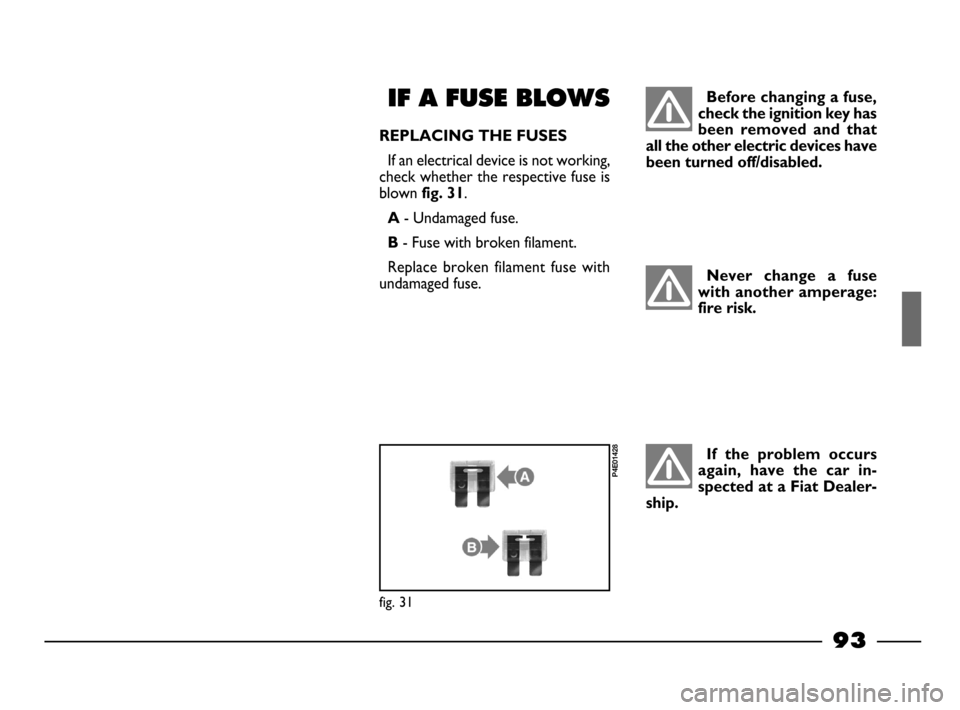
If an electrical device is not working,
check whether the respective fuse is
blown
fig. 31.
A- Undamaged fuse.
B- Fuse with broken filament.
Replace broken filament fuse with
undamaged fuse.
Before changing a fuse,
check the ignition key has
been removed and that
all the other electric devices have
been turned off/disabled.
Never change a fuse
with another amperage:
fire risk.
If the problem occurs
again, have the car in-
spected at a Fiat Dealer-
ship.
80-103 03/03/2003 06:49 PM Page 93
Page 97 of 156
96
Componentfuse N. Ampere Location
7
8
8
7
17
18
4
5
14
8
7
15
9
15
12
20
1
13
2
6
11
3
10
19
19
8
16
15
22
610A
10A
10A
10A
10A
10A
10A
10A
10A
10A
10A
15A
15A
15A
10A
10A
20A
20A
25A
10A
30A
25A
20A
30A
30A
10A
10A
15A
10A
60AFig. 33
Fig. 33
Fig. 33
Fig. 33
Fig. 33
Fig. 33
Fig. 33
Fig. 33
Fig. 33
Fig. 33
Fig. 33
Fig. 33
Fig. 33
Fig. 33
Fig. 33
Fig. 33
Fig. 33
Fig. 33
Fig. 33
Fig. 33
Fig. 33
Fig. 33
Fig. 33
Fig. 33
Fig. 33
Fig. 33
Fig. 33
Fig. 33
Fig. 33
Fig. 34 (a)Left front side light
Right front side light
Left tail light
Right tail light
Left dipped beam headlight
Right dipped beam headlight
Left main beam headlight
Right main beam headlight
Brake lights
Left number plate light
Right number plate light
Reversing lights
Foglights
Direction indicator lights
Hazard lights
Ceiling light
Windscreen/rear window wiper
Horn
Electric front window winder
Rear foglight
Heated rear window
Electric rear window winder
Central door locking system
Internal fan
Cigar lighter (power supply)
Cigar lighter (illumination)
Climate control system
Airbag
ABS
ABS (1.2 version)
80-103 03/03/2003 06:49 PM Page 96
Page 103 of 156
102
IF ANYONE IS INJURED
– Never leave the injured person
alone. The obligation to provide as-
sistance exists even for those not di-
rectly involved in the accident.
– Do not congregate around the in-
jured person.
– Reassure the injured person that
help is on its way and will arrive soon.
Stay close by to calm him/her down in
case of panic.
– Unfasten or cut seat belts holding
injured parties.
– Do not give an injured person any-
thing to drink.
– Do not move an injured person un-
less the following situation arise.
– Pull out the injured person from
the car only if there is a risk of it catch-
ing fire, sinking in water or is likely to
fall over a cliff or etc. Do not pull
his/her arms or legs, do not bend the
head and, as far as possible, keep the
body horizontal.
IF AN ACCIDENT
OCCURS
– It is important to keep calm.
– If you are not directly involved in
the accident, stop at least ten metres
away from the accident.
– If you are on a motorway, stop
without obstructing the emergency
lane with your car.
– Turn off the engine and turn on the
hazard lights.
– At night, illuminate the scene of the
accident with your headlights.
– Act carefully, you must not risk be-
ing run over.
– If the doors are blocked, do not at-
tempt to smash the windscreen to get
out of the car. It is made of layered
glass and is very hard. Side and rear
windows are much more easily bro-
ken.
– Mark the accident by putting the
red triangle at the regulatory distance
from the car where it can be clearly
seen. – Call for rescue making the infor-
mation you give as accurate as you
can. On the motorway use the special
column-mounted emergency phones.
– In pile-ups on the motorway, par-
ticularly when the visibility is bad,
there is a high risk of other vehicles
running into those already stopped.
Get out of the car immediately and
take refuge behind the guard-rail.
– Remove the ignition keys from the
vehicles involved.
– If you can smell petrol or other
chemicals, do not smoke and make
sure all cigarettes are extinguished.
– Use a fire extinguisher, blanket
sand or earth to put out fires, how-
ever small they may be. Never use wa-
ter
80-103 03/03/2003 06:49 PM Page 102
Page 116 of 156
115
Avoid that the highly
corrosive brake fluid drips
onto the paintwork. If it
does, wash immediately with wa-
ter.
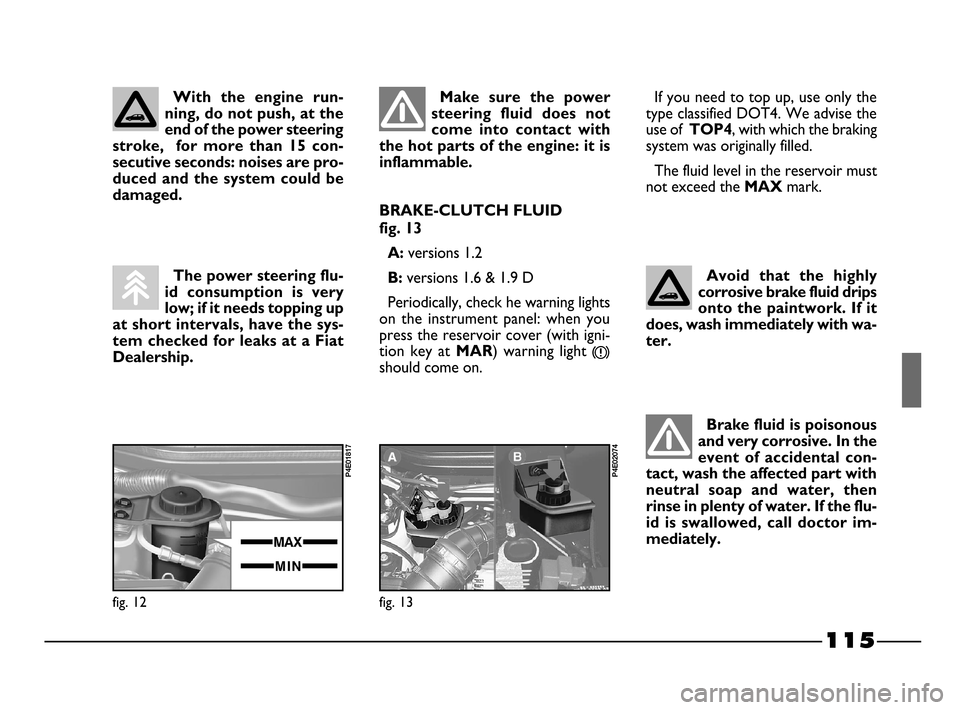
fig. 13
P4E02074
With the engine run-
ning, do not push, at the
end of the power steering
stroke, for more than 15 con-
secutive seconds: noises are pro-
duced and the system could be
damaged.
The power steering flu-
id consumption is very
low; if it needs topping up
at short intervals, have the sys-
tem checked for leaks at a Fiat
Dealership.Make sure the power
steering fluid does not
come into contact with
the hot parts of the engine: it is
inflammable.
BRAKE-CLUTCH FLUID
fig. 13
A:
versions 1.2
B: versions 1.6 & 1.9 D
Periodically, check he warning lights
on the instrument panel: when you
press the reservoir cover (with igni-
tion key at
MAR) warning light
x
should come on.
Brake fluid is poisonous
and very corrosive. In the
event of accidental con-
tact, wash the affected part with
neutral soap and water, then
rinse in plenty of water. If the flu-
id is swallowed, call doctor im-
mediately.
If you need to top up, use only the
type classified DOT4. We advise the
use of
TOP4, with which the braking
system was originally filled.
The fluid level in the reservoir must
not exceed the
MAX mark.
fig. 12
P4E01817
104-127 03/03/2003 06:53 PM Page 115
Page 119 of 156
118
The total intake of these systems
(factory and after-market) must be less
than 0,6 mA x Ah (of the battery), as
shown in the following table:
Battery Maximum permissiblestand-by intake
50Ah 30 mA
Furthermore, remember that high in-
take electric devices (such as baby bot-
tle warmer, vacuum cleaners, cellular
phones, mini-fridges, etc.) powered
when the engine is off can deploy the
battery.
IMPORTANTIf you need to fit ad-
ditional systems in the car, remember
that improper wiring connections, in
particular if they affect safety devices,
are dangerous.
USEFUL ADVICE
FOR LENGTHENING
THE LIFE
OF YOUR BATTERY
When you park the car, ensure the
doors, boot and bonnet are closed
properly. The courtesy light must be
off.
Do not keep accessories (e.g. sound
system, hazard lights, etc.) switched on
for a long time when the engine is not
running.
IMPORTANTA battery which is
kept at a charge of less than 50% for
any length of time will be damaged by
sulphation leading to a reduction in
cranking power and a higher risk of
the battery electrolyte freezing (this
may even occur at - 10°C).
If the car is inactive for a long peri-
od of time, refer to “Long inactivity of
the car”, in the “Correct use of the
car” chapter.If you want to add electrical acces-
sories after buying the car which need
permanent electric supply(alarm,
free hand phone kit, radio navigator
with satellite antitheft system etc.) vis-
it a
Fiat Dealership. They can sug-
gest the most suitable accessories to
get and check whether the electric
system can support the required load
or whether a larger capacity battery
is required.
These devices will, in fact, run off the
battery even when the key is not in-
serted (car parked, engine stopped)
and can destroy the battery.
104-127 03/03/2003 06:53 PM Page 118
Page 120 of 156
Electrolyte
filling up
Insufficient
state of charge
Sufficient electrolyte lev-
el and state of chargeContact Fiat Dealership
Recharge (we suggest you
to contact
Fiat Dealership)
No action
119
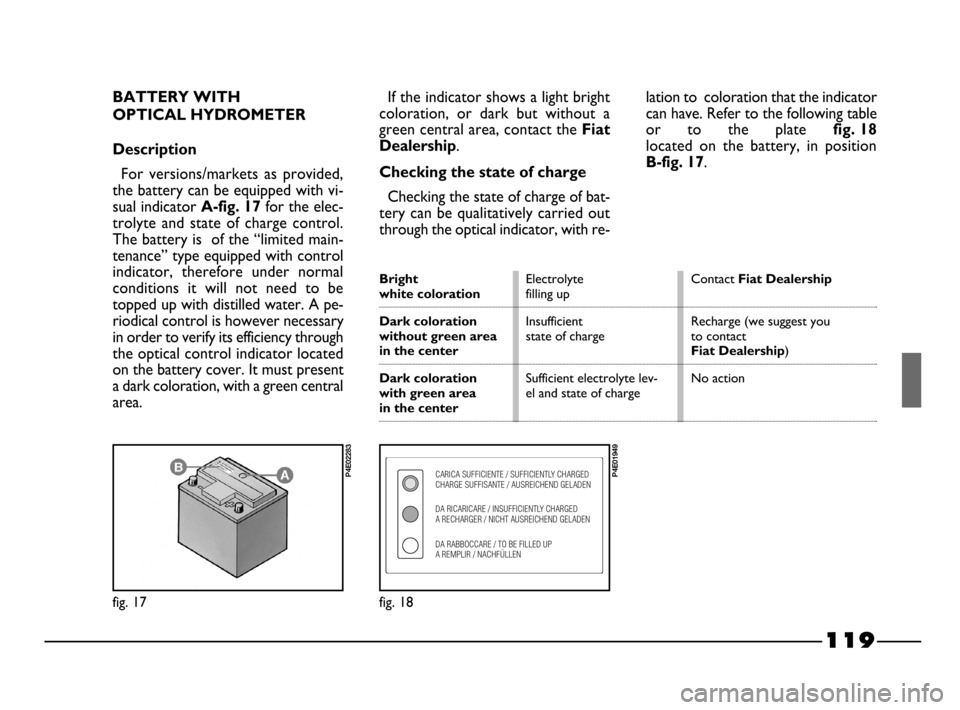
If the indicator shows a light bright
coloration, or dark but without a
green central area, contact the
Fiat
Dealership
.
Checking the state of charge
Checking the state of charge of bat-
tery can be qualitatively carried out
through the optical indicator, with re-lation to coloration that the indicator
can have. Refer to the following table
or to the plate
fig. 18
located on the battery, in position
B-fig. 17.
fig. 18
P4E01949
BATTERY WITH
OPTICAL HYDROMETER
Description
For versions/markets as provided,
the battery can be equipped with vi-
sual indicator
A-fig. 17for the elec-
trolyte and state of charge control.
The battery is of the “limited main-
tenance” type equipped with control
indicator, therefore under normal
conditions it will not need to be
topped up with distilled water. A pe-
riodical control is however necessary
in order to verify its efficiency through
the optical control indicator located
on the battery cover. It must present
a dark coloration, with a green central
area.
Bright white coloration
Dark coloration
without green area
in the center
Dark coloration
with green area
in the center
fig. 17
P4E02283
104-127 03/03/2003 06:53 PM Page 119
Page 121 of 156
IMPORTANT If the sound system
or car alarm systems are not installed
correctly, they can interfere with the
working of the electronic control
units.
Modifications or repairs
to the electrical system
carried out incorrectly
and without bearing the features
of the system in mind can cause
malfunctions with the risk of fire.
120
ELECTRONIC
CONTROL UNITS
When the car is being used normal-
ly, special measures are not necessary.
The following instructions must be
followed very carefully however, if you
work on the electrical system or
where emergency starting is neces-
sary:
– Never disconnect the battery from
the electrical system while the engine
is running.
– Disconnect the battery from the
electrical system if you are recharg-
ing it. Modern battery chargers can
discharge voltage up to 20 V.
– Never perform emergency star-
tups with a battery charger. Always
use an auxiliary battery (see “Startup
with auxiliary battery” in “In an emer-
gency” chapter).– Be particularly careful when con-
necting the battery to the electrical
system. Make sure that the polarity is
correct and the connection is efficient.
After reconnecting the battery, the in-
jection/ignition control unit will need
to readapt its internal parameters.
Therefore, the car’s performance may
change slightly during the first few kilo-
meters.
– Do not connect or disconnect the
terminals of the electronic units while
the ignition key is at
MAR.
– Do not check polarity through
sparking.
– Disconnect the electronic units if
you are electrically welding the car
body. Remove the units if tempera-
tures exceed 80°C (special operations
on the bodywork etc.).
104-127 03/03/2003 06:53 PM Page 120
Page 127 of 156
126
Detergents pollute wa-
ter. For this reason, the
car must be washed in an
area equipped for the collection
and purification of the liquids
used while washing.
To wash the car properly:
1)Wash the body using a low pres-
sure jet of water.
2)Wipe a sponge with a slightly
soapy solution over the bodywork,
frequently rinsing the sponge.
3) Rinse well with water and dry
with a jet of air or a chamois leather.
When drying the car, be careful to
get at those parts which are not so
easily seen e.g. the door frames, bon-
net and around the headlights where
water can most readily collect. You
should leave the car out in the open
so that any water remaining can evap-
orate more easily.
Do not wash the car after it has been
parked in the sun or while the bon-
net is hot: it could take the shine off
the paint.Outside plastic parts must be cleaned
following the usual car washing pro-
cedure.
Avoid parking the car under trees;
the resinous substances that certain
species of tree shed dull the paintwork
and increase the possibility of rust
forming.
IMPORTANTBird droppings must
be washed off immediately and with
great care as their acid is particularly
aggressive.
Windows
Use specific window cleaners to
clean the windows. Use very clean
cloths to avoid scratching the glass or
damaging its transparency.
TIPS FOR KEEPING THE
BODY IN GOOD CONDITION
Paintwork
The paintwork is not only to make
your car look attractive but also to
protect the steel.
If the paint is scuffed or scratched
deeply you are advised to touch up as
necessary to prevent rust from form-
ing.
Only use genuine products when
touching up the paintwork (see the
“Technical Specifications”).
Ordinary maintenance of the paint-
work means washing it. The frequen-
cy you should do this depends on the
conditions and the environment the
car is driven in. For example:
– in areas with a high level of air pol-
lution;
– on roads sprinkled with road salt-
wash;
– parking under trees which drop
resin. In these cases, you should wash
your car more frequently.
104-127 03/03/2003 06:53 PM Page 126
Page 137 of 156
136
Max speed index
Q
= up to 160 km/h.
R= up to 170 km/h.
S= up to 180 km/h.
T= up to 190 km/h.
U= up to 200 km/h.
H= up to 210 km/h.
V= up to 240 km/h.
W= up to 270 km/h.
Y= up to 300 km/h.
Load index (capacity)
60
= 250 kg
61 = 257 kg
62= 265 kg
63= 272 kg
64= 280 kg
65= 290 kg
66= 300 kg
67= 307 kg
68= 315 kg
69= 325 kg
70 = 335 kg
71= 345 kg
72= 355 kg
73= 365 kg
74= 375 kg
75= 387 kg
76= 400 kg
77= 412 kg
78= 425 kg
79= 437 kg
80= 450 kg
81= 462 kg
82= 475 kg
83= 487 kg
84= 500 kg
85= 515 kg
86= 530 kg
87= 545 kg
88= 560 kg
89= 580 kg
90= 600 kg
91= 615 kg
92= 630 kg
93= 650 kg
94= 670 kg
95= 690 kg
96 = 710 kg
97= 730 kg
98= 750 kg
99= 775 kg
100= 800 kg
101= 825 kg
102= 850 kg
103= 875 kg
104= 900 kg
1CORRECT READING
OF THE RIM fig. 6
The indications, necessary to know
the meaning of the identification ini-
tials printed on the rim, are listed be-
low.
CORRECT READING
OF THE TYRE fig. 6
The indications, necessary to know
the meaning of the identification ini-
tials printed on the tyre, are listed be-
low.
175= Nominal (S, distance in mm
between the sides).
65= height/width ratio (H/S) in per-
centage.
R= Radial tyre.
14= Diameter of the rim in inches
(Ø).
82= Load index (capacity).
T= Max speed index. Example
175/65 R 14 82 S
IMPORTANTThe light alloy
wheels are fixed with specific bolt in-
compatible with any printed steel
wheels, excluding the specific spare
wheel.
SNOW TYRES
Use reduced dimension winter tyres,
see “Snow Chains” chapter.
WHEEL GEOMETRY
Convergence of the front wheel mea-
sured between the rims: –1±1(Power
Steering), +1mm (Mechnical Steering).
The values refer to a car after running in.
WHEELS AND
TYRES
Pressed steel or alloy (as provided)
wheel rims; specific fixing bolts (di-
mensionally different and respective-
ly incompatible) for each of the two
types of rim.
IMPORTANTIn the event of dis-
crepancies between the information in
the Owner Handbook and the Log
Book, consider the specifications giv-
en in the Log Book only.
To ensure safety of the vehicle in
movement, it must be fitted with tyres
of specified size and of the same make
and type on all wheels.
Versions Rim Tyre
1.2 EL-ELX-SPORT5.00Bx13 165/80 R13
1.6 16V GTX51/2 Jx14C(*) 175/65 R14
1.9 D EL-ELX5.00Bx13 165/80 R13
(*) Alloy rims
128-143 03/03/2003 07:39 PM Page 136