light FIAT PALIO 2003 178 / 1.G India Version Owner's Manual
[x] Cancel search | Manufacturer: FIAT, Model Year: 2003, Model line: PALIO, Model: FIAT PALIO 2003 178 / 1.GPages: 156, PDF Size: 6.27 MB
Page 45 of 156
44
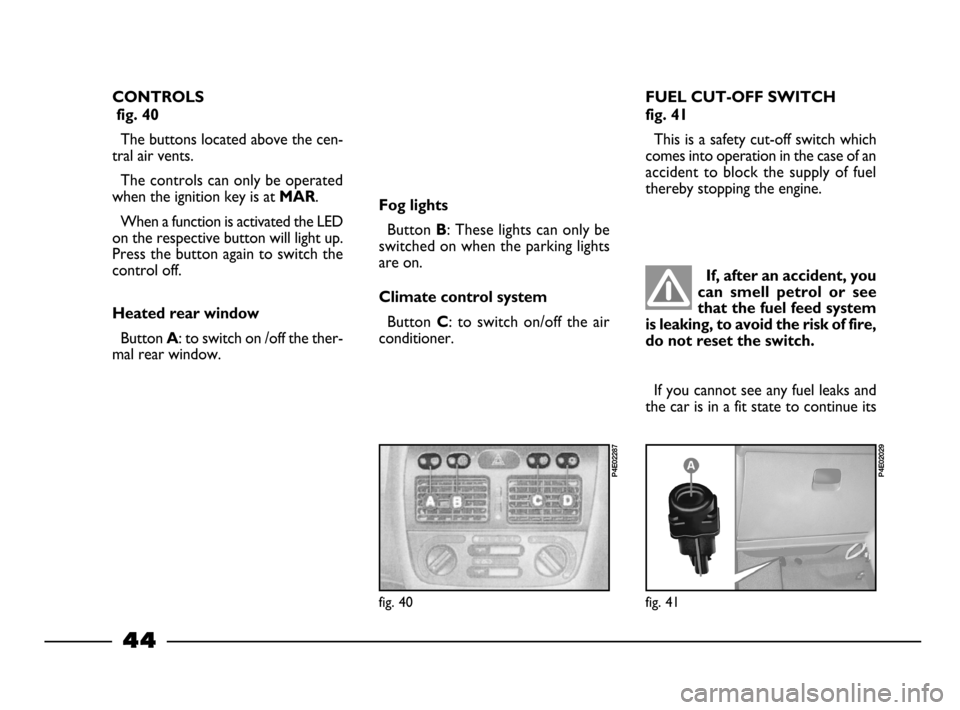
fig. 41
P4E02029
fig. 40
P4E02287
CONTROLS
fig. 40
The buttons located above the cen-
tral air vents.
The controls can only be operated
when the ignition key is at
MAR.
When a function is activated the LED
on the respective button will light up.
Press the button again to switch the
control off.
Heated rear window
Button A: to switch on /off the ther-
mal rear window.
Rear fog light
Button B: These lights can only be
switched on when the dipped beam
headlights or the front foglights are
switched on.
Fog lights
ButtonB: These lights can only be
switched on when the parking lights
are on.
Climate control system
Button C: to switch on/off the air
conditioner.
FUEL CUT-OFF SWITCH
fig. 41
This is a safety cut-off switch which
comes into operation in the case of an
accident to block the supply of fuel
thereby stopping the engine.
If, after an accident, you
can smell petrol or see
that the fuel feed system
is leaking, to avoid the risk of fire,
do not reset the switch.
If you cannot see any fuel leaks and
the car is in a fit state to continue its
20-63 03/03/2003 06:03 PM Page 44
Page 47 of 156
Warning. The cigar lighter
gets very hot. Be careful how
you handle it and make sure
it is not used by children: Danger of
fire or burns.
46
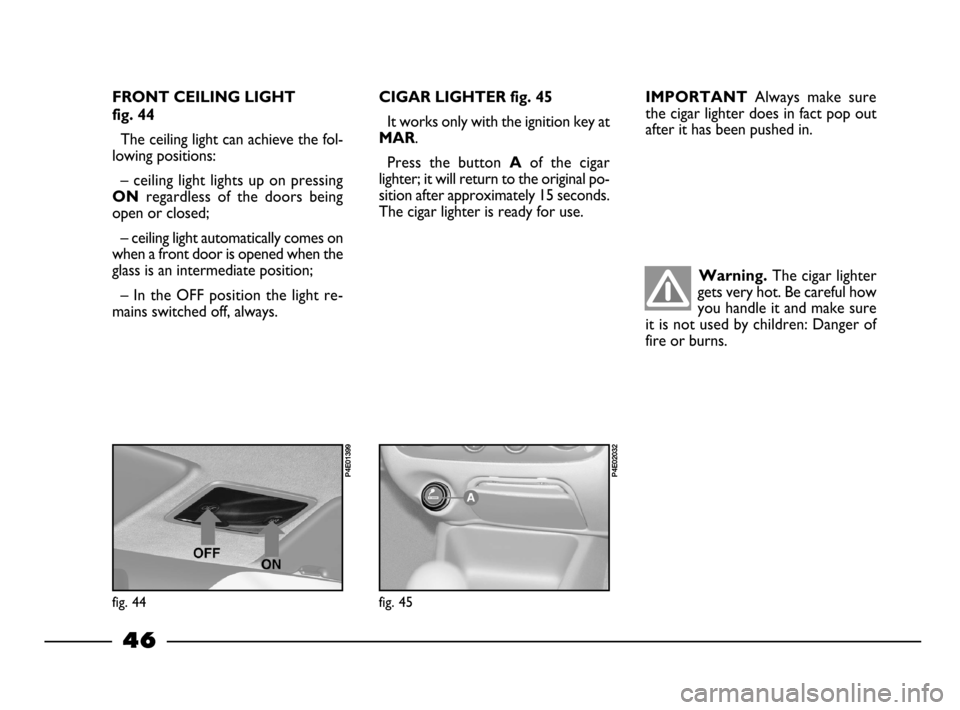
CIGAR LIGHTER fig. 45
It works only with the ignition key at
MAR.
Press the button
Aof the cigar
lighter; it will return to the original po-
sition after approximately 15 seconds.
The cigar lighter is ready for use.
fig. 45
P4E02032
fig. 44
P4E01399
FRONT CEILING LIGHT
fig. 44
The ceiling light can achieve the fol-
lowing positions:
– ceiling light lights up on pressing
ONregardless of the doors being
open or closed;
– ceiling light automatically comes on
when a front door is opened when the
glass is an intermediate position;
– In the OFF position the light re-
mains switched off, always.
IMPORTANT Always make sure
the cigar lighter does in fact pop out
after it has been pushed in.
20-63 03/03/2003 06:03 PM Page 46
Page 51 of 156
50
Do not keep the switch
pressed when the window
is completely wound up
or down.
Improper use of the
electrical windows can be
dangerous.
Before and during their opera-
tion ensure that no passengers
are at risk from the moving glass
either by personal objects getting
caught in the mechanism or by
being injured by it directly.
Always remove the ignition key
when you get out of the car to
prevent the electric windows be-
ing operated accidentally and
constituting a danger to the peo-
ple left in the car.
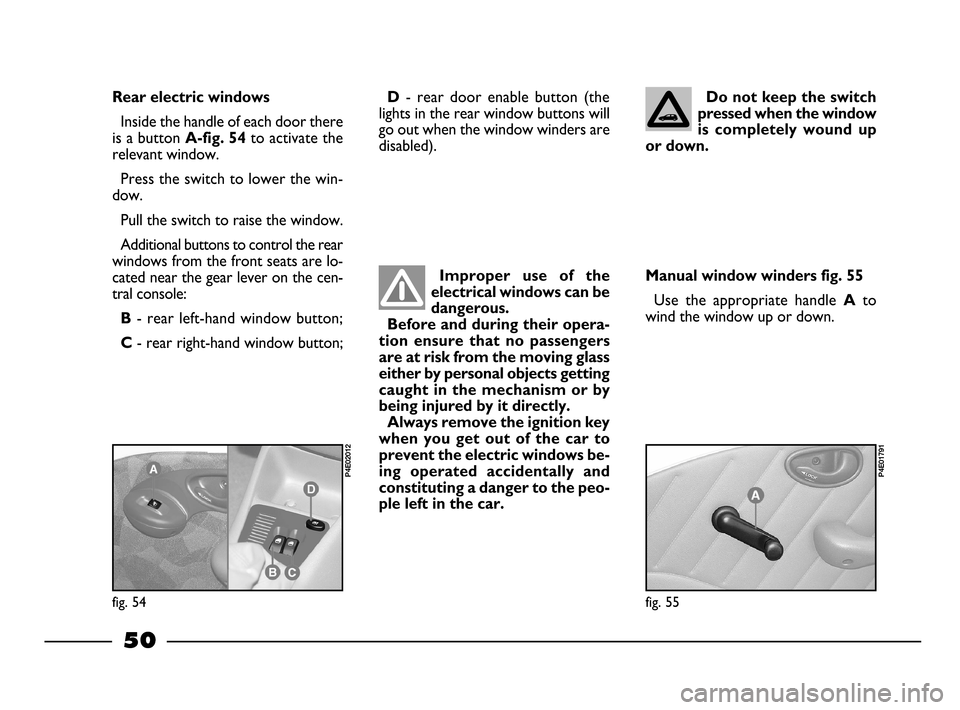
fig. 54
P4E02012
Rear electric windows
Inside the handle of each door there
is a button
A-fig. 54to activate the
relevant window.
Press the switch to lower the win-
dow.
Pull the switch to raise the window.
Additional buttons to control the rear
windows from the front seats are lo-
cated near the gear lever on the cen-
tral console:
B - rear left-hand window button;
C - rear right-hand window button;
D - rear door enable button (the
lights in the rear window buttons will
go out when the window winders are
disabled).
Manual window winders fig. 55
Use the appropriate handleA to
wind the window up or down.
fig. 55
P4E01791
20-63 03/03/2003 06:03 PM Page 50
Page 54 of 156
53
If you want to carry a
can of petrol as a reserve,
adhere to the laws in
force. Not following precautions
increases the risk of fire in the
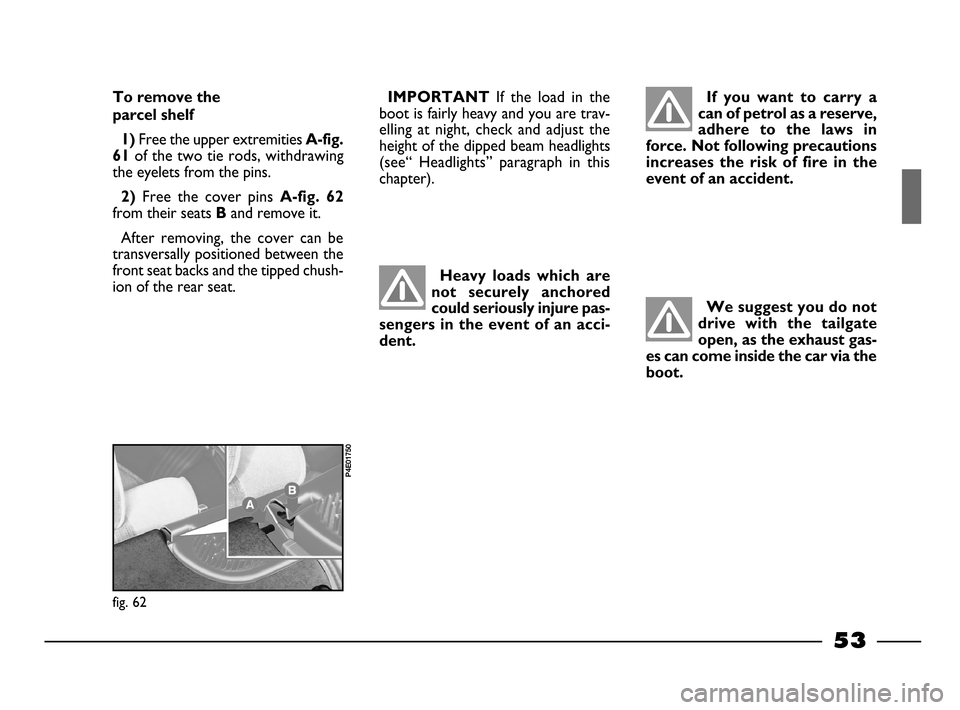
event of an accident. To remove the
parcel shelf
1)
Free the upper extremities A-fig.
61
of the two tie rods, withdrawing
the eyelets from the pins.
2)Free the cover pins A-fig. 62
from their seats Band remove it.
After removing, the cover can be
transversally positioned between the
front seat backs and the tipped chush-
ion of the rear seat.
IMPORTANT If the load in the
boot is fairly heavy and you are trav-
elling at night, check and adjust the
height of the dipped beam headlights
(see“ Headlights” paragraph in this
chapter).
Heavy loads which are
not securely anchored
could seriously injure pas-
sengers in the event of an acci-
dent.
We suggest you do not
drive with the tailgate
open, as the exhaust gas-
es can come inside the car via the
boot.
fig. 62
P4E01750
20-63 03/03/2003 06:03 PM Page 53
Page 57 of 156
56
SLANT COMPENSATION
When the car is loaded, it slopes
backwards. This means that the head-
light beam rises. In this case, it is nec-
essary to return it to the correct po-
sition.
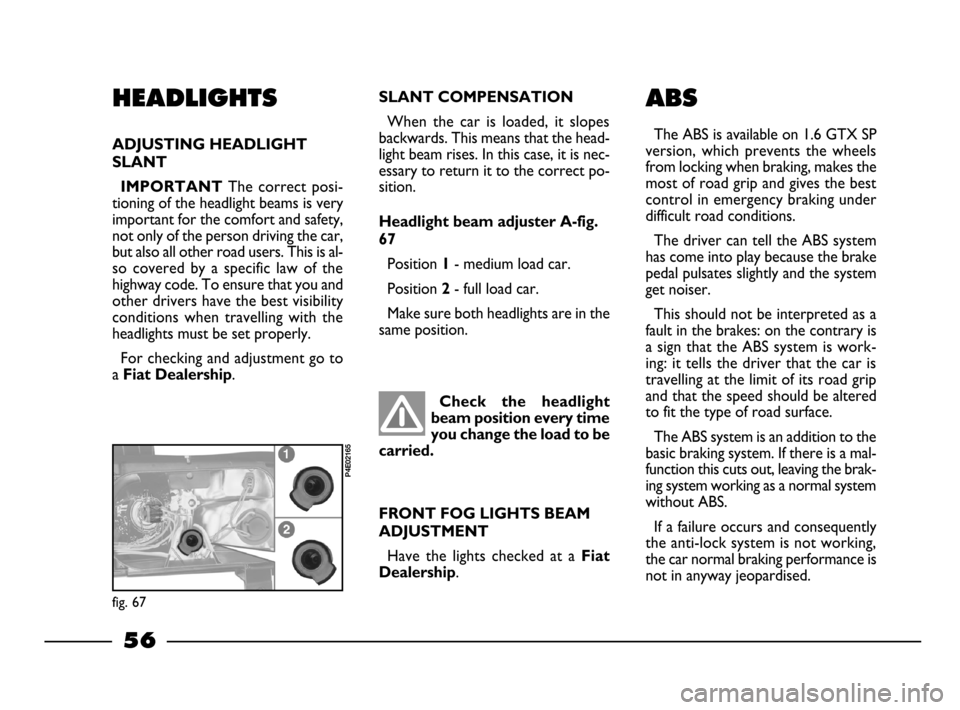
Headlight beam adjuster A-fig.
67
Position 1- medium load car.
Position
2- full load car.
Make sure both headlights are in the
same position.
Check the headlight
beam position every time
you change the load to be
carried.
FRONT FOG LIGHTS BEAM
ADJUSTMENT
Have the lights checked at a Fiat
Dealership
.
ABS
The ABS is available on 1.6 GTX SP
version, which prevents the wheels
from locking when braking, makes the
most of road grip and gives the best
control in emergency braking under
difficult road conditions.
The driver can tell the ABS system
has come into play because the brake
pedal pulsates slightly and the system
get noiser.
This should not be interpreted as a
fault in the brakes: on the contrary is
a sign that the ABS system is work-
ing: it tells the driver that the car is
travelling at the limit of its road grip
and that the speed should be altered
to fit the type of road surface.
The ABS system is an addition to the
basic braking system. If there is a mal-
function this cuts out, leaving the brak-
ing system working as a normal system
without ABS.
If a failure occurs and consequently
the anti-lock system is not working,
the car normal braking performance is
not in anyway jeopardised.
HEADLIGHTS
ADJUSTING HEADLIGHT
SLANT
IMPORTANT
The correct posi-
tioning of the headlight beams is very
important for the comfort and safety,
not only of the person driving the car,
but also all other road users. This is al-
so covered by a specific law of the
highway code. To ensure that you and
other drivers have the best visibility
conditions when travelling with the
headlights must be set properly.
For checking and adjustment go to
a
Fiat Dealership.
fig. 67
P4E02165
20-63 03/03/2003 06:03 PM Page 56
Page 58 of 156
57
If you have never driven a car with
ABS before, you should practice using
the system on slippery terrain, obvi-
ously with the necessary safety pre-
cautions and keeping to the Highway
code of the country you are in. It is al-
so a good idea to read the following
information carefully.
The advantage in using the ABS sys-
tem is that it continues to give you
maximum manoeuvrability even when
braking hard in conditions for poor
grip by preventing the wheels locking.
However, do not expect that with
ABS the braking distance will always
decrease: for example surfaces with
gravel or fresh snow on a slippery
road could infact increase the braking
distance.
To exploit the ABS system to the full
in the event of necessity, you should
take heed of the following advice:
If the brake fluid low
warning light x
comes on,
stop the car immediately
and contact the nearest Fiat Deal-
ership. Fluid leaks from the hy-
draulic system, in fact, can com-
promise the braking of both tradi-
tional systems and systems with
ABS.When the ABS is acti-
vated, you will feel the
brake pedal pulsating. Do
not remove your foot, but keep
it pressed. In doing so you will
stop in the shortest amount of
space possible under the current
road conditions.
If you follow these tips, you will be
able to brake better in any situation.
IMPORTANTCars fitted with ABS
are only to be fitted with wheel rims,
tyres and brake liners of the make and
model approved by the car manufac-
turer.
The ABS exploits the
tyre-road grip available to
the full, but it cannot im-
prove it; you should therefore
take every care when driving on
slippery surfaces, and not take
unnecessary risks. If the ABS sys-
tem cuts in it is a sign that the
grip between the tyre and the
road surface has reached the lim-
it: you must slow down to match
the speed to the road grip avail-
able
If there is a fault, the in-
strument panel warning
light
>will come on, at
this point, reduce speed and go to
a Fiat Dealership to have your car
checked and put it right imme-
diately.
Braking while cornering always re-
quires extreme care even when using
ABS.
The most important advice to follow
is this:
20-63 03/03/2003 06:03 PM Page 57
Page 60 of 156
59
When the ignition key is
turned to MAR, the indi-
cator û
comes on after
about four seconds. If the warn-
ing light does not come on, or it
remains on while travelling go
immediately to a Fiat Dealership.
Do not apply stickers or
other objects on the
steering wheel. Do not
travel with items on your lap, in
front of you or with a pipe, pencil
etc. between your lips. In a colli-
sion where the airbag is triggerd
you could seriously hurt yourself
GENERAL WARNINGS
It may happen that the air bag
inflates if the car is involved in
hard impacts or collisions in the
area of the underbody, for exam-
ple hard knocks against steps,
kerbs or raised road bumps, or if
the car drops into large pot-holes
or road dips.
When the airbag inflates it
emits a small amount of dust and
smoke. This dust and smoke is
harmless and it is not the begin-
ning of a fire.
If the warning light
ûcomes on
while travelling (indication of a
fault) go as soon as possible to a
Fiat Dealership.
The air bag system is valid for 10
years. When the expiry date is
near, contact a Fiat Dealership.
Should an accident occur in
which the airbag is activated,
take the car to a Fiat Dealership
to have the whole device re-
placed (electronic control unit,
seat belts, pretensioners) and tohave the electrical system
checked.
Any diagnostic, repair or re-
placement operations concerning
the airbag system must exclu-
sively be carried out at a Fiat
Dealership.
If you are having the car
scrapped, have the airbag system
deactivated at a Fiat Dealership.
If the car changes hands, the
new owner must be made aware
of the indications given above and
be given this Owner’s Handbook.
Pretensioners (if electronically
controlled) and air bag are trig-
gered by the electronic control
unit according to different types
of impact. Therefore, if some de-
vices do not trigger this does not
indicate a fault in the system.
20-63 03/03/2003 06:03 PM Page 59
Page 63 of 156
62
AT THE FILLING STATION
An inefficient catalytic
converter will allow
harmful gases to be re-
leased in the atmosphere.Never put even the tini-
est amount of leaded fu-
el into the tank, even in
an emergency; you would dam-
age the catalytic converter be-
yond repair.
The pollution prevention devices of
Fiat Palio mean only unleaded petrol
can be used.
Use petrol with a research octane
number (R.O.N.) equal to 87.
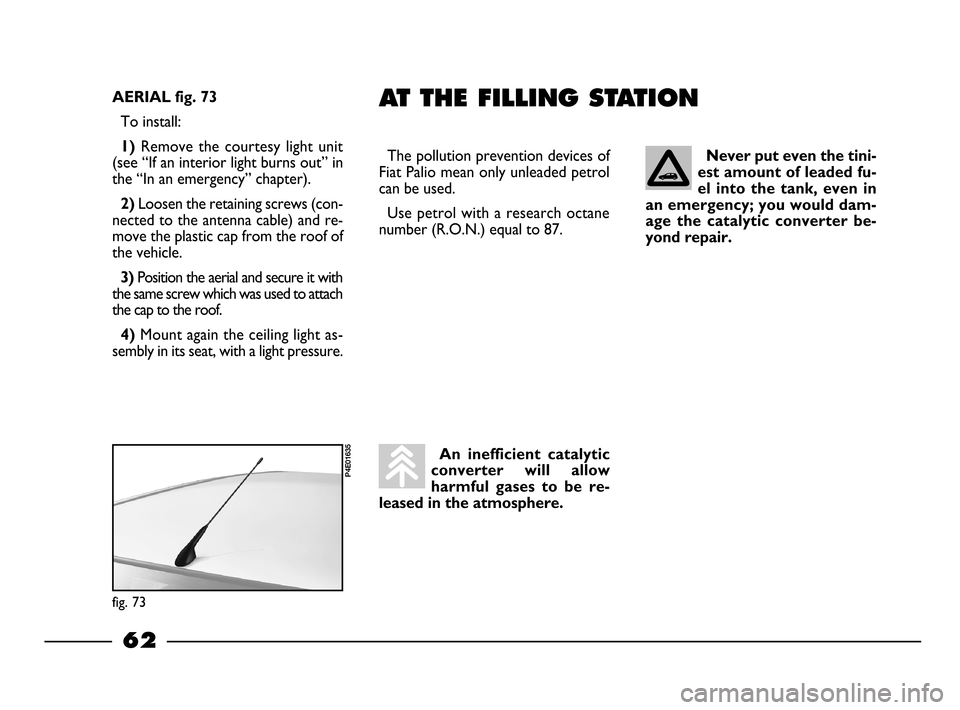
AERIAL fig. 73
To install:
1) Remove the courtesy light unit
(see “If an interior light burns out” in
the “In an emergency” chapter).
2) Loosen the retaining screws (con-
nected to the antenna cable) and re-
move the plastic cap from the roof of
the vehicle.
3) Position the aerial and secure it with
the same screw which was used to attach
the cap to the roof.
4) Mount again the ceiling light as-
sembly in its seat, with a light pressure.
fig. 73
P4E01635
20-63 03/03/2003 06:03 PM Page 62
Page 64 of 156
63
PROTECTING THE
ENVIRONMENT
Protecting the environment has been
the guiding principle in the design of the
Fiat Palio right from the start. The re-
sult is the use of materials and creation
of devices that can reduce or consid-
erably curtail harmful influences on the
environment.
The devices for curtailing emission
for petrol version are:
– a three-way catalytic converter;
– Lambda sensor;
– an anti evaporation system.
The devices for curtailing emission
for diesel version are:
– Catalytic converter;
– Exhaust gas recirculation.
As a consequence Fiat Palio is ready
to travel well ahead of the most strin-
gent international pollution control
standards.
fig. 74
P4E01945
IMPORTANT If required, replace
the fuel cap with another genuine cap
to avoid affecting the efficiency of the
fuel vapour recovery system.
NEVER go close to the
tank filler with naked
flames or lit cigarettes:
Also avoid going too close to
the fuel tank filler area, to avoid
inhaling harmful vapours.FUEL FILLER CAP
To unlock the fuel filler cap flap from
inside the car, lift the lever
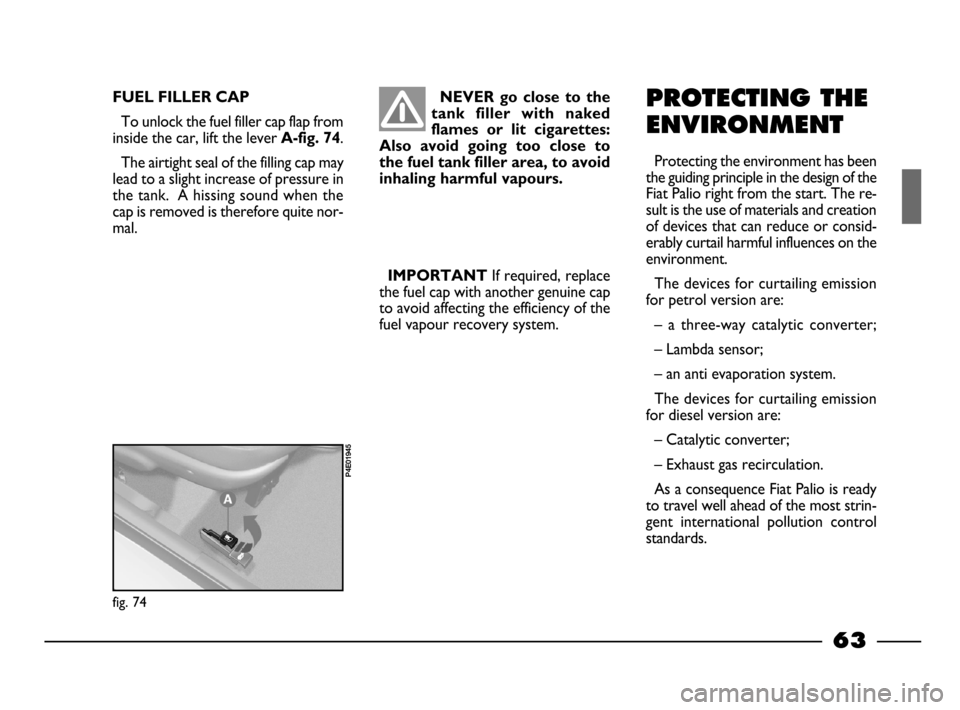
A-fig. 74.
The airtight seal of the filling cap may
lead to a slight increase of pressure in
the tank. A hissing sound when the
cap is removed is therefore quite nor-
mal.
20-63 03/03/2003 06:03 PM Page 63
Page 66 of 156
65
The key switch is equipped with a
safety device which obliges, in the
event of engine starting malfunction to
return the key at
STOP prior to re-
peating the starting operation.
At the same time, when the engine is
running, the device prevents to shift
from
MAR postion to AVV position.
In the first operational seconds,
above all after a long inactivity peri-
od, you can hear a higher noise level
of the engine. Such phenomenon,
which does not compromise the func-
tionality and reliability, is typical of the
hydraulic tappets: the distribution sys-
tem, chosen for the engine of 100
16V
version of your Fiat Palio to contribute
to the maintenance intervention re-
duction.
STARTING THE ENGINE
IMPORTANT
Do not press the
accelerator until the engine has start-
ed.
1) Ensure that the handbrake is up.
2) Put the gear lever into neutral.
3)Press the clutch pedal right down.
4) Turn the ignition key to AVVand
release it as soon as the engine starts.If the engine does not start at the
first attempt, return the ignition key
to
STOP before trying to start the
engine again.
IMPORTANT Press the accelera-
tor slightly only if the outside temper-
ature is lower than –10°C and the en-
gine does not start at the first attempt.
IMPORTANTNever leave the ig-
nition key at
MARwhen the engine is
off.
Never touch the high
voltage wires (spark plug
wires) when the engine is
running.
It is dangerous to let the
engine run in a garage of
other closed area. The en-
gine consumes oxygen and gives
off carbon dioxide, carbon monox-
ide and other poisonous fumes.
STARTING THE
ENGINE
We recommend not to
push the engine to its lim-
its for the first period of
use (e.g. abrupt accelerations, ex-
cessively prolonged distances at
max revs, hard braking, etc.).
64-79 03/03/2003 06:45 PM Page 65