technical specifications FIAT PANDA 2009 169 / 2.G Owners Manual
[x] Cancel search | Manufacturer: FIAT, Model Year: 2009, Model line: PANDA, Model: FIAT PANDA 2009 169 / 2.GPages: 226, PDF Size: 5.29 MB
Page 184 of 226
183KNOW
YOUR VEHICLE
SAFETY
CORRECT USE
OF THE CAR
WARNING LIGHTS
AND MESSAGES
IN
AN EMERGENCYCAR
MAINTENANCETECHNICAL
SPECIFICATIONS
INDEX
F0Z0112m
fig. 185
WHEELS AND TYRESCheck the pressure of each tyre, including the space-saver
wheel, approximately every two weeks and before long
journeys: the pressure should be checked with the tyre
rested and cold.
While driving the car, the pressure increases under stan-
dard conditions: for the correct tyre inflation pressure, see
“Wheels” in “Technical specifications” chapter.
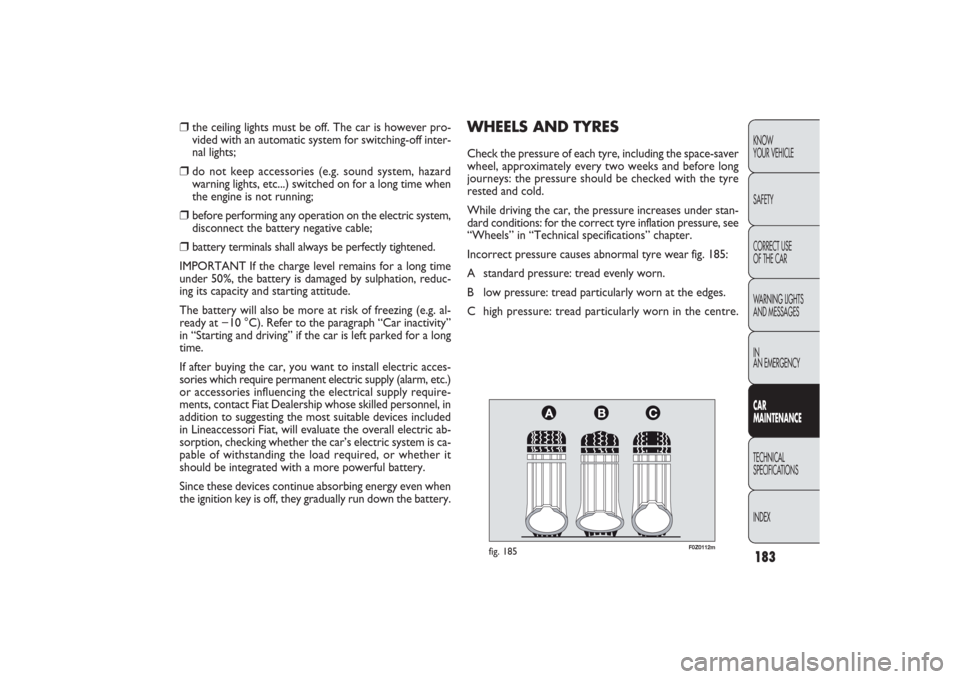
Incorrect pressure causes abnormal tyre wear fig. 185:
A standard pressure: tread evenly worn.
B low pressure: tread particularly worn at the edges.
C high pressure: tread particularly worn in the centre.
❒
the ceiling lights must be off. The car is however pro-
vided with an automatic system for switching-off inter-
nal lights;
❒
do not keep accessories (e.g. sound system, hazard
warning lights, etc...) switched on for a long time when
the engine is not running;
❒
before performing any operation on the electric system,
disconnect the battery negative cable;
❒
battery terminals shall always be perfectly tightened.
IMPORTANT If the charge level remains for a long time
under 50%, the battery is damaged by sulphation, reduc-
ing its capacity and starting attitude.
The battery will also be more at risk of freezing (e.g. al-
ready at −10 °C). Refer to the paragraph “Car inactivity”
in “Starting and driving” if the car is left parked for a long
time.
If after buying the car, you want to install electric acces-
sories which require permanent electric supply (alarm, etc.)
or accessories influencing the electrical supply require-
ments, contact Fiat Dealership whose skilled personnel, in
addition to suggesting the most suitable devices included
in Lineaccessori Fiat, will evaluate the overall electric ab-
sorption, checking whether the car’s electric system is ca-
pable of withstanding the load required, or whether it
should be integrated with a more powerful battery.
Since these devices continue absorbing energy even when
the ignition key is off, they gradually run down the battery.
169-190 PANDA EN 7-10-2009 14:15 Pagina 183
Page 185 of 226
184KNOW
YOUR VEHICLE
SAFETY
CORRECT USE
OF THE CAR
WARNING LIGHTS
AND MESSAGES
IN
AN EMERGENCYCAR
MAINTENANCE
TECHNICAL
SPECIFICATIONS
INDEX
❒
to allow even wear between the front and rear tyres,
it is advisable to change them over every 10–15 thou-
sand kilometres, keeping them on the same side of the
car so as not to reverse the direction of rotation. The tyres must be replaced when the tread is less than
1.6 mm thick. In all cases, follow the laws in force in the
country where you are driving.
IMPORTANT NOTES
❒
Avoid braking suddenly, burning starts and violent
knocks against curbs, potholes or other obstacles if pos-
sible. Driving for long stretches over bumpy roads can
damage the tyres;
❒
check the tyres regularly for cuts on the sides, swelling
or irregular tread wear. Contact a Fiat Dealership if re-
quired;
❒
avoid overloading the car when travelling: this may cause
serious damage to the wheels and tyres;
❒
if a tyre is punctured, stop the vehicle immediately
and change it to avoid damage to the tyre, the rim, the
suspensions and the steering system;
❒
a tyre will age even if it is not used much. Cracks in
the tread and on the sidewalls are a sign of ageing. Have
the tyres checked by skilled personnel if they have been
fitted for longer than six years. Remember to check
also the space-saver wheel very carefully;
❒
in case of replacement, always fit new tyres, avoiding
those with an unknown origin;
❒
if a tyre is replaced, also change the inflation valve;
Remember that the road holding qualities
of your car also depend on the correct in-
flation pressure of the tyres.
WARNING
If the pressure is too low the tyre will
get overheated, with the risk of serious
damage.
WARNING
Avoid moving the tyres from the right side
of the car to the left side and vice versa.
WARNING
Never submit alloy rims to repainting
treatments requiring to use temperatures
exceeding 150 °C. The mechanical properties of
the wheels could be impaired.
WARNING
169-190 PANDA EN 7-10-2009 14:15 Pagina 184
Page 186 of 226
185KNOW
YOUR VEHICLE
SAFETY
CORRECT USE
OF THE CAR
WARNING LIGHTS
AND MESSAGES
IN
AN EMERGENCYCAR
MAINTENANCETECHNICAL
SPECIFICATIONS
INDEX
WINDSCREEN/REAR WINDOW
WIPER/WASHERBLADES
Periodically clean the rubber part using special products;
TUTELA PROFESSIONAL SC 35 is recommended.
Replace the blades if the rubber edge is deformed or worn.
In all cases, it is advisable to replace them approximately once
a year.
A few simple precautions can reduce the possibility of dam-
age to the blades:❒
make sure that the rubber part is not stuck to the wind-
screen at sub-zero temperatures. Use an antifreeze
product to release it if required;
❒
remove any snow from the glass: in addition to pro-
tecting the blades, this prevents effort on the motor
and overheating;
❒
do not operate the windscreen and the rear screen
wipers on dry glass.
RUBBER HOSESAs far as the brake system and fuel rubber hoses are concerned,
follow the “Scheduled Servicing Programme” in this chapter care-
fully.
Ozone, high temperatures and prolonged lack of fluid in the sys-
tem may cause hardening and cracking of the hoses, with pos-
sible leaks. Careful control is therefore necessary.
Driving with worn wiper blades is a serious
hazard, because visibility is reduced in bad
weather.
WARNING
169-190 PANDA EN 7-10-2009 14:15 Pagina 185
Page 187 of 226
186KNOW
YOUR VEHICLE
SAFETY
CORRECT USE
OF THE CAR
WARNING LIGHTS
AND MESSAGES
IN
AN EMERGENCYCAR
MAINTENANCE
TECHNICAL
SPECIFICATIONS
INDEX
F0Z0218m
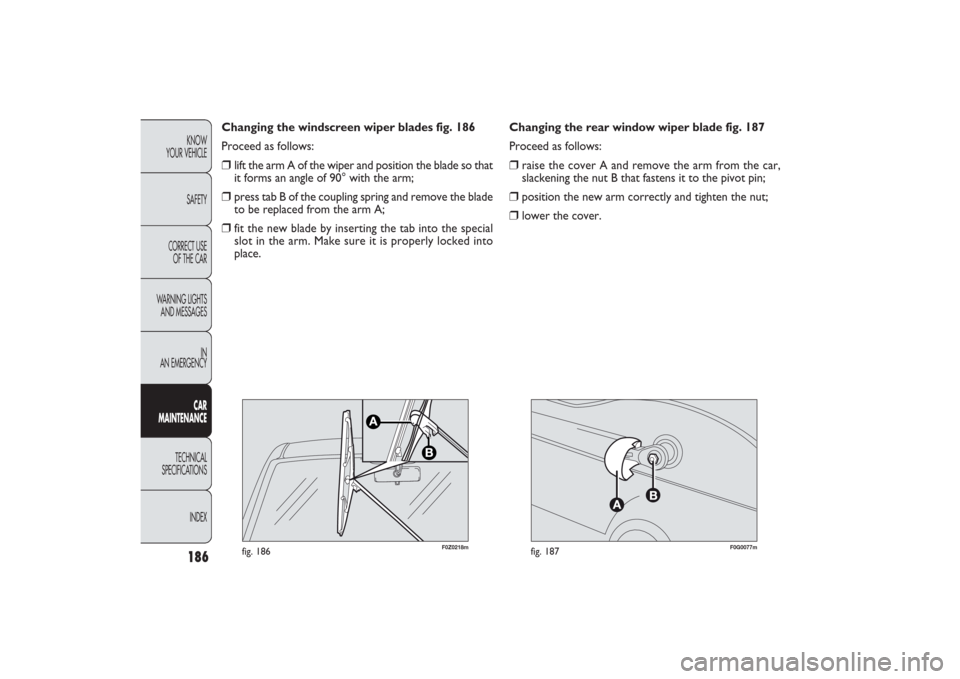
fig. 186
F0G0077m
fig. 187
Changing the rear window wiper blade fig. 187
Proceed as follows:❒
raise the cover A and remove the arm from the car,
slackening the nut B that fastens it to the pivot pin;
❒
position the new arm correctly and tighten the nut;
❒
lower the cover. Changing the windscreen wiper blades fig. 186
Proceed as follows:
❒
lift the arm A of the wiper and position the blade so that
it forms an angle of 90° with the arm;
❒
press tab B of the coupling spring and remove the blade
to be replaced from the arm A;
❒
fit the new blade by inserting the tab into the special
slot in the arm. Make sure it is properly locked into
place.
169-190 PANDA EN 7-10-2009 14:15 Pagina 186
Page 188 of 226
187KNOW
YOUR VEHICLE
SAFETY
CORRECT USE
OF THE CAR
WARNING LIGHTS
AND MESSAGES
IN
AN EMERGENCYCAR
MAINTENANCETECHNICAL
SPECIFICATIONS
INDEX
F0Z0116m
fig. 188
F0Z0117m
fig. 189
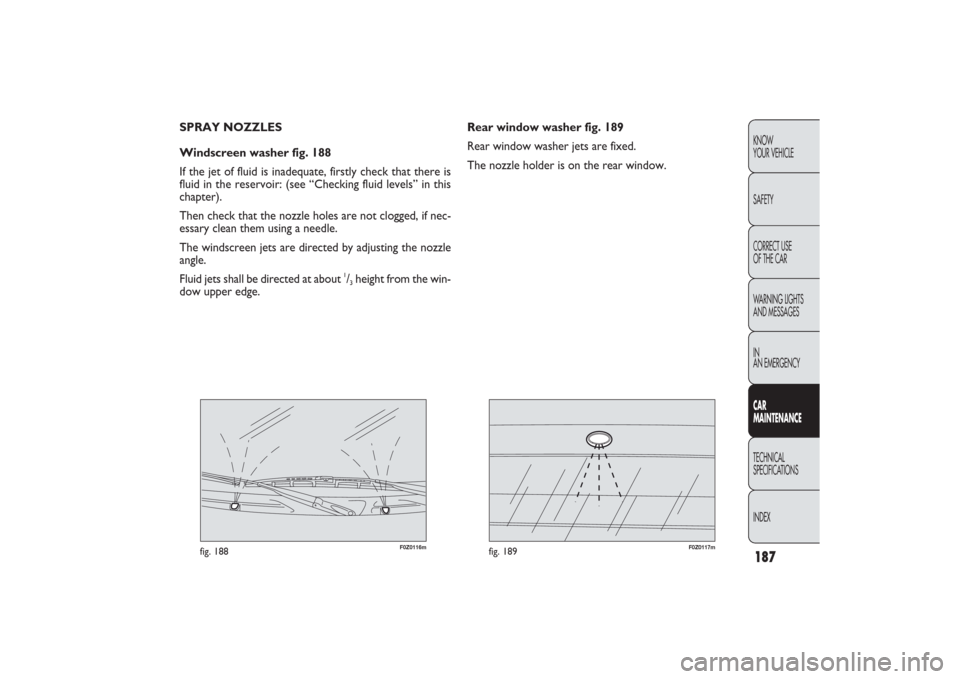
Rear window washer fig. 189
Rear window washer jets are fixed.
The nozzle holder is on the rear window. SPRAY NOZZLES
Windscreen washer fig. 188
If the jet of fluid is inadequate, firstly check that there is
fluid in the reservoir: (see “Checking fluid levels” in this
chapter).
Then check that the nozzle holes are not clogged, if nec-
essary clean them using a needle.
The windscreen jets are directed by adjusting the nozzle
angle.
Fluid jets shall be directed at about
1/3height from the win-
dow upper edge.
169-190 PANDA EN 7-10-2009 14:15 Pagina 187
Page 189 of 226
188KNOW
YOUR VEHICLE
SAFETY
CORRECT USE
OF THE CAR
WARNING LIGHTS
AND MESSAGES
IN
AN EMERGENCYCAR
MAINTENANCE
TECHNICAL
SPECIFICATIONS
INDEX
❒
spraying of protective plastic material in the more ex-
posed points: underdoor, inner mudguard parts, edges,
etc...;
❒
Use of “open” boxed sections to prevent condensation
and pockets of moisture which could cause triggering
rust inside.
BODY AND UNDERBODY
WARRANTY
Your car is covered by warranty against perforation due
to rust of any original element of the structure or body.
For the general terms of this warranty, refer to the War-
ranty Booklet.
ADVICE FOR PRESERVING THE BODYWORK
Paint
Paintwork does not only serve an aesthetic purpose, but
also protects the underlying sheet metal.
Touch-up abrasions and scratches immediately to prevent
the formation of rust. Only use genuine spare paint prod-
ucts for touch-ups (see “Bodywork paint identification plate”
in the “Technical Specifications” chapter).
Standard maintenance of paintwork consists in washing the
vehicle; its frequency depends on the conditions and envi-
ronment where the vehicle is used. For example, in highly
polluted areas, or if the roads are sprayed with salt, it is
advisable to wash the car more frequently.
BODYWORKPROTECTION FROM ATMOSPHERIC AGENTS
The main causes of corrosion are the following:❒
atmospheric pollution;
❒
salty air and humidity (coastal areas, or hot humid cli-
mates);
❒
seasonal environmental conditions.
Not to be underestimated is also the abrasive action of
wind-borne atmospheric dust and sand, along with mud
and gravel raised by other vehicles.
On your car, Fiat implemented the best manufacturing
technologies to effectively protect the bodywork against
corrosion.
These include:
❒
painting products and systems which give the car par-
ticular resistance to corrosion and abrasion;
❒
use of galvanised (or pretreated) steel sheets, with high
resistance to corrosion;
❒
spraying the underbody, engine compartment, wheel
housing internal parts and other parts with highly pro-
tective wax products;
169-190 PANDA EN 7-10-2009 14:15 Pagina 188
Page 190 of 226
189KNOW
YOUR VEHICLE
SAFETY
CORRECT USE
OF THE CAR
WARNING LIGHTS
AND MESSAGES
IN
AN EMERGENCYCAR
MAINTENANCETECHNICAL
SPECIFICATIONS
INDEX
Glasses
To clean glasses, use specific window cleaner products.
Also use clean cloths to avoid scratching the glass or dam-
aging the transparency.
IMPORTANT Wipe the rear window inside gently with
a cloth in the direction of the filaments to avoid damag-
ing the heating device.
Engine compartment
At the end of the winter the engine compartment should
be carefully washed, without directing the jet against any
electronic control unit. Have this operation performed
at a specialised workshop.
IMPORTANT The washing should take place with the en-
gine cold and the ignition key in the
STOP
position. After
the washing operation, make sure that the various pro-
tections (e.g. rubber caps and guards) have not been re-
moved or damaged.
Front headlights
IMPORTANT Never use aromatic substances (e.g.: petrol)
or ketenes (e.g.: acetone) for cleaning front headlight plas-
tic lens. To correctly wash the vehicle, proceed as follows:
❒
remove the aerial from the roof to prevent damage to
it if the car is washed in an automatic system;
❒
wash the body using a low pressure jet of water;
❒
wipe a sponge with a slightly soapy solution over the
bodywork, frequently rinsing with the sponge;
❒
rinse well with water and dry with a jet of air or
a chamois leather.
Dry the less visible parts, such as the door frames, bonnet
and the headlight frames with special care, as in these ar-
eas water may stagnate more easily. The car should not
be taken to a closed area immediately, but left outside so
that residual water can evaporate.
Do not wash the car after it has been left in the sun or
with the bonnet hot: this may alter the shine of the paint-
work.
Exterior plastic parts must be cleaned in the same way as
the rest of the car.
Where possible, do not park under trees; the resinous
substance many species release give the paint a dull ap-
pearance and increase the possibility of triggering rust
processes.
IMPORTANT Bird droppings must be washed off imme-
diately and thoroughly as the acid they contain is particu-
larly aggressive.
Detergents cause water pollution. The vehi-
cle should be washed in areas equipped for
collecting and cleaning the liquid used in the
washing process.
169-190 PANDA EN 7-10-2009 14:15 Pagina 189
Page 191 of 226
190KNOW
YOUR VEHICLE
SAFETY
CORRECT USE
OF THE CAR
WARNING LIGHTS
AND MESSAGES
IN
AN EMERGENCYCAR
MAINTENANCE
TECHNICAL
SPECIFICATIONS
INDEX
INTERIORSRegularly check that water is not trapped under the mats
(due to water dripping off shoes, umbrellas, etc.), as this
would cause oxidation of the sheet metal.
Never use flammable products, such as
petrol ether or rectified petrol to clean the
car inside. The electrostatic charges which are
generated by rubbing during the cleaning opera-
tion may cause a fire.
WARNING
Do not keep aerosol bottles in the vehicle:
risk of bursting. Aerosol bottles must not
be exposed to a temperature exceeding 50 °C.
When the car is exposed to sunlight, inner tem-
perature can greatly exceed this value.
WARNING
SEATS AND FABRIC PARTS
Remove dust with a soft brush or a vacuum cleaner. It is
advisable to use a moist brush on velvet upholstery.
Rub the seats with a sponge moistened with a solution of
water and neutral detergent.
INTERIOR PLASTIC PARTS
It is advisable to clean interior parts with a moist cloth and
a solution of water and mild soap. Use specific products
for cleaning plastic, without solvents and specifically de-
signed to prevent damage to the appearance and colour
of the treated parts to remove grease and tough stains.
IMPORTANT Never use alcohol or petroleum to clean
the instrument panel.
CLEANING SEAT PROTECTORS
In order to clean/remove stains from the
seat protectors, it is not advisable to use
alcohol or alcohol based products (e.g. solvents).
WARNING
169-190 PANDA EN 7-10-2009 14:15 Pagina 190
Page 192 of 226
191KNOW
YOUR VEHICLE
SAFETY
WARNING LIGHTS
AND MESSAGES
IN
AN EMERGENCY
CAR
MAINTENANCETECHNICAL
SPECIFICATIONSINDEX
TECHNICAL SPECIFICATIONS
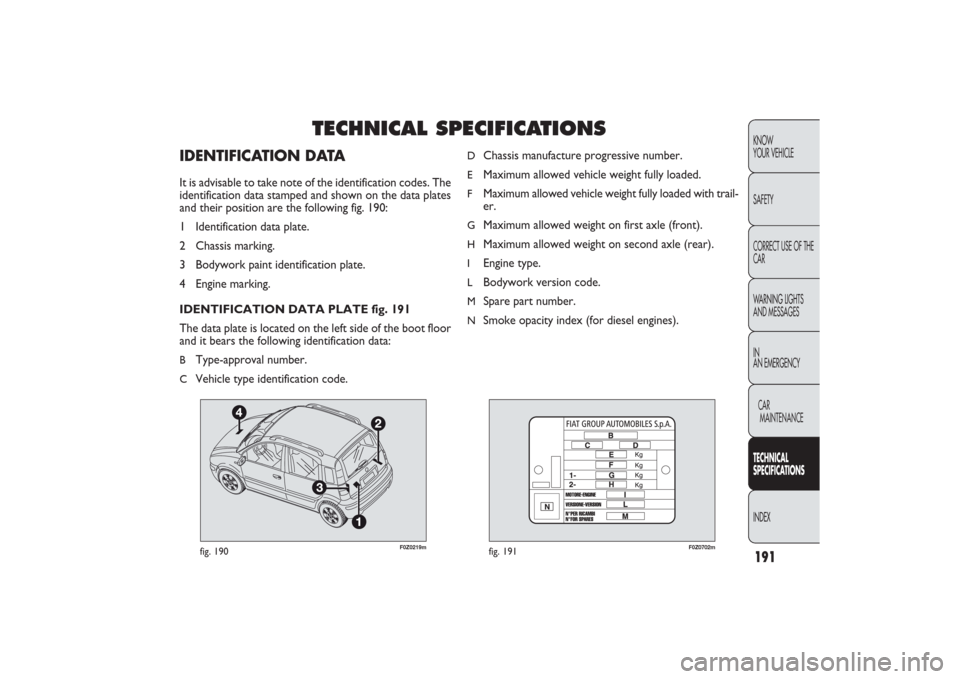
IDENTIFICATION DATAIt is advisable to take note of the identification codes. The
identification data stamped and shown on the data plates
and their position are the following fig. 190:
1 Identification data plate.
2 Chassis marking.
3 Bodywork paint identification plate.
4 Engine marking.
IDENTIFICATION DATA PLATE fig. 191
The data plate is located on the left side of the boot floor
and it bears the following identification data:B
Type-approval number.
C
Vehicle type identification code.
CORRECT USE OF THE
CAR
D
Chassis manufacture progressive number.
E
Maximum allowed vehicle weight fully loaded.
F
Maximum allowed vehicle weight fully loaded with trail-
er.
G
Maximum allowed weight on first axle (front).
H
Maximum allowed weight on second axle (rear).
I
Engine type.
L
Bodywork version code.
M
Spare part number.
N
Smoke opacity index (for diesel engines).
F0Z0219m
fig. 190
F0Z0702m
fig. 191
191-214 PANDA EN 7-10-2009 14:17 Pagina 191
Page 193 of 226
192
KNOW YOUR
VEHICLE
SAFETY
CORRECT USE OF
THE CAR
WARNING LIGHTS
AND MESSAGES
IN
AN EMERGENCY
CAR
MAINTENANCETECHNICAL
SPECIFICATIONS
INDEX
F0Z0114m
fig. 192
F0Z0220m
fig. 193
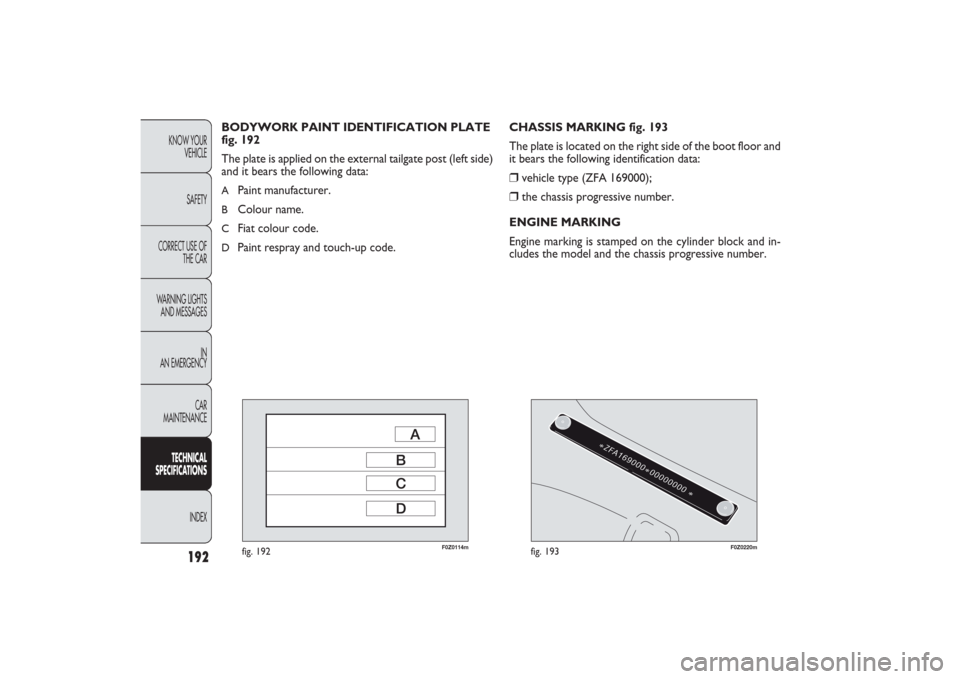
CHASSIS MARKING fig. 193
The plate is located on the right side of the boot floor and
it bears the following identification data:❒
vehicle type (ZFA 169000);
❒
the chassis progressive number.
ENGINE MARKING
Engine marking is stamped on the cylinder block and in-
cludes the model and the chassis progressive number. BODYWORK PAINT IDENTIFICATION PLATE
fig. 192
The plate is applied on the external tailgate post (left side)
and it bears the following data:
A
Paint manufacturer.
B
Colour name.
C
Fiat colour code.
D
Paint respray and touch-up code.
191-214 PANDA EN 7-10-2009 14:17 Pagina 192