roof FIAT PANDA 2009 169 / 2.G User Guide
[x] Cancel search | Manufacturer: FIAT, Model Year: 2009, Model line: PANDA, Model: FIAT PANDA 2009 169 / 2.GPages: 226, PDF Size: 5.29 MB
Page 108 of 226
107KNOW YOUR
VEHICLESAFETYCORRECT USE
OF THE CAR
WARNING LIGHTS
AND MESSAGES
IN AN EMERGENCY
CAR
MAINTENANCE
TECHNICAL
SPECIFICATIONS
INDEX
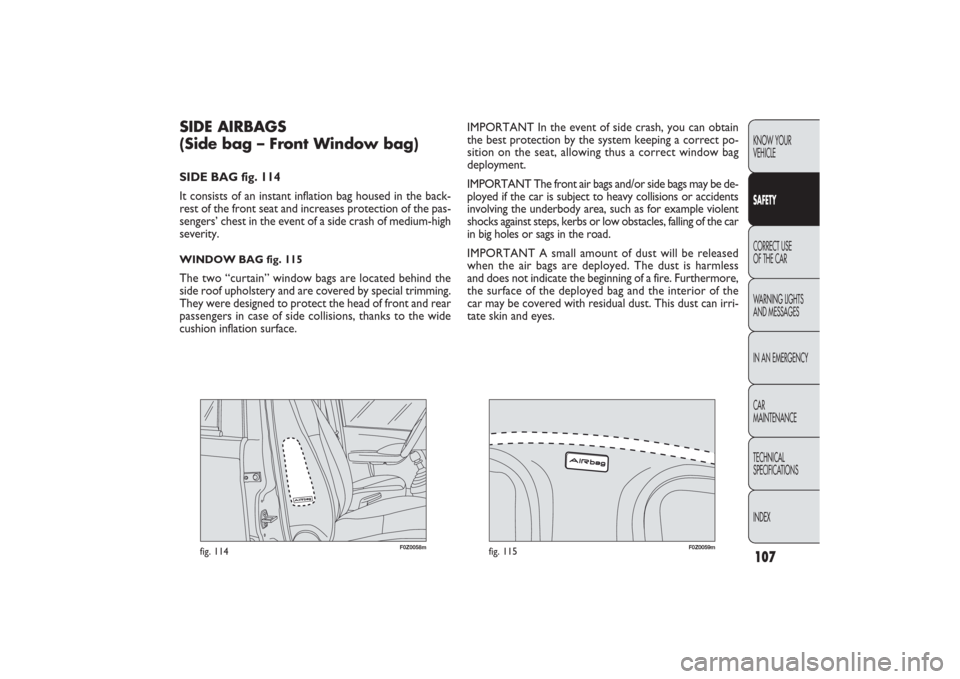
F0Z0058m
fig. 114
F0Z0059m
fig. 115
IMPORTANT In the event of side crash, you can obtain
the best protection by the system keeping a correct po-
sition on the seat, allowing thus a correct window bag
deployment.
IMPORTANT The front air bags and/or side bags may be de-
ployed if the car is subject to heavy collisions or accidents
involving the underbody area, such as for example violent
shocks against steps, kerbs or low obstacles, falling of the car
in big holes or sags in the road.
IMPORTANT A small amount of dust will be released
when the air bags are deployed. The dust is harmless
and does not indicate the beginning of a fire. Furthermore,
the surface of the deployed bag and the interior of the
car may be covered with residual dust. This dust can irri-
tate skin and eyes.
SIDE AIRBAGS
(Side bag – Front Window bag)SIDE BAG fig. 114
It consists of an instant inflation bag housed in the back-
rest of the front seat and increases protection of the pas-
sengers’ chest in the event of a side crash of medium-high
severity.WINDOW BAG fig. 115The two “curtain” window bags are located behind the
side roof upholstery and are covered by special trimming.
They were designed to protect the head of front and rear
passengers in case of side collisions, thanks to the wide
cushion inflation surface.
091-110 PANDA EN 7-10-2009 13:46 Pagina 107
Page 116 of 226
115KNOW
YOUR VEHICLE
SAFETYCORRECT USE
OF THE CARWARNING LIGHTS
AND MESSAGES
IN
AN EMERGENCY
CAR
MAINTENANCE
TECHNICAL
SPECIFICATIONS
INDEX
CONTAINING RUNNING COSTSSome useful tips are given below for fuel saving and re-
ducing harmful emissions of CO
2and other pollutants
(nitrogen oxides, unburnt hydrocarbons, Particulate
Matter (PM) etc.).
GENERAL CONSIDERATIONS
Car maintenance
Have checks and adjustments carried out in accordance
with the “Scheduled servicing plan.”
Tyres
Check the pressure of the tyres routinely at an interval
of no more than 4 weeks: if the pressure is too low, con-
sumption levels increase as resistance to rolling is higher.
Unnecessary loads
Do not travel with an overloaded boot. The weight of
the car (especially when driving in town) and its trim great-
ly affects consumption and stability.
Accessories installed on longitudinal bars
Remove accessories like: roof racks, ski racks, luggage con-
tainer, etc. from the roof as soon as they are no longer
used. These accessories lower air penetration and ad-
versely affect consumption levels. When needing to
carry particularly voluminous objects, preferably use
a trailer.
To change gears properly you must push
the clutch pedal fully down. For this rea-
son, there must be no obstacles on the floor un-
der the pedals: ensure that rubber mats (if any)
are lying flat and do not interfere with the pedals.
WARNING
Do not drive with your hand resting on the
shifting lever, because this pressure, even
if light, over time can wear out the gearbox
internal components.
111-122 PANDA EN 7-10-2009 15:01 Pagina 115
Page 164 of 226
163KNOW
YOUR VEHICLE
SAFETY
CORRECT USE
OF THE CAR
WARNING LIGHTS
AND MESSAGESIN
AN EMERGENCYCAR
MAINTENANCE
TECHNICAL
SPECIFICATIONS
INDEX
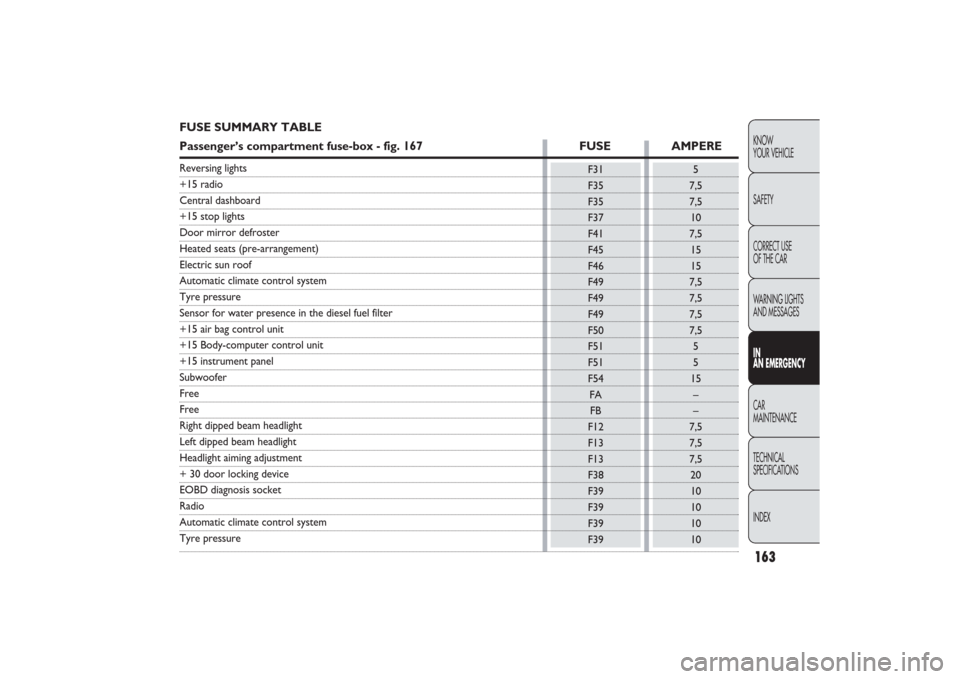
5
7,5
7,5
10
7,5
15
15
7,5
7,5
7,5
7,5
5
5
15
–
–
7,5
7,5
7,5
20
10
10
10
10
F31
F35
F35
F37
F41
F45
F46
F49
F49
F49
F50
F51
F51
F54
FA
FB
F12
F13
F13
F38
F39
F39
F39
F39
FUSE SUMMARY TABLEPassenger’s compartment fuse-box - fig. 167 FUSE AMPEREReversing lights+15 radioCentral dashboard+15 stop lightsDoor mirror defroster Heated seats (pre-arrangement)Electric sun roofAutomatic climate control systemTyre pressureSensor for water presence in the diesel fuel filter +15 air bag control unit+15 Body-computer control unit+15 instrument panelSubwooferFreeFreeRight dipped beam headlightLeft dipped beam headlightHeadlight aiming adjustment+ 30 door locking deviceEOBD diagnosis socketRadioAutomatic climate control systemTyre pressure
135-168 PANDA EN 7-10-2009 14:07 Pagina 163
Page 190 of 226
189KNOW
YOUR VEHICLE
SAFETY
CORRECT USE
OF THE CAR
WARNING LIGHTS
AND MESSAGES
IN
AN EMERGENCYCAR
MAINTENANCETECHNICAL
SPECIFICATIONS
INDEX
Glasses
To clean glasses, use specific window cleaner products.
Also use clean cloths to avoid scratching the glass or dam-
aging the transparency.
IMPORTANT Wipe the rear window inside gently with
a cloth in the direction of the filaments to avoid damag-
ing the heating device.
Engine compartment
At the end of the winter the engine compartment should
be carefully washed, without directing the jet against any
electronic control unit. Have this operation performed
at a specialised workshop.
IMPORTANT The washing should take place with the en-
gine cold and the ignition key in the
STOP
position. After
the washing operation, make sure that the various pro-
tections (e.g. rubber caps and guards) have not been re-
moved or damaged.
Front headlights
IMPORTANT Never use aromatic substances (e.g.: petrol)
or ketenes (e.g.: acetone) for cleaning front headlight plas-
tic lens. To correctly wash the vehicle, proceed as follows:
❒
remove the aerial from the roof to prevent damage to
it if the car is washed in an automatic system;
❒
wash the body using a low pressure jet of water;
❒
wipe a sponge with a slightly soapy solution over the
bodywork, frequently rinsing with the sponge;
❒
rinse well with water and dry with a jet of air or
a chamois leather.
Dry the less visible parts, such as the door frames, bonnet
and the headlight frames with special care, as in these ar-
eas water may stagnate more easily. The car should not
be taken to a closed area immediately, but left outside so
that residual water can evaporate.
Do not wash the car after it has been left in the sun or
with the bonnet hot: this may alter the shine of the paint-
work.
Exterior plastic parts must be cleaned in the same way as
the rest of the car.
Where possible, do not park under trees; the resinous
substance many species release give the paint a dull ap-
pearance and increase the possibility of triggering rust
processes.
IMPORTANT Bird droppings must be washed off imme-
diately and thoroughly as the acid they contain is particu-
larly aggressive.
Detergents cause water pollution. The vehi-
cle should be washed in areas equipped for
collecting and cleaning the liquid used in the
washing process.
169-190 PANDA EN 7-10-2009 14:15 Pagina 189
Page 202 of 226
150
150
155/162 (*)
155/162 (*)
160
160
165
165
206
490
860
815
176 (*)/235 (**)
416
786
741
201KNOW
YOUR VEHICLE
SAFETY
CORRECT USE OF THE
CAR
WARNING LIGHTS
AND MESSAGES
IN
AN EMERGENCY
CAR
MAINTENANCETECHNICAL
SPECIFICATIONSINDEX
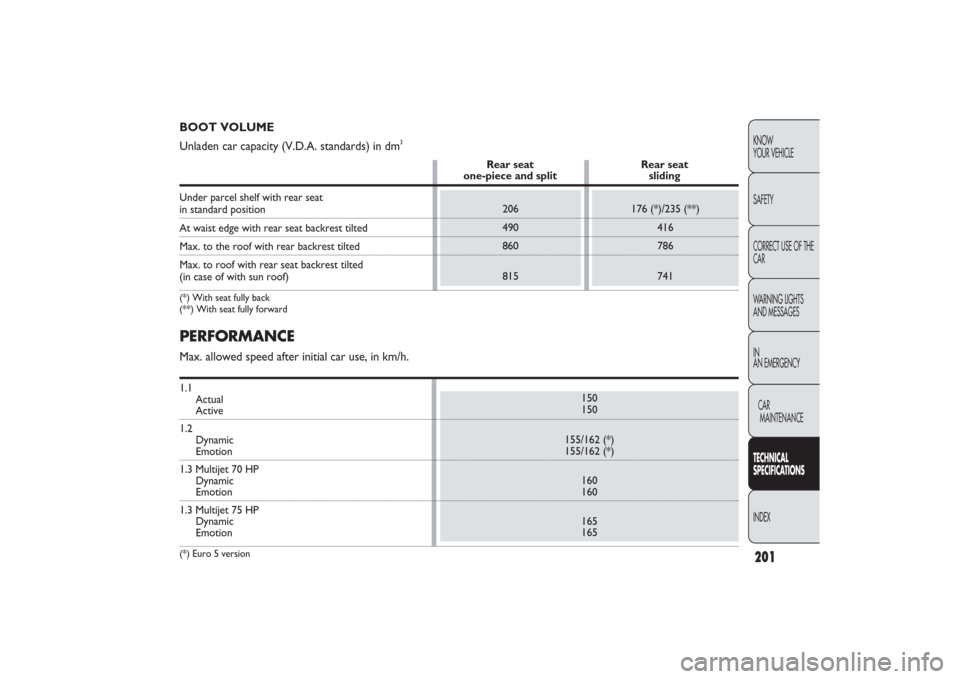
PERFORMANCEMax. allowed speed after initial car use, in km/h.1.1
Actual
Active
1.2
DynamicEmotion
1.3 Multijet 70 HP
DynamicEmotion
1.3 Multijet 75 HP
DynamicEmotion
(*) Euro 5 versionBOOT VOLUME
Unladen car capacity (V.D.A. standards) in dm
3
Rear seat Rear seat
one-piece and split sliding
Under parcel shelf with rear seat
in standard positionAt waist edge with rear seat backrest tiltedMax. to the roof with rear backrest tilted
Max. to roof with rear seat backrest tilted (in case of with sun roof)(*) With seat fully back
(**) With seat fully forward
191-214 PANDA EN 7-10-2009 14:17 Pagina 201
Page 203 of 226
935
445
750
660
1380
900
400
50
60
860
445
730
660
1305
800
400
50
60
840
415
730
640
1255
800
350
50
60
202
KNOW YOUR
VEHICLE
SAFETY
CORRECT USE OF
THE CAR
WARNING LIGHTS
AND MESSAGES
IN
AN EMERGENCY
CAR
MAINTENANCETECHNICAL
SPECIFICATIONS
INDEX
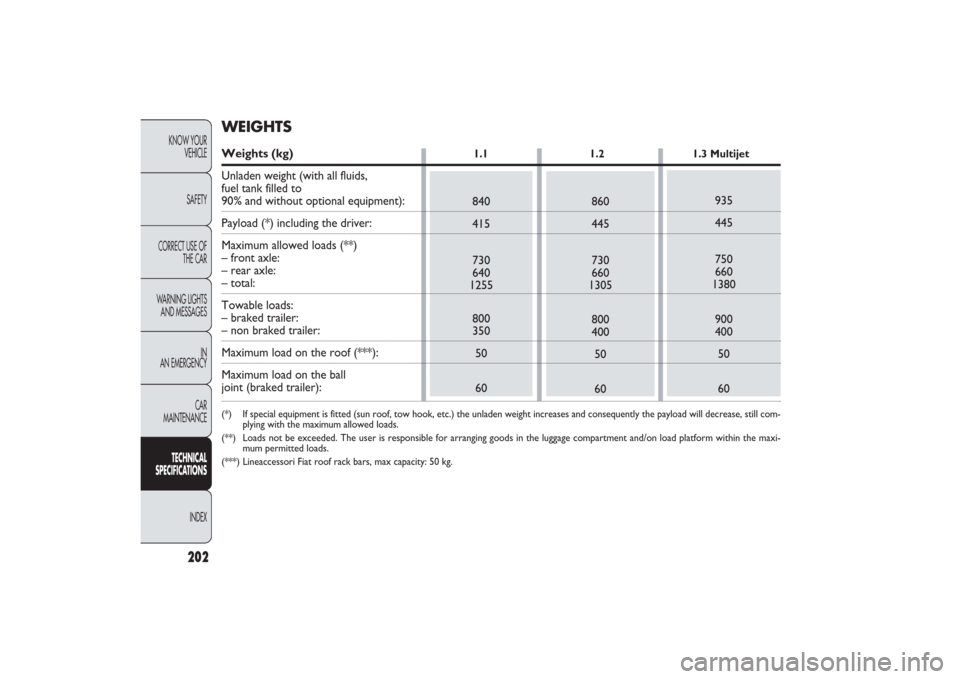
WEIGHTSWeights (kg)
1.1 1.2 1.3 Multijet
Unladen weight (with all fluids,
fuel tank filled to 90% and without optional equipment):Payload (*) including the driver:
Maximum allowed loads (**)
– front axle:
– rear axle:– total:
Towable loads:
– braked trailer:– non braked trailer:Maximum load on the roof (***):
Maximum load on the ball joint (braked trailer):(*) If special equipment is fitted (sun roof, tow hook, etc.) the unladen weight increases and consequently the payload will decrease, still com-
plying with the maximum allowed loads.
(**) Loads not be exceeded. The user is responsible for arranging goods in the luggage compartment and/on load platform within the maxi-
mum permitted loads.
(***) Lineaccessori Fiat roof rack bars, max capacity: 50 kg.
191-214 PANDA EN 7-10-2009 14:18 Pagina 202
Page 207 of 226
206
KNOW YOUR
VEHICLE
SAFETY
CORRECT USE OF
THE CAR
WARNING LIGHTS
AND MESSAGES
IN
AN EMERGENCY
CAR
MAINTENANCETECHNICAL
SPECIFICATIONS
INDEX
❒
extra-urban cycle: drive simulating the driving of the car
out of town with frequent acceleration in all gears; the
speed varies from 0 to 120 km/h;
❒
combined consumption: the weighting is around 37%
urban cycle and 63% extra-urban cycle.
IMPORTANT The type of route, traffic conditions, weath-
er conditions, driving style, general condition of the car,
trim level/equipment/accessories, use of the climate con-
trol system, vehicle load, presence of roof racks and oth-
er situations that adversely affect the aerodynamics or wind
resistance lead to different fuel consumption figures than
those measured.
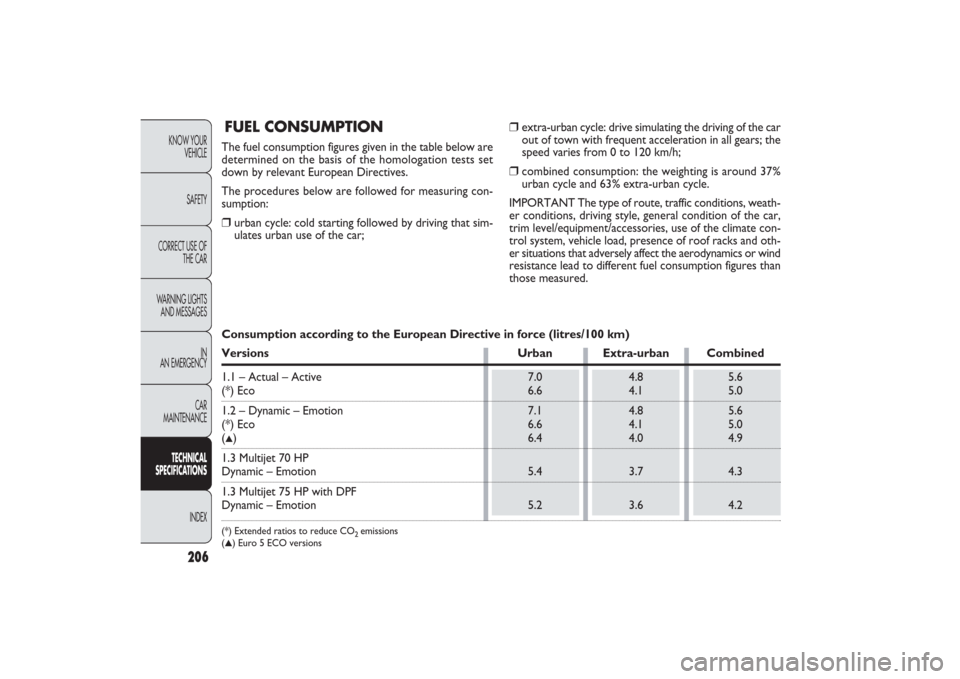
FUEL CONSUMPTIONThe fuel consumption figures given in the table below are
determined on the basis of the homologation tests set
down by relevant European Directives.
The procedures below are followed for measuring con-
sumption:❒
urban cycle: cold starting followed by driving that sim-
ulates urban use of the car;
Consumption according to the European Directive in force (litres/100 km)Versions Urban Extra-urban Combined
1.1 – Actual – Active 7.0 4.8 5.6(*) Eco 6.6 4.1 5.0
1.2 – Dynamic – Emotion 7.1 4.8 5.6
(*) Eco 6.6 4.1 5.0(▲) 6.4 4.0 4.9
1.3 Multijet 70 HP
Dynamic – Emotion 5.4 3.7 4.3
1.3 Multijet 75 HP with DPFDynamic – Emotion 5.2 3.6 4.2(*) Extended ratios to reduce CO
2 emissions
(
▲) Euro 5 ECO versions
191-214 PANDA EN 7-10-2009 14:18 Pagina 206
Page 222 of 226
221KNOW
YOUR VEHICLE
SAFETY
CORRECT USE
OF THE CAR
WARNING LIGHTS
AND MESSAGES
IN
AN EMERGENCY
CAR
MAINTENANCE
TECHNICAL
SPECIFICATIONSINDEX
– passenger compartment
ventilation and heating ......... 42
– system servicing ..................... 43
– windscreen and front side
window demisting/
defrosting ................................ 42
Mirror adjustment ....................... 36
MSR (system) ................................ 78
MSR system ................................... 78
Multifunction display ................... 17
– control buttons ...................... 19
– setup menu ............................. 20
– standard screen ..................... 17N
umber plate lights
– bulb replacement ................... 156
O
n board instruments (panel) .. 14
Paint (maintenance) ................... 188
– bodywork colour plate ........ 192
Paraflu
– level check and top-up ......... 177
– specifications .......................... 205Parking (sensors) ......................... 82
Parking lights ................................. 48
Parking sensors ............................ 82
Parking the vehicle ...................... 113
Passenger compartment light
adjustment .................................. 52
Performance ................................. 201
Pollen filter .................................... 181
Power sun roof ............................ 58
– opening/closing ...................... 59
Power windows ........................... 63
Preparation for child seats ........ 103
Q
uality specifications of fluid
and lubricants ................... 204-205
Radio transmitters and mobile
phones ......................................... 87
Radio transmitters and mobile
phones ......................................... 87
Rear door locking
emergency device ..................... 62
Rear fog light
– bulb replacement ................... 155– switching on ............................ 54
Rear fog lights ............................... 54
Rear fog lights
– bulb adjustment ..................... 156
– switching on ............................ 54
Rear light units
– bulb replacement ................... 155
Rear seats
– cleaning .................................... 190
– headrests ................................. 32
Rear view mirrors
– inside ........................................ 35
– outside ..................................... 36
Rear window washer ................... 51
– fluid level check
and top-up ............................... 178
– jet .............................................. 187
– operation ................................. 51
Rear window wiper
– blade replacement .................. 186
– operation .................................. 51
– rear window washer fluid
features ..................................... 179
215-224 PANDA EN 7-10-2009 15:09 Pagina 221
Page 223 of 226
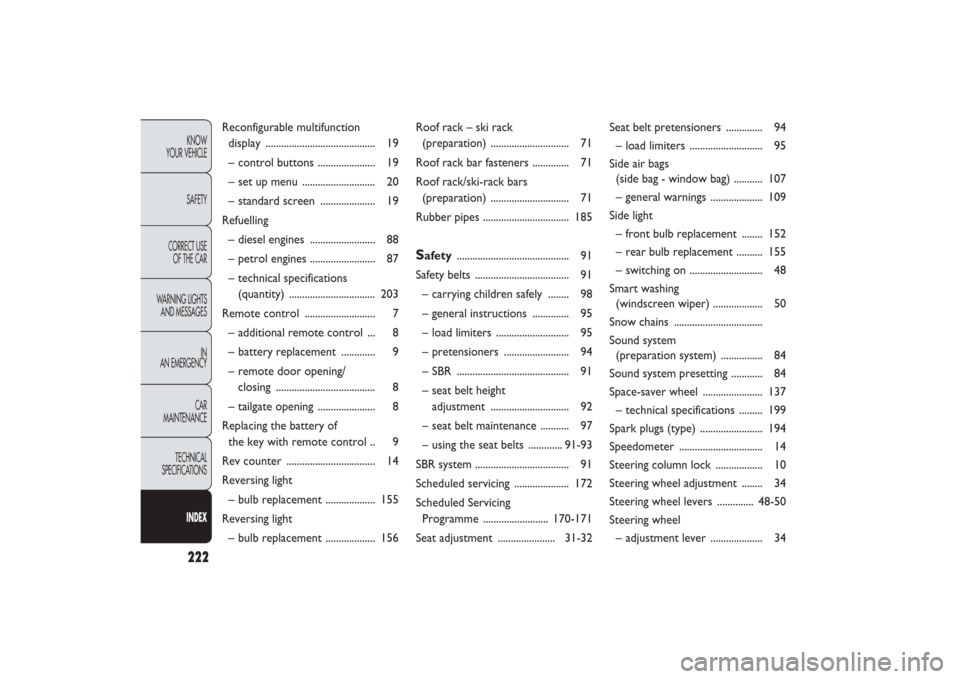
Reconfigurable multifunction
display .......................................... 19
– control buttons ...................... 19
– set up menu ............................ 20
– standard screen ..................... 19
Refuelling
– diesel engines ......................... 88
– petrol engines ......................... 87
– technical specifications
(quantity) ................................. 203
Remote control ........................... 7
– additional remote control ... 8
– battery replacement ............. 9
– remote door opening/
closing ...................................... 8
– tailgate opening ...................... 8
Replacing the battery of
the key with remote control .. 9
Rev counter .................................. 14
Reversing light
– bulb replacement ................... 155
Reversing light
– bulb replacement ................... 156Roof rack – ski rack
(preparation) .............................. 71
Roof rack bar fasteners .............. 71
Roof rack/ski-rack bars
(preparation) .............................. 71
Rubber pipes ................................. 185
Safety........................................... 91
Safety belts .................................... 91
– carrying children safely ........ 98
– general instructions .............. 95
– load limiters ............................ 95
– pretensioners ......................... 94
– SBR ........................................... 91
– seat belt height
adjustment .............................. 92
– seat belt maintenance ........... 97
– using the seat belts ............. 91-93
SBR system .................................... 91
Scheduled servicing ..................... 172
Scheduled Servicing
Programme ......................... 170-171
Seat adjustment ...................... 31-32Seat belt pretensioners .............. 94
– load limiters ............................ 95
Side air bags
(side bag - window bag) ........... 107
– general warnings .................... 109
Side light
– front bulb replacement ........ 152
– rear bulb replacement .......... 155
– switching on ............................ 48
Smart washing
(windscreen wiper) ................... 50
Snow chains ..................................
Sound system
(preparation system) ................ 84
Sound system presetting ............ 84
Space-saver wheel ....................... 137
– technical specifications ......... 199
Spark plugs (type) ........................ 194
Speedometer ................................ 14
Steering column lock .................. 10
Steering wheel adjustment ........ 34
Steering wheel levers .............. 48-50
Steering wheel
– adjustment lever .................... 34
222KNOW
YOUR VEHICLE
SAFETY
CORRECT USE
OF THE CAR
WARNING LIGHTS
AND MESSAGES
IN
AN EMERGENCY
CAR
MAINTENANCE
TECHNICAL
SPECIFICATIONSINDEX
215-224 PANDA EN 7-10-2009 15:09 Pagina 222