Steering FIAT PANDA 2009 169 / 2.G Owner's Manual
[x] Cancel search | Manufacturer: FIAT, Model Year: 2009, Model line: PANDA, Model: FIAT PANDA 2009 169 / 2.GPages: 226, PDF Size: 5.29 MB
Page 135 of 226
134
KNOW YOUR
VEHICLE
SAFETY
CORRECT USE
OF THE CAR
WARNING LIGHTS
AND MESSAGES
IN
AN EMERGENCY
CAR
MAINTENANCE
TECHNICAL
SPECIFICATIONS
INDEX
LIMITED RANGE (versions with reconfigurable
multifunction display)
The display will show the dedicated message to warn the
driver that the driving range is less than 50 km.
ASR SYSTEM (versions with reconfigurable mul-
tifunction display)
The ASR system can be turned off by pressing the button
ASR OFF.
The display will show the dedicated message to warn the
driver that the system is off; at the same time the button
LED will come on.
Pressing again the button ASR OFF, the button LED will
turn off and the display will show the dedicated message
to warn the driver that the system is on again. POSSIBLE PRESENCE OF ICE ON THE ROAD
(versions with reconfigurable multifunction
display)
When the outside temperature reaches or falls below
3 °C the outside temperature indication flashes to warn
the driver about the possible presence of ice on the road.
The display shows the dedicated message.
SPEED LIMIT EXCEEDED
The display will show the dedicated message when the car
exceeds the set speed limit (see “Multifunction Display” in
chapter “Know your vehicle”).“DUALDRIVE” ELECTRIC POWER
STEERING ACTIVATION (green)
The wording “CITY” will turn on when engag-
ing the “Dualdrive” electric power steering by pressing the
relevant button. Press the button again to turn the “CITY”
wording off.
MAIN BEAM HEADLIGHTS (blue)
The warning light comes on when the main
beams are turned on.
CITY1
123-134 PANDA EN 7-10-2009 13:49 Pagina 134
Page 137 of 226
136KNOW
YOUR VEHICLE
SAFETY
CORRECT USE
OF THE CAR
WARNING LIGHTS
AND MESSAGES
IN
AN EMERGENCYCAR
MAINTENANCE
TECHNICAL
SPECIFICATIONS
INDEX
Never use a fast battery-charger to start the
engine as this could damage the electron-
ic systems of your car, particularly the ig-
nition and fuel supply control units.This procedure must be performed by qual-
ified personnel as incorrect actions may
cause high-intensity electrical discharge. Further-
more, battery fluid is poisonous and corrosive: avoid
contact with your skin and eyes. Keep naked flames
away from the battery. No smoking. Do not cause
sparks.
WARNING
If after a few attempts the engine does not start, do not
insist rather contact the nearest Fiat Dealership.
IMPORTANT Do not directly connect the negative ter-
minals of the two batteries: any sparks may ignite the det-
onating gas which could come out of the battery. If the aux-
iliary battery is installed on another car, prevent any contact
between metal parts of the cars and the flat battery.
BUMP STARTING
Never bump start the engine by pushing, towing or driving
downhill.
This could cause a flow of fuel into the catalytic convert-
er and damage it beyond repair.
IMPORTANT Remember that the servo-brake and elec-
trical power steering system (for versions/markets where
provided) are not operating until the engine is started, a
greater effort will therefore be required to press the brake
pedal or turn the steering wheel. Proceed as follows to start the car:
❒
connect the positive terminals (+ sign close to the ter-
minal) of both batteries using a lead;
❒
with a second lead, connect the negative terminal − of
the auxiliary battery to an earthing point
E
on the en-
gine or the gearbox of the car to be started;
❒
start the engine;
❒
when the engine has been started, follow the sequence
above in reverse order to remove the leads.
135-168 PANDA EN 7-10-2009 14:06 Pagina 136
Page 138 of 226
137KNOW
YOUR VEHICLE
SAFETY
CORRECT USE
OF THE CAR
WARNING LIGHTS
AND MESSAGESIN
AN EMERGENCYCAR
MAINTENANCE
TECHNICAL
SPECIFICATIONS
INDEX
REPLACING A WHEELGENERAL INSTRUCTIONS
The car can be delivered (upon request/where provided)
with standard spare wheel or space-saver wheel; see
changing instructions on the following paragraphs. Wheel
changing and correct use of the jack and spare wheel call
for some precautions as listed below.
The space-saver wheel (where provided) is
specific to your car, do not use it on other
models, nor use the spare wheel of other models
on your car. The space-saver wheel must only be
used in case of emergency. It shall only be used for
the distance necessary to reach a service point and
the car speed shall not exceed 80 km/h. The spare
wheel has an orange sticker that summarises the
main cautions for use and limitations. The sticker
should never be removed or covered. Never apply
a wheel cup on a space-saver wheel. The sticker
gives the following information in four languages:
Caution! For temporary use only! 80 km/h max.!
Replace by standard wheel as soon as possible. Do
not cover this label in use. If you change the type
of wheel (alloy rims instead of steel rims) you will
have to change the entire set of fastening bolts with
another set of suitably sized bolts.
WARNING
Alert other drivers that the car is station-
ary in compliance with local regulations:
hazard warning lights, warning triangle, etc. Any
passengers on board should leave the car, espe-
cially if it is heavily laden. Passengers should stay
away from on-coming traffic while the wheel is
being changed. If parked on a slope or rough sur-
face, chock the wheels with wedges or other suit-
able devices.
WARNING
The driving features of the car may change
when a space-saver wheel is fitted. Avoid
sudden acceleration and braking, sudden steering
and fast cornering. The total life of a space-saver
wheel is approximately 3000 km, after which it
must be replaced by another wheel of the same
type. Never attempt to fit a conventional tyre on
a rim designed for use as a space-saver wheel.
Have the punctured wheel repaired and replaced
as soon as possible. Two or more space-saver
wheels should never be used together. Do not
grease the threads of bolts before installing them:
they might slip out.
WARNING
135-168 PANDA EN 7-10-2009 14:06 Pagina 137
Page 162 of 226
161KNOW
YOUR VEHICLE
SAFETY
CORRECT USE
OF THE CAR
WARNING LIGHTS
AND MESSAGESIN
AN EMERGENCYCAR
MAINTENANCE
TECHNICAL
SPECIFICATIONS
INDEX
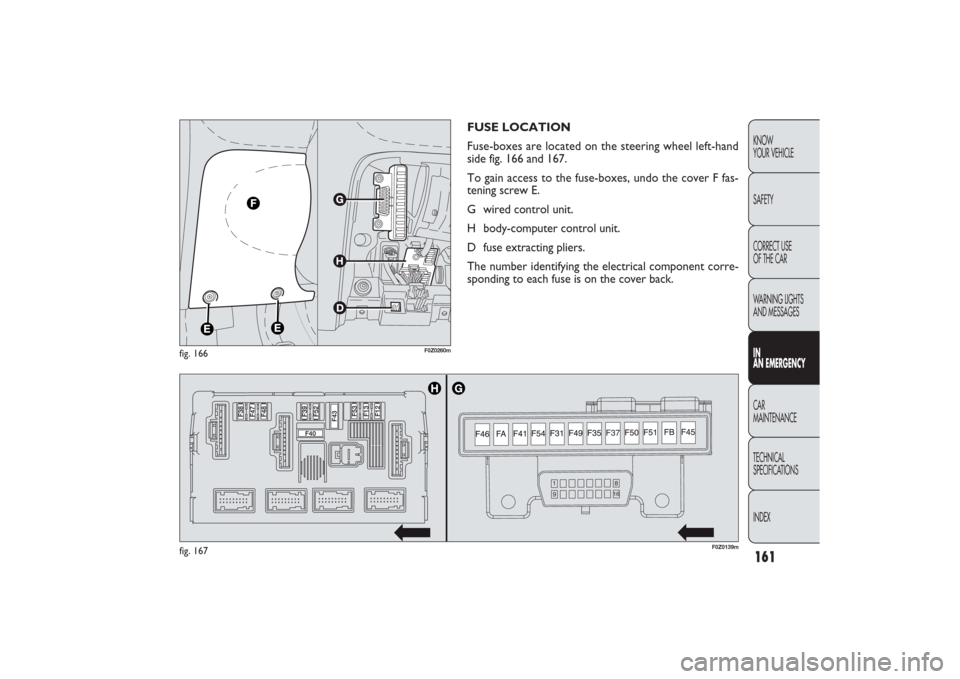
FUSE LOCATION
Fuse-boxes are located on the steering wheel left-hand
side fig. 166 and 167.
To gain access to the fuse-boxes, undo the cover F fas-
tening screw E.
G wired control unit.
H body-computer control unit.
D fuse extracting pliers.
The number identifying the electrical component corre-
sponding to each fuse is on the cover back.
fig. 167 fig. 166
F37
18
9
16
F0Z0139m
F0Z0260m
135-168 PANDA EN 7-10-2009 14:07 Pagina 161
Page 166 of 226
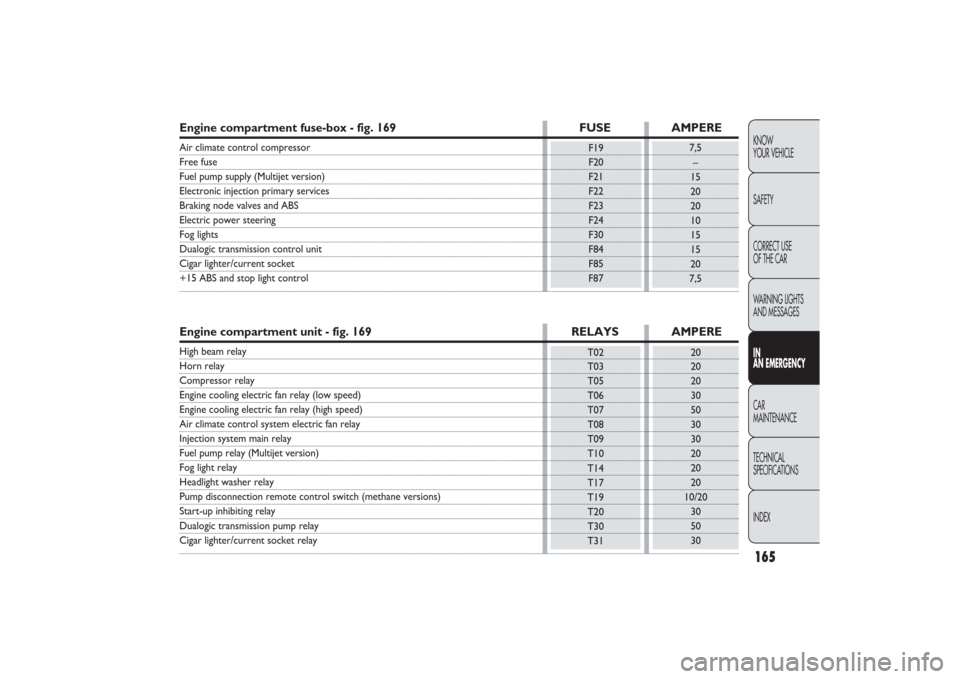
7,5
–
15
20
20
10
15
15
20
7,5
F19
F20
F21
F22
F23
F24
F30
F84
F85
F87
Engine compartment fuse-box - fig. 169 FUSE AMPEREAir climate control compressorFree fuse Fuel pump supply (Multijet version)Electronic injection primary servicesBraking node valves and ABSElectric power steeringFog lightsDualogic transmission control unitCigar lighter/current socket +15 ABS and stop light control
165KNOW
YOUR VEHICLE
SAFETY
CORRECT USE
OF THE CAR
WARNING LIGHTS
AND MESSAGESIN
AN EMERGENCYCAR
MAINTENANCE
TECHNICAL
SPECIFICATIONS
INDEX
20
20
20
30
50
30
30
20
20
20
10/20
30
50
30
T02
T03
T05
T06
T07
T08
T09
T10
T14
T17
T19
T20
T30
T31
Engine compartment unit - fig. 169 RELAYS AMPEREHigh beam relayHorn relayCompressor relayEngine cooling electric fan relay (low speed)Engine cooling electric fan relay (high speed)Air climate control system electric fan relayInjection system main relayFuel pump relay (Multijet version)Fog light relayHeadlight washer relayPump disconnection remote control switch (methane versions)Start-up inhibiting relayDualogic transmission pump relayCigar lighter/current socket relay
135-168 PANDA EN 7-10-2009 14:07 Pagina 165
Page 169 of 226
168KNOW
YOUR VEHICLE
SAFETY
CORRECT USE
OF THE CAR
WARNING LIGHTS
AND MESSAGES
IN
AN EMERGENCYCAR
MAINTENANCE
TECHNICAL
SPECIFICATIONS
INDEX
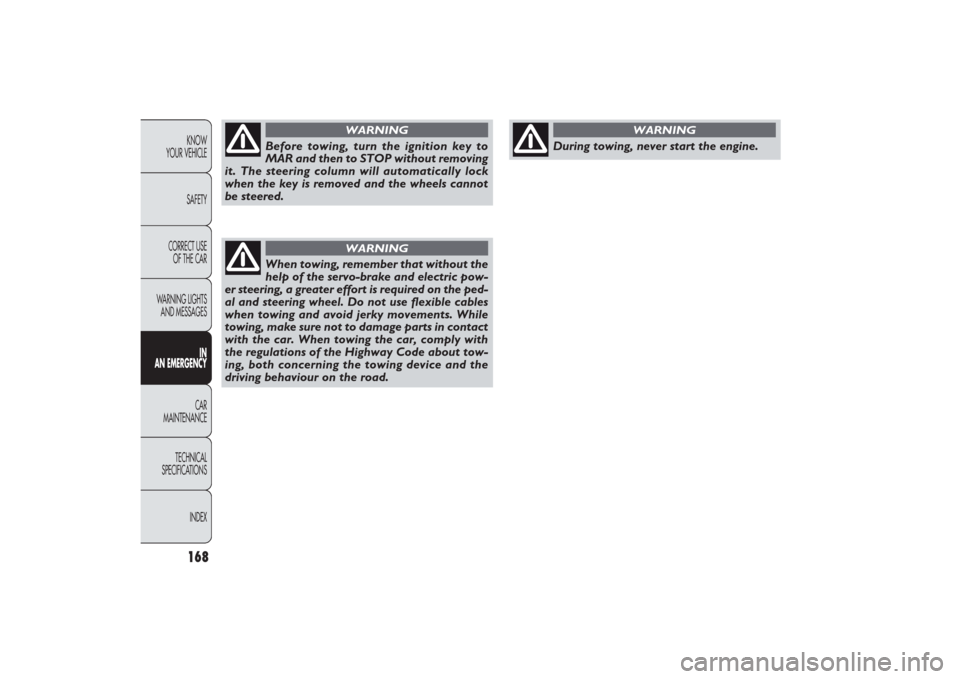
Before towing, turn the ignition key to
MAR and then to STOP without removing
it. The steering column will automatically lock
when the key is removed and the wheels cannot
be steered.
WARNING
When towing, remember that without the
help of the servo-brake and electric pow-
er steering, a greater effort is required on the ped-
al and steering wheel. Do not use flexible cables
when towing and avoid jerky movements. While
towing, make sure not to damage parts in contact
with the car. When towing the car, comply with
the regulations of the Highway Code about tow-
ing, both concerning the towing device and the
driving behaviour on the road.
WARNING
During towing, never start the engine.
WARNING
135-168 PANDA EN 7-10-2009 14:07 Pagina 168
Page 185 of 226
184KNOW
YOUR VEHICLE
SAFETY
CORRECT USE
OF THE CAR
WARNING LIGHTS
AND MESSAGES
IN
AN EMERGENCYCAR
MAINTENANCE
TECHNICAL
SPECIFICATIONS
INDEX
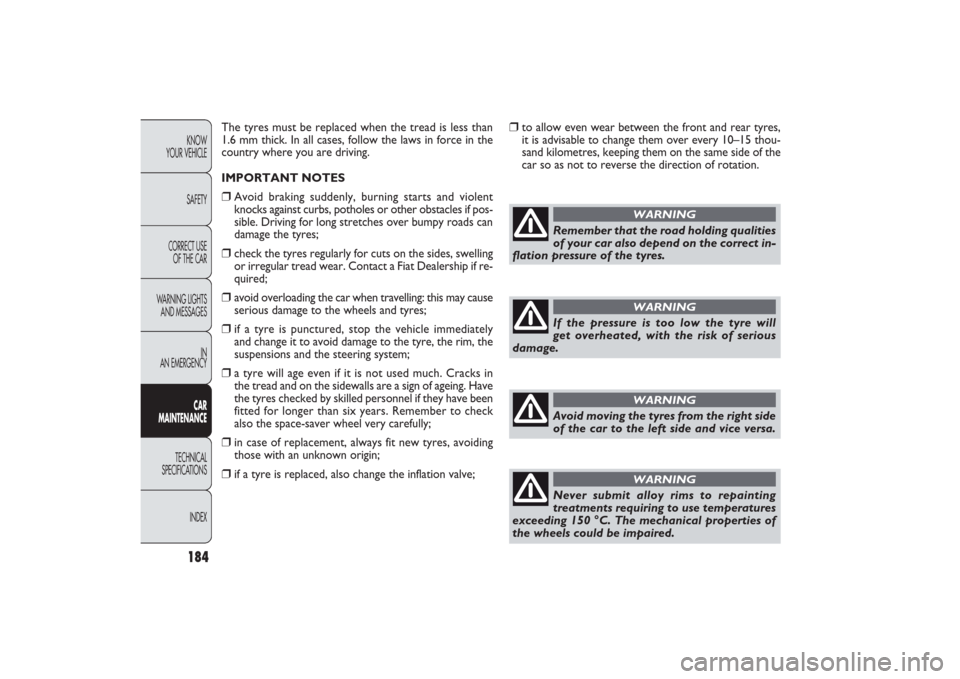
❒
to allow even wear between the front and rear tyres,
it is advisable to change them over every 10–15 thou-
sand kilometres, keeping them on the same side of the
car so as not to reverse the direction of rotation. The tyres must be replaced when the tread is less than
1.6 mm thick. In all cases, follow the laws in force in the
country where you are driving.
IMPORTANT NOTES
❒
Avoid braking suddenly, burning starts and violent
knocks against curbs, potholes or other obstacles if pos-
sible. Driving for long stretches over bumpy roads can
damage the tyres;
❒
check the tyres regularly for cuts on the sides, swelling
or irregular tread wear. Contact a Fiat Dealership if re-
quired;
❒
avoid overloading the car when travelling: this may cause
serious damage to the wheels and tyres;
❒
if a tyre is punctured, stop the vehicle immediately
and change it to avoid damage to the tyre, the rim, the
suspensions and the steering system;
❒
a tyre will age even if it is not used much. Cracks in
the tread and on the sidewalls are a sign of ageing. Have
the tyres checked by skilled personnel if they have been
fitted for longer than six years. Remember to check
also the space-saver wheel very carefully;
❒
in case of replacement, always fit new tyres, avoiding
those with an unknown origin;
❒
if a tyre is replaced, also change the inflation valve;
Remember that the road holding qualities
of your car also depend on the correct in-
flation pressure of the tyres.
WARNING
If the pressure is too low the tyre will
get overheated, with the risk of serious
damage.
WARNING
Avoid moving the tyres from the right side
of the car to the left side and vice versa.
WARNING
Never submit alloy rims to repainting
treatments requiring to use temperatures
exceeding 150 °C. The mechanical properties of
the wheels could be impaired.
WARNING
169-190 PANDA EN 7-10-2009 14:15 Pagina 184
Page 197 of 226
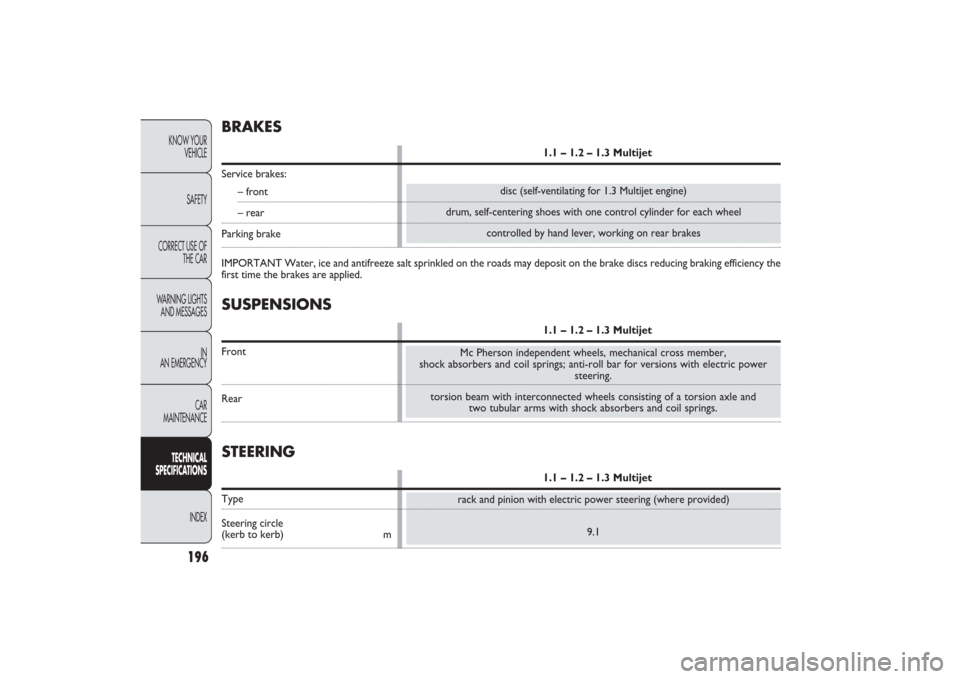
Mc Pherson independent wheels, mechanical cross member,
shock absorbers and coil springs; anti-roll bar for versions with electric power
steering.
torsion beam with interconnected wheels consisting of a torsion axle and
two tubular arms with shock absorbers and coil springs.rack and pinion with electric power steering (where provided)
9.1
disc (self-ventilating for 1.3 Multijet engine)
drum, self-centering shoes with one control cylinder for each wheel
controlled by hand lever, working on rear brakes
196
KNOW YOUR
VEHICLE
SAFETY
CORRECT USE OF
THE CAR
WARNING LIGHTS
AND MESSAGES
IN
AN EMERGENCY
CAR
MAINTENANCETECHNICAL
SPECIFICATIONS
INDEX
SUSPENSIONS
1.1 – 1.2 – 1.3 Multijet
Front
RearBRAKES
1.1 – 1.2 – 1.3 Multijet
Service brakes:
– front– rear
Parking brake
IMPORTANT Water, ice and antifreeze salt sprinkled on the roads may deposit on the brake discs reducing braking efficiency the
first time the brakes are applied.STEERING
1.1 – 1.2 – 1.3 Multijet
Type
Steering circle (kerb to kerb) m
191-214 PANDA EN 7-10-2009 14:17 Pagina 196
Page 218 of 226
217KNOW
YOUR VEHICLE
SAFETY
CORRECT USE
OF THE CAR
WARNING LIGHTS
AND MESSAGES
IN
AN EMERGENCY
CAR
MAINTENANCE
TECHNICAL
SPECIFICATIONSINDEX
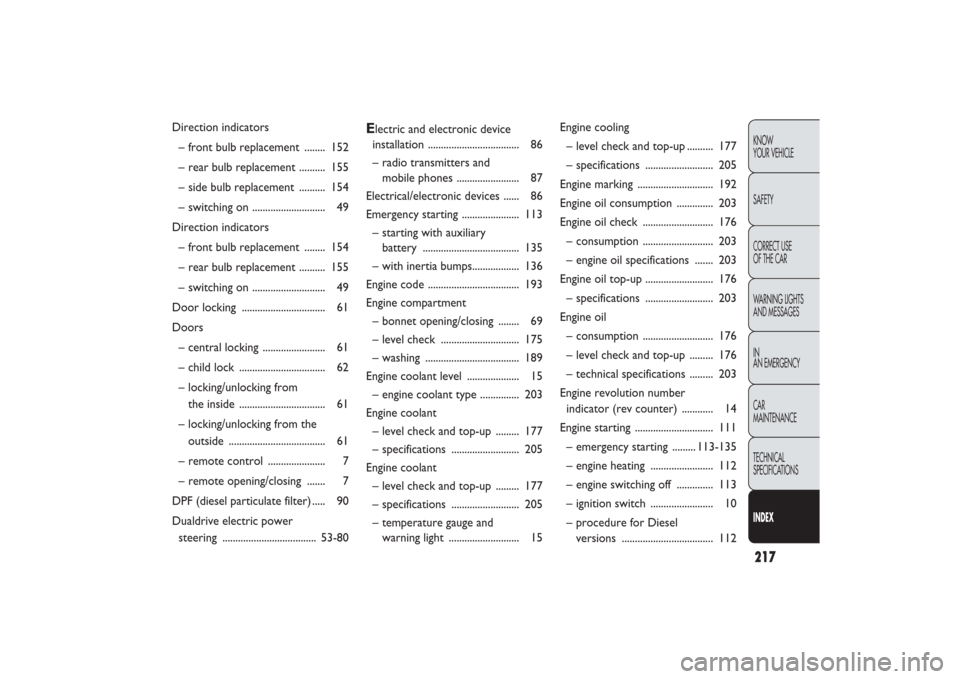
Electric and electronic device
installation ................................... 86
– radio transmitters and
mobile phones ........................ 87
Electrical/electronic devices ...... 86
Emergency starting ...................... 113
– starting with auxiliary
battery ..................................... 135
– with inertia bumps.................. 136
Engine code ................................... 193
Engine compartment
– bonnet opening/closing ........ 69
– level check .............................. 175
– washing .................................... 189
Engine coolant level .................... 15
– engine coolant type ............... 203
Engine coolant
– level check and top-up ......... 177
– specifications .......................... 205
Engine coolant
– level check and top-up ......... 177
– specifications .......................... 205
– temperature gauge and
warning light ........................... 15Engine cooling
– level check and top-up .......... 177
– specifications .......................... 205
Engine marking ............................. 192
Engine oil consumption .............. 203
Engine oil check ........................... 176
– consumption ........................... 203
– engine oil specifications ....... 203
Engine oil top-up .......................... 176
– specifications .......................... 203
Engine oil
– consumption ........................... 176
– level check and top-up ......... 176
– technical specifications ......... 203
Engine revolution number
indicator (rev counter) ............ 14
Engine starting .............................. 111
– emergency starting ......... 113-135
– engine heating ........................ 112
– engine switching off .............. 113
– ignition switch ........................ 10
– procedure for Diesel
versions ................................... 112 Direction indicators
– front bulb replacement ........ 152
– rear bulb replacement .......... 155
– side bulb replacement .......... 154
– switching on ............................ 49
Direction indicators
– front bulb replacement ........ 154
– rear bulb replacement .......... 155
– switching on ............................ 49
Door locking ................................ 61
Doors
– central locking ........................ 61
– child lock ................................. 62
– locking/unlocking from
the inside ................................. 61
– locking/unlocking from the
outside ..................................... 61
– remote control ...................... 7
– remote opening/closing ....... 7
DPF (diesel particulate filter) ..... 90
Dualdrive electric power
steering .................................... 53-80
215-224 PANDA EN 7-10-2009 15:09 Pagina 217
Page 220 of 226
219KNOW
YOUR VEHICLE
SAFETY
CORRECT USE
OF THE CAR
WARNING LIGHTS
AND MESSAGES
IN
AN EMERGENCY
CAR
MAINTENANCE
TECHNICAL
SPECIFICATIONSINDEX
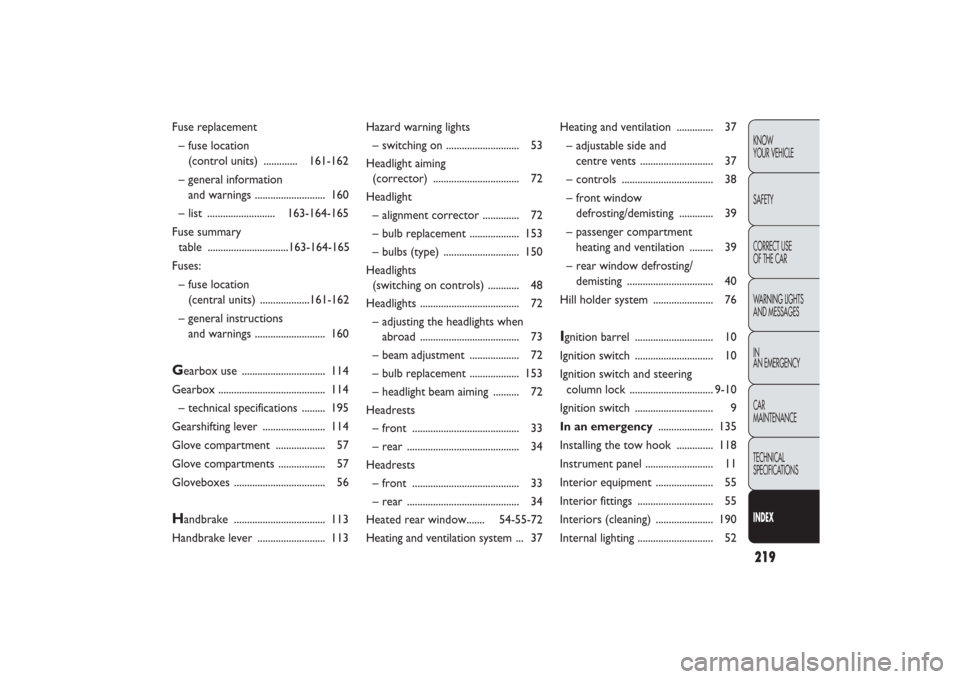
Fuse replacement
– fuse location
(control units) ............. 161-162
– general information
and warnings ........................... 160
– list .......................... 163-164-165
Fuse summary
table ...............................163-164-165
Fuses:
– fuse location
(central units) ...................161-162
– general instructions
and warnings ........................... 160G
earbox use ................................ 114
Gearbox ......................................... 114
– technical specifications ......... 195
Gearshifting lever ........................ 114
Glove compartment ................... 57
Glove compartments .................. 57
Gloveboxes ................................... 56
H
andbrake ................................... 113
Handbrake lever .......................... 113Hazard warning lights
– switching on ............................ 53
Headlight aiming
(corrector) ................................. 72
Headlight
– alignment corrector .............. 72
– bulb replacement ................... 153
– bulbs (type) ............................. 150
Headlights
(switching on controls) ............ 48
Headlights ...................................... 72
– adjusting the headlights when
abroad ...................................... 73
– beam adjustment ................... 72
– bulb replacement ................... 153
– headlight beam aiming .......... 72
Headrests
– front ......................................... 33
– rear ........................................... 34
Headrests
– front ......................................... 33
– rear ........................................... 34
Heated rear window....... 54-55-72
Heating and ventilation system ... 37Heating and ventilation .............. 37
– adjustable side and
centre vents ............................ 37
– controls ................................... 38
– front window
defrosting/demisting ............. 39
– passenger compartment
heating and ventilation ......... 39
– rear window defrosting/
demisting ................................. 40
Hill holder system ....................... 76
Ignition barrel .............................. 10
Ignition switch .............................. 10
Ignition switch and steering
column lock ................................ 9-10
Ignition switch .............................. 9
In an emergency..................... 135
Installing the tow hook .............. 118
Instrument panel .......................... 11
Interior equipment ...................... 55
Interior fittings ............................. 55
Interiors (cleaning) ...................... 190
Internal lighting ............................. 52
215-224 PANDA EN 7-10-2009 15:09 Pagina 219