fuel FIAT PANDA 2009 169 / 2.G Owner's Manual
[x] Cancel search | Manufacturer: FIAT, Model Year: 2009, Model line: PANDA, Model: FIAT PANDA 2009 169 / 2.GPages: 226, PDF Size: 5.29 MB
Page 132 of 226
131KNOW
YOUR VEHICLE
SAFETY
CORRECT USE
OF THE CARWARNING LIGHTS
AND MESSAGESIN
AN EMERGENCY
CAR
MAINTENANCE
TECHNICAL
SPECIFICATIONS
INDEX
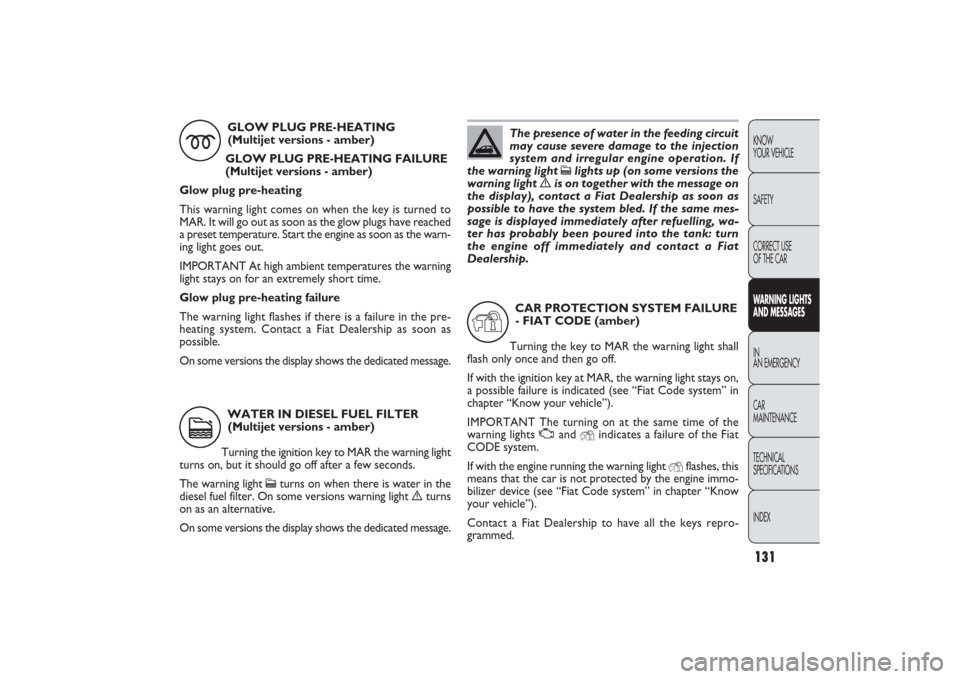
CAR PROTECTION SYSTEM FAILURE
- FIAT CODE (amber)
Turning the key to MAR the warning light shall
flash only once and then go off.
If with the ignition key at MAR, the warning light stays on,
a possible failure is indicated (see “Fiat Code system” in
chapter “Know your vehicle”).
IMPORTANT The turning on at the same time of the
warning lights
U
and
Y
indicates a failure of the Fiat
CODE system.
If with the engine running the warning light
Y
flashes, this
means that the car is not protected by the engine immo-
bilizer device (see “Fiat Code system” in chapter “Know
your vehicle”).
Contact a Fiat Dealership to have all the keys repro-
grammed. WATER IN DIESEL FUEL FILTER
(Multijet versions - amber)
Turning the ignition key to MAR the warning light
turns on, but it should go off after a few seconds.
The warning light
c
turns on when there is water in the
diesel fuel filter. On some versions warning light èturns
on as an alternative.
On some versions the display shows the dedicated message.
The presence of water in the feeding circuit
may cause severe damage to the injection
system and irregular engine operation. If
the warning light
c
lights up (on some versions the
warning light èis on together with the message on
the display), contact a Fiat Dealership as soon as
possible to have the system bled. If the same mes-
sage is displayed immediately after refuelling, wa-
ter has probably been poured into the tank: turn
the engine off immediately and contact a Fiat
Dealership.
c
Y
GLOW PLUG PRE-HEATING
(Multijet versions - amber)
GLOW PLUG PRE-HEATING FAILURE
(Multijet versions - amber)
Glow plug pre-heating
This warning light comes on when the key is turned to
MAR. It will go out as soon as the glow plugs have reached
a preset temperature. Start the engine as soon as the warn-
ing light goes out.
IMPORTANT At high ambient temperatures the warning
light stays on for an extremely short time.
Glow plug pre-heating failure
The warning light flashes if there is a failure in the pre-
heating system. Contact a Fiat Dealership as soon as
possible.
On some versions the display shows the dedicated message.
m
123-134 PANDA EN 7-10-2009 13:49 Pagina 131
Page 133 of 226
132
KNOW YOUR
VEHICLE
SAFETY
CORRECT USE
OF THE CAR
WARNING LIGHTS
AND MESSAGES
IN
AN EMERGENCY
CAR
MAINTENANCE
TECHNICAL
SPECIFICATIONS
INDEX
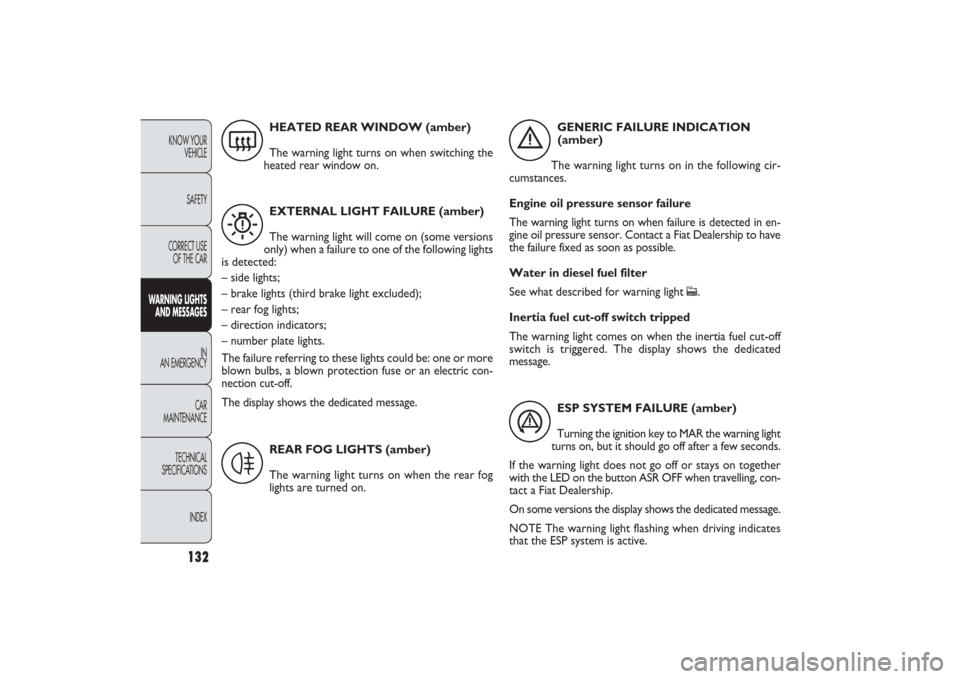
ESP SYSTEM FAILURE (amber)
Turning the ignition key to MAR the warning light
turns on, but it should go off after a few seconds.
If the warning light does not go off or stays on together
with the LED on the button ASR OFF when travelling, con-
tact a Fiat Dealership.
On some versions the display shows the dedicated message.
NOTE The warning light flashing when driving indicates
that the ESP system is active.
á
GENERIC FAILURE INDICATION
(amber)
The warning light turns on in the following cir-
cumstances.
Engine oil pressure sensor failure
The warning light turns on when failure is detected in en-
gine oil pressure sensor. Contact a Fiat Dealership to have
the failure fixed as soon as possible.
Water in diesel fuel filter
See what described for warning light
c.
Inertia fuel cut-off switch tripped
The warning light comes on when the inertia fuel cut-off
switch is triggered. The display shows the dedicated
message.
è
EXTERNAL LIGHT FAILURE (amber)
The warning light will come on (some versions
only) when a failure to one of the following lights
is detected:
– side lights;
– brake lights (third brake light excluded);
– rear fog lights;
– direction indicators;
– number plate lights.
The failure referring to these lights could be: one or more
blown bulbs, a blown protection fuse or an electric con-
nection cut-off.
The display shows the dedicated message.
W
REAR FOG LIGHTS (amber)
The warning light turns on when the rear fog
lights are turned on.
4
HEATED REAR WINDOW (amber)
The warning light turns on when switching the
heated rear window on.
(
123-134 PANDA EN 7-10-2009 13:49 Pagina 132
Page 137 of 226
136KNOW
YOUR VEHICLE
SAFETY
CORRECT USE
OF THE CAR
WARNING LIGHTS
AND MESSAGES
IN
AN EMERGENCYCAR
MAINTENANCE
TECHNICAL
SPECIFICATIONS
INDEX
Never use a fast battery-charger to start the
engine as this could damage the electron-
ic systems of your car, particularly the ig-
nition and fuel supply control units.This procedure must be performed by qual-
ified personnel as incorrect actions may
cause high-intensity electrical discharge. Further-
more, battery fluid is poisonous and corrosive: avoid
contact with your skin and eyes. Keep naked flames
away from the battery. No smoking. Do not cause
sparks.
WARNING
If after a few attempts the engine does not start, do not
insist rather contact the nearest Fiat Dealership.
IMPORTANT Do not directly connect the negative ter-
minals of the two batteries: any sparks may ignite the det-
onating gas which could come out of the battery. If the aux-
iliary battery is installed on another car, prevent any contact
between metal parts of the cars and the flat battery.
BUMP STARTING
Never bump start the engine by pushing, towing or driving
downhill.
This could cause a flow of fuel into the catalytic convert-
er and damage it beyond repair.
IMPORTANT Remember that the servo-brake and elec-
trical power steering system (for versions/markets where
provided) are not operating until the engine is started, a
greater effort will therefore be required to press the brake
pedal or turn the steering wheel. Proceed as follows to start the car:
❒
connect the positive terminals (+ sign close to the ter-
minal) of both batteries using a lead;
❒
with a second lead, connect the negative terminal − of
the auxiliary battery to an earthing point
E
on the en-
gine or the gearbox of the car to be started;
❒
start the engine;
❒
when the engine has been started, follow the sequence
above in reverse order to remove the leads.
135-168 PANDA EN 7-10-2009 14:06 Pagina 136
Page 164 of 226
163KNOW
YOUR VEHICLE
SAFETY
CORRECT USE
OF THE CAR
WARNING LIGHTS
AND MESSAGESIN
AN EMERGENCYCAR
MAINTENANCE
TECHNICAL
SPECIFICATIONS
INDEX
5
7,5
7,5
10
7,5
15
15
7,5
7,5
7,5
7,5
5
5
15
–
–
7,5
7,5
7,5
20
10
10
10
10
F31
F35
F35
F37
F41
F45
F46
F49
F49
F49
F50
F51
F51
F54
FA
FB
F12
F13
F13
F38
F39
F39
F39
F39
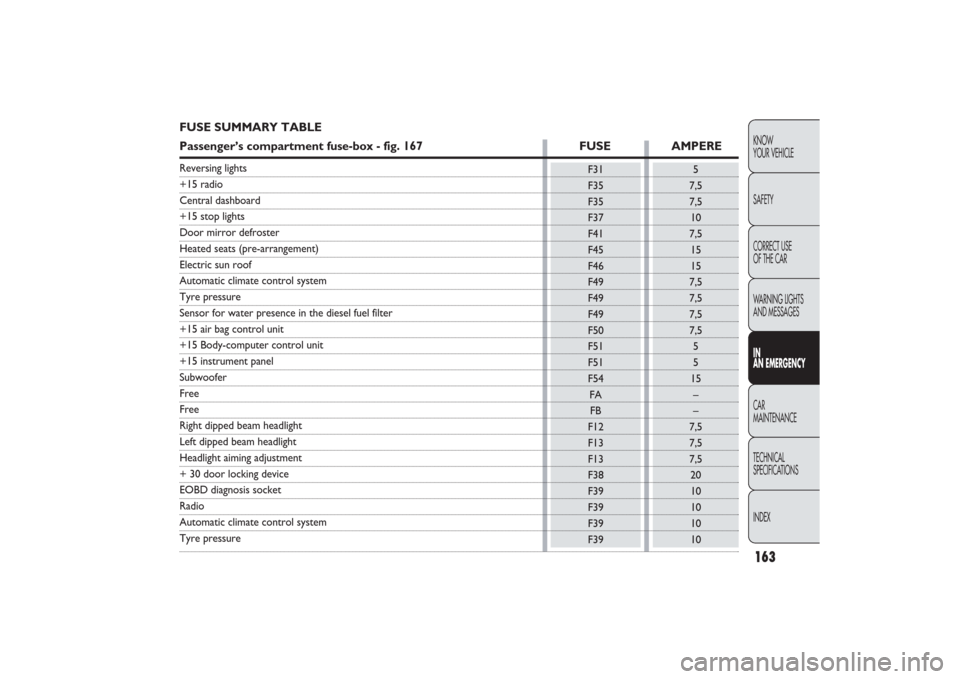
FUSE SUMMARY TABLEPassenger’s compartment fuse-box - fig. 167 FUSE AMPEREReversing lights+15 radioCentral dashboard+15 stop lightsDoor mirror defroster Heated seats (pre-arrangement)Electric sun roofAutomatic climate control systemTyre pressureSensor for water presence in the diesel fuel filter +15 air bag control unit+15 Body-computer control unit+15 instrument panelSubwooferFreeFreeRight dipped beam headlightLeft dipped beam headlightHeadlight aiming adjustment+ 30 door locking deviceEOBD diagnosis socketRadioAutomatic climate control systemTyre pressure
135-168 PANDA EN 7-10-2009 14:07 Pagina 163
Page 166 of 226
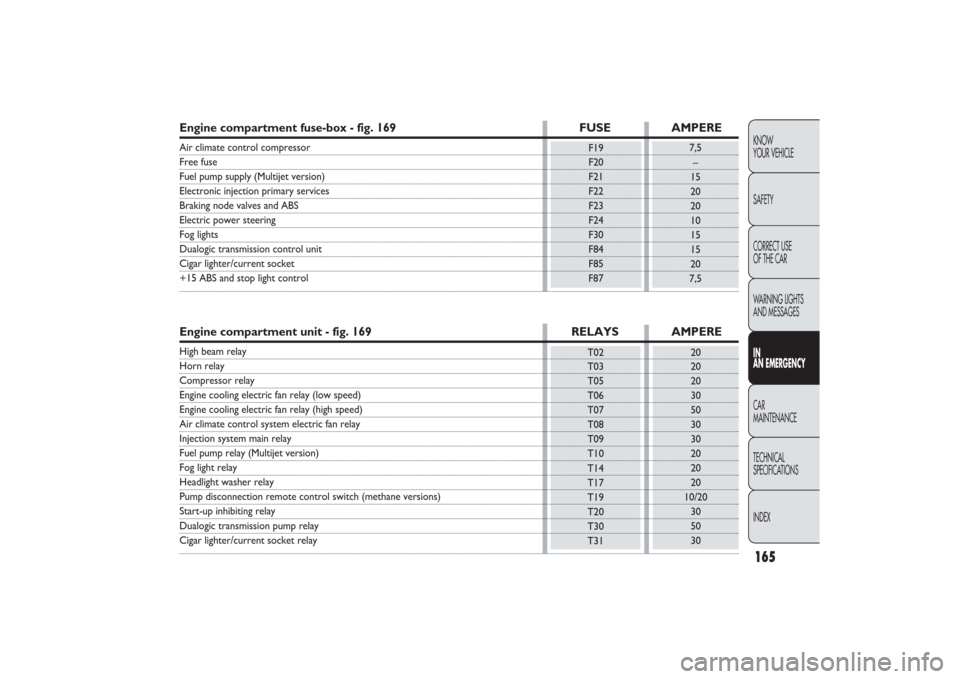
7,5
–
15
20
20
10
15
15
20
7,5
F19
F20
F21
F22
F23
F24
F30
F84
F85
F87
Engine compartment fuse-box - fig. 169 FUSE AMPEREAir climate control compressorFree fuse Fuel pump supply (Multijet version)Electronic injection primary servicesBraking node valves and ABSElectric power steeringFog lightsDualogic transmission control unitCigar lighter/current socket +15 ABS and stop light control
165KNOW
YOUR VEHICLE
SAFETY
CORRECT USE
OF THE CAR
WARNING LIGHTS
AND MESSAGESIN
AN EMERGENCYCAR
MAINTENANCE
TECHNICAL
SPECIFICATIONS
INDEX
20
20
20
30
50
30
30
20
20
20
10/20
30
50
30
T02
T03
T05
T06
T07
T08
T09
T10
T14
T17
T19
T20
T30
T31
Engine compartment unit - fig. 169 RELAYS AMPEREHigh beam relayHorn relayCompressor relayEngine cooling electric fan relay (low speed)Engine cooling electric fan relay (high speed)Air climate control system electric fan relayInjection system main relayFuel pump relay (Multijet version)Fog light relayHeadlight washer relayPump disconnection remote control switch (methane versions)Start-up inhibiting relayDualogic transmission pump relayCigar lighter/current socket relay
135-168 PANDA EN 7-10-2009 14:07 Pagina 165
Page 171 of 226
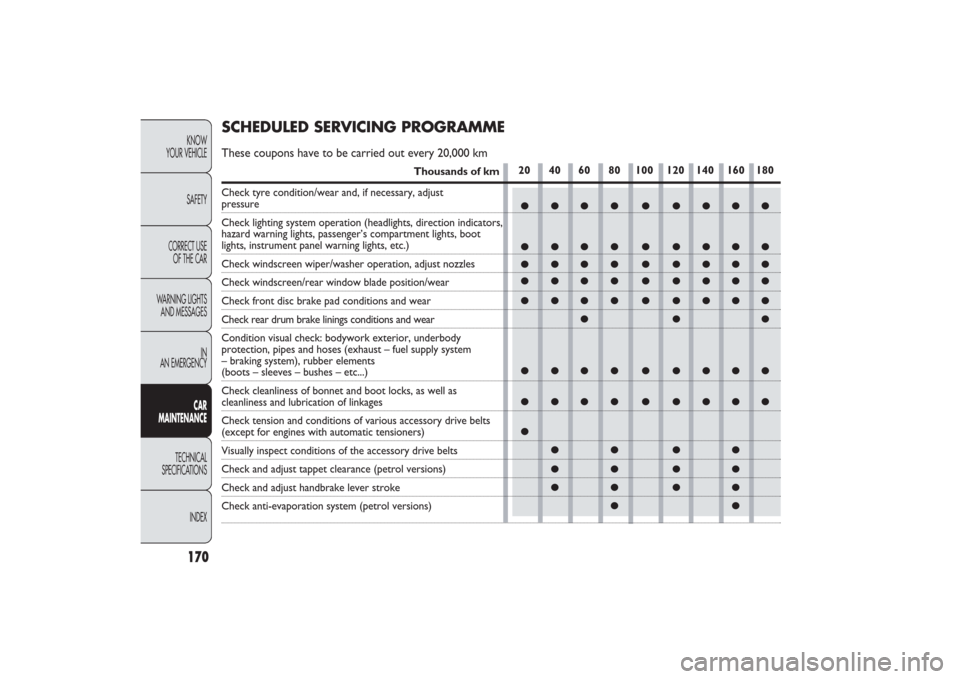
●●●● ● ●●●●
●●●● ● ●●●●
●●●● ● ●●●●
●●●● ● ●●●●
●●●● ● ●●●●
●●●
●●●● ● ●●●●
●●●● ● ●●●●
●
●● ●●
●● ●●
●● ●●
●●20 40 60 80 100 120 140 160 180
SCHEDULED SERVICING PROGRAMMEThese coupons have to be carried out every 20,000 km
Thousands of km
Check tyre condition/wear and, if necessary, adjust
pressure
Check lighting system operation (headlights, direction indicators,
hazard warning lights, passenger’s compartment lights, boot lights, instrument panel warning lights, etc.)Check windscreen wiper/washer operation, adjust nozzlesCheck windscreen/rear window blade position/wearCheck front disc brake pad conditions and wearCheck rear drum brake linings conditions and wear
Condition visual check: bodywork exterior, underbody
protection, pipes and hoses (exhaust – fuel supply system
– braking system), rubber elements (boots – sleeves – bushes – etc...)
Check cleanliness of bonnet and boot locks, as well as cleanliness and lubrication of linkages
Check tension and conditions of various accessory drive belts (except for engines with automatic tensioners)Visually inspect conditions of the accessory drive beltsCheck and adjust tappet clearance (petrol versions)Check and adjust handbrake lever stroke Check anti-evaporation system (petrol versions)
INDEX TECHNICAL
SPECIFICATIONSCAR
MAINTENANCEIN
AN EMERGENCY WARNING LIGHTS
AND MESSAGESCORRECT USE
OF THE CARSAFETYKNOW
YOUR VEHICLE
170
169-190 PANDA EN 7-10-2009 14:14 Pagina 170
Page 172 of 226
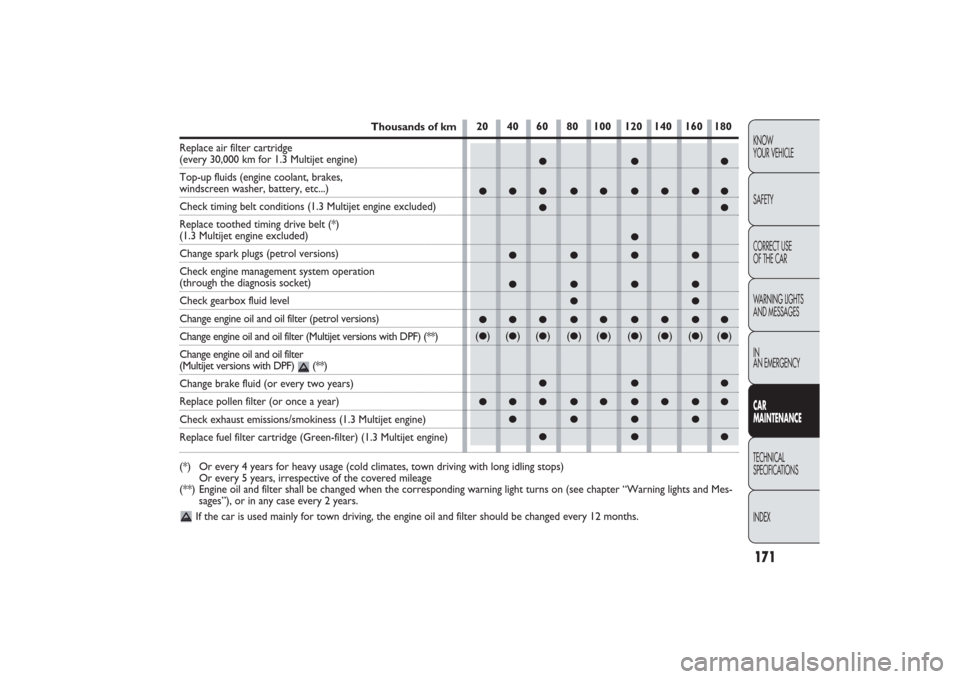
●●●
●●● ●● ●● ●●
●●
●
●●●●
●●●●
●●
●●● ●● ●● ●●
(●)(
●)(
●)(
●)(
●)(
●)(
●)(
●)(
●)
●●●
●●● ●● ●● ●●
●●●●
●●●
20 40 60 80 100 120 140 160 180
Thousands of km
Replace air filter cartridge
(every 30,000 km for 1.3 Multijet engine)
Top-up fluids (engine coolant, brakes, windscreen washer, battery, etc...)Check timing belt conditions (1.3 Multijet engine excluded)
Replace toothed timing drive belt (*) (1.3 Multijet engine excluded)Change spark plugs (petrol versions)
Check engine management system operation (through the diagnosis socket)Check gearbox fluid levelChange engine oil and oil filter (petrol versions)Change engine oil and oil filter (Multijet versions with DPF) (**)
Change engine oil and oil filter (Multijet versions with DPF) (**)Change brake fluid (or every two years)Replace pollen filter (or once a year)Check exhaust emissions/smokiness (1.3 Multijet engine)Replace fuel filter cartridge (Green-filter) (1.3 Multijet engine)
(*) Or every 4 years for heavy usage (cold climates, town driving with long idling stops)
Or every 5 years, irrespective of the covered mileage
(**) Engine oil and filter shall be changed when the corresponding warning light turns on (see chapter “Warning lights and Mes-
sages”), or in any case every 2 years.
If the car is used mainly for town driving, the engine oil and filter should be changed every 12 months.
INDEX TECHNICAL
SPECIFICATIONSCAR
MAINTENANCEIN
AN EMERGENCY WARNING LIGHTS
AND MESSAGES CORRECT USE
OF THE CAR SAFETY KNOW
YOUR VEHICLE171
169-190 PANDA EN 7-10-2009 14:14 Pagina 171
Page 173 of 226
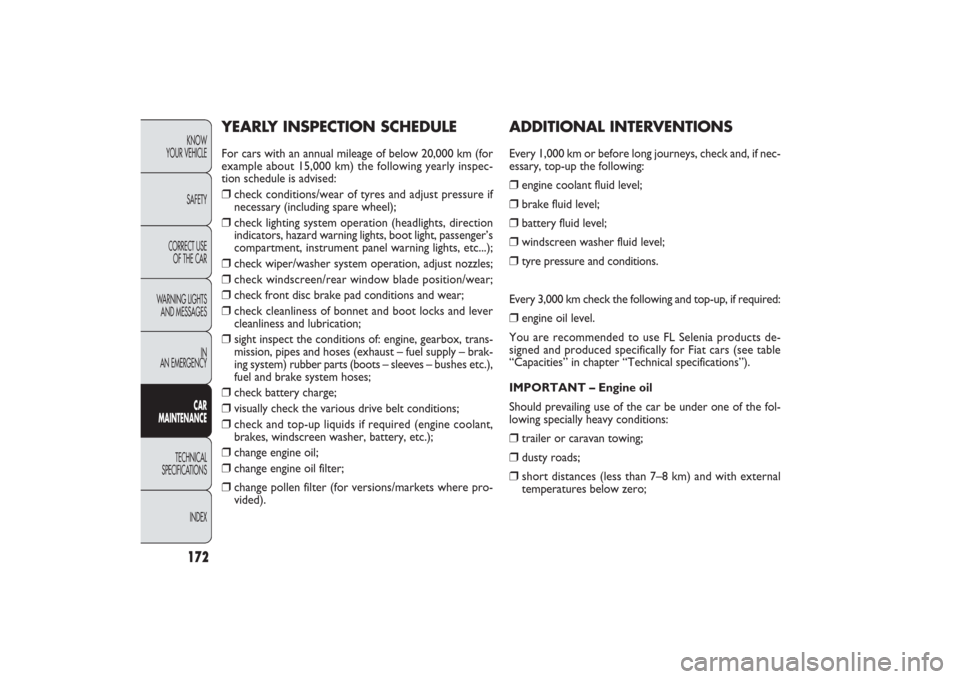
YEARLY INSPECTION SCHEDULEFor cars with an annual mileage of below 20,000 km (for
example about 15,000 km) the following yearly inspec-
tion schedule is advised:❒
check conditions/wear of tyres and adjust pressure if
necessary (including spare wheel);
❒
check lighting system operation (headlights, direction
indicators, hazard warning lights, boot light, passenger’s
compartment, instrument panel warning lights, etc...);
❒
check wiper/washer system operation, adjust nozzles;
❒
check windscreen/rear window blade position/wear;
❒
check front disc brake pad conditions and wear;
❒
check cleanliness of bonnet and boot locks and lever
cleanliness and lubrication;
❒
sight inspect the conditions of: engine, gearbox, trans-
mission, pipes and hoses (exhaust – fuel supply – brak-
ing system) rubber parts (boots – sleeves – bushes etc.),
fuel and brake system hoses;
❒
check battery charge;
❒
visually check the various drive belt conditions;
❒
check and top-up liquids if required (engine coolant,
brakes, windscreen washer, battery, etc.);
❒
change engine oil;
❒
change engine oil filter;
❒
change pollen filter (for versions/markets where pro-
vided).
ADDITIONAL INTERVENTIONSEvery 1,000 km or before long journeys, check and, if nec-
essary, top-up the following:❒
engine coolant fluid level;
❒
brake fluid level;
❒
battery fluid level;
❒
windscreen washer fluid level;
❒
tyre pressure and conditions.
Every 3,000 km check the following and top-up, if required:
❒
engine oil level.
You are recommended to use FL Selenia products de-
signed and produced specifically for Fiat cars (see table
“Capacities” in chapter “Technical specifications”).
IMPORTANT – Engine oil
Should prevailing use of the car be under one of the fol-
lowing specially heavy conditions:
❒
trailer or caravan towing;
❒
dusty roads;
❒
short distances (less than 7–8 km) and with external
temperatures below zero;
INDEX TECHNICAL
SPECIFICATIONSCAR
MAINTENANCEIN
AN EMERGENCY WARNING LIGHTS
AND MESSAGESCORRECT USE
OF THE CARSAFETYKNOW
YOUR VEHICLE
172
169-190 PANDA EN 7-10-2009 14:14 Pagina 172
Page 174 of 226
Car maintenance should be charged to
a Fiat Dealership. For routine and minor
maintenance operations you wish to carry
out yourself, always make sure you have the prop-
er equipment, genuine Fiat spare parts and the nec-
essary fluids; do not however carry out these
operations if you have no experience.
IMPORTANT – Battery
Check the battery charge once a year, preferably before
at the beginning of winter to limit the risk of electrolyte
freezing.
This check should be carried out more frequently if the
car is used mainly for short journeys, or if it is fitted with
accessories that permanently absorb electricity even with
the ignition key removed, especially in the case of after-
market accessories. If the car is used in hot climates or
particularly harsh conditions it is advisable to check the
level of the battery fluid (electrolyte) more frequently than
specified in the “Scheduled Servicing Programme”.
❒
frequently idling engine or long distance low speed dri-
ving (e.g. taxis or door-to-door deliveries) or in case
of a long term inactivity;
change engine oil more frequently than required on the
“Scheduled Servicing Programme”.
IMPORTANT – Diesel filter
The possibility of topping-up with diesel fuel not comply-
ing with EN 590 European Standard might make it neces-
sary to replace the filter more frequently than indicated in
the “Scheduled Servicing Programme”.
IMPORTANT – Air filter
When the car is used on dusty roads, change the air fil-
ter more frequently than shown on the “Scheduled Ser-
vicing Programme”. If in doubt as to how often the en-
gine oil and air filter should be changed according to how
you use the car, contact a Fiat Dealership.
IMPORTANT – Pollen filter
It is advisable to replace the filtering element more fre-
quently if the car is used in dusty or very polluted places.
Specifically, replace if a lower air flow into the passen-
ger’s compartment is found.
INDEX TECHNICAL
SPECIFICATIONSCAR
MAINTENANCEIN
AN EMERGENCY WARNING LIGHTS
AND MESSAGES CORRECT USE
OF THE CAR SAFETY KNOW
YOUR VEHICLE173
169-190 PANDA EN 7-10-2009 14:14 Pagina 173
Page 186 of 226
185KNOW
YOUR VEHICLE
SAFETY
CORRECT USE
OF THE CAR
WARNING LIGHTS
AND MESSAGES
IN
AN EMERGENCYCAR
MAINTENANCETECHNICAL
SPECIFICATIONS
INDEX
WINDSCREEN/REAR WINDOW
WIPER/WASHERBLADES
Periodically clean the rubber part using special products;
TUTELA PROFESSIONAL SC 35 is recommended.
Replace the blades if the rubber edge is deformed or worn.
In all cases, it is advisable to replace them approximately once
a year.
A few simple precautions can reduce the possibility of dam-
age to the blades:❒
make sure that the rubber part is not stuck to the wind-
screen at sub-zero temperatures. Use an antifreeze
product to release it if required;
❒
remove any snow from the glass: in addition to pro-
tecting the blades, this prevents effort on the motor
and overheating;
❒
do not operate the windscreen and the rear screen
wipers on dry glass.
RUBBER HOSESAs far as the brake system and fuel rubber hoses are concerned,
follow the “Scheduled Servicing Programme” in this chapter care-
fully.
Ozone, high temperatures and prolonged lack of fluid in the sys-
tem may cause hardening and cracking of the hoses, with pos-
sible leaks. Careful control is therefore necessary.
Driving with worn wiper blades is a serious
hazard, because visibility is reduced in bad
weather.
WARNING
169-190 PANDA EN 7-10-2009 14:15 Pagina 185