fuel FIAT PANDA 2009 169 / 2.G User Guide
[x] Cancel search | Manufacturer: FIAT, Model Year: 2009, Model line: PANDA, Model: FIAT PANDA 2009 169 / 2.GPages: 226, PDF Size: 5.29 MB
Page 56 of 226
55KNOW YOUR
VEHICLESAFETY
CORRECT USE
OF THE CAR
WARNING LIGHTS
AND MESSAGES
IN
AN EMERGENCY
CAR
MAINTENANCE
TECHNICAL
SPECIFICATIONS
INDEX
F0Z0223m
fig. 55
Carefully inspect the car for fuel leakages, e.g. in the en-
gine compartment, under the car or near the fuel tank.
If no fuel leaks are found and the car can be started again,
press the button A to reset the fuel system and the lights.
After a collision, turn the ignition key to STOP to pre-
vent battery running down.
If, after a collision, you smell fuel or see
leaks from the fuel system, do not reset the
switches to avoid fire risk.
WARNING
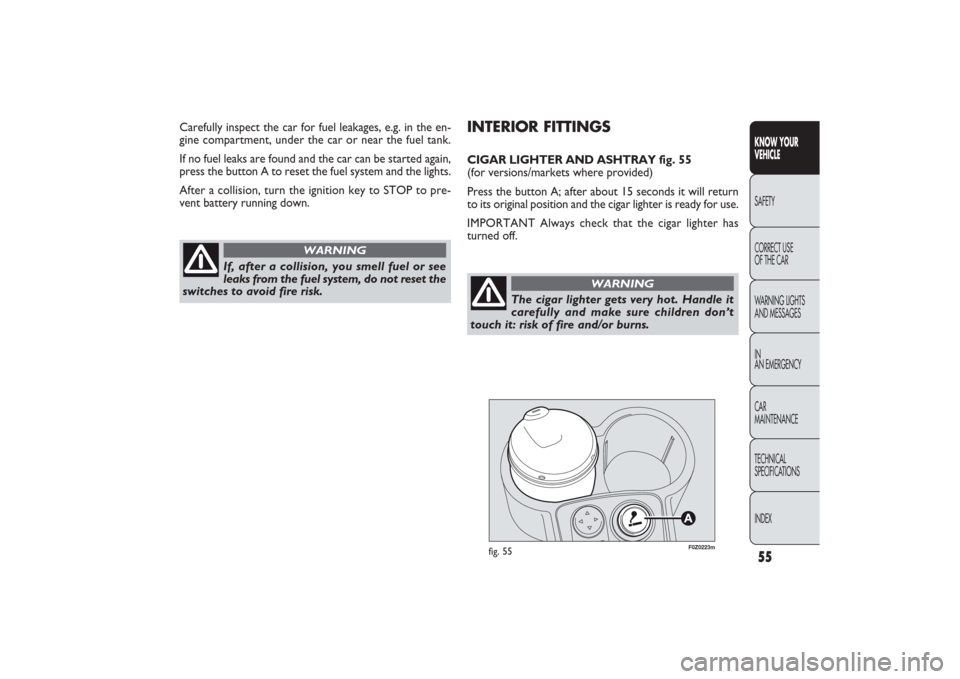
INTERIOR FITTINGSCIGAR LIGHTER AND ASHTRAY fig. 55
(for versions/markets where provided)
Press the button A; after about 15 seconds it will return
to its original position and the cigar lighter is ready for use.
IMPORTANT Always check that the cigar lighter has
turned off.
The cigar lighter gets very hot. Handle it
carefully and make sure children don’t
touch it: risk of fire and/or burns.
WARNING
031-064 PANDA EN 7-10-2009 13:43 Pagina 55
Page 67 of 226
Never exceed the maximum allowed load
in the boot (see “Technical Specifica-
tions”). Make sure that the objects are well
arranged in the boot so that they will not be pro-
jected forwards following sudden braking.
WARNING
Never travel with the tailgate open: ex-
haust gases may get into the passenger’s
compartment.
WARNING
If you travel in areas with few filling sta-
tions and you want to transport fuel in
a spare tank, comply with the regulations in force
and use only an approved, suitably secured tank.
Even in this way the risk of fire increases in case
of accident.
WARNING
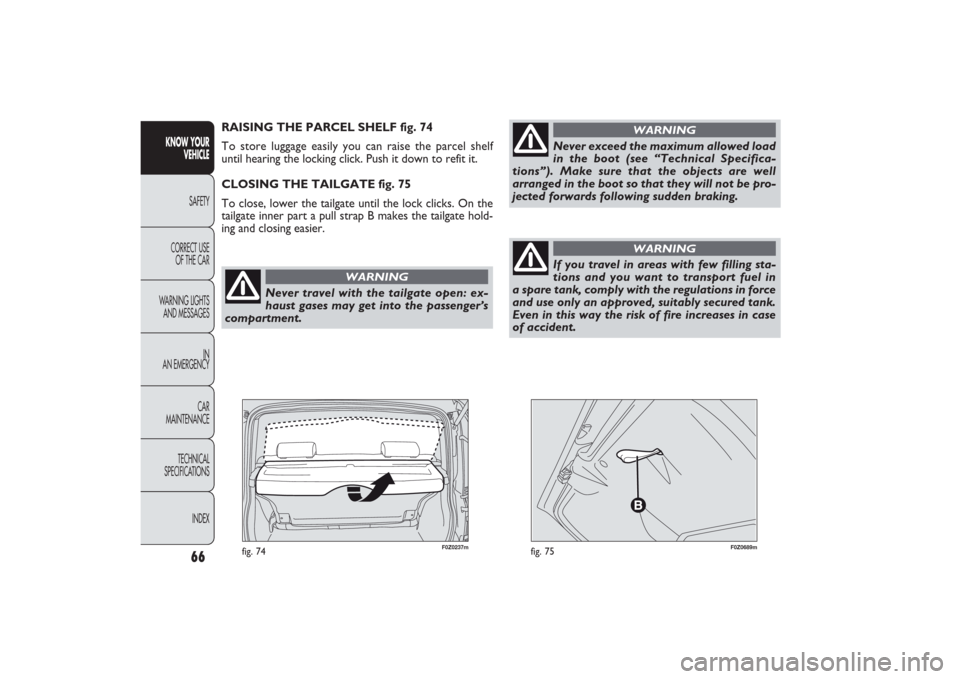
RAISING THE PARCEL SHELF fig. 74
To store luggage easily you can raise the parcel shelf
until hearing the locking click. Push it down to refit it.
CLOSING THE TAILGATE fig. 75
To close, lower the tailgate until the lock clicks. On the
tailgate inner part a pull strap B makes the tailgate hold-
ing and closing easier.
fig. 75
F0Z0689m
fig. 74
F0Z0237m
66
KNOW YOUR
VEHICLE
SAFETY
CORRECT USE
OF THE CAR
WARNING LIGHTS
AND MESSAGES
IN
AN EMERGENCY
CAR
MAINTENANCE
TECHNICAL
SPECIFICATIONS
INDEX
065-090 PANDA EN 7-10-2009 13:45 Pagina 66
Page 88 of 226
RADIO TRANSMITTERS AND MOBILE
PHONES
Radio transceivers (e.g.: CB radio systems and the like)
should not be used inside the vehicle unless a separate
aerial is mounted on the roof.
IMPORTANT The use of similar devices inside the pas-
senger compartment (without an external aerial) may, in
addition to potential damage to the health of the passen-
gers, cause malfunctions in the vehicle electronic systems,
compromising the safety of the vehicle.
In addition, transmission and reception of these devices
may be affected by the shielding effect of the vehicle body.
As far as the use of EC-approved mobile phones is con-
cerned (GSM, GPRS, UMTS), follow the instructions for
use provided by the mobile phone manufacturer.
AT THE FILLING STATIONPETROL ENGINES
Use only unleaded petrol.
To avoid mistakes, the diameter of the fuel filler is too
small to introduce the bit of a leaded petrol pumps.
The petrol octane rating (RON) must not be lower than 95.
IMPORTANT An inefficient catalytic converter leads
to harmful exhaust emissions, thus contributing to air
pollution.
IMPORTANT Never use leaded petrol, even in small
amount or in an emergency, as this would damage the cat-
alytic converter beyond repair.
87KNOW YOUR
VEHICLESAFETY
CORRECT USE
OF THE CAR
WARNING LIGHTS
AND MESSAGES
IN
AN EMERGENCY
CAR
MAINTENANCE
TECHNICAL
SPECIFICATIONS
INDEX
065-090 PANDA EN 7-10-2009 13:45 Pagina 87
Page 89 of 226
88
REFUELLING CAPACITY
To fill the tank completely, top-up twice after the first click
of the fuel delivery gun. Further top-ups could cause faults
in the fuel feeding system.
KNOW YOUR
VEHICLE
SAFETY
CORRECT USE
OF THE CAR
WARNING LIGHTS
AND MESSAGES
IN
AN EMERGENCY
CAR
MAINTENANCE
TECHNICAL
SPECIFICATIONS
INDEX
The car must only be filled with diesel fuel
for motor vehicles, in compliance with Eu-
ropean Standard EN590. The use of other
products or mixtures may damage the engine
beyond repair and consequently invalidate the war-
ranty, due to the damage caused. If you acciden-
tally introduce other types of fuel into the tank,
do not start the engine and empty the tank. If the
engine has been run, even for only a very short time,
you will need to have the entire fuel system emp-
tied in addition to the tank.
DIESEL ENGINES
Operation at low temperatures
If the outside temperature is very low, diesel thickens due
to the formation of paraffin clots with consequent defec-
tive operation of the fuel supply system.
In order to avoid these problems, different types of diesel
are distributed according to the season: summer type, win-
ter type and arctic type (cold/mountain areas). If refuelling
with diesel fuel whose specifications are not suitable for
the current temperature, it is advisable to mix TUTELA
DIESEL ART additive in the proportions shown on the con-
tainer with the fuel. Pour the additive into the tank before
the diesel fuel.
When using or parking the vehicle for a long time in the
mountains or cold areas, it is advisable to refuel using
locally available diesel fuel.
In this case, it is also advisable to keep the tank over
50% full.
065-090 PANDA EN 7-10-2009 13:45 Pagina 88
Page 90 of 226
89
F0Z0041m
fig. 96
F0Z0042m
fig. 97
KNOW YOUR
VEHICLESAFETY
CORRECT USE
OF THE CAR
WARNING LIGHTS
AND MESSAGES
IN
AN EMERGENCY
CAR
MAINTENANCE
TECHNICAL
SPECIFICATIONS
INDEX
Do not place naked flames or lit cigarettes
near to the fuel filler: fire risk. Keep away
from the fuel filler to avoid breathing in harmful
vapours.
WARNING
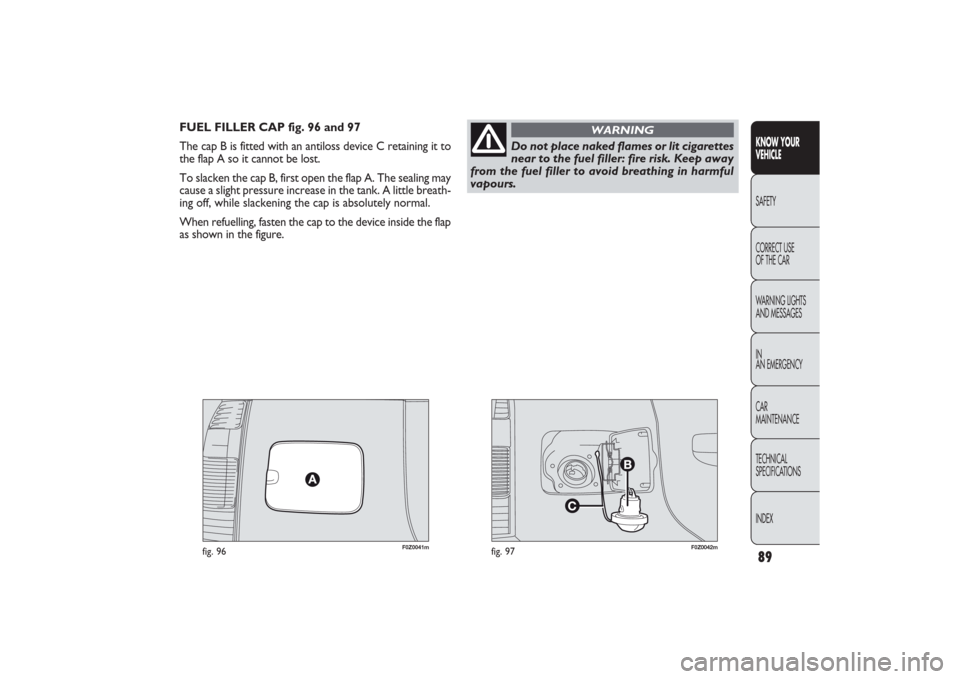
FUEL FILLER CAP fig. 96 and 97
The cap B is fitted with an antiloss device C retaining it to
the flap A so it cannot be lost.
To slacken the cap B, first open the flap A. The sealing may
cause a slight pressure increase in the tank. A little breath-
ing off, while slackening the cap is absolutely normal.
When refuelling, fasten the cap to the device inside the flap
as shown in the figure.
065-090 PANDA EN 7-10-2009 13:45 Pagina 89
Page 91 of 226
90
DIESEL PARTICULATE FILTER (DPF)
(for 1.3 Multijet 75 HP versions)
The Diesel Particulate Filter is a mechanical filter, inte-
gral with the exhaust system, that physically traps partic-
ulates present in the exhaust gases of diesel engines.
The diesel particulate filter has been adopted to eliminate
almost all particulates in compliance with current/future
legal regulations.
During normal use of the vehicle, the engine control unit
records a set of data (e.g.: travel time, type of route, tem-
peratures, etc.) and it will then calculate how much par-
ticulates has been trapped by the filter.
Since this filter physically traps particulate, it should be re-
generated (cleaned) at regular intervals by burning carbon
particles.
The regeneration procedure is controlled automatically by
the engine management control unit according to the fil-
ter conditions and vehicle use conditions.
There may be a limited increase in the engine idle speed
during the regeneration, a limited increase in fumes and
high temperatures at the exhaust. These are not faults;
they do not impair vehicle performance or damage the
environment.
If the dedicated message is displayed, refer to paragraph
“Warning lights and messages”.
KNOW YOUR
VEHICLE
SAFETY
CORRECT USE
OF THE CAR
WARNING LIGHTS
AND MESSAGES
IN
AN EMERGENCY
CAR
MAINTENANCE
TECHNICAL
SPECIFICATIONS
INDEX
PROTECTING THE ENVIRONMENTThe following devices are used for reducing petrol fuel
engine emissions:❒
three-way catalytic converter;
❒
oxygen sensors;
❒
evaporation control system.
In addition, do not let the engine run, even for a test, with
one or more spark plugs disconnected.
The following devices are used for reducing diesel fuel en-
gine emissions:
❒
oxidising catalytic converter;
❒
exhaust gas recirculation system (E.G.R.);
❒
diesel particulate filter (DPF).
The catalytic converter develops high tem-
perature during operation. Do not park
the car on grass, dry leaves, pine needles or oth-
er flammable material: fire hazard.
WARNING
065-090 PANDA EN 7-10-2009 13:45 Pagina 90
Page 114 of 226
113KNOW
YOUR VEHICLE
SAFETYCORRECT USE
OF THE CARWARNING LIGHTS
AND MESSAGES
IN
AN EMERGENCY
CAR
MAINTENANCE
TECHNICAL
SPECIFICATIONS
INDEX
F0Z0037m
fig. 116
PARKING THE VEHICLEProceed as follows:❒
stop the engine and engage the handbrake;
❒
engage a gear (on a slope, engage first gear if the vehi-
cle is parked uphill or reverse if it is parked downhill)
and leave the wheels steered.
Block the wheels with a wedge or a stone if the car is
parked on a steep slope.
Do not leave the key in the ignition switch at MAR to pre-
vent draining the battery. Always remove the key when
leaving the car. Never leave children unattended in the car.
Always remove the ignition key when leaving the car
and take it out with you.
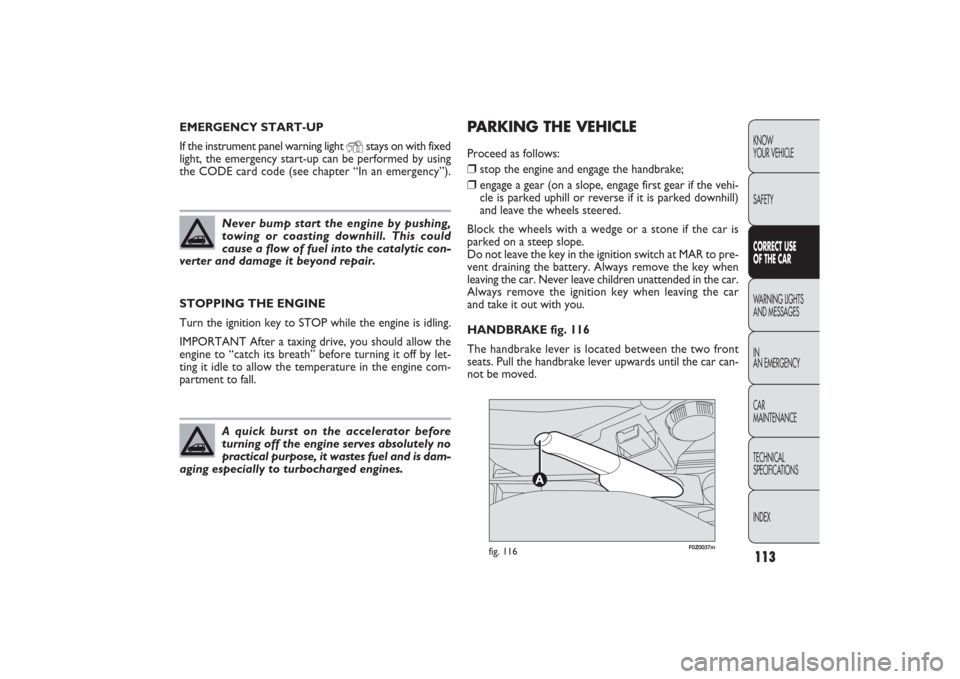
HANDBRAKE fig. 116
The handbrake lever is located between the two front
seats. Pull the handbrake lever upwards until the car can-
not be moved. STOPPING THE ENGINE
Turn the ignition key to STOP while the engine is idling.
IMPORTANT After a taxing drive, you should allow the
engine to “catch its breath” before turning it off by let-
ting it idle to allow the temperature in the engine com-
partment to fall.
Never bump start the engine by pushing,
towing or coasting downhill. This could
cause a flow of fuel into the catalytic con-
verter and damage it beyond repair.A quick burst on the accelerator before
turning off the engine serves absolutely no
practical purpose, it wastes fuel and is dam-
aging especially to turbocharged engines.
EMERGENCY START-UP
If the instrument panel warning light
Y
stays on with fixed
light, the emergency start-up can be performed by using
the CODE card code (see chapter “In an emergency”).
111-122 PANDA EN 7-10-2009 15:01 Pagina 113
Page 116 of 226
115KNOW
YOUR VEHICLE
SAFETYCORRECT USE
OF THE CARWARNING LIGHTS
AND MESSAGES
IN
AN EMERGENCY
CAR
MAINTENANCE
TECHNICAL
SPECIFICATIONS
INDEX
CONTAINING RUNNING COSTSSome useful tips are given below for fuel saving and re-
ducing harmful emissions of CO
2and other pollutants
(nitrogen oxides, unburnt hydrocarbons, Particulate
Matter (PM) etc.).
GENERAL CONSIDERATIONS
Car maintenance
Have checks and adjustments carried out in accordance
with the “Scheduled servicing plan.”
Tyres
Check the pressure of the tyres routinely at an interval
of no more than 4 weeks: if the pressure is too low, con-
sumption levels increase as resistance to rolling is higher.
Unnecessary loads
Do not travel with an overloaded boot. The weight of
the car (especially when driving in town) and its trim great-
ly affects consumption and stability.
Accessories installed on longitudinal bars
Remove accessories like: roof racks, ski racks, luggage con-
tainer, etc. from the roof as soon as they are no longer
used. These accessories lower air penetration and ad-
versely affect consumption levels. When needing to
carry particularly voluminous objects, preferably use
a trailer.
To change gears properly you must push
the clutch pedal fully down. For this rea-
son, there must be no obstacles on the floor un-
der the pedals: ensure that rubber mats (if any)
are lying flat and do not interfere with the pedals.
WARNING
Do not drive with your hand resting on the
shifting lever, because this pressure, even
if light, over time can wear out the gearbox
internal components.
111-122 PANDA EN 7-10-2009 15:01 Pagina 115
Page 117 of 226
116
KNOW YOUR
VEHICLE
SAFETYCORRECT USE
OF THE CARWARNING LIGHTS
AND MESSAGESI
IN
AN EMERGENCY
CAR
MAINTENANCE
TECHNICAL
SPECIFICATIONS
INDEX
clutching is absolutely pointless on modern cars and also
increases consumption and pollution.
Gear selection
As soon as the conditions of the traffic and road allow, use
a higher gear. Using a low gear for faster acceleration will
increase consumption.
In the same way improper use of a high gear increases con-
sumption, emissions an engine wear.
Top speed
Fuel consumption considerably increases with speed.
Avoiding unnecessary braking and acceleration, which cost
in terms of both fuel and emissions.
Acceleration
Accelerating violently increasing the revs will greatly af-
fect consumption and emissions: acceleration should be
gradual.
CONDITIONS OF USE
Cold starting
Short journeys and frequent cold starts will prevent the en-
gine from reaching optimal running temperature. This re-
sults in a significant increase in consumption levels (from
+15 to +30% on the urban cycle) and emission of harmful
substances. Electric devices
Use electric devices only for the amount of time needed.
Rear heated window, additional headlights, windscreen
wipers and heater fan need a considerable amount of en-
ergy, therefore a higher requirement of current involves
and increase of fuel consumption (up to +25% in the
urban cycle).
Climate control system
The climate control system is an additional load which
greatly affects the engine leading to higher consumption
(on average up to +20%): when the temperature outside
the car permits it, use the air vents where possible.
Devices for aerodynamic control
The use of non-certified devices for aerodynamic control
may adversely affect air drag and consumption levels.
DRIVING STYLE
Starting
Do not warm the engine with the car at a standstill or at
idle or high speed: under these conditions the engine
warms up much more slowly, increasing electrical con-
sumption and emissions. It is therefore advisable to move
off immediately, slowly, avoiding high speeds: in this way
the engine will warm faster.
Unnecessary actions
Avoid accelerating when starting at traffic lights or be-
fore switching off the engine. This and also double de-
111-122 PANDA EN 7-10-2009 15:01 Pagina 116
Page 131 of 226
130
KNOW YOUR
VEHICLE
SAFETY
CORRECT USE
OF THE CAR
WARNING LIGHTS
AND MESSAGES
IN
AN EMERGENCY
CAR
MAINTENANCE
TECHNICAL
SPECIFICATIONS
INDEX
FUEL RESERVE (amber)
Turning the ignition key to MAR the warning light
turns on, but it should go off after a few seconds.
The warning light turns on when about 5 litres fuel are left
in the tank.
IMPORTANT The warning light will flash to indicate a sys-
tem failure. If this is the case, contact a Fiat Dealership to
have the system checked.
ç
DPF (DIESEL PARTICULATE TRAP)
CLEANING IN PROGRESS
(only Multijet versions with DPF
– amber)
When the key is turned to the MAR position the warn-
ing light comes on but should go out after a few seconds.
The warning light turns on steadily when the DPF systems
needs to eliminate the trapped pollutants by the regen-
eration process.
The warning light does not come on every time the DPF
is being regenerated, rather only when the driving condi-
tions are such that the driver needs to know it. To switch
the warning light off, the car must be kept moving until the
regeneration process is completed.
As an average, the process lasts fifteen minutes.
The best conditions to complete the regeneration process
are reached driving the car at about 60 km/h with engine
speed over 2000 rpm. When this warning light comes on,
it does not indicate a car failure and thus it should not be
taken to the workshop. For versions/markets where pro-
vided, the display shows the dedicated message and the
warning light comes on.
h
The driving speed should always be suit-
able to traffic conditions, weather condi-
tions and the driver should always comply with
the Highway Code. The engine can also be
switched off if the DPF warning light is on; nev-
ertheless, repeated interruptions of the regener-
ation process could cause an early decay of en-
gine oil. For this reason, always wait until the
warning light switches off before stopping the en-
gine as above described. DPF regeneration should
not be completed when the car is at a standstill
WARNING
123-134 PANDA EN 7-10-2009 13:49 Pagina 130