belt FIAT PUNTO 2012 Owner handbook (in English)
[x] Cancel search | Manufacturer: FIAT, Model Year: 2012, Model line: PUNTO, Model: FIAT PUNTO 2012Pages: 219, PDF Size: 9.58 MB
Page 101 of 219
97
STARTING
AND DRIVING
WARNING
LIGHTS AND MESSAGES
IN AN
EMERGENCY
SERVICE
AND CARE
TECHNICAL
SPECIFICATIONS
INDEX
CONTROLS
AND DEVICES
SAFETY
For optimum protection in the event of
a crash, all passengers must be seated and
wearing adequate restraint systems.
This is even more important for children.
This prescription is compulsory in all EU
countries pursuant to Directive 2003/20/EC.
Compared with an adult, a child’s head is
larger and heavier in proportion to his/her
body and the child’s muscular and bone
structures are not fully developed. For this
reason, they require restraint systems
which are different from those used by
adults to protect them in the event of an
accident. The result of research in relation to the
best protection for children is illustrated
in European Regulation ECE-R44, which
divides the restraint systems into five
groups in addition to making their use
compulsory:
Group 0 up to 10 kg
Group 0+ up to 13 kg
Group 1 9-18 kg
Group 2 15-25 kg
Group 3 22-36 kg
As you can see, the groups overlap part-
ly and, in fact, there are devices on sale
that cover more than one weight group.
CARRYING CHILDREN SAFELY
All child restraint devices must bear the
certification data, together with the con-
trol brand, on a solidly fixed to the seat la-
bel which must never be removed.
When over 1.50 m in height, from the
point of view of restraint systems, children
are considered as adults and have to wear
the standard seat belts.
Lineaccessori Fiat has child seats for each
weight group. These devices are recom-
mended, having been specifically designed
for Fiat cars.
091-108 PUNTO POP 1ed EN 16-08-2011 14:11 Pagina 97
Page 102 of 219
98
STARTING
AND DRIVING
WARNING
LIGHTS AND MESSAGES
IN AN
EMERGENCY
SERVICE
AND CARE
TECHNICAL
SPECIFICATIONS
INDEX
CONTROLS
AND DEVICES
SAFETY
Do not place a cradle seat
facing backwards on the
front seat if the passenger side airbag
is enabled. Deployment of the airbag
in an accident could cause fatal in-
juries to the baby regardless of the
severity of the collision. It is advisable
to always carry children in dedicat-
ed child seats on the rear seat, which
is the most protected position in the
event of an accident.
WARNING
SERIOUS HAZARD Should it be absolutely necessary to
carry a child on the front
seat in a backwards-facing
cradle seat, the passenger’s
front and side airbags should
be deactivated through the setup
menu. Deactivation can be verified by
checking the
“warning light on the
instrument panel. Also, the passen-
ger seat should be as far back as pos-
sible to avoid contact between the
child seat and the dashboard.
WARNING
fig. 8F0M0046mfig. 9F0M0504m
The diagram is only an indi-
cation. For assembly, refer to
the instructions supplied with the
child seat.
WARNING
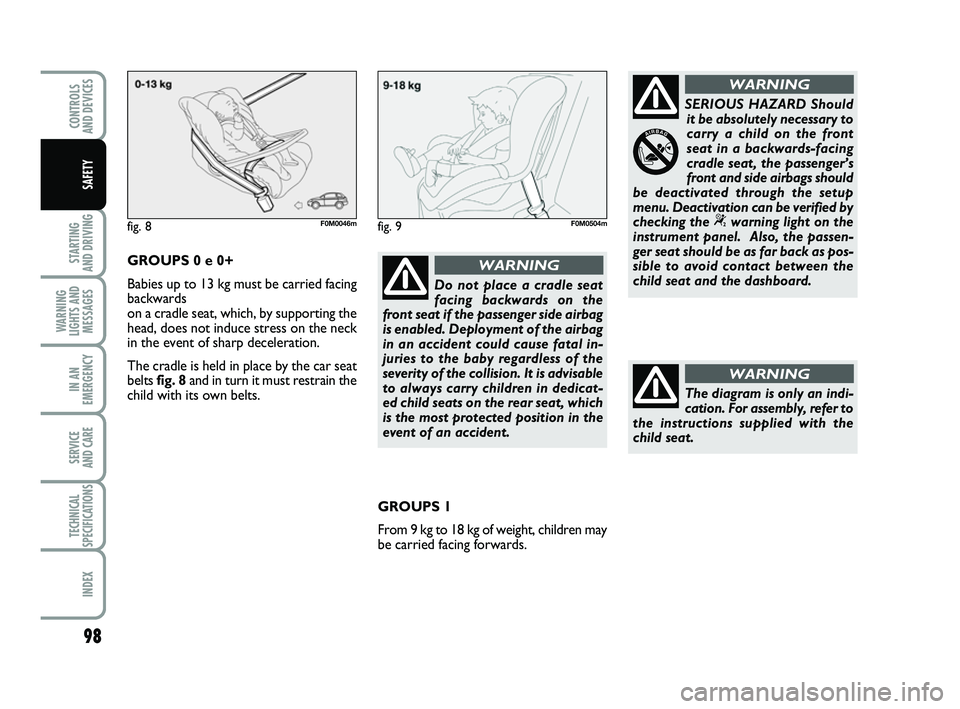
GROUPS 0 e 0+
Babies up to 13 kg must be carried facing
backwards
on a cradle seat, which, by supporting the
head, does not induce stress on the neck
in the event of sharp deceleration.
The cradle is held in place by the car seat
belts fig. 8 and in turn it must restrain the
child with its own belts.
GROUPS 1
From 9 kg to 18 kg of weight, children may
be carried facing forwards.
091-108 PUNTO POP 1ed EN 16-08-2011 14:11 Pagina 98
Page 103 of 219
99
STARTING
AND DRIVING
WARNING
LIGHTS AND MESSAGES
IN AN
EMERGENCY
SERVICE
AND CARE
TECHNICAL
SPECIFICATIONS
INDEX
CONTROLS
AND DEVICES
SAFETY
fig. 10F0M0048m
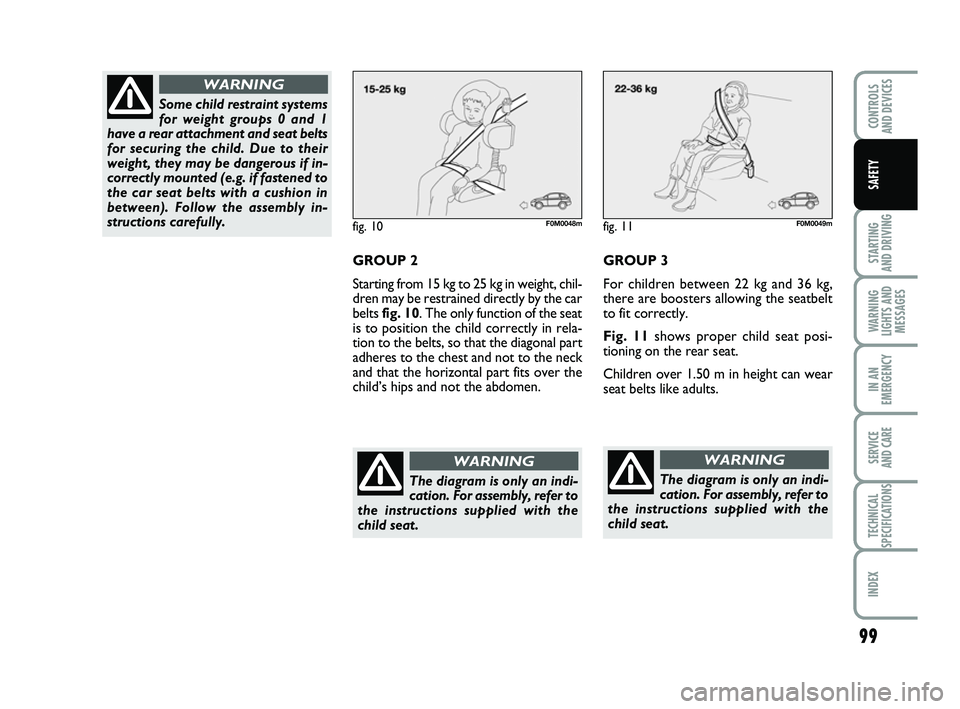
GROUP 2
Starting from 15 kg to 25 kg in weight, chil-
dren may be restrained directly by the car
belts fig. 10. The only function of the seat
is to position the child correctly in rela-
tion to the belts, so that the diagonal part
adheres to the chest and not to the neck
and that the horizontal part fits over the
child’s hips and not the abdomen.
The diagram is only an indi-
cation. For assembly, refer to
the instructions supplied with the
child seat.
WARNING
Some child restraint systems
for weight groups 0 and 1
have a rear attachment and seat belts
for securing the child. Due to their
weight, they may be dangerous if in-
correctly mounted (e.g. if fastened to
the car seat belts with a cushion in
between). Follow the assembly in-
structions carefully.
WARNING
GROUP 3
For children between 22 kg and 36 kg,
there are boosters allowing the seatbelt
to fit correctly.
Fig. 11 shows proper child seat posi-
tioning on the rear seat.
Children over 1.50 m in height can wear
seat belts like adults.
fig. 11F0M0049m
The diagram is only an indi-
cation. For assembly, refer to
the instructions supplied with the
child seat.
WARNING
091-108 PUNTO POP 1ed EN 16-08-2011 14:11 Pagina 99
Page 104 of 219
100
STARTING
AND DRIVING
WARNING
LIGHTS AND MESSAGES
IN AN
EMERGENCY
SERVICE
AND CARE
TECHNICAL
SPECIFICATIONS
INDEX
CONTROLS
AND DEVICES
SAFETY
SUITABILITY OF PASSENGER SEATS FOR CHILD SEAT USE
The car complies with the new European Directive 2000/3/EC which governs\
the
arrangement possibilities for child seats on the various seats of the ca\
r as shown in
the following table: Below is a summary of the safety
rules to be followed when carrying
children:
1) The recommended position for in-
stalling child seats is on the rear seat, as
it is the most protected area in the event
of a crash.
2) When disengaging the passenger
airbag, always check the amber warning
light on the instrument panel is perma-
nently on to make sure that the airbag has
actually been deactivated.
3) Carefully follow the instructions that
came with the child seat, which the man-
ufacturer must supply by law. Keep the in-
structions in the car along with the other
documents and this handbook. Do not use
second hand child seats without instruc-
tions.
4) Always check the seat belt is well fas-
tened by pulling on it.
5) Only one child is to be strapped into
each retaining system; never carry two
children using one child seat.
6) Always check the seat belts do not
rest on the child’s neck.
7) While travelling, do not let the child
sit incorrectly or release the belts.
8) Never carry children on your lap, even
newborns. No one, however strong, can
hold a child in the event of an accident.
9) In the event of an accident, replace the
child seat with a new one.
Front Rear Central
Group Weight range passenger passenger rear
passenger (●)
Groups 0, 0+ up to 13 kg U (▼)U *
Groups 1 9-18 kg U (▼)U *
Groups 2 15-25 kg U (▼)U *
Groups 3 22-36 kg U (▼)U *
Key:
U = suitable for child restraint systems in the “Universal” catego\
ry, according to Eu-
ropean Standard ECE-R44 for the specified “Groups”.
(
▼) on cars whose passenger seat is not adjustable in height, the backres\
t must be
perfectly upright.
* Never put any type of child seat on the central rear seat.
(
●) For versions/markets, where provided.
091-108 PUNTO POP 1ed EN 16-08-2011 14:11 Pagina 100
Page 105 of 219
101
STARTING
AND DRIVING
WARNING
LIGHTS AND MESSAGES
IN AN
EMERGENCY
SERVICE
AND CARE
TECHNICAL
SPECIFICATIONS
INDEX
CONTROLS
AND DEVICES
SAFETY
Do not place a child seat
facing backwards on the
front seat if the passenger side airbag
is enabled. Deployment of the airbag
in an accident could cause fatal in-
juries to the baby regardless of the
severity of the collision. It is advisable
to always carry children in a child seat
on the rear seat, which is the most
protected position in the event of a
collision.
WARNING“UNIVERSAL ISOFIX”
CHILD RESTRAINT
ASSEMBLY SETUP
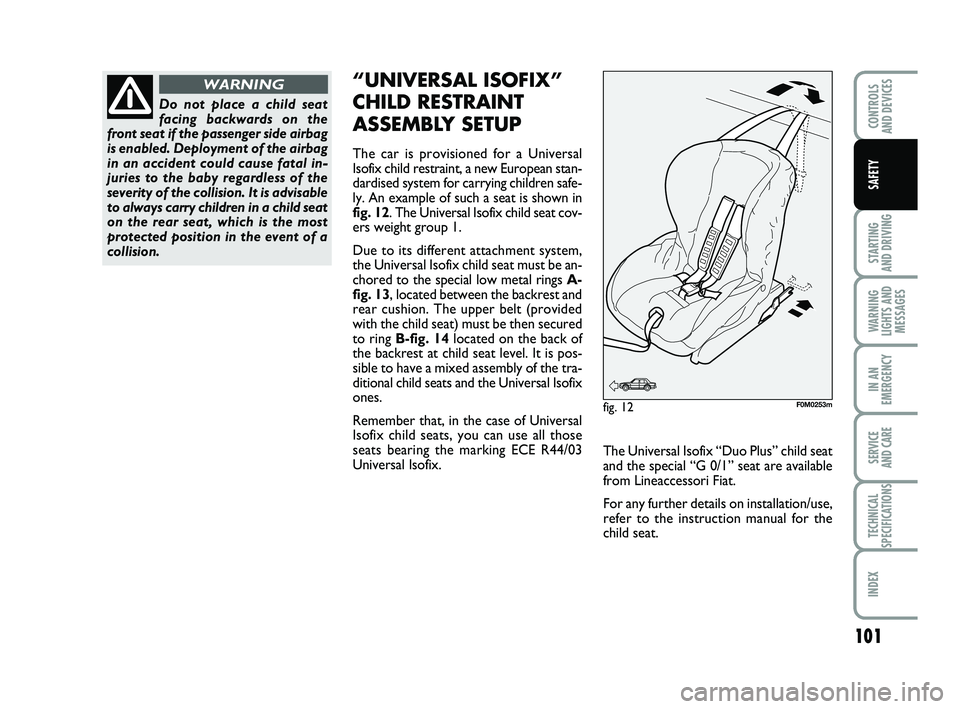
The car is provisioned for a Universal
Isofix child restraint, a new European stan-
dardised system for carrying children safe-
ly. An example of such a seat is shown in
fig. 12. The Universal Isofix child seat cov-
ers weight group 1.
Due to its different attachment system,
the Universal Isofix child seat must be an-
chored to the special low metal rings A-
fig. 13, located between the backrest and
rear cushion. The upper belt (provided
with the child seat) must be then secured
to ring B-fig. 14 located on the back of
the backrest at child seat level. It is pos-
sible to have a mixed assembly of the tra-
ditional child seats and the Universal Isofix
ones.
Remember that, in the case of Universal
Isofix child seats, you can use all those
seats bearing the marking ECE R44/03
Universal Isofix.
fig. 12F0M0253m
The Universal Isofix “Duo Plus” child seat
and the special “G 0/1” seat are available
from Lineaccessori Fiat.
For any further details on installation/use,
refer to the instruction manual for the
child seat.
091-108 PUNTO POP 1ed EN 16-08-2011 14:11 Pagina 101
Page 107 of 219
103
STARTING
AND DRIVING
WARNING
LIGHTS AND MESSAGES
IN AN
EMERGENCY
SERVICE
AND CARE
TECHNICAL
SPECIFICATIONS
INDEX
CONTROLS
AND DEVICES
SAFETY
FRONT AIRBAGS
The car is fitted with front airbags for the
driver and the passenger, and with a knee
bag on the driver’s side (for versions/mar -
kets, where provided).
The front driver/passenger airbags and the
driver’s knee bag (for versions/markets,
where provided) have been designed to
protect the occupants of the front seats
in the event of head-on crashes of medi-
um/high severity, by placing the bag be-
tween the occupant and the steering
wheel or dashboard.
Non-activation in other types of crash
(side-on collisions, rear shunts, roll-overs,
etc.) is therefore not a sign of system mal-
function.
An electronic control unit causes the bag
to inflate in the event of a head-on crash.
The bag will inflate instantaneously, placing
itself between the front occupant’s body
and the structures which could cause in-
jury. It will deflate immediately afterwards.
The front driver/passenger airbags and the
driver’s knee bag (for versions/markets,
where provided) are not a replacement
for, but rather complement the use of,
seat belts, which should always be worn,
as specified by law in Europe and most
non-European countries. The volume of the front airbags at maxi-
mum inflation fills most of the space
between the steering wheel and the dri-
ver and between the dashboard and the
passenger.
In the event of an impact, someone not
wearing a seat belt will move forward and
come into contact with the bag which is
still in the opening stage. The protection
offered by the bag is reduced in such
a case.
Front airbags may not be activated in the
following situations:
❒in collisions against highly strainable ob-
jects that do not affect the front surface
of the car (e.g. bumper collision against
guard rail, piles of gravel etc.);
❒jamming of the car underneath other
vehicles or protective barriers (e.g. un-
derneath a truck or a guard rail); in this
case, the bags would offer no addition-
al protection with respect to the seat
belt and their deployment is unneces-
sary. In these cases, non-deployment of
the airbag does not necessarily indicate
a system malfunction.
Do not apply stickers or oth-
er objects on the steering
wheel, passenger side airbag cover or
upper side upholstery. Do not place
objects (e.g. mobile phones) on the
passenger side dashboard because
these could interfere with the correct
opening of the airbag and cause se-
vere injury to occupants.
WARNING
The airbags are not deployed in the event
of minor collisions (for which the with-
holding action of the seat belts is suffi-
cient). For this reason, the seat belt must
be worn at all times. In the case of side-
on collisions, the seat belts hold occupants
in the correct position and prevent them
from being thrown out of the car by a very
violent collision.
091-108 PUNTO POP 1ed EN 16-08-2011 14:11 Pagina 103
Page 109 of 219
105
STARTING
AND DRIVING
WARNING
LIGHTS AND MESSAGES
IN AN
EMERGENCY
SERVICE
AND CARE
TECHNICAL
SPECIFICATIONS
INDEX
CONTROLS
AND DEVICES
SAFETY
MANUAL DEACTIVATION
OF FRONT AND SIDE CHEST/
PELVIS PASSENGER AIRBAGS
(for versions/markets, where provided)
Whenever a child needs to be carried on
the front seat, the passenger’s front and side
chest/pelvis airbags (for versions/ markets,
where provided) must be deactivated.
The warning light
“on the instrument
panel stays on steadily until the passenger’s
front and side chest airbags (for versions/
markets, where provided) are re-activated.
To manually deactivate the
passenger’s front and side
chest/pelvis airbags (for versions/mar -
kets, where provided), refer to para-
graphs “Digital display” and “Mul -
tifunction display” in the section
“Dashboard and controls”.
WARNING
SIDE AIRBAGS
The car is fitted with front side airbags
for driver and passenger (for versions/
mar kets, where provided) for protecting
the chest and pelvis, and window bags
(for versions/markets, where provided)
for protecting the heads of front and rear
passengers.
Side airbags (for versions/markets, where
provided) protect car occupants from
side-on crashes of medium/high severity
by placing the bag between the occupant
and the internal parts of the side structure
of the car.
Non-activation of side bags in other types
of collisions (head-on collisions, rear
shunts, roll-overs, etc…) is not an indi-
cation of system malfunction.
In the event of a side-on crash, an elec-
tronic control unit triggers the inflation of
the bag if required. The cushion immedi-
ately inflates, placing itself between the oc-
cupant’s body and structures that could
cause injuries, the cushion deflates Imme-
diately afterwards.
Side bags (for versions/markets, where
provided) are not a replacement for, but
rather a complement to, the seat belts,
which should be worn at all times as spec-
ified by law in Europe and most non-Eu-
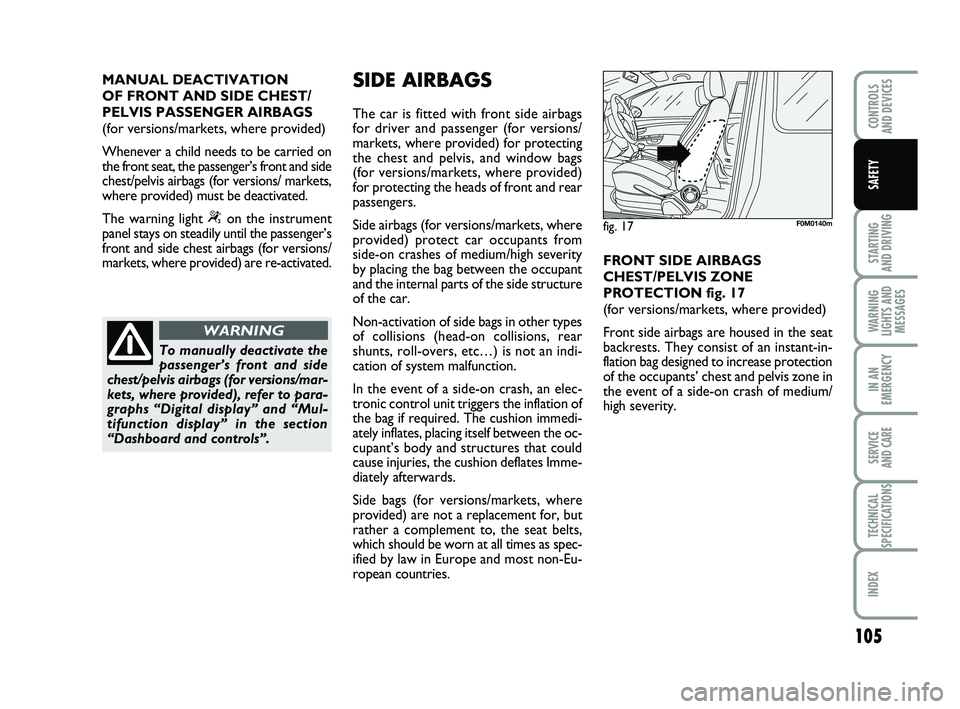
ropean countries. FRONT SIDE AIRBAGS
CHEST/PELVIS ZONE
PROTECTION fig. 17
(for versions/markets, where provided)
Front side airbags are housed in the seat
backrests. They consist of an instant-in-
flation bag designed to increase protection
of the occupants’ chest and pelvis zone in
the event of a side-on crash of medium/
high severity.
fig. 17F0M0140m
091-108 PUNTO POP 1ed EN 16-08-2011 14:11 Pagina 105
Page 112 of 219
108
STARTING
AND DRIVING
WARNING
LIGHTS AND MESSAGES
IN AN
EMERGENCY
SERVICE
AND CARE
TECHNICAL
SPECIFICATIONS
INDEX
CONTROLS
AND DEVICES
SAFETY
Do not wash the seats with
water or steam under pres-
sure (by hand or in automatic wash-
ing stations for seats).
WARNING
Front airbag deployment
takes place at a higher level
of impact than the pretensioners. For
collisions in the range between the
two thresholds, it is normal for only
the pretensioners to be activated.
WARNING
Do not hang rigid objects on
the coat hooks and the sup-
port handles.
WARNING
Airbags do not replace seat
belts, but increase their effi-
ciency. Furthermore, since front
airbags are not deployed in low
speed collisions, side-on collisions,
rear-end shunts or roll-overs, the pas-
sengers are protected only by the
seat belts which must therefore be
fastened at all times.
WARNING
When the ignition key is
turned to MAR, the warning
light (with passenger’s front airbag
activated) turns on and flashes for
a few seconds to remind you that the
passenger’s air bag will be deployed
in a crash, after which it should go off.
WARNING
Always drive with your hands
on the steering wheel rim so
that the airbag can inflate freely if
needed. Do not drive with your body
bent forward. Keep your back straight
against the backrest.
WARNING
If the vehicle has been sub-
ject to theft or a theft at-
tempt, or if it has been affected by
vandalism or flooding, have the airbag
system checked at a Fiat Dealership.
WARNING
091-108 PUNTO POP 1ed EN 16-08-2011 14:11 Pagina 108
Page 125 of 219
121
SAFETY
STARTING
AND DRIVING
IN AN
EMERGENCY
SERVICE
AND CARE
TECHNICAL
SPECIFICATIONS
INDEX
CONTROLS
AND DEVICES
WARNING
LIGHTS AND MESSAGES
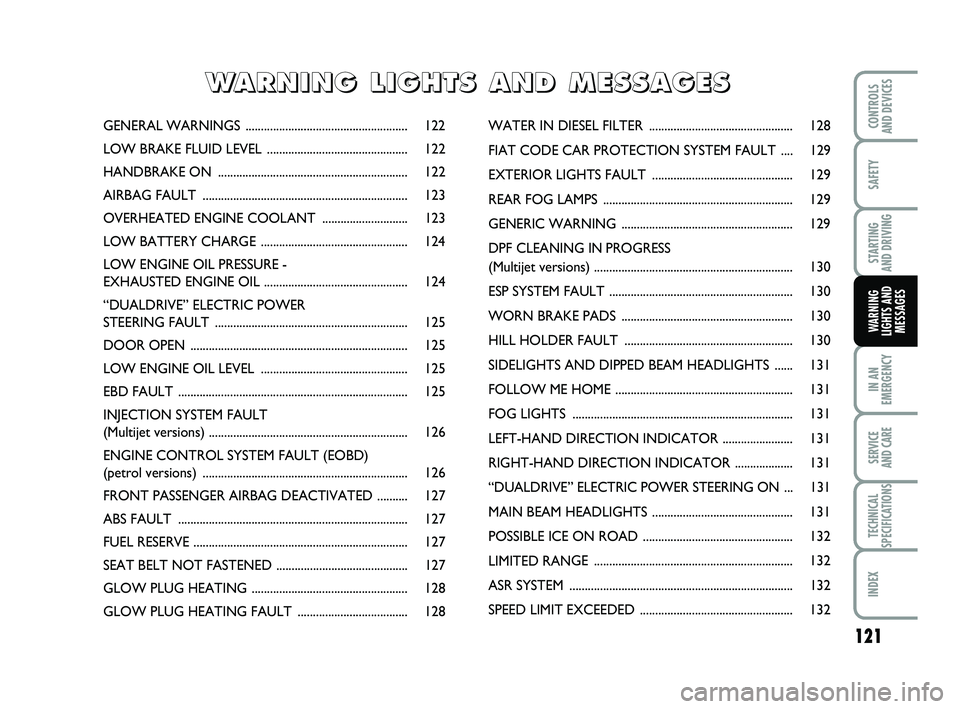
GENERAL WARNINGS ..................................................... 122
LOW BRAKE FLUID LEVEL .............................................. 122
HANDBRAKE ON .............................................................. 122
AIRBAG FAULT ................................................................... 123
OVERHEATED ENGINE COOLANT ............................ 123
LOW BATTERY CHARGE ................................................ 124
LOW ENGINE OIL PRESSURE -
EXHAUSTED ENGINE OIL ............................................... 124
“DUALDRIVE” ELECTRIC POWER
STEERING FAU LT ............................................................... 125
DOOR OPEN .......................................................................\
125
LOW ENGINE OIL LEVEL ................................................ 125
EBD FAULT .......................................................................\
.... 125
INJECTION SYSTEM FAULT
(Multijet vers ions) ................................................................. 126
ENGINE CONTROL SYSTEM FAULT (EOBD)
(petrol vers ions) ................................................................... 126
FRONT PASSENGER AIR BAG DEACTIVATED .......... 127
ABS FAULT .......................................................................\
.... 127
FUEL RESERVE ...................................................................... 127
SEAT BELT NOT FASTENED ........................................... 127
GLOW PLUG H EATING ................................................... 128
GLOW PLUG HEATIN G FAULT .................................... 128 WATER IN DIES
EL FILTER ............................................... 128
FIAT CODE CAR PROTECTION SYSTEM FAULT .... 129
EXTERIOR LIG HTS FAULT .............................................. 129
REAR FOG LAMPS .............................................................. 129
GENERIC WA RNING ........................................................ 129
DPF CLEANING IN PROGRESS
(Multijet versions) ................................................................. 130
ESP SYSTEM FAU LT ............................................................ 130
WORN BRAKE PADS ........................................................ 130
HILL HOLDER FAULT ....................................................... 130
SIDELIGHTS AND DIPPED BEAM HEADLIG HTS ...... 131
FOLLOW ME HO ME .......................................................... 131
FOG LIGHTS ........................................................................\
131
LEFT-HAND DIRECTION INDICAT OR ....................... 131
RIGHT-HAND DIRECT ION INDICATOR ................... 131
“DUALDRIVE” ELECTRIC POWER STEERING ON ... 131
MAIN BEAM HEADLIGHTS .............................................. 131
POSSIBLE ICE ON ROAD ................................................. 132
LIMITED RAN
GE ................................................................. 132
ASR SYSTEM ......................................................................\
... 132
SPEED LIMIT EXCEEDED .................................................. 132
W
W
A
A
R
R
N
N
I
I
N
N
G
G
L
L
I
I
G
G
H
H
T
T
S
S
A
A
N
N
D
D
M
M
E
E
S
S
S
S
A
A
G
G
E
E
S
S
121-132 PUNTO POP 1ed EN 16-08-2011 11:40 Pagina 121
Page 131 of 219
127
SAFETY
STARTING
AND DRIVING
IN AN
EMERGENCY
SERVICE
AND CARE
TECHNICAL
SPECIFICATIONS
INDEX
CONTROLS
AND DEVICES
WARNING
LIGHTS AND MESSAGES
ç
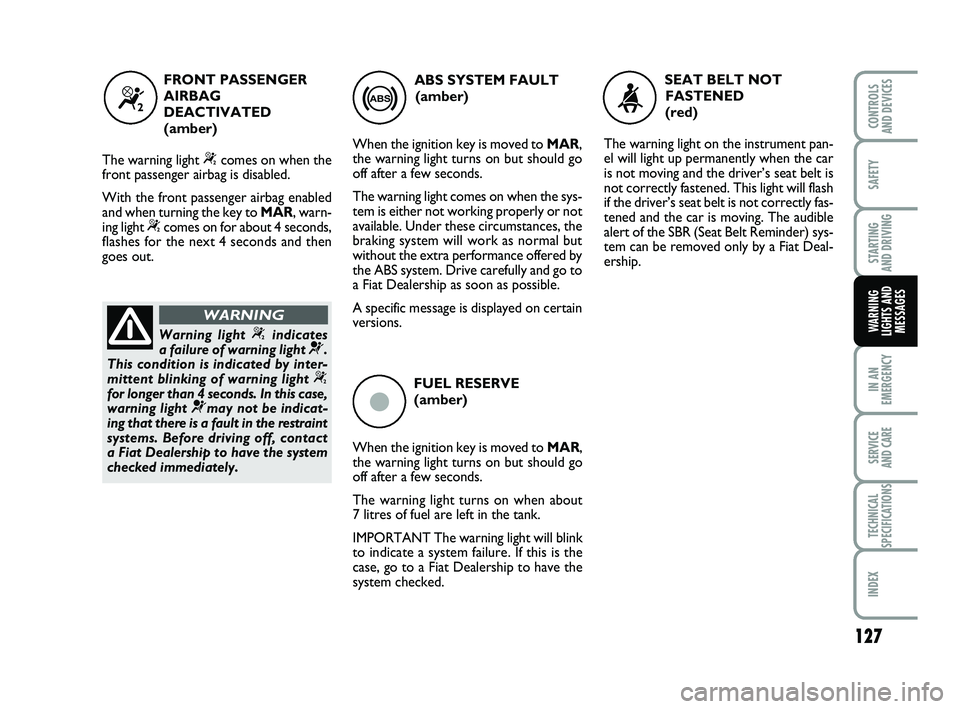
FUEL RESERVE
(amber)
When the ignition key is moved to MAR,
the warning light turns on but should go
off after a few seconds.
The warning light turns on when about
7 litres of fuel are left in the tank.
IMPORTANT The warning light will blink
to indicate a system failure. If this is the
case, go to a Fiat Dealership to have the
system checked. ABS SYSTEM FAULT
(amber)
When the ignition key is moved to MAR,
the warning light turns on but should go
off after a few seconds.
The warning light comes on when the sys-
tem is either not working properly or not
available. Under these circumstances, the
braking system will work as normal but
without the extra performance offered by
the ABS system. Drive carefully and go to
a Fiat Dealership as soon as possible.
A specific message is displayed on certain
versions.
>“
FRONT PASSENGER
AIRBAG
DEACTIVATED
(amber)
The warning light
“comes on when the
front passenger airbag is disabled.
With the front passenger airbag enabled
and when turning the key to MAR, warn-
ing light
“comes on for about 4 seconds,
flashes for the next 4 seconds and then
goes out.
Warning light
“indicates
a failure of warning light ¬.
This condition is indicated by inter-
mittent blinking of warning light
“for longer than 4 seconds. In this case,
warning light ¬may not be indicat-
ing that there is a fault in the restraint
systems. Before driving off, contact
a Fiat Dealership to have the system
checked immediately.
WARNING
SEAT BELT NOT
FASTENED
(red)
The warning light on the instrument pan-
el will light up permanently when the car
is not moving and the driver’s seat belt is
not correctly fastened. This light will flash
if the driver’s seat belt is not correctly fas-
tened and the car is moving. The audible
alert of the SBR (Seat Belt Reminder) sys-
tem can be removed only by a Fiat Deal-
ership.
<
121-132 PUNTO POP 1ed EN 16-08-2011 11:40 Pagina 127