fully FIAT PUNTO EVO 2010 1.G User Guide
[x] Cancel search | Manufacturer: FIAT, Model Year: 2010, Model line: PUNTO EVO, Model: FIAT PUNTO EVO 2010 1.GPages: 270, PDF Size: 8.34 MB
Page 104 of 270
103
KNOWING
YOUR
VEHICLE
SAFETY
STARTING
AND DRIVING
WARNING LIGHTS
AND MESSAGES
IN AN
EMERGENCY
SERVICING
AND CARE
TECHNICAL
SPECIFICATIONS
CONTENTS
SYSTEM INTERVENTION
The driver can tell the ABS system has come into action
because the brake pedal pulsates slightly and the system
gets noisier: it means that the vehicle speed should be al-
tered to suit the type of road surface.ABS SYSTEM
If you have never driven a vehicle with ABS before, it is ad-
visable to perform a few tests on slippery ground, always
in safe conditions and respecting the highway code of the
country where you are driving. Read the following infor-
mation carefully.
This system, which is an integral part of the braking sys-
tem, prevents one or more wheels from locking and skid-
ding on all road surface conditions, irrespective of the in-
tensity of the braking action, ensuring that the vehicle can
be controlled even during emergency braking.
The system is completed by EBD (Electronic Braking Force
Distribution), which distributes the braking action between
the front and rear wheels.
IMPORTANT For the maximum efficiency of the braking
system, a bedding-in period of about 500 km is needed (for
a new vehicle or after having replaced the brake
pads/discs): during this period it is better to avoid sharp,
repeated and prolonged braking.
The ABS system gets the most out of the
available grip but it cannot improve it.
Therefore, you should take great care when
driving on slippery surfaces: don’t take unneces-
sary risks.
WARNING
If the ABS cuts in, it is a sign that the grip
between tyre and the road surface has
reached the limit: you must slow down to match
the speed to the road grip available.
WARNING
FAILURE INDICATIONS
ABS failure
ABS failure is indicated by warning light >coming on on
the instrument panel together with the dedicated message
on the multifunction display (where provided), (see “Warn-
ing lights and messages”).
In this case, the braking system will work as normal, but
without the extra capacity offered by the ABS system. Dri-
ve carefully to the nearest Fiat Dealership to have the sys-
tem checked.
EBD failure
EBD failure is indicated by warning lights >and xcom-
ing on on the instrument panel together with the dedicated
message on the multifunction display (where provided),
(see section “Warning lights and messages”).
082-128 PUNTO FL EN 4ed 20-01-2010 15:06 Pagina 103
Page 105 of 270
BRAKE ASSIST
(integrated ESP emergency braking assistance)
(for versions/markets where available)
This system (which cannot be switched off) recognises
emergency braking (according to the speed of operation
of the brake pedal) and provides additional hydraulic brak-
ing pressure to support that applied by the driver. This
allows faster and more powerful operation of the brak-
ing system.
The Brake Assist is deactivated on versions equipped with
ESP if there is an ESP system failure (indicated by the warn-
ing light and the message on the multifunction display, for
versions/markets where provided). Drive carefully to the nearest Fiat Dealership to have the
system checked.
104
KNOWING
YOUR
VEHICLE
SAFETY
STARTING
AND DRIVING
WARNING LIGHTS
AND MESSAGES
IN AN
EMERGENCY
SERVICING
AND CARE
TECHNICAL
SPECIFICATIONS
CONTENTSIf only warning light xlights up on the in-
strument panel (with a message on the
multifunction display, where provided), stop the
car immediately and contact the nearest Fiat
Dealership. Fluid leaking from the hydraulic sys-
tem will compromise the operation of the brak-
ing system, whether it is of the conventional type
or with ABS.
WARNING
When the ABS cuts in, and you feel the
brake pedal pulsating, do not remove your
foot, but keep it pressed; in doing so you will stop
in the shortest distance possible under the road
conditions at the time.
WARNING
082-128 PUNTO FL EN 4ed 20-01-2010 15:06 Pagina 104
Page 118 of 270
117
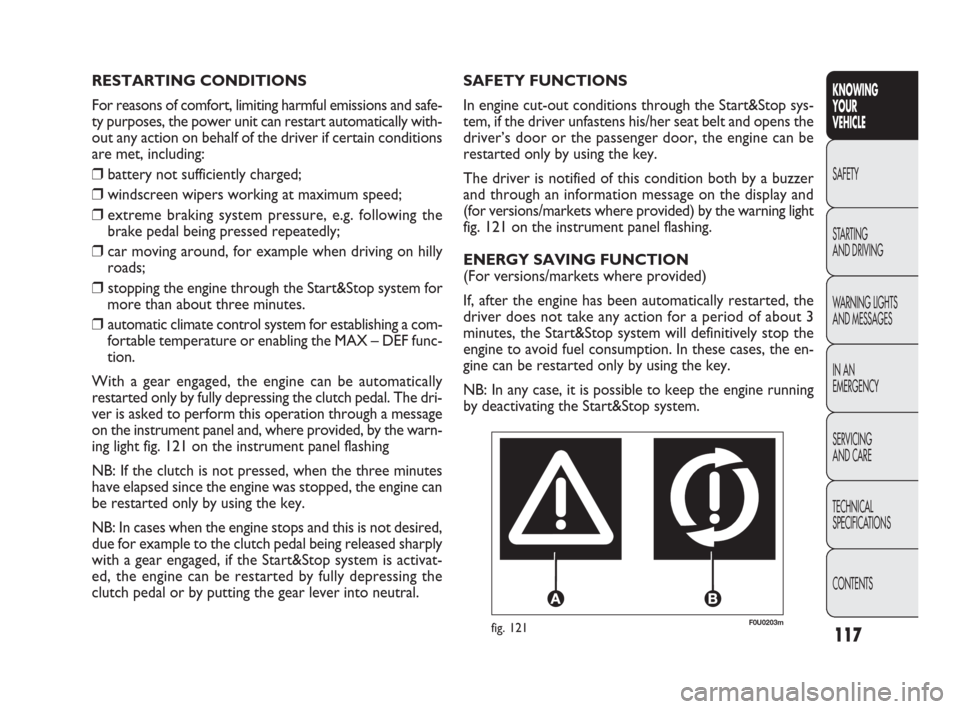
F0U0203mfig. 121
SAFETY FUNCTIONS
In engine cut-out conditions through the Start&Stop sys-
tem, if the driver unfastens his/her seat belt and opens the
driver’s door or the passenger door, the engine can be
restarted only by using the key.
The driver is notified of this condition both by a buzzer
and through an information message on the display and
(for versions/markets where provided) by the warning light
fig. 121 on the instrument panel flashing.
ENERGY SAVING FUNCTION
(For versions/markets where provided)
If, after the engine has been automatically restarted, the
driver does not take any action for a period of about 3
minutes, the Start&Stop system will definitively stop the
engine to avoid fuel consumption. In these cases, the en-
gine can be restarted only by using the key.
NB: In any case, it is possible to keep the engine running
by deactivating the Start&Stop system. RESTARTING CONDITIONS
For reasons of comfort, limiting harmful emissions and safe-
ty purposes, the power unit can restart automatically with-
out any action on behalf of the driver if certain conditions
are met, including:
❒ battery not sufficiently charged;
❒ windscreen wipers working at maximum speed;
❒extreme braking system pressure, e.g. following the
brake pedal being pressed repeatedly;
❒ car moving around, for example when driving on hilly
roads;
❒stopping the engine through the Start&Stop system for
more than about three minutes.
❒automatic climate control system for establishing a com-
fortable temperature or enabling the MAX – DEF func-
tion.
With a gear engaged, the engine can be automatically
restarted only by fully depressing the clutch pedal. The dri-
ver is asked to perform this operation through a message
on the instrument panel and, where provided, by the warn-
ing light fig. 121 on the instrument panel flashing
NB: If the clutch is not pressed, when the three minutes
have elapsed since the engine was stopped, the engine can
be restarted only by using the key.
NB: In cases when the engine stops and this is not desired,
due for example to the clutch pedal being released sharply
with a gear engaged, if the Start&Stop system is activat-
ed, the engine can be restarted by fully depressing the
clutch pedal or by putting the gear lever into neutral.KNOWING
YOUR
VEHICLE
SAFETY
STARTING
AND DRIVING
WARNING LIGHTS
AND MESSAGES
IN AN
EMERGENCY
SERVICING
AND CARE
TECHNICAL
SPECIFICATIONS
CONTENTS
082-128 PUNTO FL EN 4ed 20-01-2010 15:06 Pagina 117
Page 135 of 270
134
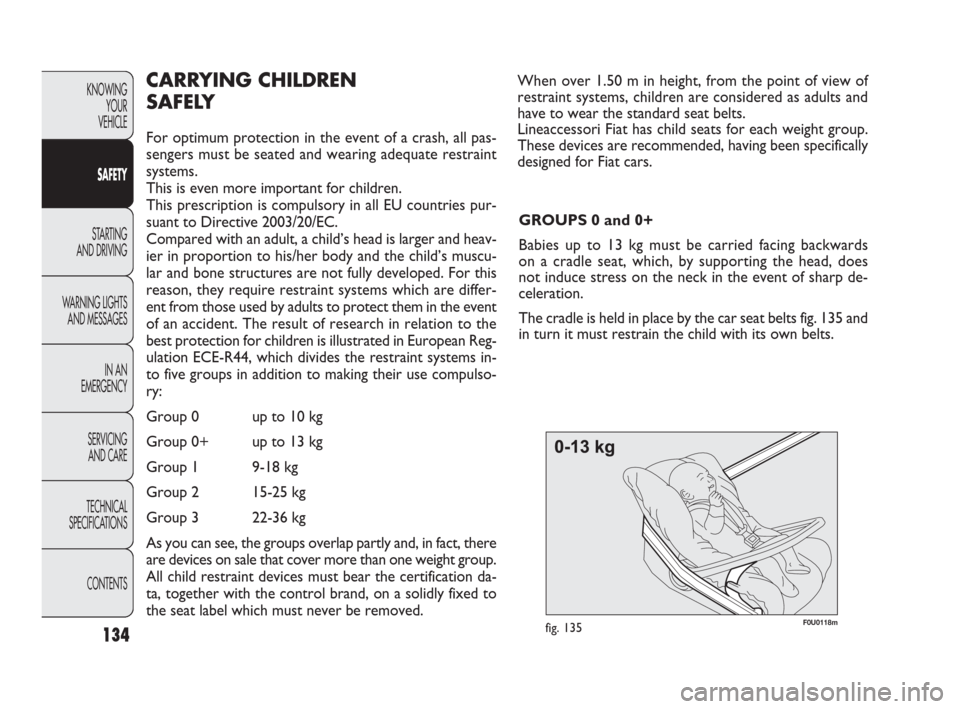
F0U0118mfig. 135
When over 1.50 m in height, from the point of view of
restraint systems, children are considered as adults and
have to wear the standard seat belts.
Lineaccessori Fiat has child seats for each weight group.
These devices are recommended, having been specifically
designed for Fiat cars.CARRYING CHILDREN
SAFELY
For optimum protection in the event of a crash, all pas-
sengers must be seated and wearing adequate restraint
systems.
This is even more important for children.
This prescription is compulsory in all EU countries pur-
suant to Directive 2003/20/EC.
Compared with an adult, a child’s head is larger and heav-
ier in proportion to his/her body and the child’s muscu-
lar and bone structures are not fully developed. For this
reason, they require restraint systems which are differ-
ent from those used by adults to protect them in the event
of an accident. The result of research in relation to the
best protection for children is illustrated in European Reg-
ulation ECE-R44, which divides the restraint systems in-
to five groups in addition to making their use compulso-
ry:
Group 0 up to 10 kg
Group 0+ up to 13 kg
Group 1 9-18 kg
Group 2 15-25 kg
Group 3 22-36 kg
As you can see, the groups overlap partly and, in fact, there
are devices on sale that cover more than one weight group.
All child restraint devices must bear the certification da-
ta, together with the control brand, on a solidly fixed to
the seat label which must never be removed.
KNOWING
YOUR
VEHICLE
SAFETY
STARTING
AND DRIVING
WARNING LIGHTS
AND MESSAGES
IN AN
EMERGENCY
SERVICING
AND CARE
TECHNICAL
SPECIFICATIONS
CONTENTSGROUPS 0 and 0+
Babies up to 13 kg must be carried facing backwards
on a cradle seat, which, by supporting the head, does
not induce stress on the neck in the event of sharp de-
celeration.
The cradle is held in place by the car seat belts fig. 135 and
in turn it must restrain the child with its own belts.
129-148 PUNTO FL EN 4ed 18-01-2010 12:25 Pagina 134
Page 136 of 270
135
F0U0119mfig. 136
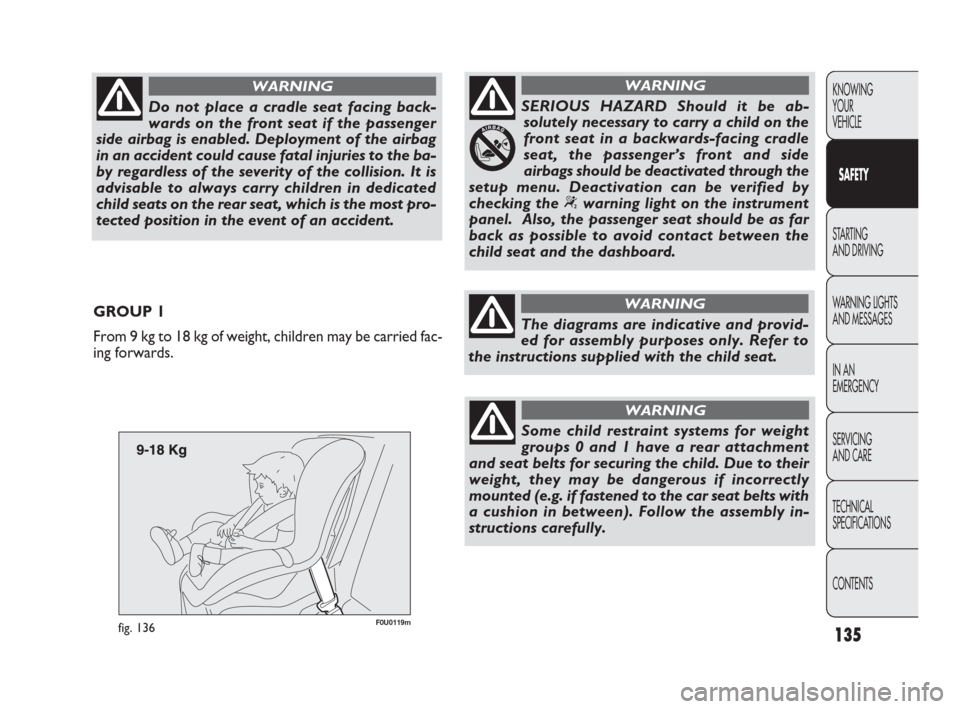
GROUP 1
From 9 kg to 18 kg of weight, children may be carried fac-
ing forwards.
KNOWING
YOUR
VEHICLE
SAFETY
STARTING
AND DRIVING
WARNING LIGHTS
AND MESSAGES
IN AN
EMERGENCY
SERVICING
AND CARE
TECHNICAL
SPECIFICATIONS
CONTENTS
Do not place a cradle seat facing back-
wards on the front seat if the passenger
side airbag is enabled. Deployment of the airbag
in an accident could cause fatal injuries to the ba-
by regardless of the severity of the collision. It is
advisable to always carry children in dedicated
child seats on the rear seat, which is the most pro-
tected position in the event of an accident.
WARNING
SERIOUS HAZARD Should it be ab-
solutely necessary to carry a child on the
front seat in a backwards-facing cradle
seat, the passenger’s front and side
airbags should be deactivated through the
setup menu. Deactivation can be verified by
checking the “warning light on the instrument
panel. Also, the passenger seat should be as far
back as possible to avoid contact between the
child seat and the dashboard.
WARNING
The diagrams are indicative and provid-
ed for assembly purposes only. Refer to
the instructions supplied with the child seat.
WARNING
Some child restraint systems for weight
groups 0 and 1 have a rear attachment
and seat belts for securing the child. Due to their
weight, they may be dangerous if incorrectly
mounted (e.g. if fastened to the car seat belts with
a cushion in between). Follow the assembly in-
structions carefully.
WARNING
129-148 PUNTO FL EN 4ed 18-01-2010 12:25 Pagina 135
Page 139 of 270
138
Below is a summary of the safety rules to be
followed when carrying children:
1) The recommended position for installing child seats is
on the rear seat, as it is the most protected area in the
event of a crash.
2) When disengaging the passenger airbag, always check
the amber warning light on the instrument panel is per-
manently on to make sure that the airbag has actually been
deactivated.
3) Carefully follow the instructions that came with the
child seat, which the manufacturer must supply by law.
Keep the instructions in the car along with the other doc-
uments and this handbook. Do not use second hand child
seats without instructions.
4) Always check the seat belt is well fastened by pulling
on it.
5) Only one child is to be strapped into each retaining sys-
tem; never carry two children using one child seat.
6) Always check the seat belts do not rest on the child’s
neck.
7) While travelling, do not let the child sit incorrectly or
release the belts.
8) Never carry children on your lap, even newborns. No
one, however strong, can hold a child in the event of an
accident.
9) In the event of an accident, replace the child seat with
a new one.KNOWING
YOUR
VEHICLE
SAFETY
STARTING
AND DRIVING
WARNING LIGHTS
AND MESSAGES
IN AN
EMERGENCY
SERVICING
AND CARE
TECHNICAL
SPECIFICATIONS
CONTENTS
Do not place a child seat facing backwards
on the front seat if the passenger side
airbag is enabled. Deployment of the airbag in an
accident could cause fatal injuries to the baby re-
gardless of the severity of the collision. It is ad-
visable to always carry children in a child seat on
the rear seat, which is the most protected posi-
tion in the event of a collision.
WARNING
“UNIVERSAL ISOFIX”
CHILD RESTRAINT ASSEMBLY
SETUP
The car is provisioned for a Universal Isofix child restraint,
a new European standardised system for carrying children
safely. An example of such a seat is shown in fig. 139. The
Universal Isofix child seat covers weight group 1.
Due to its different attachment system, the Universal Isofix
child seat must be anchored to the special low metal rings
A-fig. 140, located between the backrest and rear cushion.
The upper belt (provided with the child seat) must be then
secured to ring B-fig. 141 located on the back of the back-
rest at child seat level. It is possible to have a mixed as-
sembly of the traditional child seats and the Universal Isofix
ones.
Remember that, in the case of Universal Isofix child seats,
you can use all those seats bearing the marking ECE R44/03
Universal Isofix.
129-148 PUNTO FL EN 4ed 18-01-2010 12:26 Pagina 138
Page 150 of 270
149
STARTING PROCEDURE FOR PETROL
VERSIONS
Proceed as follows:
❒ensure that the handbrake is on;
❒put the gear lever into neutral;
❒fully depress the clutch pedal without touching the ac-
celerator;
❒turn the ignition key to AVV and let it go the moment
the engine starts.
If the engine does not start at the first attempt, return
the ignition key to STOP before repeating the procedure.
STARTING THE ENGINE
The car is fitted with an electronic engine lock device: if
the engine fails to start, see the paragraph on “The Fiat
CODE system” in the “Dashboard and controls” section.
The engine may be noisier during the first few seconds of
operation, particularly after a long period of inactivity. This
is a feature of hydraulic tappets, the timing system cho-
sen to reduce the number of servicing interventions, and
effects neither functionality nor reliability.
KNOWING
YOUR
VEHICLE
SAFETY
STARTING
AND DRIVING
WARNING LIGHTS
AND MESSAGES
IN AN
EMERGENCY
SERVICING
AND CARE
TECHNICAL
SPECIFICATIONS
CONTENTS
STARTING AND DRIVING
It is dangerous to let the engine run in en-
closed spaces. The engine consumes oxy-
gen and produces carbon dioxide, carbon monox-
ide and other toxic gases.
WARNING
In the first period of use, we recommend
that you do not demand maximum perfor-
mance from the car (e.g. excessive accel-
eration, extended travel at maximum revs, heavy
braking etc.).
With the engine off, do not leave the
key in the ignition to prevent draining the
battery.
Remember that the brake booster and
power steering are not operational until
the engine has been started, therefore you need
to apply much more force than usual to the brake
pedal and steering wheel.
WARNING
149-160 PUNTO FL EN 4ed 20-01-2010 14:37 Pagina 149
Page 151 of 270
150
If, when the ignition key is at MAR, the instrument panel
warning light
Yremains on together with warning light
U, turn the key to STOP and then back to MAR; if the
warning light remains on, try with the other keys provid-
ed with the car.
IMPORTANT If the instrument panel warning light
Ystays on permanently, contact a Fiat Dealership immedi-
ately.
IMPORTANT Never leave the ignition key at MAR when
the engine is off.
KNOWING
YOUR
VEHICLE
SAFETY
STARTING
AND DRIVING
WARNING LIGHTS
AND MESSAGES
IN AN
EMERGENCY
SERVICING
AND CARE
TECHNICAL
SPECIFICATIONS
CONTENTSSTARTING PROCEDURE FOR DIESEL
VERSIONS
Proceed as follows:
❒ensure that the handbrake is on;
❒put the gear lever into neutral;
❒turn the ignition key to MAR: the warning lights mand
Yon the instrument panel will turn on;
❒wait for the warning lights Yand m to turn off. The
hotter the engine is, the quicker this will happen;
❒fully depress the clutch pedal without touching the ac-
celerator;
❒turn the ignition key to AVV as soon as warning light
m goes out. If you wait too long, you will lose the ben-
efit of the heating work done by the glow plugs. Release
the key as soon as the engine starts.If the engine does not start at the first attempt, return
the ignition key to STOP before repeating the procedure.
If, when the ignition key is at MAR, the instrument panel
warning light
Yremains on together with warning light
m, turn the key to STOP and then back to MAR; if the
warning lights remain on, try with the other keys provid-
ed with the car.
IMPORTANT If the instrument panel warning light
Ystays on permanently, contact a Fiat Dealership immedi-
ately.
IMPORTANT Never leave the ignition key at MAR when
the engine is off.
Warning light mwill blink for 60 seconds
after starting or during prolonged crank-
ing to indicate a fault with the glow plug
system. Use the car as normal if the engine starts,
but go to a Fiat Dealership as soon as possible.
149-160 PUNTO FL EN 4ed 20-01-2010 14:37 Pagina 150
Page 154 of 270
153
KNOWING
YOUR
VEHICLE
SAFETY
STARTING
AND DRIVING
WARNING LIGHTS
AND MESSAGES
IN AN
EMERGENCY
SERVICING
AND CARE
TECHNICAL
SPECIFICATIONS
CONTENTS
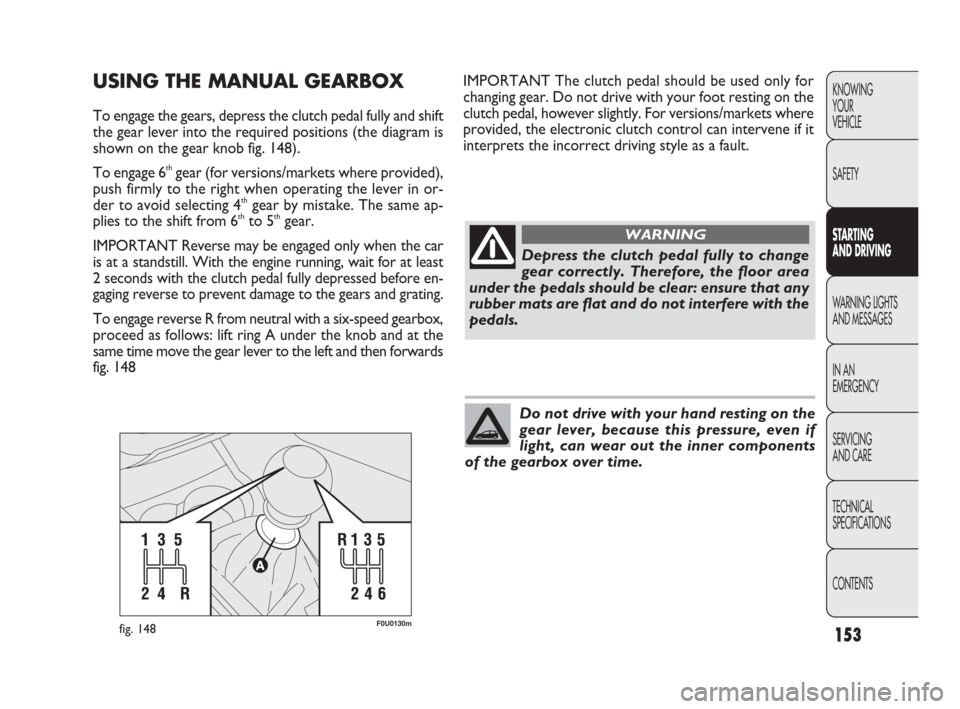
F0U0130mfig. 148
USING THE MANUAL GEARBOX
To engage the gears, depress the clutch pedal fully and shift
the gear lever into the required positions (the diagram is
shown on the gear knob fig. 148).
To engage 6
thgear (for versions/markets where provided),
push firmly to the right when operating the lever in or-
der to avoid selecting 4
thgear by mistake. The same ap-
plies to the shift from 6thto 5thgear.
IMPORTANT Reverse may be engaged only when the car
is at a standstill. With the engine running, wait for at least
2 seconds with the clutch pedal fully depressed before en-
gaging reverse to prevent damage to the gears and grating.
To engage reverse R from neutral with a six-speed gearbox,
proceed as follows: lift ring A under the knob and at the
same time move the gear lever to the left and then forwards
fig. 148
Depress the clutch pedal fully to change
gear correctly. Therefore, the floor area
under the pedals should be clear: ensure that any
rubber mats are flat and do not interfere with the
pedals.
WARNING
Do not drive with your hand resting on the
gear lever, because this pressure, even if
light, can wear out the inner components
of the gearbox over time.
IMPORTANT The clutch pedal should be used only for
changing gear. Do not drive with your foot resting on the
clutch pedal, however slightly. For versions/markets where
provided, the electronic clutch control can intervene if it
interprets the incorrect driving style as a fault.
149-160 PUNTO FL EN 4ed 20-01-2010 14:37 Pagina 153
Page 157 of 270
156
TOWING TRAILERS
IMPORTANT NOTES
The car must be equipped with an approved tow hook and
adequate electrical system to tow caravans or trailers. In-
stallation must be performed by specialised personnel who
will issue the required papers for travelling on roads.
Install any specific and/or additional rear-view mirrors in
accordance with the highway code of the country in which
you are travelling.
Remember that, when towing a trailer, steep hills are hard-
er to climb, braking distances increase and overtaking takes
longer relative to the overall weight of the trailer.
Engage a low gear when driving downhill, rather than con-
stantly using the brake.
The weight of the trailer on the car’s tow hook will re-
duce the load capacity of the car by the same amount. Con-
sider the weight of the trailer fully laden, including acces-
sories and luggage, to make sure you do not exceed the
maximum towable weight (shown on the vehicle regis-
tration document).
Respect each country’s speed limits for vehicles towing
trailers. The top speed must not exceed 100 km/h at any
time.
You should fit a suitable stabiliser to the trailer.
KNOWING
YOUR
VEHICLE
SAFETY
STARTING
AND DRIVING
WARNING LIGHTS
AND MESSAGES
IN AN
EMERGENCY
SERVICING
AND CARE
TECHNICAL
SPECIFICATIONS
CONTENTS
The ABS with which the car may be
equipped will not control the braking sys-
tem of the trailer. Particular caution is therefore
required on slippery roads.
WARNING
Never modify the braking system of the
car to control the trailer brake. The trail-
er braking system must be fully independent from
the hydraulic system of the car.
WARNING
149-160 PUNTO FL EN 4ed 20-01-2010 14:37 Pagina 156