lock FIAT QUBO 2016 1.G Service Manual
[x] Cancel search | Manufacturer: FIAT, Model Year: 2016, Model line: QUBO, Model: FIAT QUBO 2016 1.GPages: 231, PDF Size: 5.02 MB
Page 155 of 231
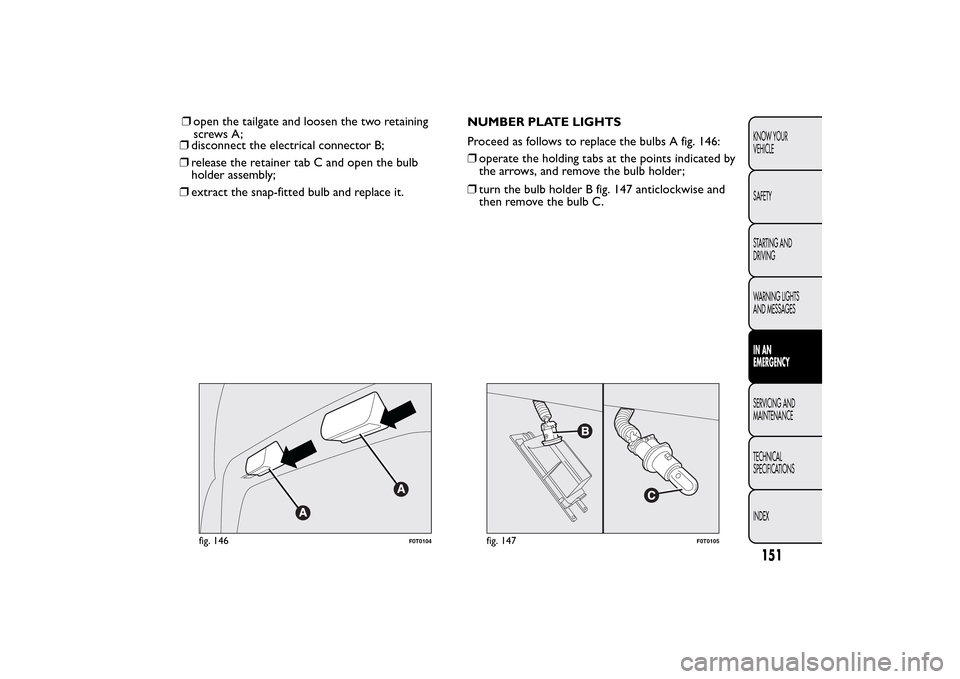
❒disconnect the electrical connector B;
❒release the retainer tab C and open the bulb
holder assembly;
❒extract the snap-fitted bulb and replace it.NUMBER PLATE LIGHTS
Proceed as follows to replace the bulbs A fig. 146:
❒operate the holding tabs at the points indicated by
the arrows, and remove the bulb holder;
❒turn the bulb holder B fig. 147 anticlockwise and
then remove the bulb C.
fig. 146
F0T0104
fig. 147
F0T0105
151KNOW YOUR
VEHICLE
SAFETY
STARTING AND
DRIVING
WARNING LIGHTS
AND MESSAGESIN AN
EMERGENCYSERVICING AND
MAINTENANCE
TECHNICAL
SPECIFICATIONS
INDEX
❒open the tailgate and loosen the two retaining
screws A;
Page 156 of 231
CHANGING AN INTERIOR BULBFor the type of bulb and corresponding power rating,
see the paragraph "Changing a bulb".
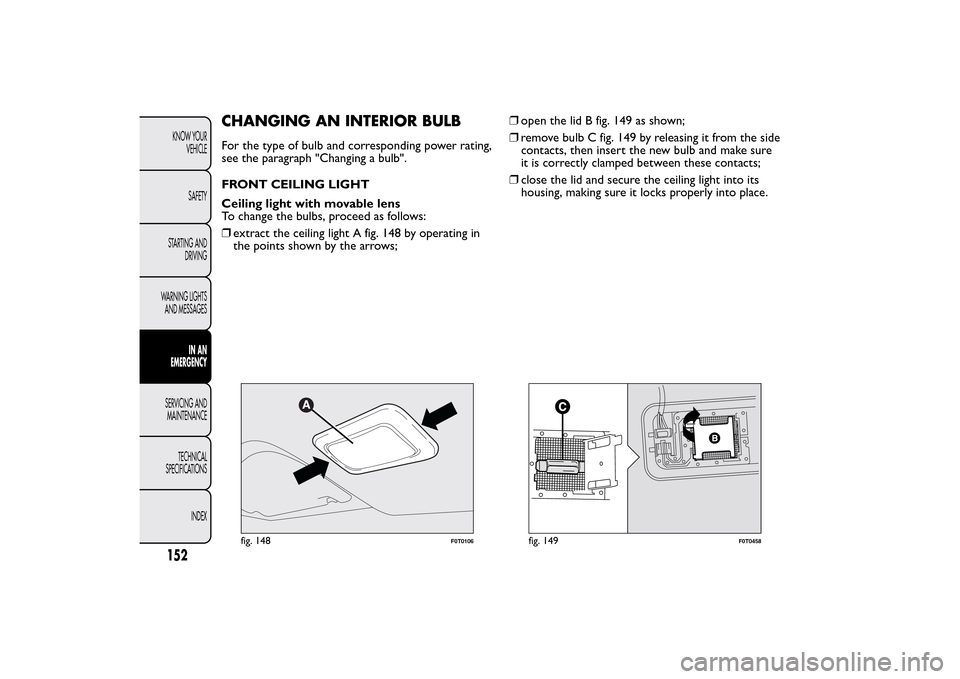
FRONT CEILING LIGHT
Ceiling light with movable lens
To change the bulbs, proceed as follows:
❒extract the ceiling light A fig. 148 by operating in
the points shown by the arrows;❒open the lid B fig. 149 as shown;
❒remove bulb C fig. 149 by releasing it from the side
contacts, then insert the new bulb and make sure
it is correctly clamped between these contacts;
❒close the lid and secure the ceiling light into its
housing, making sure it locks properly into place.
fig. 148
F0T0106
fig. 149
F0T0458
152KNOW YOUR
VEHICLE
SAFETY
STARTING AND
DRIVING
WARNING LIGHTS
AND MESSAGES
IN AN
EMERGENCY
SERVICING AND
MAINTENANCE
TECHNICAL
SPECIFICATIONS
INDEX
Page 157 of 231
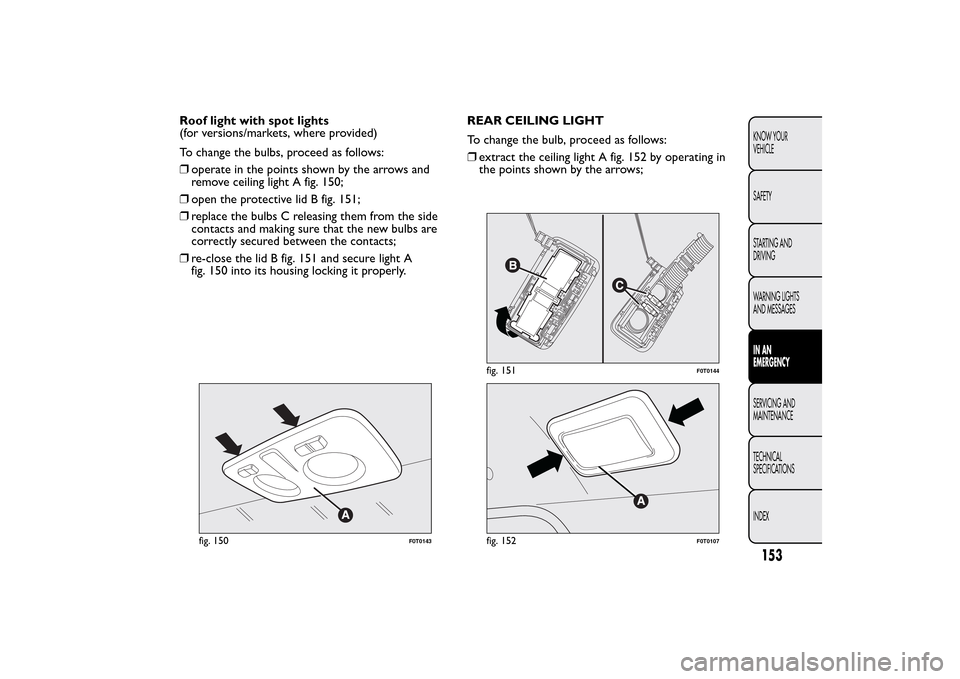
Roof light with spot lights
(for versions/markets, where provided)
To change the bulbs, proceed as follows:
❒operate in the points shown by the arrows and
remove ceiling light A fig. 150;
❒open the protective lid B fig. 151;
❒replace the bulbs C releasing them from the side
contacts and making sure that the new bulbs are
correctly secured between the contacts;
❒re-close the lid B fig. 151 and secure light A
fig. 150 into its housing locking it properly.REAR CEILING LIGHT
To change the bulb, proceed as follows:
❒extract the ceiling light A fig. 152 by operating in
the points shown by the arrows;
fig. 150
F0T0143
fig. 151
F0T0144
fig. 152
F0T0107
153KNOW YOUR
VEHICLE
SAFETY
STARTING AND
DRIVING
WARNING LIGHTS
AND MESSAGESIN AN
EMERGENCYSERVICING AND
MAINTENANCE
TECHNICAL
SPECIFICATIONS
INDEX
Page 158 of 231
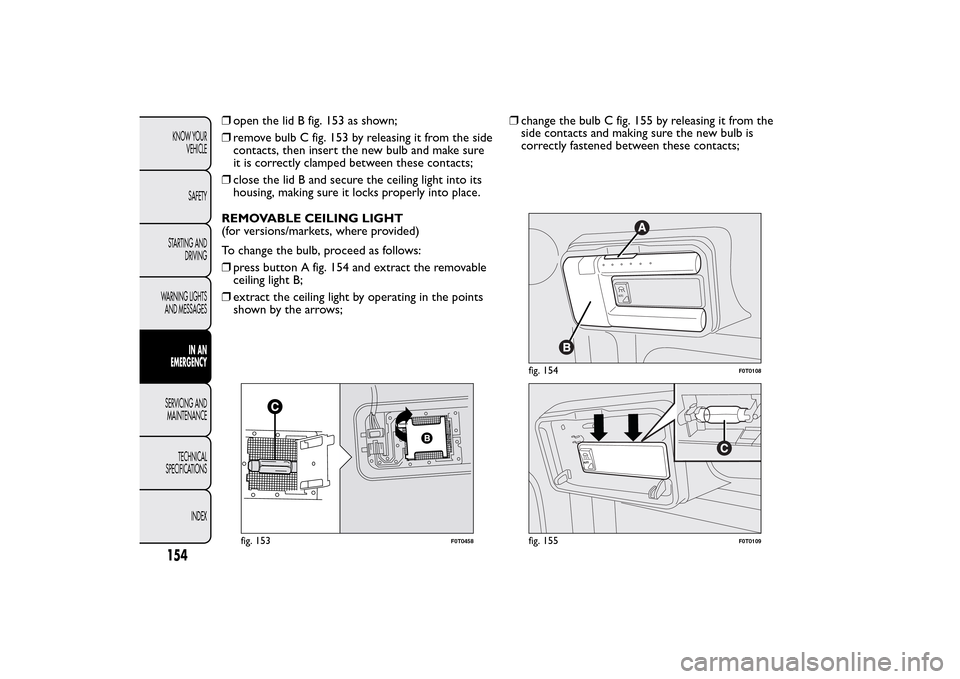
❒open the lid B fig. 153 as shown;
❒remove bulb C fig. 153 by releasing it from the side
contacts, then insert the new bulb and make sure
it is correctly clamped between these contacts;
❒close the lid B and secure the ceiling light into its
housing, making sure it locks properly into place.
REMOVABLE CEILING LIGHT
(for versions/markets, where provided)
To change the bulb, proceed as follows:
❒press button A fig. 154 and extract the removable
ceiling light B;
❒extract the ceiling light by operating in the points
shown by the arrows;❒change the bulb C fig. 155 by releasing it from the
side contacts and making sure the new bulb is
correctly fastened between these contacts;
fig. 153
F0T0458
A
UT
O
fig. 154
F0T0108
A
U
T
O
fig. 155
F0T0109
154KNOW YOUR
VEHICLE
SAFETY
STARTING AND
DRIVING
WARNING LIGHTS
AND MESSAGES
IN AN
EMERGENCY
SERVICING AND
MAINTENANCE
TECHNICAL
SPECIFICATIONS
INDEX
Page 161 of 231
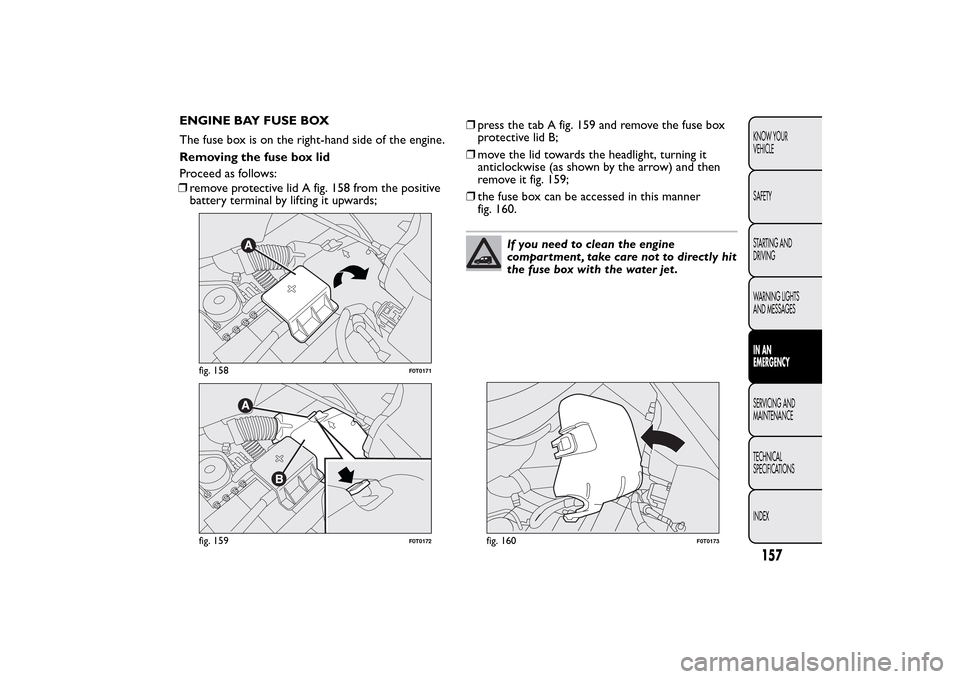
ENGINE BAY FUSE BOX
The fuse box is on the right-hand side of the engine.
Removing the fuse box lid
Proceed as follows:
❒remove protective lid A fig. 158 from the positive
battery terminal by lifting it upwards;❒press the tab A fig. 159 and remove the fuse box
protective lid B;
❒move the lid towards the headlight, turning it
anticlockwise (as shown by the arrow) and then
remove it fig. 159;
❒the fuse box can be accessed in this manner
fig. 160.
If you need to clean the engine
compartment , take care not to directly hit
the fuse box with the water jet .
fig. 158
F0T0171
fig. 159
F0T0172
fig. 160
F0T0173
157KNOW YOUR
VEHICLE
SAFETY
STARTING AND
DRIVING
WARNING LIGHTS
AND MESSAGESIN AN
EMERGENCYSERVICING AND
MAINTENANCE
TECHNICAL
SPECIFICATIONS
INDEX
Page 166 of 231
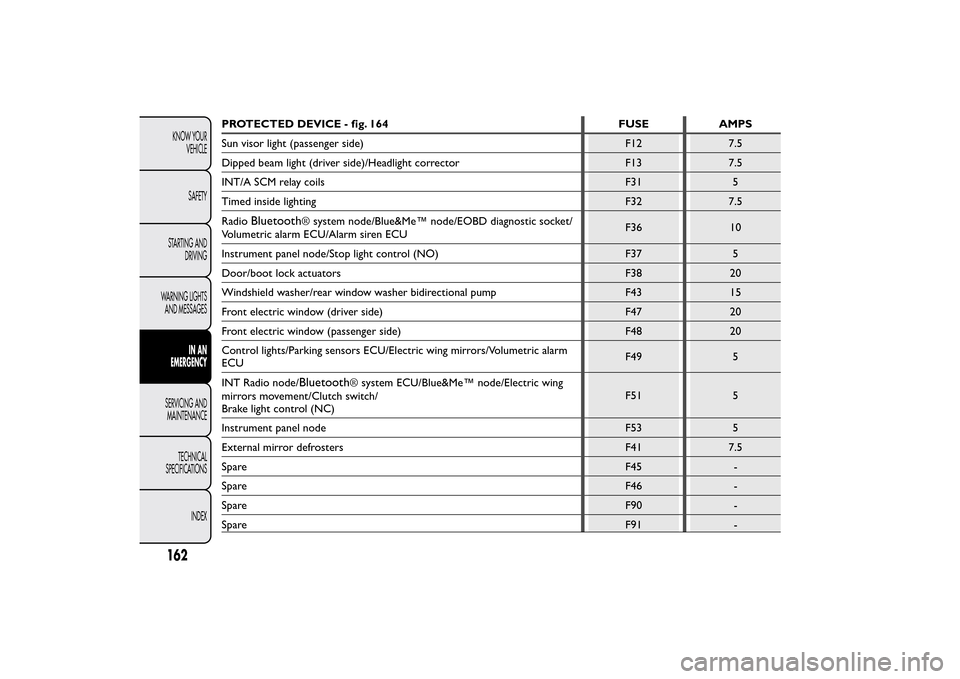
PROTECTED DEVICE - fig. 164 FUSE AMPS
Sun visor light (passenger side) F12 7.5
Dipped beam light (driver side)/Headlight corrector F13 7.5
INT/A SCM relay coils F31 5
Timed inside lighting F32 7.5
Radio
Bluetooth
®system node/Blue&Me™ node/EOBD diagnostic socket/
Volumetric alarm ECU/Alarm siren ECUF36 10
Instrument panel node/Stop light control (NO) F37 5
Door/boot lock actuators F38 20
Windshield washer/rear window washer bidirectional pump F43 15
Front electric window (driver side) F47 20
Front electric window (passenger side) F48 20
Control lights/Parking sensors ECU/Electric wing mirrors/Volumetric alarm
ECUF49 5
INT Radio node/Bluetooth
®system ECU/Blue&Me™ node/Electric wing
mirrors movement/Clutch switch/
Brake light control (NC)F51 5
Instrument panel node F53 5
External mirror defrosters F41 7.5
SpareF45 -
SpareF46 -
SpareF90 -
SpareF91 -
162KNOW YOUR
VEHICLE
SAFETY
STARTING AND
DRIVING
WARNING LIGHTS
AND MESSAGES
IN AN
EMERGENCY
SERVICING AND
MAINTENANCE
TECHNICAL
SPECIFICATIONS
INDEX
Page 170 of 231
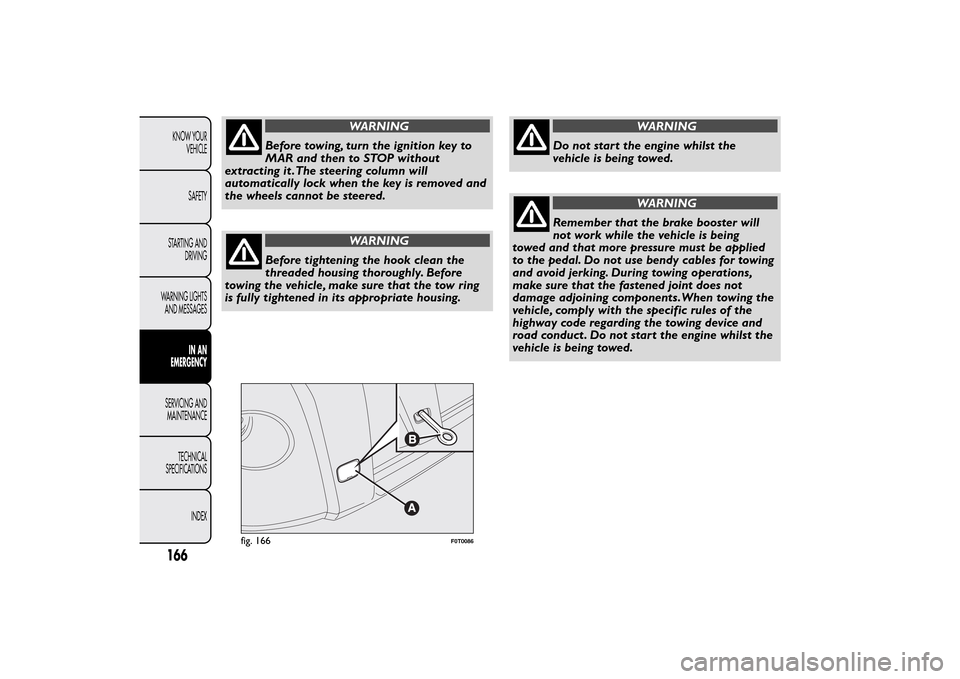
WARNING
Before towing, turn the ignition key to
MAR and then to STOP without
extracting it .The steering column will
automatically lock when the key is removed and
the wheels cannot be steered.
WARNING
Before tightening the hook clean the
threaded housing thoroughly. Before
towing the vehicle, make sure that the tow ring
is fully tightened in its appropriate housing.
WARNING
Do not start the engine whilst the
vehicle is being towed.
WARNING
Remember that the brake booster will
not work while the vehicle is being
towed and that more pressure must be applied
to the pedal. Do not use bendy cables for towing
and avoid jerking. During towing operations,
make sure that the fastened joint does not
damage adjoining components.When towing the
vehicle, comply with the specific rules of the
highway code regarding the towing device and
road conduct . Do not start the engine whilst the
vehicle is being towed.
fig. 166
F0T0086
166KNOW YOUR
VEHICLE
SAFETY
STARTING AND
DRIVING
WARNING LIGHTS
AND MESSAGES
IN AN
EMERGENCY
SERVICING AND
MAINTENANCE
TECHNICAL
SPECIFICATIONS
INDEX
Page 173 of 231
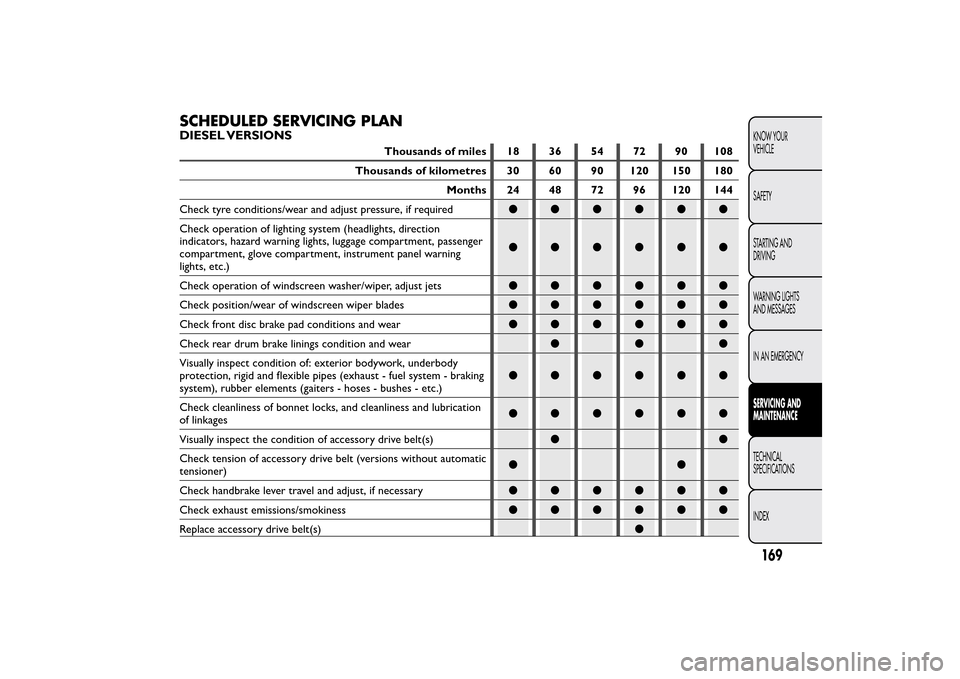
SCHEDULED SERVICING PLANDIESEL VERSIONS
Thousands of miles 18 36 54 72 90 108
Thousands of kilometres 30 60 90 120 150 180
Months 24 48 72 96 120 144
Check tyre conditions/wear and adjust pressure, if required●●●●●●
Check operation of lighting system (headlights, direction
indicators, hazard warning lights, luggage compartment, passenger
compartment, glove compartment, instrument panel warning
lights, etc.)●●●●●●
Check operation of windscreen washer/wiper, adjust jets●●●●●●
Check position/wear of windscreen wiper blades●●●●●●
Check front disc brake pad conditions and wear●●●●●●
Check rear drum brake linings condition and wear●●●
Visually inspect condition of: exterior bodywork, underbody
protection, rigid and flexible pipes (exhaust - fuel system - braking
system), rubber elements (gaiters - hoses - bushes - etc.)●●●●●●
Check cleanliness of bonnet locks, and cleanliness and lubrication
of linkages●●●●●●
Visually inspect the condition of accessory drive belt(s)●●
Check tension of accessory drive belt (versions without automatic
tensioner)●●
Check handbrake lever travel and adjust, if necessary●●●●●●
Check exhaust emissions/smokiness●●●●●●
Replace accessory drive belt(s)●
169KNOW YOUR
VEHICLE
SAFETY
STARTING AND
DRIVING
WARNING LIGHTS
AND MESSAGES
IN AN EMERGENCYSERVICING AND
MAINTENANCETECHNICAL
SPECIFICATIONS
INDEX
Page 175 of 231
REGULAR CHECKSEvery 1,000 km or before long journeys, check and, if
necessary, top up:
❒engine coolant level;
❒brake fluid level;
❒windscreen washer fluid level;
❒tyre inflation pressure and condition;
❒operation of lighting system (headlamps, direction
indicators, hazard warning lights, etc.);
❒operation of screen wash/wipe system and
positioning/wear of windscreen/rear window wiper
blades.
Check and top up, if required, the engine oil level
every 3,000 km.
You are recommended to use PETRONAS
LUBRICANTS products, which have been designed
and produced specifically for Fiat vehicles (see
“Capacities” table in the “Technical specifications”
section).
HEAVY USAGE OF THE VEHICLEShould prevailing use of the vehicle be under one of
the following specially heavy conditions:
❒towing a trailer or caravan;
❒dusty roads;
❒short, repeated journeys (less than 7-8 km) at
sub-zero outside temperatures;
❒engine often idling, or driving long distances at low
speed (e.g. door to door deliveries) or long period
of idleness;
❒urban trips;
you should perform the following inspections more
frequently than shown in the Scheduled Servicing
Plan:
❒check front disc brake pad condition and wear;
❒check cleanliness of bonnet and boot locks,
cleanliness and lubrication of linkage;
171KNOW YOUR
VEHICLE
SAFETY
STARTING AND
DRIVING
WARNING LIGHTS
AND MESSAGES
IN AN EMERGENCYSERVICING AND
MAINTENANCETECHNICAL
SPECIFICATIONS
INDEX
Page 190 of 231
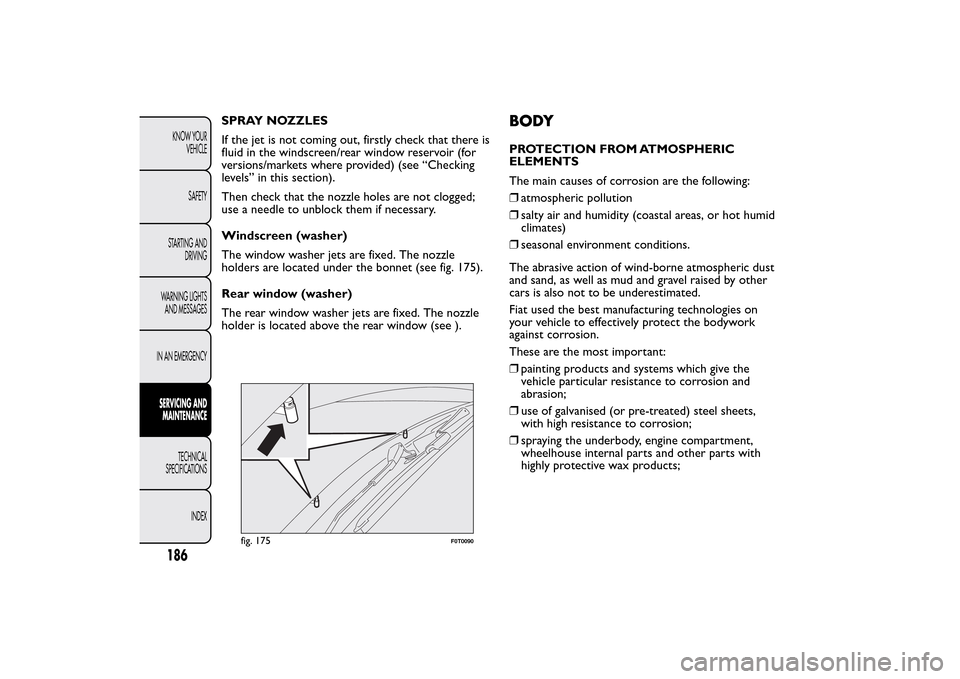
SPRAY NOZZLES
If the jet is not coming out, firstly check that there is
fluid in the windscreen/rear window reservoir (for
versions/markets where provided) (see “Checking
levels” in this section).
Then check that the nozzle holes are not clogged;
use a needle to unblock them if necessary.
Windscreen (washer)
The window washer jets are fixed. The nozzle
holders are located under the bonnet (see fig. 175).
Rear window (washer)
The rear window washer jets are fixed. The nozzle
holder is located above the rear window (see ).
BODYPROTECTION FROM ATMOSPHERIC
ELEMENTS
The main causes of corrosion are the following:
❒atmospheric pollution
❒salty air and humidity (coastal areas, or hot humid
climates)
❒seasonal environment conditions.
The abrasive action of wind-borne atmospheric dust
and sand, as well as mud and gravel raised by other
cars is also not to be underestimated.
Fiat used the best manufacturing technologies on
your vehicle to effectively protect the bodywork
against corrosion.
These are the most important:
❒painting products and systems which give the
vehicle particular resistance to corrosion and
abrasion;
❒use of galvanised (or pre-treated) steel sheets,
with high resistance to corrosion;
❒spraying the underbody, engine compartment,
wheelhouse internal parts and other parts with
highly protective wax products;
fig. 175
F0T0090
186KNOW YOUR
VEHICLE
SAFETY
STARTING AND
DRIVING
WARNING LIGHTS
AND MESSAGES
IN AN EMERGENCY
SERVICING AND
MAINTENANCE
TECHNICAL
SPECIFICATIONS
INDEX