air condition FIAT QUBO 2017 1.G User Guide
[x] Cancel search | Manufacturer: FIAT, Model Year: 2017, Model line: QUBO, Model: FIAT QUBO 2017 1.GPages: 260, PDF Size: 4.74 MB
Page 157 of 260
FIX & GO AUTOMATIC KIT
WARNING
The information required by the
applicable regulation is indicated on the
Fix&Go kit package label. Compliance with the
indications on the label is an essential condition
to ensure the safety and the effectiveness of
the Fix&Go kit . Carefully read the label before
use, avoid improper use. Fix&Go is subject to
expiration and must be replaced periodically.
The kit should be used by adults and cannot be
used by children.
Show the package and the label to the
personnel charged with handling the tyre
treated with the tyre repair kit .
Fix&Go provides a temporary repair,
therefore the tyre must be examined and
repaired by a specialist as soon as
possible.The sealing fluid is effective at
temperatures between -40°C and +50°C. It is
possible to repair tyres which have been damaged
on tread up to a diameter of 4mm; however,
tyres damaged on their side cannot be repaired.
Before using Fix&Go kit , ensure that the tyre isn't
excessively damaged and that the rim is in good
condition, otherwise do not use it and contact
a Fiat Dealership. Do not remove foreign bodies
from the tyre. Do not let the compressor turned
on for more than 20 consecutive minutes -
overheating hazard.
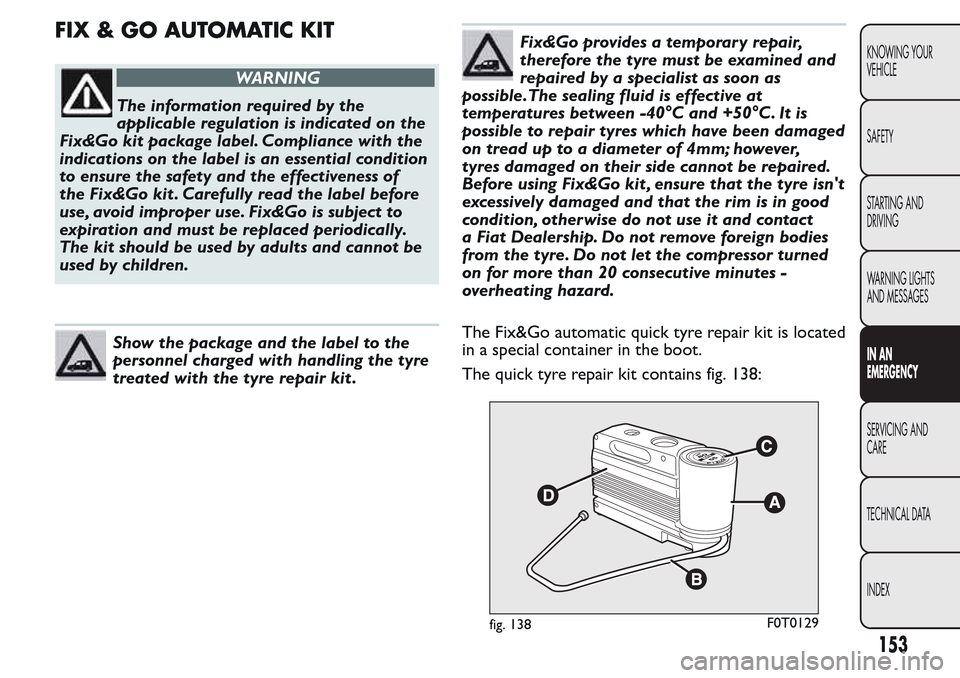
The Fix&Go automatic quick tyre repair kit is located
in a special container in the boot.
The quick tyre repair kit contains fig. 138:
fig. 138F0T0129
153
KNOWING YOUR
VEHICLE
SAFETY
STARTING AND
DRIVING
WARNING LIGHTS
AND MESSAGES
IN AN
EMERGENCY
SERVICING AND
CARE
TECHNICAL DATA
INDEX
Page 178 of 260
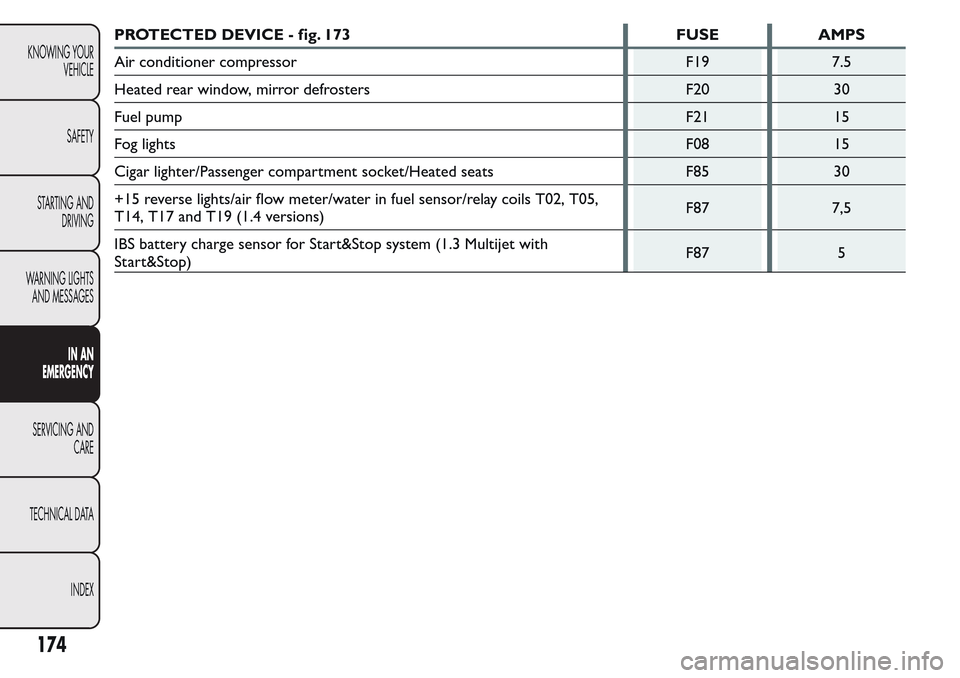
PROTECTED DEVICE - fig. 173 FUSE AMPS
Air conditioner compressor F19 7.5
Heated rear window, mirror defrosters F20 30
Fuel pump F21 15
Fog lights F08 15
Cigar lighter/Passenger compartment socket/Heated seats F85 30
+15 reverse lights/air flow meter/water in fuel sensor/relay coils T02, T05,
T14, T17 and T19 (1.4 versions)F87 7,5
IBS battery charge sensor for Start&Stop system (1.3 Multijet with
Start&Stop)F87 5
174
KNOWING YOUR
VEHICLE
SAFETY
STARTING AND
DRIVING
WARNING LIGHTS
AND MESSAGES
IN AN
EMERGENCY
SERVICING AND
CARE
TECHNICAL DATA
INDEX
Page 187 of 260
SERVICING AND CARE
SCHEDULED SERVICING
Correct servicing is essential for ensuring long
vehicle life under the best conditions.
This is why Fiat has planned a series of checks and
services every 30,000/35,000 km.
It is, however, important to remember that
scheduled servicing does not completely cover all the
requirements of the vehicle: even in the initial period
before 30,000/35,000 km, and then subsequently,
between one service and another, ordinary care
is always required such as routine checks involving
topping up fluid levels, checking tyre pressures etc.
IMPORTANT The Scheduled Servicing coupons
are set out by the Manufacturer. Failure to comply
with the schedule may invalidate the warranty.
Scheduled Servicing is performed by all Fiat
Dealerships, at pre-established times.If, during any service, the need arises for additional
replacements or repairs, these may be carried out
only with the explicit agreement of the Customer.
IMPORTANT It is advisable to inform a Fiat
Dealership of any small operating irregularities
without waiting for the next service.
The interval between scheduled services must be
reduced if your vehicle is used frequently for towing
trailers.
183
KNOWING YOUR
VEHICLE
SAFETY
STARTING AND
DRIVING
WARNING LIGHTS
AND MESSAGES
IN AN EMERGENCY
SERVICING AND
CARE
TECHNICAL DATA
INDEX
Page 188 of 260
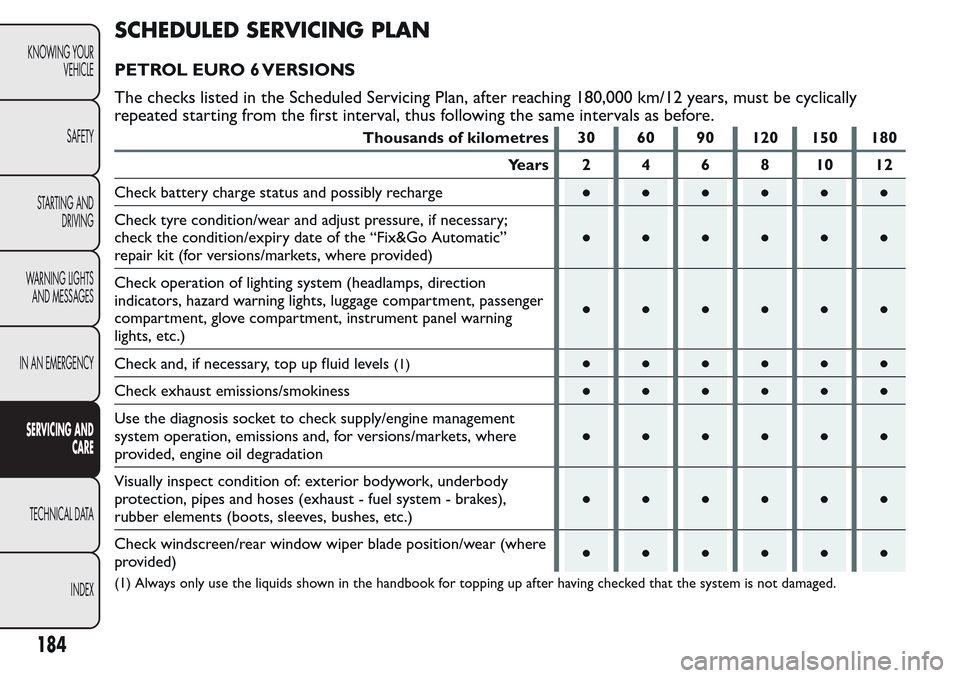
SCHEDULED SERVICING PLAN
PETROL EURO 6 VERSIONS
The checks listed in the Scheduled Servicing Plan, after reaching 180,000 km/12 years, must be cyclically
repeated starting from the first interval, thus following the same intervals as before.
Thousands of kilometres 30 60 90 120 150 180
Years 2 4 6 8 10 12
Check battery charge status and possibly recharge●●●●●●
Check tyre condition/wear and adjust pressure, if necessary;
check the condition/expiry date of the “Fix&Go Automatic”
repair kit (for versions/markets, where provided)●●●●●●
Check operation of lighting system (headlamps, direction
indicators, hazard warning lights, luggage compartment, passenger
compartment, glove compartment, instrument panel warning
lights, etc.)●●●●●●
Check and, if necessary, top up fluid levels
(1)●●●●●●
Check exhaust emissions/smokiness●●●●●●
Use the diagnosis socket to check supply/engine management
system operation, emissions and, for versions/markets, where
provided, engine oil degradation●●●●●●
Visually inspect condition of: exterior bodywork, underbody
protection, pipes and hoses (exhaust - fuel system - brakes),
rubber elements (boots, sleeves, bushes, etc.)●●●●●●
Check windscreen/rear window wiper blade position/wear (where
provided)●●●●●●
(1) Always only use the liquids shown in the handbook for topping up after having checked that the system is not damaged.
184
KNOWING YOUR
VEHICLE
SAFETY
STARTING AND
DRIVING
WARNING LIGHTS
AND MESSAGES
IN AN EMERGENCY
SERVICING AND
CARE
TECHNICAL DATA
INDEX
Page 191 of 260
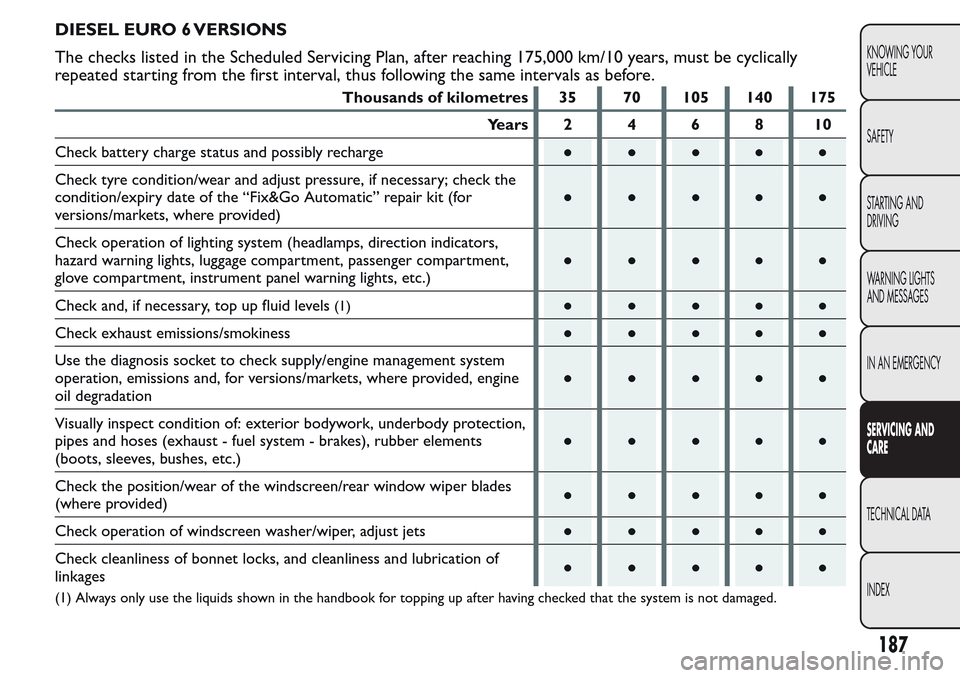
DIESEL EURO 6 VERSIONS
The checks listed in the Scheduled Servicing Plan, after reaching 175,000 km/10 years, must be cyclically
repeated starting from the first interval, thus following the same intervals as before.
Thousands of kilometres 35 70 105 140 175
Years 2 4 6 8 10
Check battery charge status and possibly recharge●●●●●
Check tyre condition/wear and adjust pressure, if necessary; check the
condition/expiry date of the “Fix&Go Automatic” repair kit (for
versions/markets, where provided)●●●●●
Check operation of lighting system (headlamps, direction indicators,
hazard warning lights, luggage compartment, passenger compartment,
glove compartment, instrument panel warning lights, etc.)●●●●●
Check and, if necessary, top up fluid levels
(1)●●●●●
Check exhaust emissions/smokiness●●●●●
Use the diagnosis socket to check supply/engine management system
operation, emissions and, for versions/markets, where provided, engine
oil degradation●●●●●
Visually inspect condition of: exterior bodywork, underbody protection,
pipes and hoses (exhaust - fuel system - brakes), rubber elements
(boots, sleeves, bushes, etc.)●●●●●
Check the position/wear of the windscreen/rear window wiper blades
(where provided)●●●●●
Check operation of windscreen washer/wiper, adjust jets●●●●●
Check cleanliness of bonnet locks, and cleanliness and lubrication of
linkages●●●●●
(1) Always only use the liquids shown in the handbook for topping up after having checked that the system is not damaged.
187
KNOWING YOUR
VEHICLE
SAFETY
STARTING AND
DRIVING
WARNING LIGHTS
AND MESSAGES
IN AN EMERGENCY
SERVICING AND
CARE
TECHNICAL DATA
INDEX
Page 192 of 260
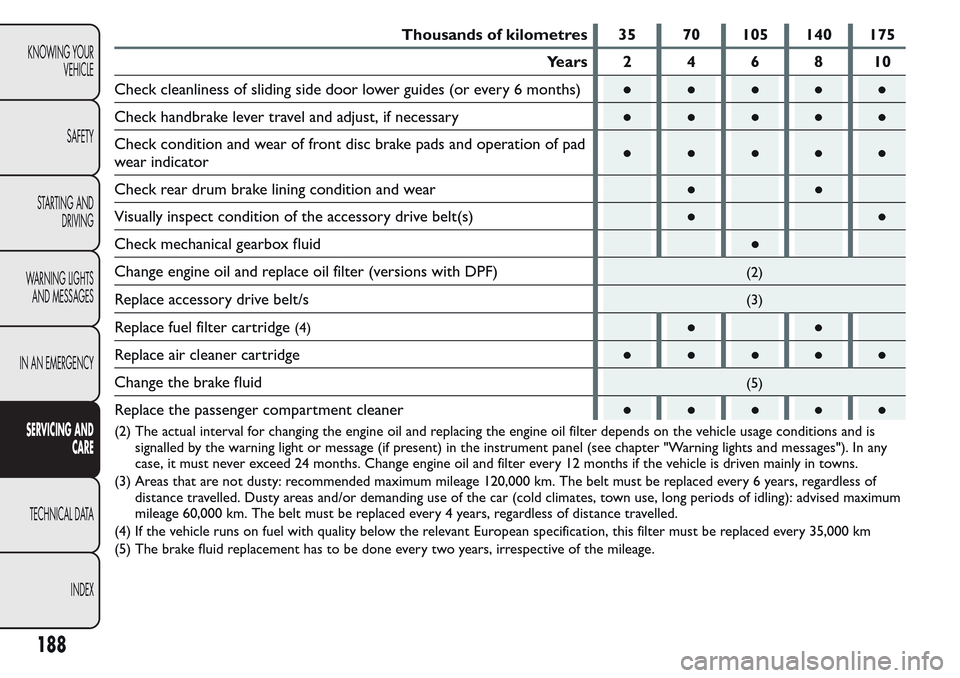
Thousands of kilometres 35 70 105 140 175
Years 2 4 6 8 10
Check cleanliness of sliding side door lower guides (or every 6 months)●●●●●
Check handbrake lever travel and adjust, if necessary●●●●●
Check condition and wear of front disc brake pads and operation of pad
wear indicator●●●●●
Check rear drum brake lining condition and wear●●
Visually inspect condition of the accessory drive belt(s)●●
Check mechanical gearbox fluid●
Change engine oil and replace oil filter (versions with DPF)
(2)
Replace accessory drive belt/s(3)
Replace fuel filter cartridge(4)●●
Replace air cleaner cartridge●●●●●
Change the brake fluid
(5)
Replace the passenger compartment cleaner●●●●●
(2) The actual interval for changing the engine oil and replacing the engine oil filter depends on the vehicle usage conditions and is
signalled by the warning light or message (if present) in the instrument panel (see chapter "Warning lights and messages"). In any
case, it must never exceed 24 months. Change engine oil and filter every 12 months if the vehicle is driven mainly in towns.
(3) Areas that are not dusty: recommended maximum mileage 120,000 km. The belt must be replaced every 6 years, regardless of
distance travelled. Dusty areas and/or demanding use of the car (cold climates, town use, long periods of idling): advised maximum
mileage 60,000 km. The belt must be replaced every 4 years, regardless of distance travelled.
(4) If the vehicle runs on fuel with quality below the relevant European specification, this filter must be replaced every 35,000 km
(5) The brake fluid replacement has to be done every two years, irrespective of the mileage.
188
KNOWING YOUR
VEHICLE
SAFETY
STARTING AND
DRIVING
WARNING LIGHTS
AND MESSAGES
IN AN EMERGENCY
SERVICING AND
CARE
TECHNICAL DATA
INDEX
Page 193 of 260
REGULAR CHECKS
Every 1,000 km or before long journeys, check and, if
necessary, top up the following:
engine coolant level;
brake fluid level;
windscreen washer fluid level;
tyre inflation pressure and condition;
operation of lighting system (headlamps, direction
indicators, hazard warning lights, etc.);
operation of screen wash/wipe system and
positioning/wear of windscreen/rear window
wiper blades.
Check and top up, if required, the engine oil level
every 3,000 km.
HEAVY USAGE OF THE VEHICLE
If the vehicle is used mainly under one of the
following conditions:
towing a trailer or caravan;
dusty roads;
short, repeated journeys (less than 7-8 km) at
sub-zero outside temperatures;
engine often idling or driving long distances at low
speeds or long periods of inactivity;
the following checks must be carried out more often
than indicated in the Scheduled Servicing Plan:
check front disc brake pad condition and wear;
check cleanliness of bonnet and boot locks,
cleanliness and lubrication of linkage;
visually inspect the conditions of: engine, gearbox,
transmission, pipes and hoses (exhaust/fuel
supply/brakes), rubber parts (boots/sleeves/
bushes, etc.);
check battery charge and battery fluid level
(electrolyte);
visually inspect condition of the auxiliary drive
belts;
check and, if necessary, change engine oil and
replace oil filter;
check and, if necessary, replace pollen filter;
check and, if necessary, replace air filter.
189
KNOWING YOUR
VEHICLE
SAFETY
STARTING AND
DRIVING
WARNING LIGHTS
AND MESSAGES
IN AN EMERGENCY
SERVICING AND
CARE
TECHNICAL DATA
INDEX
Page 201 of 260
AIR CLEANER/ POLLEN FILTER
Have the air cleaner or the pollen filter replaced by a
Fiat Dealership.
BATTERY
The battery is of the “limited maintenance” type:
under normal conditions of use, the electrolyte does
not need topping up with distilled water.
It does, however, need to be checked regularly at a
Fiat Dealership or by specialist personnel to make
sure it is working properly.
WARNING
The battery fluid is poisonous and
corrosive. Avoid contact with the skin
and eyes. Keep naked flames and sources of
sparks away from the battery: risk of explosion
and fire.
WARNING
Running the battery with an excessively
low liquid level will damage the battery
beyond repair and even cause an explosion.
197
KNOWING YOUR
VEHICLE
SAFETY
STARTING AND
DRIVING
WARNING LIGHTS
AND MESSAGES
IN AN EMERGENCY
SERVICING AND
CARE
TECHNICAL DATA
INDEX
Page 207 of 260
SPRAY NOZZLES
If the jet is not coming out, firstly check that there is
fluid in the windscreen/rear window reservoir (for
versions/markets where provided) (see “Checking
levels” in this section).
Then check that the nozzle holes are not clogged;
use a needle to unblock them if necessary.
Windscreen (washer)
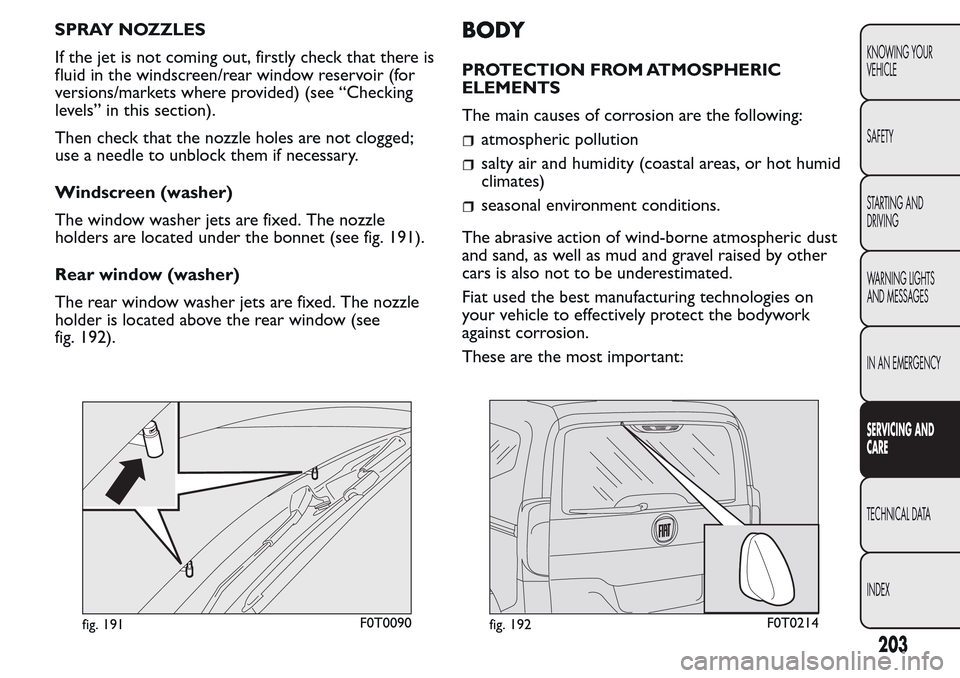
The window washer jets are fixed. The nozzle
holders are located under the bonnet (see fig. 191).
Rear window (washer)
The rear window washer jets are fixed. The nozzle
holder is located above the rear window (see
fig. 192).BODY
PROTECTION FROM ATMOSPHERIC
ELEMENTS
The main causes of corrosion are the following:
atmospheric pollution
salty air and humidity (coastal areas, or hot humid
climates)
seasonal environment conditions.
The abrasive action of wind-borne atmospheric dust
and sand, as well as mud and gravel raised by other
cars is also not to be underestimated.
Fiat used the best manufacturing technologies on
your vehicle to effectively protect the bodywork
against corrosion.
These are the most important:
fig. 191F0T0090fig. 192F0T0214
203
KNOWING YOUR
VEHICLE
SAFETY
STARTING AND
DRIVING
WARNING LIGHTS
AND MESSAGES
IN AN EMERGENCY
SERVICING AND
CARE
TECHNICAL DATA
INDEX
Page 208 of 260
painting products and systems which give the
vehicle particular resistance to corrosion and
abrasion;
use of galvanised (or pre-treated) steel sheets,
with high resistance to corrosion;
spraying the underbody, engine compartment,
wheelhouse internal parts and other parts with
highly protective wax products;
spraying of plastic materials for protective
purposes in the most exposed points: under the
doors, inside the mudguard, along the edges, etc.
use of “open” boxed sections to prevent
condensation and pockets of moisture from
triggering rust inside.
VEHICLE BODY AND UNDERBODY
WARRANTY
Your vehicle is covered by warranty against
perforation due to rust of any original element of the
structure or body.
For the general terms of this warranty, refer to your
Warranty Booklet.ADVICE FOR PRESERVING THE
BODYWORK
Paint
Paintwork does not only serve an aesthetic purpose,
but also protects the underlying sheet metal.
Touch up abrasions and scratches immediately to
prevent the formation of rust. Use only original paint
products for touch-ups (see “Bodywork paint
identification plate” in the “Technical specifications”
section).
Normal care for paintwork consists of washing the
car; how often depends on the conditions and
environment where the car is used.
For example, it is advisable to wash the vehicle more
often in areas with high atmospheric pollution or if
you are travelling on roads sprinkled with salt.
To wash the vehicle properly, proceed as follows:
wash the body using a low pressure jet of water;
wipe a sponge with a slightly soapy solution over
the bodywork, frequently rinsing with the sponge;
rinse well with water and dry with a jet of air or a
chamois leather.
If you put the vehicle through a car wash, follow
these recommendations:
remove the antenna from the roof so it does not
get damaged;
the car wash should use water added to a soapy
solution;
204
KNOWING YOUR
VEHICLE
SAFETY
STARTING AND
DRIVING
WARNING LIGHTS
AND MESSAGES
IN AN EMERGENCY
SERVICING AND
CARE
TECHNICAL DATA
INDEX