battery FIAT QUBO 2017 1.G Owner's Manual
[x] Cancel search | Manufacturer: FIAT, Model Year: 2017, Model line: QUBO, Model: FIAT QUBO 2017 1.GPages: 260, PDF Size: 4.74 MB
Page 174 of 260
WARNING
If a fuse blows again, contact a Fiat
Dealership.
Never replace a blown fuse with metallic
wires or other material.
WARNING
Never replace a fuse with another
having higher amperage; FIRE HAZARD.
WARNING
If a general protection fuse (MEGA-
FUSE, MIDI-FUSE) is activated, contact
a Fiat Dealership.
WARNING
Remove the key from the ignition and
switch off or disable all devices before
replacing a fuse.
WARNING
Contact Fiat Dealership if a safety
system (air bags, brakes), engine system
(engine, gearbox) or steering system general
protection fuse blows.
To identify the protective fuse, see the tables on the
following pages.
ENGINE BAY FUSE BOX
The fuse box is on the right-hand side of the engine.
Removing the fuse box cover
Proceed as follows:
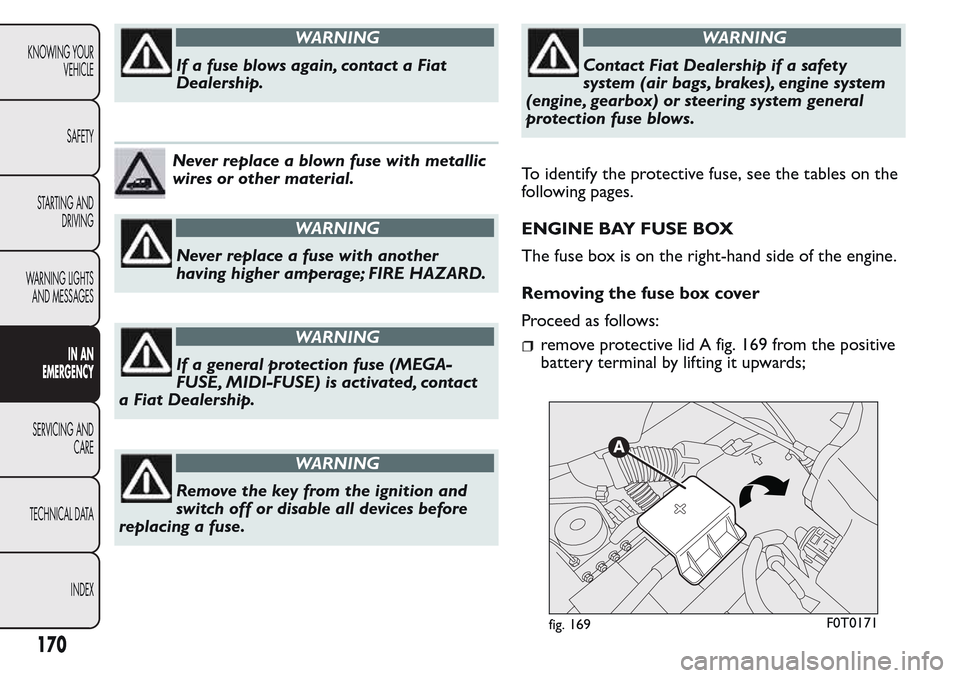
remove protective lid A fig. 169 from the positive
battery terminal by lifting it upwards;
fig. 169F0T0171
170
KNOWING YOUR
VEHICLE
SAFETY
STARTING AND
DRIVING
WARNING LIGHTS
AND MESSAGES
IN AN
EMERGENCY
SERVICING AND
CARE
TECHNICAL DATA
INDEX
Page 178 of 260
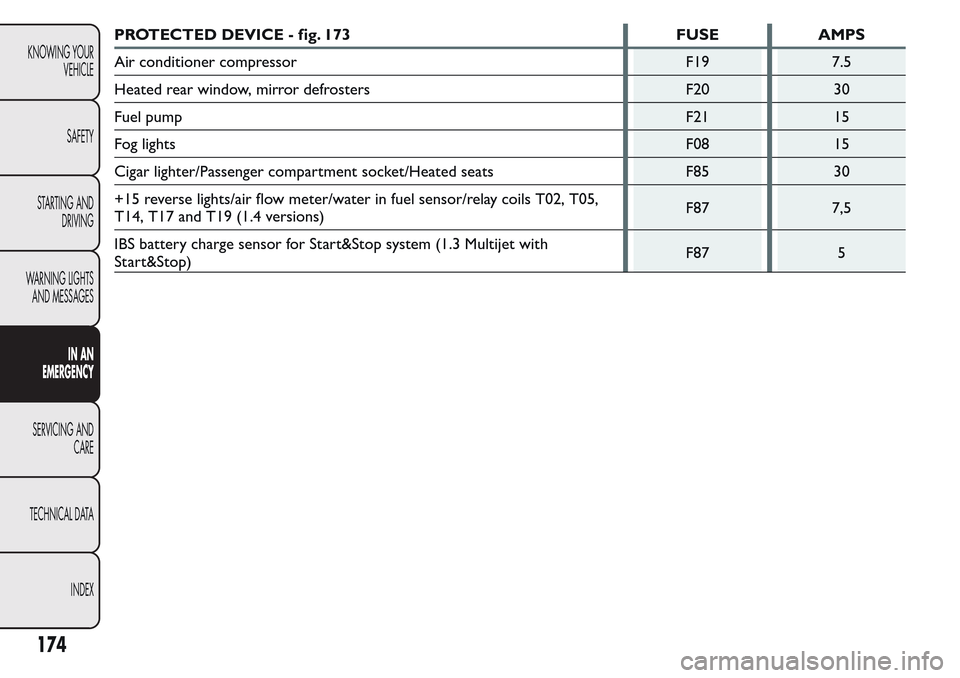
PROTECTED DEVICE - fig. 173 FUSE AMPS
Air conditioner compressor F19 7.5
Heated rear window, mirror defrosters F20 30
Fuel pump F21 15
Fog lights F08 15
Cigar lighter/Passenger compartment socket/Heated seats F85 30
+15 reverse lights/air flow meter/water in fuel sensor/relay coils T02, T05,
T14, T17 and T19 (1.4 versions)F87 7,5
IBS battery charge sensor for Start&Stop system (1.3 Multijet with
Start&Stop)F87 5
174
KNOWING YOUR
VEHICLE
SAFETY
STARTING AND
DRIVING
WARNING LIGHTS
AND MESSAGES
IN AN
EMERGENCY
SERVICING AND
CARE
TECHNICAL DATA
INDEX
Page 182 of 260
RECHARGING THE BATTERY
IMPORTANT The battery recharging procedure is
provided for information purposes only. You are
recommended to go to a Fiat Dealership to have this
operation performed.
We recommend recharging the battery slowly for
approximately 24 hours at low amperage. A
prolonged recharge might damage the battery.
Charge the battery as follows:
without Start&Stop system:
disconnect battery negative terminal;
connect the charger cables to the battery
terminals, observing the polarity;
turn on the charger;
when you have finished, turn the charger off
before disconnecting it from the battery;
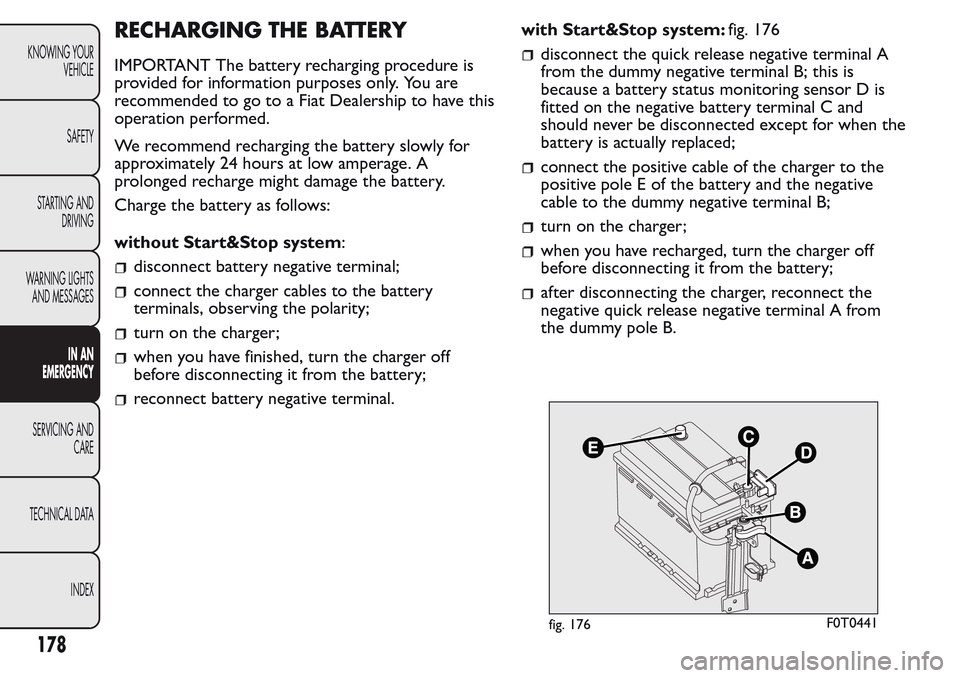
reconnect battery negative terminal.with Start&Stop system:fig. 176
disconnect the quick release negative terminal A
from the dummy negative terminal B; this is
because a battery status monitoring sensor D is
fitted on the negative battery terminal C and
should never be disconnected except for when the
battery is actually replaced;
connect the positive cable of the charger to the
positive pole E of the battery and the negative
cable to the dummy negative terminal B;
turn on the charger;
when you have recharged, turn the charger off
before disconnecting it from the battery;
after disconnecting the charger, reconnect the
negative quick release negative terminal A from
the dummy pole B.
fig. 176F0T0441
178
KNOWING YOUR
VEHICLE
SAFETY
STARTING AND
DRIVING
WARNING LIGHTS
AND MESSAGES
IN AN
EMERGENCY
SERVICING AND
CARE
TECHNICAL DATA
INDEX
Page 183 of 260
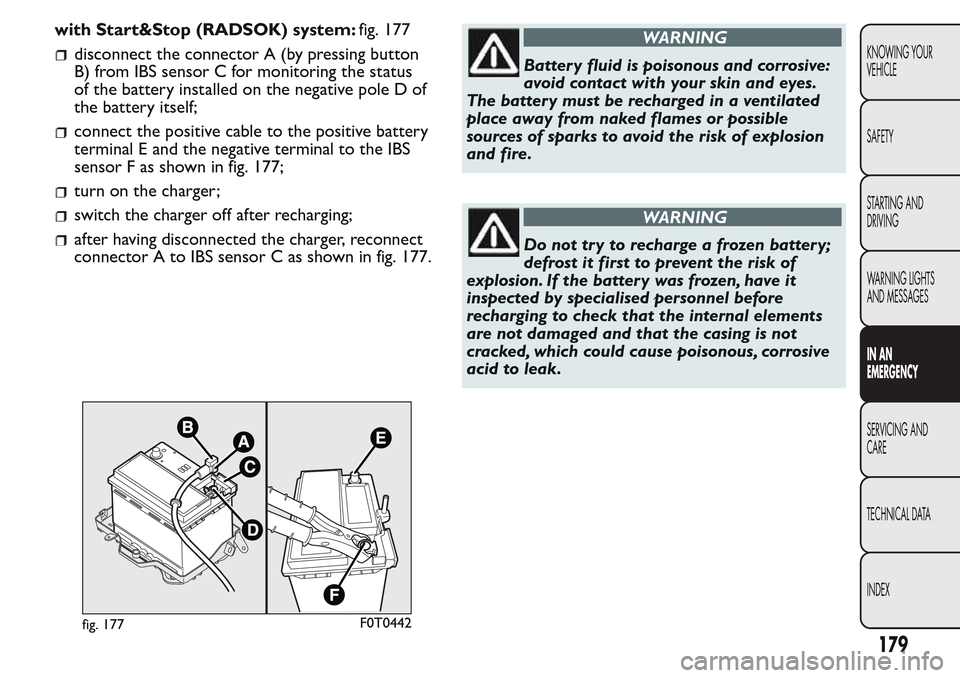
with Start&Stop (RADSOK) system:fig. 177
disconnect the connector A (by pressing button
B) from IBS sensor C for monitoring the status
of the battery installed on the negative pole D of
the battery itself;
connect the positive cable to the positive battery
terminal E and the negative terminal to the IBS
sensor F as shown in fig. 177;
turn on the charger;
switch the charger off after recharging;
after having disconnected the charger, reconnect
connector A to IBS sensor C as shown in fig. 177.
WARNING
Battery fluid is poisonous and corrosive:
avoid contact with your skin and eyes.
The battery must be recharged in a ventilated
place away from naked flames or possible
sources of sparks to avoid the risk of explosion
and fire.
WARNING
Do not tr y to recharge a frozen batter y;
defrost it first to prevent the risk of
explosion. If the battery was frozen, have it
inspected by specialised personnel before
recharging to check that the internal elements
are not damaged and that the casing is not
cracked, which could cause poisonous, corrosive
acid to leak.
fig. 177F0T0442
179
KNOWING YOUR
VEHICLE
SAFETY
STARTING AND
DRIVING
WARNING LIGHTS
AND MESSAGES
IN AN
EMERGENCY
SERVICING AND
CARE
TECHNICAL DATA
INDEX
Page 188 of 260
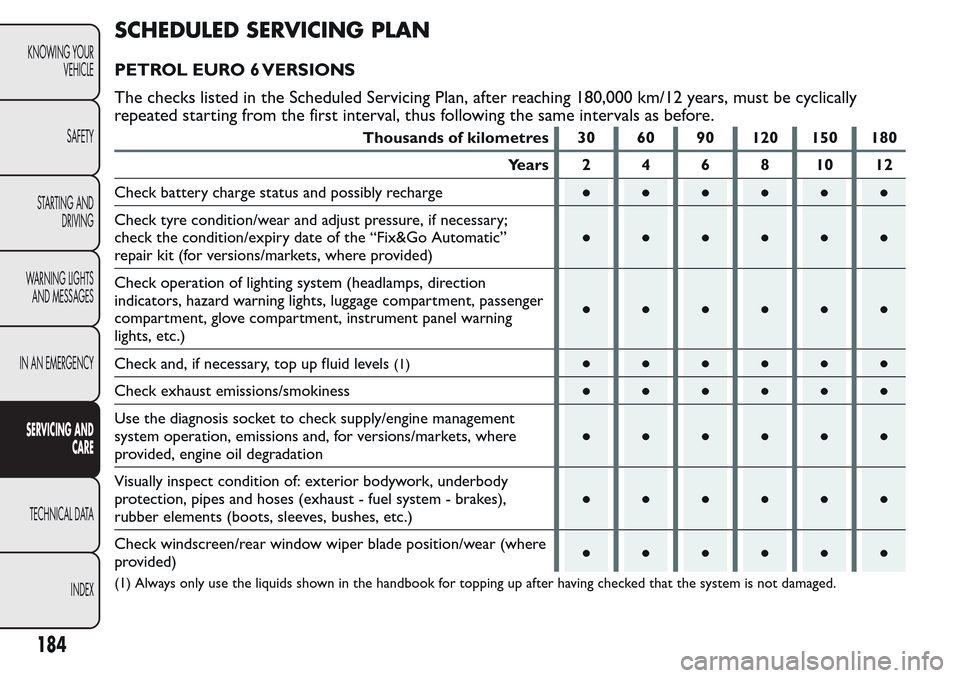
SCHEDULED SERVICING PLAN
PETROL EURO 6 VERSIONS
The checks listed in the Scheduled Servicing Plan, after reaching 180,000 km/12 years, must be cyclically
repeated starting from the first interval, thus following the same intervals as before.
Thousands of kilometres 30 60 90 120 150 180
Years 2 4 6 8 10 12
Check battery charge status and possibly recharge●●●●●●
Check tyre condition/wear and adjust pressure, if necessary;
check the condition/expiry date of the “Fix&Go Automatic”
repair kit (for versions/markets, where provided)●●●●●●
Check operation of lighting system (headlamps, direction
indicators, hazard warning lights, luggage compartment, passenger
compartment, glove compartment, instrument panel warning
lights, etc.)●●●●●●
Check and, if necessary, top up fluid levels
(1)●●●●●●
Check exhaust emissions/smokiness●●●●●●
Use the diagnosis socket to check supply/engine management
system operation, emissions and, for versions/markets, where
provided, engine oil degradation●●●●●●
Visually inspect condition of: exterior bodywork, underbody
protection, pipes and hoses (exhaust - fuel system - brakes),
rubber elements (boots, sleeves, bushes, etc.)●●●●●●
Check windscreen/rear window wiper blade position/wear (where
provided)●●●●●●
(1) Always only use the liquids shown in the handbook for topping up after having checked that the system is not damaged.
184
KNOWING YOUR
VEHICLE
SAFETY
STARTING AND
DRIVING
WARNING LIGHTS
AND MESSAGES
IN AN EMERGENCY
SERVICING AND
CARE
TECHNICAL DATA
INDEX
Page 191 of 260
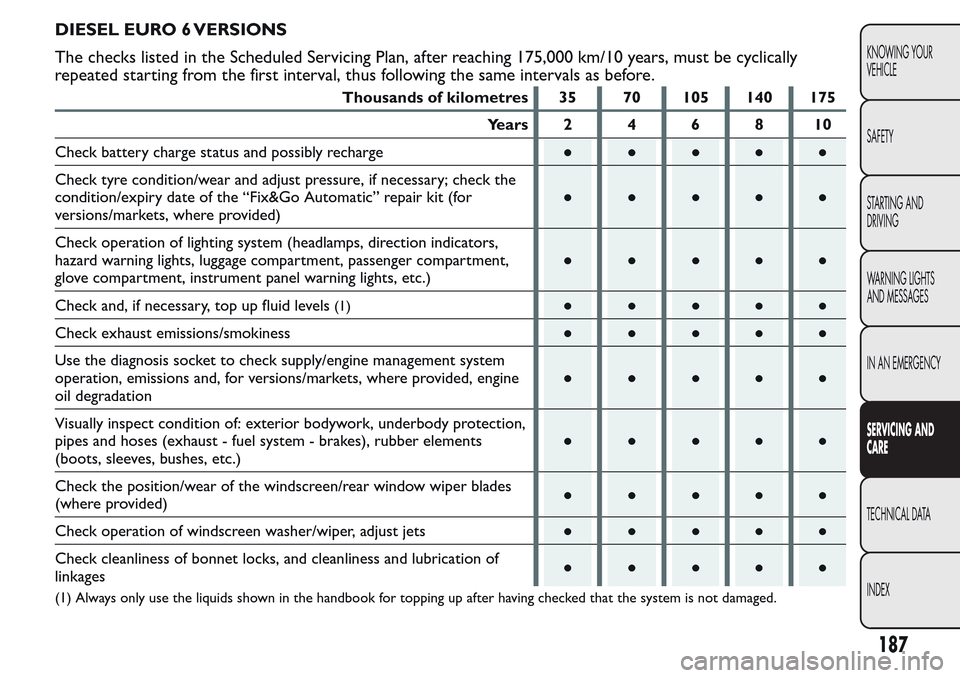
DIESEL EURO 6 VERSIONS
The checks listed in the Scheduled Servicing Plan, after reaching 175,000 km/10 years, must be cyclically
repeated starting from the first interval, thus following the same intervals as before.
Thousands of kilometres 35 70 105 140 175
Years 2 4 6 8 10
Check battery charge status and possibly recharge●●●●●
Check tyre condition/wear and adjust pressure, if necessary; check the
condition/expiry date of the “Fix&Go Automatic” repair kit (for
versions/markets, where provided)●●●●●
Check operation of lighting system (headlamps, direction indicators,
hazard warning lights, luggage compartment, passenger compartment,
glove compartment, instrument panel warning lights, etc.)●●●●●
Check and, if necessary, top up fluid levels
(1)●●●●●
Check exhaust emissions/smokiness●●●●●
Use the diagnosis socket to check supply/engine management system
operation, emissions and, for versions/markets, where provided, engine
oil degradation●●●●●
Visually inspect condition of: exterior bodywork, underbody protection,
pipes and hoses (exhaust - fuel system - brakes), rubber elements
(boots, sleeves, bushes, etc.)●●●●●
Check the position/wear of the windscreen/rear window wiper blades
(where provided)●●●●●
Check operation of windscreen washer/wiper, adjust jets●●●●●
Check cleanliness of bonnet locks, and cleanliness and lubrication of
linkages●●●●●
(1) Always only use the liquids shown in the handbook for topping up after having checked that the system is not damaged.
187
KNOWING YOUR
VEHICLE
SAFETY
STARTING AND
DRIVING
WARNING LIGHTS
AND MESSAGES
IN AN EMERGENCY
SERVICING AND
CARE
TECHNICAL DATA
INDEX
Page 193 of 260
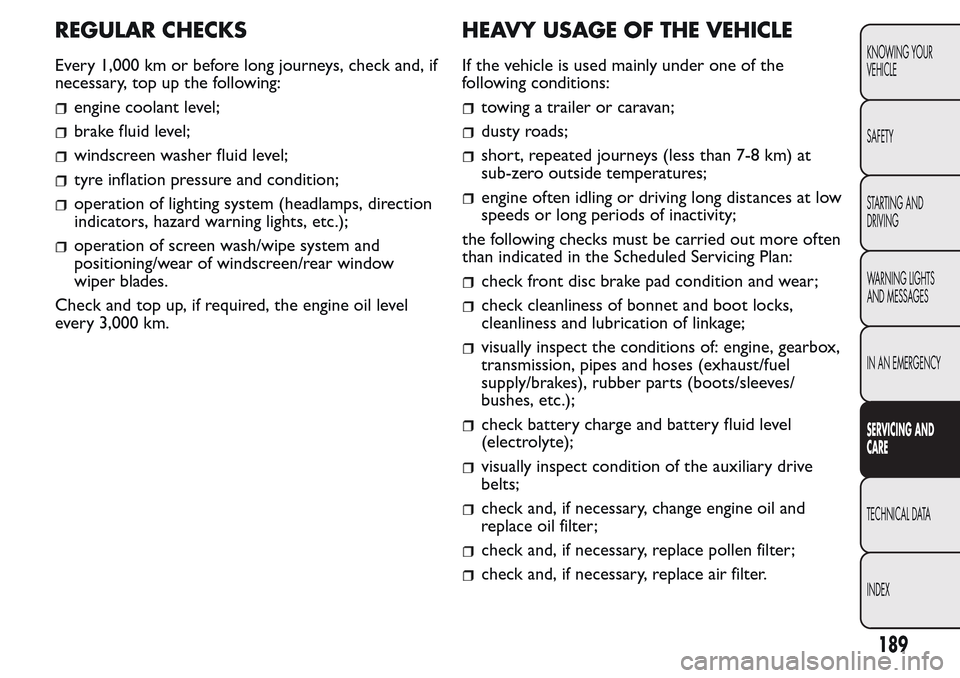
REGULAR CHECKS
Every 1,000 km or before long journeys, check and, if
necessary, top up the following:
engine coolant level;
brake fluid level;
windscreen washer fluid level;
tyre inflation pressure and condition;
operation of lighting system (headlamps, direction
indicators, hazard warning lights, etc.);
operation of screen wash/wipe system and
positioning/wear of windscreen/rear window
wiper blades.
Check and top up, if required, the engine oil level
every 3,000 km.
HEAVY USAGE OF THE VEHICLE
If the vehicle is used mainly under one of the
following conditions:
towing a trailer or caravan;
dusty roads;
short, repeated journeys (less than 7-8 km) at
sub-zero outside temperatures;
engine often idling or driving long distances at low
speeds or long periods of inactivity;
the following checks must be carried out more often
than indicated in the Scheduled Servicing Plan:
check front disc brake pad condition and wear;
check cleanliness of bonnet and boot locks,
cleanliness and lubrication of linkage;
visually inspect the conditions of: engine, gearbox,
transmission, pipes and hoses (exhaust/fuel
supply/brakes), rubber parts (boots/sleeves/
bushes, etc.);
check battery charge and battery fluid level
(electrolyte);
visually inspect condition of the auxiliary drive
belts;
check and, if necessary, change engine oil and
replace oil filter;
check and, if necessary, replace pollen filter;
check and, if necessary, replace air filter.
189
KNOWING YOUR
VEHICLE
SAFETY
STARTING AND
DRIVING
WARNING LIGHTS
AND MESSAGES
IN AN EMERGENCY
SERVICING AND
CARE
TECHNICAL DATA
INDEX
Page 194 of 260
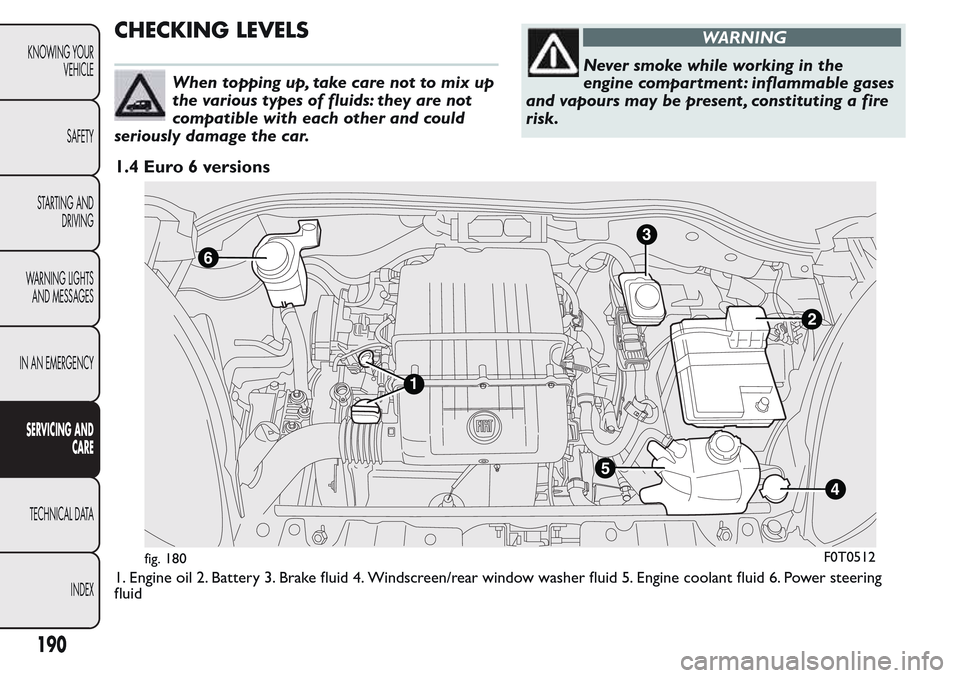
CHECKING LEVELS
When topping up, take care not to mix up
the various types of fluids: they are not
compatible with each other and could
seriously damage the car.
WARNING
Never smoke while working in the
engine compar tment : inflammable gases
and vapours may be present , constituting a fire
risk.
1.4 Euro 6 versions
1. Engine oil 2. Battery 3. Brake fluid 4. Windscreen/rear window washer fluid 5. Engine coolant fluid 6. Power steering
fluid
3
2
4
6
1
5
fig. 180F0T0512
190
KNOWING YOUR
VEHICLE
SAFETY
STARTING AND
DRIVING
WARNING LIGHTS
AND MESSAGES
IN AN EMERGENCY
SERVICING AND
CARE
TECHNICAL DATA
INDEX
Page 195 of 260
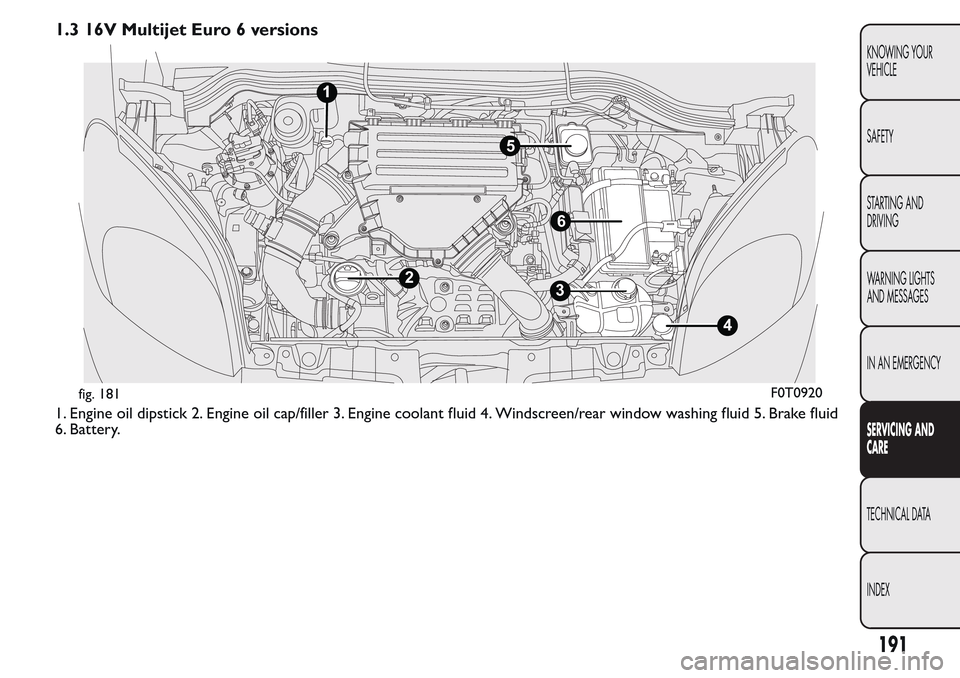
1.3 16V Multijet Euro 6 versions
1. Engine oil dipstick 2. Engine oil cap/filler 3. Engine coolant fluid 4. Windscreen/rear window washing fluid 5. Brake fluid
6. Battery.
1
32
4
5
6
fig. 181F0T0920
191
KNOWING YOUR
VEHICLE
SAFETY
STARTING AND
DRIVING
WARNING LIGHTS
AND MESSAGES
IN AN EMERGENCY
SERVICING AND
CARE
TECHNICAL DATA
INDEX
Page 201 of 260
AIR CLEANER/ POLLEN FILTER
Have the air cleaner or the pollen filter replaced by a
Fiat Dealership.
BATTERY
The battery is of the “limited maintenance” type:
under normal conditions of use, the electrolyte does
not need topping up with distilled water.
It does, however, need to be checked regularly at a
Fiat Dealership or by specialist personnel to make
sure it is working properly.
WARNING
The battery fluid is poisonous and
corrosive. Avoid contact with the skin
and eyes. Keep naked flames and sources of
sparks away from the battery: risk of explosion
and fire.
WARNING
Running the battery with an excessively
low liquid level will damage the battery
beyond repair and even cause an explosion.
197
KNOWING YOUR
VEHICLE
SAFETY
STARTING AND
DRIVING
WARNING LIGHTS
AND MESSAGES
IN AN EMERGENCY
SERVICING AND
CARE
TECHNICAL DATA
INDEX