battery FIAT QUBO 2017 1.G Owners Manual
[x] Cancel search | Manufacturer: FIAT, Model Year: 2017, Model line: QUBO, Model: FIAT QUBO 2017 1.GPages: 260, PDF Size: 4.74 MB
Page 6 of 260
READ THIS CAREFULLY!
REFUELLING
Petrol engines: only refuel with unleaded petrol
with an octane rating (RON) of no less than
95 conforming to the European specification EN
228.
Diesel engines: only use diesel fuel for motor
vehicles conforming to the European specification
EN 590. The use of other products or mixtures
may damage the engine beyond repair and
consequently invalidate the warranty, depending
on the damage caused.
STARTING THE ENGINE
Petrol engines: make sure that the handbrake is
engaged, set the gearshift lever to neutral, fully
depress the clutch without pressing the
accelerator, then turn the ignition key to AVV
and release it as soon as the engine has started.
Diesel engines: Turn the ignition key to MAR and
wait for the warning light
to go out. Turn
the ignition key to AVV and release as soon as
the engine starts.
PARKING ON FLAMMABLE MATERIAL
The catalytic converter develops high
temperatures during operation. Do not park the
vehicle on grass, dry leaves, pine needles or
other flammable material as this constitutes a fire
hazard.RESPECTING THE ENVIRONMENT
The vehicle is fitted with a system that allows
continuous diagnosis of the emission-related
components in order to help protect the
environment.
ELECTRICAL ACCESSORIES
If, after buying the vehicle, you decide to add
electrical accessories (with the risk of gradually
draining the battery), visit a Fiat Dealership. They
can calculate the overall electrical requirement
and check that the electrical system of the
vehicle can support the required load.
SCHEDULED SERVICING
Correct maintenance is essential for ensuring the
vehicle stays in tip-top condition and retains its
safety features, its environmental friendliness and
low running costs for a long time to come.
THE OWNER'S HANDBOOK CONTAINS…
... important information, advise and warnings for
correct use, driving safety and maintenance of
your vehicle over time. Particular attention
should be paid to information marked with the
following symbols:
GUID-2AF0B308-C82D-47E5-8B68-C271F32(personal safety),
GUID-1DEA0B72-B8FB-4534-9C53-9FC2E6A9E916(environmental protection),GUID-4FD0B960-96E3-46D8-B5(car integrity).
Page 12 of 260
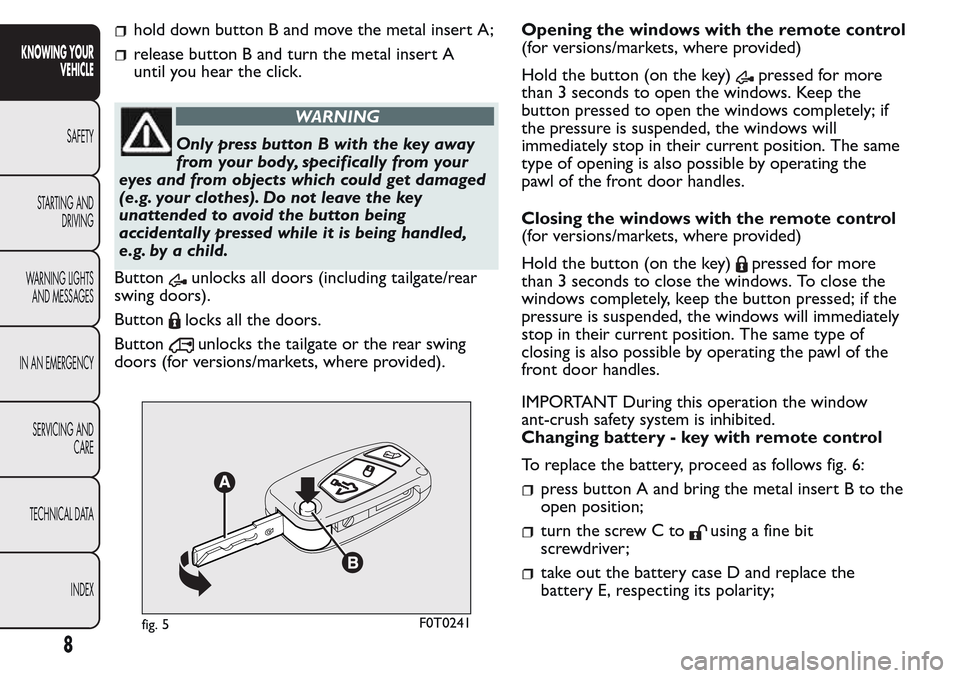
hold down button B and move the metal insert A;
release button B and turn the metal insert A
until you hear the click.
WARNING
Only press button B with the key away
from your body, specifically from your
eyes and from objects which could get damaged
(e.g. your clothes). Do not leave the key
unattended to avoid the button being
accidentally pressed while it is being handled,
e.g. by a child.
Button
unlocks all doors (including tailgate/rear
swing doors).
Button
locks all the doors.
Button
unlocks the tailgate or the rear swing
doors (for versions/markets, where provided).Opening the windows with the remote control
(for versions/markets, where provided)
Hold the button (on the key)
pressed for more
than 3 seconds to open the windows. Keep the
button pressed to open the windows completely; if
the pressure is suspended, the windows will
immediately stop in their current position. The same
type of opening is also possible by operating the
pawl of the front door handles.
Closing the windows with the remote control
(for versions/markets, where provided)
Hold the button (on the key)
pressed for more
than 3 seconds to close the windows. To close the
windows completely, keep the button pressed; if the
pressure is suspended, the windows will immediately
stop in their current position. The same type of
closing is also possible by operating the pawl of the
front door handles.
IMPORTANT During this operation the window
ant-crush safety system is inhibited.
Changing battery - key with remote control
To replace the battery, proceed as follows fig. 6:
press button A and bring the metal insert B to the
open position;
turn the screw C tousing a fine bit
screwdriver;
take out the battery case D and replace the
battery E, respecting its polarity;
fig. 5F0T0241
8
KNOWING YOUR
VEHICLE
SAFETY
STARTING AND
DRIVING
WARNING LIGHTS
AND MESSAGES
IN AN EMERGENCY
SERVICING AND
CARE
TECHNICAL DATA
INDEX
Page 13 of 260
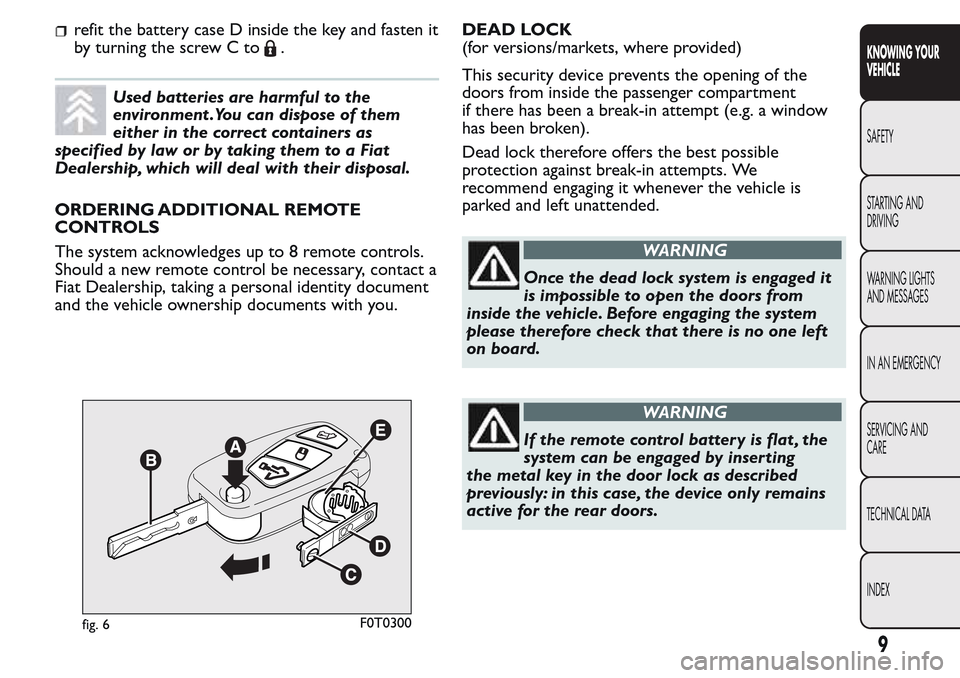
refit the battery case D inside the key and fasten it
by turning the screw C to
.
Used batteries are harmful to the
environment .You can dispose of them
either in the correct containers as
specified by law or by taking them to a Fiat
Dealership, which will deal with their disposal.
ORDERING ADDITIONAL REMOTE
CONTROLS
The system acknowledges up to 8 remote controls.
Should a new remote control be necessary, contact a
Fiat Dealership, taking a personal identity document
and the vehicle ownership documents with you.DEAD LOCK
(for versions/markets, where provided)
This security device prevents the opening of the
doors from inside the passenger compartment
if there has been a break-in attempt (e.g. a window
has been broken).
Dead lock therefore offers the best possible
protection against break-in attempts. We
recommend engaging it whenever the vehicle is
parked and left unattended.
WARNING
Once the dead lock system is engaged it
is impossible to open the doors from
inside the vehicle. Before engaging the system
please therefore check that there is no one left
on board.
WARNING
If the remote control battery is flat , the
system can be engaged by inser ting
the metal key in the door lock as described
previously: in this case, the device only remains
active for the rear doors.
fig. 6F0T0300
9
KNOWING YOUR
VEHICLE
SAFETY
STARTING AND
DRIVING
WARNING LIGHTS
AND MESSAGES
IN AN EMERGENCY
SERVICING AND
CARE
TECHNICAL DATA
INDEX
Page 14 of 260
Switching the device on
The system is automatically enabled on all the doors
by pressing button
twice on the key with remote
control.
The direction indicators flash twice to let you know
that the device is active.
If one or more of the doors is not perfectly shut, the
dead lock device will not be activated, thus
preventing a person getting into the car through the
open door and, on shutting, it, remaining stuck
inside the passenger compartment.
Switching the device off
The system is disabled automatically on every door
when:
by unlocking the doors;
by turning the ignition key to the ON position.
ALARM
(for versions/markets, where provided)
The alarm, in addition to all the previously described
remote control functions, is controlled by the
receiver located under the dashboard near the fuse
box.
ALARM TRIPPING
The alarm trips in the following cases:
unauthorised opening of a door, the bonnet, the
tailgate or a sliding side door (if present)
(perimeter protection)
unauthorized operation of the starting device (key
turned on using a key that is not enabled)
cutting of the battery leads
moving presence inside the passenger
compartment (volumetric protection)
anomalous lifting/tilting of the vehicle.
Depending on the market, the activation of the alarm
causes the activation of the siren and the direction
indicators (for about 26 seconds). Alarm tripping and
the number of cycles depend on the sales market.
There are a maximum number of acoustic/visual
cycles. When this is reached the system returns to
normal operation.
Volumetric and antilifting protections are disabled by
pressing the control button installed on the front
dashboard (see paragraph "Antilift protections).
10
KNOWING YOUR
VEHICLE
SAFETY
STARTING AND
DRIVING
WARNING LIGHTS
AND MESSAGES
IN AN EMERGENCY
SERVICING AND
CARE
TECHNICAL DATA
INDEX
Page 18 of 260
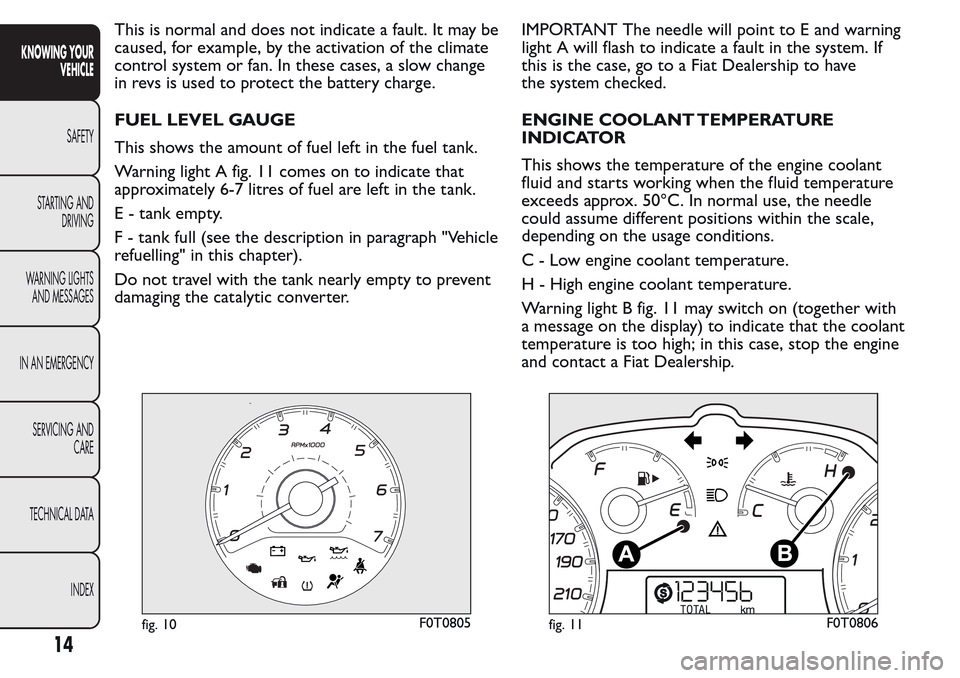
This is normal and does not indicate a fault. It may be
caused, for example, by the activation of the climate
control system or fan. In these cases, a slow change
in revs is used to protect the battery charge.
FUEL LEVEL GAUGE
This shows the amount of fuel left in the fuel tank.
Warning light A fig. 11 comes on to indicate that
approximately 6-7 litres of fuel are left in the tank.
E - tank empty.
F - tank full (see the description in paragraph "Vehicle
refuelling" in this chapter).
Do not travel with the tank nearly empty to prevent
damaging the catalytic converter.IMPORTANT The needle will point to E and warning
light A will flash to indicate a fault in the system. If
this is the case, go to a Fiat Dealership to have
the system checked.
ENGINE COOLANT TEMPERATURE
INDICATOR
This shows the temperature of the engine coolant
fluid and starts working when the fluid temperature
exceeds approx. 50°C. In normal use, the needle
could assume different positions within the scale,
depending on the usage conditions.
C - Low engine coolant temperature.
H - High engine coolant temperature.
Warning light B fig. 11 may switch on (together with
a message on the display) to indicate that the coolant
temperature is too high; in this case, stop the engine
and contact a Fiat Dealership.
fig. 10F0T0805fig. 11F0T0806
14
KNOWING YOUR
VEHICLE
SAFETY
STARTING AND
DRIVING
WARNING LIGHTS
AND MESSAGES
IN AN EMERGENCY
SERVICING AND
CARE
TECHNICAL DATA
INDEX
Page 30 of 260
“manual” resetting by the user, by pressing the
relevant button;
automatically when the distance travelled reaches
9,999.9 km (miles) or when the journey time
reaches 99.59:59 (99 hours and 59 minutes);
disconnection/reconnection of the battery.
IMPORTANT The reset operation when “Trip A”
details are being displayed only resets the
information associated with this function.
IMPORTANT The reset operation when “Trip B”
details are being displayed resets only the
information associated with this function.
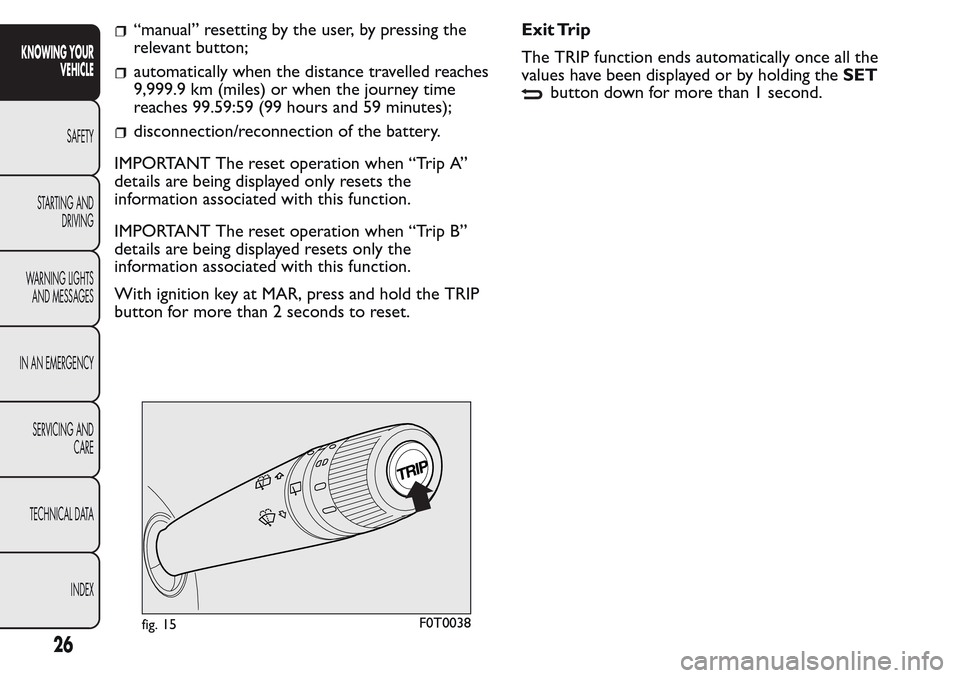
With ignition key at MAR, press and hold the TRIP
button for more than 2 seconds to reset.Exit Trip
The TRIP function ends automatically once all the
values have been displayed or by holding theSET
button down for more than 1 second.
fig. 15F0T0038
26
KNOWING YOUR
VEHICLE
SAFETY
STARTING AND
DRIVING
WARNING LIGHTS
AND MESSAGES
IN AN EMERGENCY
SERVICING AND
CARE
TECHNICAL DATA
INDEX
Page 42 of 260
knob A turned to blue section
take the slider B to
turn knob C to the required speed
turn knob D to
INTERNAL AIR RECIRCULATION
ACTIVATION
Take the slider B to
.
It is advisable to switch the internal air recirculation
on while standing in queues or in tunnels to prevent
the introduction of polluted air.
Do not use the function for a long time, particularly
if there are several passengers on board, to prevent
the windows from steaming up.
IMPORTANT The internal air recirculation system
makes it possible to reach the required heating
or cooling conditions more quickly. Do not use the
internal air recirculation function on rainy/cold
days to avoid the possibility of the windows misting.
DEMISTING/DEFROSTING OF HEATED
REAR WINDSCREEN AND DOOR MIRRORS
(for versions/markets, where provided)
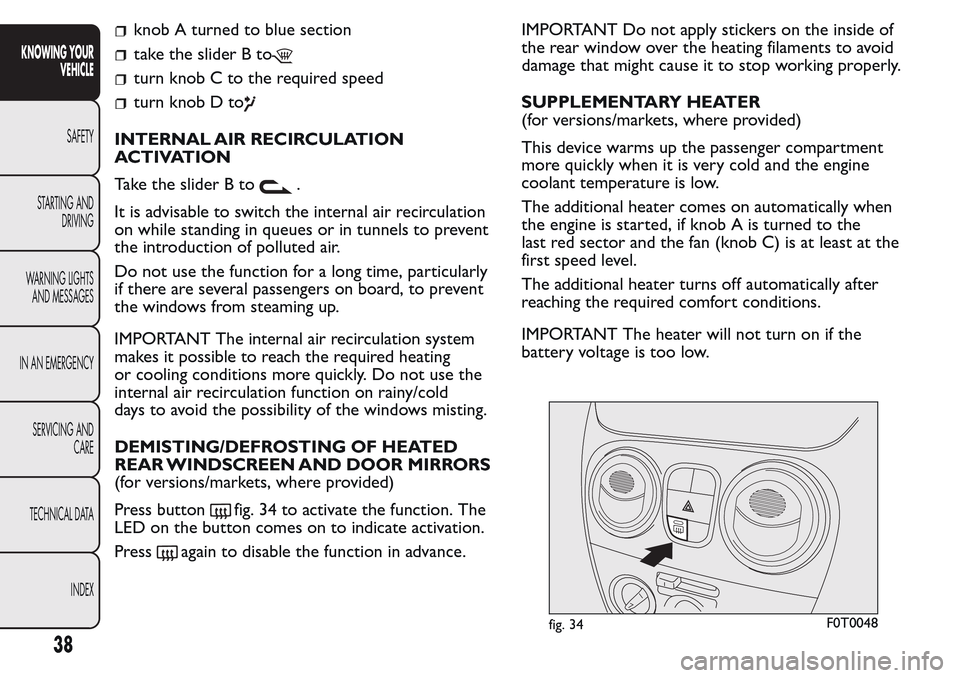
Press button
fig. 34 to activate the function. The
LED on the button comes on to indicate activation.
Press
again to disable the function in advance.IMPORTANT Do not apply stickers on the inside of
the rear window over the heating filaments to avoid
damage that might cause it to stop working properly.
SUPPLEMENTARY HEATER
(for versions/markets, where provided)
This device warms up the passenger compartment
more quickly when it is very cold and the engine
coolant temperature is low.
The additional heater comes on automatically when
the engine is started, if knob A is turned to the
last red sector and the fan (knob C) is at least at the
first speed level.
The additional heater turns off automatically after
reaching the required comfort conditions.
IMPORTANT The heater will not turn on if the
battery voltage is too low.
fig. 34F0T0048
38
KNOWING YOUR
VEHICLE
SAFETY
STARTING AND
DRIVING
WARNING LIGHTS
AND MESSAGES
IN AN EMERGENCY
SERVICING AND
CARE
TECHNICAL DATA
INDEX
Page 45 of 260
turn knob C to
take the slider B to
turn knob D to
press knob C.
Adjusting cooling
Proceed as follows:
take the slider B to
turn knob A rightwards to increase the
temperature
turn knob C leftwards to reduce the fan speed.
DEMISTING/DEFROSTING OF HEATED
REAR WINDSCREEN AND DOOR MIRRORS
(for versions/markets, where provided)
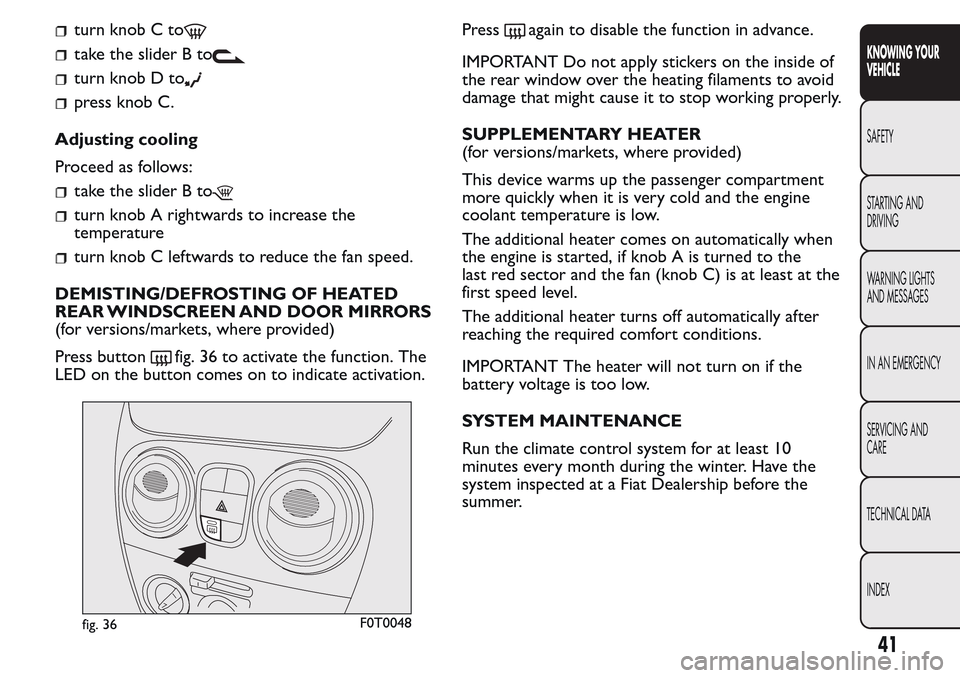
Press button
fig. 36 to activate the function. The
LED on the button comes on to indicate activation.Press
again to disable the function in advance.
IMPORTANT Do not apply stickers on the inside of
the rear window over the heating filaments to avoid
damage that might cause it to stop working properly.
SUPPLEMENTARY HEATER
(for versions/markets, where provided)
This device warms up the passenger compartment
more quickly when it is very cold and the engine
coolant temperature is low.
The additional heater comes on automatically when
the engine is started, if knob A is turned to the
last red sector and the fan (knob C) is at least at the
first speed level.
The additional heater turns off automatically after
reaching the required comfort conditions.
IMPORTANT The heater will not turn on if the
battery voltage is too low.
SYSTEM MAINTENANCE
Run the climate control system for at least 10
minutes every month during the winter. Have the
system inspected at a Fiat Dealership before the
summer.
fig. 36F0T0048
41
KNOWING YOUR
VEHICLE
SAFETY
STARTING AND
DRIVING
WARNING LIGHTS
AND MESSAGES
IN AN EMERGENCY
SERVICING AND
CARE
TECHNICAL DATA
INDEX
Page 52 of 260
CEILING LIGHTS
FRONT CEILING LIGHT WITH MOVABLE
LENS
The light comes on automatically when a front door
or sliding side door is opened and goes out when
it is closed.
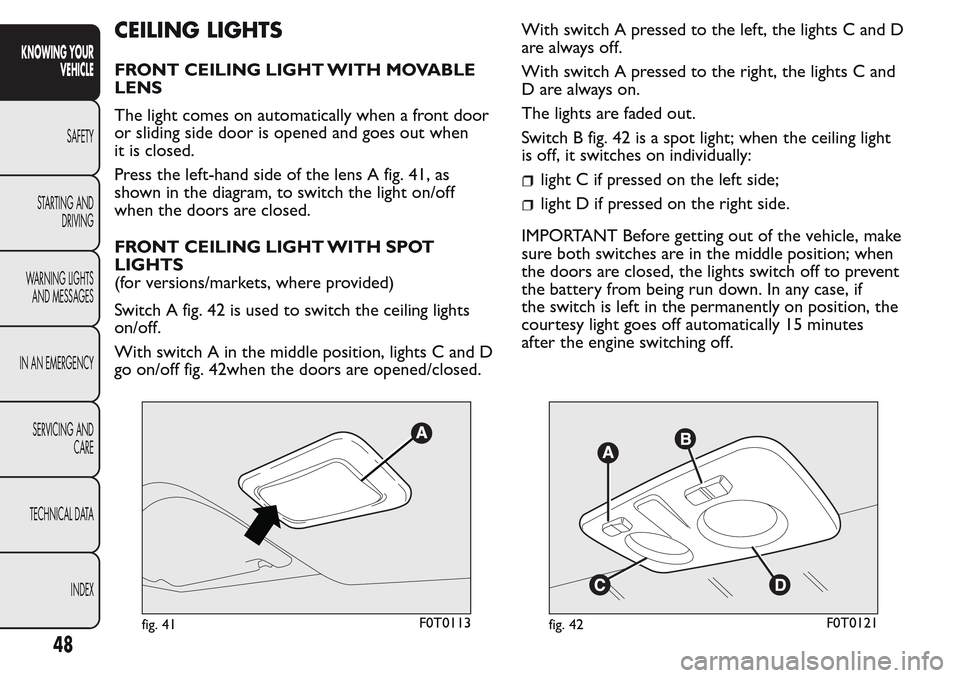
Press the left-hand side of the lens A fig. 41, as
shown in the diagram, to switch the light on/off
when the doors are closed.
FRONT CEILING LIGHT WITH SPOT
LIGHTS
(for versions/markets, where provided)
Switch A fig. 42 is used to switch the ceiling lights
on/off.
With switch A in the middle position, lights C and D
go on/off fig. 42when the doors are opened/closed.With switch A pressed to the left, the lights C and D
arealwaysoff.
With switch A pressed to the right, the lights C and
D are always on.
The lights are faded out.
Switch B fig. 42 is a spot light; when the ceiling light
is off, it switches on individually:
light C if pressed on the left side;
light D if pressed on the right side.
IMPORTANT Before getting out of the vehicle, make
sure both switches are in the middle position; when
the doors are closed, the lights switch off to prevent
the battery from being run down. In any case, if
the switch is left in the permanently on position, the
courtesy light goes off automatically 15 minutes
after the engine switching off.
fig. 41F0T0113fig. 42F0T0121
48
KNOWING YOUR
VEHICLE
SAFETY
STARTING AND
DRIVING
WARNING LIGHTS
AND MESSAGES
IN AN EMERGENCY
SERVICING AND
CARE
TECHNICAL DATA
INDEX
Page 54 of 260
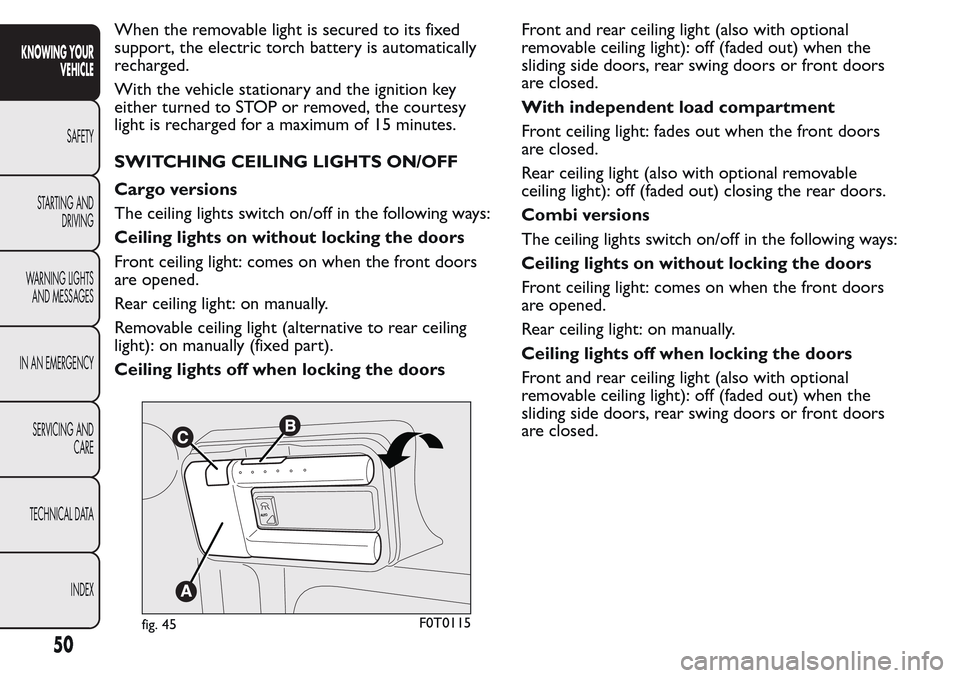
When the removable light is secured to its fixed
support, the electric torch battery is automatically
recharged.
With the vehicle stationary and the ignition key
either turned to STOP or removed, the courtesy
light is recharged for a maximum of 15 minutes.
SWITCHING CEILING LIGHTS ON/OFF
Cargo versions
The ceiling lights switch on/off in the following ways:
Ceiling lights on without locking the doors
Front ceiling light: comes on when the front doors
are opened.
Rear ceiling light: on manually.
Removable ceiling light (alternative to rear ceiling
light): on manually (fixed part).
Ceiling lights off when locking the doorsFront and rear ceiling light (also with optional
removable ceiling light): off (faded out) when the
sliding side doors, rear swing doors or front doors
are closed.
With independent load compartment
Front ceiling light: fades out when the front doors
are closed.
Rear ceiling light (also with optional removable
ceiling light): off (faded out) closing the rear doors.
Combi versions
The ceiling lights switch on/off in the following ways:
Ceiling lights on without locking the doors
Front ceiling light: comes on when the front doors
are opened.
Rear ceiling light: on manually.
Ceiling lights off when locking the doors
Front and rear ceiling light (also with optional
removable ceiling light): off (faded out) when the
sliding side doors, rear swing doors or front doors
are closed.
A
UT
O
fig. 45F0T0115
50
KNOWING YOUR
VEHICLE
SAFETY
STARTING AND
DRIVING
WARNING LIGHTS
AND MESSAGES
IN AN EMERGENCY
SERVICING AND
CARE
TECHNICAL DATA
INDEX