boot FIAT SEICENTO 2007 1.G User Guide
[x] Cancel search | Manufacturer: FIAT, Model Year: 2007, Model line: SEICENTO, Model: FIAT SEICENTO 2007 1.GPages: 154, PDF Size: 3.68 MB
Page 93 of 154
92IN AN EMERGENCY
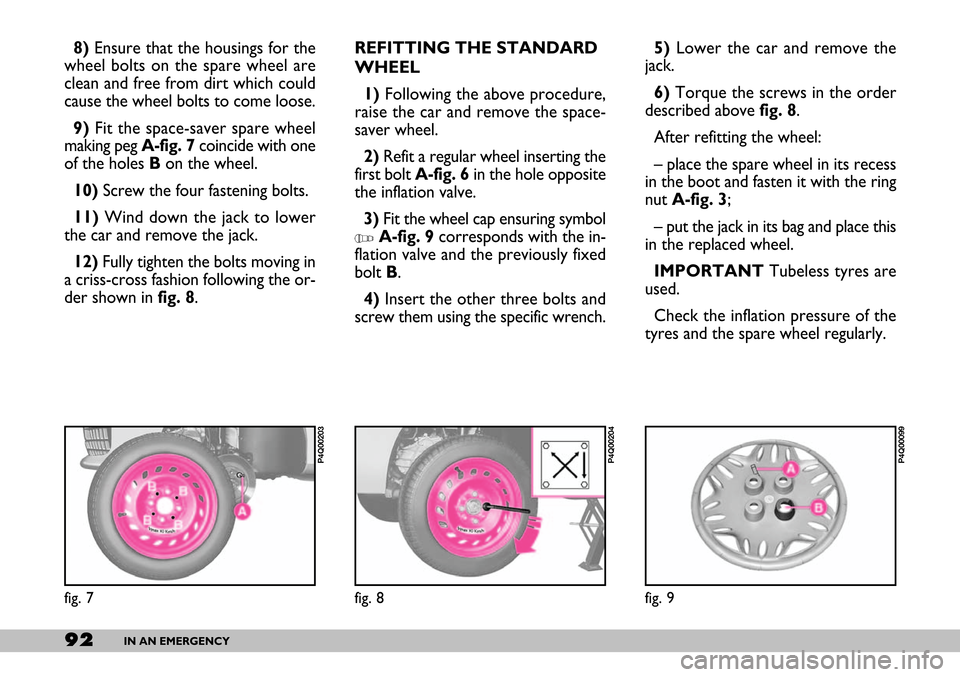
5) Lower the car and remove the
jack.
6)Torque the screws in the order
described above fig. 8.
After refitting the wheel:
– place the spare wheel in its recess
in the boot and fasten it with the ring
nut A-fig. 3;
– put the jack in its bag and place this
in the replaced wheel.
IMPORTANTTubeless tyres are
used.
Check the inflation pressure of the
tyres and the spare wheel regularly.
fig. 9
P4Q00099
8) Ensure that the housings for the
wheel bolts on the spare wheel are
clean and free from dirt which could
cause the wheel bolts to come loose.
9) Fit the space-saver spare wheel
making peg A-fig. 7coincide with one
of the holes B on the wheel.
10)Screw the four fastening bolts.
11)Wind down the jack to lower
the car and remove the jack.
12)Fully tighten the bolts moving in
a criss-cross fashion following the or-
der shown in fig. 8.REFITTING THE STANDARD
WHEEL
1)Following the above procedure,
raise the car and remove the space-
saver wheel.
2)Refit a regular wheel inserting the
first bolt A-fig. 6in the hole opposite
the inflation valve.
3)Fit the wheel cap ensuring symbol
YA-fig. 9corresponds with the in-
flation valve and the previously fixed
bolt B.
4)Insert the other three bolts and
screw them using the specific wrench.
fig. 7
P4Q00203
fig. 8
P4Q00204
Page 102 of 154
101IN AN EMERGENCY
IF AN INTERIOR
LIGHT BURNS OUT IF A FUSE BLOWS
A fuse is an element for protecting
the electrical system. A fuse will trip
(i.e. it will blow) in the event of a fail-
ure or improper interventions in the
electrical system.
If an electrical device is not working,
check whether the respective fuse is
blown. The conductor should be in-
tact. If it is not, replace the fuse with
another with the same amperage
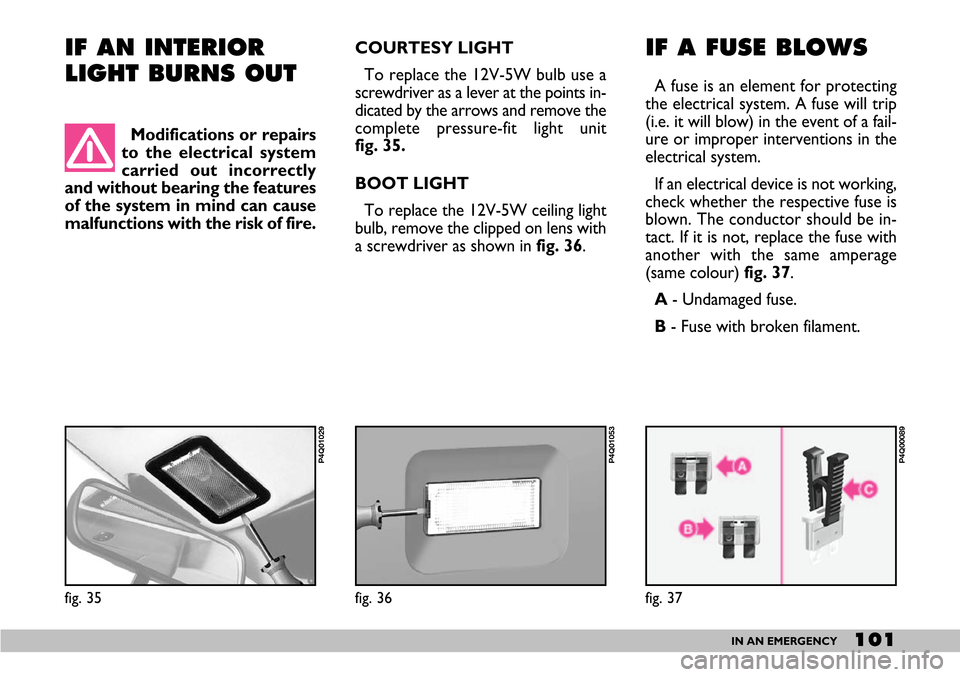
(same colour) fig. 37.
A- Undamaged fuse.
B - Fuse with broken filament. Modifications or repairs
to the electrical system
carried out incorrectly
and without bearing the features
of the system in mind can cause
malfunctions with the risk of fire. COURTESY LIGHT
To replace the 12V-5W bulb use a
screwdriver as a lever at the points in-
dicated by the arrows and remove the
complete pressure-fit light unit
fig. 35.
BOOT LIGHT
To replace the 12V-5W ceiling light
bulb, remove the clipped on lens with
a screwdriver as shown in fig. 36.
fig. 35
P4Q01029
fig. 37
P4Q00089
fig. 36
P4Q01053
Page 108 of 154
107IN AN EMERGENCY
Before starting to tow,
turn the ignition key to
MAR and then to STOP.
Do not remove the key. If the
key is removed, the steering lock
engages automatically which pre-
vents the wheels being turned.
While the car is being
towed with the engine
off, remember that the
brake pedal and steering will re-
quire more effort as you no
longer have the benefit of the
power brakes and power steer-
ing. Do not use flexible cables to
tow. Avoid jerking. Whilst tow-
ing, ensure that the coupling to
the vehicle does not damage the
surrounding components.
The car can be lifted
from the side providing
the hydraulic jack arm is
fitted with a special bracket in
the plate housing.
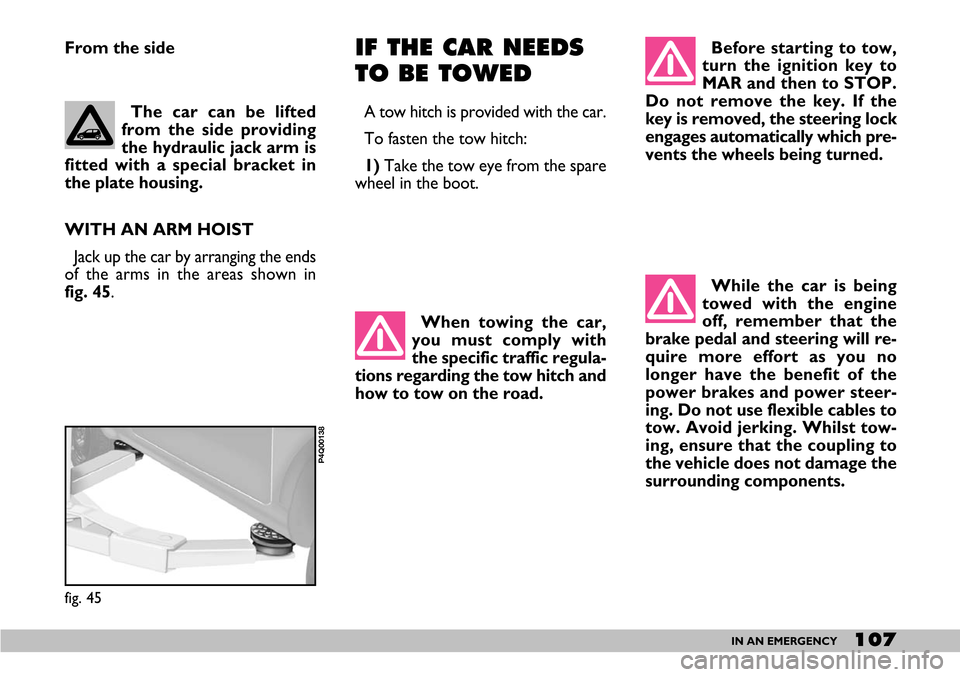
WITH AN ARM HOIST
Jack up the car by arranging the ends
of the arms in the areas shown in
fig. 45.
IF THE CAR NEEDS
TO BE TOWED
A tow hitch is provided with the car.
To fasten the tow hitch:
1)Take the tow eye from the spare
wheel in the boot.
When towing the car,
you must comply with
the specific traffic regula-
tions regarding the tow hitch and
how to tow on the road.
fig. 45
P4Q00138
From the side
Page 111 of 154
110CAR MAINTENANCE
SERVICE SCHEDULE
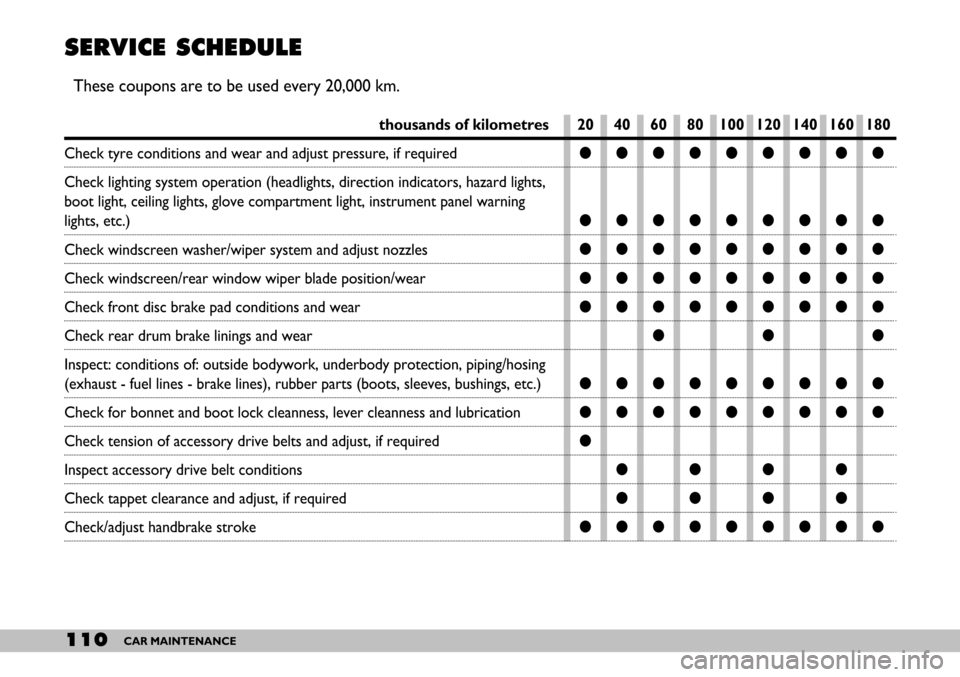
These coupons are to be used every 20,000 km.
thousands of kilometres
Check tyre conditions and wear and adjust pressure, if required
Check lighting system operation (headlights, direction indicators, hazard lights,
boot light, ceiling lights, glove compartment light, instrument panel warning
lights, etc.)
Check windscreen washer/wiper system and adjust nozzles
Check windscreen/rear window wiper blade position/wear
Check front disc brake pad conditions and wear
Check rear drum brake linings and wear
Inspect: conditions of: outside bodywork, underbody protection, piping/hosing
(exhaust - fuel lines - brake lines), rubber parts (boots, sleeves, bushings, etc.)
Check for bonnet and boot lock cleanness, lever cleanness and lubrication
Check tension of accessory drive belts and adjust, if required
Inspect accessory drive belt conditions
Check tappet clearance and adjust, if required
Check/adjust handbrake stroke20 40 60 80 100 120 140 160 180
●●●●●●●●●
●●●●●●●●●
●●●●●●●●●
●●●●●●●●●
●●●●●●●●●
●●●
●●●●●●●●●
●●●●●●●●●
●
●●●●
●●●●
●●●●●●●●●
Page 113 of 154
112CAR MAINTENANCE
ANNUAL INSPECTION SCHEDULE
– Inspect conditions of. engine, gear-
box, transmission, piping (exhaust -
fuel feed - brakes), rubber parts
(boots - sleeves - bushings - etc.),
brake and fuel line hoses.
– Check for bonnet and boot lock
cleanness, lever cleanness and lubri-
cation.
– Check battery charge status.
– Check conditions of various con-
trol belts.
– Check and top up fluid levels (en-
gine coolant, brakes, windscreen
washer, battery, etc.).
– Change engine oil.
– Replace engine oil filter.
– Replace pollen filter (where fitted). The following annual inspection
schedule is recommended for
cars travelling less than
20,000 km a year (e.g. approxi-
mately 10,000 km). The schedule
includes the following operations:
– Check tyre condition and wear
and adjust pressure, if required (in-
cluding spare wheel).
– Check operation of lights (head-
lights, direction indicators, hazard
lights, boot light, passenger compart-
ment ceiling light, glove compartment
light, instrument panel lights, etc.).
– Check windscreen wiper/washer
and adjust nozzles.
– Check position wear of wind-
screen/rear window wiper blades.
– Check front brake pad conditions
and wear.
ADDITIONAL
CHECKS
Every 1,000 kmor before long
trips, check and top up as necessary:
– engine coolant level, brake fluid
level, windscreen washer liquid level,
tyre pressure and conditions.
Every 3,000 kmcheck and top up
as necessary: engine oil level.
We recommend using FL Selenia
products which were specifically de-
signed and made for use in Fiat vehi-
cles (see
CAPACITIEStable in TECHNICAL
SPECIFICATIONS
).
Page 127 of 154
126CAR MAINTENANCE
Engine compartment
At the end of each winter season,
carefully clean the engine compart-
ment. Have this done at a garage. Leave the car in the open so that the
water can evaporate.
Do not wash the car after it has
been parked in the sun or while the
bonnet is hot: it could take the shine
off the paint.
Outside plastic parts must be
cleaned following the usual car wash-
ing procedure.
Where possible avoid parking the
car under trees; the resinous sub-
stances that certain species of tree
shed dull the paintwork and increase
the possibility of rust forming.
IMPORTANT Bird droppings
must be washed off immediately and
with great care as their acid is partic-
ularly aggressive.Detergents pollute wa-
ter. The car must there-
fore be washed in an area
equipped for the collection and
purification of the liquids used
while washing.
IMPORTANTThe engine com-
partment should be washed while the
engine is cold and with the ignition key
at STOP. After washing, make sure
that the various protections (e.g. rub-
ber boots and various guards) have
not be removed or damaged. To better protect the paintwork,
polish with specific protective wax.
When the paintwork tends to lose
its shine because of the build-up of
smog, use polish wax which has a
slightly abrasive as well as protective
action.
Windows
Use specific window cleaners to
clean the windows. Use very clean
cloths to avoid scratching the glass or
damaging its transparency.
IMPORTANT To prevent damage
to the electrical heater element, wipe
the inside of the heated rear window
gently in the same direction as the el-
ements.
Page 129 of 154
128TECHNICAL SPECIFICATIONS
T T T T
E E E E
C C C C
H H H H
N N N N
I I I I
C C C C
A A A A
L L L L
S S S S
P P P P
E E E E
C C C C
I I I I
F F F F
I I I I
C C C C
A A A A
T T T T
I I I I
O O O O
N N N N
S S S S
IDENTIFICATION DATA
CHASSIS MARKING
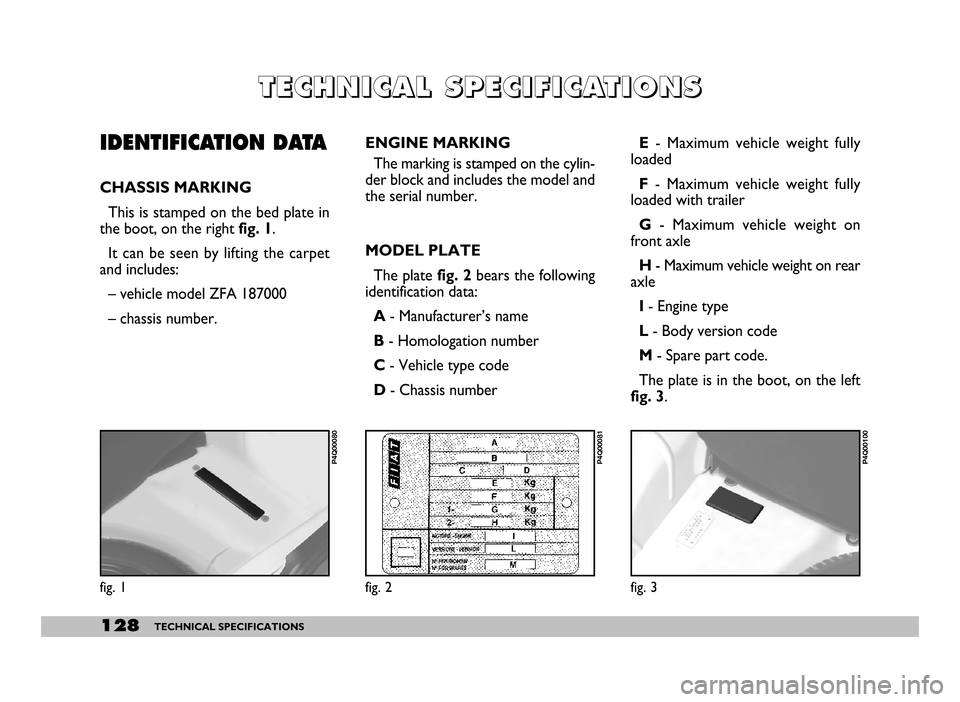
This is stamped on the bed plate in
the boot, on the right fig. 1.
It can be seen by lifting the carpet
and includes:
– vehicle model ZFA 187000
– chassis number.ENGINE MARKING
The marking is stamped on the cylin-
der block and includes the model and
the serial number.
MODEL PLATE
The plate fig. 2 bears the following
identification data:
A - Manufacturer’s name
B - Homologation number
C - Vehicle type code
D - Chassis numberE - Maximum vehicle weight fully
loaded
F - Maximum vehicle weight fully
loaded with trailer
G - Maximum vehicle weight on
front axle
H - Maximum vehicle weight on rear
axle
I - Engine type
L - Body version code
M - Spare part code.
The plate is in the boot, on the left
fig. 3.
fig. 1
P4Q00080
fig. 2
P4Q00081
fig. 3
P4Q00100
Page 138 of 154
137TECHNICAL SPECIFICATIONS
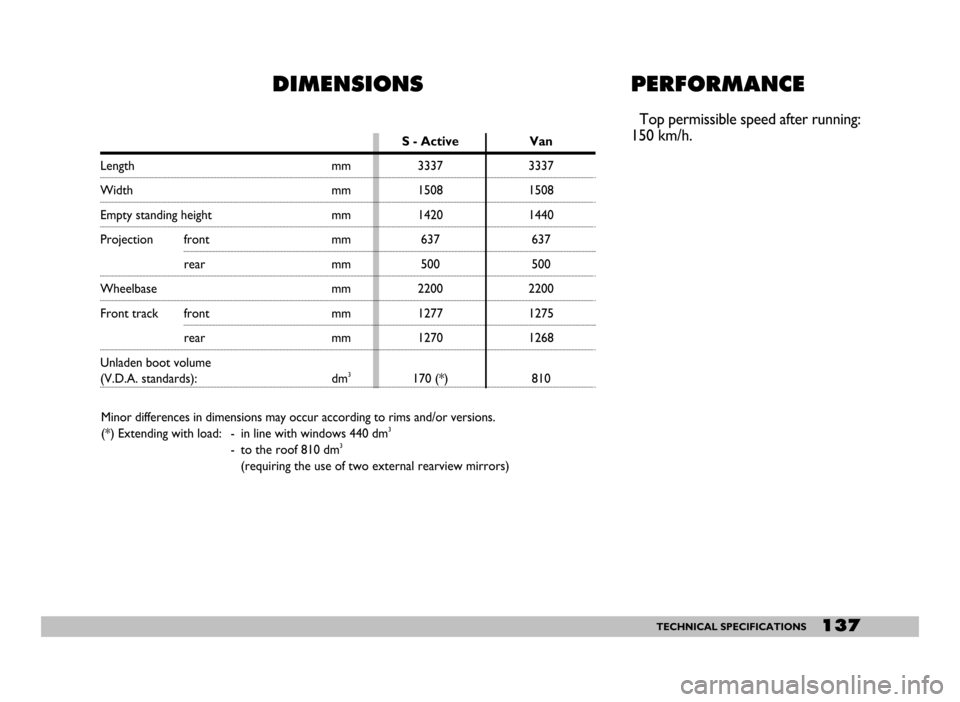
Length mm
Width mm
Empty standing height mm
Projection front mm
rear mm
Wheelbase mm
Front track front mm
rear mm
Unladen boot volume
(V.D.A. standards): dm3
PERFORMANCE
Top permissible speed after running:
150 km/h.
S - Active
3337
1508
1420
637
500
2200
1277
1270
170 (*)Van
3337
1508
1440
637
500
2200
1275
1268
810
DIMENSIONS
Minor differences in dimensions may occur according to rims and/or versions.
(*) Extending with load: - in line with windows 440 dm3
- to the roof 810 dm3
(requiring the use of two external rearview mirrors)
Page 140 of 154
139TECHNICAL SPECIFICATIONS
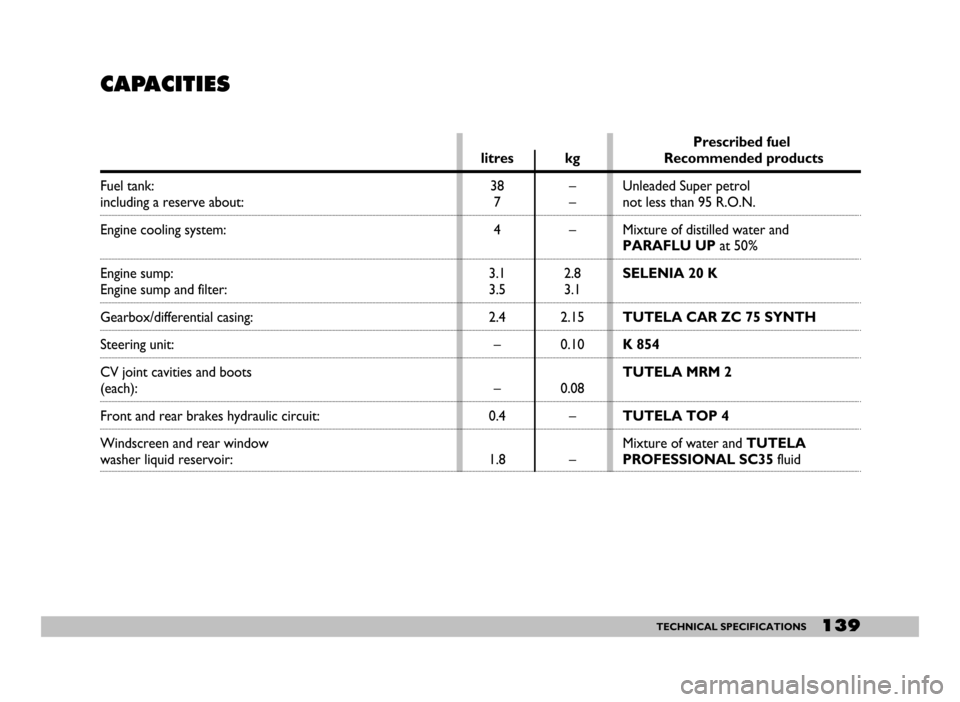
CAPACITIES
Fuel tank:
including a reserve about:
Engine cooling system:
Engine sump:
Engine sump and filter:
Gearbox/differential casing:
Steering unit:
CV joint cavities and boots
(each):
Front and rear brakes hydraulic circuit:
Windscreen and rear window
washer liquid reservoir: Prescribed fuel
Recommended products
Unleaded Super petrol
not less than 95 R.O.N.
Mixture of distilled water and
PARAFLU UPat 50%
SELENIA 20 K
TUTELA CAR ZC 75 SYNTH
K 854
TUTELA MRM 2
TUTELA TOP 4
Mixture of water and TUTELA
PROFESSIONAL SC35fluid litres kg
38–
7–
4–
3.1 2.8
3.5 3.1
2.4 2.15
– 0.10
– 0.08
0.4 –
1.8–
Page 146 of 154
145INDEX
I I I I
N N N N
D D D D
E E E E
X X X X
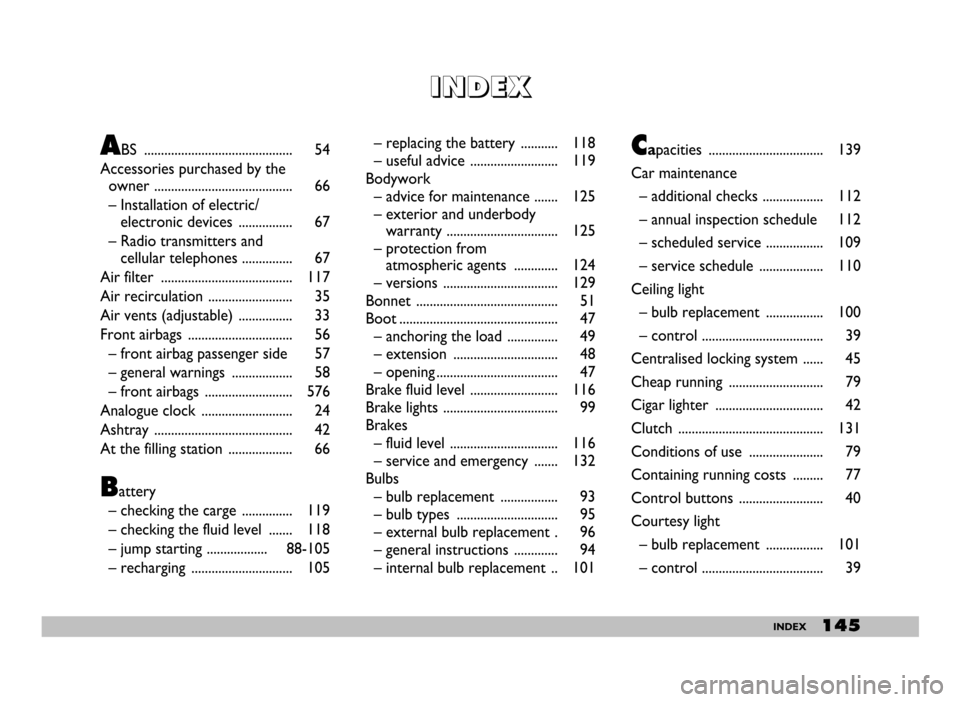
ABS ............................................ 54
Accessories purchased by the
owner ......................................... 66
– Installation of electric/
electronic devices ................ 67
– Radio transmitters and
cellular telephones ............... 67
Air filter ....................................... 117
Air recirculation ......................... 35
Air vents (adjustable) ................ 33
Front airbags ............................... 56
– front airbag passenger side 57
– general warnings .................. 58
– front airbags .......................... 576
Analogue clock ........................... 24
Ashtray ......................................... 42
At the filling station ................... 66
Battery
– checking the carge ............... 119
– checking the fluid level ....... 118
– jump starting .................. 88-105
– recharging .............................. 105– replacing the battery ........... 118
– useful advice .......................... 119
Bodywork
– advice for maintenance ....... 125
– exterior and underbody
warranty ................................. 125
– protection from
atmospheric agents ............. 124
– versions .................................. 129
Bonnet .......................................... 51
Boot ............................................... 47
– anchoring the load ............... 49
– extension ............................... 48
– opening .................................... 47
Brake fluid level .......................... 116
Brake lights .................................. 99
Brakes
– fluid level ................................ 116
– service and emergency ....... 132
Bulbs
– bulb replacement ................. 93
– bulb types .............................. 95
– external bulb replacement . 96
– general instructions ............. 94
– internal bulb replacement .. 101
Capacities .................................. 139
Car maintenance
– additional checks .................. 112
– annual inspection schedule 112
– scheduled service ................. 109
– service schedule ................... 110
Ceiling light
– bulb replacement ................. 100
– control .................................... 39
Centralised locking system ...... 45
Cheap running ............................ 79
Cigar lighter ................................ 42
Clutch ........................................... 131
Conditions of use ...................... 79
Containing running costs ......... 77
Control buttons ......................... 40
Courtesy light
– bulb replacement ................. 101
– control .................................... 39