brake FIAT STILO 2006 1.G Owner's Manual
[x] Cancel search | Manufacturer: FIAT, Model Year: 2006, Model line: STILO, Model: FIAT STILO 2006 1.GPages: 274, PDF Size: 4.76 MB
Page 145 of 274
144
WARNING
LIGHTS AND
MESSAGES
IN AN
EMERGENCY
CAR
MAINTENANCE
TECHNICAL
SPECIFICATIONS
INDEX
DASHBOARD
AND CONTROLS
SAFETY
DEVICES
CORRECT USE
OF THE CAR
IMPORTANT NOTES
❒With the car stopped and a gear en-
gaged always keep the brake pedal
pressed until deciding to move off;
❒during prolonged halts with the engine
running it is advisable to keep the gear-
box in neutral;
❒when the car is parked facing uphill, do
not use the moving off manoeuvre to
keep the car still; use the brake pedal
and press the accelerator pedal only
when the deciding to move off;
❒use second gear (2) only when more
control is needed for moving off ma-
noeuvres at low speed;
❒if, in reverse gear, first (1) gear is en-
gaged or vice versa, shift gear only
when the car is stopped completely and
with the brake pedal pressed.Though highly inadvisable, if when travel-
ling downhill for some unexpected reason
the car is set to neutral (N), when the en-
gagement of a gear is requested, the sys-
tem automatically engages the best gear in
relation to the speed of the car to allow
the correct transmission of torque to the
wheels.
When travelling downhill with a gear en-
gaged and the accelerator released (if the
car is moving), beyond a pre-established
speed, the system engages the clutch au-
tomatically to give the car adequate engine
braking.GEARSHIFTING
Through lever
Gearshifting takes place through the con-
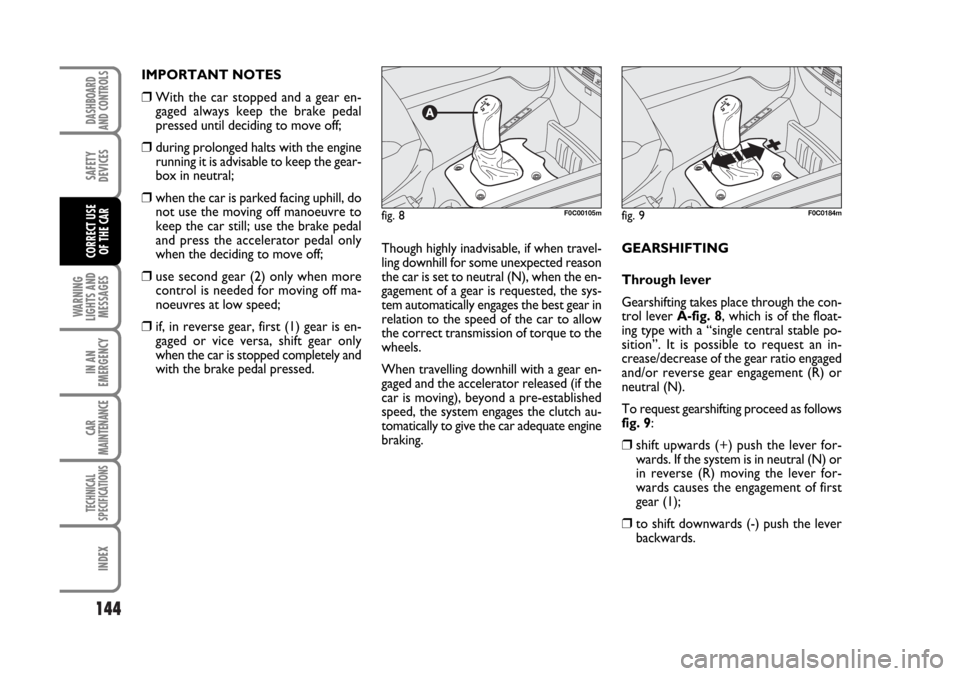
trol lever A-fig. 8, which is of the float-
ing type with a “single central stable po-
sition”. It is possible to request an in-
crease/decrease of the gear ratio engaged
and/or reverse gear engagement (R) or
neutral (N).
To request gearshifting proceed as follows
fig. 9:
❒shift upwards (+) push the lever for-
wards. If the system is in neutral (N) or
in reverse (R) moving the lever for-
wards causes the engagement of first
gear (1);
❒to shift downwards (-) push the lever
backwards.
fig. 8F0C00105mfig. 9F0C0184m
Page 146 of 274
145
WARNING
LIGHTS AND
MESSAGES
IN AN
EMERGENCY
CAR
MAINTENANCE
TECHNICAL
SPECIFICATIONS
INDEX
DASHBOARD
AND CONTROLS
SAFETY
DEVICES
CORRECT USE
OF THE CARIMPORTANT Before using the gearshift
control lever, always check the gear en-
gaged on the display (N, 1, 2, 3, 4, 5, R).
With the engine off and the car stationary
it is possible to engage all the gears.
With the car stopped and the brake ped-
al pressed, requests to change gear are ac-
cepted only through the control lever on
the centre console.
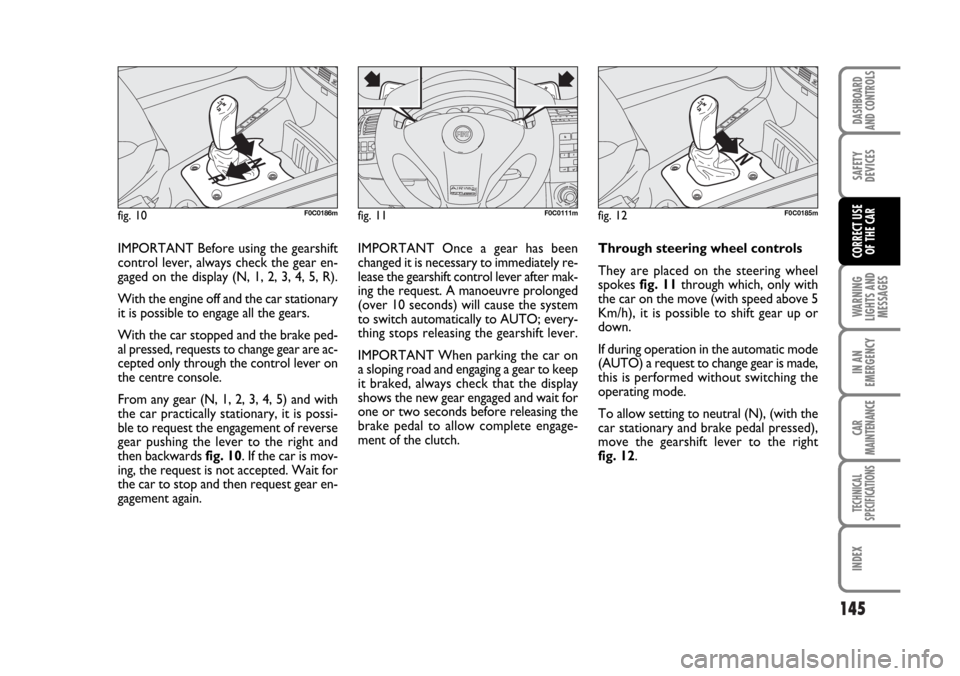
From any gear (N, 1, 2, 3, 4, 5) and with
the car practically stationary, it is possi-
ble to request the engagement of reverse
gear pushing the lever to the right and
then backwards fig. 10. If the car is mov-
ing, the request is not accepted. Wait for
the car to stop and then request gear en-
gagement again.IMPORTANT Once a gear has been
changed it is necessary to immediately re-
lease the gearshift control lever after mak-
ing the request. A manoeuvre prolonged
(over 10 seconds) will cause the system
to switch automatically to AUTO; every-
thing stops releasing the gearshift lever.
IMPORTANT When parking the car on
a sloping road and engaging a gear to keep
it braked, always check that the display
shows the new gear engaged and wait for
one or two seconds before releasing the
brake pedal to allow complete engage-
ment of the clutch.Through steering wheel controls
They are placed on the steering wheel
spokes fig. 11through which, only with
the car on the move (with speed above 5
Km/h), it is possible to shift gear up or
down.
If during operation in the automatic mode
(AUTO) a request to change gear is made,
this is performed without switching the
operating mode.
To allow setting to neutral (N), (with the
car stationary and brake pedal pressed),
move the gearshift lever to the right
fig. 12.
fig. 10F0C0186mfig. 11F0C0111mfig. 12F0C0185m
Page 147 of 274
146
WARNING
LIGHTS AND
MESSAGES
IN AN
EMERGENCY
CAR
MAINTENANCE
TECHNICAL
SPECIFICATIONS
INDEX
DASHBOARD
AND CONTROLS
SAFETY
DEVICES
CORRECT USE
OF THE CAR
ENGINE STARTING
The engine can be started either with a
gear engaged or with the gearbox in neu-
tral (N).
After starting, the gearbox sets to neutral
automatically, the display shows the letter
N and the system selects last operating
mode (MANUAL or AUTO) before
switching off.
IMPORTANT With gear engaged, fully de-
press the brake pedal to allow engine
starting.SWITCHING OFF THE ENGINE
AND SYSTEM DEACTIVATION
Turning the ignition key to STOPthe en-
gine turns off.
The gear selected before switching off the
engine remains engaged.
If the engine is stopped with the gearbox
in neutral (N), letter N flashing on the dis-
play calls the driver’s attention so that the
car can be put in safety conditions engag-
ing first gear (1) or reverse (R).
In this case, the ignition key should be
turned to MARand, with the brake ped-
al pressed, engage first gear (1) or reverse
(R).
If the engine fails to start
with the gear engaged, the
driver is informed of the potentially
dangerous situation (due to the fact
that the gearbox is in neutral) by the
buzzer.
WARNING
NEVER leave the car with
the gear in neutral (N).
WARNING
Page 148 of 274
147
WARNING
LIGHTS AND
MESSAGES
IN AN
EMERGENCY
CAR
MAINTENANCE
TECHNICAL
SPECIFICATIONS
INDEX
DASHBOARD
AND CONTROLS
SAFETY
DEVICES
CORRECT USE
OF THE CAR
FAILURE INDICATIONS
Failures of the Selespeed gearbox are
shown by warning light
ton the in-
strument panel, together with the relevant
message (see section “Warning lights and
messages”).
In case of system failure:
❒a buzzer will sound;
❒where provided, the AUTO mode will
be engaged automatically to make it
possible to reach the nearest Fiat Deal-
ership and have the fault eliminated.
In the case of a fault, the system only al-
lows the engagement of first gear (1), sec-
ond gear (2) and reverse (R). IMPORTANT If the engine is stopped with
the AUTO mode engaged, this will be
stored by the system. Indeed, the next
time the engine is started, this condition
will still be active.
IMPORTANT Should the engine go off
with the car on the move, the next time
it is started the warning light
Ymay
come on. In this case check that the warn-
ing light
Ygoes off turning the engine off
and on again with the car stationary. If not,
contact Fiat Dealership.
Never remove the ignition
key when the car is moving.
In addition to the fact that the Sele-
speed system would not work prop-
erly up to stopping the car, the steer-
ing wheel would lock automatically
the first time it is turned.
WARNING
It is absolutely necessary to
turn off the engine and then
turn off the Selespeed system keep-
ing the brake pedal pressed: ONLY
release the pedal when the display on
the instrument panel has gone out.
WARNING
In the event of a gearbox
fault (to any component),
contact Fiat Dealership as soon as
possible to have the system checked
over.
WARNING
Page 149 of 274
148
WARNING
LIGHTS AND
MESSAGES
IN AN
EMERGENCY
CAR
MAINTENANCE
TECHNICAL
SPECIFICATIONS
INDEX
DASHBOARD
AND CONTROLS
SAFETY
DEVICES
CORRECT USE
OF THE CAR
STOPPING THE CAR
To stop the car, simply release the accel-
erator pedal and, if necessary press the
brake pedal.
Regardless of the gear engaged and the op-
erating mode activated (MANUAL or AU-
TO) the system automatically disengages
the clutch and shifts to a lower gear.
Stopping the car the system automatical-
ly engages the first gear (1).PARKING THE CAR
To park the car safely it is absolutely nec-
essary to engage first gear (1) or reverse
(R) and also the handbrake if the car is on
a slope.
When turning off the engine with the car
on an uphill slope and a gear engaged, it
is absolutely necessary to wait for the dis-
play showing the gear engaged to go off
before releasing the brake pedal.
If the gearbox is in neutral (N) and want-
ing to engage a parking gear, the system
should be activated and with the foot on
the brake pedal it is necessary to engage
first gear (1) or reverse (R).
TOWING THE CAR
See the instructions contained in para-
graph “Towing the car” in section “In an
emergency”. BUZZER WARNINGS
The buzzer is activated when:
❒reverse gear is engaged (R);
❒clutch overheating occurs when mov-
ing off (in this case it is necessary to
“force” start-up without hesitation or,
if the car is on a slope, release the ac-
celerator and use the brake pedal to
stop the car);
❒an attempt is made to start the engine
with a gear engaged and the brake ped-
al is not pressed completely;
Still for safety reasons, when the car is sta-
tionary, with engine started gear engaged,
the system activates the buzzer and au-
tomatically shifts to neutral (N) when:
❒no action is made on the accelerator
and/or brake pedal for at least 3 min-
utes;
❒the brake is pressed for over 10 min-
utes;
❒the driver’s door is opened and no ac-
tion is made on the accelerator and
brake by at least 2 seconds;
❒a gearbox failure has been detected.
Page 152 of 274
151
WARNING
LIGHTS AND
MESSAGES
IN AN
EMERGENCY
CAR
MAINTENANCE
TECHNICAL
SPECIFICATIONS
INDEX
DASHBOARD
AND CONTROLS
SAFETY
DEVICES
CORRECT USE
OF THE CAR
TOWING TRAILERS
IMPORTANT NOTES
For towing caravans or trailers the car
must be fitted with a certified tow hook
and an adequate electric system. Installa-
tion should be carried out by specialised
personnel who release a special document
for circulation on the road.
Install any specific and/or additional rear-
view mirrors as specified by law.
Remember that when towing a trailer,
steep hills are harder to climb, the brak-
ing spaces increase and overtaking takes
longer depending on the overall weight.
Engage a low gear when driving downhill,
rather than constantly using the brake.The weight the trailer exerts on the car
tow hook reduces by the same amount
the actual car loading capacity. To make
sure the maximum towable weight is not
exceeded (given in the log book) account
should be taken of the fully laden trailer,
including accessories and personal be-
longings.
Do not exceed the speed limits of the
country you are driving in. In any case do
not exceed 100 km/h.INSTALLING THE TOW HOOK
The towing device should be fastened to
the body by specialised personnel ac-
cording to any additional and/or integra-
tive information supplied by the Manufac-
turer of the device.
The ABS system with which
the car may be fitted does
not control the trailer braking system.
Drive with extreme care on slippery
roadbeds.
WARNING
Under no circumstances
should the car brake system
be altered to control the trailer brake.
The trailer braking system must be
fully independent of the car hydraulic
system.
WARNING
Page 153 of 274
152
WARNING
LIGHTS AND
MESSAGES
IN AN
EMERGENCY
CAR
MAINTENANCE
TECHNICAL
SPECIFICATIONS
INDEX
DASHBOARD
AND CONTROLS
SAFETY
DEVICES
CORRECT USE
OF THE CAR
The towing device must meet current reg-
ulations with reference to 94/20/EC Di-
rective and subsequent amendments.
For any version the towing device used
must match the towable weight of the car
on which it is to be installed.
IMPORTANT Supplementary electric
loads other than external lights (e.g. elec-
tric brake, electric winch, etc.) shall be
used with running engine.Assembly diagram fig. 13-14
The tow hook structure must be fastened
in the points shown by the symbol
Øus-
ing a total of 6 M10 screws.
Counterplates
➀shall have a 4 mm min
thickness.
Counterplates
➁shall have a 6 mm min
thickness.
The hook should be fastened to the body
avoiding any type of drilling and trimming
of the rear bumpers that remains visible
when the hook is removed.IMPORTANT It is compulsory to fasten a
label (plainly visible) of suitable size and
material with the following wording:
MAX LOAD ON BALL 60 kg
After fitting, screw holes shall be sealed to
prevent exhaust gas inlet.
Page 157 of 274
156
WARNING
LIGHTS AND
MESSAGES
IN AN
EMERGENCY
CAR
MAINTENANCE
TECHNICAL
SPECIFICATIONS
INDEX
DASHBOARD
AND CONTROLS
SAFETY
DEVICES
CORRECT USE
OF THE CAR
CAR INACTIVITY
If the car is to be left inactive for longer
than a month, the following precautions
should be noted:
❒park the car in covered, dry and if pos-
sible well-ventilated premises;
❒engage a gear;
❒ check that the handbrake is not en-
gaged;
❒disconnect battery terminals (first dis-
connect the negative terminal) and
check the battery charge. This check
is to be repeated every three months
when the car is left inactive. Recharge
if the optical indicator shows a dark
colour without the central green area;
❒ clean and protect the painted parts us-
ing protective wax;
❒clean and protect the shiny metal parts
using special compounds readily avail-
able.
❒sprinkle talcum powder on the rubber
windscreen and rear window wiper
blades and lift them off the glass;
❒slightly open the windows;
❒ cover the car with a cloth or perforat-
ed plastic sheet. Do not use sheets of
non-perforated plastic as they do not
allow moisture on the car body to
evaporate;
❒inflate tyres to +0,5 bar above the nor-
mal specified pressure and check it at
intervals;
❒ if you don’t disconnect the battery from
the electric system, check its charge
every month and recharge it if the op-
tical indicator shows a dark colour
without the central green area;
❒ do not drain the engine cooling system.IMPORTANT Where relevant, switch off
the electronic car alarm with the remote
control.
Page 158 of 274
157
IN AN
EMERGENCY
CAR
MAINTENANCE
TECHNICAL
SPECIFICATIONS
INDEX
DASHBOARD
AND CONTROLS
SAFETY
DEVICES
CORRECT USE
OF THE CAR
WARNING
LIGHTS AND
MESSAGES
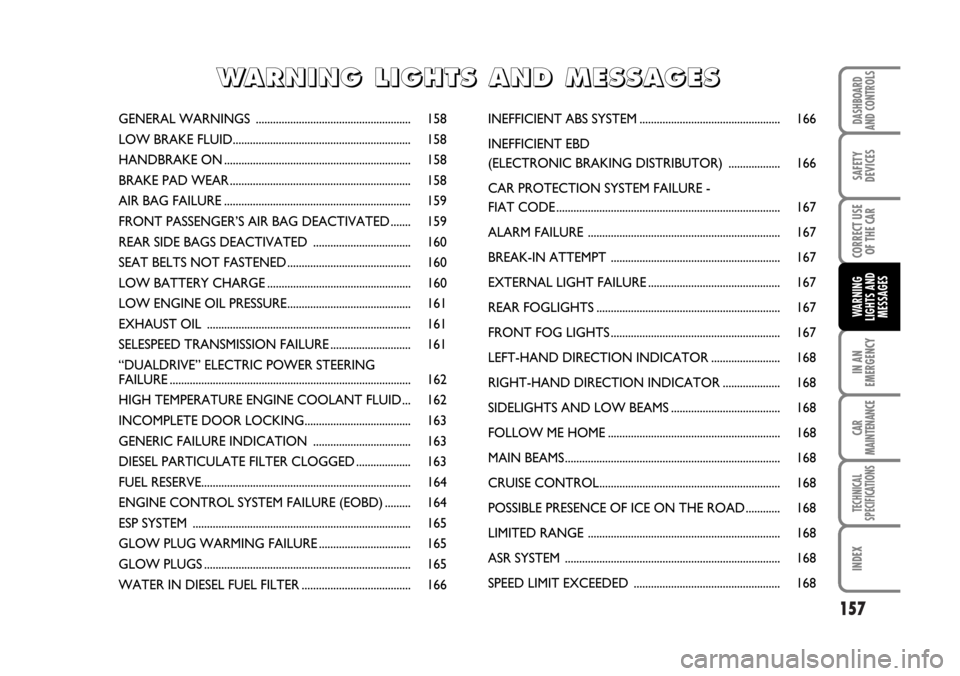
GENERAL WARNINGS ...................................................... 158
LOW BRAKE FLUID.............................................................. 158
HANDBRAKE ON ................................................................. 158
BRAKE PAD WEAR ............................................................... 158
AIR BAG FAILURE ................................................................. 159
FRONT PASSENGER’S AIR BAG DEACTIVATED ....... 159
REAR SIDE BAGS DEACTIVATED .................................. 160
SEAT BELTS NOT FASTENED ........................................... 160
LOW BATTERY CHARGE .................................................. 160
LOW ENGINE OIL PRESSURE........................................... 161
EXHAUST OIL ....................................................................... 161
SELESPEED TRANSMISSION FAILURE ............................ 161
“DUALDRIVE” ELECTRIC POWER STEERING
FAILURE .................................................................................... 162
HIGH TEMPERATURE ENGINE COOLANT FLUID ... 162
INCOMPLETE DOOR LOCKING..................................... 163
GENERIC FAILURE INDICATION .................................. 163
DIESEL PARTICULATE FILTER CLOGGED ................... 163
FUEL RESERVE......................................................................... 164
ENGINE CONTROL SYSTEM FAILURE (EOBD) ......... 164
ESP SYSTEM ............................................................................ 165
GLOW PLUG WARMING FAILURE ................................ 165
GLOW PLUGS ........................................................................ 165
WATER IN DIESEL FUEL FILTER ...................................... 166INEFFICIENT ABS SYSTEM ................................................. 166
INEFFICIENT EBD
(ELECTRONIC BRAKING DISTRIBUTOR) .................. 166
CAR PROTECTION SYSTEM FAILURE -
FIAT CODE .............................................................................. 167
ALARM FAILURE ................................................................... 167
BREAK-IN ATTEMPT ........................................................... 167
EXTERNAL LIGHT FAILURE .............................................. 167
REAR FOGLIGHTS ................................................................ 167
FRONT FOG LIGHTS ........................................................... 167
LEFT-HAND DIRECTION INDICATOR ........................ 168
RIGHT-HAND DIRECTION INDICATOR .................... 168
SIDELIGHTS AND LOW BEAMS ...................................... 168
FOLLOW ME HOME ............................................................ 168
MAIN BEAMS ........................................................................... 168
CRUISE CONTROL............................................................... 168
POSSIBLE PRESENCE OF ICE ON THE ROAD ............ 168
LIMITED RANGE ................................................................... 168
ASR SYSTEM ........................................................................... 168
SPEED LIMIT EXCEEDED ................................................... 168
W W
A A
R R
N N
I I
N N
G G
L L
I I
G G
H H
T T
S S
A A
N N
D D
M M
E E
S S
S S
A A
G G
E E
S S
Page 159 of 274
158
IN AN
EMERGENCY
CAR
MAINTENANCE
TECHNICAL
SPECIFICATIONS
INDEX
DASHBOARD
AND CONTROLS
SAFETY
DEVICES
CORRECT USE
OF THE CAR
WARNING
LIGHTS AND
MESSAGES
WARNING LIGHTS
AND MESSAGES
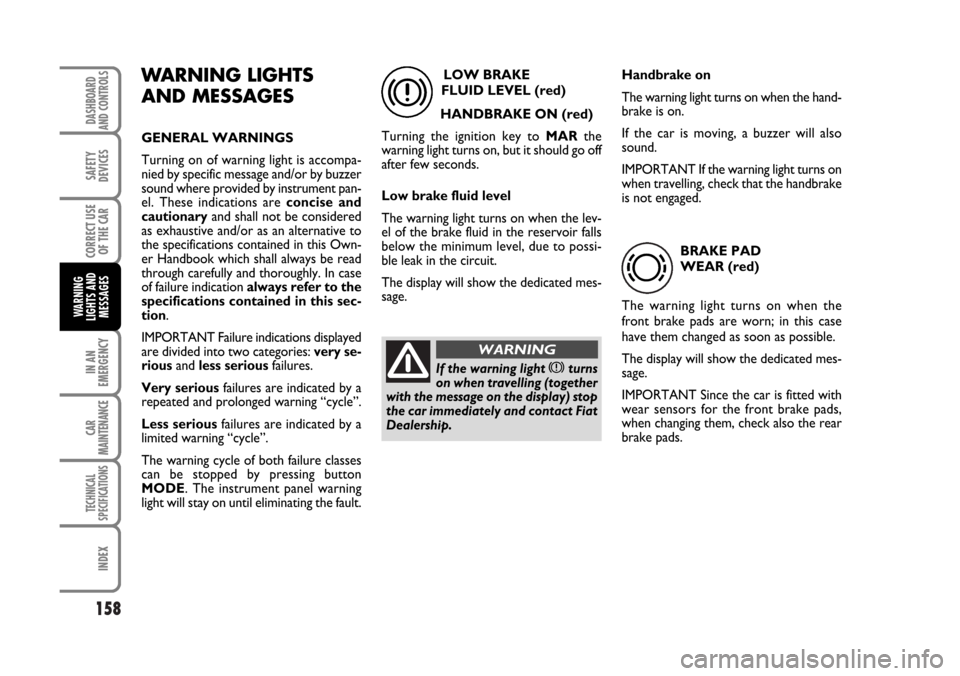
GENERAL WARNINGS
Turning on of warning light is accompa-
nied by specific message and/or by buzzer
sound where provided by instrument pan-
el. These indications are concise and
cautionaryand shall not be considered
as exhaustive and/or as an alternative to
the specifications contained in this Own-
er Handbook which shall always be read
through carefully and thoroughly. In case
of failure indication always refer to the
specifications contained in this sec-
tion.
IMPORTANT Failure indications displayed
are divided into two categories: very se-
riousand less seriousfailures.
Very seriousfailures are indicated by a
repeated and prolonged warning “cycle”.
Less seriousfailures are indicated by a
limited warning “cycle”.
The warning cycle of both failure classes
can be stopped by pressing button
MODE. The instrument panel warning
light will stay on until eliminating the fault.Handbrake on
The warning light turns on when the hand-
brake is on.
If the car is moving, a buzzer will also
sound.
IMPORTANT If the warning light turns on
when travelling, check that the handbrake
is not engaged. LOW BRAKE
FLUID LEVEL (red)
HANDBRAKE ON (red)
Turning the ignition key to MARthe
warning light turns on, but it should go off
after few seconds.
Low brake fluid level
The warning light turns on when the lev-
el of the brake fluid in the reservoir falls
below the minimum level, due to possi-
ble leak in the circuit.
The display will show the dedicated mes-
sage.BRAKE PAD
WEAR (red)
The warning light turns on when the
front brake pads are worn; in this case
have them changed as soon as possible.
The display will show the dedicated mes-
sage.
IMPORTANT Since the car is fitted with
wear sensors for the front brake pads,
when changing them, check also the rear
brake pads.
x
If the warning light xturns
on when travelling (together
with the message on the display) stop
the car immediately and contact Fiat
Dealership.
WARNING
d