brake FIAT STILO 2006 1.G User Guide
[x] Cancel search | Manufacturer: FIAT, Model Year: 2006, Model line: STILO, Model: FIAT STILO 2006 1.GPages: 274, PDF Size: 4.76 MB
Page 102 of 274
101
SAFETY
DEVICES
CORRECT USE
OF THE CAR
WARNING
LIGHTS AND
MESSAGES
IN AN
EMERGENCY
CAR
MAINTENANCE
TECHNICAL
SPECIFICATIONS
INDEX
DASHBOARD
AND CONTROLS
ACCESSORIES
PURCHASED BY THE
OWNER
If after buying the car, you decide to install
electrical accessories that require a per-
manent electric supply (alarm, satellite an-
titheft system, etc.) or accessories that in
any case burden the electric supply, con-
tact Fiat Dealership, whose qualified per-
sonnel, besides suggesting the most suit-
able devices belonging to Lineaccessori Fi-
at, will also evaluate the overall electric ab-
sorption, checking whether the car’s elec-
tric system is able to withstand the load
required, or whether it needs to be inte-
grated with a more powerful battery.
INSTALLATION OF
ELECTRIC/ELECTRONIC
DEVICES
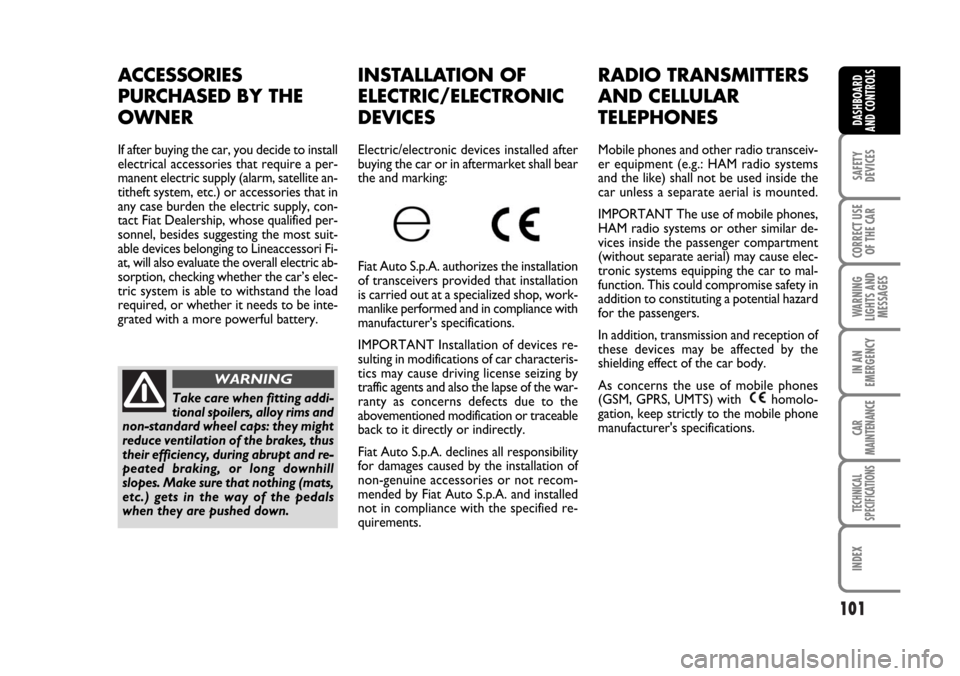
Electric/electronic devices installed after
buying the car or in aftermarket shall bear
the and marking:
Fiat Auto S.p.A. authorizes the installation
of transceivers provided that installation
is carried out at a specialized shop, work-
manlike performed and in compliance with
manufacturer's specifications.
IMPORTANT Installation of devices re-
sulting in modifications of car characteris-
tics may cause driving license seizing by
traffic agents and also the lapse of the war-
ranty as concerns defects due to the
abovementioned modification or traceable
back to it directly or indirectly.
Fiat Auto S.p.A. declines all responsibility
for damages caused by the installation of
non-genuine accessories or not recom-
mended by Fiat Auto S.p.A. and installed
not in compliance with the specified re-
quirements.
RADIO TRANSMITTERS
AND CELLULAR
TELEPHONES
Mobile phones and other radio transceiv-
er equipment (e.g.: HAM radio systems
and the like) shall not be used inside the
car unless a separate aerial is mounted.
IMPORTANT The use of mobile phones,
HAM radio systems or other similar de-
vices inside the passenger compartment
(without separate aerial) may cause elec-
tronic systems equipping the car to mal-
function. This could compromise safety in
addition to constituting a potential hazard
for the passengers.
In addition, transmission and reception of
these devices may be affected by the
shielding effect of the car body.
As concerns the use of mobile phones
(GSM, GPRS, UMTS) with homolo-
gation, keep strictly to the mobile phone
manufacturer's specifications.
Take care when fitting addi-
tional spoilers, alloy rims and
non-standard wheel caps: they might
reduce ventilation of the brakes, thus
their efficiency, during abrupt and re-
peated braking, or long downhill
slopes. Make sure that nothing (mats,
etc.) gets in the way of the pedals
when they are pushed down.
WARNING
Page 105 of 274
104
SAFETY
DEVICES
CORRECT USE
OF THE CAR
WARNING
LIGHTS AND
MESSAGES
IN AN
EMERGENCY
CAR
MAINTENANCE
TECHNICAL
SPECIFICATIONS
INDEX
DASHBOARD
AND CONTROLS
Detection distances
Central action radius ......................150 cm
Side action radius ............................ 60 cm
If several obstacles are detected, the con-
trol unit indicates the nearest one.
FAILURE INDICATIONS
In the event of sensor failures, when en-
gaging the reverse gear the driver is
warned by the turning on of warning light
èon the instrument panel and by the rel-
evant message on the display (see section
“Warning lights and messages”).
OPERATION WITH TRAILER
Parking sensor operation is deactivated
automatically when the trailer electric ca-
ble plug is fitted into the car tow hook
socket.
Sensors are reactivated when removing
the trailer cable plug.GENERAL WARNINGS
❒When parking, take the utmost care to
obstacles set above or under the sen-
sors.
❒Objects set close to the car front or
rear part, under certain circumstances
are not detected and could therefore
cause damages to the car.
❒Indications sent by the sensors can be
altered by dirt, snow or ice deposited
on the sensors or by ultrasound sys-
tems (e.g.: truck pneumatic brakes or
pneumatic hammers) set nearby the
car. For proper operation, the
parking sensors set on the
bumpers shall be clean from
mud, dirt, snow or ice. When
cleaning the sensors, take the utmost
care to prevent their damaging; do not
use therefore dry or rough clothes. Sen-
sors shall be washed with clean water
and car detergent, if required. In wash-
ing stations, clean sensors quickly keep-
ing the vapour jet/high pressure wash-
ing nozzles at 10 cm at least from the
sensors.
Parking manoeuvres howev-
er are always under the dri-
ver’s responsibility that shall always
check the absence of people (spe-
cially children) or animals in the ma-
noeuvre space. This system is just a
help for the driver but she/he shall
never reduce attention during dan-
gerous manoeuvres even if performed
at low speed.
WARNING
Page 111 of 274
110
CORRECT USE
OF THE CAR
WARNING
LIGHTS AND
MESSAGES
IN AN
EMERGENCY
CAR
MAINTENANCE
TECHNICAL
SPECIFICATIONS
IINDEX
DASHBOARD
AND CONTROLS
SAFETY
DEVICES
When the car is parked on a steep slope
the reel mechanism may block; this is nor-
mal. The reel mechanism prevents the
webbing coming out when it is jerked or
if the car brakes sharply, in a collision or
when cornering at high speed.
The rear seat is fitted with inertial seat
belts with three anchor points and reel for
the side and centre seats.
SEAT BELTS
USING THE SEAT BELTS
The belt should be worn keeping the chest
straight and rested against the seat back.
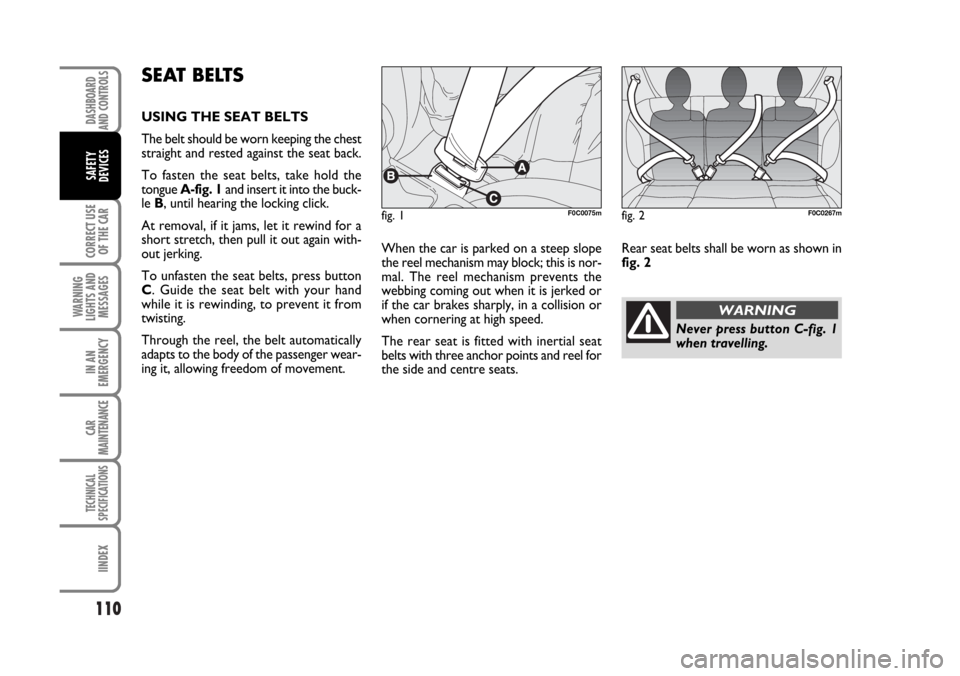
To fasten the seat belts, take hold the
tongue A-fig. 1and insert it into the buck-
le B, until hearing the locking click.
At removal, if it jams, let it rewind for a
short stretch, then pull it out again with-
out jerking.
To unfasten the seat belts, press button
C. Guide the seat belt with your hand
while it is rewinding, to prevent it from
twisting.
Through the reel, the belt automatically
adapts to the body of the passenger wear-
ing it, allowing freedom of movement.
Never press button C-fig. 1
when travelling.
WARNING
Rear seat belts shall be worn as shown in
fig. 2
fig. 1F0C0075mfig. 2F0C0267m
Page 112 of 274
111
CORRECT USE
OF THE CAR
WARNING
LIGHTS AND
MESSAGES
IN AN
EMERGENCY
CAR
MAINTENANCE
TECHNICAL
SPECIFICATIONS
INDEX
DASHBOARD
AND CONTROLS
SAFETY
DEVICES
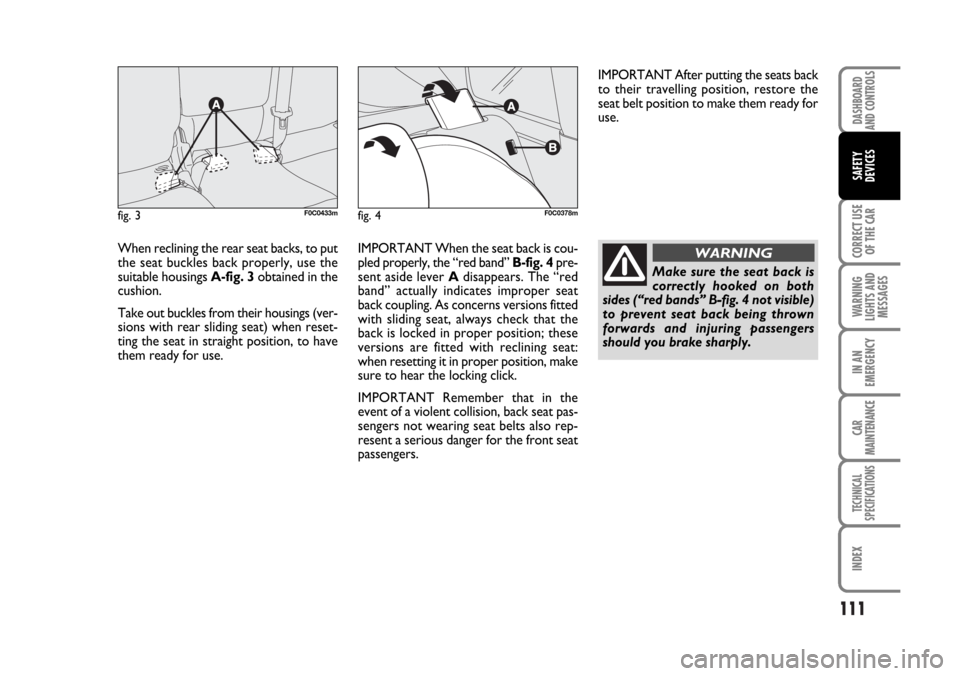
When reclining the rear seat backs, to put
the seat buckles back properly, use the
suitable housings A-fig. 3obtained in the
cushion.
Take out buckles from their housings (ver-
sions with rear sliding seat) when reset-
ting the seat in straight position, to have
them ready for use.IMPORTANT When the seat back is cou-
pled properly, the “red band” B-fig. 4pre-
sent aside lever Adisappears. The “red
band” actually indicates improper seat
back coupling. As concerns versions fitted
with sliding seat, always check that the
back is locked in proper position; these
versions are fitted with reclining seat:
when resetting it in proper position, make
sure to hear the locking click.
IMPORTANT Remember that in the
event of a violent collision, back seat pas-
sengers not wearing seat belts also rep-
resent a serious danger for the front seat
passengers.
fig. 3F0C0433mfig. 4F0C0378m
Make sure the seat back is
correctly hooked on both
sides (“red bands” B-fig. 4 not visible)
to prevent seat back being thrown
forwards and injuring passengers
should you brake sharply.
WARNING
IMPORTANT After putting the seats back
to their travelling position, restore the
seat belt position to make them ready for
use.
Page 137 of 274
ENGINE STARTING
The car is fitted with an electronic engine
lock device: if the engine fails to start, see
the paragraph “The Fiat CODE system” in
section “Dashboard and controls”.
The engine may be noisier than usual dur-
ing the first seconds of operation, espe-
cially after it has not been used for a while.
This characteristic feature of the hydraulic
tappet system does not compromise func-
tionality or reliability. This timing system
for petrol engines was adopted to limit
servicing.
Engine starting is guaranteed up to a min-
imum temperature of -18°C (Italy and
Middle Europe) and -20°C (North Eu-
rope).
136
WARNING
LIGHTS AND
MESSAGES
IN AN
EMERGENCY
CAR
MAINTENANCE
TECHNICAL
SPECIFICATIONS
INDEX
DASHBOARD
AND CONTROLS
SAFETY
DEVICES
CORRECT USE
OF THE CAR
STARTING PROCEDURE FOR
PETROL VERSIONS
Proceed as follows:
❒pull up the handbrake;
❒set the gear lever to neutral;
❒press the clutch pedal down to the
floor without touching the accelerator;
❒turn the ignition key to AVVand let
it go the moment the engine starts.
If the engine does not start at the first at-
tempt, return the ignition key to STOP
before repeating starting.
If, when the ignition key is at MAR, warn-
ing light
Yremains lit together with
warning light U, turn the key to STOP
and then back to MAR; if the warning light
remains on, try with the other keys pro-
vided with the car.
We recommend that during
the initial period you do not
drive to full car performance
(e.g.: excessive acceleration,
long journeys at top speed, sharp brak-
ing, etc.).
Running the engine in con-
fined areas is extremely dan-
gerous. The engine consumes oxygen
and produces carbon monoxide
which is a highly toxic and lethal gas.
WARNING
When the engine is switched
off never leave the ignition key
at MARto prevent pointless
current absorption from drain-
ing the battery.
If you are still unable to start the engine,
perform the emergency start-up proce-
dure (see “Emergency start-up” in section
“In an emergency”) and contact Fiat Deal-
ership.
IMPORTANT Never leave the ignition key
at MARwhen the engine is off.
Page 138 of 274
137
WARNING
LIGHTS AND
MESSAGES
IN AN
EMERGENCY
CAR
MAINTENANCE
TECHNICAL
SPECIFICATIONS
INDEX
DASHBOARD
AND CONTROLS
SAFETY
DEVICES
CORRECT USE
OF THE CAR
STARTING PROCEDURE
FOR DIESEL VERSIONS
Proceed as follows:
❒ pull up the handbrake;
❒set the gear lever to neutral;
❒turn the ignition key to MAR. The
warning lights
mand Yon the in-
strument panel will turn on;
❒wait for the warning lights Yand mto turn off. The hotter the engine is, the
quicker this will happen;
❒press the clutch pedal down to the
floor without touching the accelerator;
❒turn the ignition key to AVVas soon
as warning light mturns off. If you
wait too long you will lose the benefit
of the work done by the glow plugs. Re-
lease the key as soon as the engine
starts.IMPORTANT Never leave the ignition key
at MARwhen the engine is off.
The warning light
mwill
flash for 60 seconds at start-
up or during prolonged crank-
ing to signal a fault in the glow
plug heating system. You can use the
car as usual if the engine starts but you
should contact a Fiat Dealership as
soon as possible.
IMPORTANT With cold engine, the ac-
celerator pedal shall be completely re-
leased while turning the ignition key to
AVV.
If the engine does not start at the first at-
tempt, return the ignition key to STOP
before repeating starting.
If, when the ignition key is at MAR, warn-
ing light
Yon the instrument panel stays
on, turn the key to STOPand then back
to MAR; if the warning light remains on,
try with the other keys provided with the
car.
If you still cannot start the engine, contact
Fiat Dealership.
Page 139 of 274
138
WARNING
LIGHTS AND
MESSAGES
IN AN
EMERGENCY
CAR
MAINTENANCE
TECHNICAL
SPECIFICATIONS
INDEX
DASHBOARD
AND CONTROLS
SAFETY
DEVICES
CORRECT USE
OF THE CAR
STOPPING THE ENGINE
Turn the ignition to STOPwhile the en-
gine is idling.
IMPORTANT After a taxing drive, you
should allow the engine to “catch its
breath” before turning it off by letting it
idle to allow the temperature in the en-
gine compartment to fall.
Never bump start the engine
by pushing, towing or coasting
downhill as this could cause
fuel to flow into the catalytic
exhaust system and damage it beyond
repair.
Remember that the servo-
brake and power steering
are not operational until the engine
has been started, therefore much ef-
fort than usual is required on the
brake pedal and steering wheel.
WARNING
A quick burst on the acceler-
ator before turning off the en-
gine serves absolutely no prac-
tical purpose, it wastes fuel
and is damaging especially to tur-
bocharged engines.
HOW TO WARM UP
THE ENGINE AFTER IT
HAS JUST STARTED
(petrol and diesel engines)
Proceed as follows:
❒Drive off slowly, letting the engine turn
at medium revs. Do not accelerate
abruptly;
❒Do not drive at full performance for the
initial kilometres. Wait until the coolant
temperature gauge starts moving.
EMERGENCY START-UP
If the instrument panel warning light
Ystays on with fixed light, contact Fiat Deal-
ership.
Page 140 of 274
139
WARNING
LIGHTS AND
MESSAGES
IN AN
EMERGENCY
CAR
MAINTENANCE
TECHNICAL
SPECIFICATIONS
INDEX
DASHBOARD
AND CONTROLS
SAFETY
DEVICES
CORRECT USE
OF THE CAR
PARKING THE CAR
Proceed as follows:
❒ Stop the engine and engage the hand-
brake;
❒Engage a gear (first if the car is faced up-
hill or reverse if it is faced downhill) and
leave the wheels steered.
Block the wheels with a wedge or a stone
if the car is parked on a steep slope. Do
not leave the ignition key at MARto pre-
vent draining the battery. Always remove
the key when you leave the car.HANDBRAKE
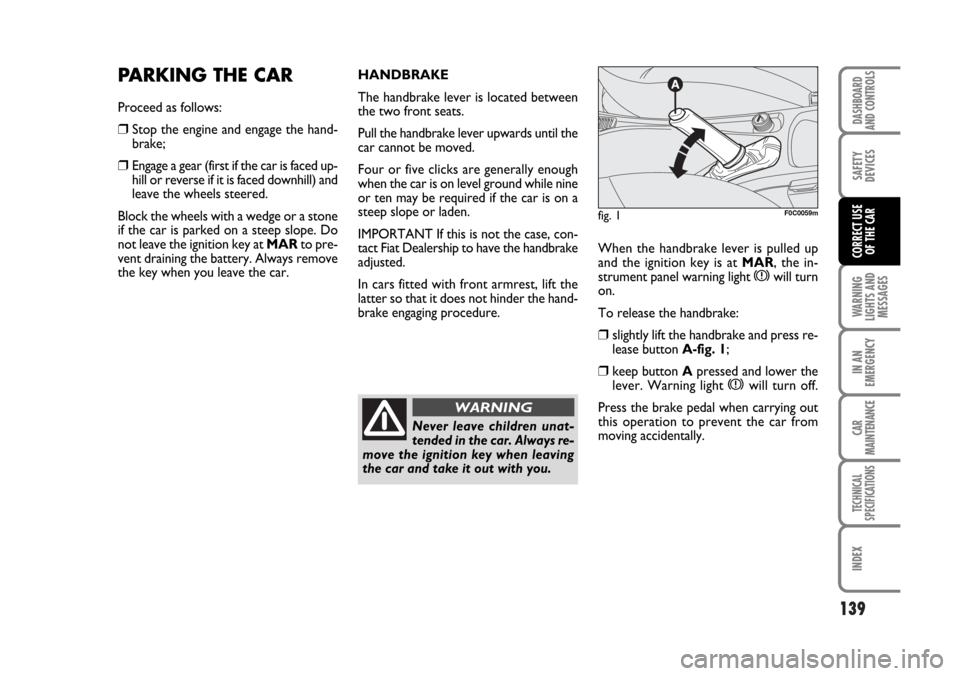
The handbrake lever is located between
the two front seats.
Pull the handbrake lever upwards until the
car cannot be moved.
Four or five clicks are generally enough
when the car is on level ground while nine
or ten may be required if the car is on a
steep slope or laden.
IMPORTANT If this is not the case, con-
tact Fiat Dealership to have the handbrake
adjusted.
In cars fitted with front armrest, lift the
latter so that it does not hinder the hand-
brake engaging procedure.When the handbrake lever is pulled up
and the ignition key is at MAR, the in-
strument panel warning light
xwill turn
on.
To release the handbrake:
❒slightly lift the handbrake and press re-
lease button A-fig. 1;
❒keep button Apressed and lower the
lever. Warning light xwill turn off.
Press the brake pedal when carrying out
this operation to prevent the car from
moving accidentally.
fig. 1F0C0059m
Never leave children unat-
tended in the car. Always re-
move the ignition key when leaving
the car and take it out with you.
WARNING
Page 143 of 274
142
WARNING
LIGHTS AND
MESSAGES
IN AN
EMERGENCY
CAR
MAINTENANCE
TECHNICAL
SPECIFICATIONS
INDEX
DASHBOARD
AND CONTROLS
SAFETY
DEVICES
CORRECT USE
OF THE CARSuch operating mode is set when, with
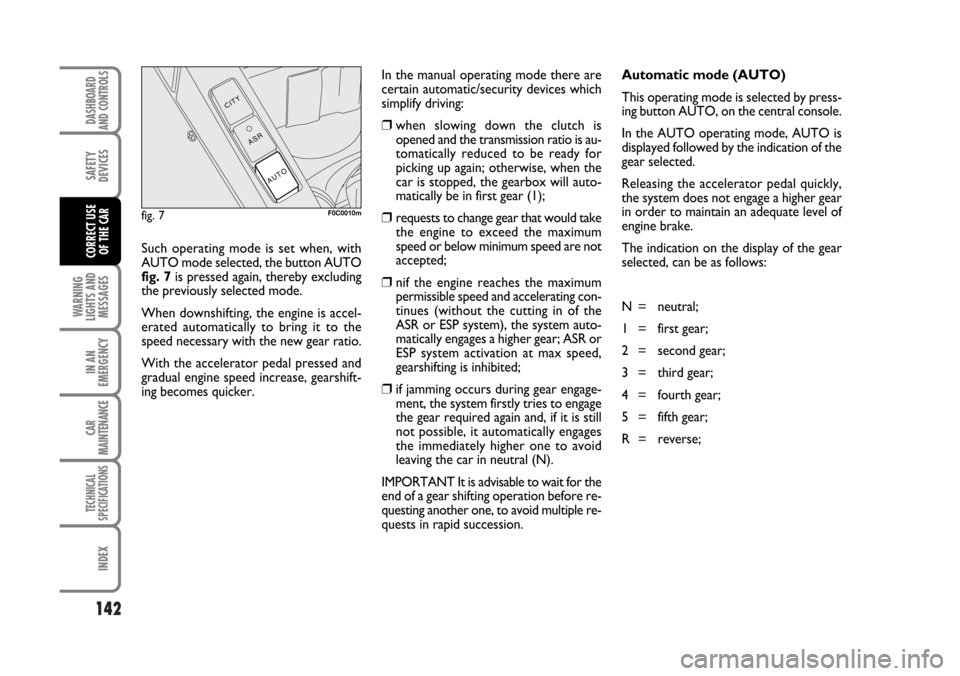
AUTO mode selected, the button AUTO
fig. 7is pressed again, thereby excluding
the previously selected mode.
When downshifting, the engine is accel-
erated automatically to bring it to the
speed necessary with the new gear ratio.
With the accelerator pedal pressed and
gradual engine speed increase, gearshift-
ing becomes quicker.In the manual operating mode there are
certain automatic/security devices which
simplify driving:
❒when slowing down the clutch is
opened and the transmission ratio is au-
tomatically reduced to be ready for
picking up again; otherwise, when the
car is stopped, the gearbox will auto-
matically be in first gear (1);
❒requests to change gear that would take
the engine to exceed the maximum
speed or below minimum speed are not
accepted;
❒nif the engine reaches the maximum
permissible speed and accelerating con-
tinues (without the cutting in of the
ASR or ESP system), the system auto-
matically engages a higher gear; ASR or
ESP system activation at max speed,
gearshifting is inhibited;
❒if jamming occurs during gear engage-
ment, the system firstly tries to engage
the gear required again and, if it is still
not possible, it automatically engages
the immediately higher one to avoid
leaving the car in neutral (N).
IMPORTANT It is advisable to wait for the
end of a gear shifting operation before re-
questing another one, to avoid multiple re-
quests in rapid succession.Automatic mode (AUTO)
This operating mode is selected by press-
ing button AUTO, on the central console.
In the AUTO operating mode, AUTO is
displayed followed by the indication of the
gear selected.
Releasing the accelerator pedal quickly,
the system does not engage a higher gear
in order to maintain an adequate level of
engine brake.
The indication on the display of the gear
selected, can be as follows:
N = neutral;
1 = first gear;
2 = second gear;
3 = third gear;
4 = fourth gear;
5 = fifth gear;
R = reverse;
fig. 7F0C0010m
Page 144 of 274
143
WARNING
LIGHTS AND
MESSAGES
IN AN
EMERGENCY
CAR
MAINTENANCE
TECHNICAL
SPECIFICATIONS
INDEX
DASHBOARD
AND CONTROLS
SAFETY
DEVICES
CORRECT USE
OF THE CAR
SYSTEM ACTIVATION
Turning the ignition key to MAR, after
about one second, the display shows the
gear engaged (N, 1, 2, 3, 4, 5, R): from this
moment onwards, the Selespeed system
accepts gearshift commands.
IMPORTANT If after 10 seconds the dis-
play does not show the gear engaged, turn
the ignition key to STOP, and wait for the
display to turn off, then repeat system
switch on. If the fault persists, contact Fi-
at Dealership.
IMPORTANT When the driver’s door is
opened the system starts the hydraulic
part of the system to prepare it for when
the engine is started. MOVING-OFF
With the engine on and the car stationary,
the gears that can be engaged for moving
off are only first (1), second (2) and/or re-
verse (R).
To engage them it is possible, keeping the
brake pedal pressed, to use only the
gearshift lever on the central console.
Moving off of the car is obtained releas-
ing the brake pedal and gradually press-
ing the accelerator pedal.
With the ASR system off (pressing the
ASR off button) moving off will be more
“brilliant”.
IMPORTANT Reverse gear (R) can be en-
gaged from any of the following other
gears: neutral (N), first (1) or second (2)
only when the car is stationary.IMPORTANT If when shifting from re-
verse (R) / first (1) or neutral (N) / first (1)
sticking occurs on the first gear, the sys-
tem automatically engages second gear (2).
This is not to be considered as a fault as
it is part of the operating logic. For the
same reason, in the case of sticking on re-
verse gear, the system partially closes the
clutch to allow gear engagement; in this
case the engagement of reverse gear (R)
will not be as smooth as usual.
After a request to shift gear
with the car stationary, be-
fore pressing the accelerator pedal to
make the car move, the driver must
always check the display to see that
the gear engaged is the one required.
WARNING