lock FIAT TEMPRA 1988 Service And User Guide
[x] Cancel search | Manufacturer: FIAT, Model Year: 1988, Model line: TEMPRA, Model: FIAT TEMPRA 1988Pages: 171, PDF Size: 18.05 MB
Page 22 of 171
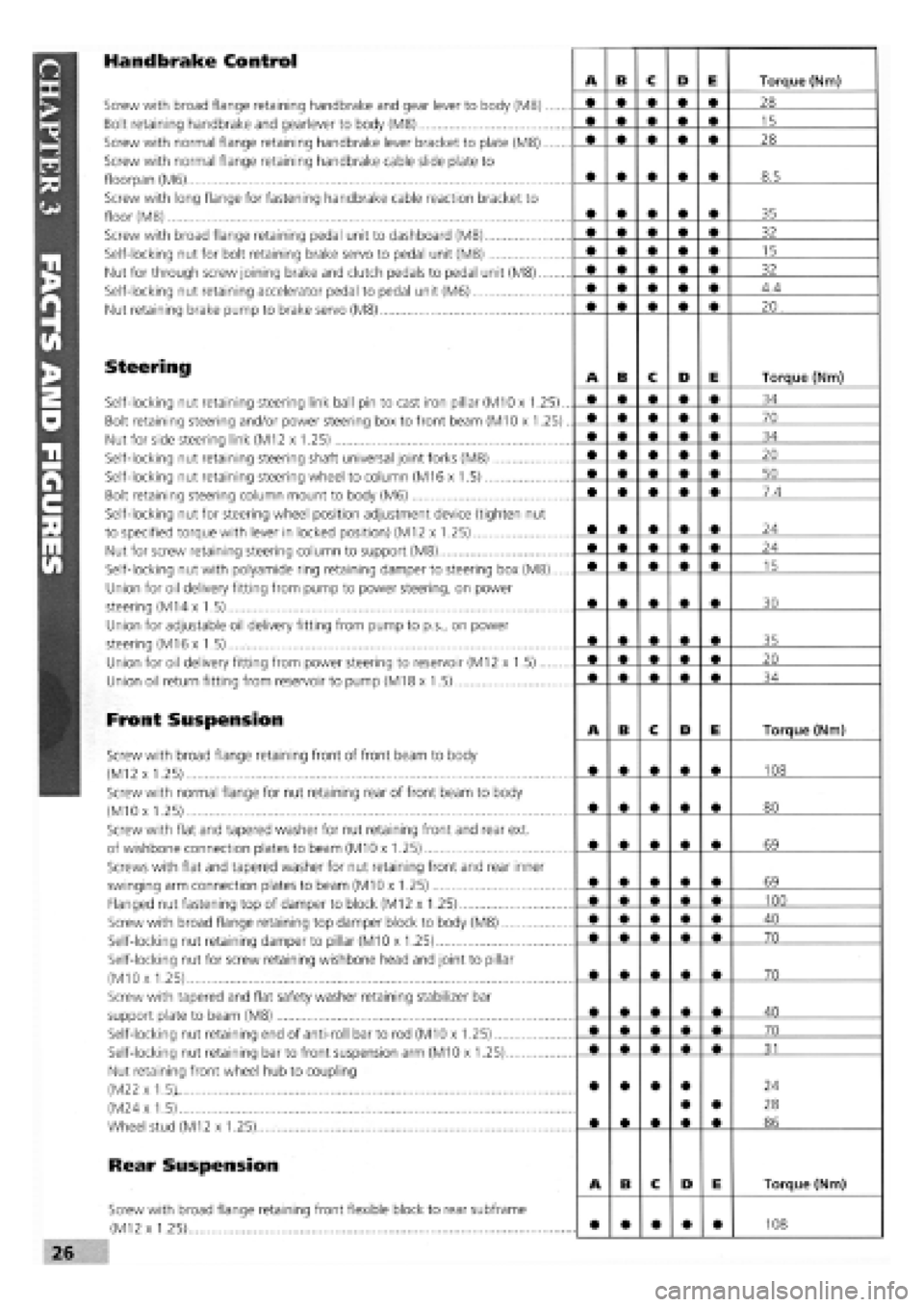
Handbrake Control
Screw with broad flange retaining handbrake and gear lever to body (M8)
Bolt retaining handbrake and gearlever to body (M8)
Screw with normal flange retaining handbrake lever bracket to plate (M8)
Screw with normal flange retaining handbrake cable slide plate to
floorpan (M6)
Screw with long flange for fastening handbrake cable reaction bracket to
floor (M8)
Screw with broad flange retaining pedal unit to dashboard (M8)
Self-locking nut for bolt retaining brake servo to pedal unit (M8)
Nut for through screw joining brake and clutch pedals to pedal unit (M8).
Self-locking nut retaining accelerator pedal to pedal unit (M6)
Nut retaining brake pump to brake servo (M8)
Steering
Self-locking nut retaining steering link ball pin to cast iron pillar (M10 x 1.25)..
Bolt retaining steering and/or power steering box to front beam (M10 x 1.25).
Nut for side steering link (M12 x 1.25)
Self-locking nut retaining steering shaft universal joint forks (M8)
Self-locking nut retaining steering wheel to column (M16 x 1.5)
Bolt retaining steering column mount to body (M6)
Self-locking nut for steering wheel position adjustment device (tighten nut
to specified torque with lever in locked position) (M12 x 1.25)
Nut for screw retaining steering column to support (M8)
Self-locking nut with polyamide ring retaining damper to steering box (M8)
Union for oil delivery fitting from pump to power steering, on power
steering (M14 x 1.5)
Union for adjustable oil delivery fitting from pump to p.s., on power
steering (M16 x 1.5)
Union for oil delivery fitting from power steering to reservoir (M12 x 1.5)
Union oil return fitting from reservoir to pump (M18 x 1.5)
Front Suspension
Screw with broad flange retaining front of front beam to body
(M12 x 1.25)
Screw with normal flange for nut retaining rear of front beam to body
(M10
x
1.25)
Screw with flat and tapered washer for nut retaining front and rear ext.
of wishbone connection plates to beam (M10 x 1.25)
Screws with flat and tapered washer for nut retaining front and rear inner
swinging arm connection plates to beam (M10 x 1.25)
Flanged nut fastening top of damper to block (M12 x 1.25)
Screw with broad flange retaining top damper block to body (M8)
Self-locking nut retaining damper to pillar (M10 x 1.25)
Self-locking nut for screw retaining wishbone head and joint to pillar
(M10
x
1.25)
Screw with tapered and flat safety washer retaining stabilizer bar
support plate to beam (M8)
Self-locking nut retaining end of anti-roll bar to rod (M10 x 1.25)
Self-locking nut retaining bar to front suspension arm (M10 x 1.25)
Nut retaining front wheel hub to coupling
(M22 x 1.5)i
(M24
x
1.5)
Wheel stud (M12 x 1.25).....
Rear Suspension
Screw with broad flange retaining front flexible block to rear subframe
(M12 x 1.25)
A B C D E Torque (Nm)
• • • • • 28
• • • • • 15
• • • • • 28
8.5
35
32
15
32
4.4
20 .
A B C D E Torque (Nm)
• • • • • 34
70
34
• • • • • 20
50
7.4
24
24
15
30
35
20
34
A B c D E Torque (Nm)
108
80
69
69
100
40
70
70
40
70
31
• • • • • •
24
28
86
A B c D E Torque (Nm)
108
Page 23 of 171
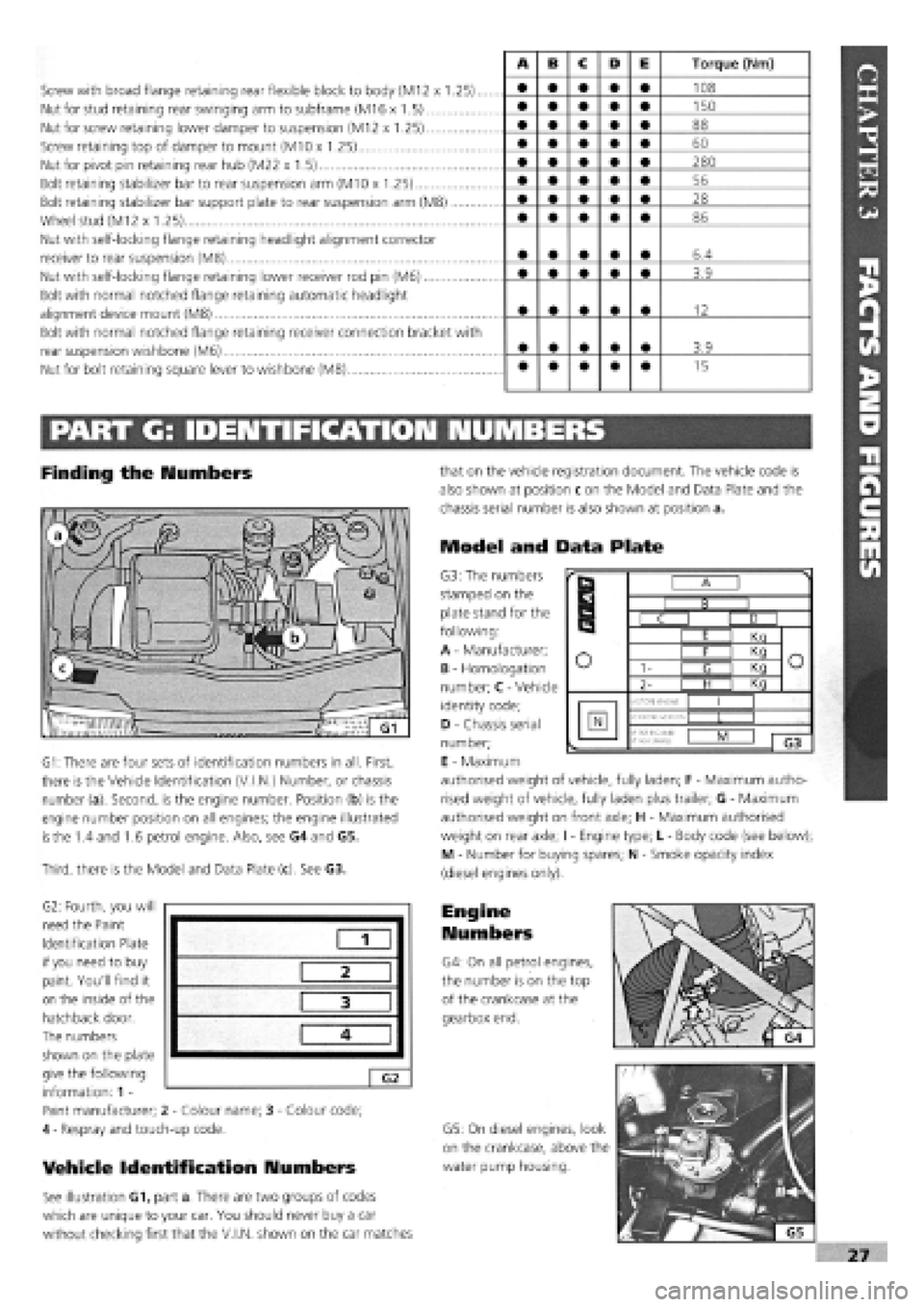
Screw with broad flange retaining rear flexible block to body (M12 x 1.25)..
Nut for stud retaining rear swinging arm to subframe (M16 x 1.5)
Nut for screw retaining lower damper to suspension (M12 x 1.25)
Screw retaining top of damper to mount (M10 x 1.25)
Nut for pivot pin retaining rear hub (M22 x 1.5)
Bolt retaining stabilizer bar to rear suspension arm (M10 x 1.25)
Bolt retaining stabilizer bar support plate to rear suspension arm (M8)
Wheel stud (M12 x 1.25)
Nut with self-locking flange retaining headlight alignment corrector
receiver to rear suspension (M8)
Nut with self-locking flange retaining lower receiver rod pin (M6)
Bolt with normal notched flange retaining automatic headlight
alignment device mount (M8)
Bolt with normal notched flange retaining receiver connection bracket with
rear suspension wishbone (M6)
Nut for bolt retaining square lever to wishbone (M8)
A B c D E Torque (Nm)
• • • • • 108
• • • • • 150
• • • • • 88
• • • • • 60
• • • • • 280
• • • • • 56
• • • • • 28
• • • • • 86
• • • • • 6.4
• • • • • 3.9
• • • • • 12
• • • • • 3.9
• • • • • 15
PART G: IDENTIFICATION NUMBERS
Finding the Numbers
G1: There are four sets of identification numbers in all. First,
there is the Vehicle Identification (V.I.N.) Number, or chassis
number (a). Second, is the engine number. Position (b) is the
engine number position on all engines; the engine illustrated
is
the 1.4 and 1.6 petrol engine. Also, see G4 and G5.
Third, there is the Model and Data Plate (c). See G3.
G2: Fourth, you will
need the Paint
Identification Plate
if you need to buy
paint. You'll find it
on the inside of the
hatchback door.
The numbers
shown on the plate
give the following
information: 1 -
Paint manufacturer; 2
-
Colour name; 3
-
Colour code;
4
-
Respray and touch-up code.
Vehicle Identification Numbers
See illustration G1, part a. There are two groups of codes
which are unique to your car. You should never buy a car
without checking first that the V.I.N, shown on the car matches
that on the vehicle registration document. The vehicle code is
also shown at position c on the Model and Data Plate and the
chassis serial number is also shown at position a.
Model and Data Plate
G3: The numbers
stamped on the
plate stand for the
following:
A
-
Manufacturer;
B
-
Homologation
number; C
-
Vehicle
identity code;
D
-
Chassis serial
number;
E
-
Maximum
authorised weight of vehicle, fully laden; F
-
Maximum autho-
rised weight of vehicle, fully laden plus trailer; G
-
Maximum
authorised weight on front axle; H
-
Maximum authorised
weight on rear axle; I
-
Engine type; L
-
Body code (see below);
M - Number for buying spares; N
-
Smoke opacity index
(diesel engines only).
Engine
Numbers
G4: On all petrol engines,
the number is on the top
of the crankcase at the
gearbox end.
G5: On diesel engines, look
on the crankcase, above the
water pump housing.
1
2
3
4
G2
r
B
r
B I B I
r
B
C I D I
r
B
I E I Kn
o o I F I Kq o o 1- I <3 I Kq o o
2- | H I Kq
o
MOTORE ENGINE
I I
N VERSIONE-VERSION •f
PER RICAM8:
N*
FOR SPARED
L I
1 G3
Page 25 of 171
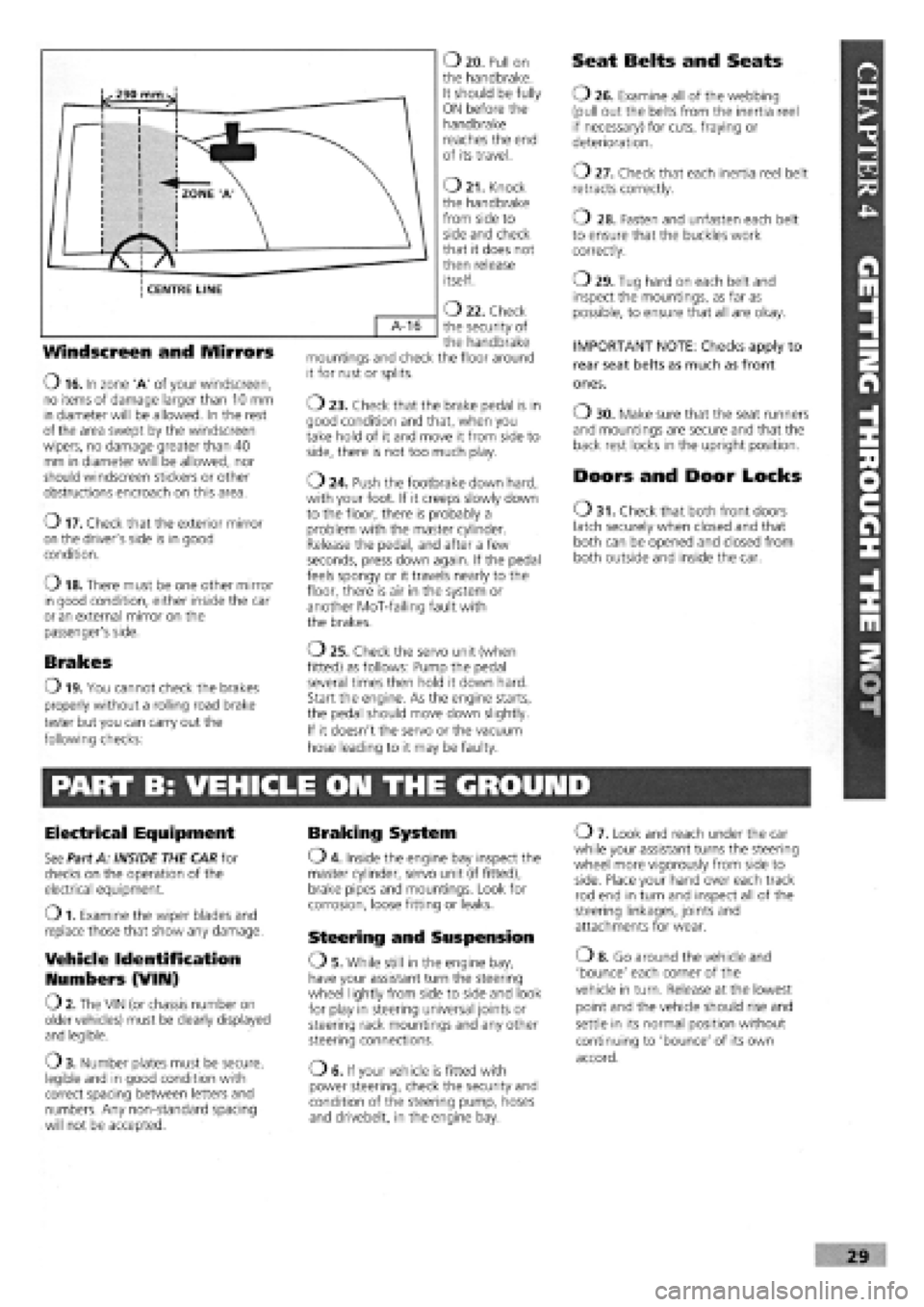
Windscreen and Mirrors
O 16. In zone 'A' of your windscreen, no items of damage larger than 10 mm in diameter will be allowed. In the rest of the area swept by the windscreen wipers, no damage greater than 40 mm in diameter will be allowed, nor should windscreen stickers or other obstructions encroach on this area.
o 17. Check that the exterior mirror on the driver's side is in good condition.
o 18. There must be one other mirror in good condition, either inside the car or an external mirror on the passenger's side.
Brakes
O 19. You cannot check the brakes
properly without a rolling road brake
tester but you can carry out the
following checks:
O 20. Pull on the handbrake. It should be fully ON before the handbrake reaches the end of its travel.
O 21. Knock the handbrake from side to side and check that it does not then release itself.
O 22. Check the security of the handbrake mountings and check the floor around it for rust or splits.
o 23. Check that the brake pedal is in good condition and that, when you take hold of it and move it from side to side, there is not too much play.
o 24. Push the footbrake down hard, with your foot. If it creeps slowly down to the floor, there is probably a problem with the master cylinder. Release the pedal, and after a few seconds, press down again. If the pedal feels spongy or it travels nearly to the floor, there is air in the system or another MoT-failing fault with the brakes.
o 25. Check the servo unit (when
fitted) as follows: Pump the pedal
several times then hold it down hard.
Start the engine. As the engine starts,
the pedal should move down slightly.
If it doesn't the servo or the vacuum
hose leading to it may be faulty.
Seat Belts and Seats
O 26. Examine all of the webbing (pull out the belts from the inertia reel if necessary) for cuts, fraying or deterioration.
o 27. Check that each inertia reel belt retracts correctly.
o 28. Fasten and unfasten each belt to ensure that the buckles work correctly.
o 29. Tug hard on each belt and inspect the mountings, as far as possible, to ensure that all are okay.
IMPORTANT NOTE: Checks apply to
rear seat belts as much as front
ones.
O 30. Make sure that the seat runners and mountings are secure and that the back rest locks in the upright position.
Doors and Door Locks
O 31. Check that both front doors latch securely when closed and that both can be opened and closed from both outside and inside the car.
PART B: VEHICLE ON THE GROUND
Electrical Equipment
See Part A: INSIDE THE CAR for checks on the operation of the electrical equipment.
O 1. Examine the wiper blades and replace those that show any damage.
Vehicle Identification
Numbers (VIIU)
O 2. The VIN (or chassis number on older vehicles) must be clearly displayed and legible.
O 3. Number plates must be secure, legible and in good condition with correct spacing between letters and numbers. Any non-standard spacing will not be accepted.
Braking System
O 4. Inside the engine bay inspect the master cylinder, servo unit (if fitted), brake pipes and mountings. Look for corrosion, loose fitting or leaks.
Steering and Suspension
OS . While still in the engine bay, have your assistant turn the steering wheel lightly from side to side and look for play in steering universal joints or steering rack mountings and any other steering connections.
OE. If your vehicle is fitted with power steering, check the security and condition of the steering pump, hoses and drivebelt, in the engine bay.
O 7. Look and reach under the car while your assistant turns the steering wheel more vigorously from side to side. Place your hand over each track rod end in turn and inspect all of the steering linkages, joints and attachments for wear.
o 8. Go around the vehicle and
'bounce' each corner of the
vehicle in turn. Release at the lowest
point and the vehicle should rise and
settle in its normal position without
continuing to 'bounce' of its own
accord.
Page 26 of 171
PART C: VEHICLE RAISED OFF THE GROUND
Bodywork Structure
01
.
Any sharp edges on the external bodywork, caused by damage or corrosion will cause the vehicle to fail.
02 . Check all load bearing areas for corrosion. Open the doors and check the sills inside and out, above and below. Any corrosion in structural metalwork within 30 cm (12 in.) of seat belt mounting, steering and suspension attachment points will cause the vehicle to fail.
Wheels and Tyres
Under the Front of the
Car
You will need to support the front of the car on axle stands with the rear wheels firmly chocked in both directions.
OE . Have your helper turn the steering from lock to lock and check that the steering turns smoothly and that the brake hoses or pipes do not contact the wheel, tyre or any part of the steering or suspension.
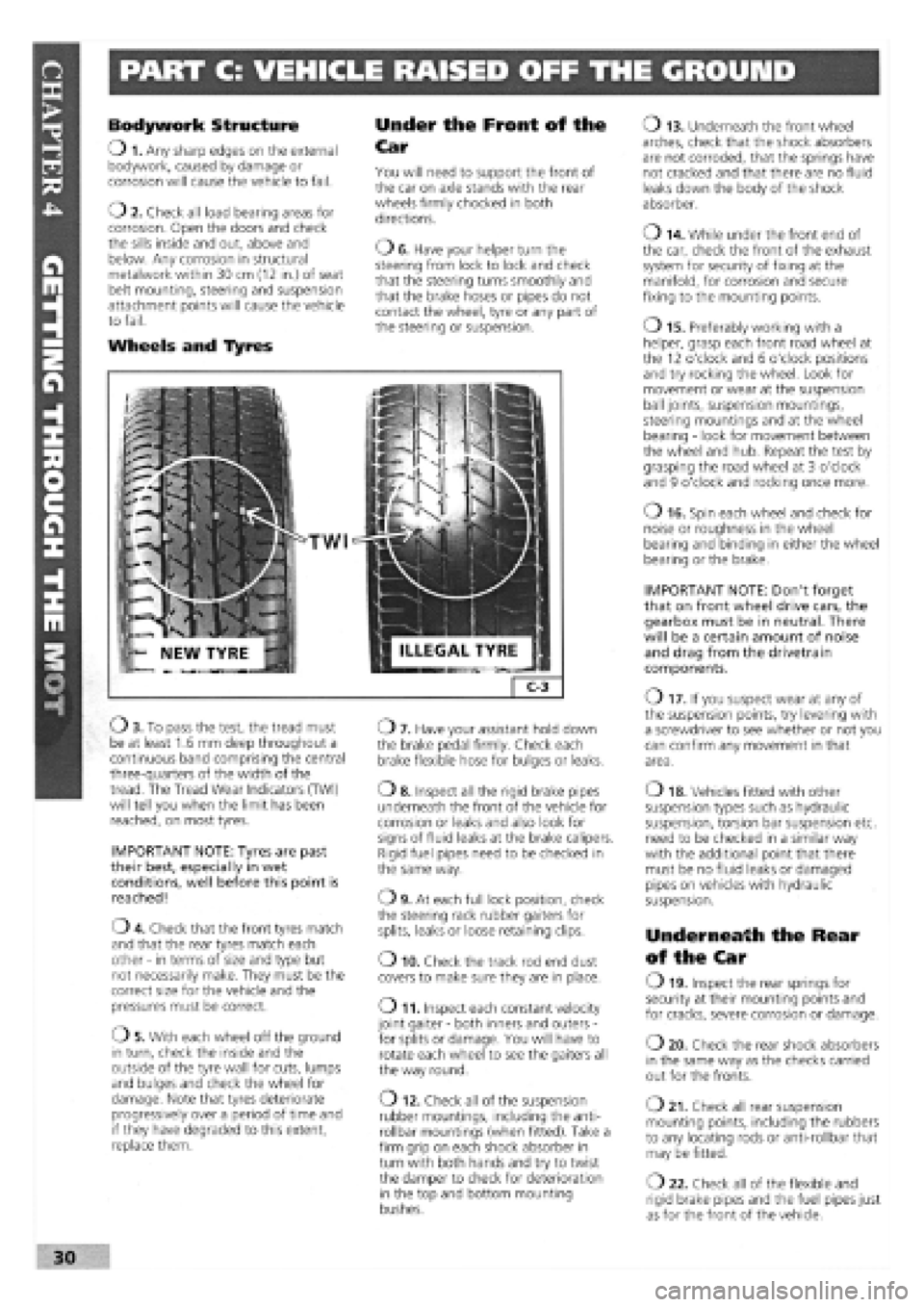
TWI
Ob . To pass the test, the tread must be at least 1.6 mm deep throughout a continuous band comprising the central three-quarters of the width of the tread. The Tread Wear Indicators (TWI) will tell you when the limit has been reached, on most tyres.
IMPORTANT NOTE: Tyres are past their best, especially in wet conditions, well before this point is reached!
04 . Check that the front tyres match and that the rear tyres match each other
-
in terms of size and type but not necessarily make. They must be the correct size for the vehicle and the pressures must be correct.
05 . With each wheel off the ground in turn, check the inside and the outside of the tyre wall for cuts, lumps and bulges and check the wheel for damage. Note that tyres deteriorate progressively over a period of time and if they have degraded to this extent, replace them.
07 . Have your assistant hold down the brake pedal firmly. Check each brake flexible hose for bulges or leaks.
o 8. Inspect all the rigid brake pipes underneath the front of the vehicle for corrosion or leaks and also look for signs of fluid leaks at the brake calipers. Rigid fuel pipes need to be checked in the same way.
09 . At each full lock position, check the steering rack rubber gaiters for splits, leaks or loose retaining clips.
o 10. Check the track rod end dust covers to make sure they are in place.
o 11. Inspect each constant velocity joint gaiter
-
both inners and outers
-
for splits or damage. You will have to rotate each wheel to see the gaiters all the way round.
O 12. Check all of the suspension rubber mountings, including the anti-rollbar mountings (when fitted). Take a firm grip on each shock absorber in turn with both hands and try to twist the damper to check for deterioration in the top and bottom mounting bushes.
o 13. Underneath the front wheel arches, check that the shock absorbers are not corroded, that the springs have not cracked and that there are no fluid leaks down the body of the shock absorber.
o 14. While under the front end of the car, check the front of the exhaust system for security of fixing at the manifold, for corrosion and secure fixing to the mounting points.
o 15. Preferably working with a helper, grasp each front road wheel at the 12 o'clock and 6 o'clock positions and try rocking the wheel. Look for movement or wear at the suspension ball joints, suspension mountings, steering mountings and at the wheel bearing
-
look for movement between the wheel and hub. Repeat the test by grasping the road wheel at 3 o'clock and 9 o'clock and rocking once more.
o 16. Spin each wheel and check for noise or roughness in the wheel bearing and binding in either the wheel bearing or the brake.
IMPORTANT NOTE: Don't forget that on front wheel drive cars, the gearbox must be in neutral. There will be a certain amount of noise and drag from the drivetrain components.
O 17. If you suspect wear at any of the suspension points, try levering with a screwdriver to see whether or not you can confirm any movement in that area.
o 18. Vehicles fitted with other suspension types such as hydraulic suspension, torsion bar suspension etc. need to be checked in a similar way with the additional point that there must be no fluid leaks or damaged pipes on vehicles with hydraulic suspension.
Underneath the Rear
of the Car
O 19. Inspect the rear springs for security at their mounting points and for cracks, severe corrosion or damage.
o 20. Check the rear shock absorbers in the same way as the checks carried out for the fronts.
o 21. Check all rear suspension mounting points, including the rubbers to any locating rods or anti-rollbar that may be fitted.
O 22. Check all of the flexible and rigid brake pipes and the fuel pipes just as for the front of the vehicle.
30
Page 30 of 171
PART G: BRAKING SYSTEM
Job 49. Check front brakes
Job 50. Check rear brakes
Job 51. Check/adjust handbrake
Job 52. Check brake pipes
Job 53. Change brake hydraulic fluid
SERVICE INTERVALS
C
C
C
C
E
Job 56. Check seat and seat belt mountings C
Job 57. Check headlight alignment C
Job 58. Check underbody C
Job 59. Check spare tyre B
Job 60. Change pollen filter C
Job 61. Replace airbag gas generator 10 years
PART I: ROAD TEST
PART H: BODYWORK & INTERIOR
Job 54. Lubricate hinges and locks
Job 55. Check windscreen
Job 62. Road test and specialist check. AFTER EVERY
SERVICE
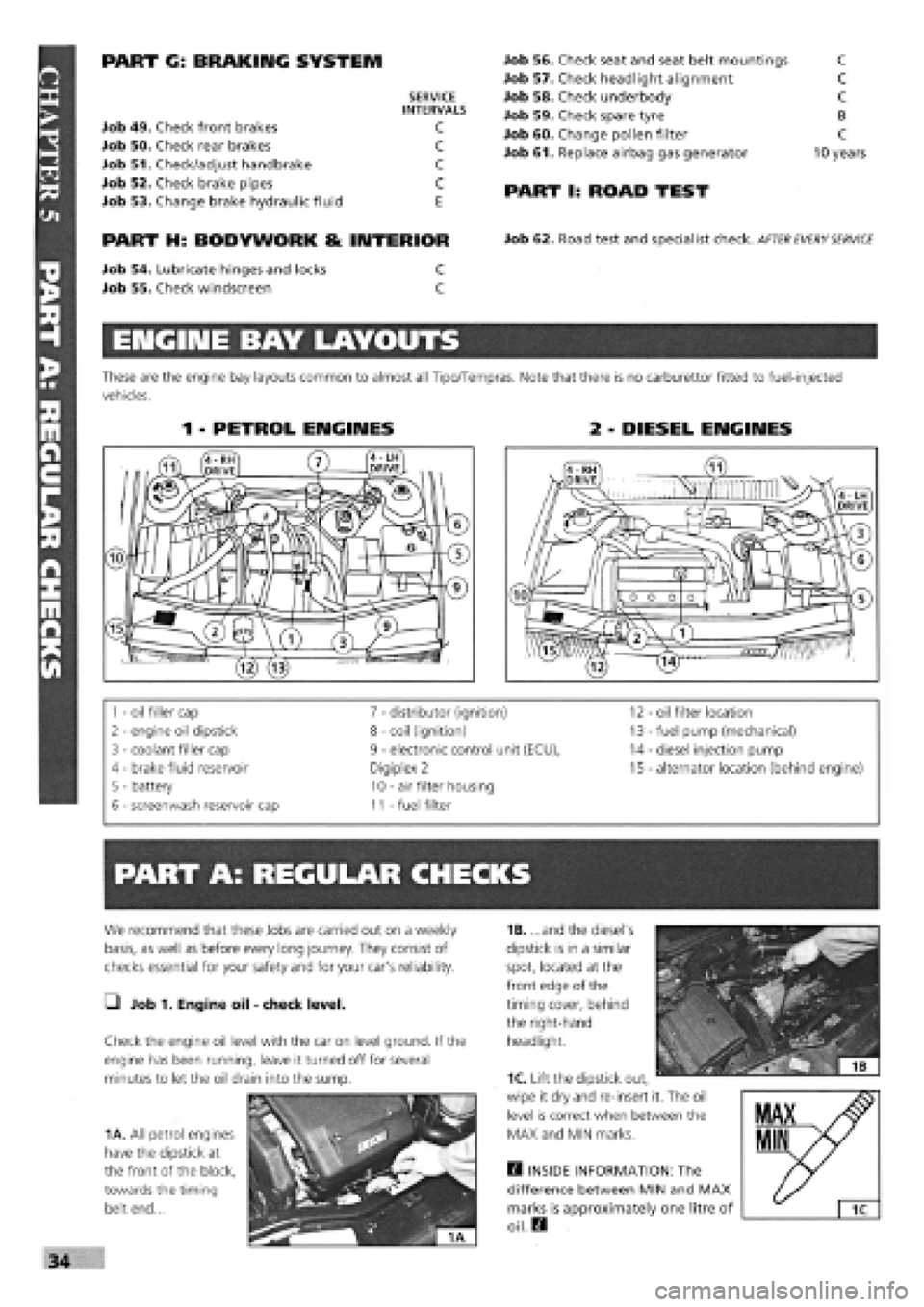
ENGINE BAY LAYOUTS
These are the engine bay layouts common to almost all Tipo/Tempras. Note that there is no carburettor fitted to fuel-injected
vehicles.
1 - PETROL ENGINES 2 - DIESEL ENGINES
1
-
oil filler cap 7
-
distributor (ignition) 12 - oil filter location
2
-
engine oil dipstick 8
-
coil (ignition) 13
-
fuel pump (mechanical)
3
-
coolant filler cap 9
-
electronic control unit (ECU), 14
-
diesel injection pump
4 - brake fluid reservoir Digiplex 2 15
-
alternator location (behind engine)
5 - battery 10
-
air filter housing
6
-
screenwash reservoir cap 11
-
fuel filter
PART A: REGULAR CHECKS
1B. ...and the diesel's
dipstick is in a similar
spot, located at the
front edge of the
timing cover, behind
the right-hand
headlight.
Q INSIDE INFORMATION: The
difference between MIN and MAX
marks is approximately one litre of
oil. Q
We recommend that these Jobs are carried out on a weekly
basis, as well as before every long journey. They consist of
checks essential for your safety and for your car's reliability.
• Job 1. Engine oil
-
check level.
Check the engine oil level with the car on level ground. If the
engine has been running, leave it turned off for several
minutes to let the oil drain into the sump.
1A. All petrol engines
have the dipstick at
the front of the block,
towards the timing
belt end...
1C. Lift the dipstick out,
wipe it dry and re-insert it. The oil
level is correct when between the
MAX and MIN marks.
Page 31 of 171
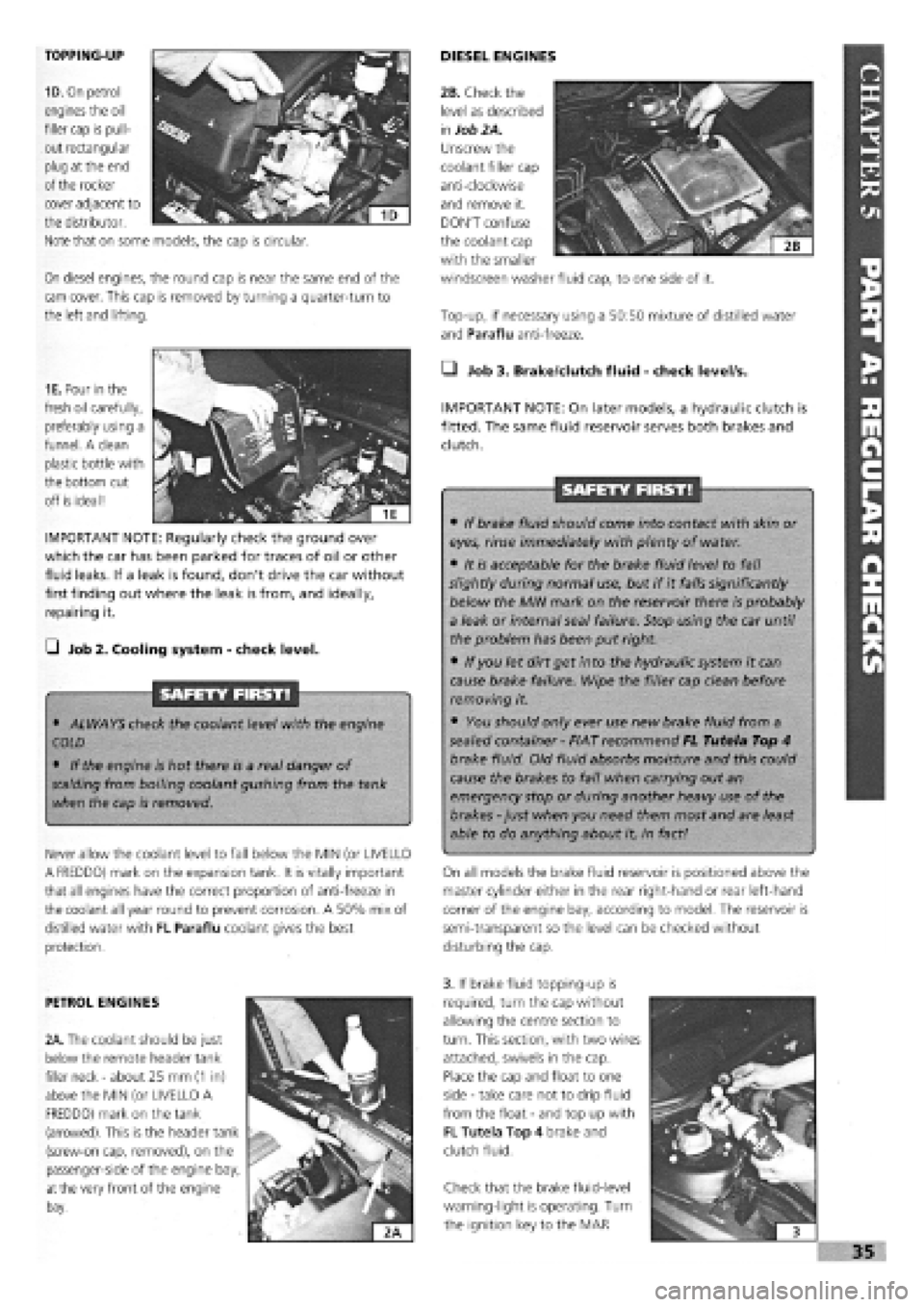
TOPPING-UP
1D. On petrol
engines the oil
filler cap is pull-
out rectangular
plug at the end
of the rocker
On diesel engines, the round cap is near the same end of the
cam cover. This cap is removed by turning a quarter-turn to
the left and lifting.
DIESEL ENGINES
Top-up, if necessary using a 50:50 mixture of distilled water
and Paraflu anti-freeze.
cover adjacent to
the distributor.
Note that on some models, the cap is circular.
1E. Pour in the
fresh oil carefully,
preferably using a
funnel. A clean
plastic bottle with
the bottom cut
off is ideal!
IMPORTANT NOTE: Regularly check the ground over
which the car has been parked for traces of oil or other
fluid leaks. If a leak is found, don't drive the car without
first finding out where the leak is from, and ideally,
repairing it.
G Job 2. Cooling system
-
check level.
SAFETY FIRST!
• ALWAYS check the coolant level with the engine
COLD
• If the engine is hot there is a real danger of
scalding
from boiling coolant gushing from the tank
when the cap is removed.
Never allow the coolant level to fall below the MIN (or UVELLO
A FREDDO) mark on the expansion tank. It is vitally important
that all engines have the correct proportion of anti-freeze in
the coolant all year round to prevent corrosion. A 50% mix of
distilled water with FL Paraflu coolant gives the best
protection.
• Job 3. Brake/dutch fluid
-
check level/s.
IMPORTANT NOTE: On later models, a hydraulic clutch is
fitted. The same fluid reservoir serves both brakes and
clutch.
SAFETY FIRST!
• If brake fluid should come into contact with skin or
eyes, rinse immediately with plenty of water.
• It is acceptable for the brake fluid level to fall
slightly during normal use, but if it falls significantly
below the MIN mark on the reservoir there is probably
a leak or internal seal failure. Stop using the car until
the problem has been put right.
• If you let dirt get into the hydraulic system it can
cause brake failure. Wipe the filler cap clean before
removing it.
• You should only ever use new brake fluid from a
sealed container
-
FIAT recommend FL Tutela Top 4
brake fluid. Old fluid absorbs moisture and this could
cause the brakes to fail when carrying out an
emergency stop or during another heavy use of the
brakes
-
just when you need them most and are least
able to do anything about it, in fact!
On all models the brake fluid reservoir is positioned above the
master cylinder either in the rear right-hand or rear left-hand
corner of the engine bay, according to model. The reservoir is
semi-transparent so the level can be checked without
disturbing the cap.
PETROL ENGINES
2A. The coolant should be just
below the remote header tank
filler neck
-
about 25 mm
(1
in)
above the MIN (or UVELLO A
FREDDO) mark on the tank
(arrowed). This is the header tank
(screw-on cap, removed), on the
passenger-side of the engine bay,
at
the very front of the engine
bay.
3. If brake fluid topping-up is
required, turn the cap without
allowing the centre section to
turn. This section, with two wires
attached, swivels in the cap.
Place the cap and float to one
side
-
take care not to drip fluid
from the float
-
and top up with
FL Tutela Top 4 brake and
clutch fluid.
Check that the brake fluid-level
warning-light is operating. Turn
the ignition key to the MAR
I
i 3
»35
2B. Check the
level as described
in
Job 2A.
Unscrew the
coolant filler cap
anti-clockwise
and remove it.
DON'T confuse
the coolant cap
with the smaller
windscreen washer fluid cap, to one side of it.
Page 33 of 171
• Whenever a light fails to
work, check its fuse before
replacing the bulb.
• A blown bulb often causes a fuse to 'go' in
sympathy.
hands, looking and feeling for any bulges, tears or splits in the
tyre walls, especially the inner sidewalls. (See Job 59 for spare
tyre checks.)
H INSIDE INFORMATION: In time, rubber deteriorates,
increasing the risk of a blow-out. Keep your eye on the
sidewalls of older tyres. If you see any cracking, splits or
other damage scrap the tyre. If you're not sure, consult
your FIAT dealer or tyre specialist. Q
_) Job 7. Check lights/change bulbs.
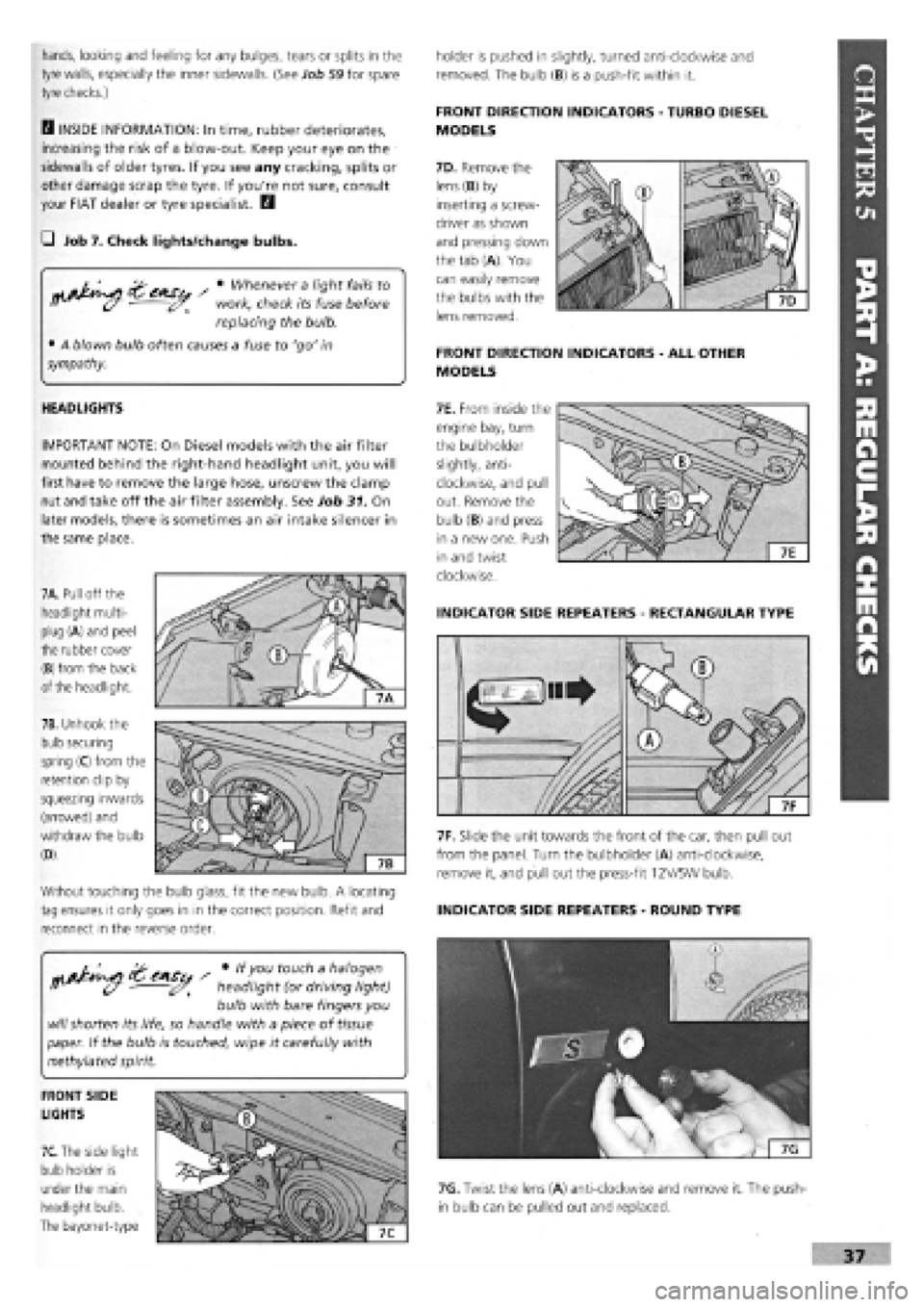
7A. Pull off the
headlight multi-
plug (A) and peel
the rubber cover
(B) from the back
of the headlight.
7B. Unhook the
bulb securing
spring (C) from the
retention clip by
squeezing inwards
(arrowed) and
withdraw the bulb
(D).
Without touching the bulb glass, fit the new bulb. A locating
tag ensures it only goes in in the correct position. Refit and
reconnect in the reverse order.
HEADLIGHTS
IMPORTANT NOTE: On Diesel models with the air filter
mounted behind the right-hand headlight unit, you will
first have to remove the large hose, unscrew the clamp
nut and take off the air filter assembly. See Job 31. On
later models, there is sometimes an air intake silencer in
the same place.
7F. Slide the unit towards the front of the car, then pull out
from the panel. Turn the bulbholder (A) anti-clockwise,
remove it, and pull out the press-fit 12V/5W bulb.
INDICATOR SIDE REPEATERS
-
ROUND TYPE
holder is pushed in slightly, turned anti-clockwise and
removed. The bulb (B) is a push-fit within it.
FRONT DIRECTION INDICATORS
-
TURBO DIESEL
MODELS
7D. Remove the
lens (B) by
inserting a screw-
driver as shown
and pressing down
the tab (A). You
can easily remove
the bulbs with the
lens removed.
FRONT DIRECTION INDICATORS
-
ALL OTHER
MODELS
7E. From inside the
engine bay, turn
the bulbholder
slightly, anti-
clockwise, and pull
out. Remove the
bulb (B) and press
in a new one. Push
in and twist
clockwise.
INDICATOR SIDE REPEATERS
-
RECTANGULAR TYPE
CAS / * touc^ a halogen
• headlight (or driving light)
bulb with bare fingers you
will
shorten its life, so handle with a piece of
tissue
paper. If the bulb is touched, wipe it carefully with
methylated spirit.
FRONT SIDE
LIGHTS
7C.
The side light
bulb holder is
under the main
headlight bulb.
The bayonet-type
7G. Twist the lens (A) anti-clockwise and remove it. The push-
in bulb can be pulled out and replaced.
Page 34 of 171
ruvj
uivjh I
uuluj
^ Use a magnetic screw-
driver or place some thick
grease on the end of the
screwdriver to prevent the screws from falling
-
especially when replacing the lens.
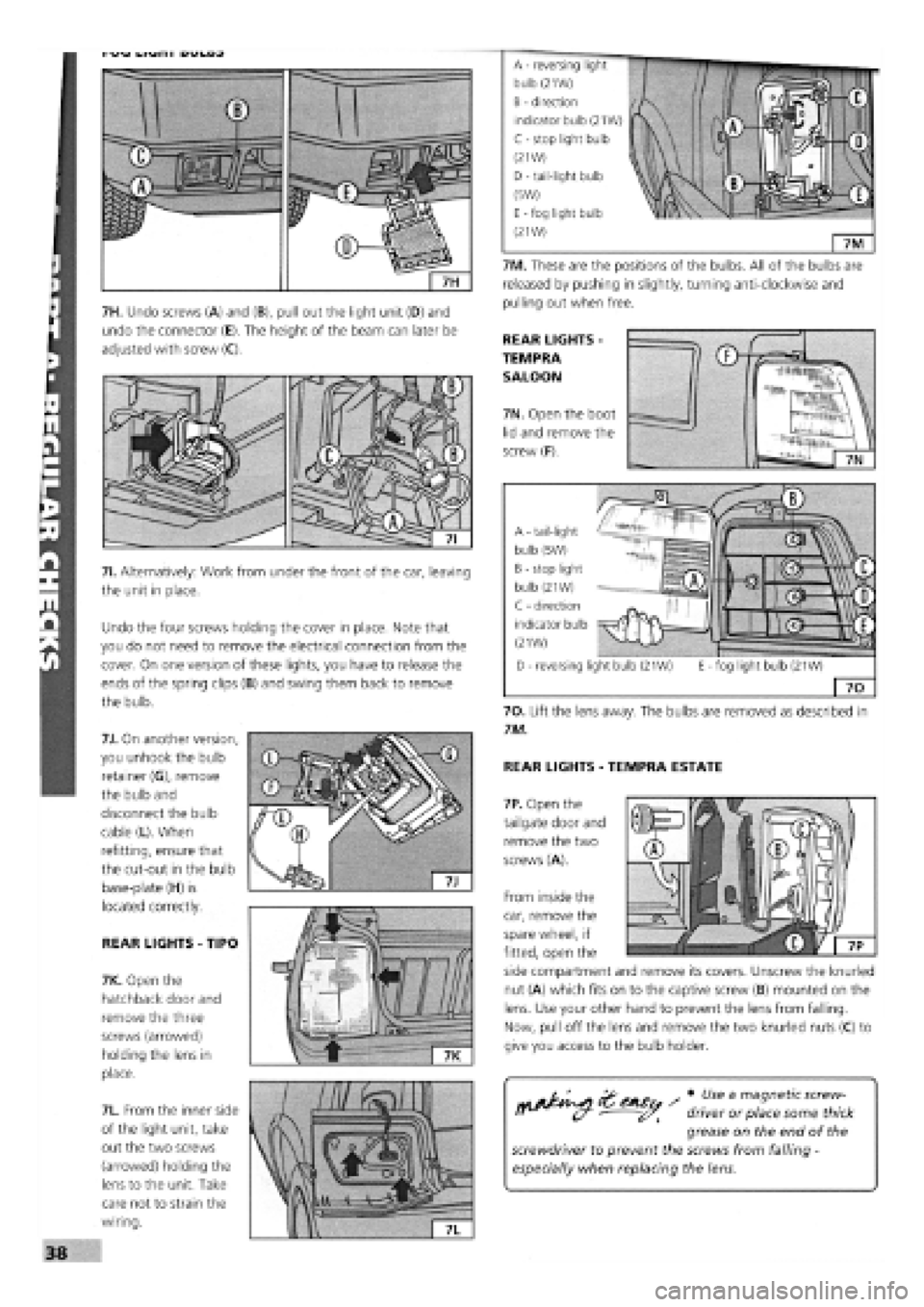
7H. Undo screws (A) and (B), pull out the light unit (D) and
undo the connector (E). The height of the beam can later be
adjusted with screw (C).
71. Alternatively: Work from under the front of the car, leaving
the unit in place.
Undo the four screws holding the cover in place. Note that
you do not need to remove the electrical connection from the
cover. On one version of these lights, you have to release the
ends of the spring clips (B) and swing them back to remove
the bulb.
7J. On another version,
you unhook the bulb
retainer (G), remove
the bulb and
disconnect the bulb
cable (L). When
refitting, ensure that
the cut-out in the bulb
base-plate (H) is
located correctly.
REAR LIGHTS
-
TIPO
7K. Open the
hatchback door and
remove the three
screws (arrowed)
holding the lens in
place.
7L. From the inner side
of the light unit, take
out the two screws
(arrowed) holding the
lens to the unit. Take
care not to strain the
wiring.
7M. These are the positions of the bulbs. All of the bulbs are
released by pushing in slightly, turning anti-clockwise and
pulling out when free.
REAR LIGHTS -
TEMPRA
SALOON
7N. Open the boot
lid and remove the
screw (F).
-fog light bulb (21W)
70
70. Lift the lens away. The bulbs are removed as described in
7M.
REAR LIGHTS
-
TEMPRA ESTATE
7P. Open the
tailgate door and
remove the two
screws (A).
From inside the
car, remove the
spare wheel, if
fitted, open the
side compartment and remove its covers. Unscrew the knurled
nut (A) which fits on to the captive screw (B) mounted on the
lens. Use your other hand to prevent the lens from falling.
Now, pull off the lens and remove the two knurled nuts (C) to
give you access to the bulb holder.
A - tail-light
bulb (5W)
B - stop light
bulb (21W)
C - direction
indicator bulb
(21W)
D - reversing light bulb (21W) E
A - reversing
bulb (21W)
B - direction
indicator bulb (21W)
C - stop light bulb
(21W)
D
-
tail-light bulb
(5W)
E - fog light bulb
(21W)
Page 35 of 171
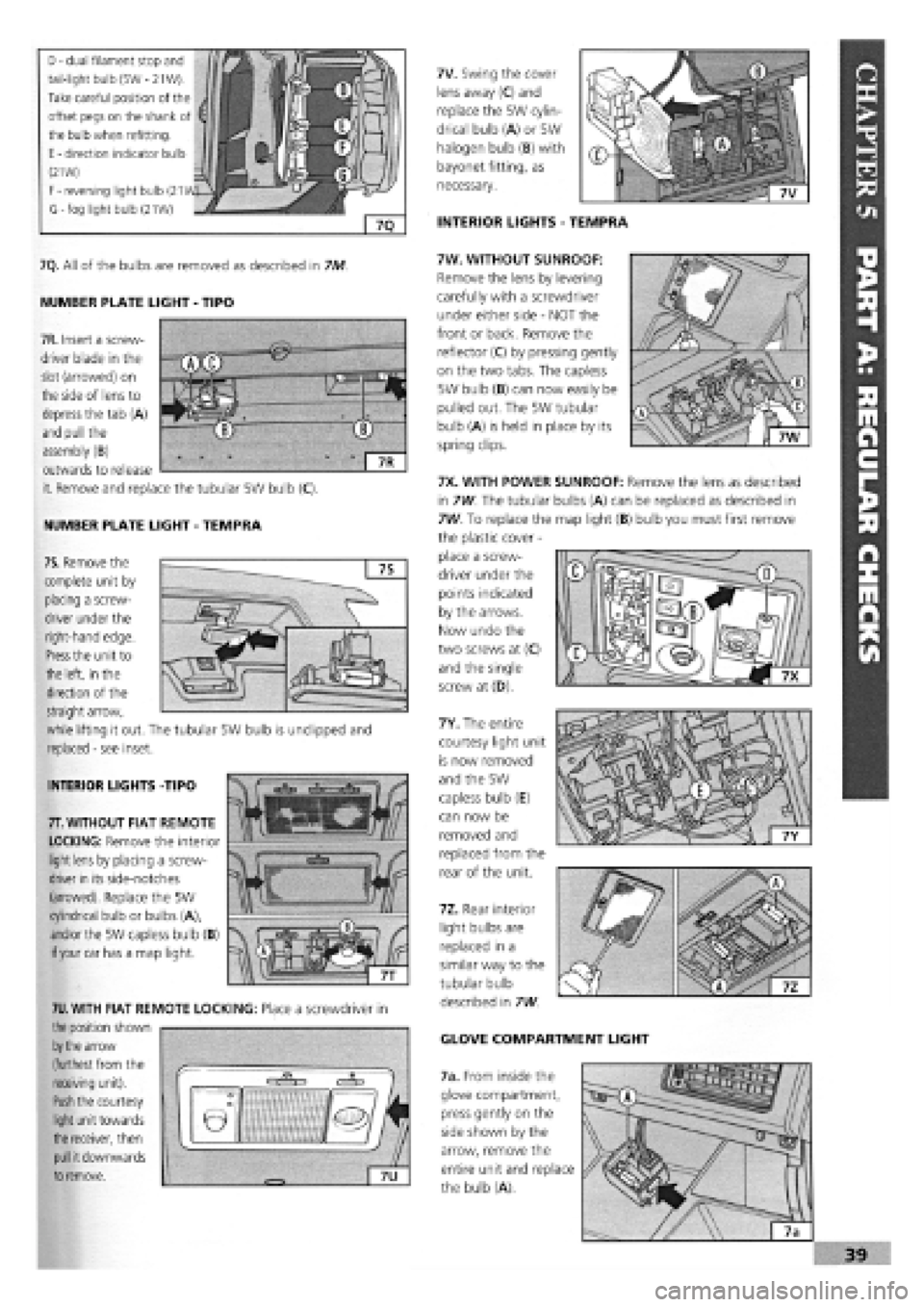
D
-
dual filament stop and
tail-light bulb (5W
-
21W).
Take careful position of the
offset pegs on the shank of
the bulb when refitting.
E
-
direction indicator bulb
(21W)
F
-
reversing light bulb (21
G-fog light bulb (21W)
7V. Swing the cover
lens away (C) and
replace the 5W cylin-
drical bulb (A) or 5W
halogen bulb (B) with
bayonet fitting, as
necessary.
INTERIOR LIGHTS
-
TEMPRA
7Q. All of the bulbs are removed as described in 7M
NUMBER PLATE LIGHT
-
TIPO
NUMBER PLATE LIGHT
-
TEMPRA
7W. WITHOUT SUNROOF:
Remove the lens by levering
carefully with a screwdriver
under either side
-
NOT the
front or back. Remove the
reflector (C) by pressing gently
on the two tabs. The capless
5W bulb (B) can now easily be
pulled out. The 5W tubular
bulb (A) is held in place by its
spring clips.
7X. WITH POWER SUNROOF: Remove the lens as described
in 7W. The tubular bulbs (A) can be replaced as described in
7W. To replace the map light (B) bulb you must first remove
the plastic cover
-
place a screw-
driver under the
points indicated
by the arrows.
Now undo the
two screws at (C)
and the single
screw at (D).
7Y. The entire
courtesy light unit
is now removed
and the 5W
capless bulb (E)
can now be
removed and
replaced from the
rear of the unit.
7Z. Rear interior
light bulbs are
replaced in a
similar way to the
tubular bulb
described in 7W
GLOVE COMPARTMENT LIGHT
7a. From inside the
glove compartment,
press gently on the
side shown by the
arrow, remove the
entire unit and replace
the bulb (A).
INTERIOR LIGHTS -TIPO
7T.
WITHOUT FIAT REMOTE
LOCKING: Remove the interior
light
lens
by placing a screw-
driver
in
its side-notches
(arrowed). Replace the 5W
cylindrical bulb or bulbs (A),
and/or
the 5W capless bulb (B)
if your
car has a map light.
7U.
WITH FIAT REMOTE LOCKING: Place a screwdriver in
the position shown
by the
arrow
(furthest
from
the
receiving unit).
Push
the courtesy
light
unit towards
the receiver, then
pull
it downwards
to
remove.
7R. Insert a screw-
driver blade in the
slot (arrowed) on
the side of lens to
depress the tab (A)
and pull the
assembly (B)
outwards to release
it. Remove and replace the tubular 5W bulb (C).
7S. Remove the
complete unit by
placing a screw-
driver under the
right-hand edge.
Press
the unit to
the left, in the
direction of the
straight arrow,
while lifting it out. The tubular 5W bulb is undipped and
replaced
-
see inset.
Page 36 of 171
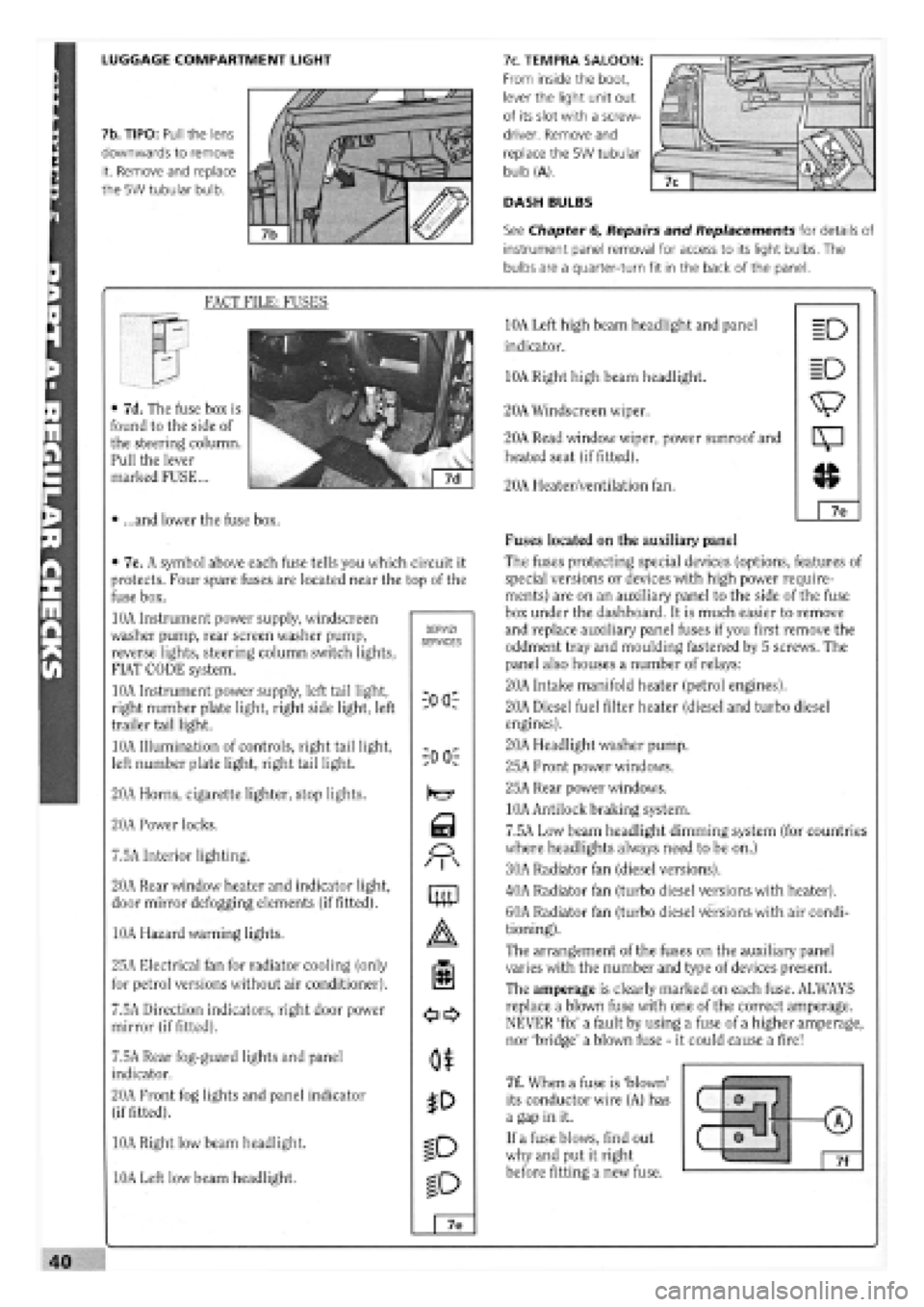
LUGGAGE COMPARTMENT LIGHT
7b. TIPO: Pull the lens
downwards to remove
it. Remove and replace
the 5W tubular bulb.
7c. TEMPRA SALOON:
From inside the boot,
lever the light unit out
of its slot with a screw-
driver. Remove and
replace the 5W tubular
bulb (A).
DASH BULBS
See Chapter 6, Repairs and Replacements for details of
instrument panel removal for access to its light bulbs. The
bulbs are a quarter-turn fit in the back of the panel.
FACT FILE: FUSES
• 7d. The fuse box is
found to the side of
the steering column.
Pull the lever
marked FUSE...
• ...and lower the fuse box.
• 7e. A symbol above each fuse tells you which circuit it
protects. Four spare fuses are located near the top of the
fuse box.
10A Instrument power supply, windscreen
washer pump, rear screen washer pump,
reverse lights, steering column switch lights,
FIAT CODE system.
10A Instrument power supply, left tail light,
right number plate light, right side light, left
trailer tail light.
10A Illumination of controls, right tail light,
left number plate light, right tail light.
20A Horns, cigarette lighter, stop lights.
20A Power locks.
7.5A Interior lighting.
20A Rear window heater and indicator light,
door mirror defogging elements (if fitted).
10A Hazard warning lights.
25A Electrical fan for radiator cooling (only
for petrol versions without air conditioner).
7.5A Direction indicators, right door power
mirror (if fitted).
7.5A Rear fog-guard lights and panel
indicator.
20A Front fog lights and panel indicator
(if fitted).
10A Right low beam headlight.
10A Left low beam headlight.
SERVIZI SERVICES
iOO:
-00 r
Q
M
mp
o$
ID
ID
7e
10A Left high beam headlight and panel
indicator.
10A Right high beam headlight.
20A Windscreen wiper.
20A Read window wiper, power sunroof and
heated seat (if fitted).
20A Heater/ventilation fan.
Fuses located on the auxiliary panel
The fuses protecting special devices (options, features of
special versions or devices with high power require-
ments) are on an auxiliary panel to the side of the fuse
box under the dashboard. It is much easier to remove
and replace auxiliary panel fuses if you first remove the
oddment tray and moulding fastened by 5 screws. The
panel also houses a number of relays:
20A Intake manifold heater (petrol engines).
20A Diesel fuel filter heater (diesel and turbo diesel
engines).
20A Headlight washer pump.
25A Front power windows.
25A Rear power windows.
10A Antilock braking system.
7.5A Low beam headlight dimming system (for countries
where headlights always need to be on.)
30A Radiator fan (diesel versions).
40A Radiator fan (turbo diesel versions with heater).
60A Radiator fan (turbo diesel versions with air condi-
tioning).
The arrangement of the fuses on the auxiliary panel
varies with the number and type of devices present.
The amperage is clearly marked on each fuse. ALWAYS
replace a blown fuse with one of the correct amperage.
NEVER 'fix' a fault by using a fuse of a higher amperage,
nor 'bridge' a blown fuse
-
it could cause a fire!
7f. When a fuse is 'blown'
its conductor wire (A) has
a gap in it.
If a fuse blows, find out
why and put it right
before fitting a new fuse.
(7)
o m f (7) (7)
0 tJ 7f