light FIAT TEMPRA 1988 Service And Owner's Manual
[x] Cancel search | Manufacturer: FIAT, Model Year: 1988, Model line: TEMPRA, Model: FIAT TEMPRA 1988Pages: 171, PDF Size: 18.05 MB
Page 33 of 171
• Whenever a light fails to
work, check its fuse before
replacing the bulb.
• A blown bulb often causes a fuse to 'go' in
sympathy.
hands, looking and feeling for any bulges, tears or splits in the
tyre walls, especially the inner sidewalls. (See Job 59 for spare
tyre checks.)
H INSIDE INFORMATION: In time, rubber deteriorates,
increasing the risk of a blow-out. Keep your eye on the
sidewalls of older tyres. If you see any cracking, splits or
other damage scrap the tyre. If you're not sure, consult
your FIAT dealer or tyre specialist. Q
_) Job 7. Check lights/change bulbs.
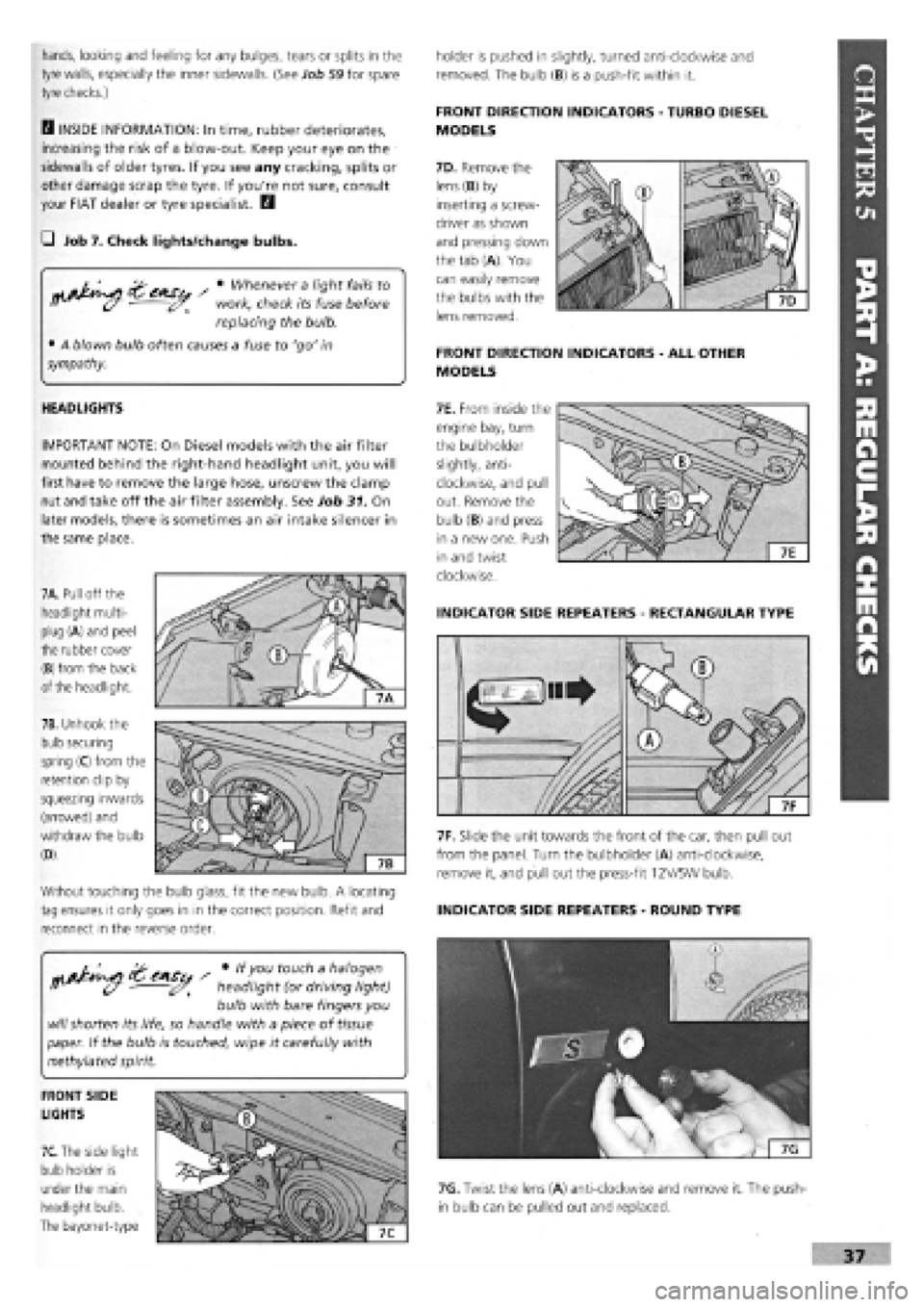
7A. Pull off the
headlight multi-
plug (A) and peel
the rubber cover
(B) from the back
of the headlight.
7B. Unhook the
bulb securing
spring (C) from the
retention clip by
squeezing inwards
(arrowed) and
withdraw the bulb
(D).
Without touching the bulb glass, fit the new bulb. A locating
tag ensures it only goes in in the correct position. Refit and
reconnect in the reverse order.
HEADLIGHTS
IMPORTANT NOTE: On Diesel models with the air filter
mounted behind the right-hand headlight unit, you will
first have to remove the large hose, unscrew the clamp
nut and take off the air filter assembly. See Job 31. On
later models, there is sometimes an air intake silencer in
the same place.
7F. Slide the unit towards the front of the car, then pull out
from the panel. Turn the bulbholder (A) anti-clockwise,
remove it, and pull out the press-fit 12V/5W bulb.
INDICATOR SIDE REPEATERS
-
ROUND TYPE
holder is pushed in slightly, turned anti-clockwise and
removed. The bulb (B) is a push-fit within it.
FRONT DIRECTION INDICATORS
-
TURBO DIESEL
MODELS
7D. Remove the
lens (B) by
inserting a screw-
driver as shown
and pressing down
the tab (A). You
can easily remove
the bulbs with the
lens removed.
FRONT DIRECTION INDICATORS
-
ALL OTHER
MODELS
7E. From inside the
engine bay, turn
the bulbholder
slightly, anti-
clockwise, and pull
out. Remove the
bulb (B) and press
in a new one. Push
in and twist
clockwise.
INDICATOR SIDE REPEATERS
-
RECTANGULAR TYPE
CAS / * touc^ a halogen
• headlight (or driving light)
bulb with bare fingers you
will
shorten its life, so handle with a piece of
tissue
paper. If the bulb is touched, wipe it carefully with
methylated spirit.
FRONT SIDE
LIGHTS
7C.
The side light
bulb holder is
under the main
headlight bulb.
The bayonet-type
7G. Twist the lens (A) anti-clockwise and remove it. The push-
in bulb can be pulled out and replaced.
Page 34 of 171
ruvj
uivjh I
uuluj
^ Use a magnetic screw-
driver or place some thick
grease on the end of the
screwdriver to prevent the screws from falling
-
especially when replacing the lens.
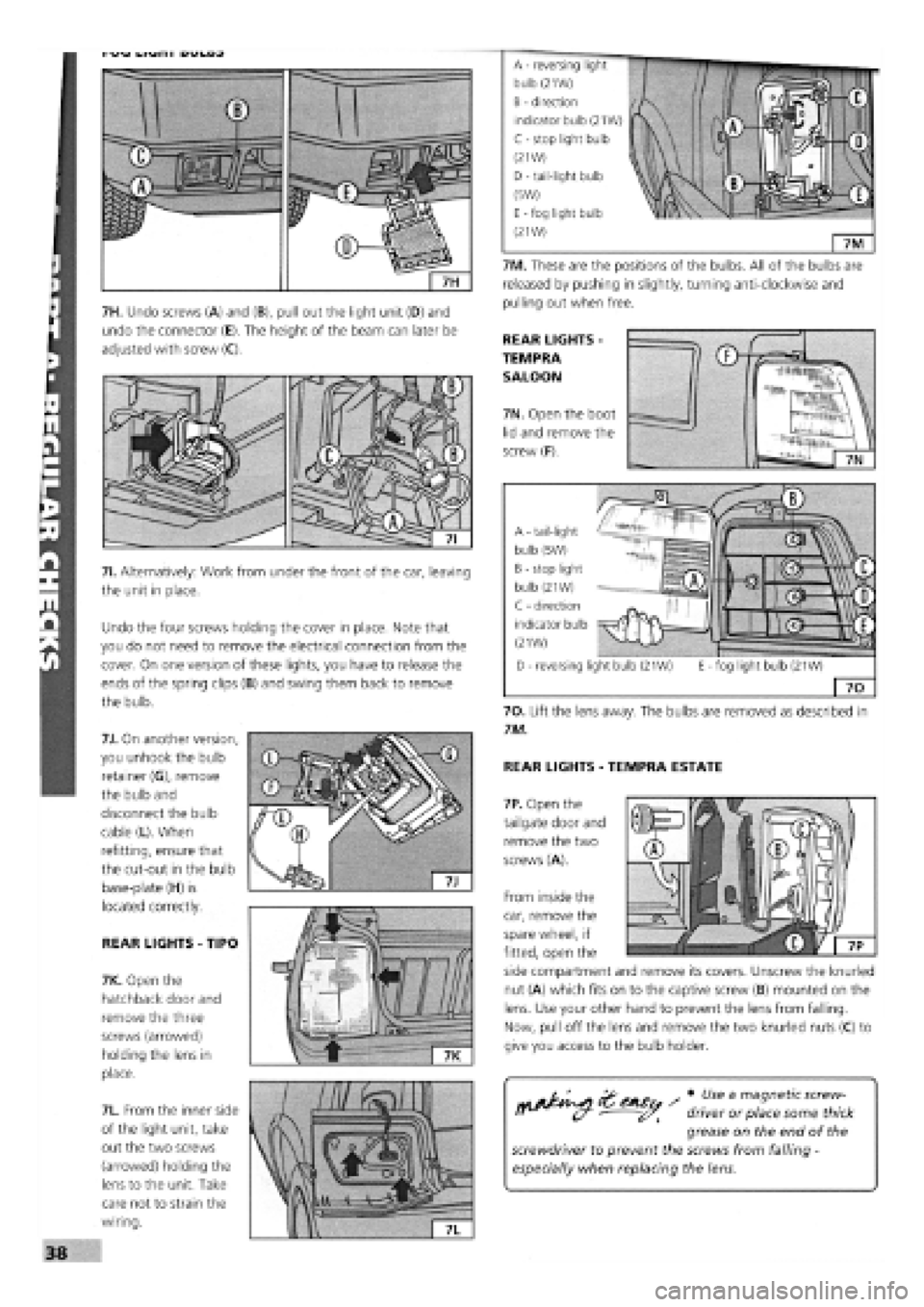
7H. Undo screws (A) and (B), pull out the light unit (D) and
undo the connector (E). The height of the beam can later be
adjusted with screw (C).
71. Alternatively: Work from under the front of the car, leaving
the unit in place.
Undo the four screws holding the cover in place. Note that
you do not need to remove the electrical connection from the
cover. On one version of these lights, you have to release the
ends of the spring clips (B) and swing them back to remove
the bulb.
7J. On another version,
you unhook the bulb
retainer (G), remove
the bulb and
disconnect the bulb
cable (L). When
refitting, ensure that
the cut-out in the bulb
base-plate (H) is
located correctly.
REAR LIGHTS
-
TIPO
7K. Open the
hatchback door and
remove the three
screws (arrowed)
holding the lens in
place.
7L. From the inner side
of the light unit, take
out the two screws
(arrowed) holding the
lens to the unit. Take
care not to strain the
wiring.
7M. These are the positions of the bulbs. All of the bulbs are
released by pushing in slightly, turning anti-clockwise and
pulling out when free.
REAR LIGHTS -
TEMPRA
SALOON
7N. Open the boot
lid and remove the
screw (F).
-fog light bulb (21W)
70
70. Lift the lens away. The bulbs are removed as described in
7M.
REAR LIGHTS
-
TEMPRA ESTATE
7P. Open the
tailgate door and
remove the two
screws (A).
From inside the
car, remove the
spare wheel, if
fitted, open the
side compartment and remove its covers. Unscrew the knurled
nut (A) which fits on to the captive screw (B) mounted on the
lens. Use your other hand to prevent the lens from falling.
Now, pull off the lens and remove the two knurled nuts (C) to
give you access to the bulb holder.
A - tail-light
bulb (5W)
B - stop light
bulb (21W)
C - direction
indicator bulb
(21W)
D - reversing light bulb (21W) E
A - reversing
bulb (21W)
B - direction
indicator bulb (21W)
C - stop light bulb
(21W)
D
-
tail-light bulb
(5W)
E - fog light bulb
(21W)
Page 35 of 171
D
-
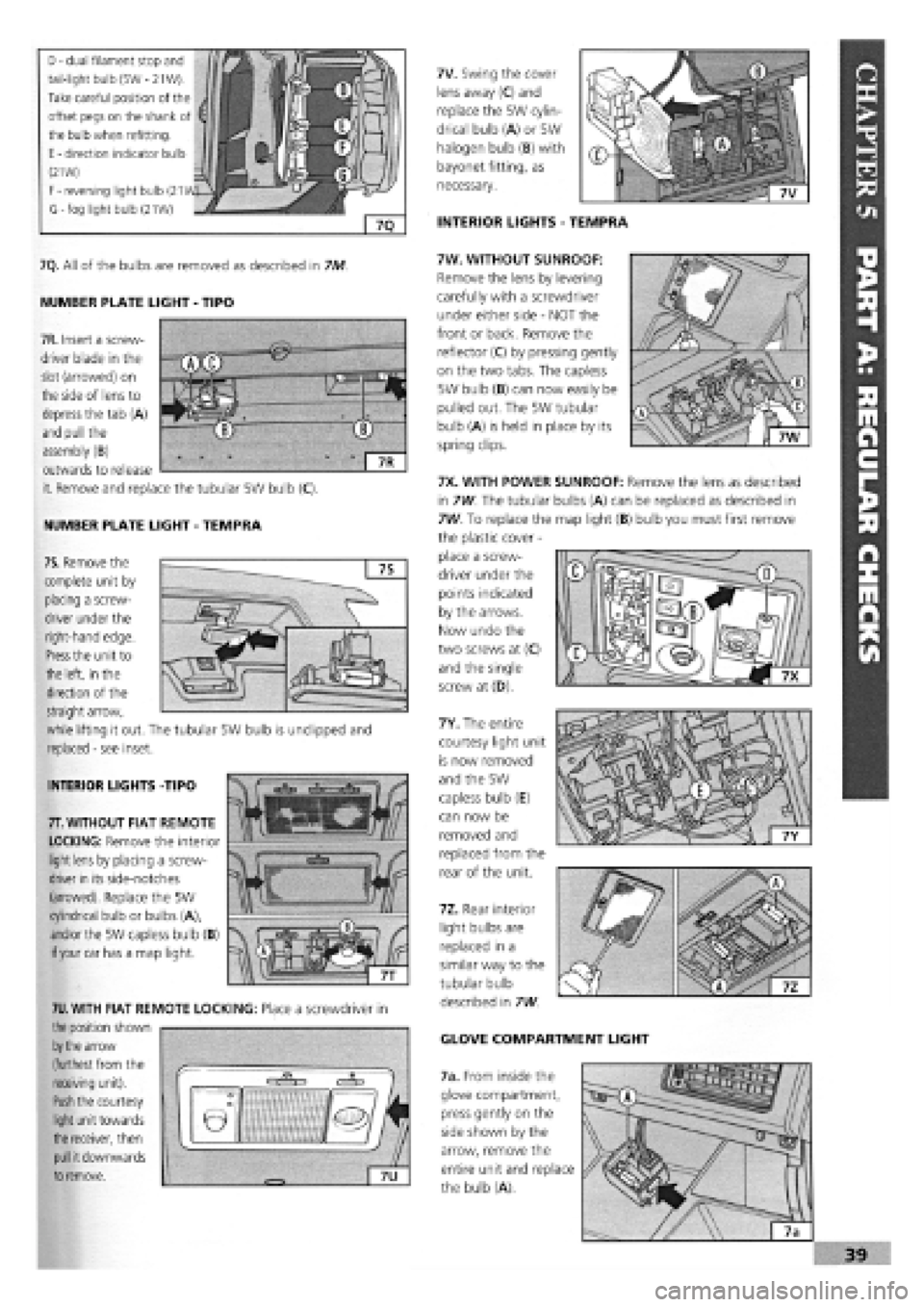
dual filament stop and
tail-light bulb (5W
-
21W).
Take careful position of the
offset pegs on the shank of
the bulb when refitting.
E
-
direction indicator bulb
(21W)
F
-
reversing light bulb (21
G-fog light bulb (21W)
7V. Swing the cover
lens away (C) and
replace the 5W cylin-
drical bulb (A) or 5W
halogen bulb (B) with
bayonet fitting, as
necessary.
INTERIOR LIGHTS
-
TEMPRA
7Q. All of the bulbs are removed as described in 7M
NUMBER PLATE LIGHT
-
TIPO
NUMBER PLATE LIGHT
-
TEMPRA
7W. WITHOUT SUNROOF:
Remove the lens by levering
carefully with a screwdriver
under either side
-
NOT the
front or back. Remove the
reflector (C) by pressing gently
on the two tabs. The capless
5W bulb (B) can now easily be
pulled out. The 5W tubular
bulb (A) is held in place by its
spring clips.
7X. WITH POWER SUNROOF: Remove the lens as described
in 7W. The tubular bulbs (A) can be replaced as described in
7W. To replace the map light (B) bulb you must first remove
the plastic cover
-
place a screw-
driver under the
points indicated
by the arrows.
Now undo the
two screws at (C)
and the single
screw at (D).
7Y. The entire
courtesy light unit
is now removed
and the 5W
capless bulb (E)
can now be
removed and
replaced from the
rear of the unit.
7Z. Rear interior
light bulbs are
replaced in a
similar way to the
tubular bulb
described in 7W
GLOVE COMPARTMENT LIGHT
7a. From inside the
glove compartment,
press gently on the
side shown by the
arrow, remove the
entire unit and replace
the bulb (A).
INTERIOR LIGHTS -TIPO
7T.
WITHOUT FIAT REMOTE
LOCKING: Remove the interior
light
lens
by placing a screw-
driver
in
its side-notches
(arrowed). Replace the 5W
cylindrical bulb or bulbs (A),
and/or
the 5W capless bulb (B)
if your
car has a map light.
7U.
WITH FIAT REMOTE LOCKING: Place a screwdriver in
the position shown
by the
arrow
(furthest
from
the
receiving unit).
Push
the courtesy
light
unit towards
the receiver, then
pull
it downwards
to
remove.
7R. Insert a screw-
driver blade in the
slot (arrowed) on
the side of lens to
depress the tab (A)
and pull the
assembly (B)
outwards to release
it. Remove and replace the tubular 5W bulb (C).
7S. Remove the
complete unit by
placing a screw-
driver under the
right-hand edge.
Press
the unit to
the left, in the
direction of the
straight arrow,
while lifting it out. The tubular 5W bulb is undipped and
replaced
-
see inset.
Page 36 of 171
LUGGAGE COMPARTMENT LIGHT
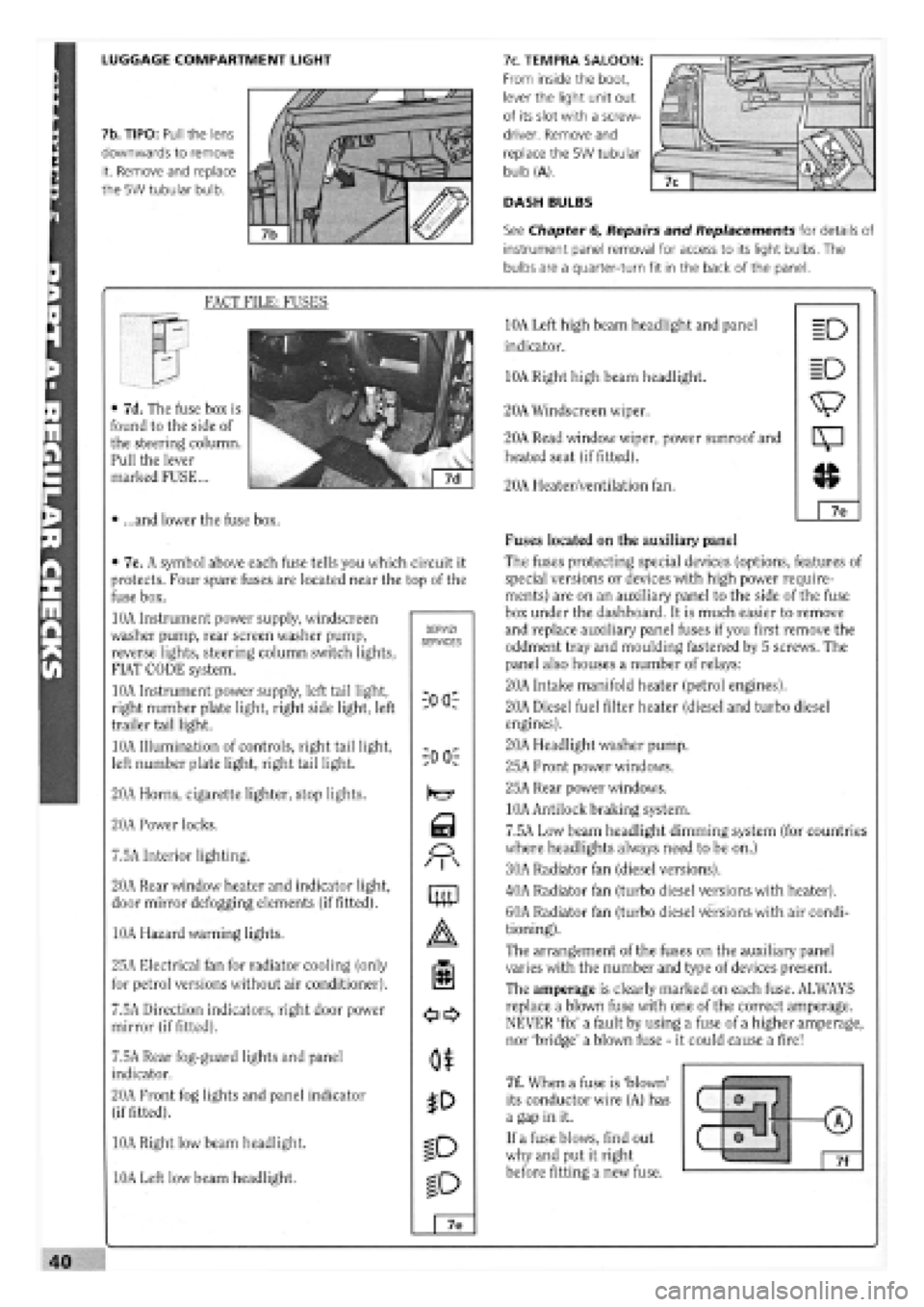
7b. TIPO: Pull the lens
downwards to remove
it. Remove and replace
the 5W tubular bulb.
7c. TEMPRA SALOON:
From inside the boot,
lever the light unit out
of its slot with a screw-
driver. Remove and
replace the 5W tubular
bulb (A).
DASH BULBS
See Chapter 6, Repairs and Replacements for details of
instrument panel removal for access to its light bulbs. The
bulbs are a quarter-turn fit in the back of the panel.
FACT FILE: FUSES
• 7d. The fuse box is
found to the side of
the steering column.
Pull the lever
marked FUSE...
• ...and lower the fuse box.
• 7e. A symbol above each fuse tells you which circuit it
protects. Four spare fuses are located near the top of the
fuse box.
10A Instrument power supply, windscreen
washer pump, rear screen washer pump,
reverse lights, steering column switch lights,
FIAT CODE system.
10A Instrument power supply, left tail light,
right number plate light, right side light, left
trailer tail light.
10A Illumination of controls, right tail light,
left number plate light, right tail light.
20A Horns, cigarette lighter, stop lights.
20A Power locks.
7.5A Interior lighting.
20A Rear window heater and indicator light,
door mirror defogging elements (if fitted).
10A Hazard warning lights.
25A Electrical fan for radiator cooling (only
for petrol versions without air conditioner).
7.5A Direction indicators, right door power
mirror (if fitted).
7.5A Rear fog-guard lights and panel
indicator.
20A Front fog lights and panel indicator
(if fitted).
10A Right low beam headlight.
10A Left low beam headlight.
SERVIZI SERVICES
iOO:
-00 r
Q
M
mp
o$
ID
ID
7e
10A Left high beam headlight and panel
indicator.
10A Right high beam headlight.
20A Windscreen wiper.
20A Read window wiper, power sunroof and
heated seat (if fitted).
20A Heater/ventilation fan.
Fuses located on the auxiliary panel
The fuses protecting special devices (options, features of
special versions or devices with high power require-
ments) are on an auxiliary panel to the side of the fuse
box under the dashboard. It is much easier to remove
and replace auxiliary panel fuses if you first remove the
oddment tray and moulding fastened by 5 screws. The
panel also houses a number of relays:
20A Intake manifold heater (petrol engines).
20A Diesel fuel filter heater (diesel and turbo diesel
engines).
20A Headlight washer pump.
25A Front power windows.
25A Rear power windows.
10A Antilock braking system.
7.5A Low beam headlight dimming system (for countries
where headlights always need to be on.)
30A Radiator fan (diesel versions).
40A Radiator fan (turbo diesel versions with heater).
60A Radiator fan (turbo diesel versions with air condi-
tioning).
The arrangement of the fuses on the auxiliary panel
varies with the number and type of devices present.
The amperage is clearly marked on each fuse. ALWAYS
replace a blown fuse with one of the correct amperage.
NEVER 'fix' a fault by using a fuse of a higher amperage,
nor 'bridge' a blown fuse
-
it could cause a fire!
7f. When a fuse is 'blown'
its conductor wire (A) has
a gap in it.
If a fuse blows, find out
why and put it right
before fitting a new fuse.
(7)
o m f (7) (7)
0 tJ 7f
Page 37 of 171
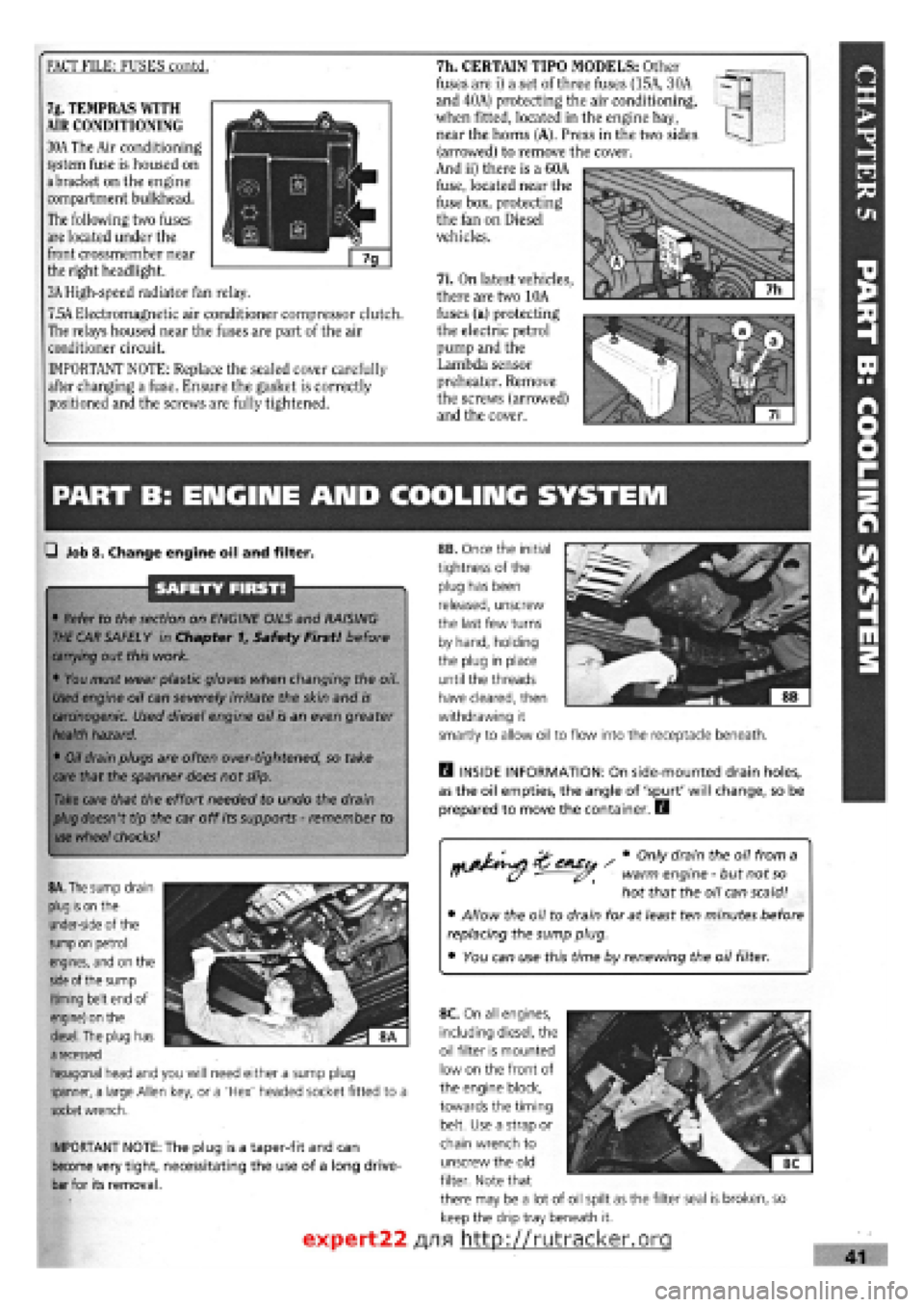
FACT FILE: FUSES contd. 7h. CERTAIN TIPO MODELS: Other
fuses are i) a set of three fuses (15A, 30A
and 40A) protecting the air conditioning,
when fitted, located in the engine bay,
near the horns (A). Press in the two sides
(arrowed) to remove the cover.
And ii) there is a 60A
fuse, located near the
fuse box, protecting
the fan on Diesel
vehicles.
7i. On latest vehicles,
there are two 10A
fuses (a) protecting
the electric petrol
pump and the
Lambda sensor
preheater. Remove
the screws (arrowed)
and the cover.
7g. TEMPRAS WITH
AIR CONDITIONING
30A The Air conditioning
system fuse is housed on
a bracket on the engine
compartment bulkhead.
The following two fuses
are located under the
front crossmember near
the right headlight.
3A High-speed radiator fan relay.
7.5A Electromagnetic air conditioner compressor clutch.
The relays housed near the fuses are part of the air
conditioner circuit.
IMPORTANT NOTE: Replace the sealed cover carefully
after changing a fuse. Ensure the gasket is correctly
positioned and the screws are fully tightened.
PART B: ENGIIME AND COOLING SYSTEM
Q Job 8. Change engine oil and filter.
SAFETY FIRST!
• Refer to the section on ENGINE OILS and RAISING
THE
CAR SAFELY in Chapter f, Safety First! before
carrying
out this work.
• You must wear plastic gloves when changing the oil.
Used
engine oil can severely irritate the skin and
is
carcinogenic.
Used diesel engine oil is an even greater
health
hazard.
•
Oil
drain plugs are often over-tightened, so take
care
that the spanner does not slip.
Take
care that the effort needed to undo the drain
plug
doesn't tip the car off its supports
-
remember to
use
wheel
chocks!
rtj&^si ' # °nly dram theu 0,7 fr°m a ff (y warm engine
-
but not
so
hot that the oil can scald!
• Allow the oil to drain for at least ten minutes before
replacing the sump plug.
• You can use this time by renewing the oil filter.
IMPORTANT NOTE: The plug is a taper-fit and can
become very tight, necessitating the use of a long drive-
bar for its removal.
H INSIDE INFORMATION: On side-mounted drain holes,
as the oil empties, the angle of 'spurt' will change, so be
prepared to move the container. E3
8A. The
sump drain
plug is on
the
under-side of the
sump on
petrol
engines, and on the
side
of the sump
(timing belt end of
engine) on the
diesel.
The plug has
a
recessed
hexagonal head and you will need either a sump plug
spanner, a large Allen key, or a 'Hex' headed socket fitted to a
socket
wrench.
8B. Once the initial
tightness of the
plug has been
released, unscrew
the last few turns
by hand, holding
the plug in place
until the threads
have cleared, then
withdrawing it
smartly to allow oil to flow into the receptacle beneath.
expert22
8C. On all engines,
including diesel, the
oil filter is mounted
low on the front of
the engine block,
towards the timing
belt. Use a strap or
chain wrench to
unscrew the old
filter. Note that
there may be a lot of oil spilt as the filter seal is broken, so
keep the drip tray beneath it.
/yifl http://rutracker.org
Page 38 of 171
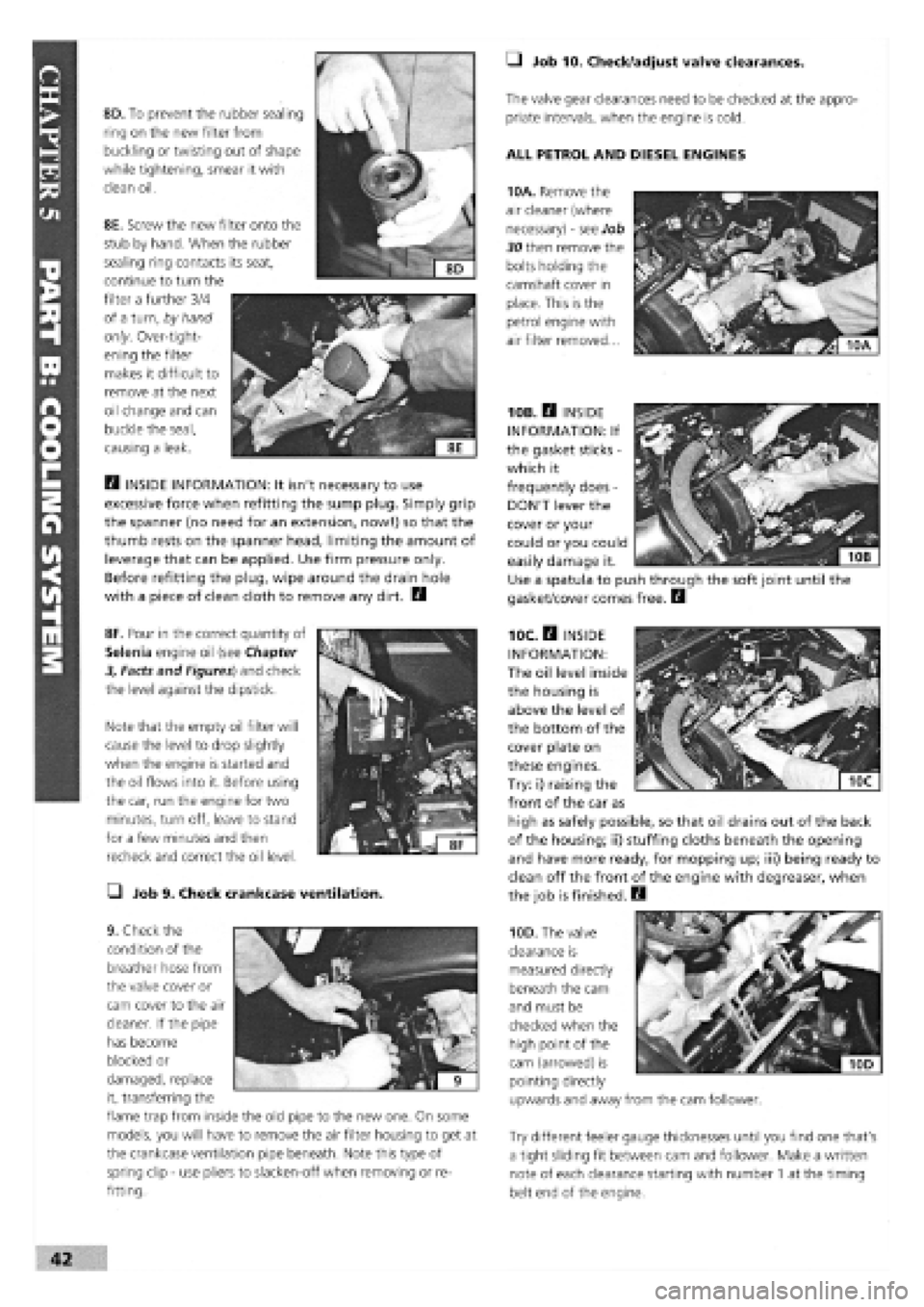
8D. To prevent the rubber sealing
ring on the new filter from
buckling or twisting out of shape
while tightening, smear it with
clean oil.
8E. Screw the new filter onto the
stub by hand. When the rubber
sealing ring contacts its seat,
continue to turn the
filter a further 3/4
of a turn, by hand
only. Over-tight-
ening the filter
makes it difficult to
remove at the next
oil change and can
buckle the seal,
causing a leak.
E3 INSIDE INFORMATION: It isn't necessary to use
excessive force when refitting the sump plug. Simply grip
the spanner (no need for an extension, now!) so that the
thumb rests on the spanner head, limiting the amount of
leverage that can be applied. Use firm pressure only.
Before refitting the plug, wipe around the drain hole
with a piece of clean cloth to remove any dirt. II
8F. Pour in the correct quantity of
Selenia engine oil (see Chapter
3, Facts and Figures) and check
the level against the dipstick.
Note that the empty oil filter will
cause the level to drop slightly
when the engine is started and
the oil flows into it. Before using
the car, run the engine for two
minutes, turn off, leave to stand
for a few minutes and then
recheck and correct the oil level.
• Job 9. Check crankcase ventilation.
10B. H INSIDE
INFORMATION: If
the gasket sticks
-
which it
frequently does -
DON'T lever the
Q Job 10. Check/adjust valve clearances.
The valve gear clearances need to be checked at the appro-
priate intervals, when the engine is cold.
ALL PETROL AND DIESEL ENGINES
10A. Remove the
air cleaner (where
necessary)
-
see Job
30 then remove the
bolts holding the
camshaft cover in
place. This is the
petrol engine with
air filter removed...
cover or your
could or you could
easily damage it.
Use a spatula to push through the soft joint until the
gasket/cover comes free. D
10C. E3 INSIDE
INFORMATION:
The oil level inside
the housing is
above the level of
the bottom of the
cover plate on
these engines.
Try: i) raising the
front of the car as
high as safely possible, so that oil drains out of the back
of the housing; ii) stuffing cloths beneath the opening
and have more ready, for mopping up; iii) being ready to
clean off the front of the engine with degreaser, when
the job is finished. D
10D. The valve
clearance is
measured directly
beneath the cam
and must be
checked when the
high point of the
cam (arrowed) is
pointing directly
upwards and away
9. Check the
condition of the
breather hose from
the valve cover or
cam cover to the air
cleaner. If the pipe
has become
blocked or
damaged, replace
it, transferring the
flame trap from inside the old pipe to the new one. On some
models, you will have to remove the air filter housing to get at
the crankcase ventilation pipe beneath. Note this type of
spring clip
-
use pliers to slacken-off when removing or re-
fitting.
Try different feeler gauge thicknesses until you find one that's
a tight sliding fit between cam and follower. Make a written
note of each clearance starting with number
1
at the timing
belt end of the engine.
from the cam follower.
Page 42 of 171
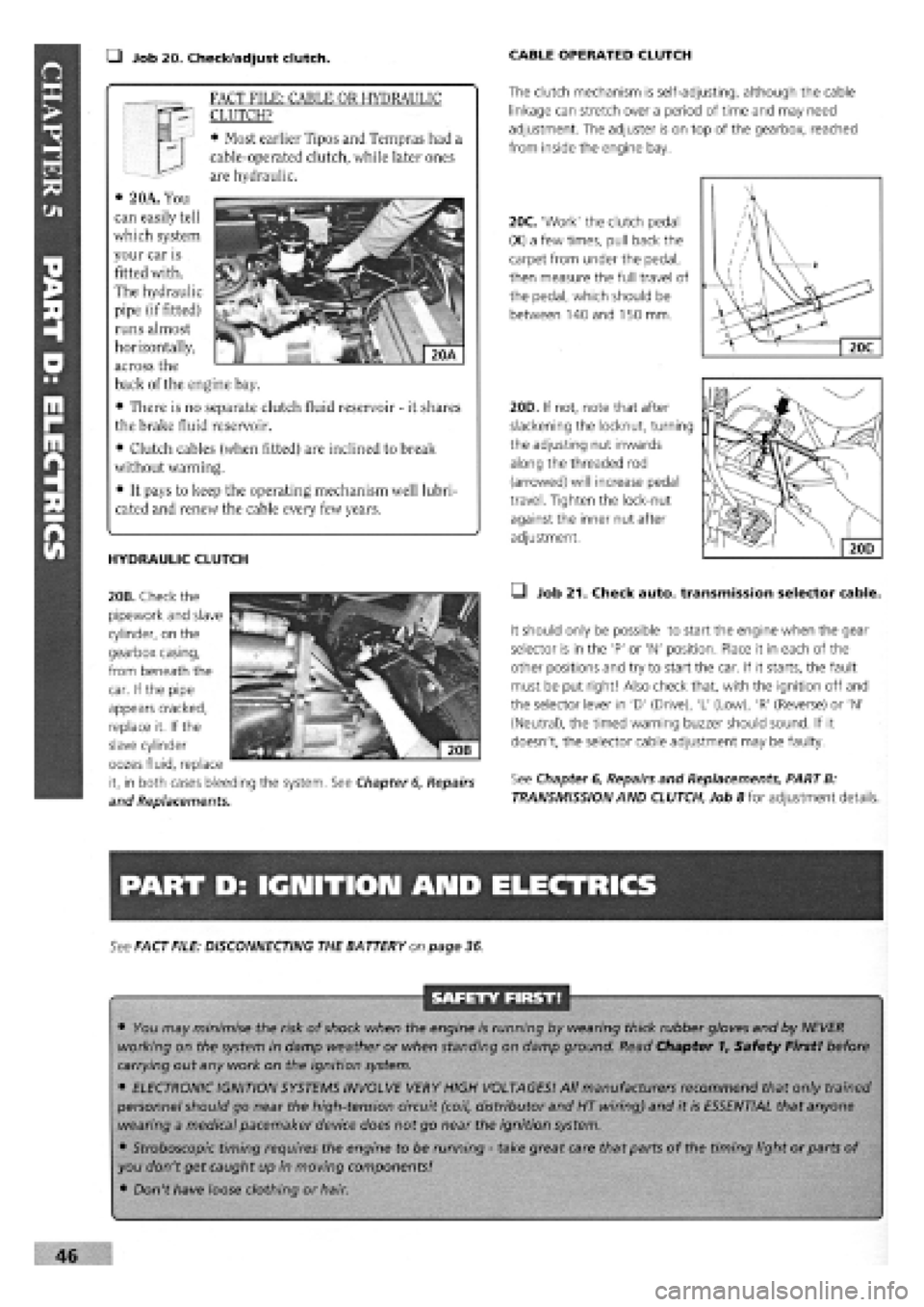
• Job 20. Check/adjust clutch. CABLE OPERATED CLUTCH
The clutch mechanism is self-adjusting, although the cable
linkage can stretch over a period of time and may need
adjustment. The adjuster is on top of the gearbox, reached
from inside the engine bay.
20C. 'Work' the clutch pedal
(X) a few times, pull back the
carpet from under the pedal,
then measure the full travel of
the pedal, which should be
between 140 and 150 mm.
/
\
/ \
/ u / Xl
1 ' ' / . V y 2
Jdi V 1 \
X. 1 —
20C
HYDRAULIC CLUTCH
20B. Check the
pipework and slave
cylinder, on the
gearbox casing,
from beneath the
20D. If not, note that after
slackening the locknut, turning
the adjusting nut inwards
along the threaded rod
(arrowed) will increase pedal
travel. Tighten the lock-nut
against the inner nut after
adjustment.
• Job 21. Check auto, transmission selector cable.
It should only be possible to start the engine when the gear
selector is in the 'P' or 'N' position. Place it in each of the
other positions and try to start the car. If it starts, the fault
must be put right! Also check that, with the ignition off and
the selector lever in 'D' (Drive), 'L' (Low), 'R' (Reverse) or 'N'
(Neutral), the timed warning buzzer should sound. If it
doesn't, the selector cable adjustment may be faulty.
See Chapter
6,
Repairs and Replacements, PART B:
TRANSMISSION AND CLUTCH, Job 8 for adjustment details.
PART D: IGNITION AND ELECTRICS
See FACT FILE: DISCONNECTING THE BATTERY on page 36
SAFETY FIRST!
• You may minimise the risk of shock when the engine is running by wearing thick rubber gloves and by NEVER
working on the system in damp weather or when standing on damp ground. Read Chapter 1, Safety First! before
carrying out any work on the ignition system.
• ELECTRONIC IGNITION SYSTEMS INVOLVE VERY HIGH VOLTAGES! All manufacturers recommend that only trained
personnel should go near the high-tension circuit (coil, distributor and HT wiring) and it is ESSENTIAL that anyone
wearing a medical pacemaker device does not go near the ignition system.
• Stroboscopic timing requires the engine to be running
-
take great care that parts of the timing light or parts of
you don't get caught up in moving components!
• Don't have loose clothing or hair.
46
FACT FILE: CABLE OR HYDRAULIC
CLUTCH?
• Most earlier Tipos and Tempras had a
cable-operated clutch, while later ones
are hydraulic.
• 2 OA. You
can easily tell
which system
your car is
fitted with.
The hydraulic
pipe (if fitted)
runs almost
horizontally,
across the
back of the engine bay.
• There is no separate clutch fluid reservoir
-
it shares
the brake fluid reservoir.
• Clutch cables (when fitted) are inclined to break
without warning.
• It pays to keep the operating mechanism well lubri-
cated and renew the cable every few years.
car. If the pipe
appears cracked,
replace it. If the
slave cylinder
oozes fluid, replace
it, in both cases bleeding the system. See Chapter
6,
Repairs
and Replacements.
Page 43 of 171
J Job 22. Check/clean/gap spark plugs. Q Job 23. Change spark plugs.
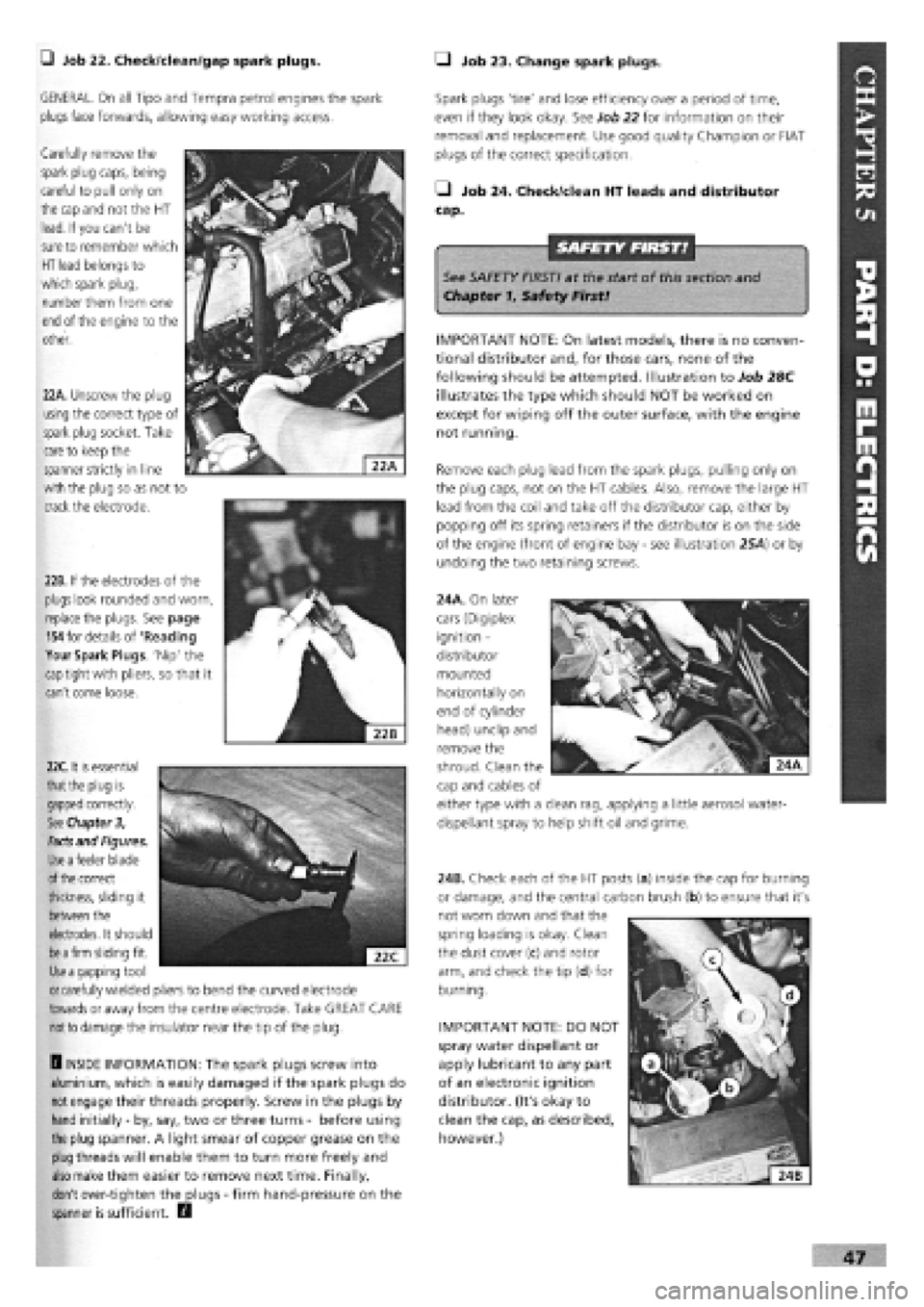
GENERAL. On all Tipo and Tempra petrol engines the spark
plugs
face forwards, allowing easy working access.
Carefully remove the
spark plug caps, being
careful to pull only on
the cap and
not the HT
lead. If you can't be
sure
to remember which
HT lead
belongs to
which spark plug,
number them from one
end
of the engine to the
other.
22B. If the electrodes of the
plugs look rounded and worn,
replace
the plugs. See page
154
for details of 'Reading
Your Spark Plugs. Nip' the
cap
tight with pliers, so that it
can't come loose.
Spark plugs 'tire' and lose efficiency over a period of time,
even if they look okay. See Job 22 for information on their
removal and replacement. Use good quality Champion or FIAT
plugs of the correct specification.
• Job 24. Check/dean HT leads and distributor
cap.
See SAFETY FIRST! at the start of this section and
Chapter 1, Safety First!
IMPORTANT NOTE: On latest models, there is no conven-
tional distributor and, for those cars, none of the
following should be attempted. Illustration to Job 28C
illustrates the type which should NOT be worked on
except for wiping off the outer surface, with the engine
not running.
Remove each plug lead from the spark plugs, pulling only on
the plug caps, not on the HT cables. Also, remove the large HT
lead from the coil and take off the distributor cap, either by
popping off its spring retainers if the distributor is on the side
of the engine (front of engine bay
-
see illustration 25A) or by
undoing the two retaining screws.
24A. On later
cars (Digiplex
ignition -
distributor
mounted
horizontally on
end of cylinder
head) unclip and
remove the
22A. Unscrew the plug
using
the correct type of
spark plug socket. Take
care
to keep the
spanner strictly in line
with the plug so as not to
crack the electrode.
22C.
it
is
essential
that the
plug is
gapped
correctly.
See Chapter 3,
Facts
and Figures.
Use a
feeler blade
of the
correct
thickness, sliding it
between
the
electrodes. It should
be a firm
sliding fit.
Use a
gapping tool
or
carefully wielded pliers to bend the curved electrode
towards
or away from the centre electrode. Take GREAT CARE
not to
damage the insulator near the tip of the plug.
H INSIDE INFORMATION: The spark plugs screw into
aluminium, which is easily damaged if the spark plugs do
not
engage their threads properly. Screw in the plugs by
hand initially
-
by, say, two or three turns
-
before using
the plug spanner. A light smear of copper grease on the
plug
threads will enable them to turn more freely and
also
make them easier to remove next time. Finally,
don't over-tighten the plugs
-
firm hand-pressure on the
spanner is sufficient. D
IMPORTANT NOTE: DO NOT
spray water dispellant or
apply lubricant to any part
of an electronic ignition
distributor. (It's okay to
clean the cap, as described,
however.)
shroud. Clean the
cap and cables of
either type with a clean rag, applying a little aerosol water-
dispellant spray to help shift oil and grime.
24B. Check each of the HT posts (a) inside the cap for burning
or damage, and the central carbon brush (b) to ensure that it's
not worn down and that the
spring loading is okay. Clean
the dust cover (c) and rotor
arm, and check the tip (d) for
burning.
Page 44 of 171
• Job 25. Check ignition timing.
_ FACT FILE: IGNITION SYSTEM TYPES
Two different types of electronic ignition
systems have been fitted to the petrol
engines covered by this manual.
The earlier Breakerless Inductive Discharge System can
be adjusted. Its distributor is fitted as shown in illus-
tration 25A.
The later, Digiplex 2 system, has an integrated ignition
and fuel injection control system and any checks and
adjustments will need to be carried out by your FIAT
dealership with the appropriate diagnostic equipment.
See Job 28.
MAGNETI MARELLI BREAKERLESS INDUCTIVE
DISCHARGE IGNITION SYSTEM
CHECK VACUUM AND MECHANICAL ADVANCE SYSTEMS
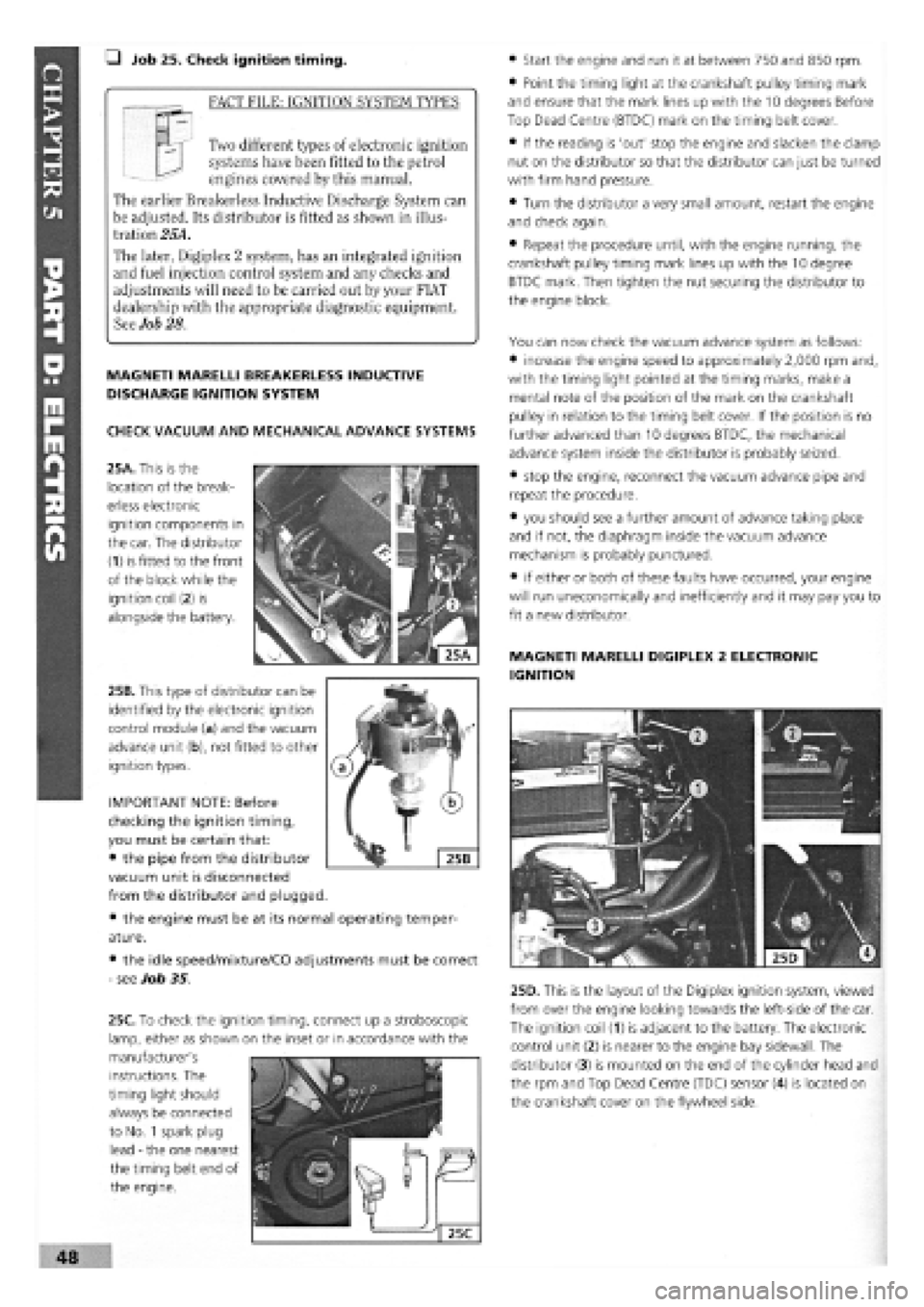
25A. This is the
location of the break-
erless electronic
ignition components in
the car. The distributor
(1) is fitted to the front
of the block while the
ignition coil
(2)
is
alongside the battery.
25B. This type of distributor can be
identified by the electronic ignition
control module (a) and the vacuum
advance unit (b), not fitted to other
ignition types.
• the engine must be at
ature.
• the idle speed/mixture/CO adjustments must be correct
-
see Job 35.
• Start the engine and run it at between 750 and 850 rpm.
• Point the timing light at the crankshaft pulley timing mark
and ensure that the mark lines up with the 10 degrees Before
Top Dead Centre (BTDC) mark on the timing belt cover.
• If the reading is 'out' stop the engine and slacken the clamp
nut on the distributor so that the distributor can just be turned
with firm hand pressure.
• Turn the distributor a very small amount, restart the engine
and check again.
• Repeat the procedure until, with the engine running, the
crankshaft pulley timing mark lines up with the 10 degree
BTDC mark. Then tighten the nut securing the distributor to
the engine block.
You can now check the vacuum advance system as follows:
• increase the engine speed to approximately 2,000 rpm and,
with the timing light pointed at the timing marks, make a
mental note of the position of the mark on the crankshaft
pulley in relation to the timing belt cover. If the position is no
further advanced than 10 degrees BTDC, the mechanical
advance system inside the distributor is probably seized.
• stop the engine, reconnect the vacuum advance pipe and
repeat the procedure.
• you should see a further amount of advance taking place
and if not, the diaphragm inside the vacuum advance
mechanism is probably punctured.
• if either or both of these faults have occurred, your engine
will run uneconomical^ and inefficiently and it may pay you to
fit a new distributor.
MAGNETI MARELLI DIGIPLEX 2 ELECTRONIC
IGNITION
25D. This is the layout of the Digiplex ignition system, viewed
from over the engine looking towards the left-side of the car.
The ignition coil (1) is adjacent to the battery. The electronic
control unit (2) is nearer to the engine bay sidewall. The
distributor (3) is mounted on the end of the cylinder head and
the rpm and Top Dead Centre (TDC) sensor (4) is located on
the crankshaft cover on the flywheel side.
IMPORTANT NOTE: Before
checking the ignition timing,
you must be certain that:
• the pipe from the distributor
vacuum unit is disconnected
from the distributor and plugged.
its normal operating temper-
instructions. The
timing light should
always be connected
to No.
1
spark plug
lead
-
the one nearest
the timing belt end of
the engine.
48
25C. To check the ignition timing, connect up a stroboscopic
lamp, either as shown on the inset or in accordance with the
manufacturer's
Page 45 of 171
FACT FILE: DIGIPLEX DISTRIBUTOR
REMOVAL
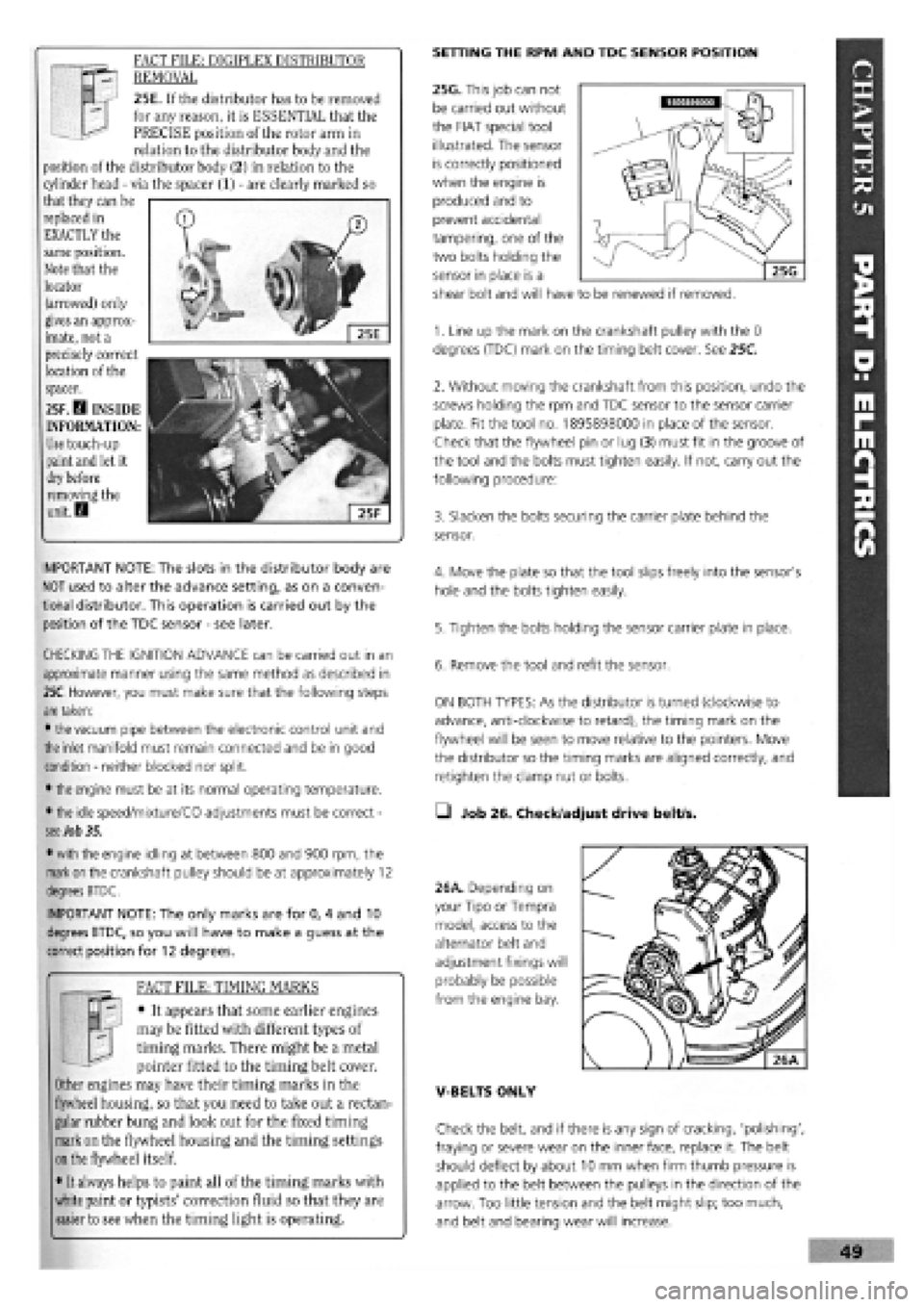
25E. If the distributor has to be removed
for any reason, it is ESSENTIAL that the
PRECISE position of the rotor arm in
relation to the distributor body and the
position of the distributor body (2) in relation to the
cylinder head
-
via the spacer (1)
-
are clearly marked so
that they can be
replaced in
EXACTLY the
same position.
Note that the
locator
(arrowed) only
gives an approx-
imate, not a
precisely correct
location of the
spacer.
25F. D INSIDE
INFORMATION:
Use
touch-up
paint
and
let it
dry before
removing the
unit. D
SETTING THE RPM AND TDC SENSOR POSITION
25G. This job can not
be carried out without
the FIAT special tool
illustrated. The sensor
is correctly positioned
when the engine is
produced and to
prevent accidental
tampering, one of the
two bolts holding the
sensor in place is a
shear bolt and will have to be renewed if removed.
IMPORTANT NOTE: The slots in the distributor body are
NOT used to alter the advance setting, as on a conven-
tional distributor. This operation is carried out by the
position of the TDC sensor
-
see later.
CHECKING THE IGNITION ADVANCE can be carried out in an
approximate manner using the same method as described in
25C.
However, you must make sure that the following steps
are
taken:
•
the
vacuum pipe between the electronic control unit and
the
inlet manifold must remain connected and be in good
condition
-
neither blocked nor split.
•
the
engine must be at its normal operating temperature.
•
the
idle speed/mixture/CO adjustments must be correct
-
see Job 35.
•
with
the engine idling at between 800 and 900 rpm, the
mark on
the crankshaft pulley should be at approximately 12
degrees BTDC.
IMPORTANT NOTE: The only marks are for 0, 4 and 10
degrees BTDC, so you will have to make a guess at the
correct position for 12 degrees.
FACT FILE: TIMING MARKS
y-; • It appears that some earlier engines
H. j may be fitted with different types of
J timing marks. There might be a metal
pointer fitted to the timing belt cover.
Other engines may have their timing marks in the
flywheel housing, so that you need to take out a rectan-
gular rubber bung and look out for the fixed timing
mark on the flywheel housing and the timing settings
on
the flywheel itself.
• It always helps to paint all of the timing marks with
white paint or typists' correction fluid so that they are
easier to see when the timing light is operating.
1. Line up the mark on the crankshaft pulley with the 0
degrees (TDC) mark on the timing belt cover. See 25C.
2. Without moving the crankshaft from this position, undo the
screws holding the rpm and TDC sensor to the sensor carrier
plate. Fit the tool no. 1895898000 in place of the sensor.
Check that the flywheel pin or lug (3) must fit in the groove of
the tool and the bolts must tighten easily. If not, carry out the
following procedure:
3. Slacken the bolts securing the carrier plate behind the
sensor.
4. Move the plate so that the tool slips freely into the sensor's
hole and the bolts tighten easily.
5. Tighten the bolts holding the sensor carrier plate in place.
6. Remove the tool and refit the sensor.
ON BOTH TYPES: As the distributor is turned (clockwise to
advance, anti-clockwise to retard), the timing mark on the
flywheel will be seen to move relative to the pointers. Move
the distributor so the timing marks are aligned correctly, and
retighten the clamp nut or bolts.
• Job 26. Check/adjust drive belt/s.
26A. Depending on
your Tipo or Tempra
model, access to the
alternator belt and
adjustment fixings will
probably be possible
from the engine bay.
V-BELTS ONLY
Check the belt, and if there is any sign of cracking, 'polishing',
fraying or severe wear on the inner face, replace it. The belt
should deflect by about 10 mm when firm thumb pressure is
applied to the belt between the pulleys in the direction of the
arrow. Too little tension and the belt might slip; too much,
and belt and bearing wear will increase.