wheel FIAT ULYSSE 2007 2.G User Guide
[x] Cancel search | Manufacturer: FIAT, Model Year: 2007, Model line: ULYSSE, Model: FIAT ULYSSE 2007 2.GPages: 254, PDF Size: 3.42 MB
Page 89 of 254
GETTING TO KNOW YOUR CAR
88
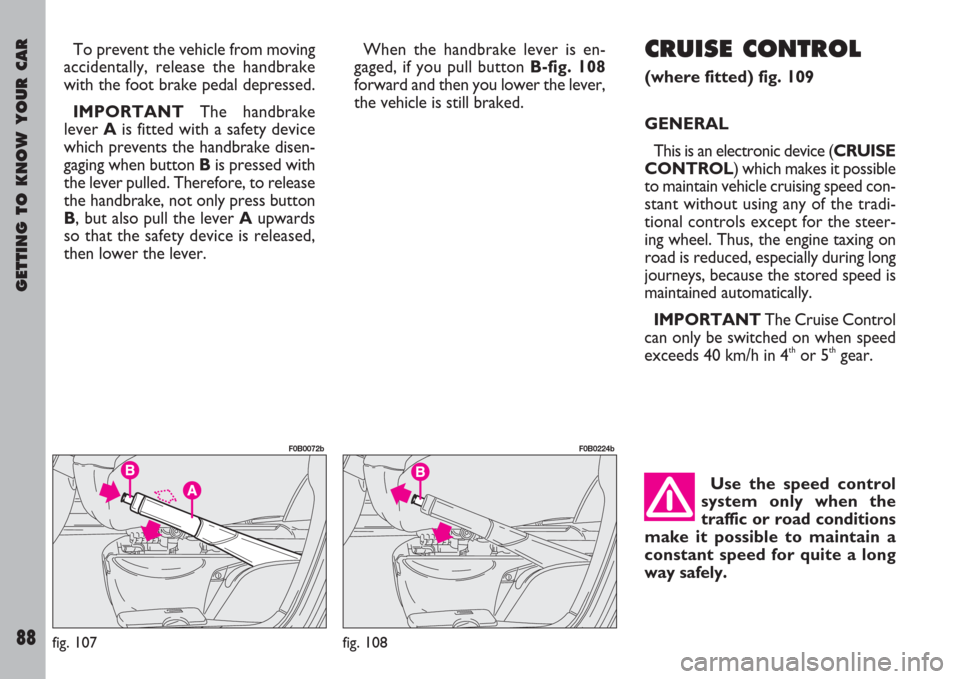
To prevent the vehicle from moving
accidentally, release the handbrake
with the foot brake pedal depressed.
IMPORTANTThe handbrake
lever A is fitted with a safety device
which prevents the handbrake disen-
gaging when button Bis pressed with
the lever pulled. Therefore, to release
the handbrake, not only press button
B, but also pull the lever Aupwards
so that the safety device is released,
then lower the lever.When the handbrake lever is en-
gaged, if you pull button B-fig. 108
forward and then you lower the lever,
the vehicle is still braked.CRUISE CONTROL
(where fitted) fig. 109
GENERAL
This is an electronic device (CRUISE
CONTROL) which makes it possible
to maintain vehicle cruising speed con-
stant without using any of the tradi-
tional controls except for the steer-
ing wheel. Thus, the engine taxing on
road is reduced, especially during long
journeys, because the stored speed is
maintained automatically.
IMPORTANTThe Cruise Control
can only be switched on when speed
exceeds 40 km/h in 4
thor 5thgear.
fig. 107
F0B0072b
fig. 108
F0B0224b
Use the speed control
system only when the
traffic or road conditions
make it possible to maintain a
constant speed for quite a long
way safely.
Page 93 of 254
GETTING TO KNOW YOUR CAR
92
Neutral (N)
It corresponds to the neutral posi-
tion of a traditional mechanic gear.Reverse (R)
To engage the reverse
the vehicle must be sta-
tionary, the engine idling
and the accelerator pedal re-
leased. Then follow the instruc-
tions given in “Engine starting”
paragraph in this chapter.
When the engine is at Rit is not pos-
sible to start the engine.Parking (P)
Pposition locks drive wheels.
Engage this gear only when the ve-
hicle is stationary and apply also the
handbrake. Then follow the instruc-
tions given in “Engine starting” para-
graph in this chapter.
IMPORTANTIf the lever is not
positioned correctly, the last stable en-
gaged gear flashes on the display. To move the lever from
N, release the accelerator
pedal, let the engine idling
and follow the instructions given
in “Engine starting” paragraph in
this chapter.
When the lever is at N it is possible
to start the engine.
Page 97 of 254
GETTING TO KNOW YOUR CAR
96
INTERIOR
EQUIPMENT
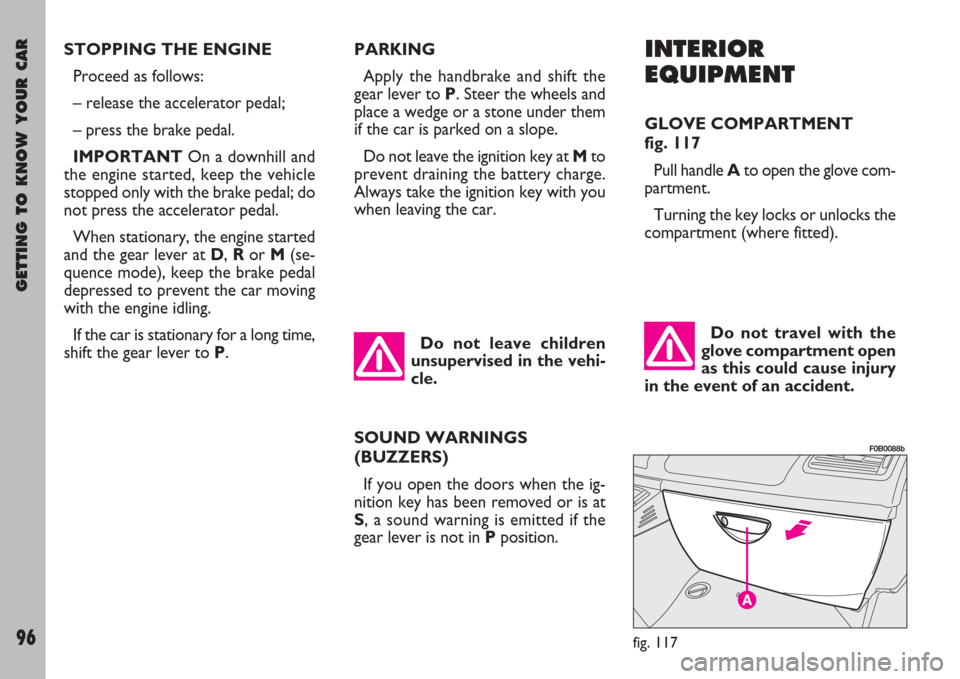
GLOVE COMPARTMENT
fig. 117
Pull handle Ato open the glove com-
partment.
Turning the key locks or unlocks the
compartment (where fitted).
Do not travel with the
glove compartment open
as this could cause injury
in the event of an accident.
fig. 117
F0B0088b
STOPPING THE ENGINE
Proceed as follows:
– release the accelerator pedal;
– press the brake pedal.
IMPORTANTOn a downhill and
the engine started, keep the vehicle
stopped only with the brake pedal; do
not press the accelerator pedal.
When stationary, the engine started
and the gear lever at D, Ror M(se-
quence mode), keep the brake pedal
depressed to prevent the car moving
with the engine idling.
If the car is stationary for a long time,
shift the gear lever to P.PARKING
Apply the handbrake and shift the
gear lever to P. Steer the wheels and
place a wedge or a stone under them
if the car is parked on a slope.
Do not leave the ignition key at Mto
prevent draining the battery charge.
Always take the ignition key with you
when leaving the car.
SOUND WARNINGS
(BUZZERS)
If you open the doors when the ig-
nition key has been removed or is at
S, a sound warning is emitted if the
gear lever is not in Pposition. Do not leave children
unsupervised in the vehi-
cle.
Page 99 of 254
GETTING TO KNOW YOUR CAR
98
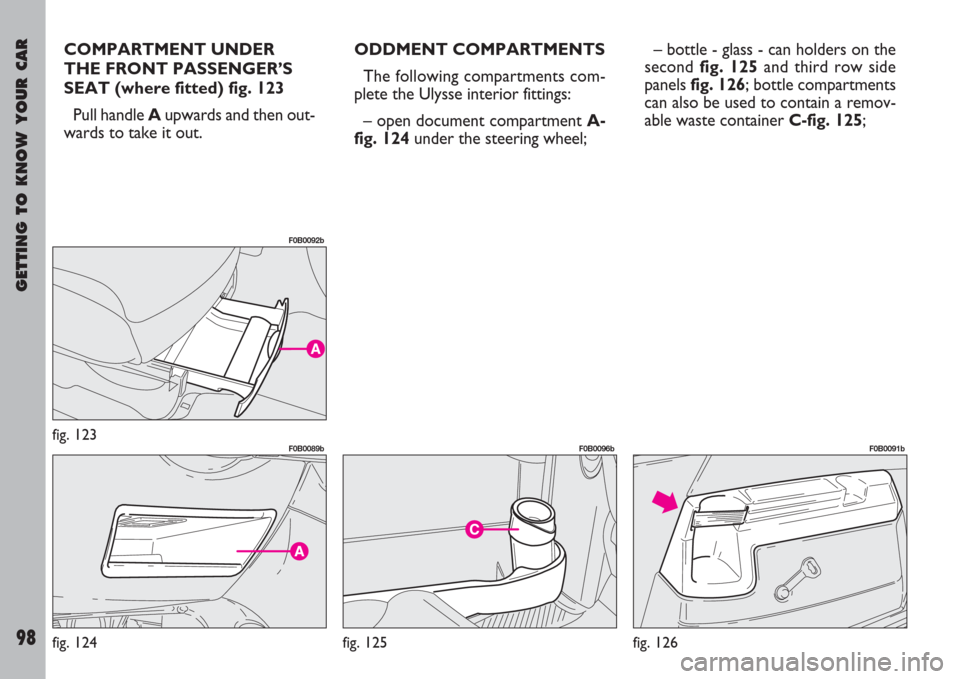
COMPARTMENT UNDER
THE FRONT PASSENGER’S
SEAT (where fitted) fig. 123
Pull handle Aupwards and then out-
wards to take it out.ODDMENT COMPARTMENTS
The following compartments com-
plete the Ulysse interior fittings:
– open document compartment A-
fig. 124under the steering wheel;– bottle - glass - can holders on the
second fig. 125and third row side
panels fig. 126; bottle compartments
can also be used to contain a remov-
able waste container C-fig. 125;
fig. 123
F0B0092b
fig. 124
F0B0089b
fig. 125
F0B0096b
fig. 126
F0B0091b
Page 117 of 254
GETTING TO KNOW YOUR CAR
116
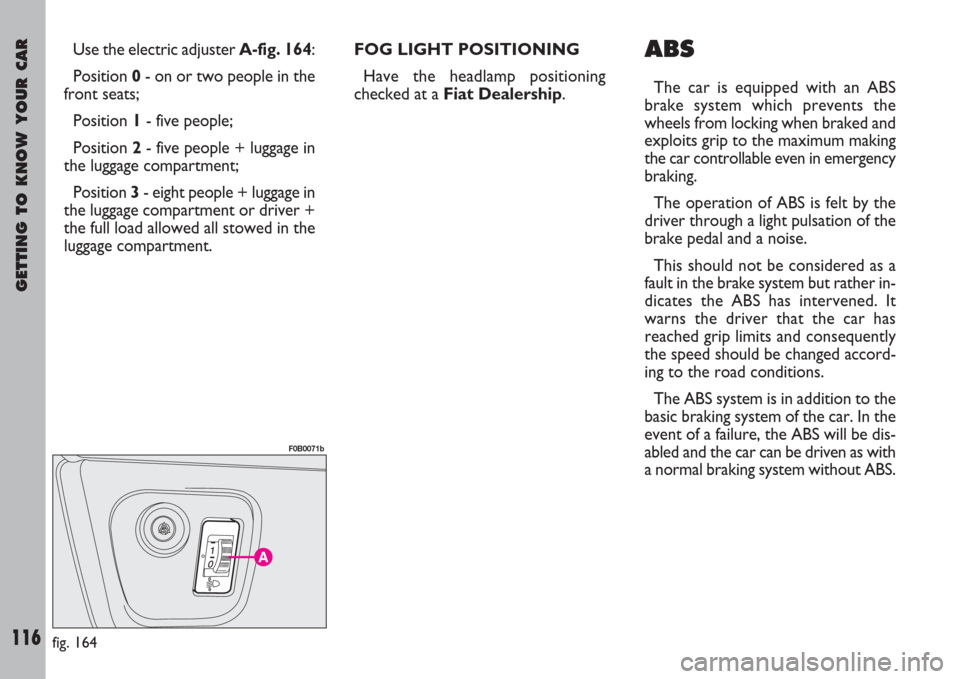
Use the electric adjuster A-fig. 164:
Position 0- on or two people in the
front seats;
Position 1- five people;
Position 2- five people + luggage in
the luggage compartment;
Position 3- eight people + luggage in
the luggage compartment or driver +
the full load allowed all stowed in the
luggage compartment.FOG LIGHT POSITIONING
Have the headlamp positioning
checked at a Fiat Dealership.ABS
The car is equipped with an ABS
brake system which prevents the
wheels from locking when braked and
exploits grip to the maximum making
the car controllable even in emergency
braking.
The operation of ABS is felt by the
driver through a light pulsation of the
brake pedal and a noise.
This should not be considered as a
fault in the brake system but rather in-
dicates the ABS has intervened. It
warns the driver that the car has
reached grip limits and consequently
the speed should be changed accord-
ing to the road conditions.
The ABS system is in addition to the
basic braking system of the car. In the
event of a failure, the ABS will be dis-
abled and the car can be driven as with
a normal braking system without ABS.
fig. 164
F0B0071b
Page 118 of 254
GETTING TO KNOW YOUR CAR
117
In the event of a failure, the braking
capacity of the car will not be pe-
nalised in any way although the an-
tilocking effect cannot be relied upon.
If this is the first time you are dri-
ving a car with ABS, we recommend
you learn how to use it by testing the
brakes on slippery ground - obvious-
ly in conditions of safety and respect-
ing the highway code enforced in the
country you are driving in - and read
the following notes carefully.
The advantage of ABS with respect
to the traditional braking system is the
fact that maximum drivability is en-
sured even when braking to the grip
limit and wheel locking is prevented.
You should, however, not always ex-
pect the braking distance to decrease.
For example, on soft surfaces - i.e.
gravel or fresh snow on a slippery
road - the braking distance could, in
fact, increase.To make the most of the possibilities
offered by the anti-locking system
when it is required, attain to the fol-
lowing advice.If there is a fault, the in-
strument panel warning
light >will come on. At
this point, reduce speed and go to
a Fiat Dealership to have your car
checked and full system opera-
tion restored.
When the ABS inter-
venes and you feel the
brake pedal pushing, do
not release the pressure on the
pedal but hold it down without
hesitation. This will ensure the
car stops in the shortest time
compatibly to the road surface
conditions.In any case, always pay the utmost
care when braking and cornering even
with ABS.
The most important piece of advice
is, however, the following: The ABS makes the
most of the available grip
but cannot increase it.
Consequently, drive very care-
fully on slippery roads without
taking unnecessary risks.
When the ABS inter-
venes, you have reached
the grip limit between
tyres and road surface: slow
down to suit speed to the avail-
able grip.
Page 119 of 254
GETTING TO KNOW YOUR CAR
118
MBA AND HBA
SYSTEMS
(where fitted)
The MBA (Mechanic Brake Assis-
tance) and HBA (Hydraulic Brake As-
sistance) systems increase braking
pressure in emergency braking. When
the driver is forced by the critical dri-
ving conditions to press violently the
brake pedal, the system increases the
braking pressure to assure the quick-
est vehicle stop.
These two systems behave in the
same way, the only difference is that
one increases braking pressure
through the ESP control unit and the
other with a mechanic action. By following these indications you
will be able to brake in the best con-
ditions in all events.
IMPORTANTVehicles fitted with
ABS may only be fitted with wheel
rims, tyres and brake pads of the make
and model approved by the vehicle
manufacturer.
The system is completed with an
Electronic Brake Distributor EBD
which increases the brake system per-
formance and employs the ABS con-
trol unit and sensors.
If the xbrake fluid low
warning light comes on,
stop the vehicle immedi-
ately and contact the nearest Fi-
at Dealership. Fluid leaks from
the hydraulic system, in fact, can
compromise brake system oper-
ation, both traditional systems
and systems with ABS. The car is fitted with an
electronic braking device
(EBD). The xand >
warning lights will come on at the
same time when the engine is
running to indicate that there is
an EBD system failure. In this
case violent braking may be ac-
companied by early rear wheel
locking with the possibility of
skidding. Drive the car extreme-
ly carefully to the nearest Fiat
Dealership to have the system
checked.Warning light >alone,
with the engine running,
normally indicates a fault
in the ABS system. In this case,
the braking system is still effi-
cient, though without the an-
tilocking device. Under these
conditions, performance of the
EBD system may be reduced. Al-
so in this case, you are advised to
go immediately to the nearest Fi-
at Dealership, driving in such a
way to avoid sharp braking to
have the system checked.
Page 120 of 254
GETTING TO KNOW YOUR CAR
119
ESP SYSTEM
(where fitted)
The ESP (Electronic Stability Pro-
gram) system controls the vehicle sta-
bility. It brakes drive wheels in a dif-
ferent way from the other wheels and
if grip is lost, it helps the car recover
stability and the correct travelling di-
rection.
While travelling the vehicle is subject
to side and longitudinal forces which
can be controlled by the driver as long
as the tyre grip is good. When the tyre
grip falls below the minimum level, the
vehicle starts deviating from the dri-
ver’s wished direction.
Especially when travelling on uneven
roads (paving, water, ice or earth) or
irregular roads (bends or other ob-
stacles) the tyre grip may be greatly
reduced.When the sensors detect such con-
ditions, the ESP system intervenes on
the engine and the brakes and makes
the vehicle recover stability.
The system perfor-
mance, in terms of active
safety, should not make
the driver run useless risks. Dri-
ving must suit road conditions, vis-
ibility and traffic. Nevertheless it
is always the behaviour of the dri-
ver that determines road safety.
The ESP system helps the driver keep
the vehicle control in the event of tyre
grip loss. Anyway, the ESP operation
depends on the grip between tyre and
roadbed.
ESP SYSTEM OPERATION
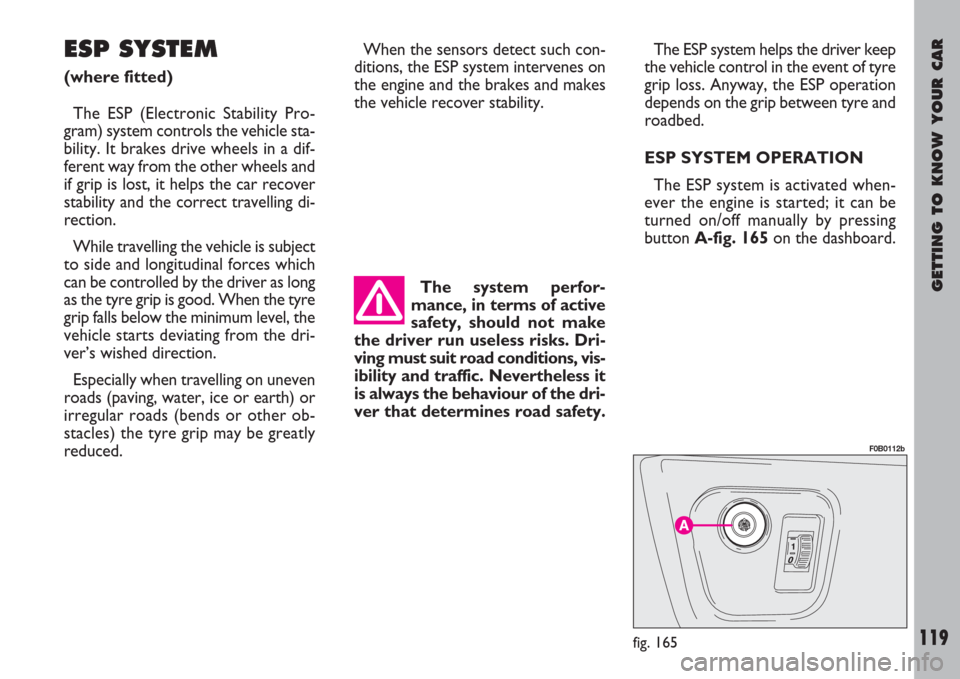
The ESP system is activated when-
ever the engine is started; it can be
turned on/off manually by pressing
button A-fig. 165on the dashboard.
fig. 165
F0B0112b
Page 121 of 254
Cars with ESP may only
be fitted with tyres of the
same make, model and
size and be in good conditions.
GETTING TO KNOW YOUR CAR
120
ESP SYSTEM ACTION
The ESP system action is signalled by
warning light
ñflashing to inform the
driver that the vehicle stability and grip
are critical.
ESP failure indication
In the event of an ESP system failure,
it turns off automatically and warning
light
ñcomes on together with the
relative message on the multifunction
display.
In the event of an ESP system failure,
the vehicle behaves as the version
without this type of system. We rec-
ommend you to contact a Fiat Deal-
ership as soon as possible. The ESP main components are:
– an electronic control unit which
processes the sensor signals and ap-
plies the best strategy;
– an angle sensor which detects the
steering position;
– four sensors which detect each
wheel rotation speed;
– a braking system pressure sensor;
– a yawing sensor which detects the
vehicle spinning around a vertical axis;
– a sensor which detects side accel-
eration (centrifugal force).
The ESP heart is the control unit
which processes the centrifugal forces
deriving from cornering on the basis
of the data coming from the sensors
installed on the vehicle. The yawing
sensor detects the vehicle spinning
around its vertical axis. Centrifugal
forces resulting from cornering are de-
tected by a highly sensible side accel-
eration sensor.
The ESP stabilising action is based on
the control unit processing of data
coming from the steering wheel rota-
tion sensors, side acceleration sensors
and wheel rotation speed sensors.These signals make the control unit
recognise the driver’s manoeuvre
when he/she turns the steering wheel.
The control unit processes such in-
formation and is able to detect the ve-
hicle position at any time and compare
it with the driver’s wished direction. If
they do not match, the control unit is
able to adjust the vehicle’s position in-
stantly, by choosing the best strategy:
it can brake one or more wheels with
different force and reduce the engine
power, if needed.
Adjustments are made for continu-
ously adapting to the driver’s wished
travelling direction.
The ESP system action improves the
vehicle safety in many critical situations
and is useful especially when the
roadbed grip changes.
Page 122 of 254
GETTING TO KNOW YOUR CAR
121
TC and ASR FUNCTIONS
The TC (Traction Control) and ASR
(Anti Slip Regulation), integrated in the
ESP system, prevent drive wheel slip
in poor grip conditions.
Two different control systems inter-
vene:
– if both drive wheels slip because of
excessive power, the ASR system re-
duces the engine power;
– if only one drive wheel slips, the TC
function brakes the slipping wheel as
a self-locking differential would do.
The TC and ASR functions are par-
ticularly useful in the following condi-
tions:
– inside wheel slipping due to load
variations and excessive acceleration;too much power to the wheels de-
pending also on the road conditions;
– acceleration on snowy or icy roads;
– wet road grip loss.
The TC and ASR system
performance, in terms of
active safety, should not
make the driver run useless risks.
Driving must suit road condi-
tions, visibility and traffic. Never-
theless it is always the behaviour
of the driver that determines
road safety.
Cars with TC and ASR
functions may only be fit-
ted with tyres of the same
make, model and size and be in
good conditions.IMPORTANTWhen travelling on
snowy roads with the snow chains ap-
plied, we suggest turning the ESP sys-
tem off and switching on the TC and
ASR functions, so that the drive action
is increased in the event the drive
wheels slip.
MSR FUNCTION
The MSR (Motor Schleppmoment
Regelung) function controls automat-
ically the engine braking torque while
shifting the gears. In the event of sud-
den gear shifting, this function prevents
the drive wheel dragging, especially in
poor grip conditions, and restores the
vehicle stability.