wheel FIAT ULYSSE 2007 2.G Owner's Manual
[x] Cancel search | Manufacturer: FIAT, Model Year: 2007, Model line: ULYSSE, Model: FIAT ULYSSE 2007 2.GPages: 254, PDF Size: 3.42 MB
Page 123 of 254
GETTING TO KNOW YOUR CAR
122
EOBD SYSTEM
The EOBD (European On Board
Diagnosis) system fitted in this car
complies with Directive 98/69/CE
(EURO 3).
This system continuously monitors
the engine emission system compo-
nents. Furthermore, the system warns
the driver of deterioration concerning
the emission system components by
means of
Uwarning light on the in-
strument panel.
The objective is to:
– monitor system efficiency;
– warn when failures can increase
emissions over the threshold estab-
lished by the European regulations;
– warn of the need to replace dete-
riorated components.
Furthermore, the system is equipped
with a connector for interfacing with
specific tools used to read the error
codes stored in the control unit mem-
ory along with a set of diagnostic and
engine specific parameters. This check can also be performed by
traffic controller agents.
If, turning the ignition
key to M, the warning
light
Udoes not turn on
or if, while travelling it turns on
glowing steadily or flashing, con-
tact a Fiat Dealership as soon as
possible. Dealership as soon as
possible. Warning light
Uoper-
ation can be checked by traffic
controller agents by means of
special equipment. Always com-
ply with the traffic regulations in
force in the country where you
are travelling.
IMPORTANTAfter eliminating the
problem, your Fiat Dealershipwill
run a bench test to fully check the sys-
tem. In some cases, a long road test
may be required.
TYRE PRESSURE
MONITORING
SYSTEM - T.P.M.S.
(where provided)
The car can be equipped with the
T.P.M.S. (Tyre Pressure Monitoring
System). This system consists of a ra-
dio-frequency sensor, installed on each
wheel (on the rim inside the tyre) that
sends pressure information to the
control unit.
IMPORTANTSystem control unit
monitors the pressure of the four car
tyres but not the space-saver spare
wheel. It is therefore recommended
to always check also the space-saver
spare wheel pressure.
IMPORTANTPay the attention
when checking or inflating tyres. Ex-
cessive pressure impairs road holding,
increases suspension and wheel stress
and causes abnormal tyre wear.
Page 124 of 254
The T.P.M.S. system
does not exempt the dri-
ver to check tyre and
space-saver spare wheel pressure
at regular intervals.
GETTING TO KNOW YOUR CAR
123
IMPORTANTTyre pressure
should be checked with tyres rested
and cold. Should it become necessary
for whatever reason to check pres-
sure with hot tyres, do not reduce
pressure although it is higher than the
prescribed value but repeat the check
when tyres are cold.IMPORTANT NOTES ABOUT
THE T.P.M.S. SYSTEM
Failure indications will not be stored
and therefore will not be displayed
when turning the engine off and on
again. If failure persists, the control
unit will send warning indications to
the instrument panel only after a few
seconds when the car is moving.
IMPORTANTT.P.M.S. system can-
not indicate sudden tyre pressure
drops (e.g.: tyre burst). In this event,
brake the car cautiously and avoid sud-
den steering.
IMPORTANTReplacing standard
tyres with winter tyres and vice ver-
sa involves T.P.M.S. system set-up that
shall be performed at Fiat Dealer-
ships only.
IMPORTANT The T.P.M.S. system
requires special equipment. Consult
Fiat Dealership to know what type
of accessories are compatible with the
system (wheels, wheel caps, etc.). Us-
ing other accessories could cause sys-
tem malfunctioning.IMPORTANTTyre pressure could
change according to outside temper-
ature. For this reason the T.P.M.S. sys-
tem could temporarily indicate low
tyre pressure. In this event check pres-
sure with cold tyres and restore prop-
er inflation values if required.
IMPORTANTIf the car is fitted
with T.P.M.S. system, tyre and/or rim
removal and refitting operations in-
volve special precautions; to prevent
damages or wrong sensor refitting,
contact Fiat Dealership to have tyre
and/or rim changed.
IMPORTANTIf the car is fitted
with T.P.M.S. system, when changing a
tyre, change also the rubber seal of the
valve. Contact a Fiat Dealership.
IMPORTANT Strong radio-fre-
quency disturbances could inhibit
proper TPMS system operation. This
condition is indicated by a dedicated
massage on the display. This indication
will go off automatically as soon as the
radio-frequency disturbance ceases.
Page 125 of 254
GETTING TO KNOW YOUR CAR
124fig. 168
F0B0111b
FRONT AND SIDE
AIR BAGS
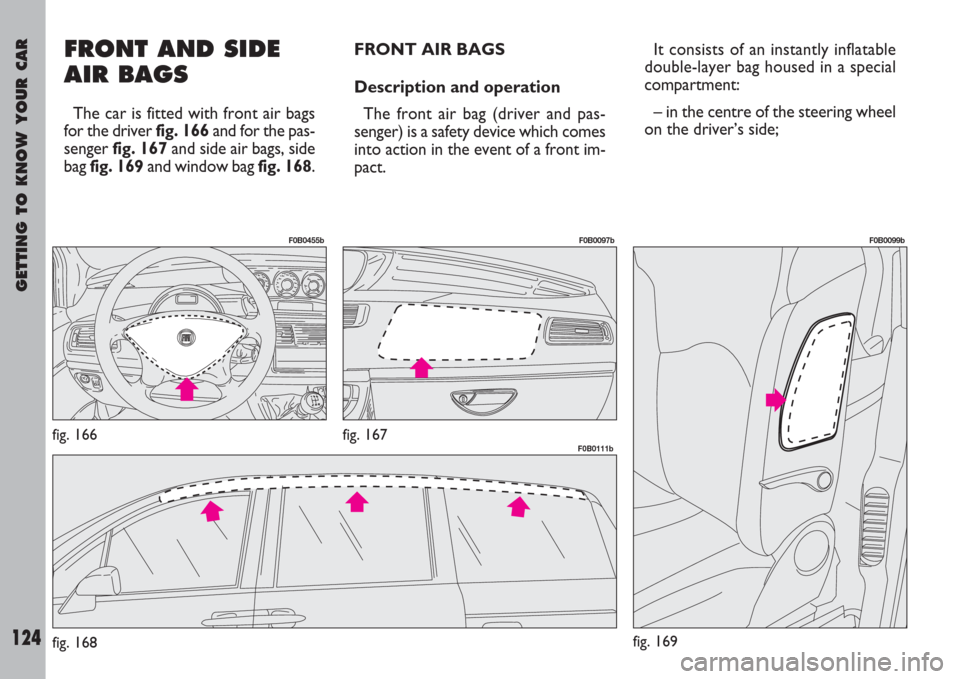
The car is fitted with front air bags
for the driver fig. 166and for the pas-
senger fig. 167and side air bags, side
bag fig. 169and window bag fig. 168.FRONT AIR BAGS
Description and operation
The front air bag (driver and pas-
senger) is a safety device which comes
into action in the event of a front im-
pact.It consists of an instantly inflatable
double-layer bag housed in a special
compartment:
– in the centre of the steering wheel
on the driver’s side;
fig. 167
F0B0097b
fig. 169
F0B0099b
fig. 166
F0B0455b
Page 126 of 254
GETTING TO KNOW YOUR CAR
125
– in the dashboard and with a bigger
cushion for the passenger.
The front air bag (driver and pas-
senger) has been designed to protect
the occupants in the event of head-
on crashes of medium-high severity,
by placing the cushion between the oc-
cupant and the steering wheel or dash-
board.
In case of a crash, an electronic con-
trol unit processes the signals from a
deceleration sensor and, when re-
quired, triggers the inflation of the
cushion.
The bag inflates instantly and acts as
a protective barrier between the front
seat passengers and the structures in
front of them that could cause injury.
The bags deflate immediately after-
wards.In case of crash, a person not wear-
ing the seat belt moves forward and
may come into contact with the cush-
ion while it is still inflating. Under this
circumstance the protection offered
by the air bag is reduced. The front air
bag (driver and passenger) is therefore
not a replacement of but a comple-
mentary to the use of belts, which
should always be worn, as specified by
law in Europe and most non-European
countries.
In the case of minor head-on colli-
sions (for which the restraining action
of the seat belt is sufficient), the air bag
is not triggered.
In collisions against highly deformable
or mobile objects (such as road signs,
heaps of gravel or snow, parked vehi-
cles, etc.), in rear crashes (such as
bumps from behind by another vehi-
cle), side impacts, and in case of wedg-
ing under other vehicles or protective
barriers (for example under a truck or
guard rail), the air bag is not triggered
as it offers no additional protection
compared with the seat belts, conse-
quently, it would be pointless.The fact that the airbag is not trig-
gered in these situations, this does not
signify a malfunction.
PASSENGER’S FRONT
AIRBAG
The passenger’s airbag was designed
and calibrated to protect a person
wearing seat belts.
When fully inflated the bag will fill
most of the space between the dash-
board and the passenger.
Page 130 of 254
Remember that with the
key engaged and in M po-
sition, even with the en-
gine not running, the air bags may
be triggered on a stationary ve-
hicle if it is bumped by another
moving car. Therefore, never seat
children on the front seat even
when the vehicle is stationary.
On the other hand, remember
that with the vehicle stationary,
without the key engaged and
turned, the air bags are not trig-
gered in the event of an impact;
in these cases, failure to come in-
to action of the air bags cannot
be considered as a sign that the
system is not working properly.
GETTING TO KNOW YOUR CAR
129
Never travel with ob-
jects on your lap, in front
of your chest or with a
pipe, pencil, etc. between your
lips; injury may result in the event
of the air bag being triggered.If the car has been stolen
or an attempt to steal it
has been made, if it has
been subjected to vandals or
floods, have the air bag system
checked by Fiat Dealership.
Do not wash the seat
back rest with pressurised
water or steam at auto-
matic seat washing stations.
Do not cover the back-
rest of front seats with
trims or covers that are
not suitable to be used with side
bags. Always keep you hands
on the steering wheel rim
when driving, so that if
the air bag is triggered, it can in-
flate without meeting any obsta-
cles which could cause serious
harm to you. Do not drive with
the body bent forward, keep the
seat back rest in the erect posi-
tion and lean your back well
against it.
Do not apply stickers or
other objects to the
steering wheel or to the
air bag cover on the passenger’s
side or on the side roof lining.
Never put objects (e.g. mobile
phones) on the dashboard on pas-
senger side since they could in-
terfere with proper passenger air
bag inflation and also cause seri-
ous injury.
Page 133 of 254
GETTING TO KNOW YOUR CAR
132
GENERAL NOTES
While parking, pay attention to ob-
stacles above or below the sensors. In
fact certain objects very close to the
vehicle rear part are not detected by
the system and so the car or the sen-
sors might get damaged.
Warnings coming from the damaged
sensors may be altered and no longer
reliable, also when they are covered
with dirt, mud, snow or ice, or con-
founded by nearby ultrasound systems
(e.g. air brakes of trucks or rivetting
hammers).SOUND SYSTEM
For the sound system, see the
“Sound system” handbook enclosed
to this “Owner handbook”.
ACCESSORIES
PURCHASED
BY THE OWNER
If, after purchasing your car, you wish
to add electric accessories (alarm,
satellite antitheft device, etc.) that re-
quire permanent power supply or high
feed accessories, visit a Fiat Dealer-
ship. The staff of experts, beside sug-
gesting the most suitable accessories
in the Lineaccessori Fiat range, will al-
so check whether the car electrical
system can support the the required
load or if a larger size battery needs to
be installed.Take care when fitting
additional spoilers, alloy
rims and non-standard
wheel caps: they might reduce
ventilation of the brakes, thus
their efficiency, during abrupt
and repeated braking, or long
downhill slopes. Make sure that
nothing (mats, etc.) gets in the
way of the pedals when they are
pushed down.
Page 139 of 254
DRIVING YOUR CAR
138
HOW TO WARM UP
THE ENGINE AFTER
IT HAS JUST STARTED
– Begin to move forward slowly let-
ting the engine turning at medium revs.
Do not accelerate abruptly.
– Do not push the engine to its lim-
it for the first kilometres. You are rec-
ommended to wait until the water
temperature has reached 50° to 60°C.BUMP STARTING
For versions with a cat-
alytic converter, bump
starting by pushing, tow-
ing or rolling downhill must be
avoided at all costs. This ma-
noeuvre could cause a rush of fu-
el into the catalytic exhaust pipe
and damage it beyond repair.STOPPING THE ENGINE
Turn the ignition key to Swhile the
engine is idling.
Remember that as long
as the engine is not run-
ning, the power brakes
and power steering do not work.
You therefore have to use con-
siderably more effort on both the
brake pedal and the steering
wheel than you would do other-
wise.
Gunning the accelerator
before turning off the en-
gine serves absolutely no
practical purpose, wastes fuel and
is damaging, particularly to tur-
bocharged engines.
IMPORTANTAfter a taxing drive,
it is better to allow the engine to
“catch its breath” before turning it off
by letting it idle to allow the temper-
ature in the engine compartment to
fall.
Page 140 of 254
DRIVING YOUR CAR
139
PARKING
Proceed as follows:
– turn the engine off;
– pull up the handbrake;
– put the vehicle in gear (1
stif the ve-
hicle is pointing uphill, reverse if down-
hill);
– leave the wheels steered to block
the vehicle in the event the handbrake
is released.
For vehicles with automatic elec-
tronic gearbox refer to “Getting to
know your car” chapter.
SAFE DRIVING
In designing the Ulysse, Fiat has made
every effort to come up with a vehicle
able to provide driver and passengers
with top-class levels of safety. Never-
theless it is always the behaviour of the
person at the wheel that determines
road safety.
Below you will find some simple tips
to help you travel in safety under dif-
ferent conditions. You will no doubt
be already familiar with many of them
but it will be useful to read them all
carefully. Do not leave the ignition
key at M to prevent drain-
ing the battery.
Never leave children un-
attended in the car. Al-
ways remove the ignition
key when leaving the car and take
it out with you.
Page 141 of 254
DRIVING YOUR CAR
140
BEFORE GETTING BEHIND
THE WHEEL
The main suggestions are the fol-
lowing:
– make sure all lights including the
headlights are working properly;
– adjust the position of the seat,
steering wheel, driving and door mir-
rors properly for the best driving po-
sition;
– adjust the head restraints careful-
ly so that they support the head and
not the neck;
– make sure that nothing (mats, etc.)
gets in the way of the pedals when
they are pushed down;
– make sure that any child restraint
systems (child seats, carriers, etc.) are
properly fixed, preferably on the back
seat as this is the safest place in the
event of an accident;– make sure that objects being trans-
ported are carefully arranged so they
will not fly forward if you have to
brake sharply;
– do not eat a heavy meal before
travelling. Light eating will help keep
your reflexes prompt. Above all, do
not have anything alcoholic to drink.
Using certain prescription drugs can
reduce your ability to drive: read in-
structions for use carefully.
Periodically, remember to check:
– tyre pressure and conditions;
– engine oil level;
– coolant level and conditions of the
system;
– brake fluid level;
– power steering fluid level;
– windscreen washer liquid level.WHEN TRAVELLING
The main suggestions are the fol-
lowing:
– the first rule of safe driving is pru-
dence. Prudence also means putting
yourself into a position where you can
predict wrong or imprudent behaviour
from other drivers;
– stick closely to the rules of the
road in the particular country where
the vehicle is being driven and, above
all, do not exceed speed limits;
– ensure that, besides yourself, all the
other passengers in the vehicle have
their seat belts fastened, that children
are sitting in the appropriate child
seats and any animals in the car are
placed in suitable compartments;
– you should be physically fit and
mentally alert before setting out on
long journeys;
Page 142 of 254
DRIVING YOUR CAR
141
Be careful when fitting
additional spoilers, light
alloy rims and optional
wheel caps: these devices could
reduce brake ventilation and ef-
ficiency in the event of repeated
and sudden braking or long
downhill drives.Never drive with objects
on the floor in front of the
driver’s seat. The objects
could get jammed under the ped-
als making braking or accelerat-
ing impossible.
Driving while drunk or
under the influence of
drugs or certain medi-
cines is dangerous for both you
and other road users.Pay attention to mats: if
you note even a small
problem in braking, the
pedal stroke may need to be ad-
justed.
Always fasten both front
and back seat belts, in-
cluding child restraint sys-
tems. Travelling with the seat
belts unfastened increases the
risk of injury or death if you are
in a collision.
Water, ice and road salt
may deposit on brake
discs making it difficult to
brake the first time this is neces-
sary.– do not drive too many hours at a
time but stop at intervals to stretch
your legs and recoup your energies;
– make sure the air in the vehicle is
being changed continuously;
– never coast downhill (i.e. with the
engine off): if you do, you lose the aid
of the engine brake, power brakes and
power steering, so that braking and
steering require greater effort.