wheel FIAT ULYSSE 2007 2.G Owner's Guide
[x] Cancel search | Manufacturer: FIAT, Model Year: 2007, Model line: ULYSSE, Model: FIAT ULYSSE 2007 2.GPages: 254, PDF Size: 3.42 MB
Page 143 of 254
DRIVING YOUR CAR
142
– only use full-beam headlights when
you are driving outside the city and
when you are sure they do not annoy
other drivers;
– if the headlights are on full, dip
them when you meet cars going in the
other direction and pass them with the
headlights dipped;
– keep all lights clean;
– be careful of animals crossing the
road when driving in the country.
DRIVING IN THE RAIN
Rain and wet road surfaces spell dan-
ger.
All manoeuvres are more difficult on
a wet road because the friction of the
wheels on the tarmac is greatly re-
duced. This is why braking distances
are much longer and roadholding on
bends is lower.
The main suggestions are the fol-
lowing:
– reduce speed and keep a greater
safety distance from the cars in front;– if it is raining particularly heavily,
visibility is also reduced. In these cas-
es, switch on the dipped headlights
even if it is still daylight, to make your-
self easier to be seen;
– do not drive through puddles at
speed and hold on tightly to the wheel:
the loss of grip caused by taking a pud-
dle at speed can make you lose con-
trol of the vehicle (“aquaplaning”);
– move the ventilation controls to
the position for demisting the win-
dows (see the section “Getting to
know your car”), to avoid visibility
problems;
– periodically check the condition of
the windscreen wiper blades. DRIVING AT NIGHT
The main suggestions are the fol-
lowing:
– drive especially carefully: it is hard-
er to drive at night;
– slow down especially if the road is
not lit;
– at the first signs of sleepiness, stop:
continuing would be a risk to yourself
and everybody else. Only start driving
again when you have had enough rest;
– keep a greater safety distance from
the cars in front of you than during
daylight hours: it is hard to judge how
fast other cars are going when all you
can see are their lights;
– make sure the headlight beams are
properly positioned: if they are too
low, they reduce visibility and are hard
on the eyes. If they are too high they
can dazzle other drivers;
Page 145 of 254
DRIVING YOUR CAR
144
DRIVING WITH ABS
ABS is a part of the braking system
offering 2 advantages:
1)it prevents wheel lock-up and
consequent skidding in emergency
stops, particularly when the road does
not offer much grip;
2)it makes it possible to brake and
steer at the same time so you can
avoid sudden objects on the road and
direct the vehicle where you want
while braking; this compatibly with the
physical limits of overall tyre grip.To get the most out of ABS:
– during emergency stops or when
grip conditions are poor, you will feel
a slight pulsation on the brake pedal.
This is the sign that the ABS is in ac-
tion. Do not release the brake pedal
but continue to press so as not to in-
terrupt the braking action;
– ABS prevents the wheels from
locking but it does not increase actu-
al grip conditions between tyre and
road. Therefore, even if your vehicle
is fitted with ABS, respect the safety
distance from the vehicle in front of
you and keep your speed down when
driving into bends.
ABS serves to increase the control-
lability of the vehicle, not to enable you
to go faster. DRIVING ON SNOW AND ICE
The main suggestions are the fol-
lowing:
– keep you speed down;
– keep a good distance from the cars
in front of you;
– use chains if the roads are covered
in snow. See “Snow chains” in this
chapter;
– do not keep the engine running for
long periods in deep snow as the snow
could push exhaust gases into the pas-
senger compartment;
– mainly use the engine brake and un-
der all circumstances avoid braking
sharply;
– do not accelerate suddenly and
avoid swerving;
– in the winter, even apparently dry
roads may have icy patches. Be care-
ful therefore when driving over
stretches that do not get much expo-
sure to the sun or that are lined by
trees and rocks, where ice might not
have melted.
Page 151 of 254
DRIVING YOUR CAR
150
The specific characteristics of the
winter tyres mean that under normal
driving conditions or when driving long
distances on motorways, their perfor-
mance is greatly reduced in compari-
son to those normally fitted to the car.
The use of these tyres should there-
fore be limited to the conditions for
which they were designed and certified.
IMPORTANTWhen using winter
tyres with a maximum speed rating
lower than the speed which can be
reached by the car (plus 5%), place a
suitable notice in the passenger com-
partment to inform the driver of the
top speed which the winter tyre can
run at (as per Directive CE).
All four tyres should be the same
(brand and track) to ensure greater
safety when driving, braking and cor-
nering.SNOW CHAINS
The use of snow chains is regulated
by the legislation in force in the coun-
try the car is driven in.
The chains may only be applied to
the front wheel (drive wheel) tyres.
Use only low profile chains (maxi-
mum 12 mm off the tyre).
We recommend using Lineaccessori
Fiat snow chains.
Check the tautness of the chains af-
ter driving some ten meters. The max speed for snow
tyres with “Q” marking is
160 km/h, 190 Km/h for
tyres with “T” marking and
210 Km/h for tyres with “H”
marking. The Road Traffic Code
speed limits must however be al-
ways strictly observed.
Remember not to invert the tyre di-
rection of rotation.
Page 155 of 254
IN AN EMERGENCY
154
Do not carry out this
procedure if you lack ex-
perience; if it is not done
correctly it can cause very in-
tense electrical discharges. In ad-
dition, the fluid contained in the
battery is poisonous and corro-
sive. Avoid contact with skin and
eyes. You are also advised not to
put naked flames or lighted cig-
arettes near the battery and not
to cause sparks.
Remember that until
the engine has started the
brake booster and elec-
trical power steering systems will
not work and a greater effort will
therefore be required to press
the brake pedal or turn the steer-
ing wheel.IF A TYRE
IS PUNCTURED
Certain versions (where provided)
are fitted with wheel identification and
tyre inflation sensors; pressure loss is
signalled to the driver in the follow-
ing way:
pressure loss- the infotelematic
CONNECT system displays the relat-
ed message and a “gong” is emitted by
the system. Contact a Fiat Dealer-
ship;
punctured tyre- warning light
“STOP” comes on and the in-
fotelematic CONNECT system dis-
plays the related message together
with 3 consecutive “gong” sounds.
Change the wheel in the following
way.
The system can also display a dedi-
cated message in the event it should
not be able to detect the tyre pres-
sure. Under no circumstances
should a battery charger
be used to start the en-
gine: it could damage the elec-
tronic systems and in particular
the ignition and injection control
units.
BUMP STARTING
Do not bump start by
pushing, towing or coast-
ing downhill. This way of
starting could cause a rush of fu-
el into the catalytic converter and
damage it beyond repair.
Page 156 of 254
IN AN EMERGENCY
155
An incorrectly posi-
tioned jack may cause the
vehicle to fall. Do not use
the jack to lift loads exceeding
that indicated on the label at-
tached to the jack itself.Do not lubricate the bolt
threads before fitting
them back: they could
come loose.
Never start the engine when the
vehicle is jacked up.
If you are towing a trailer, re-
move the trailer before jacking
up the vehicle.Never tamper with the
inflation valve. Never
place tools between the
rim and the tyre.
Check the tyre and space-saver
spare wheel pressure regularly.
The tyre inflation pressure is
shown in the “Technical specifi-
cations” chapter.
The jack should only be
used to change a wheel
on the vehicle for which it
was designed. It should not be put
to other uses or employed to
raise other models. Under no cir-
cumstances should it be used
when carrying out repairs under
the vehicle.
Check the inflation pres-
sure of the tyres and the
spare wheel regularly. If
you change the type of wheels (al-
loy rims instead of steel rims) you
will have to change the entire set
of fastening bolts with another
set of suitably sized bolts.
You should keep the bolts in
case you decide to use the origi-
nal type of wheel later on.Signal the presence of
the stopped car according
to the laws in force: haz-
ard lights, reflecting triangle, etc.
Any passengers on board should
leave the car, especially if it is
heavily laden. Passengers should
stay away from oncoming traffic
while the wheel is being changed.
If the wheel is being changed on
a steep or badly surfaced road,
place wedges or other suitable
material under the wheels to
stop the car.
GENERAL INSTRUCTIONS
Observe the instructions on this and
the following pages to use the jack and
space-saver spare wheel correctly.
Page 157 of 254
IN AN EMERGENCY
156
CHANGING A WHEEL
Please note:
– the jack weighs 3.4 kg;
– the jack requires no adjustments;
– the jack cannot be repaired. If it
breaks it must be replaced with a new
jack;
– no tool with the exception of the
handle can be fitted on the jack.
Proceed as follows:
1) Stop the car in a position that is
not dangerous for oncoming traffic
where you can change the wheel safe-
ly. The ground should be flat and ad-
equately firm. 2) Turn the engine off and pull up the
handbrake.
3) Engage first gear or reverse or, for
versions with automatic electronic
gear, select P.
4) Lift the boot mat (see the relative
instructions in the “Bonnet” paragraph
of “Getting to know your car” chap-
ter).
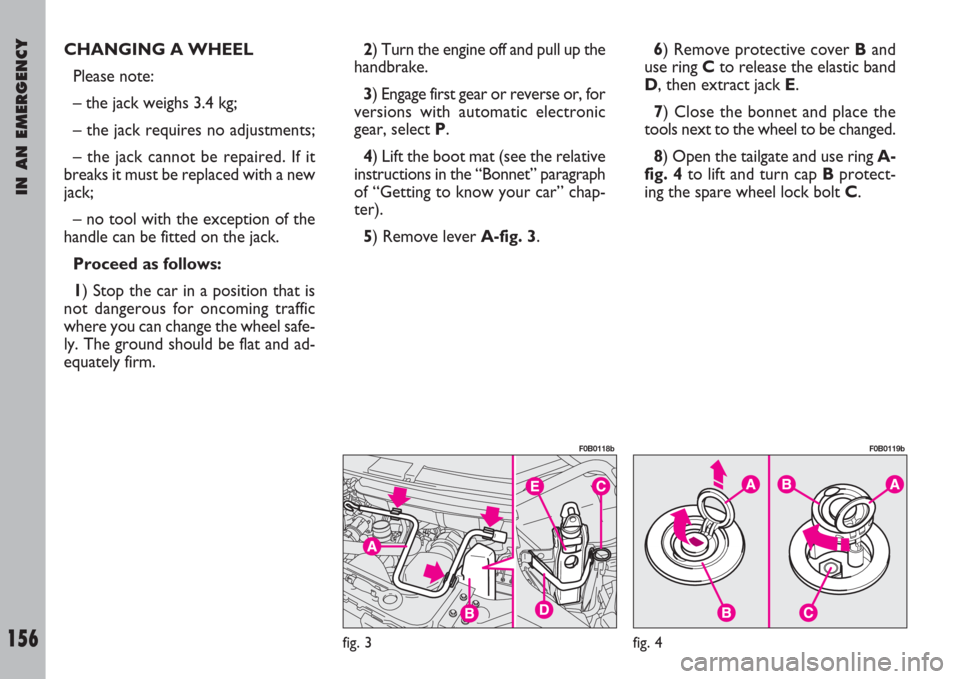
5) Remove lever A-fig. 3.6) Remove protective cover Band
use ring Cto release the elastic band
D, then extract jack E.
7) Close the bonnet and place the
tools next to the wheel to be changed.
8) Open the tailgate and use ringA-
fig. 4to lift and turn cap Bprotect-
ing the spare wheel lock bolt C.
fig. 3
F0B0118b
fig. 4
F0B0119b
Page 158 of 254
IN AN EMERGENCY
157
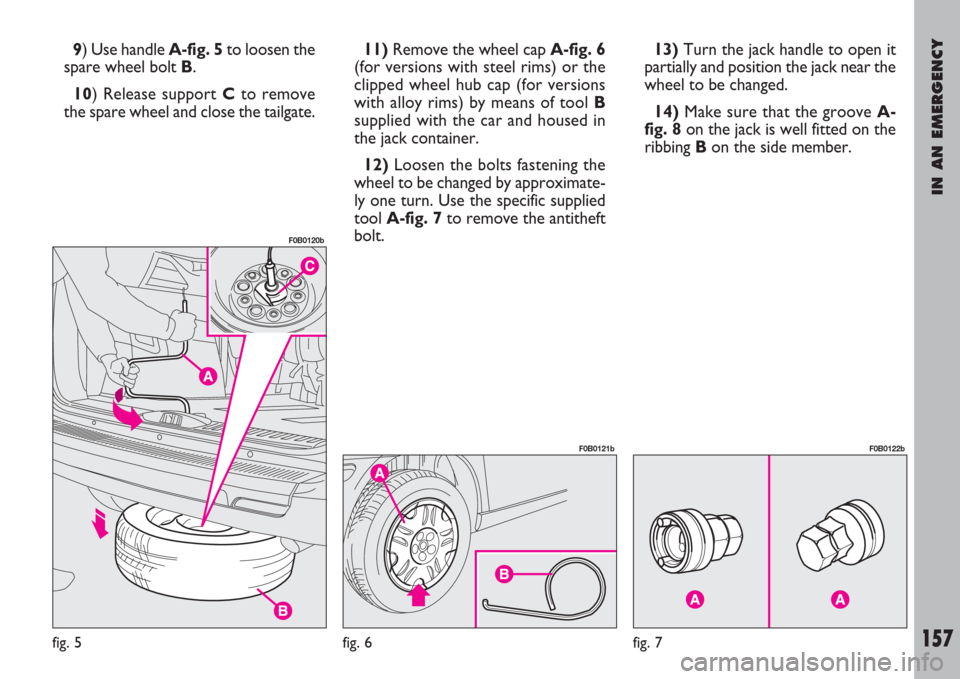
9) Use handle A-fig. 5to loosen the
spare wheel bolt B.
10) Release support Cto remove
the spare wheel and close the tailgate.11)Remove the wheel cap A-fig. 6
(for versions with steel rims) or the
clipped wheel hub cap (for versions
with alloy rims) by means of tool B
supplied with the car and housed in
the jack container.
12)Loosen the bolts fastening the
wheel to be changed by approximate-
ly one turn. Use the specific supplied
tool A-fig. 7to remove the antitheft
bolt.13) Turn the jack handle to open it
partially and position the jack near the
wheel to be changed.
14)Make sure that the groove A-
fig. 8on the jack is well fitted on the
ribbing Bon the side member.
fig. 5
F0B0120b
fig. 6
F0B0121b
fig. 7
F0B0122b
Page 159 of 254
IN AN EMERGENCY
158
15)Warn other passengers that the
vehicle is about to be raised; all per-
sons should be kept away from the ve-
hicle until it has been lowered.
16)Turn the jack handle and raise
the vehicle until the wheel is a few
inches off the ground. Make sure the
jack handle can be turned easily and
take care not to scrape your hand
against the ground.17)The moving parts of the jack
(screw and joints) may also cause in-
jury if touched. Clean off any grease.
18)Loosen the five bolts complete-
ly and remove the wheel.
19)When fitting the spare wheel,
make sure the hub is clean so that the
bolts will not loosen.
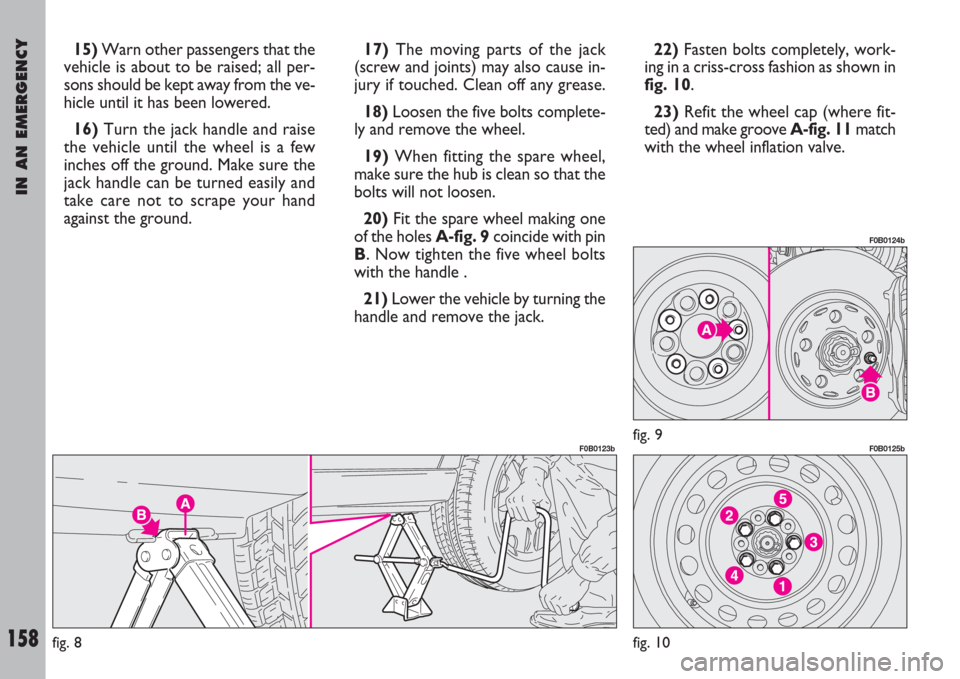
20)Fit the spare wheel making one
of the holes A-fig. 9coincide with pin
B. Now tighten the five wheel bolts
with the handle .
21)Lower the vehicle by turning the
handle and remove the jack.22)Fasten bolts completely, work-
ing in a criss-cross fashion as shown in
fig. 10.
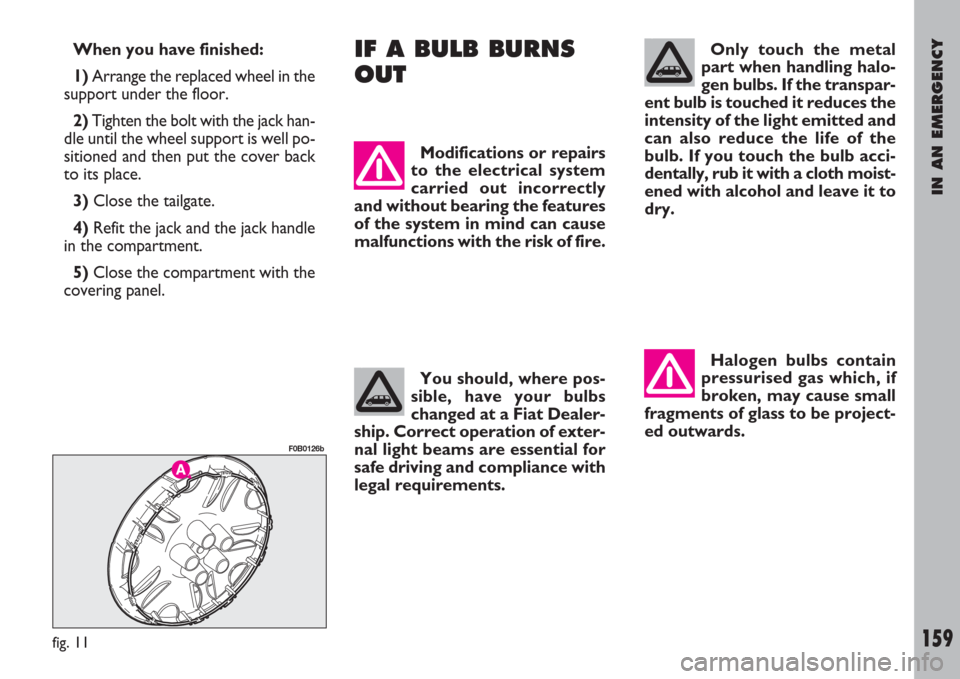
23)Refit the wheel cap (where fit-
ted) and make groove A-fig. 11match
with the wheel inflation valve.
fig. 8
F0B0123bfig. 9
F0B0124b
fig. 10
F0B0125b
Page 160 of 254
IN AN EMERGENCY
159
When you have finished:
1)Arrange the replaced wheel in the
support under the floor.
2)Tighten the bolt with the jack han-
dle until the wheel support is well po-
sitioned and then put the cover back
to its place.
3)Close the tailgate.
4)Refit the jack and the jack handle
in the compartment.
5)Close the compartment with the
covering panel.IF A BULB BURNS
OUT
Modifications or repairs
to the electrical system
carried out incorrectly
and without bearing the features
of the system in mind can cause
malfunctions with the risk of fire.
You should, where pos-
sible, have your bulbs
changed at a Fiat Dealer-
ship. Correct operation of exter-
nal light beams are essential for
safe driving and compliance with
legal requirements.
fig. 11
F0B0126b
Only touch the metal
part when handling halo-
gen bulbs. If the transpar-
ent bulb is touched it reduces the
intensity of the light emitted and
can also reduce the life of the
bulb. If you touch the bulb acci-
dentally, rub it with a cloth moist-
ened with alcohol and leave it to
dry.
Halogen bulbs contain
pressurised gas which, if
broken, may cause small
fragments of glass to be project-
ed outwards.
Page 180 of 254
IN AN EMERGENCY
179
JACKING THE CAR
WITH THE JACK
See “If a tyre is punctured”, in this
chapter.
Please note:
– the jack requires no adjustments;
– the jack cannot be repaired. If it
breaks it must be replaced with a new
jack;
– no other tool, apart from the han-
dle shown in this chapter, can be fit-
ted to the jack.An incorrectly posi-
tioned jack may cause the
vehicle to fall. Do not use
the jack to lift loads exceeding
that indicated on the label at-
tached to the jack itself.WITH A SHOP JACK
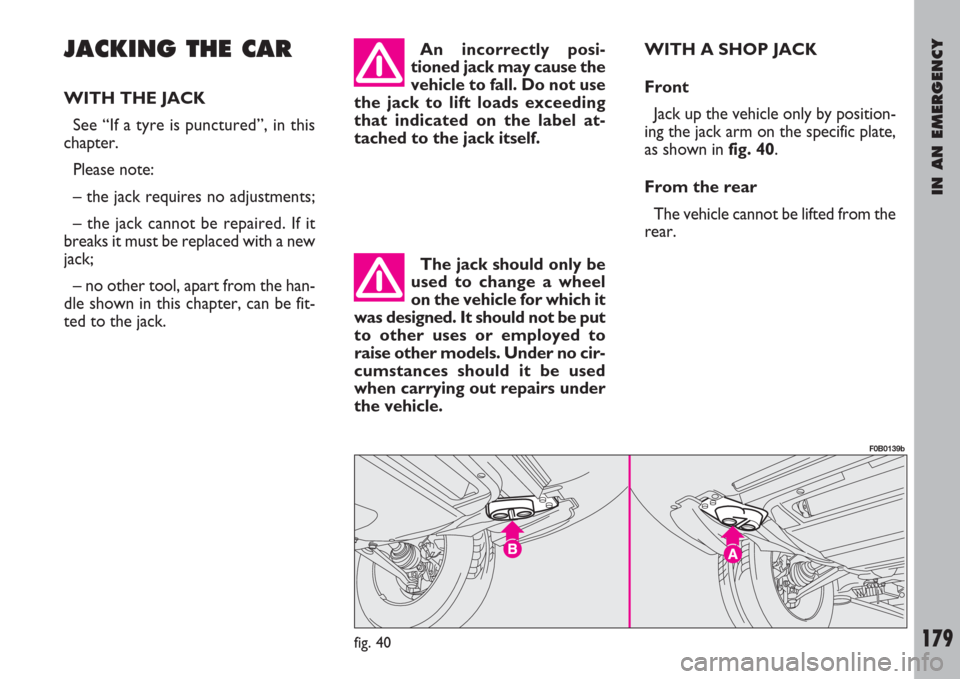
Front
Jack up the vehicle only by position-
ing the jack arm on the specific plate,
as shown in fig. 40.
From the rear
The vehicle cannot be lifted from the
rear.
The jack should only be
used to change a wheel
on the vehicle for which it
was designed. It should not be put
to other uses or employed to
raise other models. Under no cir-
cumstances should it be used
when carrying out repairs under
the vehicle.
fig. 40
F0B0139b