ECO mode FIAT UNO 1983 Service Owners Manual
[x] Cancel search | Manufacturer: FIAT, Model Year: 1983, Model line: UNO, Model: FIAT UNO 1983Pages: 303, PDF Size: 10.36 MB
Page 230 of 303
Starter motor brushes
(later models) - renewal#
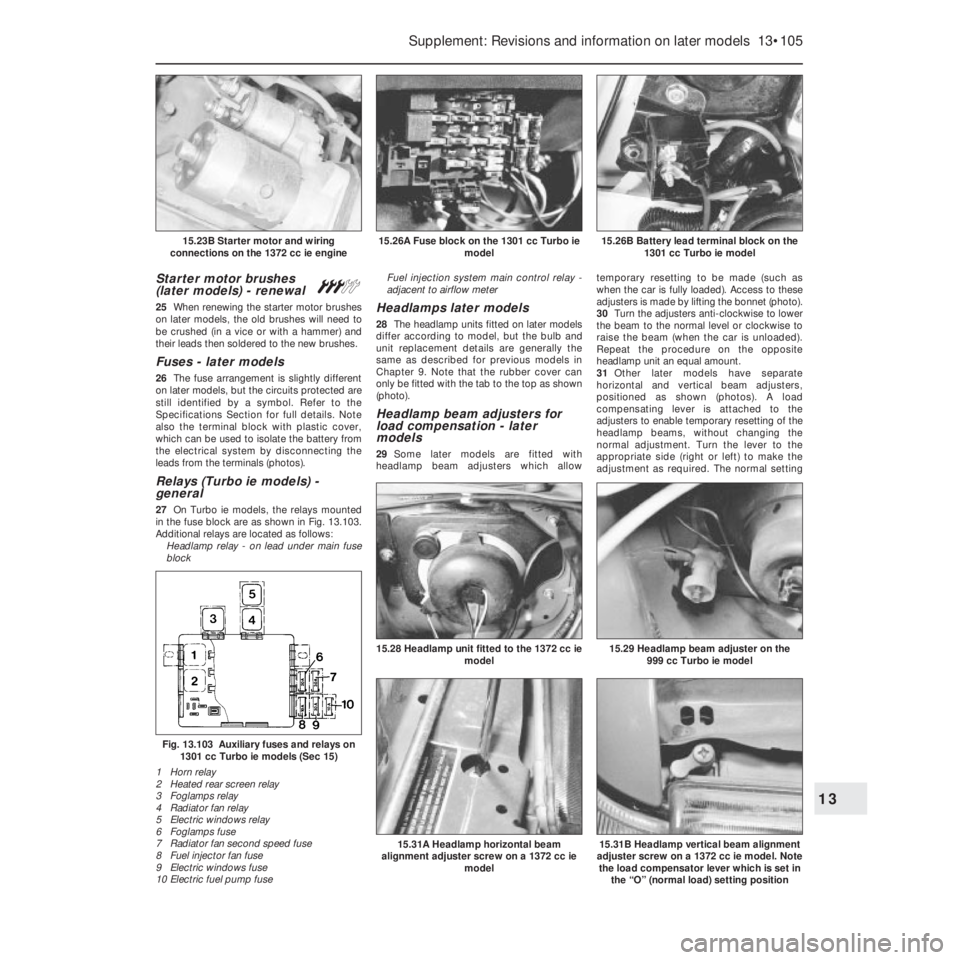
25When renewing the starter motor brushes
on later models, the old brushes will need to
be crushed (in a vice or with a hammer) and
their leads then soldered to the new brushes.
Fuses - later models
26The fuse arrangement is slightly different
on later models, but the circuits protected are
still identified by a symbol. Refer to the
Specifications Section for full details. Note
also the terminal block with plastic cover,
which can be used to isolate the battery from
the electrical system by disconnecting the
leads from the terminals (photos).
Relays (Turbo ie models) -
general
27On Turbo ie models, the relays mounted
in the fuse block are as shown in Fig. 13.103.
Additional relays are located as follows:
Headlamp relay - on lead under main fuse
blockFuel injection system main control relay -
adjacent to airflow meter
Headlamps later models
28The headlamp units fitted on later models
differ according to model, but the bulb and
unit replacement details are generally the
same as described for previous models in
Chapter 9. Note that the rubber cover can
only be fitted with the tab to the top as shown
(photo).
Headlamp beam adjusters for
load compensation - later
models
29Some later models are fitted with
headlamp beam adjusters which allowtemporary resetting to be made (such as
when the car is fully loaded). Access to these
adjusters is made by lifting the bonnet (photo).
30Turn the adjusters anti-clockwise to lower
the beam to the normal level or clockwise to
raise the beam (when the car is unloaded).
Repeat the procedure on the opposite
headlamp unit an equal amount.
31Other later models have separate
horizontal and vertical beam adjusters,
positioned as shown (photos). A load
compensating lever is attached to the
adjusters to enable temporary resetting of the
headlamp beams, without changing the
normal adjustment. Turn the lever to the
appropriate side (right or left) to make the
adjustment as required. The normal setting
Supplement: Revisions and information on later models 13•105
15.26B Battery lead terminal block on the
1301 cc Turbo ie model15.23B Starter motor and wiring
connections on the 1372 cc ie engine
15.31B Headlamp vertical beam alignment
adjuster screw on a 1372 cc ie model. Note
the load compensator lever which is set in
the “O” (normal load) setting position15.31A Headlamp horizontal beam
alignment adjuster screw on a 1372 cc ie
model
15.29 Headlamp beam adjuster on the
999 cc Turbo ie model15.28 Headlamp unit fitted to the 1372 cc ie
model
15.26A Fuse block on the 1301 cc Turbo ie
model
13
Fig. 13.103 Auxiliary fuses and relays on
1301 cc Turbo ie models (Sec 15)
1 Horn relay
2 Heated rear screen relay
3 Foglamps relay
4 Radiator fan relay
5 Electric windows relay
6 Foglamps fuse
7 Radiator fan second speed fuse
8 Fuel injector fan fuse
9 Electric windows fuse
10 Electric fuel pump fuse
Page 233 of 303
Auxiliary control panel
(later models) -
removal and refitting
Á
61Disconnect the battery negative lead.
62Insert the flat of a screwdriver under the
trim piece at the end of the auxiliary panel as
shown and prise it free. Repeat the procedure
and remove the trim piece at the other end of
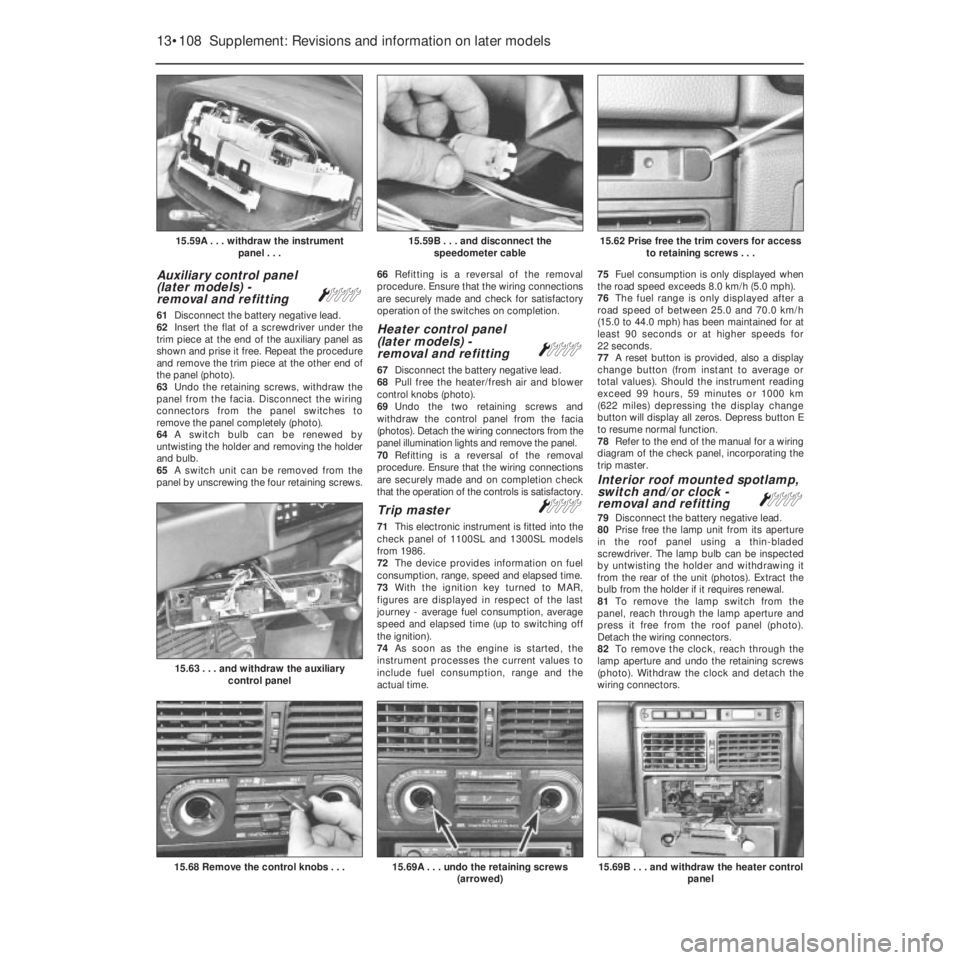
the panel (photo).
63Undo the retaining screws, withdraw the
panel from the facia. Disconnect the wiring
connectors from the panel switches to
remove the panel completely (photo).
64A switch bulb can be renewed by
untwisting the holder and removing the holder
and bulb.
65A switch unit can be removed from the
panel by unscrewing the four retaining screws.66Refitting is a reversal of the removal
procedure. Ensure that the wiring connections
are securely made and check for satisfactory
operation of the switches on completion.
Heater control panel
(later models) -
removal and refitting
Á
67Disconnect the battery negative lead.
68Pull free the heater/fresh air and blower
control knobs (photo).
69Undo the two retaining screws and
withdraw the control panel from the facia
(photos). Detach the wiring connectors from the
panel illumination lights and remove the panel.
70Refitting is a reversal of the removal
procedure. Ensure that the wiring connections
are securely made and on completion check
that the operation of the controls is satisfactory.
Trip master Á
71This electronic instrument is fitted into the
check panel of 1100SL and 1300SL models
from 1986.
72The device provides information on fuel
consumption, range, speed and elapsed time.
73With the ignition key turned to MAR,
figures are displayed in respect of the last
journey - average fuel consumption, average
speed and elapsed time (up to switching off
the ignition).
74As soon as the engine is started, the
instrument processes the current values to
include fuel consumption, range and the
actual time. 75Fuel consumption is only displayed when
the road speed exceeds 8.0 km/h (5.0 mph).
76The fuel range is only displayed after a
road speed of between 25.0 and 70.0 km/h
(15.0 to 44.0 mph) has been maintained for at
least 90 seconds or at higher speeds for
22 seconds.
77A reset button is provided, also a display
change button (from instant to average or
total values). Should the instrument reading
exceed 99 hours, 59 minutes or 1000 km
(622 miles) depressing the display change
button will display all zeros. Depress button E
to resume normal function.
78Refer to the end of the manual for a wiring
diagram of the check panel, incorporating the
trip master.
Interior roof mounted spotlamp,
switch and/or clock -
removal and refitting
Á
79Disconnect the battery negative lead.
80Prise free the lamp unit from its aperture
in the roof panel using a thin-bladed
screwdriver. The lamp bulb can be inspected
by untwisting the holder and withdrawing it
from the rear of the unit (photos). Extract the
bulb from the holder if it requires renewal.
81To remove the lamp switch from the
panel, reach through the lamp aperture and
press it free from the roof panel (photo).
Detach the wiring connectors.
82To remove the clock, reach through the
lamp aperture and undo the retaining screws
(photo). Withdraw the clock and detach the
wiring connectors.
13•108 Supplement: Revisions and information on later models
15.69B . . . and withdraw the heater control
panel15.69A . . . undo the retaining screws
(arrowed)15.68 Remove the control knobs . . .
15.63 . . . and withdraw the auxiliary
control panel
15.62 Prise free the trim covers for access
to retaining screws . . .15.59B . . . and disconnect the
speedometer cable15.59A . . . withdraw the instrument
panel . . .
Page 234 of 303
83Refitting is a reversal of the removal
procedure. Reset the clock on completion.
Central door locking system
84Certain later models, equipped with a
central door locking system, have an infra-red
remote control for opening the door locks.
85It is important that the battery used in the
hand control is renewed when necessary with
one of identical type (Duracell 7H34). This is
only available as a FIAT spare part (No
7595393).
86The remote control door lock receiver unit
can be removed by carefully prising it free
from the roof panel and disconnecting the
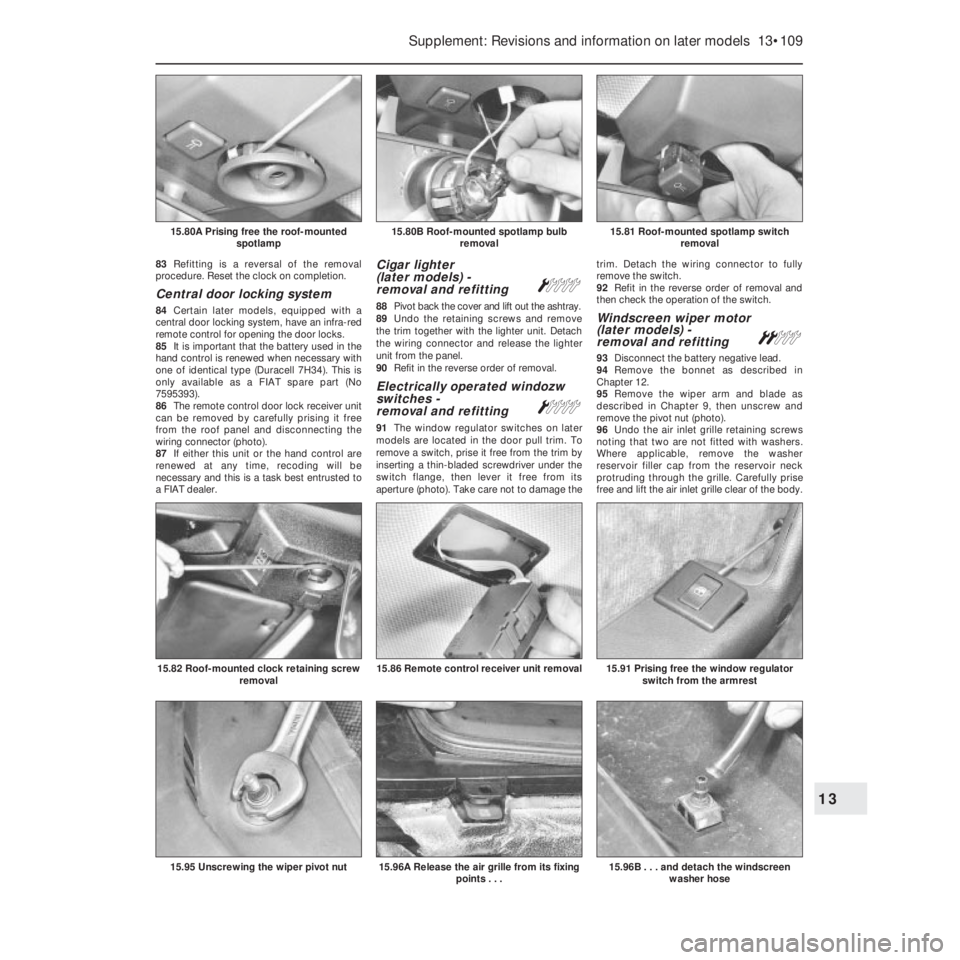
wiring connector (photo).
87If either this unit or the hand control are
renewed at any time, recoding will be
necessary and this is a task best entrusted to
a FIAT dealer.
Cigar lighter
(later models) -
removal and refitting
Á
88Pivot back the cover and lift out the ashtray.
89Undo the retaining screws and remove
the trim together with the lighter unit. Detach
the wiring connector and release the lighter
unit from the panel.
90Refit in the reverse order of removal.
Electrically operated windozw
switches -
removal and refitting
Á
91The window regulator switches on later
models are located in the door pull trim. To
remove a switch, prise it free from the trim by
inserting a thin-bladed screwdriver under the
switch flange, then lever it free from its
aperture (photo). Take care not to damage thetrim. Detach the wiring connector to fully
remove the switch.
92Refit in the reverse order of removal and
then check the operation of the switch.
Windscreen wiper motor
(later models) -
removal and refitting
ª
93Disconnect the battery negative lead.
94Remove the bonnet as described in
Chapter 12.
95Remove the wiper arm and blade as
described in Chapter 9, then unscrew and
remove the pivot nut (photo).
96Undo the air inlet grille retaining screws
noting that two are not fitted with washers.
Where applicable, remove the washer
reservoir filler cap from the reservoir neck
protruding through the grille. Carefully prise
free and lift the air inlet grille clear of the body.
Supplement: Revisions and information on later models 13•109
15.81 Roof-mounted spotlamp switch
removal15.80B Roof-mounted spotlamp bulb
removal15.80A Prising free the roof-mounted
spotlamp
15.96B . . . and detach the windscreen
washer hose15.96A Release the air grille from its fixing
points . . .15.95 Unscrewing the wiper pivot nut
15.91 Prising free the window regulator
switch from the armrest15.86 Remote control receiver unit removal15.82 Roof-mounted clock retaining screw
removal
13
Page 236 of 303
Door closure sensor
117The sensor consists of a microswitch
within the lock. The switch actuates the
warning lamp according to whether the lock is
in the open or closed mode.
Check control system sensors -
testing
Brake fluid level sensor
118With the fluid level correct, switch on the
ignition and depress the centre of the
reservoir cap. If the sensor switches are
working correctly, then “FAULT” should be
indicated on the check panel.
Coolant level sensor
119With the coolant level in the expansion
tank correct, switch on the ignition and then
pull the wiring plug from the sensor. “FAULT”
should be indicated on the check panel. If it is
not, then it is the panel which is faulty.
120An ohmmeter should be used to check
for continuity, holding the float in both the full
and low level positions.
Engine oil level sensor
121With the oil level correct, disconnect the
wiring plug from the dipstick, and then bridge
the plug terminals (not dipstick side) with a 12
ohm resistor. Switch on the ignition.
122If the red light on the check panel goes
out, then the fault is due to the sensor.
123If the light stays on, then it is the check
panel module which is faulty.
Door closure sensor
124Any fault in the lock microswitch can best
be detected using an ohmmeter.
16 Suspension
Front anti-roll bar -
removal and refittingª
1A front anti-roll bar is fitted to the 1301 cc,
1372 cc ie and 1372 cc Turbo ie engined
models. Removal of the bar on all models isas follows. Firstly loosen off the front
roadwheel bolts, then raise the front of the
car, securely support it on axle stands and
remove the front roadwheels.
2Disconnect the two gearchange rods from
the transmission.
3Unbolt and disconnect the anti-roll bar
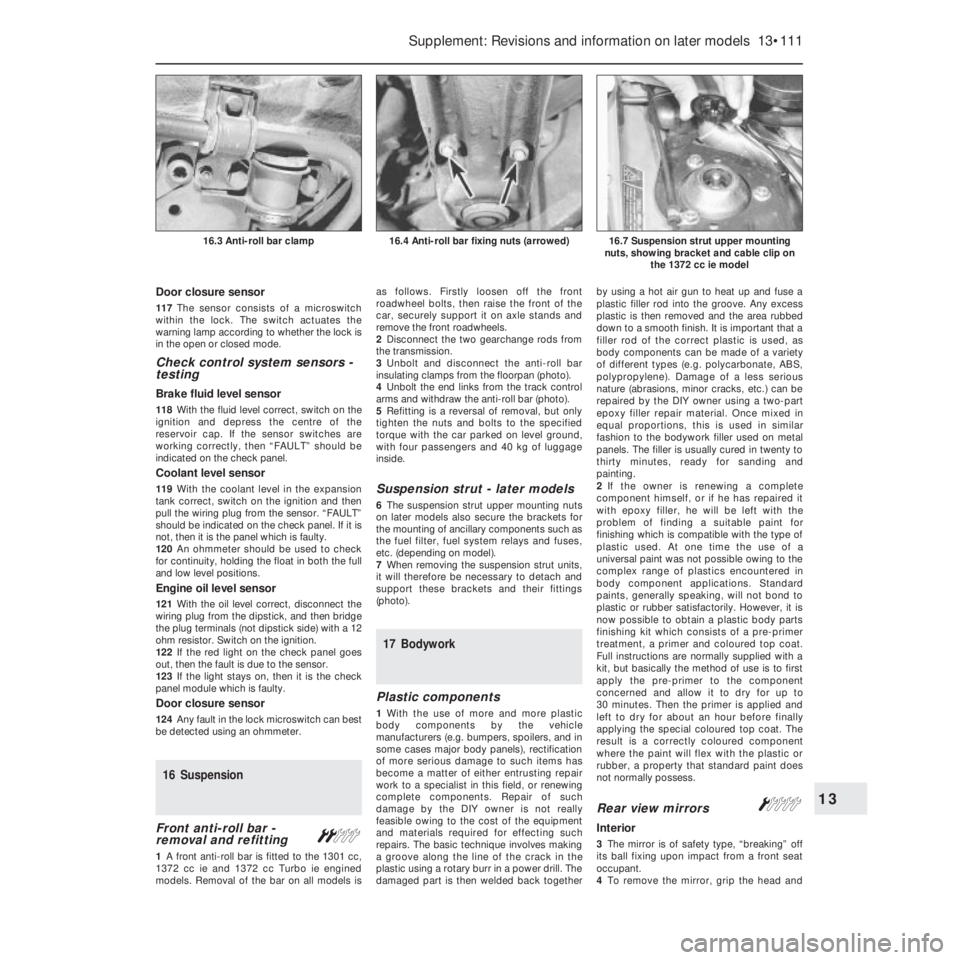
insulating clamps from the floorpan (photo).
4Unbolt the end links from the track control
arms and withdraw the anti-roll bar (photo).
5Refitting is a reversal of removal, but only
tighten the nuts and bolts to the specified
torque with the car parked on level ground,
with four passengers and 40 kg of luggage
inside.
Suspension strut - later models
6The suspension strut upper mounting nuts
on later models also secure the brackets for
the mounting of ancillary components such as
the fuel filter, fuel system relays and fuses,
etc. (depending on model).
7When removing the suspension strut units,
it will therefore be necessary to detach and
support these brackets and their fittings
(photo).
17 Bodywork
Plastic components
1With the use of more and more plastic
body components by the vehicle
manufacturers (e.g. bumpers, spoilers, and in
some cases major body panels), rectification
of more serious damage to such items has
become a matter of either entrusting repair
work to a specialist in this field, or renewing
complete components. Repair of such
damage by the DIY owner is not really
feasible owing to the cost of the equipment
and materials required for effecting such
repairs. The basic technique involves making
a groove along the line of the crack in the
plastic using a rotary burr in a power drill. The
damaged part is then welded back togetherby using a hot air gun to heat up and fuse a
plastic filler rod into the groove. Any excess
plastic is then removed and the area rubbed
down to a smooth finish. It is important that a
filler rod of the correct plastic is used, as
body components can be made of a variety
of different types (e.g. polycarbonate, ABS,
polypropylene). Damage of a less serious
nature (abrasions, minor cracks, etc.) can be
repaired by the DIY owner using a two-part
epoxy filler repair material. Once mixed in
equal proportions, this is used in similar
fashion to the bodywork filler used on metal
panels. The filler is usually cured in twenty to
thirty minutes, ready for sanding and
painting.
2If the owner is renewing a complete
component himself, or if he has repaired it
with epoxy filler, he will be left with the
problem of finding a suitable paint for
finishing which is compatible with the type of
plastic used. At one time the use of a
universal paint was not possible owing to the
complex range of plastics encountered in
body component applications. Standard
paints, generally speaking, will not bond to
plastic or rubber satisfactorily. However, it is
now possible to obtain a plastic body parts
finishing kit which consists of a pre-primer
treatment, a primer and coloured top coat.
Full instructions are normally supplied with a
kit, but basically the method of use is to first
apply the pre-primer to the component
concerned and allow it to dry for up to
30 minutes. Then the primer is applied and
left to dry for about an hour before finally
applying the special coloured top coat. The
result is a correctly coloured component
where the paint will flex with the plastic or
rubber, a property that standard paint does
not normally possess.
Rear view mirrors Á
Interior
3The mirror is of safety type, “breaking” off
its ball fixing upon impact from a front seat
occupant.
4To remove the mirror, grip the head and
Supplement: Revisions and information on later models 13•111
16.7 Suspension strut upper mounting
nuts, showing bracket and cable clip on
the 1372 cc ie model16.4 Anti-roll bar fixing nuts (arrowed)16.3 Anti-roll bar clamp
13
Page 241 of 303
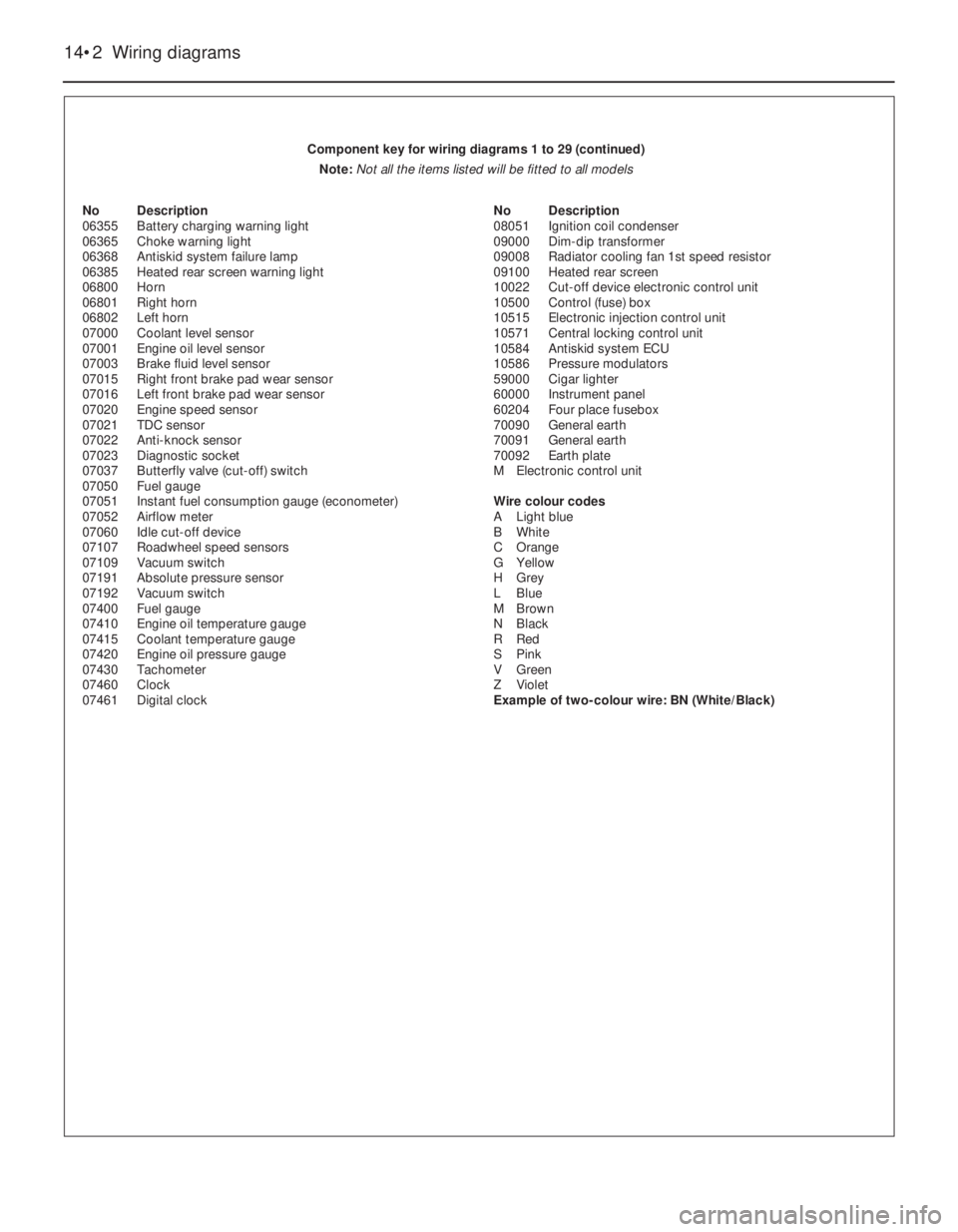
14•2 Wiring diagrams
No Description
06355 Battery charging warning light
06365 Choke warning light
06368 Antiskid system failure lamp
06385 Heated rear screen warning light
06800 Horn
06801 Right horn
06802 Left horn
07000 Coolant level sensor
07001 Engine oil level sensor
07003 Brake fluid level sensor
07015 Right front brake pad wear sensor
07016 Left front brake pad wear sensor
07020 Engine speed sensor
07021 TDC sensor
07022 Anti-knock sensor
07023 Diagnostic socket
07037 Butterfly valve (cut-off) switch
07050 Fuel gauge
07051 Instant fuel consumption gauge (econometer)
07052 Airflow meter
07060 Idle cut-off device
07107 Roadwheel speed sensors
07109 Vacuum switch
07191 Absolute pressure sensor
07192 Vacuum switch
07400 Fuel gauge
07410 Engine oil temperature gauge
07415 Coolant temperature gauge
07420 Engine oil pressure gauge
07430 Tachometer
07460 Clock
07461 Digital clockNo Description
08051 Ignition coil condenser
09000 Dim-dip transformer
09008 Radiator cooling fan 1st speed resistor
09100 Heated rear screen
10022 Cut-off device electronic control unit
10500 Control (fuse) box
10515 Electronic injection control unit
10571 Central locking control unit
10584 Antiskid system ECU
10586 Pressure modulators
59000 Cigar lighter
60000 Instrument panel
60204 Four place fusebox
70090 General earth
70091 General earth
70092 Earth plate
M Electronic control unit
Wire colour codes
A Light blue
B White
C Orange
G Yellow
H Grey
L Blue
M Brown
N Black
R Red
S Pink
V Green
Z Violet
Example of two-colour wire: BN (White/Black) Component key for wiring diagrams 1 to 29 (continued)
Note: Not all the items listed will be fitted to all models
Page 244 of 303
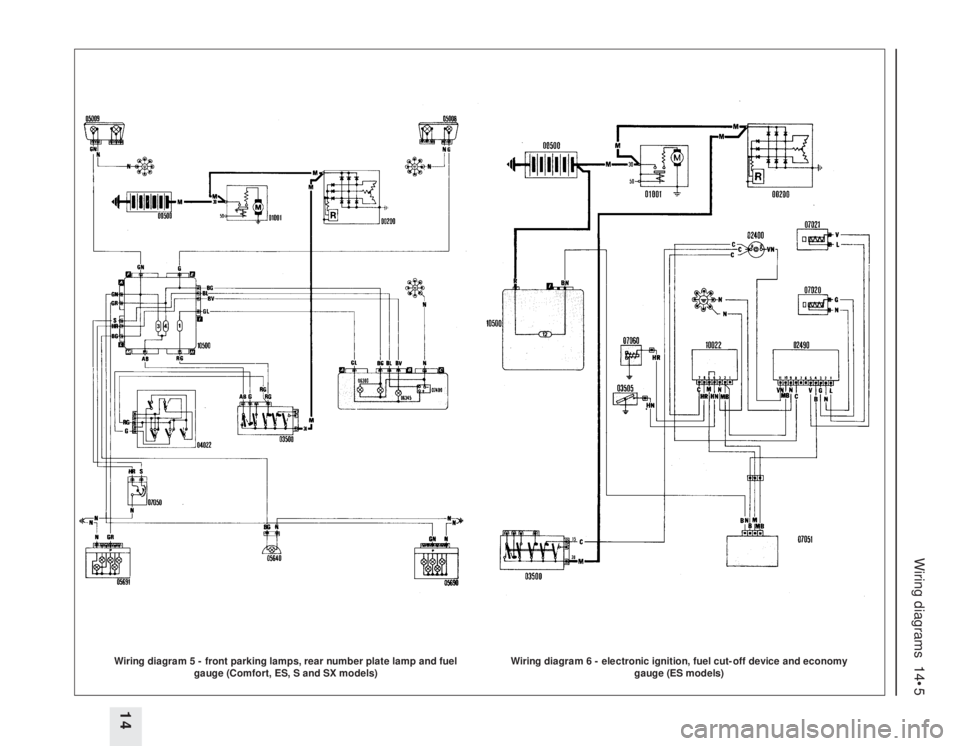
Wiring diagrams 14•5
14Wiring diagram 5 - front parking lamps, rear number plate lamp and fuel
gauge (Comfort, ES, S and SX models)
Wiring diagram 6 - electronic ignition, fuel cut-off device and economy
gauge (ES models)
Page 287 of 303
REF•4MOT Test Checks
MExamine the handbrake mechanism,
checking for frayed or broken cables,
excessive corrosion, or wear or insecurity of
the linkage. Check that the mechanism works
on each relevant wheel, and releases fully,
without binding.
MIt is not possible to test brake efficiency
without special equipment, but a road test can
be carried out later to check that the vehicle
pulls up in a straight line.
Fuel and exhaust systems
MInspect the fuel tank (including the filler
cap), fuel pipes, hoses and unions. All
components must be secure and free from
leaks.
MExamine the exhaust system over its entire
length, checking for any damaged, broken or
missing mountings, security of the retaining
clamps and rust or corrosion.
Wheels and tyres
MExamine the sidewalls and tread area of
each tyre in turn. Check for cuts, tears, lumps,
bulges, separation of the tread, and exposure
of the ply or cord due to wear or damage.
Check that the tyre bead is correctly seated
on the wheel rim, that the valve is sound andproperly seated, and that the wheel is not
distorted or damaged.
MCheck that the tyres are of the correct size
for the vehicle, that they are of the same size
and type on each axle, and that the pressures
are correct.
MCheck the tyre tread depth. The legal
minimum at the time of writing is 1.6 mm over
at least three-quarters of the tread width.
Abnormal tread wear may indicate incorrect
front wheel alignment.
Body corrosion
MCheck the condition of the entire vehicle
structure for signs of corrosion in load-bearing
areas. (These include chassis box sections,
side sills, cross-members, pillars, and all
suspension, steering, braking system and
seat belt mountings and anchorages.) Any
corrosion which has seriously reduced the
thickness of a load-bearing area is likely to
cause the vehicle to fail. In this case
professional repairs are likely to be needed.
MDamage or corrosion which causes sharp
or otherwise dangerous edges to be exposed
will also cause the vehicle to fail.
Petrol models
MHave the engine at normal operating
temperature, and make sure that it is in good
tune (ignition system in good order, air filter
element clean, etc).
MBefore any measurements are carried out,
raise the engine speed to around 2500 rpm,
and hold it at this speed for 20 seconds. Allowthe engine speed to return to idle, and watch
for smoke emissions from the exhaust
tailpipe. If the idle speed is obviously much
too high, or if dense blue or clearly-visible
black smoke comes from the tailpipe for more
than 5 seconds, the vehicle will fail. As a rule
of thumb, blue smoke signifies oil being burnt
(engine wear) while black smoke signifies
unburnt fuel (dirty air cleaner element, or other
carburettor or fuel system fault).
MAn exhaust gas analyser capable of
measuring carbon monoxide (CO) and
hydrocarbons (HC) is now needed. If such an
instrument cannot be hired or borrowed, a
local garage may agree to perform the check
for a small fee.
CO emissions (mixture)
MAt the time of writing, the maximum CO
level at idle is 3.5% for vehicles first used after
August 1986 and 4.5% for older vehicles.
From January 1996 a much tighter limit
(around 0.5%) applies to catalyst-equipped
vehicles first used from August 1992. If the
CO level cannot be reduced far enough to
pass the test (and the fuel and ignition
systems are otherwise in good condition) then
the carburettor is badly worn, or there is some
problem in the fuel injection system or
catalytic converter (as applicable).
HC emissionsMWith the CO emissions within limits, HC
emissions must be no more than 1200 ppm
(parts per million). If the vehicle fails this test
at idle, it can be re-tested at around 2000 rpm;
if the HC level is then 1200 ppm or less, this
counts as a pass.
MExcessive HC emissions can be caused by
oil being burnt, but they are more likely to be
due to unburnt fuel.
Diesel models
MThe only emission test applicable to Diesel
engines is the measuring of exhaust smoke
density. The test involves accelerating the
engine several times to its maximum
unloaded speed.
Note: It is of the utmost importance that the
engine timing belt is in good condition before
the test is carried out.
M
Excessive smoke can be caused by a dirty
air cleaner element. Otherwise, professional
advice may be needed to find the cause.
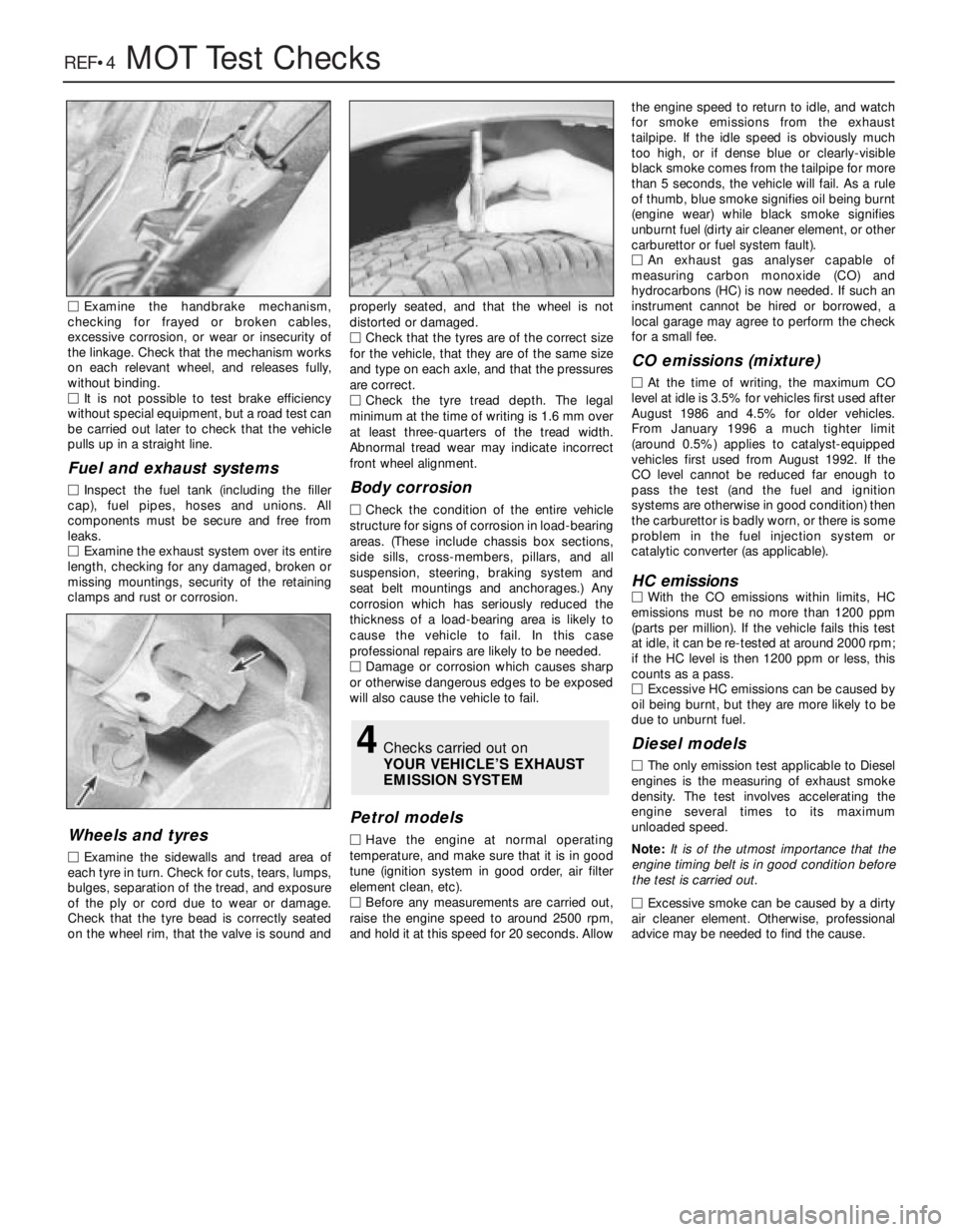
4Checks carried out on
YOUR VEHICLE’S EXHAUST
EMISSION SYSTEM
Page 288 of 303
Introduction
A selection of good tools is a fundamental
requirement for anyone contemplating the
maintenance and repair of a motor vehicle.
For the owner who does not possess any,
their purchase will prove a considerable
expense, offsetting some of the savings made
by doing-it-yourself. However, provided that
the tools purchased meet the relevant national
safety standards and are of good quality, they
will last for many years and prove an
extremely worthwhile investment.
To help the average owner to decide which
tools are needed to carry out the various tasks
detailed in this manual, we have compiled
three lists of tools under the following
headings: Maintenance and minor repair,
Repair and overhaul, and Special. Newcomers
to practical mechanics should start off with
the Maintenance and minor repairtool kit, and
confine themselves to the simpler jobs around
the vehicle. Then, as confidence and
experience grow, more difficult tasks can be
undertaken, with extra tools being purchased
as, and when, they are needed. In this way, a
Maintenance and minor repairtool kit can be
built up into a Repair and overhaultool kit over
a considerable period of time, without any
major cash outlays. The experienced do-it-
yourselfer will have a tool kit good enough for
most repair and overhaul procedures, and will
add tools from the Specialcategory when it is
felt that the expense is justified by the amount
of use to which these tools will be put.
Maintenance and minor repair
tool kit
The tools given in this list should be
considered as a minimum requirement if
routine maintenance, servicing and minor
repair operations are to be undertaken. We
recommend the purchase of combination
spanners (ring one end, open-ended the
other); although more expensive than open-
ended ones, they do give the advantages of
both types of spanner.
MCombination spanners: 8, 9, 10, 11, 12, 13,
14, 15, 16, 17, 19, 21, 22, 24 & 26 mm
MAdjustable spanner - 35 mm jaw (approx)
MSet of feeler gauges
MSpark plug spanner (with rubber insert)
MSpark plug gap adjustment tool
MBrake bleed nipple spannerMScrewdrivers: Flat blade and cross blade –
approx 100 mm long x 6 mm dia
MCombination pliers
MHacksaw (junior)
MTyre pump
MTyre pressure gauge
MOil can
MOil filter removal tool
MFine emery cloth
MWire brush (small)
MFunnel (medium size)
Repair and overhaul tool kit
These tools are virtually essential for
anyone undertaking any major repairs to a
motor vehicle, and are additional to those
given in the Maintenance and minor repairlist.
Included in this list is a comprehensive set of
sockets. Although these are expensive, they
will be found invaluable as they are so
versatile - particularly if various drives are
included in the set. We recommend the half-
inch square-drive type, as this can be used
with most proprietary torque wrenches. If you
cannot afford a socket set, even bought
piecemeal, then inexpensive tubular box
spanners are a useful alternative.
The tools in this list will occasionally need
to be supplemented by tools from the Special
list:
MSockets (or box spanners) to cover range in
previous list
MReversible ratchet drive (for use with
sockets) (see illustration)
MExtension piece, 250 mm (for use with
sockets)
MUniversal joint (for use with sockets)
MTorque wrench (for use with sockets)
MSelf-locking grips
MBall pein hammer
MSoft-faced mallet (plastic/aluminium or
rubber)
MScrewdrivers:
Flat blade - long & sturdy, short (chubby),
and narrow (electrician’s) types
Cross blade - Long & sturdy, and short
(chubby) types
MPliers:
Long-nosed
Side cutters (electrician’s)
Circlip (internal and external)
MCold chisel - 25 mm
MScriber
MScraperMCentre-punch
MPin punch
MHacksaw
MBrake hose clamp
MBrake bleeding kit
MSelection of twist drills
MSteel rule/straight-edge
MAllen keys
MSelection of files
MWire brush
MAxle stands
MJack (strong trolley or hydraulic type)
MLight with extension lead
Special tools
The tools in this list are those which are not
used regularly, are expensive to buy, or which
need to be used in accordance with their
manufacturers’ instructions. Unless relatively
difficult mechanical jobs are undertaken
frequently, it will not be economic to buy
many of these tools. Where this is the case,
you could consider clubbing together with
friends (or joining a motorists’ club) to make a
joint purchase, or borrowing the tools against
a deposit from a local garage or tool hire
specialist. It is worth noting that many of the
larger DIY superstores now carry a large
range of special tools for hire at modest rates.
The following list contains only those tools
and instruments freely available to the public,
and not those special tools produced by the
vehicle manufacturer specifically for its dealer
network. You will find occasional references
to these manufacturers’ special tools in the
text of this manual. Generally, an alternative
method of doing the job without the vehicle
manufacturers’ special tool is given. However,
sometimes there is no alternative to using
them. Where this is the case and the relevant
tool cannot be bought or borrowed, you will
have to entrust the work to a franchised
garage.
MValve spring compressor (see illustration)
MValve grinding tool
MPiston ring compressor (see illustration)
MPiston ring removal/installation tool (see
illustration)
MCylinder bore hone (see illustration)
MBalljoint separator
MCoil spring compressors (where applicable)
MTwo/three-legged hub and bearing puller
(see illustration)
Tools and Working FacilitiesREF•5
REF
Page 292 of 303
Fault FindingREF•9
REF
Introduction
The vehicle owner who does his or her own
maintenance according to the recommended
schedules should not have to use this section
of the manual very often. Modern component
reliability is such that, provided those items
subject to wear or deterioration are inspected
or renewed at the specified intervals, sudden
failure is comparatively rare. Faults do not
usually just happen as a result of sudden
failure, but develop over a period of time.
Major mechanical failures in particular are
usually preceded by characteristic symptoms
over hundreds or even thousands of miles.
Those components which do occasionally fail
without warning are often small and easily
carried in the vehicle.
With any fault finding, the first step is to
decide where to begin investigations.
Sometimes this is obvious, but on other
occasions a little detective work will be
necessary. The owner who makes half a
dozen haphazard adjustments or
replacements may be successful in curing a
fault (or its symptoms), but he will be none the
wiser if the fault recurs and he may well have
spent more time and money than was
necessary. A calm and logical approach will
be found to be more satisfactory in the long
run. Always take into account any warning
signs or abnormalities that may have been
noticed in the period preceding the fault –
power loss, high or low gauge readings,
unusual noises or smells, etc – and remember
that failure of components such as fuses or
spark plugs may only be pointers to some
underlying fault.
The pages which follow here are intended
to help in cases of failure to start or
breakdown on the road. There is also a Fault
Diagnosis Section at the end of each Chapter
which should be consulted if the preliminary
checks prove unfruitful. Whatever the fault,
certain basic principles apply. These are as
follows:Verify the fault. This is simply a matter of
being sure that you know what the symptoms
are before starting work. This is particularly
important if you are investigating a fault for
someone else who may not have described it
very accurately.
Don’t overlook the obvious. For example,
if the vehicle won’t start, is there petrol in the
tank? (Don’t take anyone else’s word on this
particular point, and don’t trust the fuel gauge
either!) If an electrical fault is indicated, look
for loose or broken wires before digging out
the test gear.
Cure the disease, not the symptom.
Substituting a flat battery with a fully charged
one will get you off the hard shoulder, but if
the underlying cause is not attended to,the
new battery will go the same way. Similarly,
changing oil-fouled spark plugs for a new set
will get you moving again, but remember that
the reason for the fouling (if it wasn’t simply an
incorrect grade of plug) will have to be
established and corrected.
Don’t take anything for granted.
Particularly, don’t forget that a ‘new’
component may itself be defective (especially
if it’s been rattling round in the boot for
months), and don’t leave components out of a
fault diagnosis sequence just because they
are new or recently fitted. When you do finally
diagnose a difficult fault, you’ll probably
realise that all the evidence was there from
the start.
Electrical faults
Electrical faults can be more puzzling than
straightforward mechanical failures, but they
are no less susceptible to logical analysis if
the basic principles of operation are
understood. Vehicle electrical wiring exists in
extremely unfavourable conditions – heat,
vibration and chemical attack and the first
things to look for are loose or corroded
connections and broken or chafed wires,especially where the wires pass through holes
in the bodywork or are subject to vibration.
All metal-bodied vehicles in current
production have one pole of the battery
‘earthed’, ie connected to the vehicle
bodywork, and in nearly all modern vehicles it
is the negative (–) terminal. The various
electrical components – motors, bulb holders,
etc – are also connected to earth, either by
means of a lead or directly by their mountings.
Electric current flows through the component
and then back to the battery via the
bodywork. If the component mounting is
loose or corroded, or if a good path back to
the battery is not available, the circuit will be
incomplete and malfunction will result. The
engine and/or gearbox are also earthed by
means of flexible metal straps to the body or
subframe; if these straps are loose or missing,
starter motor, generator and ignition trouble
may result.
Assuming the earth return to be
satisfactory, electrical faults will be due either
to component malfunction or to defects in the
current supply. Individual components are
dealt with in Chapter 9. If supply wires are
broken or cracked internally this results in an
open-circuit, and the easiest way to check for
this is to bypass the suspect wire temporarily
with a length of wire having a crocodile clip or
suitable connector at each end. Alternatively,
a 12V test lamp can be used to verify the
presence of supply voltage at various points
along the wire and the break can be thus
isolated.
If a bare portion of a live wire touches the
bodywork or other earthed metal part, the
electricity will take the low-resistance path
thus formed back to the battery: this is known
as a short-circuit. Hopefully a short-circuit will
blow a fuse, but otherwise it may cause
burning of the insulation (and possibly further
short-circuits) or even a fire. This is why it is
inadvisable to bypass persistently blowing
fuses with silver foil or wire.
Page 295 of 303
Buying spare parts
Spare parts are available from many
sources, for example, FIAT garages, other
garages and accessory shops, and motor
factors. Our advice regarding spare parts is as
follows:
Officially appointed FIAT garages -This is
the best source of parts which are peculiar to
your car and otherwise not generally available
(eg complete cylinder heads, internal gearbox
components, badges, interior trim etc). It is
also the only place at which you should buy
parts if your vehicle is still under warranty;
non-FlAT components may invalidate the
warranty. To be sure of obtaining the correct
parts it will always be necessary to give the
partsman your car’s engine number, chassis
number and number for spares, and if
possible, to take the old part along for positive
identification. Many parts are available under
a factory exchange scheme - any parts
returned should always be clean. It obviously
makes good sense to go straight to the
specialists on your car for this type of part for
they are best equipped to supply you. They
will also be able to provide their own FIATservice manual for your car should you require
one.
Other garages and accessory shops - These
are often very good places to buy material
and components needed for the maintenance
of your car (eg oil filters, spark plugs, bulbs,
drivebelts, oils and grease, touch-up paint,
filler paste etc). They also sell accessories,
usually have convenient opening hours,
charge lower prices and can often be found
not far from home.
Motor factors - Good factors stock all of the
more important components which wear out
relatively quickly (eg clutch components,
pistons, valves, exhaust systems, brake
pipes/seals/shoes and pads etc). Motor
factors will often provide new or reconditioned
components on a part exchange basis - this
can save a considerable amount of money.
Vehicle identification
numbers
Modifications are a continuing and
unpublicised process in vehicle manufacture
quite apart from major model changes. Spareparts manuals and lists are compiled upon a
numerical basis, the individual vehicle
numbers being essential to correct identifi-
cation of the component required.
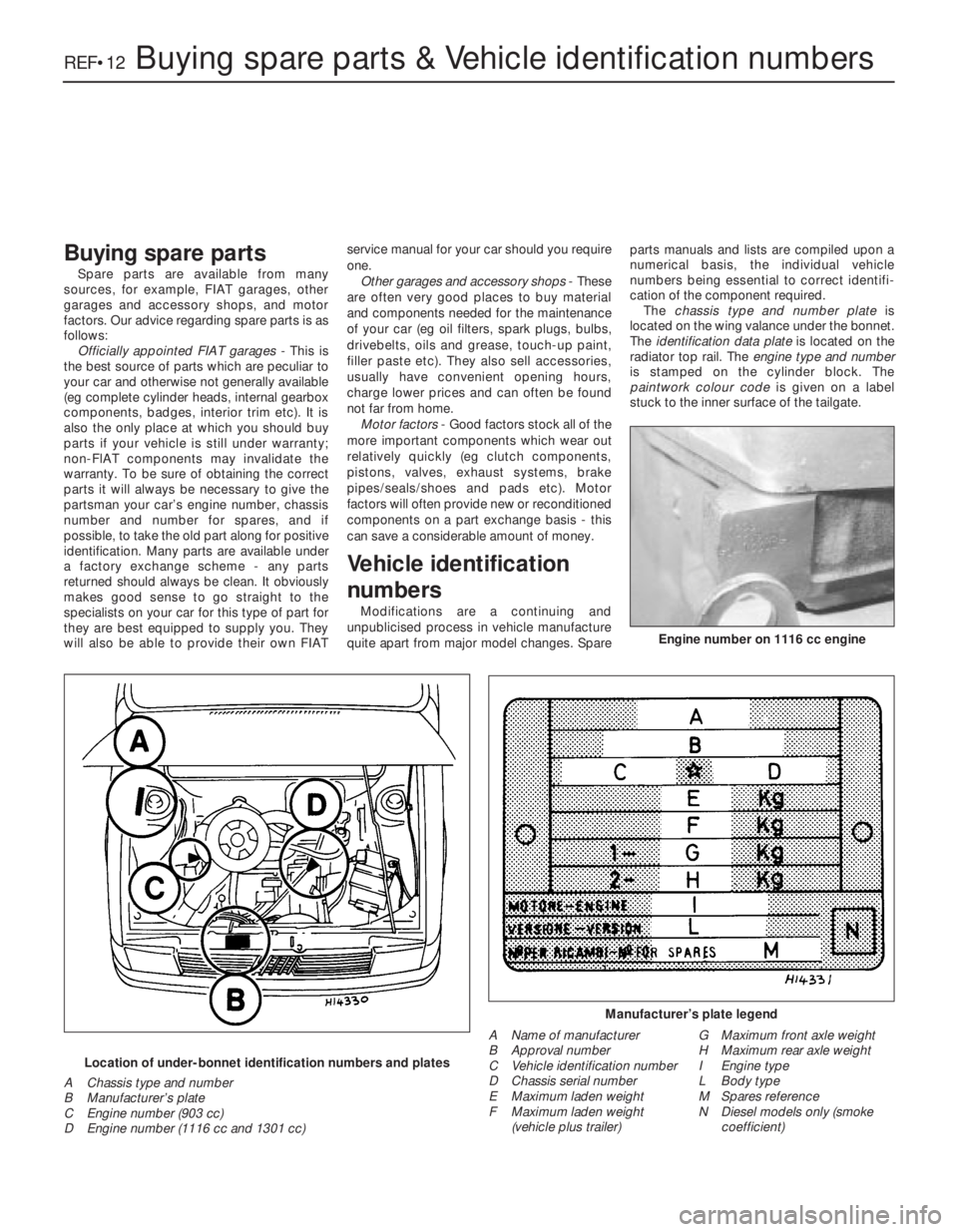
The chassis type and number plate is
located on the wing valance under the bonnet.
The identification data plate is located on the
radiator top rail. The engine type and number
is stamped on the cylinder block. The
paintwork colour code is given on a label
stuck to the inner surface of the tailgate.
REF•12Buying spare parts & Vehicle identification numbers
Manufacturer’s plate legend
Location of under-bonnet identification numbers and plates
A Chassis type and number
B Manufacturer’s plate
C Engine number (903 cc)
D Engine number (1116 cc and 1301 cc)
Engine number on 1116 cc engine
A Name of manufacturer
B Approval number
C Vehicle identification number
D Chassis serial number
E Maximum laden weight
F Maximum laden weight
(vehicle plus trailer)G Maximum front axle weight
H Maximum rear axle weight
I Engine type
L Body type
M Spares reference
N Diesel models only (smoke
coefficient)