gearbox FIAT UNO 1983 Service User Guide
[x] Cancel search | Manufacturer: FIAT, Model Year: 1983, Model line: UNO, Model: FIAT UNO 1983Pages: 303, PDF Size: 10.36 MB
Page 217 of 303
11 Clutch
Clutch pedal - adjustment
(cable clutch)
Á
1The method of adjusting the clutch has
been revised.
2Fully depress the clutch pedal two or three
times.
3Using a suitable measuring stick placed in
contact with the floor panel (carpet peeled
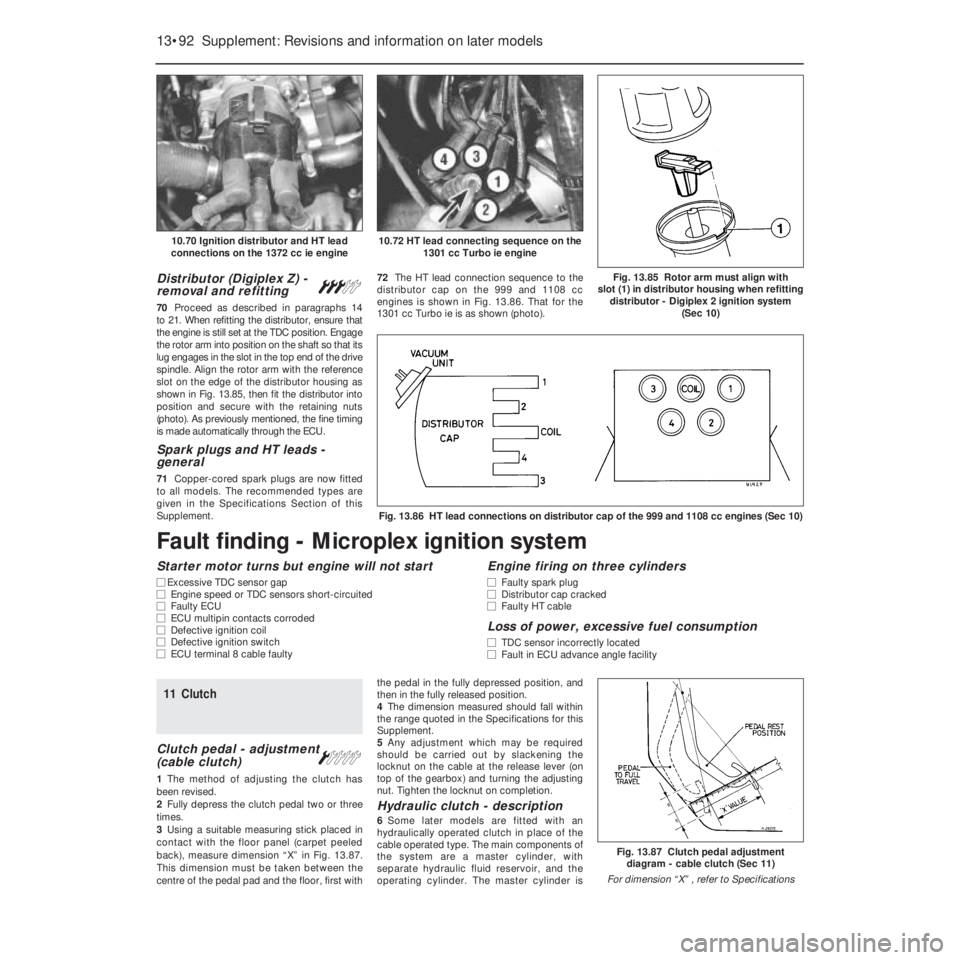
back), measure dimension “X” in Fig. 13.87.
This dimension must be taken between the
centre of the pedal pad and the floor, first withthe pedal in the fully depressed position, and
then in the fully released position.
4The dimension measured should fall within
the range quoted in the Specifications for this
Supplement.
5Any adjustment which may be required
should be carried out by slackening the
locknut on the cable at the release lever (on
top of the gearbox) and turning the adjusting
nut. Tighten the locknut on completion.
Hydraulic clutch - description
6Some later models are fitted with an
hydraulically operated clutch in place of the
cable operated type. The main components of
the system are a master cylinder, with
separate hydraulic fluid reservoir, and the
operating cylinder. The master cylinder is
Distributor (Digiplex Z) -
removal and refitting#
70Proceed as described in paragraphs 14
to 21. When refitting the distributor, ensure that
the engine is still set at the TDC position. Engage
the rotor arm into position on the shaft so that its
lug engages in the slot in the top end of the drive
spindle. Align the rotor arm with the reference
slot on the edge of the distributor housing as
shown in Fig. 13.85, then fit the distributor into
position and secure with the retaining nuts
(photo). As previously mentioned, the fine timing
is made automatically through the ECU.
Spark plugs and HT leads -
general
71Copper-cored spark plugs are now fitted
to all models. The recommended types are
given in the Specifications Section of this
Supplement.72The HT lead connection sequence to the
distributor cap on the 999 and 1108 cc
engines is shown in Fig. 13.86. That for the
1301 cc Turbo ie is as shown (photo).
13•92 Supplement: Revisions and information on later models
Fig. 13.87 Clutch pedal adjustment
diagram - cable clutch (Sec 11)
For dimension “X” , refer to Specifications
Fig. 13.86 HT lead connections on distributor cap of the 999 and 1108 cc engines (Sec 10)
Fig. 13.85 Rotor arm must align with
slot (1) in distributor housing when refitting
distributor - Digiplex 2 ignition system
(Sec 10)
10.72 HT lead connecting sequence on the
1301 cc Turbo ie engine10.70 Ignition distributor and HT lead
connections on the 1372 cc ie engine
Fault finding - Microplex ignition system
Starter motor turns but engine will not start
m mExcessive TDC sensor gap
m mEngine speed or TDC sensors short-circuited
m mFaulty ECU
m mECU multipin contacts corroded
m mDefective ignition coil
m mDefective ignition switch
m mECU terminal 8 cable faulty
Engine firing on three cylinders
m
mFaulty spark plug
m mDistributor cap cracked
m mFaulty HT cable
Loss of power, excessive fuel consumption
m
mTDC sensor incorrectly located
m mFault in ECU advance angle facility
Page 220 of 303
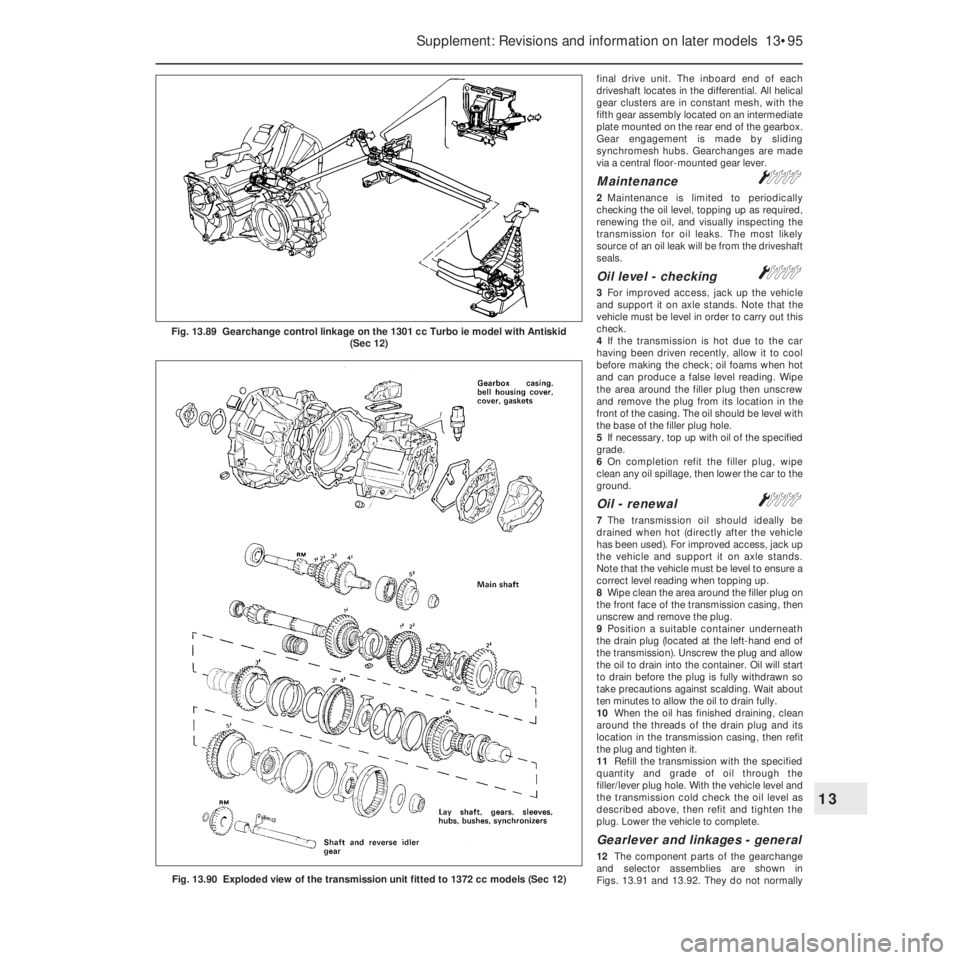
final drive unit. The inboard end of each
driveshaft locates in the differential. All helical
gear clusters are in constant mesh, with the
fifth gear assembly located on an intermediate
plate mounted on the rear end of the gearbox.
Gear engagement is made by sliding
synchromesh hubs. Gearchanges are made
via a central floor-mounted gear lever.
MaintenanceÁ
2Maintenance is limited to periodically
checking the oil level, topping up as required,
renewing the oil, and visually inspecting the
transmission for oil leaks. The most likely
source of an oil leak will be from the driveshaft
seals.
Oil level - checkingÁ
3For improved access, jack up the vehicle
and support it on axle stands. Note that the
vehicle must be level in order to carry out this
check.
4If the transmission is hot due to the car
having been driven recently, allow it to cool
before making the check; oil foams when hot
and can produce a false level reading. Wipe
the area around the filler plug then unscrew
and remove the plug from its location in the
front of the casing. The oil should be level with
the base of the filler plug hole.
5If necessary, top up with oil of the specified
grade.
6On completion refit the filler plug, wipe
clean any oil spillage, then lower the car to the
ground.
Oil - renewalÁ
7The transmission oil should ideally be
drained when hot (directly after the vehicle
has been used). For improved access, jack up
the vehicle and support it on axle stands.
Note that the vehicle must be level to ensure a
correct level reading when topping up.
8Wipe clean the area around the filler plug on
the front face of the transmission casing, then
unscrew and remove the plug.
9Position a suitable container underneath
the drain plug (located at the left-hand end of
the transmission). Unscrew the plug and allow
the oil to drain into the container. Oil will start
to drain before the plug is fully withdrawn so
take precautions against scalding. Wait about
ten minutes to allow the oil to drain fully.
10When the oil has finished draining, clean
around the threads of the drain plug and its
location in the transmission casing, then refit
the plug and tighten it.
11Refill the transmission with the specified
quantity and grade of oil through the
filler/lever plug hole. With the vehicle level and
the transmission cold check the oil level as
described above, then refit and tighten the
plug. Lower the vehicle to complete.
Gearlever and linkages - general
12The component parts of the gearchange
and selector assemblies are shown in
Figs. 13.91 and 13.92. They do not normally
Supplement: Revisions and information on later models 13•95
Fig. 13.90 Exploded view of the transmission unit fitted to 1372 cc models (Sec 12)
13
Fig. 13.89 Gearchange control linkage on the 1301 cc Turbo ie model with Antiskid
(Sec 12)
Page 292 of 303
Fault FindingREF•9
REF
Introduction
The vehicle owner who does his or her own
maintenance according to the recommended
schedules should not have to use this section
of the manual very often. Modern component
reliability is such that, provided those items
subject to wear or deterioration are inspected
or renewed at the specified intervals, sudden
failure is comparatively rare. Faults do not
usually just happen as a result of sudden
failure, but develop over a period of time.
Major mechanical failures in particular are
usually preceded by characteristic symptoms
over hundreds or even thousands of miles.
Those components which do occasionally fail
without warning are often small and easily
carried in the vehicle.
With any fault finding, the first step is to
decide where to begin investigations.
Sometimes this is obvious, but on other
occasions a little detective work will be
necessary. The owner who makes half a
dozen haphazard adjustments or
replacements may be successful in curing a
fault (or its symptoms), but he will be none the
wiser if the fault recurs and he may well have
spent more time and money than was
necessary. A calm and logical approach will
be found to be more satisfactory in the long
run. Always take into account any warning
signs or abnormalities that may have been
noticed in the period preceding the fault –
power loss, high or low gauge readings,
unusual noises or smells, etc – and remember
that failure of components such as fuses or
spark plugs may only be pointers to some
underlying fault.
The pages which follow here are intended
to help in cases of failure to start or
breakdown on the road. There is also a Fault
Diagnosis Section at the end of each Chapter
which should be consulted if the preliminary
checks prove unfruitful. Whatever the fault,
certain basic principles apply. These are as
follows:Verify the fault. This is simply a matter of
being sure that you know what the symptoms
are before starting work. This is particularly
important if you are investigating a fault for
someone else who may not have described it
very accurately.
Don’t overlook the obvious. For example,
if the vehicle won’t start, is there petrol in the
tank? (Don’t take anyone else’s word on this
particular point, and don’t trust the fuel gauge
either!) If an electrical fault is indicated, look
for loose or broken wires before digging out
the test gear.
Cure the disease, not the symptom.
Substituting a flat battery with a fully charged
one will get you off the hard shoulder, but if
the underlying cause is not attended to,the
new battery will go the same way. Similarly,
changing oil-fouled spark plugs for a new set
will get you moving again, but remember that
the reason for the fouling (if it wasn’t simply an
incorrect grade of plug) will have to be
established and corrected.
Don’t take anything for granted.
Particularly, don’t forget that a ‘new’
component may itself be defective (especially
if it’s been rattling round in the boot for
months), and don’t leave components out of a
fault diagnosis sequence just because they
are new or recently fitted. When you do finally
diagnose a difficult fault, you’ll probably
realise that all the evidence was there from
the start.
Electrical faults
Electrical faults can be more puzzling than
straightforward mechanical failures, but they
are no less susceptible to logical analysis if
the basic principles of operation are
understood. Vehicle electrical wiring exists in
extremely unfavourable conditions – heat,
vibration and chemical attack and the first
things to look for are loose or corroded
connections and broken or chafed wires,especially where the wires pass through holes
in the bodywork or are subject to vibration.
All metal-bodied vehicles in current
production have one pole of the battery
‘earthed’, ie connected to the vehicle
bodywork, and in nearly all modern vehicles it
is the negative (–) terminal. The various
electrical components – motors, bulb holders,
etc – are also connected to earth, either by
means of a lead or directly by their mountings.
Electric current flows through the component
and then back to the battery via the
bodywork. If the component mounting is
loose or corroded, or if a good path back to
the battery is not available, the circuit will be
incomplete and malfunction will result. The
engine and/or gearbox are also earthed by
means of flexible metal straps to the body or
subframe; if these straps are loose or missing,
starter motor, generator and ignition trouble
may result.
Assuming the earth return to be
satisfactory, electrical faults will be due either
to component malfunction or to defects in the
current supply. Individual components are
dealt with in Chapter 9. If supply wires are
broken or cracked internally this results in an
open-circuit, and the easiest way to check for
this is to bypass the suspect wire temporarily
with a length of wire having a crocodile clip or
suitable connector at each end. Alternatively,
a 12V test lamp can be used to verify the
presence of supply voltage at various points
along the wire and the break can be thus
isolated.
If a bare portion of a live wire touches the
bodywork or other earthed metal part, the
electricity will take the low-resistance path
thus formed back to the battery: this is known
as a short-circuit. Hopefully a short-circuit will
blow a fuse, but otherwise it may cause
burning of the insulation (and possibly further
short-circuits) or even a fire. This is why it is
inadvisable to bypass persistently blowing
fuses with silver foil or wire.
Page 295 of 303
Buying spare parts
Spare parts are available from many
sources, for example, FIAT garages, other
garages and accessory shops, and motor
factors. Our advice regarding spare parts is as
follows:
Officially appointed FIAT garages -This is
the best source of parts which are peculiar to
your car and otherwise not generally available
(eg complete cylinder heads, internal gearbox
components, badges, interior trim etc). It is
also the only place at which you should buy
parts if your vehicle is still under warranty;
non-FlAT components may invalidate the
warranty. To be sure of obtaining the correct
parts it will always be necessary to give the
partsman your car’s engine number, chassis
number and number for spares, and if
possible, to take the old part along for positive
identification. Many parts are available under
a factory exchange scheme - any parts
returned should always be clean. It obviously
makes good sense to go straight to the
specialists on your car for this type of part for
they are best equipped to supply you. They
will also be able to provide their own FIATservice manual for your car should you require
one.
Other garages and accessory shops - These
are often very good places to buy material
and components needed for the maintenance
of your car (eg oil filters, spark plugs, bulbs,
drivebelts, oils and grease, touch-up paint,
filler paste etc). They also sell accessories,
usually have convenient opening hours,
charge lower prices and can often be found
not far from home.
Motor factors - Good factors stock all of the
more important components which wear out
relatively quickly (eg clutch components,
pistons, valves, exhaust systems, brake
pipes/seals/shoes and pads etc). Motor
factors will often provide new or reconditioned
components on a part exchange basis - this
can save a considerable amount of money.
Vehicle identification
numbers
Modifications are a continuing and
unpublicised process in vehicle manufacture
quite apart from major model changes. Spareparts manuals and lists are compiled upon a
numerical basis, the individual vehicle
numbers being essential to correct identifi-
cation of the component required.
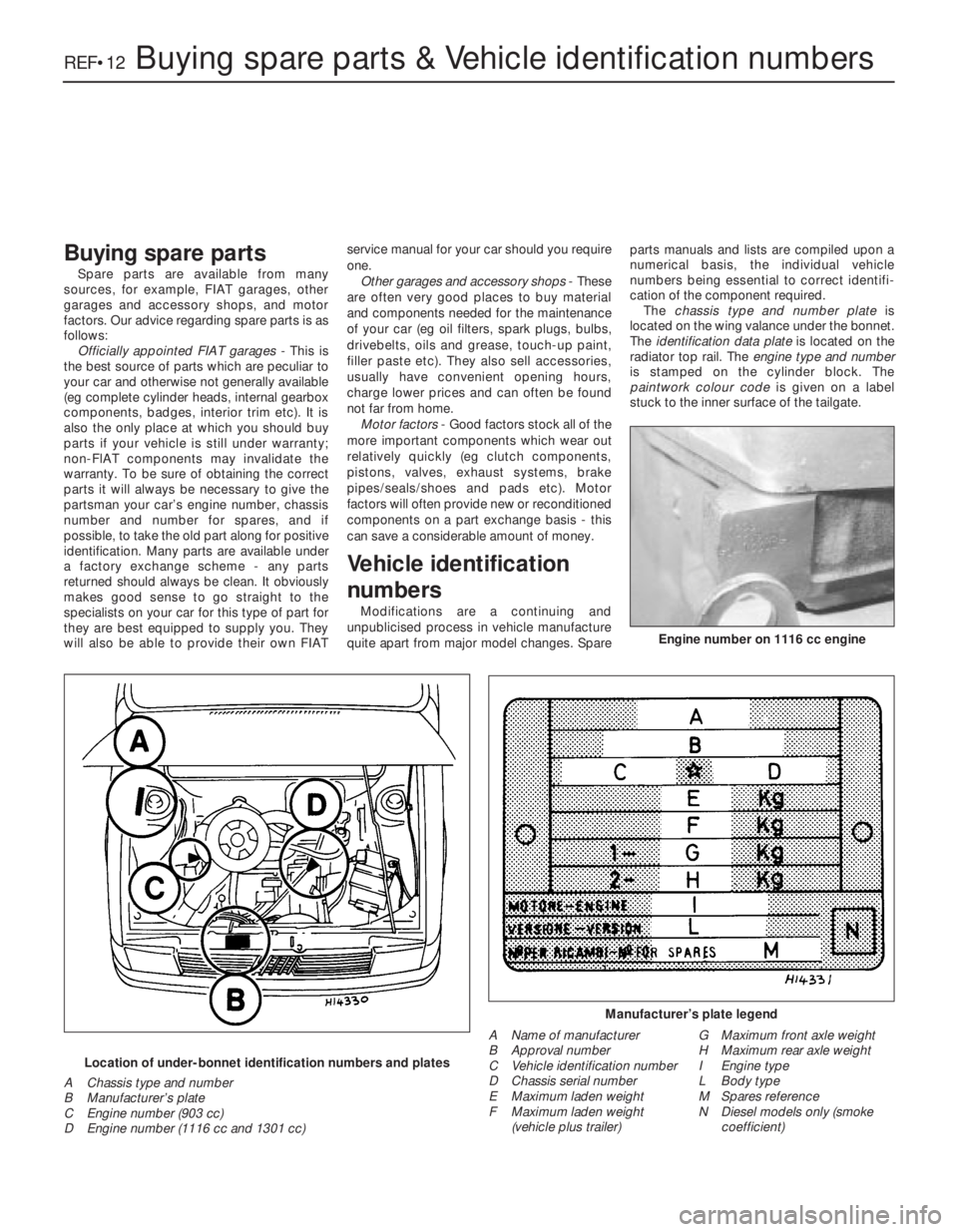
The chassis type and number plate is
located on the wing valance under the bonnet.
The identification data plate is located on the
radiator top rail. The engine type and number
is stamped on the cylinder block. The
paintwork colour code is given on a label
stuck to the inner surface of the tailgate.
REF•12Buying spare parts & Vehicle identification numbers
Manufacturer’s plate legend
Location of under-bonnet identification numbers and plates
A Chassis type and number
B Manufacturer’s plate
C Engine number (903 cc)
D Engine number (1116 cc and 1301 cc)
Engine number on 1116 cc engine
A Name of manufacturer
B Approval number
C Vehicle identification number
D Chassis serial number
E Maximum laden weight
F Maximum laden weight
(vehicle plus trailer)G Maximum front axle weight
H Maximum rear axle weight
I Engine type
L Body type
M Spares reference
N Diesel models only (smoke
coefficient)
Page 301 of 303
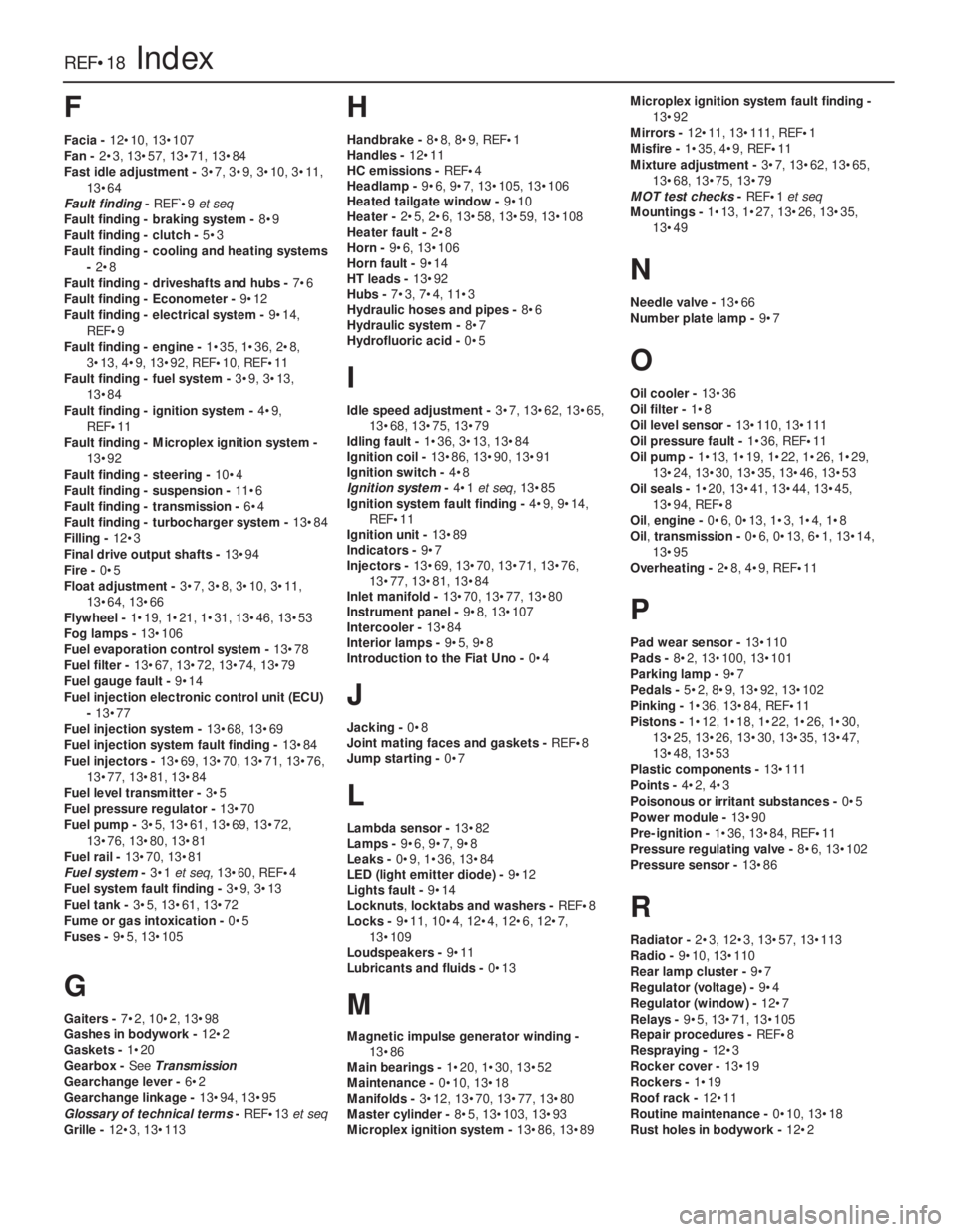
F
Facia - 12•10, 13•107
Fan -2•3, 13•57, 13•71, 13•84
Fast idle adjustment -3•7, 3•9, 3•10, 3•11,
13•64
Fault finding- REF`•9et seq
Fault finding - braking system -8•9
Fault finding - clutch -5•3
Fault finding - cooling and heating systems
-2•8
Fault finding - driveshafts and hubs -7•6
Fault finding - Econometer -9•12
Fault finding - electrical system -9•14,
REF•9
Fault finding - engine -1•35, 1•36, 2•8,
3•13, 4•9, 13•92, REF•10, REF•11
Fault finding - fuel system -3•9, 3•13,
13•84
Fault finding - ignition system -4•9,
REF•11
Fault finding - Microplex ignition system -
13•92
Fault finding - steering - 10•4
Fault finding - suspension - 11•6
Fault finding - transmission -6•4
Fault finding - turbocharger system - 13•84
Filling - 12•3
Final drive output shafts - 13•94
Fire -0•5
Float adjustment -3•7, 3•8, 3•10, 3•11,
13•64, 13•66
Flywheel -1•19, 1•21, 1•31, 13•46, 13•53
Fog lamps - 13•106
Fuel evaporation control system - 13•78
Fuel filter - 13•67, 13•72, 13•74, 13•79
Fuel gauge fault -9•14
Fuel injection electronic control unit (ECU)
- 13•77
Fuel injection system - 13•68, 13•69
Fuel injection system fault finding - 13•84
Fuel injectors - 13•69, 13•70, 13•71, 13•76,
13•77, 13•81, 13•84
Fuel level transmitter -3•5
Fuel pressure regulator - 13•70
Fuel pump -3•5, 13•61, 13•69, 13•72,
13•76, 13•80, 13•81
Fuel rail - 13•70, 13•81
Fuel system-3•1et seq, 13•60, REF•4
Fuel system fault finding -3•9, 3•13
Fuel tank -3•5, 13•61, 13•72
Fume or gas intoxication -0•5
Fuses -9•5, 13•105
G
Gaiters -7•2, 10•2, 13•98
Gashes in bodywork - 12•2
Gaskets -1•20
Gearbox - SeeTransmission
Gearchange lever -6•2
Gearchange linkage - 13•94, 13•95
Glossary of technical terms- REF•13et seq
Grille - 12•3, 13•113
H
Handbrake -8•8, 8•9, REF•1
Handles - 12•11
HC emissions - REF•4
Headlamp -9•6, 9•7, 13•105, 13•106
Heated tailgate window -9•10
Heater -2•5, 2•6, 13•58, 13•59, 13•108
Heater fault -2•8
Horn -9•6, 13•106
Horn fault -9•14
HT leads - 13•92
Hubs -7•3, 7•4, 11•3
Hydraulic hoses and pipes -8•6
Hydraulic system -8•7
Hydrofluoric acid -0•5
I
Idle speed adjustment -3•7, 13•62, 13•65,
13•68, 13•75, 13•79
Idling fault -1•36, 3•13, 13•84
Ignition coil - 13•86, 13•90, 13•91
Ignition switch -4•8
Ignition system-4•1et seq, 13•85
Ignition system fault finding -4•9, 9•14,
REF•11
Ignition unit - 13•89
Indicators -9•7
Injectors - 13•69, 13•70, 13•71, 13•76,
13•77, 13•81, 13•84
Inlet manifold - 13•70, 13•77, 13•80
Instrument panel -9•8, 13•107
Intercooler - 13•84
Interior lamps -9•5, 9•8
Introduction to the Fiat Uno -0•4
J
Jacking -0•8
Joint mating faces and gaskets - REF•8
Jump starting -0•7
L
Lambda sensor - 13•82
Lamps -9•6, 9•7, 9•8
Leaks -0•9, 1•36, 13•84
LED (light emitter diode) -9•12
Lights fault -9•14
Locknuts,locktabs and washers - REF•8
Locks -9•11, 10•4, 12•4, 12•6, 12•7,
13•109
Loudspeakers -9•11
Lubricants and fluids -0•13
M
Magnetic impulse generator winding -
13•86
Main bearings -1•20, 1•30, 13•52
Maintenance -0•10, 13•18
Manifolds -3•12, 13•70, 13•77, 13•80
Master cylinder -8•5, 13•103, 13•93
Microplex ignition system - 13•86, 13•89Microplex ignition system fault finding -
13•92
Mirrors - 12•11, 13•111, REF•1
Misfire -1•35, 4•9, REF•11
Mixture adjustment -3•7, 13•62, 13•65,
13•68, 13•75, 13•79
MOT test checks- REF•1et seq
Mountings -1•13, 1•27, 13•26, 13•35,
13•49
N
Needle valve - 13•66
Number plate lamp -9•7
O
Oil cooler - 13•36
Oil filter -1•8
Oil level sensor - 13•110, 13•111
Oil pressure fault -1•36, REF•11
Oil pump -1•13, 1•19, 1•22, 1•26, 1•29,
13•24, 13•30, 13•35, 13•46, 13•53
Oil seals -1•20, 13•41, 13•44, 13•45,
13•94, REF•8
Oil,engine -0•6, 0•13, 1•3, 1•4, 1•8
Oil,transmission -0•6, 0•13, 6•1, 13•14,
13•95
Overheating -2•8, 4•9, REF•11
P
Pad wear sensor - 13•110
Pads -8•2, 13•100, 13•101
Parking lamp -9•7
Pedals -5•2, 8•9, 13•92, 13•102
Pinking -1•36, 13•84, REF•11
Pistons -1•12, 1•18, 1•22, 1•26, 1•30,
13•25, 13•26, 13•30, 13•35, 13•47,
13•48, 13•53
Plastic components - 13•111
Points -4•2, 4•3
Poisonous or irritant substances -0•5
Power module - 13•90
Pre-ignition -1•36, 13•84, REF•11
Pressure regulating valve -8•6, 13•102
Pressure sensor - 13•86
R
Radiator -2•3, 12•3, 13•57, 13•113
Radio -9•10, 13•110
Rear lamp cluster -9•7
Regulator (voltage) -9•4
Regulator (window) - 12•7
Relays -9•5, 13•71, 13•105
Repair procedures - REF•8
Respraying - 12•3
Rocker cover - 13•19
Rockers -1•19
Roof rack - 12•11
Routine maintenance -0•10, 13•18
Rust holes in bodywork - 12•2
REF•18Index