recommended oil FIAT UNO 1983 Service User Guide
[x] Cancel search | Manufacturer: FIAT, Model Year: 1983, Model line: UNO, Model: FIAT UNO 1983Pages: 303, PDF Size: 10.36 MB
Page 152 of 303
8Disconnect the heater hose from the inlet
manifold.
9On fuel injection models, depressurize the
fuel system (refer to Section 9D). Disconnect
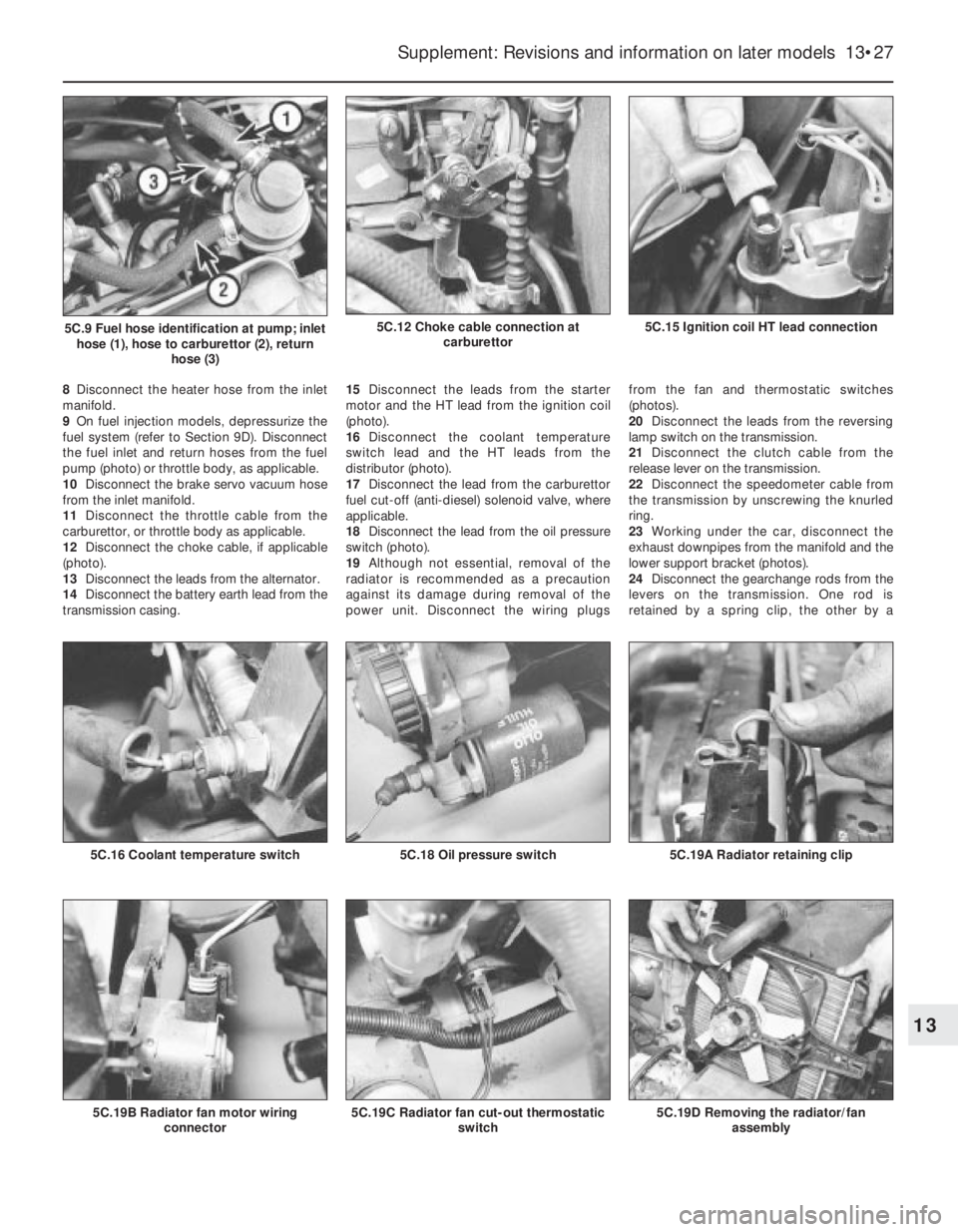
the fuel inlet and return hoses from the fuel
pump (photo) or throttle body, as applicable.
10Disconnect the brake servo vacuum hose
from the inlet manifold.
11Disconnect the throttle cable from the
carburettor, or throttle body as applicable.
12Disconnect the choke cable, if applicable
(photo).
13Disconnect the leads from the alternator.
14Disconnect the battery earth lead from the
transmission casing.15Disconnect the leads from the starter
motor and the HT lead from the ignition coil
(photo).
16Disconnect the coolant temperature
switch lead and the HT leads from the
distributor (photo).
17Disconnect the lead from the carburettor
fuel cut-off (anti-diesel) solenoid valve, where
applicable.
18Disconnect the lead from the oil pressure
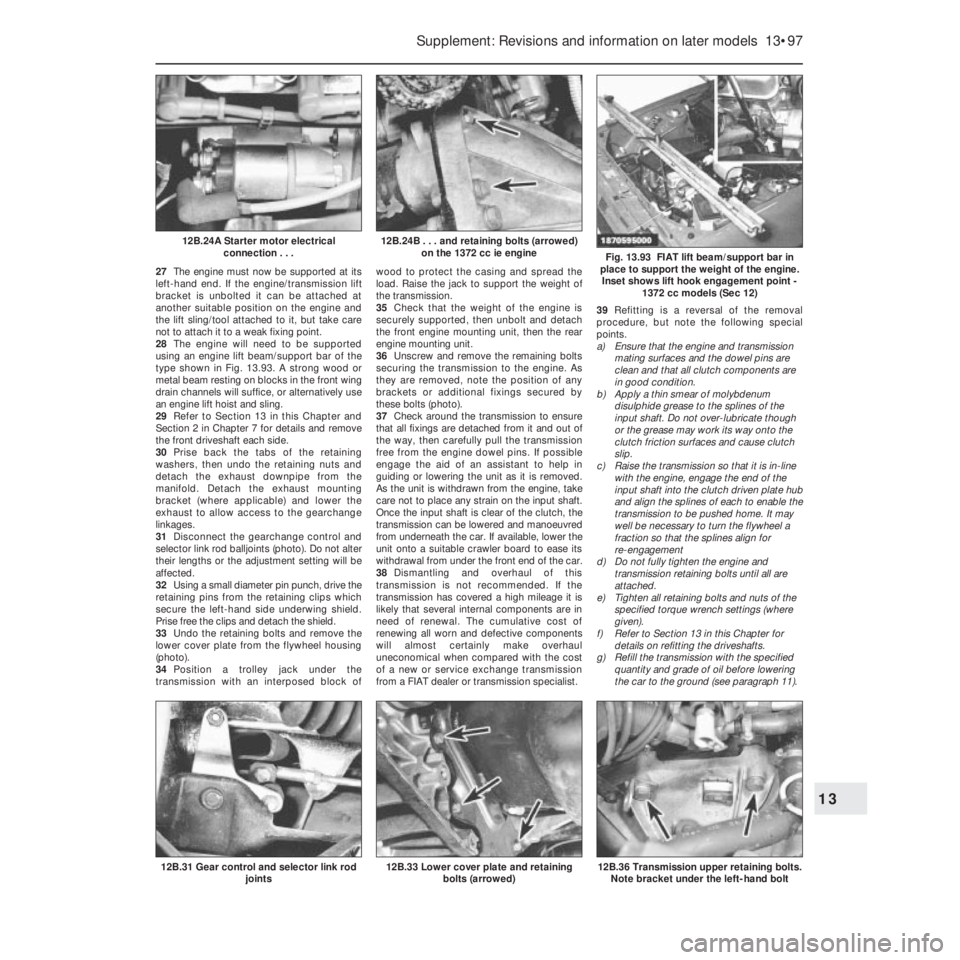
switch (photo).
19Although not essential, removal of the
radiator is recommended as a precaution
against its damage during removal of the
power unit. Disconnect the wiring plugs from the fan and thermostatic switches
(photos).
20Disconnect the leads from the reversing
lamp switch on the transmission.
21Disconnect the clutch cable from the
release lever on the transmission.
22Disconnect the speedometer cable from
the transmission by unscrewing the knurled
ring.
23Working under the car, disconnect the
exhaust downpipes from the manifold and the
lower support bracket (photos).
24Disconnect the gearchange rods from the
levers on the transmission. One rod is
retained by a spring clip, the other by a
Supplement: Revisions and information on later models 13•27
5C.15 Ignition coil HT lead connection5C.12 Choke cable connection at
carburettor5C.9 Fuel hose identification at pump; inlet
hose (1), hose to carburettor (2), return
hose (3)
5C.19D Removing the radiator/fan
assembly5C.19C Radiator fan cut-out thermostatic
switch5C.19B Radiator fan motor wiring
connector
5C.19A Radiator retaining clip5C.18 Oil pressure switch5C.16 Coolant temperature switch
13
Page 160 of 303
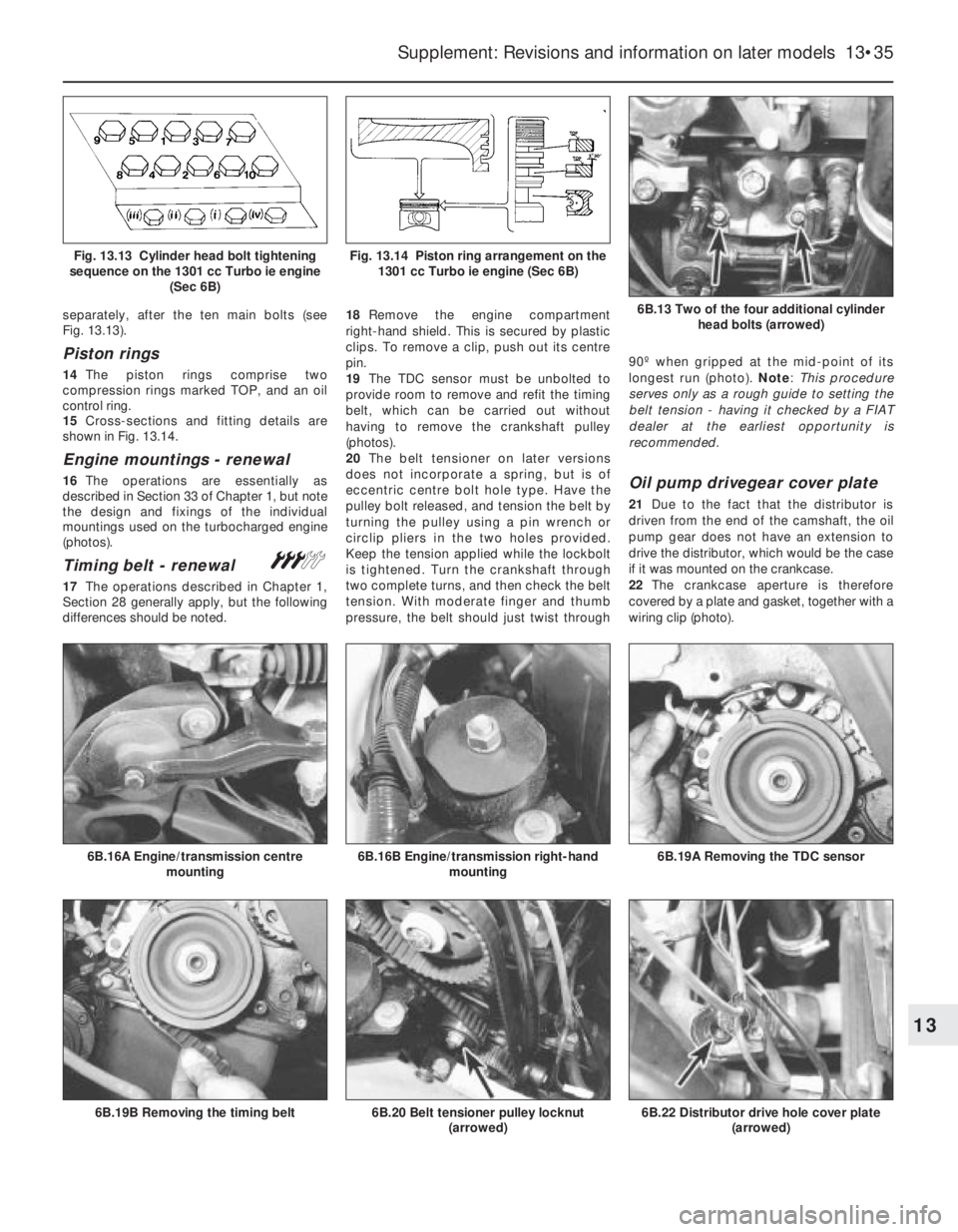
separately, after the ten main bolts (see
Fig. 13.13).
Piston rings
14The piston rings comprise two
compression rings marked TOP, and an oil
control ring.
15Cross-sections and fitting details are
shown in Fig. 13.14.
Engine mountings - renewal
16The operations are essentially as
described in Section 33 of Chapter 1, but note
the design and fixings of the individual
mountings used on the turbocharged engine
(photos).
Timing belt - renewal#
17The operations described in Chapter 1,
Section 28 generally apply, but the following
differences should be noted.18Remove the engine compartment
right-hand shield. This is secured by plastic
clips. To remove a clip, push out its centre
pin.
19The TDC sensor must be unbolted to
provide room to remove and refit the timing
belt, which can be carried out without
having to remove the crankshaft pulley
(photos).
20The belt tensioner on later versions
does not incorporate a spring, but is of
eccentric centre bolt hole type. Have the
pulley bolt released, and tension the belt by
turning the pulley using a pin wrench or
circlip pliers in the two holes provided.
Keep the tension applied while the lockbolt
is tightened. Turn the crankshaft through
two complete turns, and then check the belt
tension. With moderate finger and thumb
pressure, the belt should just twist through90º when gripped at the mid-point of its
longest run (photo). Note: This procedure
serves only as a rough guide to setting the
belt tension - having it checked by a FIAT
dealer at the earliest opportunity is
recommended.
Oil pump drivegear cover plate
21Due to the fact that the distributor is
driven from the end of the camshaft, the oil
pump gear does not have an extension to
drive the distributor, which would be the case
if it was mounted on the crankcase.
22The crankcase aperture is therefore
covered by a plate and gasket, together with a
wiring clip (photo).
Supplement: Revisions and information on later models 13•35
6B.13 Two of the four additional cylinder
head bolts (arrowed)
Fig. 13.14 Piston ring arrangement on the
1301 cc Turbo ie engine (Sec 6B)Fig. 13.13 Cylinder head bolt tightening
sequence on the 1301 cc Turbo ie engine
(Sec 6B)
6B.22 Distributor drive hole cover plate
(arrowed)6B.20 Belt tensioner pulley locknut
(arrowed)6B.19B Removing the timing belt
6B.19A Removing the TDC sensor6B.16B Engine/transmission right-hand
mounting6B.16A Engine/transmission centre
mounting
13
Page 211 of 303
6On 999, 1108 and 1372 cc engines, the
distributor is driven from the rear end of the
camshaft.
7On the 1116 and 1299/1301 cc engines, the
distributor is driven from an extension of the
oil pump driveshaft which is geared to the
auxiliary shaft.
8The distributor contains a reluctor mounted
on its shaft, and a magnet and stator fixed to
the baseplate.
9Ignition advance is controlled in the
conventional way mechanically by centrifugal
weights and a diaphragm unit for vacuum
advance.
10Instead of the conventional method of
interrupting the low tension circuit to generate
high tension voltage in the coil by means of a
mechanical contact breaker, when the
electronic ignition is switched on, the
switching of the transistors in the electronic
control unit (ECU) prevents current flow in the
coil primary windings.
11Once the crankshaft rotates, the reluctor
moves through the magnetic field created by
the stator and when the reluctor teeth are in
alignment with the stator projections a small
AC voltage is created. The ECU amplifies this
voltage and applies it to switch the transistors
and so provide an earth path for the primary
circuit.
12As the reluctor teeth move out of
alignment with the stator projections the AC
voltage changes, the transistors in the ECU
are switched again to interrupt the primary
circuit earth path. This causes a high voltage
to be induced in the secondary winding.
Distributor
(breakerless type) -
removal and refitting
#
13Removal of the distributor on the 903,1116, 1299 and 1301 cc engines is as
described in Chapter 4, Section 6.
14On 999, 1108 and 1372 cc engines, mark
the position of the distributor clamp plate in
relation to the cylinder head surface.
15Unclip the distributor cap and move it to
one side with the HT leads attached.
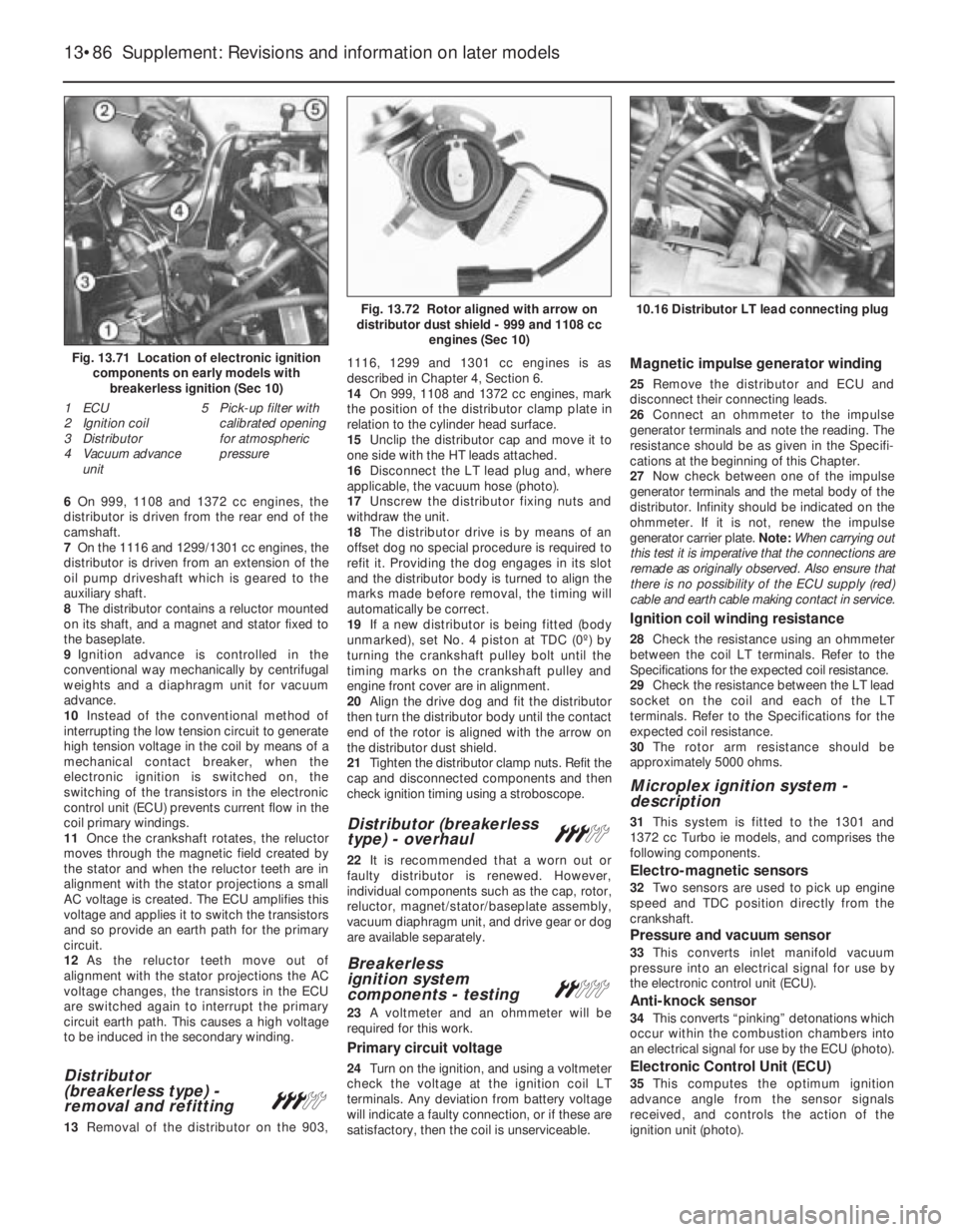
16Disconnect the LT lead plug and, where
applicable, the vacuum hose (photo).
17Unscrew the distributor fixing nuts and
withdraw the unit.
18The distributor drive is by means of an
offset dog no special procedure is required to
refit it. Providing the dog engages in its slot
and the distributor body is turned to align the
marks made before removal, the timing will
automatically be correct.
19If a new distributor is being fitted (body
unmarked), set No. 4 piston at TDC (0º) by
turning the crankshaft pulley bolt until the
timing marks on the crankshaft pulley and
engine front cover are in alignment.
20Align the drive dog and fit the distributor
then turn the distributor body until the contact
end of the rotor is aligned with the arrow on
the distributor dust shield.
21Tighten the distributor clamp nuts. Refit the
cap and disconnected components and then
check ignition timing using a stroboscope.
Distributor (breakerless
type) - overhaul#
22It is recommended that a worn out or
faulty distributor is renewed. However,
individual components such as the cap, rotor,
reluctor, magnet/stator/baseplate assembly,
vacuum diaphragm unit, and drive gear or dog
are available separately.
Breakerless
ignition system
components - testing
ª
23A voltmeter and an ohmmeter will be
required for this work.
Primary circuit voltage
24Turn on the ignition, and using a voltmeter
check the voltage at the ignition coil LT
terminals. Any deviation from battery voltage
will indicate a faulty connection, or if these are
satisfactory, then the coil is unserviceable.
Magnetic impulse generator winding
25Remove the distributor and ECU and
disconnect their connecting leads.
26Connect an ohmmeter to the impulse
generator terminals and note the reading. The
resistance should be as given in the Specifi-
cations at the beginning of this Chapter.
27Now check between one of the impulse
generator terminals and the metal body of the
distributor. Infinity should be indicated on the
ohmmeter. If it is not, renew the impulse
generator carrier plate. Note: When carrying out
this test it is imperative that the connections are
remade as originally observed. Also ensure that
there is no possibility of the ECU supply (red)
cable and earth cable making contact in service.
Ignition coil winding resistance
28Check the resistance using an ohmmeter
between the coil LT terminals. Refer to the
Specifications for the expected coil resistance.
29Check the resistance between the LT lead
socket on the coil and each of the LT
terminals. Refer to the Specifications for the
expected coil resistance.
30The rotor arm resistance should be
approximately 5000 ohms.
Microplex ignition system -
description
31This system is fitted to the 1301 and
1372 cc Turbo ie models, and comprises the
following components.
Electro-magnetic sensors
32Two sensors are used to pick up engine
speed and TDC position directly from the
crankshaft.
Pressure and vacuum sensor
33This converts inlet manifold vacuum
pressure into an electrical signal for use by
the electronic control unit (ECU).
Anti-knock sensor
34This converts “pinking” detonations which
occur within the combustion chambers into
an electrical signal for use by the ECU (photo).
Electronic Control Unit (ECU)
35This computes the optimum ignition
advance angle from the sensor signals
received, and controls the action of the
ignition unit (photo).
13•86 Supplement: Revisions and information on later models
Fig. 13.72 Rotor aligned with arrow on
distributor dust shield - 999 and 1108 cc
engines (Sec 10)
1 ECU
2 Ignition coil
3 Distributor
4 Vacuum advance
unit5 Pick-up filter with
calibrated opening
for atmospheric
pressure
Fig. 13.71 Location of electronic ignition
components on early models with
breakerless ignition (Sec 10)
10.16 Distributor LT lead connecting plug
Page 217 of 303
11 Clutch
Clutch pedal - adjustment
(cable clutch)
Á
1The method of adjusting the clutch has
been revised.
2Fully depress the clutch pedal two or three
times.
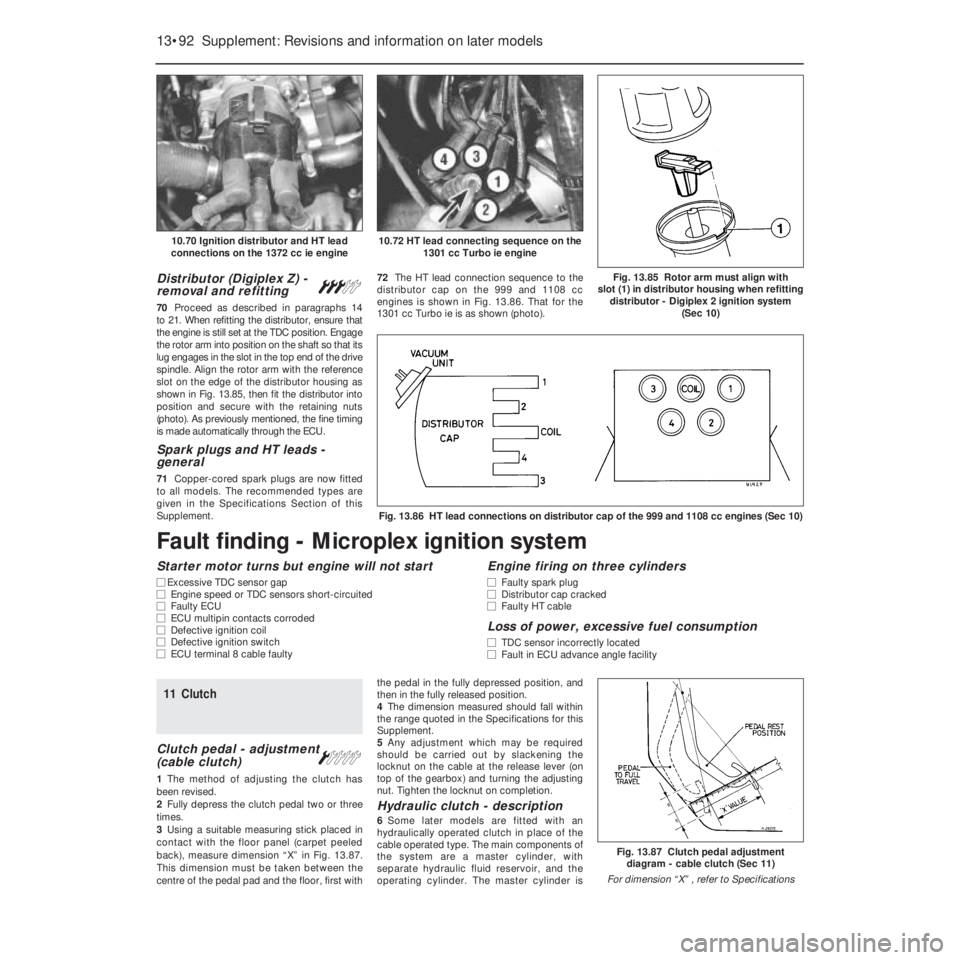
3Using a suitable measuring stick placed in
contact with the floor panel (carpet peeled
back), measure dimension “X” in Fig. 13.87.
This dimension must be taken between the
centre of the pedal pad and the floor, first withthe pedal in the fully depressed position, and
then in the fully released position.
4The dimension measured should fall within
the range quoted in the Specifications for this
Supplement.
5Any adjustment which may be required
should be carried out by slackening the
locknut on the cable at the release lever (on
top of the gearbox) and turning the adjusting
nut. Tighten the locknut on completion.
Hydraulic clutch - description
6Some later models are fitted with an
hydraulically operated clutch in place of the
cable operated type. The main components of
the system are a master cylinder, with
separate hydraulic fluid reservoir, and the
operating cylinder. The master cylinder is
Distributor (Digiplex Z) -
removal and refitting#
70Proceed as described in paragraphs 14
to 21. When refitting the distributor, ensure that
the engine is still set at the TDC position. Engage
the rotor arm into position on the shaft so that its
lug engages in the slot in the top end of the drive
spindle. Align the rotor arm with the reference
slot on the edge of the distributor housing as
shown in Fig. 13.85, then fit the distributor into
position and secure with the retaining nuts
(photo). As previously mentioned, the fine timing
is made automatically through the ECU.
Spark plugs and HT leads -
general
71Copper-cored spark plugs are now fitted
to all models. The recommended types are
given in the Specifications Section of this
Supplement.72The HT lead connection sequence to the
distributor cap on the 999 and 1108 cc
engines is shown in Fig. 13.86. That for the
1301 cc Turbo ie is as shown (photo).
13•92 Supplement: Revisions and information on later models
Fig. 13.87 Clutch pedal adjustment
diagram - cable clutch (Sec 11)
For dimension “X” , refer to Specifications
Fig. 13.86 HT lead connections on distributor cap of the 999 and 1108 cc engines (Sec 10)
Fig. 13.85 Rotor arm must align with
slot (1) in distributor housing when refitting
distributor - Digiplex 2 ignition system
(Sec 10)
10.72 HT lead connecting sequence on the
1301 cc Turbo ie engine10.70 Ignition distributor and HT lead
connections on the 1372 cc ie engine
Fault finding - Microplex ignition system
Starter motor turns but engine will not start
m mExcessive TDC sensor gap
m mEngine speed or TDC sensors short-circuited
m mFaulty ECU
m mECU multipin contacts corroded
m mDefective ignition coil
m mDefective ignition switch
m mECU terminal 8 cable faulty
Engine firing on three cylinders
m
mFaulty spark plug
m mDistributor cap cracked
m mFaulty HT cable
Loss of power, excessive fuel consumption
m
mTDC sensor incorrectly located
m mFault in ECU advance angle facility
Page 222 of 303
27The engine must now be supported at its
left-hand end. If the engine/transmission lift
bracket is unbolted it can be attached at
another suitable position on the engine and
the lift sling/tool attached to it, but take care
not to attach it to a weak fixing point.
28The engine will need to be supported
using an engine lift beam/support bar of the
type shown in Fig. 13.93. A strong wood or
metal beam resting on blocks in the front wing
drain channels will suffice, or alternatively use
an engine lift hoist and sling.
29Refer to Section 13 in this Chapter and
Section 2 in Chapter 7 for details and remove
the front driveshaft each side.
30Prise back the tabs of the retaining
washers, then undo the retaining nuts and
detach the exhaust downpipe from the
manifold. Detach the exhaust mounting
bracket (where applicable) and lower the
exhaust to allow access to the gearchange
linkages.
31Disconnect the gearchange control and
selector link rod balljoints (photo). Do not alter
their lengths or the adjustment setting will be
affected.
32Using a small diameter pin punch, drive the
retaining pins from the retaining clips which
secure the left-hand side underwing shield.
Prise free the clips and detach the shield.
33Undo the retaining bolts and remove the
lower cover plate from the flywheel housing
(photo).
34Position a trolley jack under the
transmission with an interposed block ofwood to protect the casing and spread the
load. Raise the jack to support the weight of
the transmission.
35Check that the weight of the engine is
securely supported, then unbolt and detach
the front engine mounting unit, then the rear
engine mounting unit.
36Unscrew and remove the remaining bolts
securing the transmission to the engine. As
they are removed, note the position of any
brackets or additional fixings secured by
these bolts (photo).
37Check around the transmission to ensure
that all fixings are detached from it and out of
the way, then carefully pull the transmission
free from the engine dowel pins. If possible
engage the aid of an assistant to help in
guiding or lowering the unit as it is removed.
As the unit is withdrawn from the engine, take
care not to place any strain on the input shaft.
Once the input shaft is clear of the clutch, the
transmission can be lowered and manoeuvred
from underneath the car. If available, lower the
unit onto a suitable crawler board to ease its
withdrawal from under the front end of the car.
38Dismantling and overhaul of this
transmission is not recommended. If the
transmission has covered a high mileage it is
likely that several internal components are in
need of renewal. The cumulative cost of
renewing all worn and defective components
will almost certainly make overhaul
uneconomical when compared with the cost
of a new or service exchange transmission
from a FIAT dealer or transmission specialist.39Refitting is a reversal of the removal
procedure, but note the following special
points.
a) Ensure that the engine and transmission
mating surfaces and the dowel pins are
clean and that all clutch components are
in good condition.
b) Apply a thin smear of molybdenum
disulphide grease to the splines of the
input shaft. Do not over-lubricate though
or the grease may work its way onto the
clutch friction surfaces and cause clutch
slip.
c) Raise the transmission so that it is in-line
with the engine, engage the end of the
input shaft into the clutch driven plate hub
and align the splines of each to enable the
transmission to be pushed home. It may
well be necessary to turn the flywheel a
fraction so that the splines align for
re-engagement
d) Do not fully tighten the engine and
transmission retaining bolts until all are
attached.
e) Tighten all retaining bolts and nuts of the
specified torque wrench settings (where
given).
f) Refer to Section 13 in this Chapter for
details on refitting the driveshafts.
g) Refill the transmission with the specified
quantity and grade of oil before lowering
the car to the ground (see paragraph 11).
Supplement: Revisions and information on later models 13•97
Fig. 13.93 FIAT lift beam/support bar in
place to support the weight of the engine.
Inset shows lift hook engagement point -
1372 cc models (Sec 12)
12B.24B . . . and retaining bolts (arrowed)
on the 1372 cc ie engine12B.24A Starter motor electrical
connection . . .
12B.36 Transmission upper retaining bolts.
Note bracket under the left-hand bolt12B.33 Lower cover plate and retaining
bolts (arrowed)12B.31 Gear control and selector link rod
joints
13
Page 292 of 303
Fault FindingREF•9
REF
Introduction
The vehicle owner who does his or her own
maintenance according to the recommended
schedules should not have to use this section
of the manual very often. Modern component
reliability is such that, provided those items
subject to wear or deterioration are inspected
or renewed at the specified intervals, sudden
failure is comparatively rare. Faults do not
usually just happen as a result of sudden
failure, but develop over a period of time.
Major mechanical failures in particular are
usually preceded by characteristic symptoms
over hundreds or even thousands of miles.
Those components which do occasionally fail
without warning are often small and easily
carried in the vehicle.
With any fault finding, the first step is to
decide where to begin investigations.
Sometimes this is obvious, but on other
occasions a little detective work will be
necessary. The owner who makes half a
dozen haphazard adjustments or
replacements may be successful in curing a
fault (or its symptoms), but he will be none the
wiser if the fault recurs and he may well have
spent more time and money than was
necessary. A calm and logical approach will
be found to be more satisfactory in the long
run. Always take into account any warning
signs or abnormalities that may have been
noticed in the period preceding the fault –
power loss, high or low gauge readings,
unusual noises or smells, etc – and remember
that failure of components such as fuses or
spark plugs may only be pointers to some
underlying fault.
The pages which follow here are intended
to help in cases of failure to start or
breakdown on the road. There is also a Fault
Diagnosis Section at the end of each Chapter
which should be consulted if the preliminary
checks prove unfruitful. Whatever the fault,
certain basic principles apply. These are as
follows:Verify the fault. This is simply a matter of
being sure that you know what the symptoms
are before starting work. This is particularly
important if you are investigating a fault for
someone else who may not have described it
very accurately.
Don’t overlook the obvious. For example,
if the vehicle won’t start, is there petrol in the
tank? (Don’t take anyone else’s word on this
particular point, and don’t trust the fuel gauge
either!) If an electrical fault is indicated, look
for loose or broken wires before digging out
the test gear.
Cure the disease, not the symptom.
Substituting a flat battery with a fully charged
one will get you off the hard shoulder, but if
the underlying cause is not attended to,the
new battery will go the same way. Similarly,
changing oil-fouled spark plugs for a new set
will get you moving again, but remember that
the reason for the fouling (if it wasn’t simply an
incorrect grade of plug) will have to be
established and corrected.
Don’t take anything for granted.
Particularly, don’t forget that a ‘new’
component may itself be defective (especially
if it’s been rattling round in the boot for
months), and don’t leave components out of a
fault diagnosis sequence just because they
are new or recently fitted. When you do finally
diagnose a difficult fault, you’ll probably
realise that all the evidence was there from
the start.
Electrical faults
Electrical faults can be more puzzling than
straightforward mechanical failures, but they
are no less susceptible to logical analysis if
the basic principles of operation are
understood. Vehicle electrical wiring exists in
extremely unfavourable conditions – heat,
vibration and chemical attack and the first
things to look for are loose or corroded
connections and broken or chafed wires,especially where the wires pass through holes
in the bodywork or are subject to vibration.
All metal-bodied vehicles in current
production have one pole of the battery
‘earthed’, ie connected to the vehicle
bodywork, and in nearly all modern vehicles it
is the negative (–) terminal. The various
electrical components – motors, bulb holders,
etc – are also connected to earth, either by
means of a lead or directly by their mountings.
Electric current flows through the component
and then back to the battery via the
bodywork. If the component mounting is
loose or corroded, or if a good path back to
the battery is not available, the circuit will be
incomplete and malfunction will result. The
engine and/or gearbox are also earthed by
means of flexible metal straps to the body or
subframe; if these straps are loose or missing,
starter motor, generator and ignition trouble
may result.
Assuming the earth return to be
satisfactory, electrical faults will be due either
to component malfunction or to defects in the
current supply. Individual components are
dealt with in Chapter 9. If supply wires are
broken or cracked internally this results in an
open-circuit, and the easiest way to check for
this is to bypass the suspect wire temporarily
with a length of wire having a crocodile clip or
suitable connector at each end. Alternatively,
a 12V test lamp can be used to verify the
presence of supply voltage at various points
along the wire and the break can be thus
isolated.
If a bare portion of a live wire touches the
bodywork or other earthed metal part, the
electricity will take the low-resistance path
thus formed back to the battery: this is known
as a short-circuit. Hopefully a short-circuit will
blow a fuse, but otherwise it may cause
burning of the insulation (and possibly further
short-circuits) or even a fire. This is why it is
inadvisable to bypass persistently blowing
fuses with silver foil or wire.