warning FIAT UNO 1983 Service Workshop Manual
[x] Cancel search | Manufacturer: FIAT, Model Year: 1983, Model line: UNO, Model: FIAT UNO 1983Pages: 303, PDF Size: 10.36 MB
Page 267 of 303

14•28 Wiring diagrams
Wiring diagram 36 - direction indicators, hazard warning lamps, reversing lamps and brake stop-lamps
(1372 cc Turbo ie model)
Page 278 of 303

Wiring diagrams 14•39
14
Wiring diagram 47 - fuel gauge, tachometer, digital clock, brake fluid and handbrake warning lamp
(1990-on 45, 55, 70 and 1.4 models)
*Only for 1372 S ie – 1372 SX ie – 1697 D ** Only for D versions sOnly for SX versions
Page 285 of 303
REF•2MOT Test Checks
Seat belts and seats
Note: The following checks are applicable to
all seat belts, front and rear.
MExamine the webbing of all the belts
(including rear belts if fitted) for cuts, serious
fraying or deterioration. Fasten and unfasten
each belt to check the buckles. If applicable,
check the retracting mechanism. Check the
security of all seat belt mountings accessible
from inside the vehicle.
MThe front seats themselves must be
securely attached and the backrests must
lock in the upright position.
Doors
MBoth front doors must be able to be opened
and closed from outside and inside, and must
latch securely when closed.
Vehicle identification
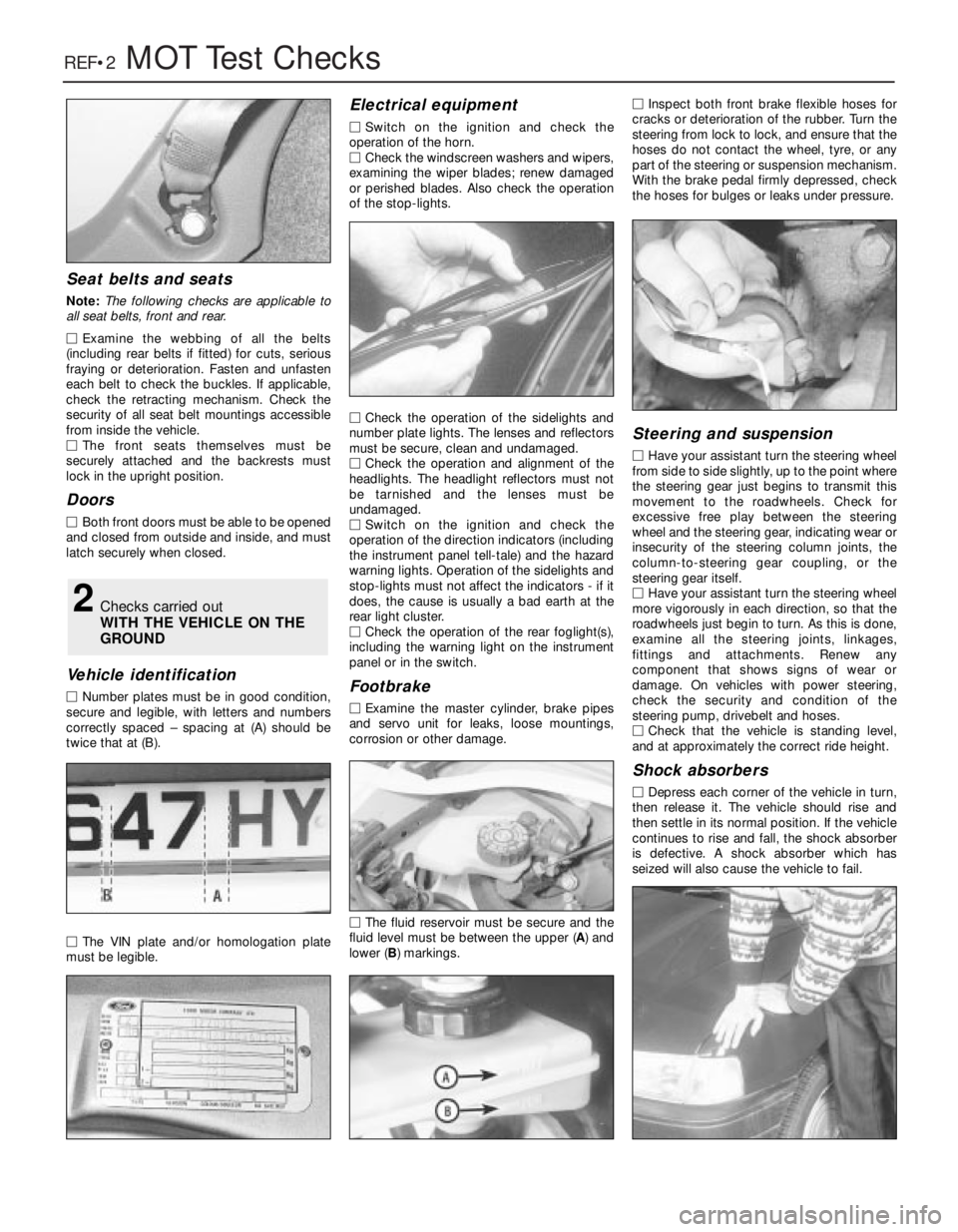
MNumber plates must be in good condition,
secure and legible, with letters and numbers
correctly spaced – spacing at (A) should be
twice that at (B).
MThe VIN plate and/or homologation plate
must be legible.
Electrical equipment
MSwitch on the ignition and check the
operation of the horn.
MCheck the windscreen washers and wipers,
examining the wiper blades; renew damaged
or perished blades. Also check the operation
of the stop-lights.
MCheck the operation of the sidelights and
number plate lights. The lenses and reflectors
must be secure, clean and undamaged.
MCheck the operation and alignment of the
headlights. The headlight reflectors must not
be tarnished and the lenses must be
undamaged.
MSwitch on the ignition and check the
operation of the direction indicators (including
the instrument panel tell-tale) and the hazard
warning lights. Operation of the sidelights and
stop-lights must not affect the indicators - if it
does, the cause is usually a bad earth at the
rear light cluster.
MCheck the operation of the rear foglight(s),
including the warning light on the instrument
panel or in the switch.
Footbrake
MExamine the master cylinder, brake pipes
and servo unit for leaks, loose mountings,
corrosion or other damage.
MThe fluid reservoir must be secure and the
fluid level must be between the upper (A) and
lower (B) markings.MInspect both front brake flexible hoses for
cracks or deterioration of the rubber. Turn the
steering from lock to lock, and ensure that the
hoses do not contact the wheel, tyre, or any
part of the steering or suspension mechanism.
With the brake pedal firmly depressed, check
the hoses for bulges or leaks under pressure.
Steering and suspension
MHave your assistant turn the steering wheel
from side to side slightly, up to the point where
the steering gear just begins to transmit this
movement to the roadwheels. Check for
excessive free play between the steering
wheel and the steering gear, indicating wear or
insecurity of the steering column joints, the
column-to-steering gear coupling, or the
steering gear itself.
MHave your assistant turn the steering wheel
more vigorously in each direction, so that the
roadwheels just begin to turn. As this is done,
examine all the steering joints, linkages,
fittings and attachments. Renew any
component that shows signs of wear or
damage. On vehicles with power steering,
check the security and condition of the
steering pump, drivebelt and hoses.
MCheck that the vehicle is standing level,
and at approximately the correct ride height.
Shock absorbers
MDepress each corner of the vehicle in turn,
then release it. The vehicle should rise and
then settle in its normal position. If the vehicle
continues to rise and fall, the shock absorber
is defective. A shock absorber which has
seized will also cause the vehicle to fail.
2Checks carried out
WITH THE VEHICLE ON THE
GROUND
Page 292 of 303
Fault FindingREF•9
REF
Introduction
The vehicle owner who does his or her own
maintenance according to the recommended
schedules should not have to use this section
of the manual very often. Modern component
reliability is such that, provided those items
subject to wear or deterioration are inspected
or renewed at the specified intervals, sudden
failure is comparatively rare. Faults do not
usually just happen as a result of sudden
failure, but develop over a period of time.
Major mechanical failures in particular are
usually preceded by characteristic symptoms
over hundreds or even thousands of miles.
Those components which do occasionally fail
without warning are often small and easily
carried in the vehicle.
With any fault finding, the first step is to
decide where to begin investigations.
Sometimes this is obvious, but on other
occasions a little detective work will be
necessary. The owner who makes half a
dozen haphazard adjustments or
replacements may be successful in curing a
fault (or its symptoms), but he will be none the
wiser if the fault recurs and he may well have
spent more time and money than was
necessary. A calm and logical approach will
be found to be more satisfactory in the long
run. Always take into account any warning
signs or abnormalities that may have been
noticed in the period preceding the fault –
power loss, high or low gauge readings,
unusual noises or smells, etc – and remember
that failure of components such as fuses or
spark plugs may only be pointers to some
underlying fault.
The pages which follow here are intended
to help in cases of failure to start or
breakdown on the road. There is also a Fault
Diagnosis Section at the end of each Chapter
which should be consulted if the preliminary
checks prove unfruitful. Whatever the fault,
certain basic principles apply. These are as
follows:Verify the fault. This is simply a matter of
being sure that you know what the symptoms
are before starting work. This is particularly
important if you are investigating a fault for
someone else who may not have described it
very accurately.
Don’t overlook the obvious. For example,
if the vehicle won’t start, is there petrol in the
tank? (Don’t take anyone else’s word on this
particular point, and don’t trust the fuel gauge
either!) If an electrical fault is indicated, look
for loose or broken wires before digging out
the test gear.
Cure the disease, not the symptom.
Substituting a flat battery with a fully charged
one will get you off the hard shoulder, but if
the underlying cause is not attended to,the
new battery will go the same way. Similarly,
changing oil-fouled spark plugs for a new set
will get you moving again, but remember that
the reason for the fouling (if it wasn’t simply an
incorrect grade of plug) will have to be
established and corrected.
Don’t take anything for granted.
Particularly, don’t forget that a ‘new’
component may itself be defective (especially
if it’s been rattling round in the boot for
months), and don’t leave components out of a
fault diagnosis sequence just because they
are new or recently fitted. When you do finally
diagnose a difficult fault, you’ll probably
realise that all the evidence was there from
the start.
Electrical faults
Electrical faults can be more puzzling than
straightforward mechanical failures, but they
are no less susceptible to logical analysis if
the basic principles of operation are
understood. Vehicle electrical wiring exists in
extremely unfavourable conditions – heat,
vibration and chemical attack and the first
things to look for are loose or corroded
connections and broken or chafed wires,especially where the wires pass through holes
in the bodywork or are subject to vibration.
All metal-bodied vehicles in current
production have one pole of the battery
‘earthed’, ie connected to the vehicle
bodywork, and in nearly all modern vehicles it
is the negative (–) terminal. The various
electrical components – motors, bulb holders,
etc – are also connected to earth, either by
means of a lead or directly by their mountings.
Electric current flows through the component
and then back to the battery via the
bodywork. If the component mounting is
loose or corroded, or if a good path back to
the battery is not available, the circuit will be
incomplete and malfunction will result. The
engine and/or gearbox are also earthed by
means of flexible metal straps to the body or
subframe; if these straps are loose or missing,
starter motor, generator and ignition trouble
may result.
Assuming the earth return to be
satisfactory, electrical faults will be due either
to component malfunction or to defects in the
current supply. Individual components are
dealt with in Chapter 9. If supply wires are
broken or cracked internally this results in an
open-circuit, and the easiest way to check for
this is to bypass the suspect wire temporarily
with a length of wire having a crocodile clip or
suitable connector at each end. Alternatively,
a 12V test lamp can be used to verify the
presence of supply voltage at various points
along the wire and the break can be thus
isolated.
If a bare portion of a live wire touches the
bodywork or other earthed metal part, the
electricity will take the low-resistance path
thus formed back to the battery: this is known
as a short-circuit. Hopefully a short-circuit will
blow a fuse, but otherwise it may cause
burning of the insulation (and possibly further
short-circuits) or even a fire. This is why it is
inadvisable to bypass persistently blowing
fuses with silver foil or wire.
Page 293 of 303
Engine fails to turn when starter
operated
m mFlat battery (recharge use jump leads or
push start)
m mBattery terminals loose or corroded
m mBattery earth to body defective
m mEngine earth strap loose or broken
m mStarter motor (or solenoid) wiring loose or
broken
m mIgnition/starter switch faulty
m mMajor mechanical failure (seizure)
m mStarter or solenoid internal fault (see
Chapter 12)
Starter motor turns engine slowly
m mPartially discharged battery (recharge, use
jump leads, or push start)
m mBattery terminals loose or corroded
m mBattery earth to body defective
m mEngine earth strap loose m mStarter motor (or solenoid) wiring loose
m mStarter motor internal fault (see Chapter 9)
Starter motor spins without
turning engine
m mFlywheel gear teeth damaged or worn
m mStarter motor mounting bolts loose
Engine turns normally but fails to
start
m mDamp or dirty HT leads and distributor cap
(crank engine and check for spark)
m mNo fuel in tank (check for delivery at
carburettor) m mExcessive choke (hot engine) or insufficient
choke (cold engine)
m mFouled or incorrectly gapped spark plugs
(remove, clean and regap)
m mOther ignition system fault (see Chapter 4)
m mOther fuel system fault (see Chapter 3)
m mPoor compression (see Chapter 1)
m mMajor mechanical failure (eg camshaft drive)
Engine fires but will not run
m
mInsufficient choke (cold engine)
m mAir leaks at carburettor or inlet manifold
m mFuel starvation (see Chapter 3)
m mIgnition fault (see Chapter 4)
Engine will not start
REF•10Fault Finding
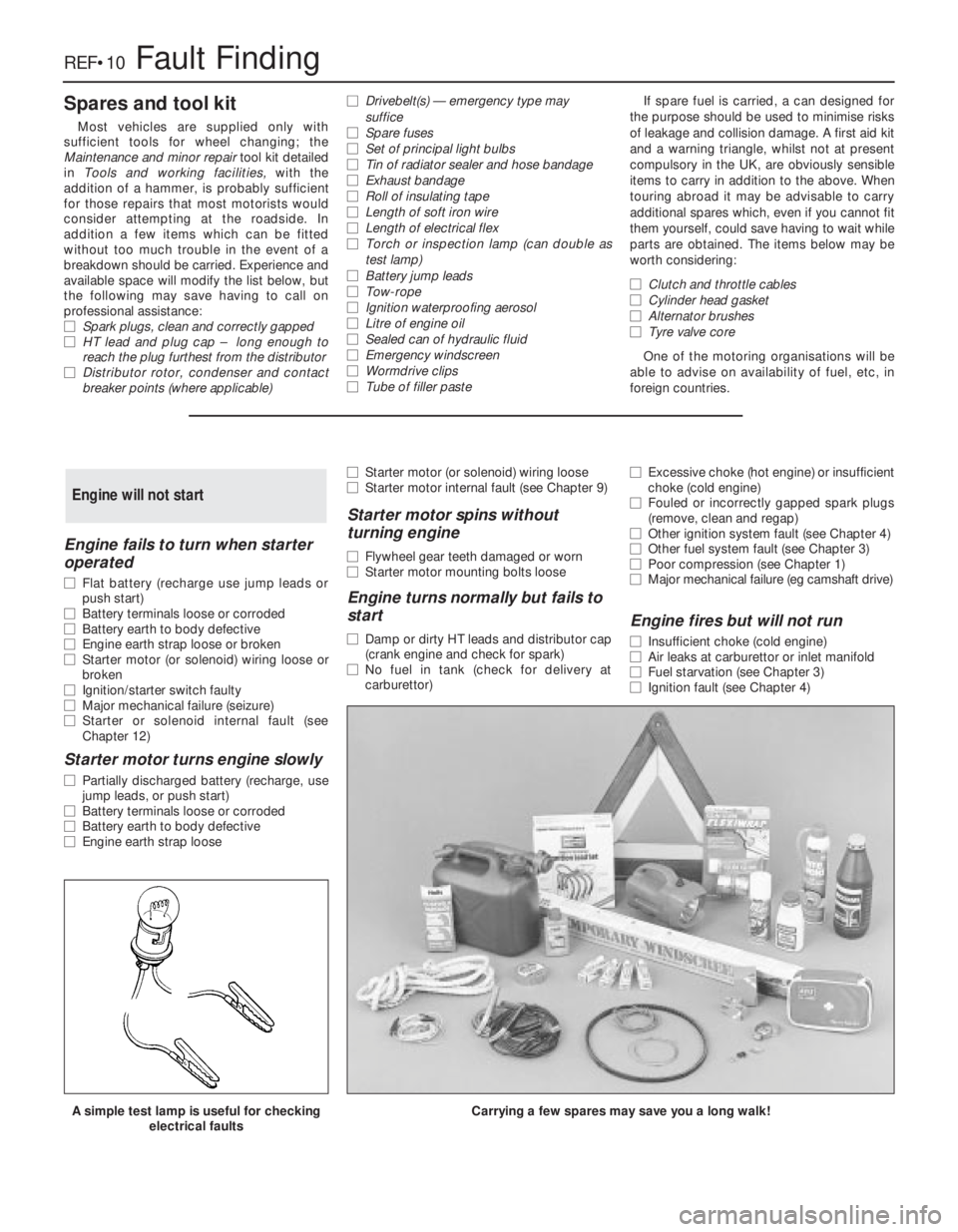
Spares and tool kit
Most vehicles are supplied only with
sufficient tools for wheel changing; the
Maintenance and minor repairtool kit detailed
in Tools and working facilities,with the
addition of a hammer, is probably sufficient
for those repairs that most motorists would
consider attempting at the roadside. In
addition a few items which can be fitted
without too much trouble in the event of a
breakdown should be carried. Experience and
available space will modify the list below, but
the following may save having to call on
professional assistance:
m mSpark plugs, clean and correctly gapped
m mHT lead and plug cap – long enough to
reach the plug furthest from the distributor
m mDistributor rotor, condenser and contact
breaker points (where applicable)m mDrivebelt(s) — emergency type may
suffice
m mSpare fuses
m mSet of principal light bulbs
m mTin of radiator sealer and hose bandage
m mExhaust bandage
m mRoll of insulating tape
m mLength of soft iron wire
m mLength of electrical flex
m mTorch or inspection lamp (can double as
test lamp)
m mBattery jump leads
m mTow-rope
m mIgnition waterproofing aerosol
m mLitre of engine oil
m mSealed can of hydraulic fluid
m mEmergency windscreen
m mWormdrive clips
m mTube of filler pasteIf spare fuel is carried, a can designed for
the purpose should be used to minimise risks
of leakage and collision damage. A first aid kit
and a warning triangle, whilst not at present
compulsory in the UK, are obviously sensible
items to carry in addition to the above. When
touring abroad it may be advisable to carry
additional spares which, even if you cannot fit
them yourself, could save having to wait while
parts are obtained. The items below may be
worth considering:
m mClutch and throttle cables
m mCylinder head gasket
m mAlternator brushes
m mTyre valve core
One of the motoring organisations will be
able to advise on availability of fuel, etc, in
foreign countries.
A simple test lamp is useful for checking
electrical faultsCarrying a few spares may save you a long walk!
Page 294 of 303
Engine cuts out suddenly –
ignition fault
m mLoose or disconnected LT wires
m mWet HT leads or distributor cap (after
traversing water splash)
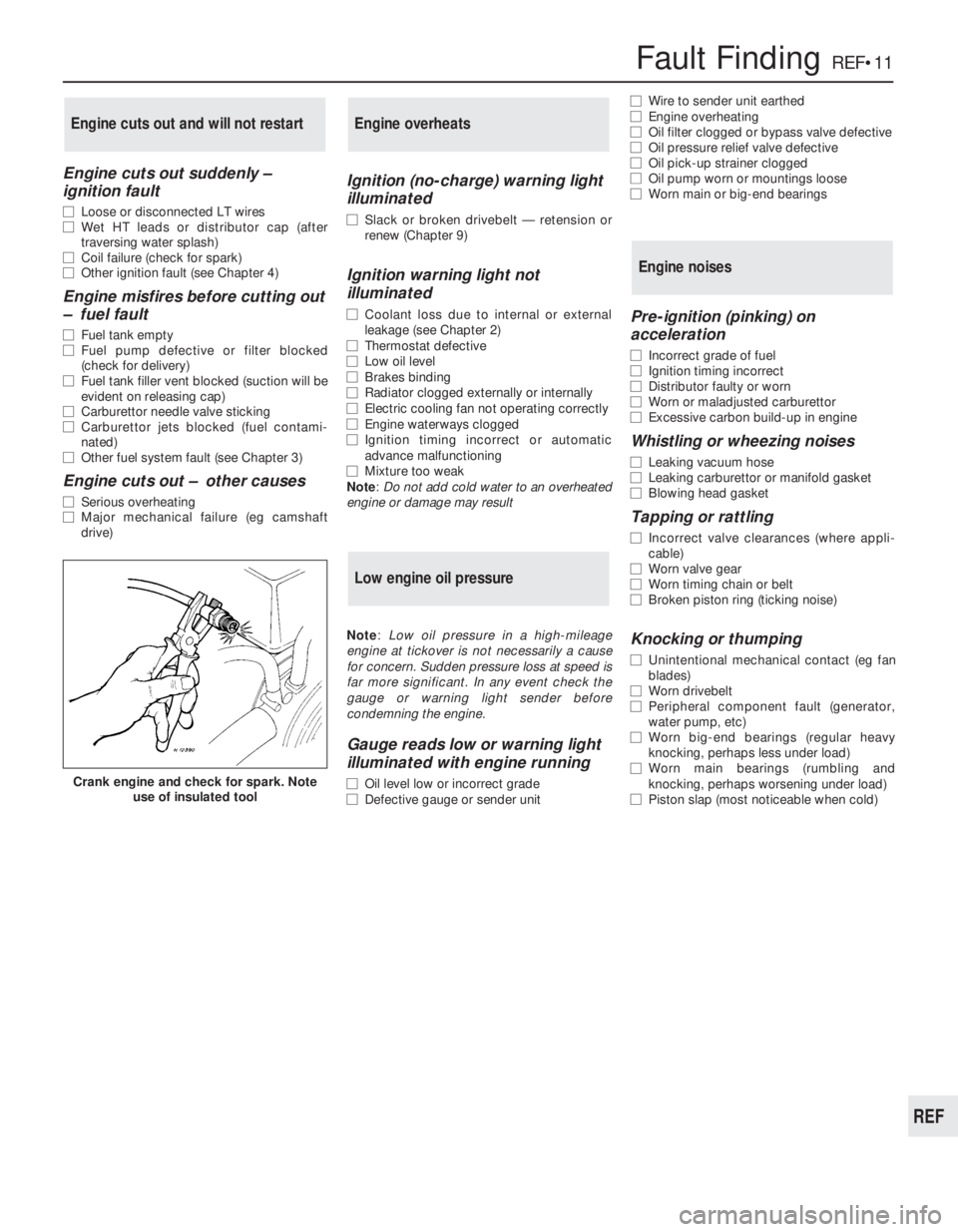
m mCoil failure (check for spark)
m mOther ignition fault (see Chapter 4)
Engine misfires before cutting out
– fuel fault
m mFuel tank empty
m mFuel pump defective or filter blocked
(check for delivery)
m mFuel tank filler vent blocked (suction will be
evident on releasing cap)
m mCarburettor needle valve sticking
m mCarburettor jets blocked (fuel contami-
nated)
m mOther fuel system fault (see Chapter 3)
Engine cuts out – other causes
m
mSerious overheating
m mMajor mechanical failure (eg camshaft
drive)
Ignition (no-charge) warning light
illuminated
m mSlack or broken drivebelt — retension or
renew (Chapter 9)
Ignition warning light not
illuminated
m mCoolant loss due to internal or external
leakage (see Chapter 2)
m mThermostat defective
m mLow oil level
m mBrakes binding
m mRadiator clogged externally or internally
m mElectric cooling fan not operating correctly
m mEngine waterways clogged
m mIgnition timing incorrect or automatic
advance malfunctioning
m mMixture too weak
Note: Do not add cold water to an overheated
engine or damage may result
Note: Low oil pressure in a high-mileage
engine at tickover is not necessarily a cause
for concern. Sudden pressure loss at speed is
far more significant. In any event check the
gauge or warning light sender before
condemning the engine.
Gauge reads low or warning light
illuminated with engine running
m mOil level low or incorrect grade
m mDefective gauge or sender unit m mWire to sender unit earthed
m mEngine overheating
m mOil filter clogged or bypass valve defective
m mOil pressure relief valve defective
m mOil pick-up strainer clogged
m mOil pump worn or mountings loose
m mWorn main or big-end bearings
Pre-ignition (pinking) on
acceleration
m mIncorrect grade of fuel
m mIgnition timing incorrect
m mDistributor faulty or worn
m mWorn or maladjusted carburettor
m mExcessive carbon build-up in engine
Whistling or wheezing noises
m
mLeaking vacuum hose
m mLeaking carburettor or manifold gasket
m mBlowing head gasket
Tapping or rattling
m
mIncorrect valve clearances (where appli-
cable)
m mWorn valve gear
m mWorn timing chain or belt
m mBroken piston ring (ticking noise)
Knocking or thumping
m
mUnintentional mechanical contact (eg fan
blades)
m mWorn drivebelt
m mPeripheral component fault (generator,
water pump, etc)
m mWorn big-end bearings (regular heavy
knocking, perhaps less under load)
m mWorn main bearings (rumbling and
knocking, perhaps worsening under load)
m mPiston slap (most noticeable when cold)
Engine noises
Low engine oil pressure
Engine overheatsEngine cuts out and will not restart
Fault FindingREF•11
REF
Crank engine and check for spark. Note
use of insulated tool
Page 300 of 303
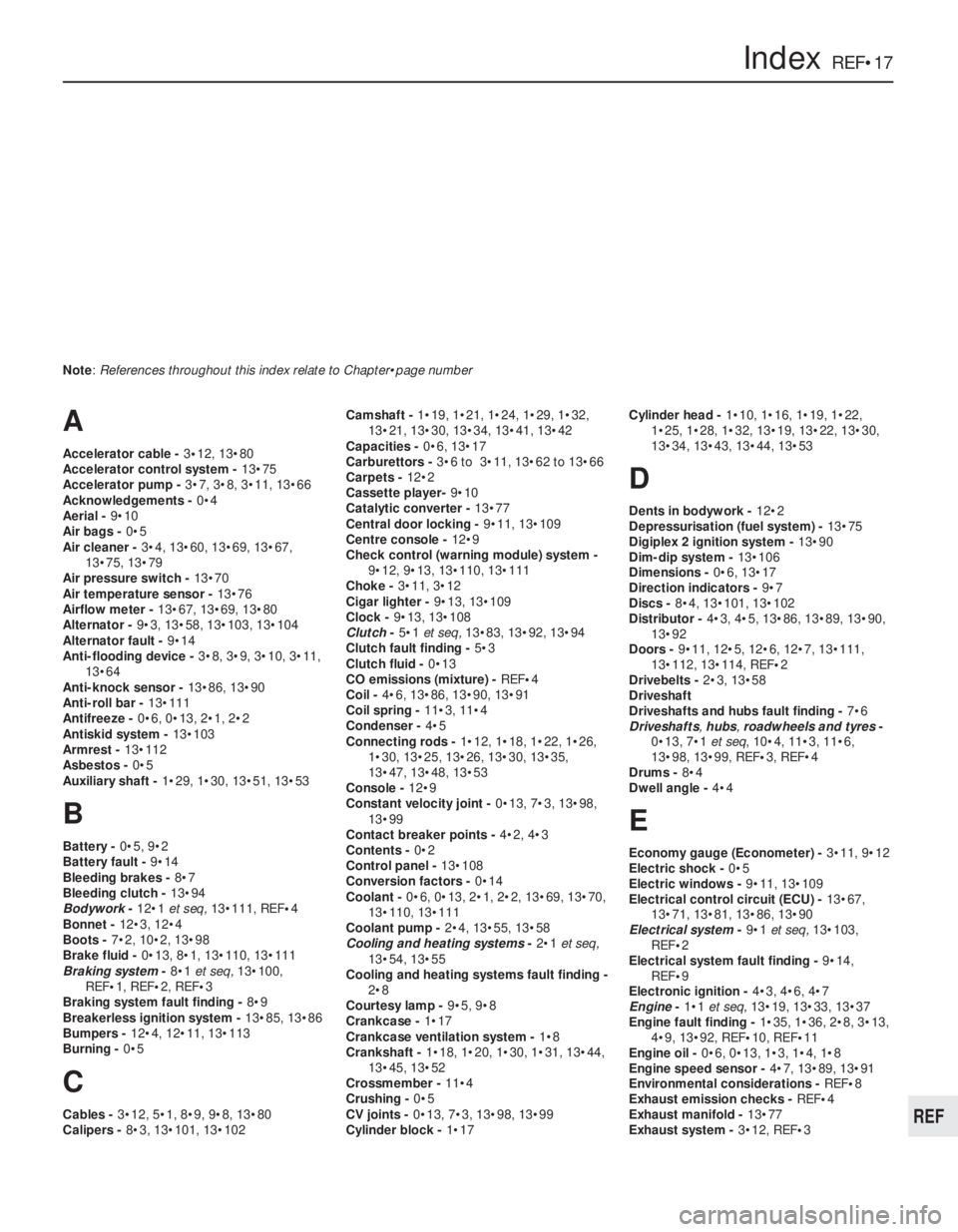
A
Accelerator cable - 3•12, 13•80
Accelerator control system - 13•75
Accelerator pump -3•7, 3•8, 3•11, 13•66
Acknowledgements - 0•4
Aerial -9•10
Air bags - 0•5
Air cleaner -3•4, 13•60, 13•69, 13•67,
13•75, 13•79
Air pressure switch - 13•70
Air temperature sensor - 13•76
Airflow meter - 13•67, 13•69, 13•80
Alternator -9•3, 13•58, 13•103, 13•104
Alternator fault -9•14
Anti-flooding device -3•8, 3•9, 3•10, 3•11,
13•64
Anti-knock sensor - 13•86, 13•90
Anti-roll bar - 13•111
Antifreeze - 0•6, 0•13, 2•1, 2•2
Antiskid system - 13•103
Armrest - 13•112
Asbestos - 0•5
Auxiliary shaft -1•29, 1•30, 13•51, 13•53
B
Battery -0•5, 9•2
Battery fault -9•14
Bleeding brakes -8•7
Bleeding clutch - 13•94
Bodywork- 12•1et seq, 13•111, REF•4
Bonnet - 12•3, 12•4
Boots -7•2, 10•2, 13•98
Brake fluid -0•13, 8•1, 13•110, 13•111
Braking system-8•1et seq, 13•100,
REF•1, REF•2, REF•3
Braking system fault finding -8•9
Breakerless ignition system - 13•85, 13•86
Bumpers - 12•4, 12•11, 13•113
Burning -0•5
C
Cables -3•12, 5•1, 8•9, 9•8, 13•80
Calipers -8•3, 13•101, 13•102Camshaft -1•19, 1•21, 1•24, 1•29, 1•32,
13•21, 13•30, 13•34, 13•41, 13•42
Capacities -0•6, 13•17
Carburettors -3•6 to 3•11, 13•62 to 13•66
Carpets - 12•2
Cassette player-9•10
Catalytic converter - 13•77
Central door locking -9•11, 13•109
Centre console - 12•9
Check control (warning module) system -
9•12, 9•13, 13•110, 13•111
Choke -3•11, 3•12
Cigar lighter -9•13, 13•109
Clock -9•13, 13•108
Clutch-5•1et seq, 13•83, 13•92, 13•94
Clutch fault finding -5•3
Clutch fluid -0•13
CO emissions (mixture) - REF•4
Coil -4•6, 13•86, 13•90, 13•91
Coil spring - 11•3, 11•4
Condenser -4•5
Connecting rods -1•12, 1•18, 1•22, 1•26,
1•30, 13•25, 13•26, 13•30, 13•35,
13•47, 13•48, 13•53
Console - 12•9
Constant velocity joint -0•13, 7•3, 13•98,
13•99
Contact breaker points -4•2, 4•3
Contents -0•2
Control panel - 13•108
Conversion factors -0•14
Coolant -0•6, 0•13, 2•1, 2•2, 13•69, 13•70,
13•110, 13•111
Coolant pump -2•4, 13•55, 13•58
Cooling and heating systems-2•1et seq,
13•54, 13•55
Cooling and heating systems fault finding -
2•8
Courtesy lamp -9•5, 9•8
Crankcase -1•17
Crankcase ventilation system -1•8
Crankshaft -1•18, 1•20, 1•30, 1•31, 13•44,
13•45, 13•52
Crossmember - 11•4
Crushing -0•5
CV joints -0•13, 7•3, 13•98, 13•99
Cylinder block -1•17Cylinder head -1•10, 1•16, 1•19, 1•22,
1•25, 1•28, 1•32, 13•19, 13•22, 13•30,
13•34, 13•43, 13•44, 13•53
D
Dents in bodywork - 12•2
Depressurisation (fuel system) - 13•75
Digiplex 2 ignition system - 13•90
Dim-dip system - 13•106
Dimensions -0•6, 13•17
Direction indicators -9•7
Discs -8•4, 13•101, 13•102
Distributor -4•3, 4•5, 13•86, 13•89, 13•90,
13•92
Doors -9•11, 12•5, 12•6, 12•7, 13•111,
13•112, 13•114, REF•2
Drivebelts -2•3, 13•58
Driveshaft
Driveshafts and hubs fault finding -7•6
Driveshafts,hubs,roadwheels and tyres-
0•13, 7•1et seq, 10•4, 11•3, 11•6,
13•98, 13•99, REF•3, REF•4
Drums -8•4
Dwell angle -4•4
E
Economy gauge (Econometer) -3•11, 9•12
Electric shock -0•5
Electric windows -9•11, 13•109
Electrical control circuit (ECU) - 13•67,
13•71, 13•81, 13•86, 13•90
Electrical system-9•1et seq,13•103,
REF•2
Electrical system fault finding -9•14,
REF•9
Electronic ignition -4•3, 4•6, 4•7
Engine-1•1et seq, 13•19, 13•33, 13•37
Engine fault finding -1•35, 1•36, 2•8, 3•13,
4•9, 13•92, REF•10, REF•11
Engine oil -0•6, 0•13, 1•3, 1•4, 1•8
Engine speed sensor -4•7, 13•89, 13•91
Environmental considerations - REF•8
Exhaust emission checks - REF•4
Exhaust manifold - 13•77
Exhaust system -3•12, REF•3
IndexREF•17
REF
Note: References throughout this index relate to Chapter•page number