warning FIAT UNO 1983 Service Owner's Manual
[x] Cancel search | Manufacturer: FIAT, Model Year: 1983, Model line: UNO, Model: FIAT UNO 1983Pages: 303, PDF Size: 10.36 MB
Page 147 of 303
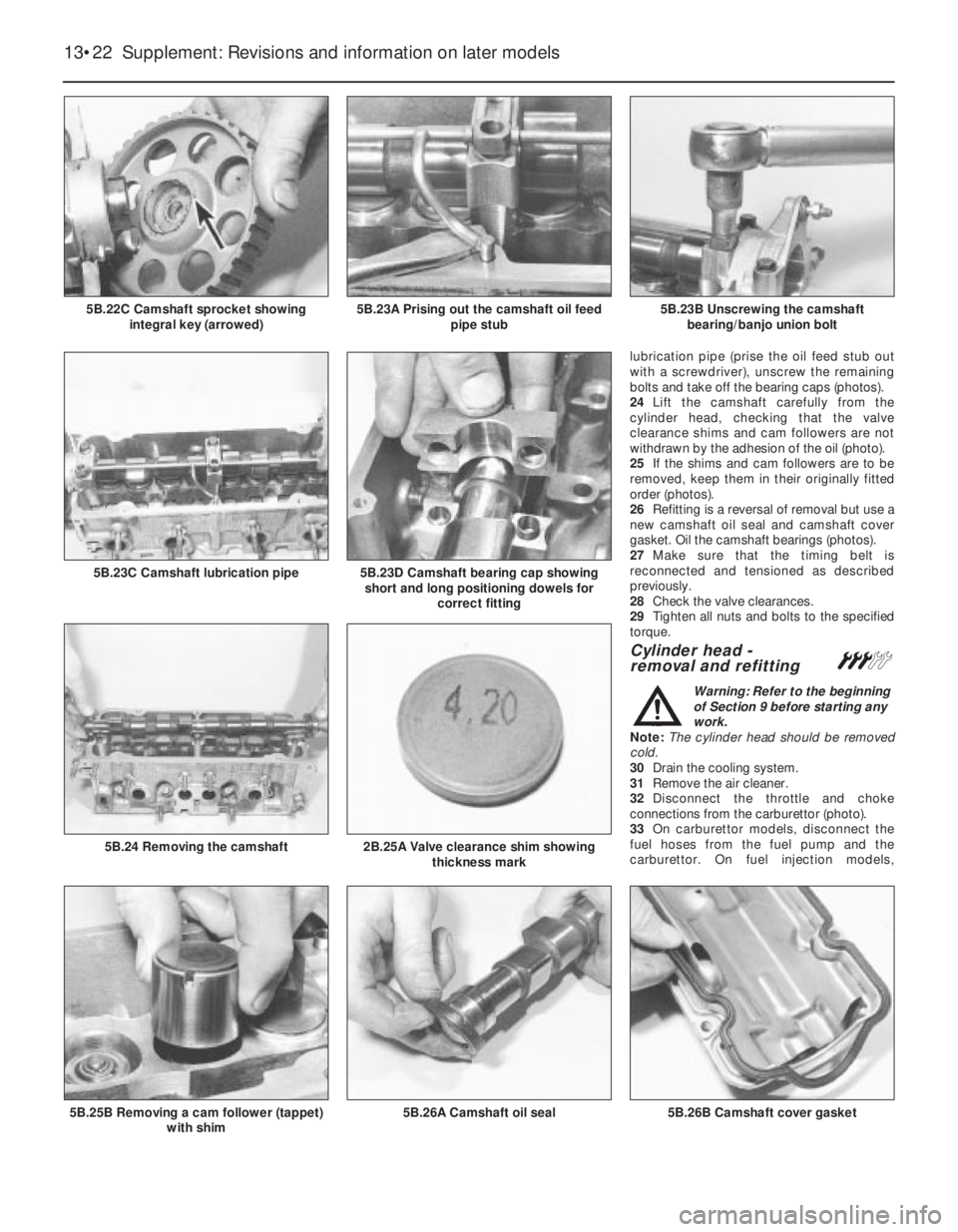
lubrication pipe (prise the oil feed stub out
with a screwdriver), unscrew the remaining
bolts and take off the bearing caps (photos).
24Lift the camshaft carefully from the
cylinder head, checking that the valve
clearance shims and cam followers are not
withdrawn by the adhesion of the oil (photo).
25If the shims and cam followers are to be
removed, keep them in their originally fitted
order (photos).
26Refitting is a reversal of removal but use a
new camshaft oil seal and camshaft cover
gasket. Oil the camshaft bearings (photos).
27Make sure that the timing belt is
reconnected and tensioned as described
previously.
28Check the valve clearances.
29Tighten all nuts and bolts to the specified
torque.
Cylinder head -
removal and refitting#
Warning: Refer to the beginning
of Section 9 before starting any
work.
Note: The cylinder head should be removed
cold.
30Drain the cooling system.
31Remove the air cleaner.
32Disconnect the throttle and choke
connections from the carburettor (photo).
33On carburettor models, disconnect the
fuel hoses from the fuel pump and the
carburettor. On fuel injection models,
13•22 Supplement: Revisions and information on later models
5B.26B Camshaft cover gasket5B.26A Camshaft oil seal5B.25B Removing a cam follower (tappet)
with shim
2B.25A Valve clearance shim showing
thickness mark5B.24 Removing the camshaft
5B.23D Camshaft bearing cap showing
short and long positioning dowels for
correct fitting5B.23C Camshaft lubrication pipe
5B.23B Unscrewing the camshaft
bearing/banjo union bolt5B.23A Prising out the camshaft oil feed
pipe stub5B.22C Camshaft sprocket showing
integral key (arrowed)
Page 151 of 303
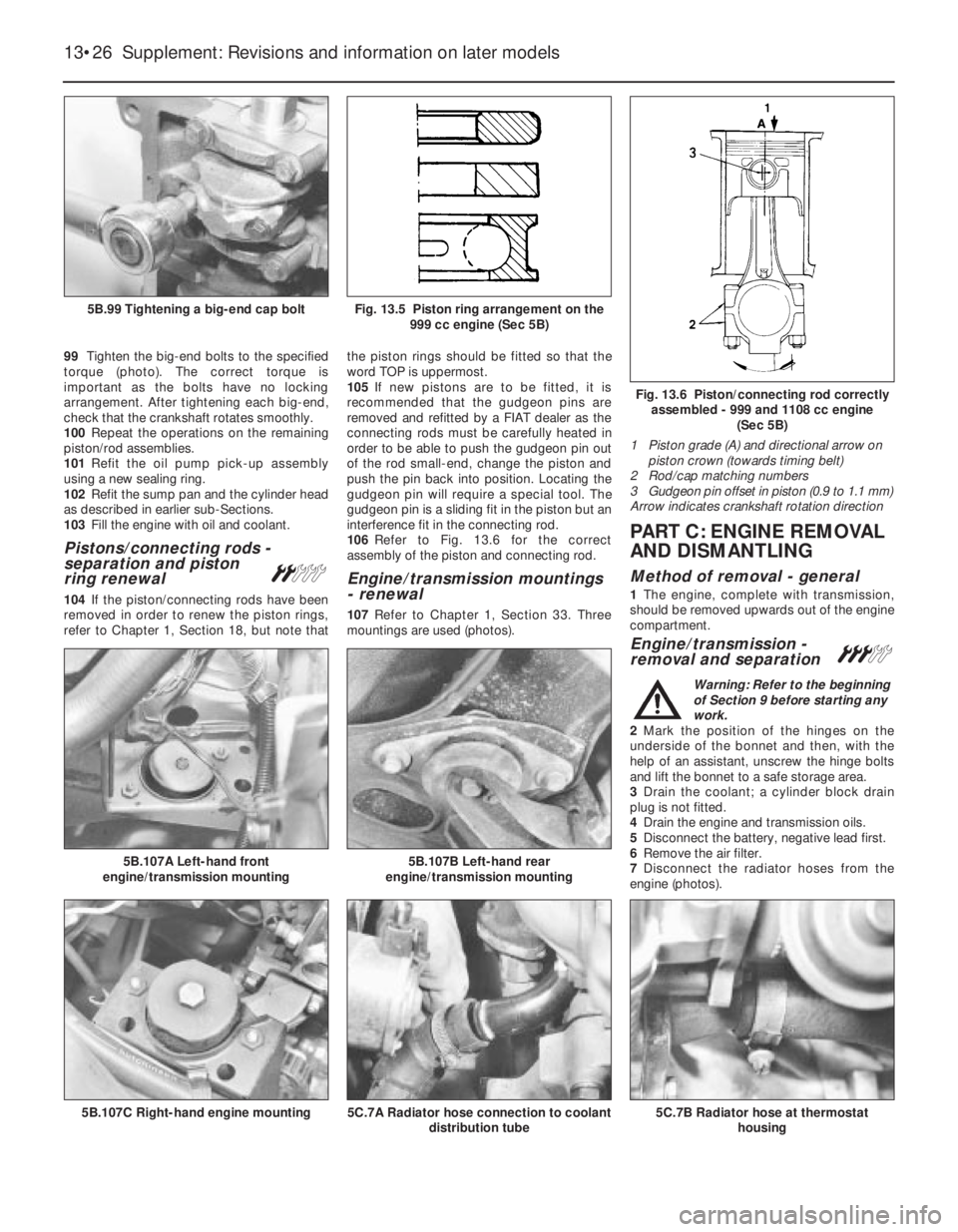
99Tighten the big-end bolts to the specified
torque (photo). The correct torque is
important as the bolts have no locking
arrangement. After tightening each big-end,
check that the crankshaft rotates smoothly.
100Repeat the operations on the remaining
piston/rod assemblies.
101Refit the oil pump pick-up assembly
using a new sealing ring.
102Refit the sump pan and the cylinder head
as described in earlier sub-Sections.
103Fill the engine with oil and coolant.
Pistons/connecting rods -
separation and piston
ring renewal
ª
104If the piston/connecting rods have been
removed in order to renew the piston rings,
refer to Chapter 1, Section 18, but note thatthe piston rings should be fitted so that the
word TOP is uppermost.
105If new pistons are to be fitted, it is
recommended that the gudgeon pins are
removed and refitted by a FIAT dealer as the
connecting rods must be carefully heated in
order to be able to push the gudgeon pin out
of the rod small-end, change the piston and
push the pin back into position. Locating the
gudgeon pin will require a special tool. The
gudgeon pin is a sliding fit in the piston but an
interference fit in the connecting rod.
106Refer to Fig. 13.6 for the correct
assembly of the piston and connecting rod.
Engine/transmission mountings
- renewal
107Refer to Chapter 1, Section 33. Three
mountings are used (photos).
PART C: ENGINE REMOVAL
AND DISMANTLING
Method of removal - general
1The engine, complete with transmission,
should be removed upwards out of the engine
compartment.
Engine/transmission -
removal and separation #
Warning: Refer to the beginning
of Section 9 before starting any
work.
2Mark the position of the hinges on the
underside of the bonnet and then, with the
help of an assistant, unscrew the hinge bolts
and lift the bonnet to a safe storage area.
3Drain the coolant; a cylinder block drain
plug is not fitted.
4Drain the engine and transmission oils.
5Disconnect the battery, negative lead first.
6Remove the air filter.
7Disconnect the radiator hoses from the
engine (photos).
13•26 Supplement: Revisions and information on later models
5C.7B Radiator hose at thermostat
housing5C.7A Radiator hose connection to coolant
distribution tube5B.107C Right-hand engine mounting
5B.107B Left-hand rear
engine/transmission mounting5B.107A Left-hand front
engine/transmission mounting
Fig. 13.6 Piston/connecting rod correctly
assembled - 999 and 1108 cc engine
(Sec 5B)
1 Piston grade (A) and directional arrow on
piston crown (towards timing belt)
2 Rod/cap matching numbers
3 Gudgeon pin offset in piston (0.9 to 1.1 mm)
Arrow indicates crankshaft rotation direction
Fig. 13.5 Piston ring arrangement on the
999 cc engine (Sec 5B)5B.99 Tightening a big-end cap bolt
Page 154 of 303
can be lowered to rest on the exhaust and
bodymember.
34Continue to raise the engine and the
transmission until it can be removed from the
engine compartment and placed on the work
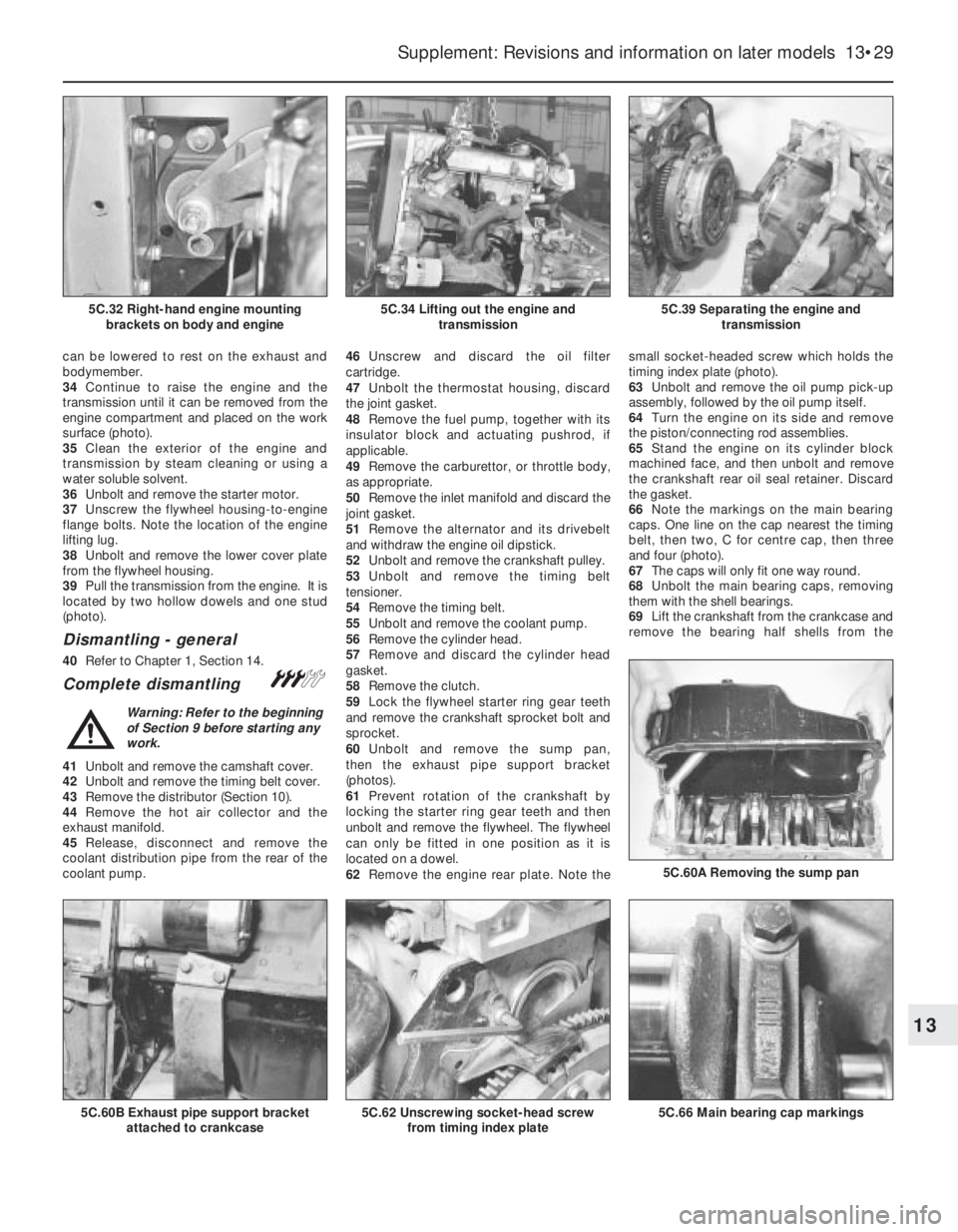
surface (photo).
35Clean the exterior of the engine and
transmission by steam cleaning or using a
water soluble solvent.
36Unbolt and remove the starter motor.
37Unscrew the flywheel housing-to-engine
flange bolts. Note the location of the engine
lifting lug.
38Unbolt and remove the lower cover plate
from the flywheel housing.
39Pull the transmission from the engine. It is
located by two hollow dowels and one stud
(photo).
Dismantling - general
40Refer to Chapter 1, Section 14.
Complete dismantling#
Warning: Refer to the beginning
of Section 9 before starting any
work.
41Unbolt and remove the camshaft cover.
42Unbolt and remove the timing belt cover.
43Remove the distributor (Section 10).
44Remove the hot air collector and the
exhaust manifold.
45Release, disconnect and remove the
coolant distribution pipe from the rear of the
coolant pump.46Unscrew and discard the oil filter
cartridge.
47Unbolt the thermostat housing, discard
the joint gasket.
48Remove the fuel pump, together with its
insulator block and actuating pushrod, if
applicable.
49Remove the carburettor, or throttle body,
as appropriate.
50Remove the inlet manifold and discard the
joint gasket.
51Remove the alternator and its drivebelt
and withdraw the engine oil dipstick.
52Unbolt and remove the crankshaft pulley.
53Unbolt and remove the timing belt
tensioner.
54Remove the timing belt.
55Unbolt and remove the coolant pump.
56Remove the cylinder head.
57Remove and discard the cylinder head
gasket.
58Remove the clutch.
59Lock the flywheel starter ring gear teeth
and remove the crankshaft sprocket bolt and
sprocket.
60Unbolt and remove the sump pan,
then the exhaust pipe support bracket
(photos).
61Prevent rotation of the crankshaft by
locking the starter ring gear teeth and then
unbolt and remove the flywheel. The flywheel
can only be fitted in one position as it is
located on a dowel.
62Remove the engine rear plate. Note thesmall socket-headed screw which holds the
timing index plate (photo).
63Unbolt and remove the oil pump pick-up
assembly, followed by the oil pump itself.
64Turn the engine on its side and remove
the piston/connecting rod assemblies.
65Stand the engine on its cylinder block
machined face, and then unbolt and remove
the crankshaft rear oil seal retainer. Discard
the gasket.
66Note the markings on the main bearing
caps. One line on the cap nearest the timing
belt, then two, C for centre cap, then three
and four (photo).
67The caps will only fit one way round.
68Unbolt the main bearing caps, removing
them with the shell bearings.
69Lift the crankshaft from the crankcase and
remove the bearing half shells from the
Supplement: Revisions and information on later models 13•29
5C.39 Separating the engine and
transmission5C.34 Lifting out the engine and
transmission5C.32 Right-hand engine mounting
brackets on body and engine
5C.66 Main bearing cap markings
5C.60A Removing the sump pan
5C.62 Unscrewing socket-head screw
from timing index plate5C.60B Exhaust pipe support bracket
attached to crankcase
13
Page 159 of 303
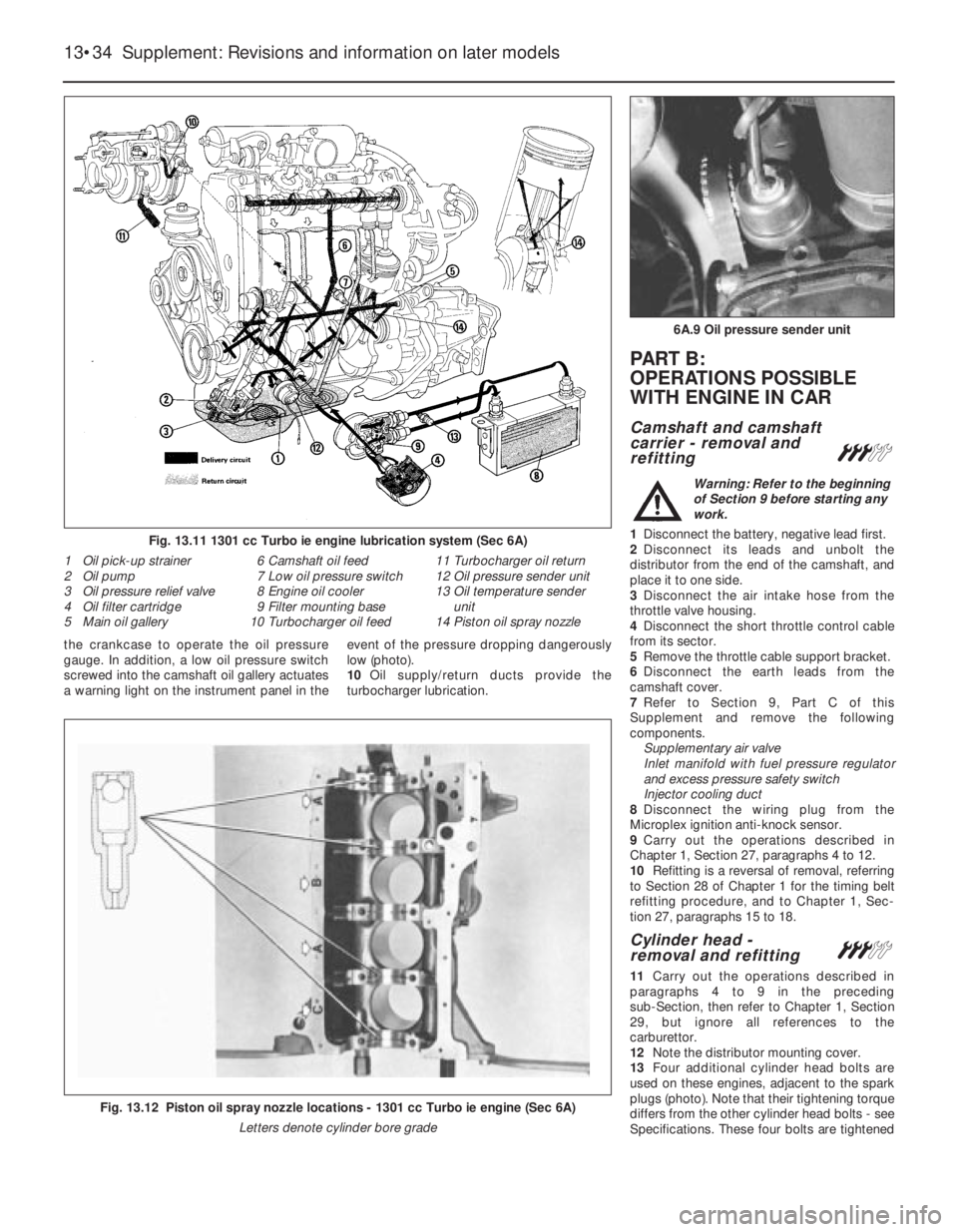
the crankcase to operate the oil pressure
gauge. In addition, a low oil pressure switch
screwed into the camshaft oil gallery actuates
a warning light on the instrument panel in theevent of the pressure dropping dangerously
low (photo).
10Oil supply/return ducts provide the
turbocharger lubrication.
PART B:
OPERATIONS POSSlBLE
WITH ENGINE IN CAR
Camshaft and camshaft
carrier - removal and
refitting
#
Warning: Refer to the beginning
of Section 9 before starting any
work.
1Disconnect the battery, negative lead first.
2Disconnect its leads and unbolt the
distributor from the end of the camshaft, and
place it to one side.
3Disconnect the air intake hose from the
throttle valve housing.
4Disconnect the short throttle control cable
from its sector.
5Remove the throttle cable support bracket.
6Disconnect the earth leads from the
camshaft cover.
7Refer to Section 9, Part C of this
Supplement and remove the following
components.
Supplementary air valve
Inlet manifold with fuel pressure regulator
and excess pressure safety switch
Injector cooling duct
8Disconnect the wiring plug from the
Microplex ignition anti-knock sensor.
9Carry out the operations described in
Chapter 1, Section 27, paragraphs 4 to 12.
10Refitting is a reversal of removal, referring
to Section 28 of Chapter 1 for the timing belt
refitting procedure, and to Chapter 1, Sec-
tion 27, paragraphs 15 to 18.
Cylinder head -
removal and refitting#
11Carry out the operations described in
paragraphs 4 to 9 in the preceding
sub-Section, then refer to Chapter 1, Section
29, but ignore all references to the
carburettor.
12Note the distributor mounting cover.
13Four additional cylinder head bolts are
used on these engines, adjacent to the spark
plugs (photo). Note that their tightening torque
differs from the other cylinder head bolts - see
Specifications. These four bolts are tightened
13•34 Supplement: Revisions and information on later models
1 Oil pick-up strainer
2 Oil pump
3 Oil pressure relief valve
4 Oil filter cartridge
5 Main oil gallery6 Camshaft oil feed
7 Low oil pressure switch
8 Engine oil cooler
9 Filter mounting base
10 Turbocharger oil feed11 Turbocharger oil return
12 Oil pressure sender unit
13 Oil temperature sender
unit
14 Piston oil spray nozzle
Fig. 13.12 Piston oil spray nozzle locations - 1301 cc Turbo ie engine (Sec 6A)
Letters denote cylinder bore grade
Fig. 13.11 1301 cc Turbo ie engine lubrication system (Sec 6A)
6A.9 Oil pressure sender unit
Page 161 of 303
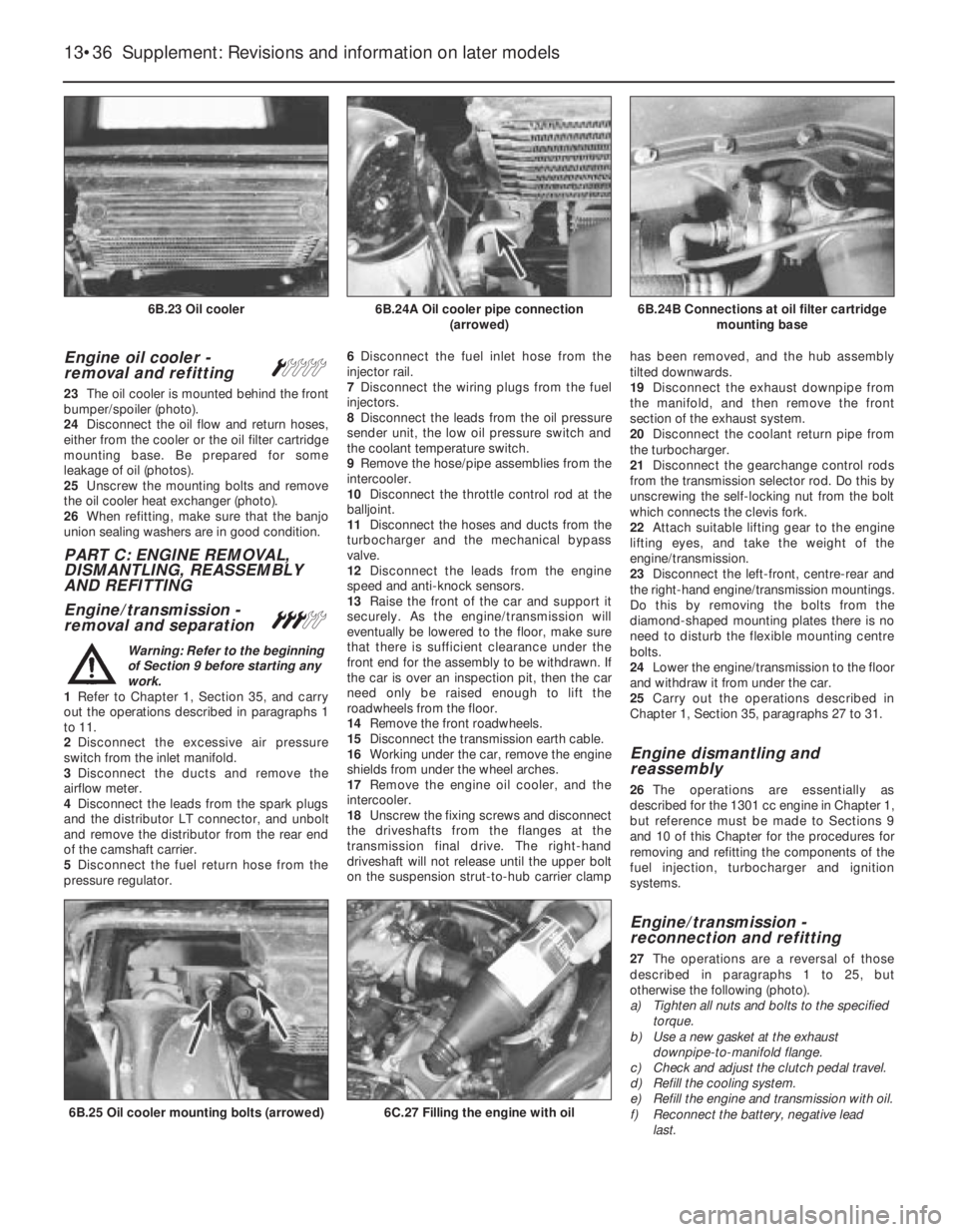
Engine oil cooler -
removal and refittingÁ
23The oil cooler is mounted behind the front
bumper/spoiler (photo).
24Disconnect the oil flow and return hoses,
either from the cooler or the oil filter cartridge
mounting base. Be prepared for some
leakage of oil (photos).
25Unscrew the mounting bolts and remove
the oil cooler heat exchanger (photo).
26When refitting, make sure that the banjo
union sealing washers are in good condition.
PART C: ENGINE REMOVAL,
DISMANTLING, REASSEMBLY
AND REFITTING
Engine/transmission -
removal and separation
#
Warning: Refer to the beginning
of Section 9 before starting any
work.
1Refer to Chapter 1, Section 35, and carry
out the operations described in paragraphs 1
to 11.
2Disconnect the excessive air pressure
switch from the inlet manifold.
3Disconnect the ducts and remove the
airflow meter.
4Disconnect the leads from the spark plugs
and the distributor LT connector, and unbolt
and remove the distributor from the rear end
of the camshaft carrier.
5Disconnect the fuel return hose from the
pressure regulator. 6Disconnect the fuel inlet hose from the
injector rail.
7Disconnect the wiring plugs from the fuel
injectors.
8Disconnect the leads from the oil pressure
sender unit, the low oil pressure switch and
the coolant temperature switch.
9Remove the hose/pipe assemblies from the
intercooler.
10Disconnect the throttle control rod at the
balljoint.
11Disconnect the hoses and ducts from the
turbocharger and the mechanical bypass
valve.
12Disconnect the leads from the engine
speed and anti-knock sensors.
13Raise the front of the car and support it
securely. As the engine/transmission will
eventually be lowered to the floor, make sure
that there is sufficient clearance under the
front end for the assembly to be withdrawn. If
the car is over an inspection pit, then the car
need only be raised enough to lift the
roadwheels from the floor.
14Remove the front roadwheels.
15Disconnect the transmission earth cable.
16Working under the car, remove the engine
shields from under the wheel arches.
17Remove the engine oil cooler, and the
intercooler.
18Unscrew the fixing screws and disconnect
the driveshafts from the flanges at the
transmission final drive. The right-hand
driveshaft will not release until the upper bolt
on the suspension strut-to-hub carrier clamphas been removed, and the hub assembly
tilted downwards.
19Disconnect the exhaust downpipe from
the manifold, and then remove the front
section of the exhaust system.
20Disconnect the coolant return pipe from
the turbocharger.
21Disconnect the gearchange control rods
from the transmission selector rod. Do this by
unscrewing the self-locking nut from the bolt
which connects the clevis fork.
22Attach suitable lifting gear to the engine
lifting eyes, and take the weight of the
engine/transmission.
23Disconnect the left-front, centre-rear and
the right-hand engine/transmission mountings.
Do this by removing the bolts from the
diamond-shaped mounting plates there is no
need to disturb the flexible mounting centre
bolts.
24Lower the engine/transmission to the floor
and withdraw it from under the car.
25Carry out the operations described in
Chapter 1, Section 35, paragraphs 27 to 31.
Engine dismantling and
reassembly
26The operations are essentially as
described for the 1301 cc engine in Chapter 1,
but reference must be made to Sections 9
and 10 of this Chapter for the procedures for
removing and refitting the components of the
fuel injection, turbocharger and ignition
systems.
Engine/transmission -
reconnection and refitting
27The operations are a reversal of those
described in paragraphs 1 to 25, but
otherwise the following (photo).
a) Tighten all nuts and bolts to the specified
torque.
b) Use a new gasket at the exhaust
downpipe-to-manifold flange.
c) Check and adjust the clutch pedal travel.
d) Refill the cooling system.
e) Refill the engine and transmission with oil.
f) Reconnect the battery, negative lead
last.
13•36 Supplement: Revisions and information on later models
6C.27 Filling the engine with oil6B.25 Oil cooler mounting bolts (arrowed)
6B.24B Connections at oil filter cartridge
mounting base6B.24A Oil cooler pipe connection
(arrowed)6B.23 Oil cooler
Page 168 of 303
98Commence reassembly by liberally oiling
the bearings in the housing, and the oil seal lip.
99Carefully insert the camshaft into the
housing from the blanking plate/distributor
end, taking care to avoid damage to the
bearings.
100Refit the blanking plate using a new
gasket.
101Refit the camshaft housing as described
previously in this Section.
Cylinder head
(1372 cc ie engine) -
removal and refitting
#
Note: The following instructions describe
cylinder head removal and refitting leaving the
camshaft, manifolds and associated items in situ
In the head. If required, these items can be
removed separately. When removing the
cylinder head the engine must be cold - do not
remove the head from a hot engine. A new
cylinder head gasket and any associated gaskets
must be used during reassembly. FIAT specify
that the main cylinder head bolts should be
renewed after they have been used (ie tightened)
four times. If in any doubt as to the number of
times that they have been used renew them as a
precaution against possible failure.
Warning: Refer to the beginning
of Section 9 before starting any
work.
102Depressurise the fuel supply system as
described in Section 9 of this Chapter.
103Disconnect the battery negative lead.
104Drain the engine coolant as described in
Section 8.
105Remove the air cleaner unit as described
in Section 9.
106Remove the timing belt as described
previously in this Section.107Disconnect the crankcase ventilation
hose from the cylinder head and the SPi
injector unit.
108Disconnect the accelerator cable at the
engine end.
109Detach the engine idle speed check
actuator lead, the inlet manifold vacuum
sensor lead, the coolant temperature sensor
lead, the injector supply lead, the throttle
position switch lead and the distributor cap
(with HT leads). Position them out of the way.
110Disconnect the brake servo hose from
the manifold.
111Disconnect the coolant hoses from the
thermostat and the inlet manifold.
112Slowly release the fuel supply and return
hose retaining clips and detach the hoses
from the injector unit housing and
connections. Catch any fuel spillage in a clean
cloth and plug the hoses to prevent the
ingress of dirt and further fuel loss.
113Unbolt and detach the exhaust downpipe
from the manifold.
114Loosen off the cylinder head retaining
bolts in a progressive manner, reversing the
sequence shown in Fig. 13.17. When all of the
bolts are loosened off, extract them and
collect the washers.
115Check that all fittings and associated
attachments are clear of the cylinder head,
then carefully lift the head from the cylinder
block. If necessary tap the head lightly with a
soft-faced mallet to free it from the block, but
do not lever it free between the joint faces.
Note that the cylinder head is located on
dowels.116Recover the old cylinder head gasket and
discard it.
117Clean the cylinder head and block mating
surfaces by careful scraping. Take care not to
damage the cylinder head - it is manufactured in
light alloy and is easily scored. Cover the coolant
passages and other openings to prevent dirt and
carbon from falling into them. Mop out all the oil
from the cylinder head bolt holes - if oil is left in
them, hydraulic pressure, caused when the bolts
are refitted, could cause the block to crack.
118If required the cylinder head can be
dismantled and overhauled as described in
paragraphs 129 to 131 of this Section.
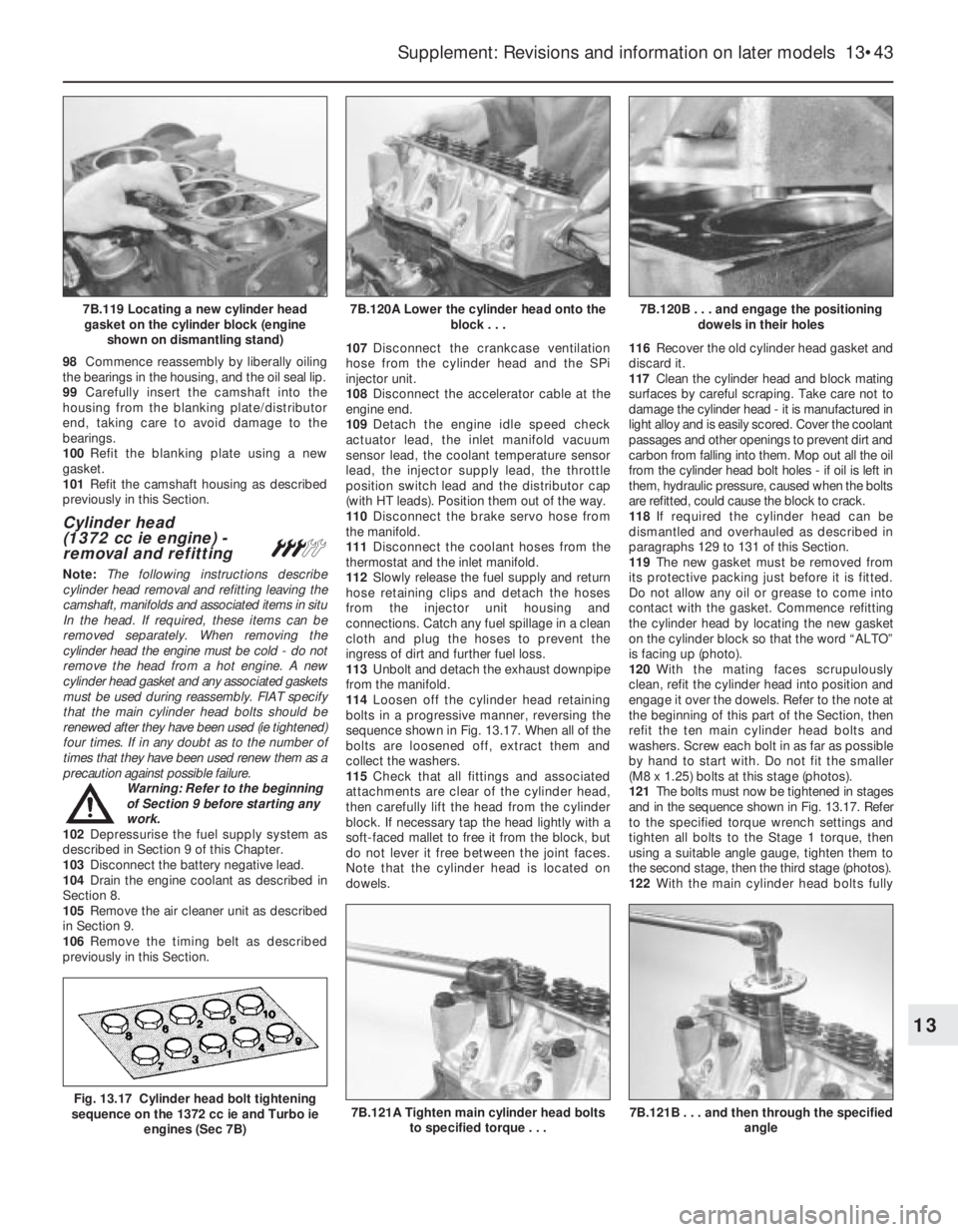
119The new gasket must be removed from
its protective packing just before it is fitted.
Do not allow any oil or grease to come into
contact with the gasket. Commence refitting
the cylinder head by locating the new gasket
on the cylinder block so that the word “ALTO”
is facing up (photo).
120With the mating faces scrupulously
clean, refit the cylinder head into position and
engage it over the dowels. Refer to the note at
the beginning of this part of the Section, then
refit the ten main cylinder head bolts and
washers. Screw each bolt in as far as possible
by hand to start with. Do not fit the smaller
(M8 x 1.25) bolts at this stage (photos).
121The bolts must now be tightened in stages
and in the sequence shown in Fig. 13.17. Refer
to the specified torque wrench settings and
tighten all bolts to the Stage 1 torque, then
using a suitable angle gauge, tighten them to
the second stage, then the third stage (photos).
122With the main cylinder head bolts fully
Supplement: Revisions and information on later models 13•43
7B.120B . . . and engage the positioning
dowels in their holes7B.120A Lower the cylinder head onto the
block . . .7B.119 Locating a new cylinder head
gasket on the cylinder block (engine
shown on dismantling stand)
7B.121A Tighten main cylinder head bolts
to specified torque . . .Fig. 13.17 Cylinder head bolt tightening
sequence on the 1372 cc ie and Turbo ie
engines (Sec 7B)
13
7B.121B . . . and then through the specified
angle
Page 174 of 303
fitting, as during removal. Note that the
compression rings are brittle, and will snap if
expanded too far.
206If new pistons are to be fitted, they must
be selected from the grades available, after
measuring the cylinder bores. Normally, the
appropriate oversize pistons are supplied by
the dealer when the block is rebored.
207Whenever new piston rings are being
installed, the glaze on the original cylinder
bores should be removed using either
abrasive paper or a glaze-removing tool in an
electric drill. If abrasive paper is used, use
strokes at 60º to the bore centre-line, to
create a cross-hatching effect.
Engine/transmission
mountings - renewalÁ
208The engine/gearbox assembly is
suspended in the engine compartment on
three mountings, two of which are attached to
the gearbox, and one to the engine.
Right-hand mounting
209Apply the handbrake, then jack up the
front of the vehicle and support it securely on
axle stands.
210Suitable lifting tackle must now be
attached to the engine in order to support it as
the engine mounting is removed. No lifting
brackets are provided, so care must be taken
when deciding on an engine lifting point. In the
workshop, a right-angled bracket was made up
by bending a suitable piece of steel plate. The
bracket was then bolted to the engine using the
rear right-hand camshaft housing securing bolt
with suitable packing washers.
211Attach the lifting tackle to the bracket on
the engine and just take the weight of the
assembly.
212Working under the vehicle, unbolt the
engine mounting bracket from the cylinder
block, and unbolt the mounting from the
body, then withdraw the bracket/mounting
assembly.
213Unscrew the nut and through-bolt,
counter holding the bolt with a second
spanner or socket, and separate the mounting
from the bracket.
214Fit the new mounting to the bracket, and
tighten the nut to the specified torque, while
counterholding the through-bolt using a
suitable spanner or socket.
215Refit the mounting bracket to the cylinder
block, and tighten the securing bolts to the
specified torque.
216Refit the mounting to the body and
tighten the securing bolts to the specified
torque.
217Disconnect the lifting tackle from the
engine, and remove the engine lifting bracket.
218Lower the vehicle to the ground.
Left-hand mountings
219Apply the handbrake, then jack up the
front of the vehicle and support it securely on
axle stands.
220Suitable lifting tackle must now be
attached to the gearbox lifting bracket inorder to support the weight of the assembly
as the mounting is removed.
221Attach the lifting tackle to the bracket on
the gearbox, and just take the weight of the
assembly.
222Working under the vehicle, unbolt the
mounting bracket from the gearbox, and
unbolt the mounting from the body, then
withdraw the bracket/mounting assembly.
223Proceed as described in paragraphs 213
and 214.
224Refit the mounting bracket to the
gearbox, and tighten the securing bolts to the
specified torque.
225Refit the mounting to the body and
tighten the mounting bolts to the specified
torque.
226Disconnect the lifting tackle from the
engine.
227Lower the vehicle to the ground.
PART C: ENGINE REMOVAL
AND DISMANTLING
Method of removal - general
1The engine (complete with transmission) is
disconnected and lowered downwards
through the engine compartment, then
withdrawn from the front underside of the car.
1372 cc engine/
transmission - removal
and separation
#
Warning: Refer to the beginning
of Section 9 before starting any
work.
2Depressurize the fuel system as described
in Section 9 of this Chapter.
3Disconnect the battery negative lead.
4Mark the position of the hinges on the
underside of the bonnet, then with the aid of
an assistant, unscrew the hinge bolts and lift
the bonnet clear of the car. Store the bonnet
in a safe area.
5Drain the engine coolant.
6Drain the engine and transmission oils.
7Disconnect and remove the air filter.
8Disconnect the coolant hoses from the
engine, including the hose to the inlet
manifold.
9Detach the ignition coil (HT) lead from the
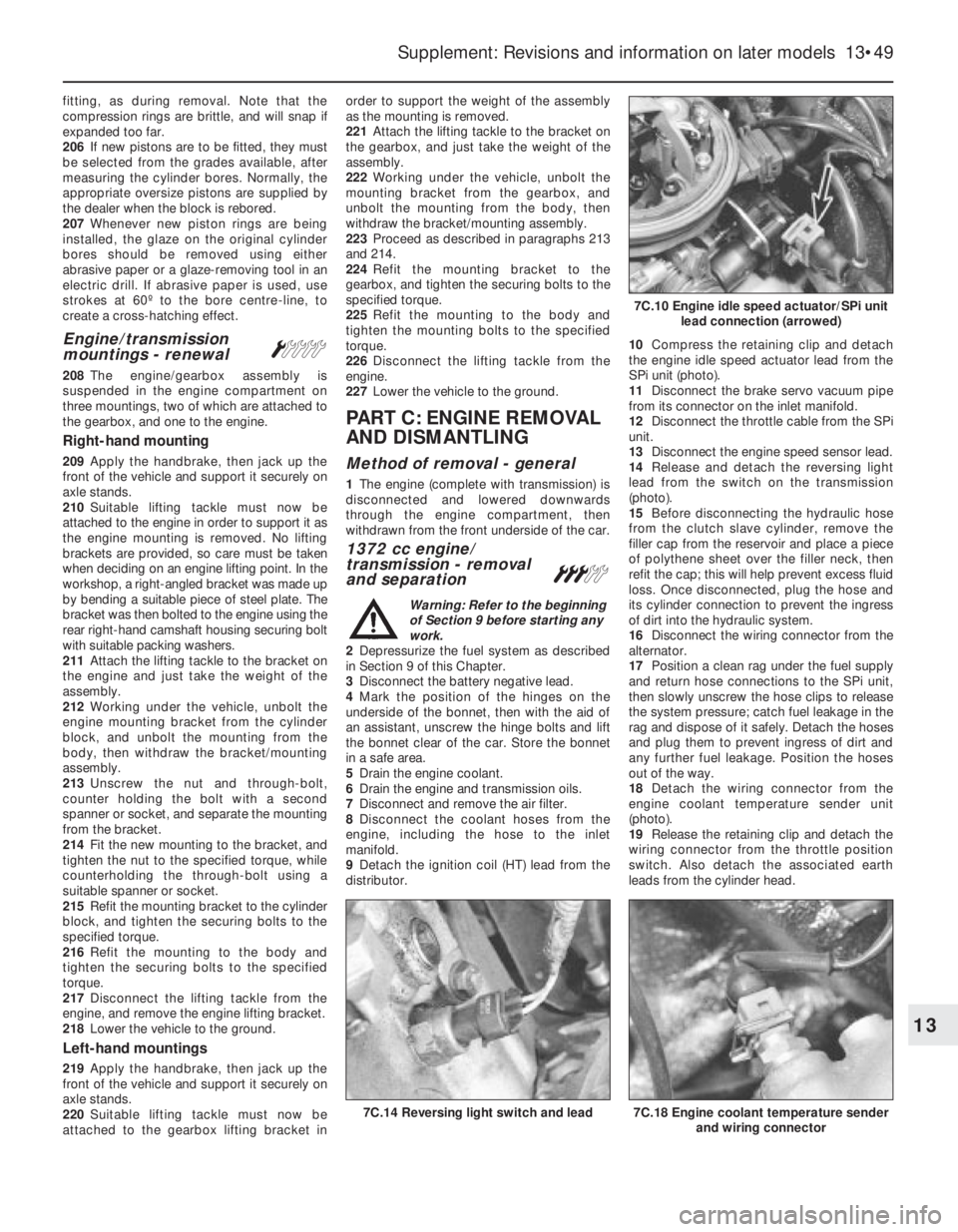
distributor.10Compress the retaining clip and detach
the engine idle speed actuator lead from the
SPi unit (photo).
11Disconnect the brake servo vacuum pipe
from its connector on the inlet manifold.
12Disconnect the throttle cable from the SPi
unit.
13Disconnect the engine speed sensor lead.
14Release and detach the reversing light
lead from the switch on the transmission
(photo).
15Before disconnecting the hydraulic hose
from the clutch slave cylinder, remove the
filler cap from the reservoir and place a piece
of polythene sheet over the filler neck, then
refit the cap; this will help prevent excess fluid
loss. Once disconnected, plug the hose and
its cylinder connection to prevent the ingress
of dirt into the hydraulic system.
16Disconnect the wiring connector from the
alternator.
17Position a clean rag under the fuel supply
and return hose connections to the SPi unit,
then slowly unscrew the hose clips to release
the system pressure; catch fuel leakage in the
rag and dispose of it safely. Detach the hoses
and plug them to prevent ingress of dirt and
any further fuel leakage. Position the hoses
out of the way.
18Detach the wiring connector from the
engine coolant temperature sender unit
(photo).
19Release the retaining clip and detach the
wiring connector from the throttle position
switch. Also detach the associated earth
leads from the cylinder head.
Supplement: Revisions and information on later models 13•49
7C.14 Reversing light switch and lead7C.18 Engine coolant temperature sender
and wiring connector
7C.10 Engine idle speed actuator/SPi unit
lead connection (arrowed)
13
Page 176 of 303
fittings are disconnected from the engine and
transmission and positioned out of the way.
Enlist the aid of an assistant to help steady
and guide the power unit down through the
engine compartment as it is removed, If
available, position a suitable engine trolley or
crawler board under the engine/transmission
so that when lowered, the power unit can be
withdrawn from the front end of the vehicle
and moved to the area where it is to be
cleaned and dismantled.
38Carefully lower the engine and
transmission unit, ensuring that no fittings
become snagged. Detach the hoist and
withdraw the power unit from under the
vehicle.
39To separate the engine from the
transmission, unbolt and remove the starter
motor, then unscrew the retaining bolts and
withdraw the transmission from the engine. As
it is withdrawn, do not allow the weight of the
engine or transmission to be taken by the
input shaft.
40To remove the clutch unit, refer to
Chapter 5 for details.
1372 cc Turbo ie
engine/transmission -
removal and separation
#
41The engine and transmission removal and
refitting details for Turbo-engined models are
similar to those described for the non-Turbo
models in the previous sub-Section, but the
following differences should be noted.
42To provide access for the disconnection
of the turbo and related components, first
remove the inlet manifold. Removal of the inlet
manifold and the turbocharger is described in
Section 9 of this Chapter.
43The ignition distributor on the Turbo
engine is driven from the auxiliary shaft and is
mounted at the front of the engine, towards
the timing cover end.
44The right-hand driveshaft has a steady
bearing and this will need to be unbolted and
detached.
Engine dismantling - general
45Refer to Chapter 1, Section 14 for details.
Auxiliary shaft - removal,
inspection and refitting #
46Remove the engine and transmission from
the vehicle as described previously in this
Section part.
47Drain the engine oil and remove the sump
as described in Part B of this Section.
48Remove the oil pump as described in Part
B of this Section.
49Remove the timing belt and the auxiliary
shaft sprocket as described in Part B of this
Section.
50Unscrew the three retaining bolts and
remove the auxiliary shaft cover. Remove the
gasket.
51Withdraw the auxiliary shaft from the
cylinder block.
52Examine the shaft and its bearing bushes
in the cylinder block for signs of excessive
wear and/or damage and renew it if
necessary. Bush renewal is described in
paragraph 79 in this Section.
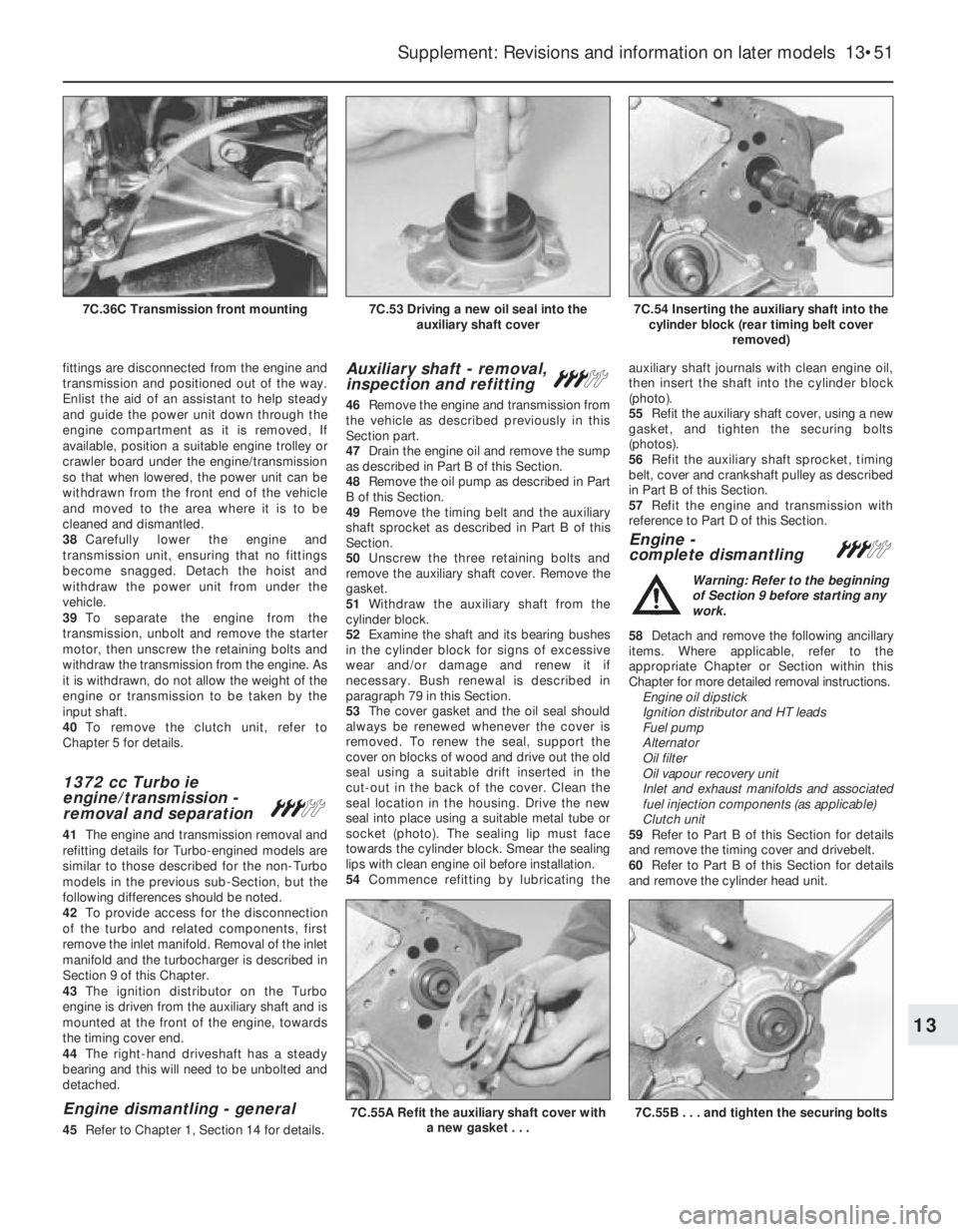
53The cover gasket and the oil seal should
always be renewed whenever the cover is
removed. To renew the seal, support the
cover on blocks of wood and drive out the old
seal using a suitable drift inserted in the
cut-out in the back of the cover. Clean the
seal location in the housing. Drive the new
seal into place using a suitable metal tube or
socket (photo). The sealing lip must face
towards the cylinder block. Smear the sealing
lips with clean engine oil before installation.
54Commence refitting by lubricating theauxiliary shaft journals with clean engine oil,
then insert the shaft into the cylinder block
(photo).
55Refit the auxiliary shaft cover, using a new
gasket, and tighten the securing bolts
(photos).
56Refit the auxiliary shaft sprocket, timing
belt, cover and crankshaft pulley as described
in Part B of this Section.
57Refit the engine and transmission with
reference to Part D of this Section.
Engine -
complete dismantling#
Warning: Refer to the beginning
of Section 9 before starting any
work.
58Detach and remove the following ancillary
items. Where applicable, refer to the
appropriate Chapter or Section within this
Chapter for more detailed removal instructions.
Engine oil dipstick
Ignition distributor and HT leads
Fuel pump
Alternator
Oil filter
Oil vapour recovery unit
Inlet and exhaust manifolds and associated
fuel injection components (as applicable)
Clutch unit
59Refer to Part B of this Section for details
and remove the timing cover and drivebelt.
60Refer to Part B of this Section for details
and remove the cylinder head unit.
Supplement: Revisions and information on later models 13•51
7C.54 Inserting the auxiliary shaft into the
cylinder block (rear timing belt cover
removed)7C.53 Driving a new oil seal into the
auxiliary shaft cover7C.36C Transmission front mounting
7C.55B . . . and tighten the securing bolts7C.55A Refit the auxiliary shaft cover with
a new gasket . . .
13
Page 180 of 303
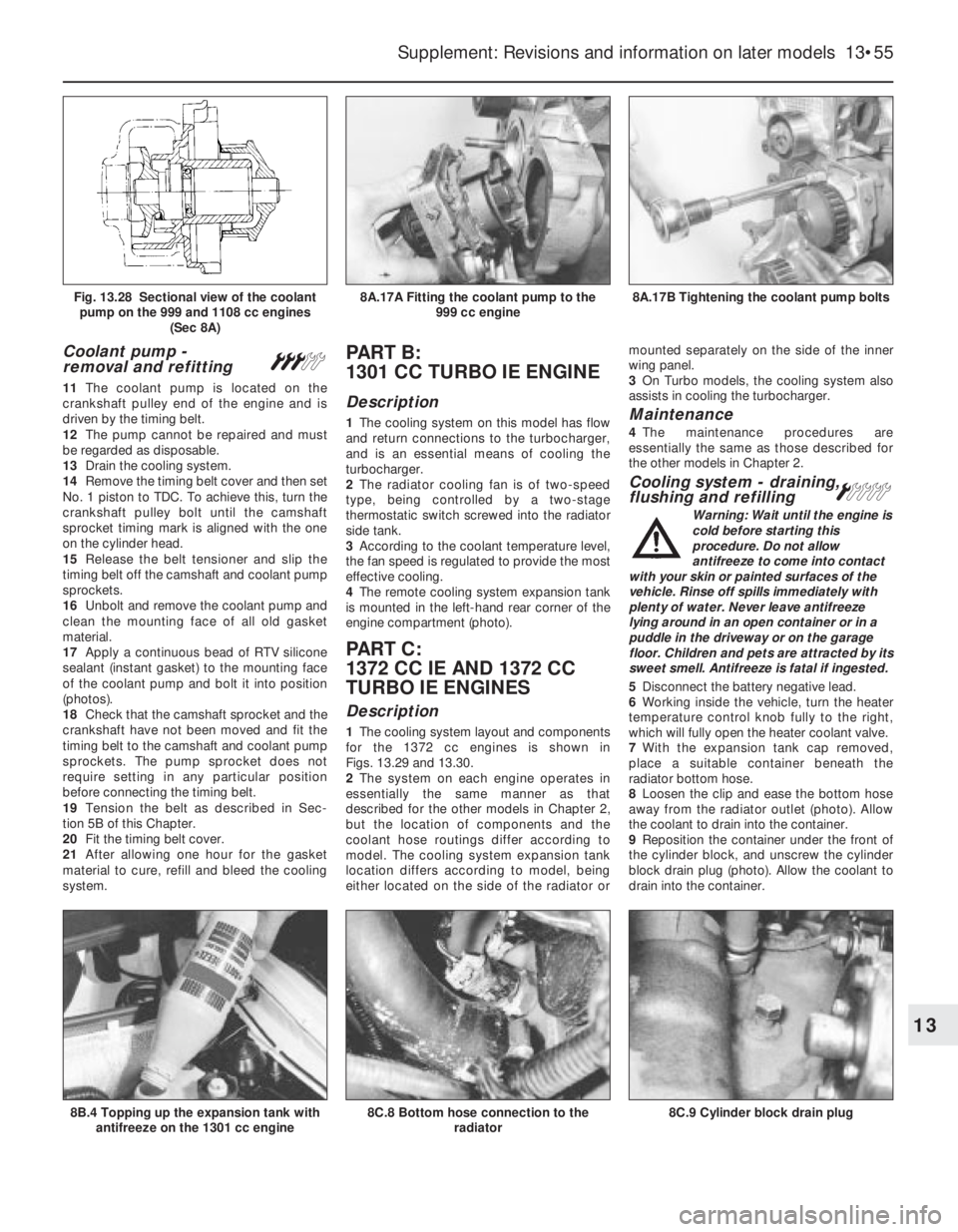
Coolant pump -
removal and refitting#
11The coolant pump is located on the
crankshaft pulley end of the engine and is
driven by the timing belt.
12The pump cannot be repaired and must
be regarded as disposable.
13Drain the cooling system.
14Remove the timing belt cover and then set
No. 1 piston to TDC. To achieve this, turn the
crankshaft pulley bolt until the camshaft
sprocket timing mark is aligned with the one
on the cylinder head.
15Release the belt tensioner and slip the
timing belt off the camshaft and coolant pump
sprockets.
16Unbolt and remove the coolant pump and
clean the mounting face of all old gasket
material.
17Apply a continuous bead of RTV silicone
sealant (instant gasket) to the mounting face
of the coolant pump and bolt it into position
(photos).
18Check that the camshaft sprocket and the
crankshaft have not been moved and fit the
timing belt to the camshaft and coolant pump
sprockets. The pump sprocket does not
require setting in any particular position
before connecting the timing belt.
19Tension the belt as described in Sec-
tion 5B of this Chapter.
20Fit the timing belt cover.
21After allowing one hour for the gasket
material to cure, refill and bleed the cooling
system.
PART B:
1301 CC TURBO IE ENGINE
Description
1The cooling system on this model has flow
and return connections to the turbocharger,
and is an essential means of cooling the
turbocharger.
2The radiator cooling fan is of two-speed
type, being controlled by a two-stage
thermostatic switch screwed into the radiator
side tank.
3According to the coolant temperature level,
the fan speed is regulated to provide the most
effective cooling.
4The remote cooling system expansion tank
is mounted in the left-hand rear corner of the
engine compartment (photo).
PART C:
1372 CC IE AND 1372 CC
TURBO IE ENGINES
Description
1The cooling system layout and components
for the 1372 cc engines is shown in
Figs. 13.29 and 13.30.
2The system on each engine operates in
essentially the same manner as that
described for the other models in Chapter 2,
but the location of components and the
coolant hose routings differ according to
model. The cooling system expansion tank
location differs according to model, being
either located on the side of the radiator ormounted separately on the side of the inner
wing panel.
3On Turbo models, the cooling system also
assists in cooling the turbocharger.
Maintenance
4The maintenance procedures are
essentially the same as those described for
the other models in Chapter 2.
Cooling system - draining,
flushing and refillingÁ
Warning: Wait until the engine is
cold before starting this
procedure. Do not allow
antifreeze to come into contact
with your skin or painted surfaces of the
vehicle. Rinse off spills immediately with
plenty of water. Never leave antifreeze
lying around in an open container or in a
puddle in the driveway or on the garage
floor. Children and pets are attracted by its
sweet smell. Antifreeze is fatal if ingested.
5Disconnect the battery negative lead.
6Working inside the vehicle, turn the heater
temperature control knob fully to the right,
which will fully open the heater coolant valve.
7With the expansion tank cap removed,
place a suitable container beneath the
radiator bottom hose.
8Loosen the clip and ease the bottom hose
away from the radiator outlet (photo). Allow
the coolant to drain into the container.
9Reposition the container under the front of
the cylinder block, and unscrew the cylinder
block drain plug (photo). Allow the coolant to
drain into the container.
Supplement: Revisions and information on later models 13•55
8A.17B Tightening the coolant pump bolts8A.17A Fitting the coolant pump to the
999 cc engineFig. 13.28 Sectional view of the coolant
pump on the 999 and 1108 cc engines
(Sec 8A)
8C.9 Cylinder block drain plug8C.8 Bottom hose connection to the
radiator8B.4 Topping up the expansion tank with
antifreeze on the 1301 cc engine
13
Page 185 of 303
9 Fuel and exhaust systems
Warning: Many of the
procedures in this Section
require the removal of fuel lines
and connections that may result
in some fuel spillage. Before carrying out
any operation on the fuel system refer to
the precautions given in ‘Safety first!’ at
the beginning of this Manual and follow
them implicitly. Petrol is a highly
dangerous and volatile liquid, and the
precautions necessary when handling it
cannot be overstressed.
Caution: On fuel injection
models, the system is
pressurised, therefore extra
care must be taken when
disconnecting fuel lines. When
disconnecting a fuel line union, loosen the
union slowly, to avoid a sudden release of
pressure that may cause fuel to spray out
and have a container and cloth ready to
catch spillages. Fuel pressure checking
must be entrusted to a Fiat dealer, or other
specialist, who has the necessary special
equipment.
PART A: GENERAL
Unleaded fuel
Note: On models with catalytic convertersonly unleaded petrol must be used - the use
of leaded petrol will destroy the catalyst.
1It is possible to use unleaded fuel (minimum
95 RON) in the following models with the
indicated serial numbers.
Engine Serial number
903 cc 146A.000
146A.046
146A.048
999 cc 156A2.00
1108 cc 160A3.000
1116 cc 138B.000
138B.046
146A4000
146A4.048
1299/1301 cc 138B2.000
138B2.046
149A7.000
1149A7.000
146A2.000
1372 cc 146C1.000
146A8.000
160A1.046
2On all except the 903 cc engine, the use of
unleaded fuel is conditional upon the
avoidance of constant high speeds and
sudden acceleration.
Air cleaner - modified types
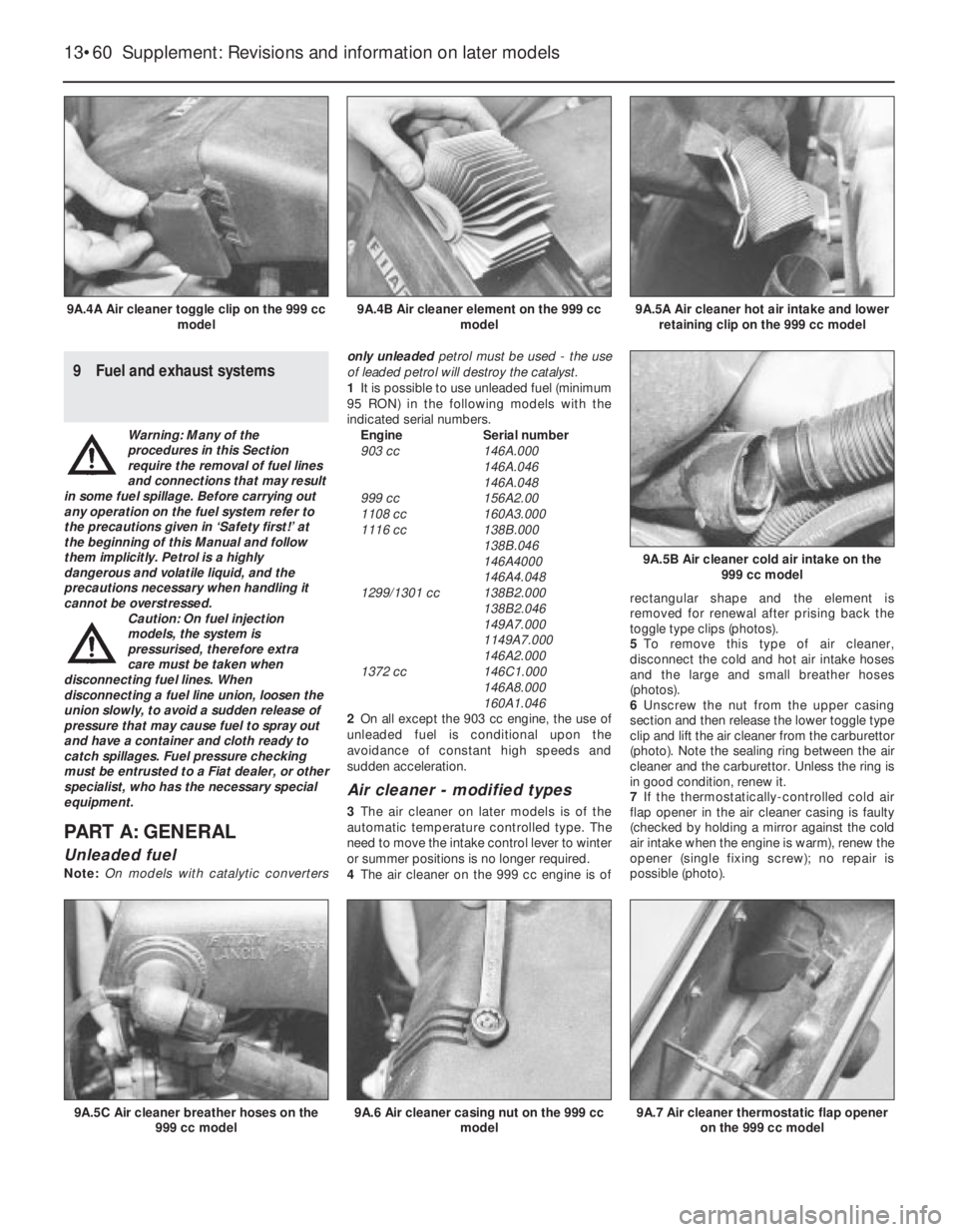
3The air cleaner on later models is of the
automatic temperature controlled type. The
need to move the intake control lever to winter
or summer positions is no longer required.
4The air cleaner on the 999 cc engine is ofrectangular shape and the element is
removed for renewal after prising back the
toggle type clips (photos).
5To remove this type of air cleaner,
disconnect the cold and hot air intake hoses
and the large and small breather hoses
(photos).
6Unscrew the nut from the upper casing
section and then release the lower toggle type
clip and lift the air cleaner from the carburettor
(photo). Note the sealing ring between the air
cleaner and the carburettor. Unless the ring is
in good condition, renew it.
7If the thermostatically-controlled cold air
flap opener in the air cleaner casing is faulty
(checked by holding a mirror against the cold
air intake when the engine is warm), renew the
opener (single fixing screw); no repair is
possible (photo).
13•60 Supplement: Revisions and information on later models
9A.7 Air cleaner thermostatic flap opener
on the 999 cc model9A.6 Air cleaner casing nut on the 999 cc
model9A.5C Air cleaner breather hoses on the
999 cc model
9A.5B Air cleaner cold air intake on the
999 cc model
9A.5A Air cleaner hot air intake and lower
retaining clip on the 999 cc model9A.4B Air cleaner element on the 999 cc
model9A.4A Air cleaner toggle clip on the 999 cc
model