warning FIAT UNO 1983 Service Owner's Guide
[x] Cancel search | Manufacturer: FIAT, Model Year: 1983, Model line: UNO, Model: FIAT UNO 1983Pages: 303, PDF Size: 10.36 MB
Page 187 of 303
PART B:
CARBURETTOR MODELS
Carburettor (Weber 32 TLF) -
description
Warning: Refer to the beginning
of this Section before starting
any work.
1This carburettor is used on the 999 cc
engine and is of the single venturi
downdraught type, with a manually-operated
choke (cold start).
2The unit incorporates an automatic
anti-flooding device, a full power valve and an
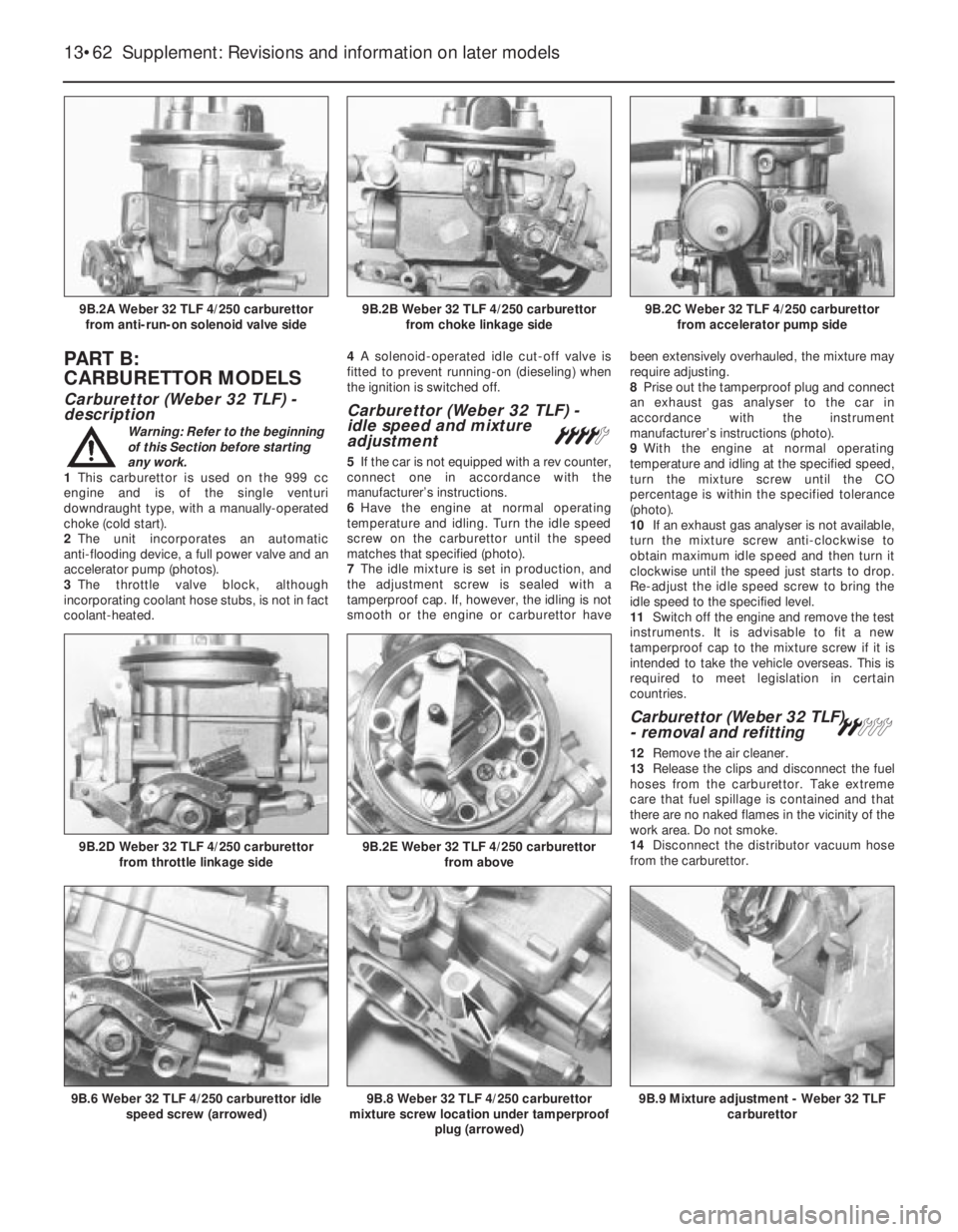
accelerator pump (photos).
3The throttle valve block, although
incorporating coolant hose stubs, is not in fact
coolant-heated.4A solenoid-operated idle cut-off valve is
fitted to prevent running-on (dieseling) when
the ignition is switched off.
Carburettor (Weber 32 TLF) -
idle speed and mixture
adjustment
¢
5If the car is not equipped with a rev counter,
connect one in accordance with the
manufacturer’s instructions.
6Have the engine at normal operating
temperature and idling. Turn the idle speed
screw on the carburettor until the speed
matches that specified (photo).
7The idle mixture is set in production, and
the adjustment screw is sealed with a
tamperproof cap. If, however, the idling is not
smooth or the engine or carburettor havebeen extensively overhauled, the mixture may
require adjusting.
8Prise out the tamperproof plug and connect
an exhaust gas analyser to the car in
accordance with the instrument
manufacturer’s instructions (photo).
9With the engine at normal operating
temperature and idling at the specified speed,
turn the mixture screw until the CO
percentage is within the specified tolerance
(photo).
10If an exhaust gas analyser is not available,
turn the mixture screw anti-clockwise to
obtain maximum idle speed and then turn it
clockwise until the speed just starts to drop.
Re-adjust the idle speed screw to bring the
idle speed to the specified level.
11Switch off the engine and remove the test
instruments. It is advisable to fit a new
tamperproof cap to the mixture screw if it is
intended to take the vehicle overseas. This is
required to meet legislation in certain
countries.
Carburettor (Weber 32 TLF)
- removal and refitting ª
12Remove the air cleaner.
13Release the clips and disconnect the fuel
hoses from the carburettor. Take extreme
care that fuel spillage is contained and that
there are no naked flames in the vicinity of the
work area. Do not smoke.
14Disconnect the distributor vacuum hose
from the carburettor.
13•62 Supplement: Revisions and information on later models
9B.9 Mixture adjustment - Weber 32 TLF
carburettor9B.8 Weber 32 TLF 4/250 carburettor
mixture screw location under tamperproof
plug (arrowed)9B.6 Weber 32 TLF 4/250 carburettor idle
speed screw (arrowed)
9B.2E Weber 32 TLF 4/250 carburettor
from above9B.2D Weber 32 TLF 4/250 carburettor
from throttle linkage side
9B.2C Weber 32 TLF 4/250 carburettor
from accelerator pump side9B.2B Weber 32 TLF 4/250 carburettor
from choke linkage side9B.2A Weber 32 TLF 4/250 carburettor
from anti-run-on solenoid valve side
Page 191 of 303
adjustments described in this sub-Section,
however, will require removal of the
carburettor.
39Disconnect the short, curved diaphragm
hose from the top cover.
40Extract the top cover screws, lift the cover
from the carburettor body, and rotate it in
order to release the cranked choke control
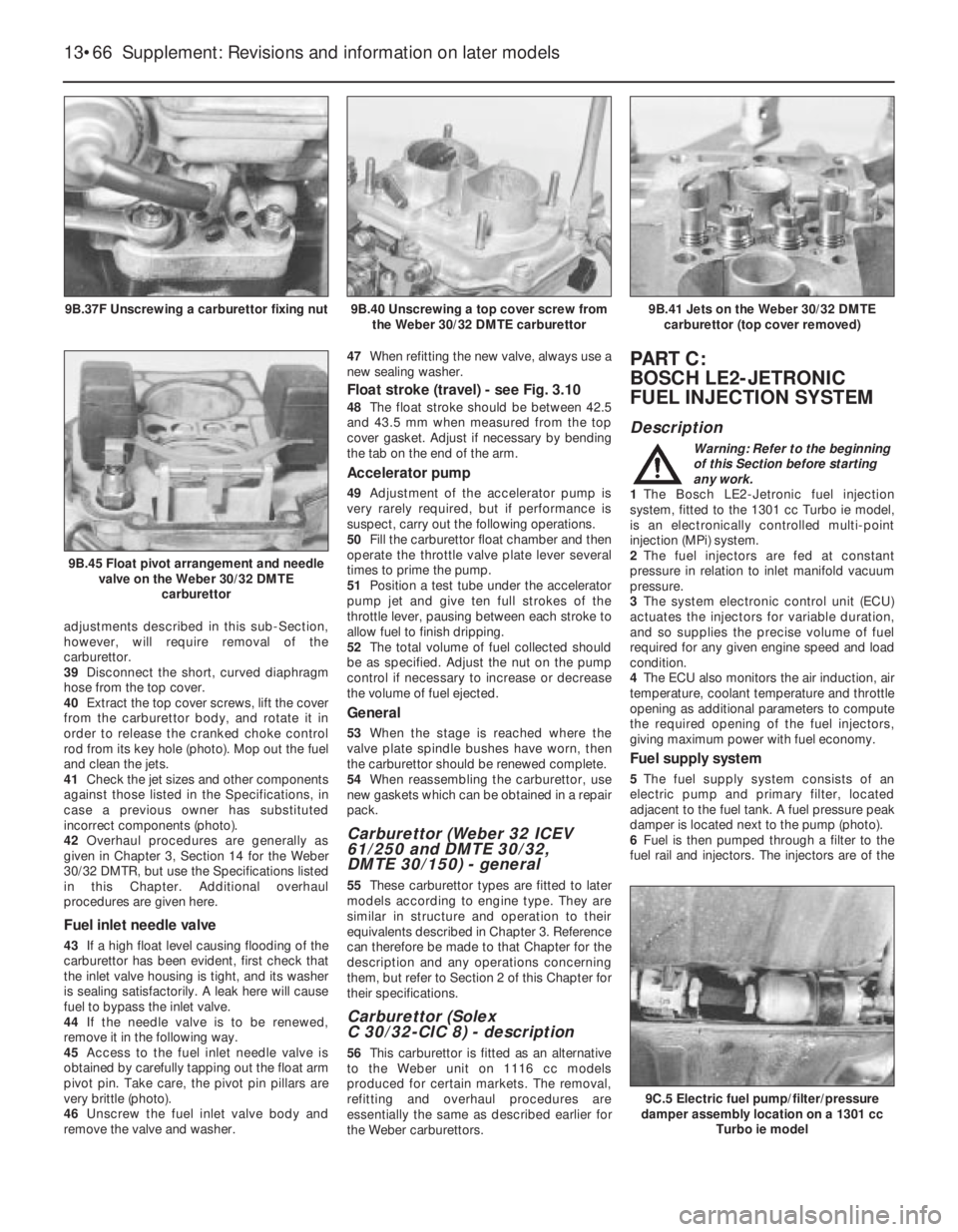
rod from its key hole (photo). Mop out the fuel
and clean the jets.
41Check the jet sizes and other components
against those listed in the Specifications, in
case a previous owner has substituted
incorrect components (photo).
42Overhaul procedures are generally as
given in Chapter 3, Section 14 for the Weber
30/32 DMTR, but use the Specifications listed
in this Chapter. Additional overhaul
procedures are given here.
Fuel inlet needle valve
43If a high float level causing flooding of the
carburettor has been evident, first check that
the inlet valve housing is tight, and its washer
is sealing satisfactorily. A leak here will cause
fuel to bypass the inlet valve.
44If the needle valve is to be renewed,
remove it in the following way.
45Access to the fuel inlet needle valve is
obtained by carefully tapping out the float arm
pivot pin. Take care, the pivot pin pillars are
very brittle (photo).
46Unscrew the fuel inlet valve body and
remove the valve and washer.47When refitting the new valve, always use a
new sealing washer.
Float stroke (travel) - see Fig. 3.10
48The float stroke should be between 42.5
and 43.5 mm when measured from the top
cover gasket. Adjust if necessary by bending
the tab on the end of the arm.
Accelerator pump
49Adjustment of the accelerator pump is
very rarely required, but if performance is
suspect, carry out the following operations.
50Fill the carburettor float chamber and then
operate the throttle valve plate lever several
times to prime the pump.
51Position a test tube under the accelerator
pump jet and give ten full strokes of the
throttle lever, pausing between each stroke to
allow fuel to finish dripping.
52The total volume of fuel collected should
be as specified. Adjust the nut on the pump
control if necessary to increase or decrease
the volume of fuel ejected.
General
53When the stage is reached where the
valve plate spindle bushes have worn, then
the carburettor should be renewed complete.
54When reassembling the carburettor, use
new gaskets which can be obtained in a repair
pack.
Carburettor (Weber 32 ICEV
61/250 and DMTE 30/32,
DMTE 30/150) - general
55These carburettor types are fitted to later
models according to engine type. They are
similar in structure and operation to their
equivalents described in Chapter 3. Reference
can therefore be made to that Chapter for the
description and any operations concerning
them, but refer to Section 2 of this Chapter for
their specifications.
Carburettor (Solex
C 30/32-CIC 8) - description
56This carburettor is fitted as an alternative
to the Weber unit on 1116 cc models
produced for certain markets. The removal,
refitting and overhaul procedures are
essentially the same as described earlier for
the Weber carburettors.
PART C:
BOSCH LE2-JETRONIC
FUEL INJECTION SYSTEM
Description
Warning: Refer to the beginning
of this Section before starting
any work.
1The Bosch LE2-Jetronic fuel injection
system, fitted to the 1301 cc Turbo ie model,
is an electronically controlled multi-point
injection (MPi) system.
2The fuel injectors are fed at constant
pressure in relation to inlet manifold vacuum
pressure.
3The system electronic control unit (ECU)
actuates the injectors for variable duration,
and so supplies the precise volume of fuel
required for any given engine speed and load
condition.
4The ECU also monitors the air induction, air
temperature, coolant temperature and throttle
opening as additional parameters to compute
the required opening of the fuel injectors,
giving maximum power with fuel economy.
Fuel supply system
5The fuel supply system consists of an
electric pump and primary filter, located
adjacent to the fuel tank. A fuel pressure peak
damper is located next to the pump (photo).
6Fuel is then pumped through a filter to the
fuel rail and injectors. The injectors are of the
13•66 Supplement: Revisions and information on later models
9C.5 Electric fuel pump/filter/pressure
damper assembly location on a 1301 cc
Turbo ie model
9B.41 Jets on the Weber 30/32 DMTE
carburettor (top cover removed)
9B.45 Float pivot arrangement and needle
valve on the Weber 30/32 DMTE
carburettor
9B.40 Unscrewing a top cover screw from
the Weber 30/32 DMTE carburettor9B.37F Unscrewing a carburettor fixing nut
Page 198 of 303
PART D:
BOSCH MONO-JETRONIC
FUEL INJECTION SYSTEM
Warning: Refer to the beginning
of this Section before starting
any work.
Description
1The Bosch Mono-Jetronic fuel injection
system fitted to the 1372 cc ie engine and
later 999/1108 ‘FIRE’ models is an electroni-
cally-controlled single point injection (SPi)
system. The SPi system is a compromise
between a conventional carburettor fuel
supply system and a multi-point fuel injection
(MPi) system.
2Compared with a conventional carburettor,
the SPi unit is a relatively simple device. Fuel
is pumped to the SPi unit and then injected
into the inlet system by a single solenoid valve
(fuel injector), mounted centrally on top of the
unit. The injector is energised by an electrical
signal sent from the electronic control unit
(ECU), at which point the injector pintle is
lifted from its seat and atomised fuel is
delivered into the inlet manifold under
pressure. The electrical signals take two forms
of current; a high current to open the injector
and a low current to hold it open for the
duration required. At idle speed the injector
is pulsed at every other intake stroke rather
than with every stroke as during normal
operation.
3The air-to-fuel mixture ratio is regulated by
values obtained from the ignition coil (engine
speed), engine coolant temperature sensor,
throttle position switch, and the Lambda
sensor in the exhaust system. No adjustments
to the fuel mixture are possible.
4The throttle position switch enables the
ECU to compute both throttle position and its
rate of change. Extra fuel can then be
provided for acceleration when the throttle is
suddenly opened. Throttle position
information, together with the idle tracking
switch, provide the ECU with the closed
throttle position information.
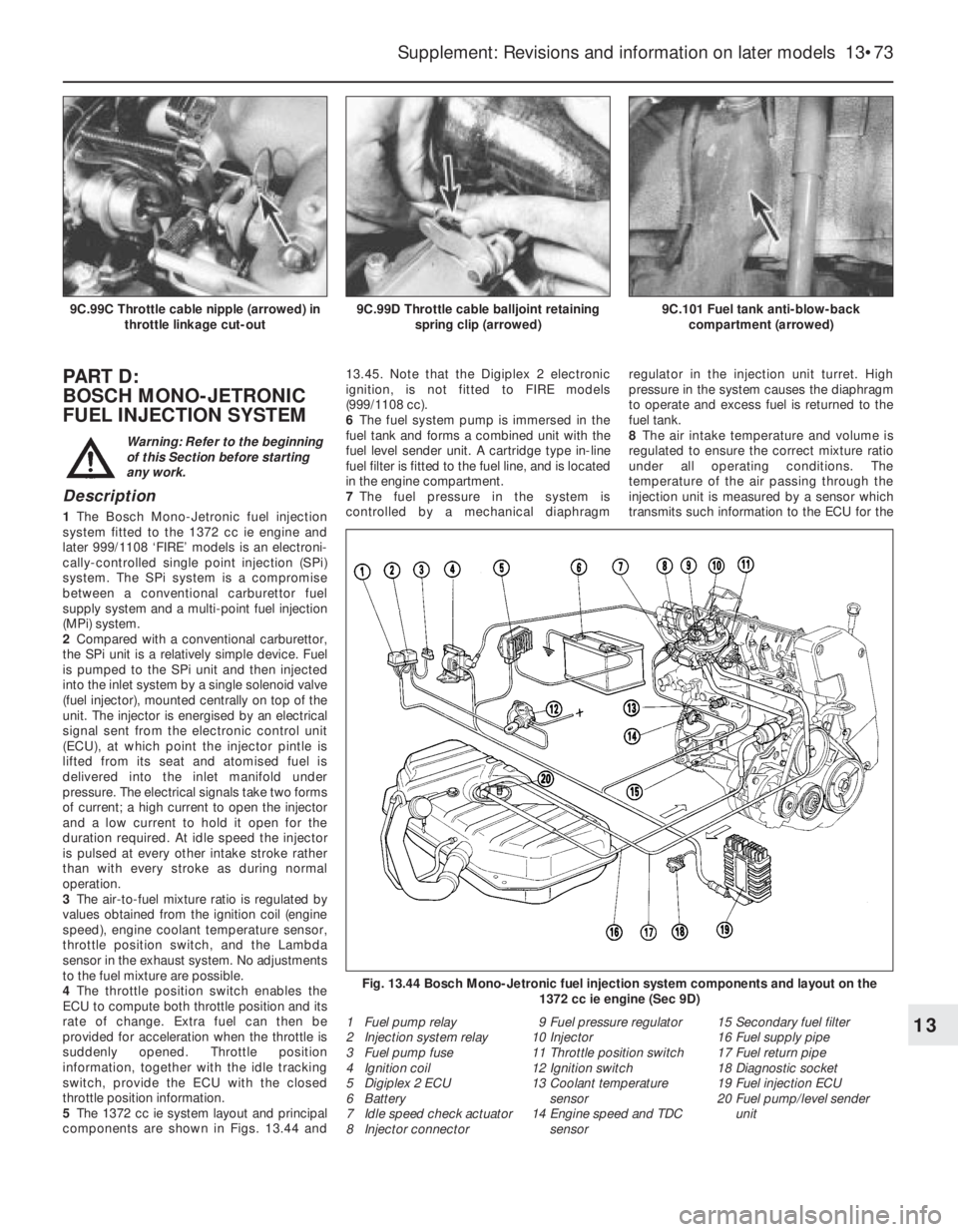
5The 1372 cc ie system layout and principal
components are shown in Figs. 13.44 and13.45. Note that the Digiplex 2 electronic
ignition, is not fitted to FIRE models
(999/1108 cc).
6The fuel system pump is immersed in the
fuel tank and forms a combined unit with the
fuel level sender unit. A cartridge type in-line
fuel filter is fitted to the fuel line, and is located
in the engine compartment.
7The fuel pressure in the system is
controlled by a mechanical diaphragmregulator in the injection unit turret. High
pressure in the system causes the diaphragm
to operate and excess fuel is returned to the
fuel tank.
8The air intake temperature and volume is
regulated to ensure the correct mixture ratio
under all operating conditions. The
temperature of the air passing through the
injection unit is measured by a sensor which
transmits such information to the ECU for the
Supplement: Revisions and information on later models 13•73
9C.101 Fuel tank anti-blow-back
compartment (arrowed)9C.99D Throttle cable balljoint retaining
spring clip (arrowed)9C.99C Throttle cable nipple (arrowed) in
throttle linkage cut-out
Fig. 13.44 Bosch Mono-Jetronic fuel injection system components and layout on the
1372 cc ie engine (Sec 9D)
1 Fuel pump relay
2 Injection system relay
3 Fuel pump fuse
4 Ignition coil
5 Digiplex 2 ECU
6 Battery
7 Idle speed check actuator
8 Injector connector9 Fuel pressure regulator
10 Injector
11 Throttle position switch
12 Ignition switch
13 Coolant temperature
sensor
14 Engine speed and TDC
sensor15 Secondary fuel filter
16 Fuel supply pipe
17 Fuel return pipe
18 Diagnostic socket
19 Fuel injection ECU
20 Fuel pump/level sender
unit13
Page 200 of 303
15Undo the retaining strap bolt and
withdraw the filter from its location bracket.
Disconnect the inlet and supply hose from the
filter. If crimp connectors are fitted they will
have to be cut free and new screw type clips
fitted (photo).
16Connect the hoses to the new filter
ensuring that the filter is correctly orientated
(the arrow mark on the body indicates the
direction of fuel flow). Ensure that the hose
clips are secure before refitting the filter into
the retaining strap and securing the retaining
bolt. When the engine is restarted, check the
hose connections to ensure that there is no
fuel leakage from them.
Air cleaner element -
renewalÁ
17Release the spring clip each side at the
front of the air cleaner, then unscrew and
remove the two screws from the top front face
of the housing. Withdraw the end cover and
element from the filter unit (photos).18Wipe any dirt from within the casing then
locate the new element and refit it together
with the end cover.
Idle speed and mixture
adjustment°
19No manual idle speed and/or mixture
adjustments to this type of fuel system are
necessary or possible. Any such adjustments
are automatically made by the ECU. If the
engine idle speed and/or mixture adjustment
is suspect, it must be checked using CO
measuring equipment; a task best entrusted
to a FIAT dealer or a competent garage. The
most probable cause of a malfunction is likely
to be a defective sensor or incorrectly
adjusted accelerator control cable.
Accelerator control system
- check and adjustment#
20To check the adjustment of the
accelerator control system, it is essential thatthe engine is at its normal operating
temperature. This is achieved by running the
engine for a period of about fifteen minutes,
by which time the cooling fan should have cut
into operation several times. At this point,
stop the engine, turn the ignition key to the
OFF position and proceed as follows.
21Remove the air cleaner unit.
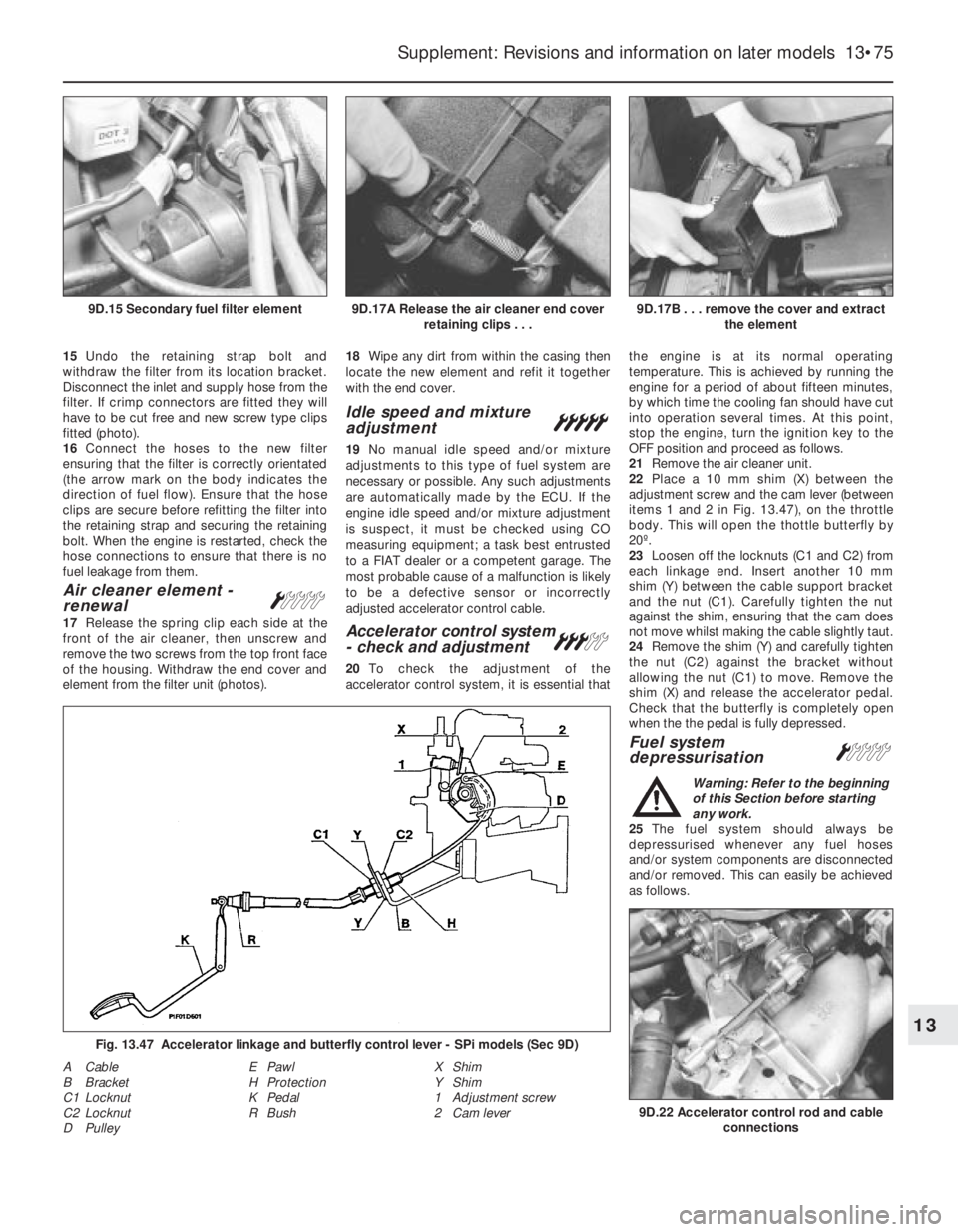
22Place a 10 mm shim (X) between the
adjustment screw and the cam lever (between
items 1 and 2 in Fig. 13.47), on the throttle
body. This will open the thottle butterfly by
20º.
23Loosen off the locknuts (C1 and C2) from
each linkage end. Insert another 10 mm
shim (Y) between the cable support bracket
and the nut (C1). Carefully tighten the nut
against the shim, ensuring that the cam does
not move whilst making the cable slightly taut.
24Remove the shim (Y) and carefully tighten
the nut (C2) against the bracket without
allowing the nut (C1) to move. Remove the
shim (X) and release the accelerator pedal.
Check that the butterfly is completely open
when the the pedal is fully depressed.
Fuel system
depressurisationÁ
Warning: Refer to the beginning
of this Section before starting
any work.
25The fuel system should always be
depressurised whenever any fuel hoses
and/or system components are disconnected
and/or removed. This can easily be achieved
as follows.
Supplement: Revisions and information on later models 13•75
9D.17B . . . remove the cover and extract
the element9D.17A Release the air cleaner end cover
retaining clips . . .9D.15 Secondary fuel filter element
9D.22 Accelerator control rod and cable
connections
A Cable
B Bracket
C1 Locknut
C2 Locknut
D PulleyE Pawl
H Protection
K Pedal
R BushX Shim
Y Shim
1 Adjustment screw
2 Cam lever
13
Fig. 13.47 Accelerator linkage and butterfly control lever - SPi models (Sec 9D)
Page 203 of 303
c) If the engine develops a misfire, do not
drive the car at all (or at least as little as
possible) until the fault is cured - the
misfire will allow unburned fuel to enter
the converter, which will result in its
overheating, as noted above.
d) DO NOT push- or tow-start the car - this
will soak the catalytic converter in
unburned fuel, causing it to overheat
when the engine does start - see b)
above.
e) DO NOT switch off the ignition at high
engine speeds - if the ignition is switched
off at anything above idle speed,
unburned fuel will enter the (very hot)
catalytic converter, with the possible risk
of its igniting on the element and
damaging the converter.
f) DO NOT use fuel or engine oil additives -
these may contain substances harmful to
the catalytic converter.
g) DO NOT continue to use the car if the
engine burns oil to the extent of leaving a
visible trail of blue smoke - the unburned
carbon deposits will clog the converter
passages and reduce its efficiency; in
severe cases the element will overheat.
h) Remember that the catalytic converter
operates at very high temperatures and
the casing will become hot enough to
ignite combustible materials which brush
against it. DO NOT, therefore, park the car
in dry undergrowth, over long grass or
piles of dead leaves.
i) Remember that the catalytic converter is
FRAGILE - do not strike it with tools
during servicing work, take great care
when working on the exhaust system,
ensure that the converter is well clear of
any jacks or other lifting gear used to raise
the car and do not drive the car over
rough ground road humps, etc., in such a
way as to ground the exhaust system.
j) In some cases, particularly when the car is
new and/or is used for stop/start driving, a
sulphurous smell (like that of rotten eggs)
may be noticed from the exhaust. This is
common to many catalytic
converter-equipped cars and seems to be
due to the small amount of sulphur found
in some petrols reacting with hydrogen in
the exhaust to produce hydrogen sulphide
(H
2S) gas; while this gas is toxic, it is not
produced in sufficient amounts to be a
problem. Once the car has covered a few
thousand miles the problem should
disappear - in the meanwhile a change of
driving style or of the brand of petrol used
may effect a solution.
k) The catalytic converter, used on a
well-maintained and well driven car,
should last for at least 50 000 miles
(80 000 km) or five years - from this point
on, careful checks should be made at all
specified service intervals on the CO level
to ensure that the converter is still
operating efficiently - if the converter is no
longer effective it must be renewed.
Fuel evaporation control system
- general
76As mentioned earlier, fuel evaporation is
contained within the system. In high outdoor
temperatures, when the vehicle is parked for a
period of time, the fuel in the tank evaporates,
building up pressure. When the pressure builds
up to a predetermined level a vent valve opens
to allow the vapours to pass on to and absorbed
by a carbon filter. However, if extreme pressure
or vacuum should build up, a two way safety
valve opens to allow external venting.
77If the safety valve needs replacing, note
that it must be fitted correctly. The black end
should be connected to the fuel tank and the
blue to the carbon filter.
78The vapours in the carbon filter are
flushed by warm air passing through the filter
on to a ECU controlled vapour cut-off
solenoid.
79The cut-off solenoid is closed when
starting the engine and opens to allow
vapours to be drawn into the inlet manifold,
through a second solenoid. If the cut-off
solenoid needs replacing ensure that the
black arrow on the casing is pointing towards
the inlet manifold.
80The second solenoid, known as an Elbi
solenoid, is closed when the engine is turned
off, thus preventing engine run-on. The side
facing connection is for the inlet manifold
pipe.
PART E:
BOSCH L3.1/2 JETRONIC
FUEL INJECTION SYSTEMS
Warning: Refer to the beginning
of this Section before starting
any work.
Description
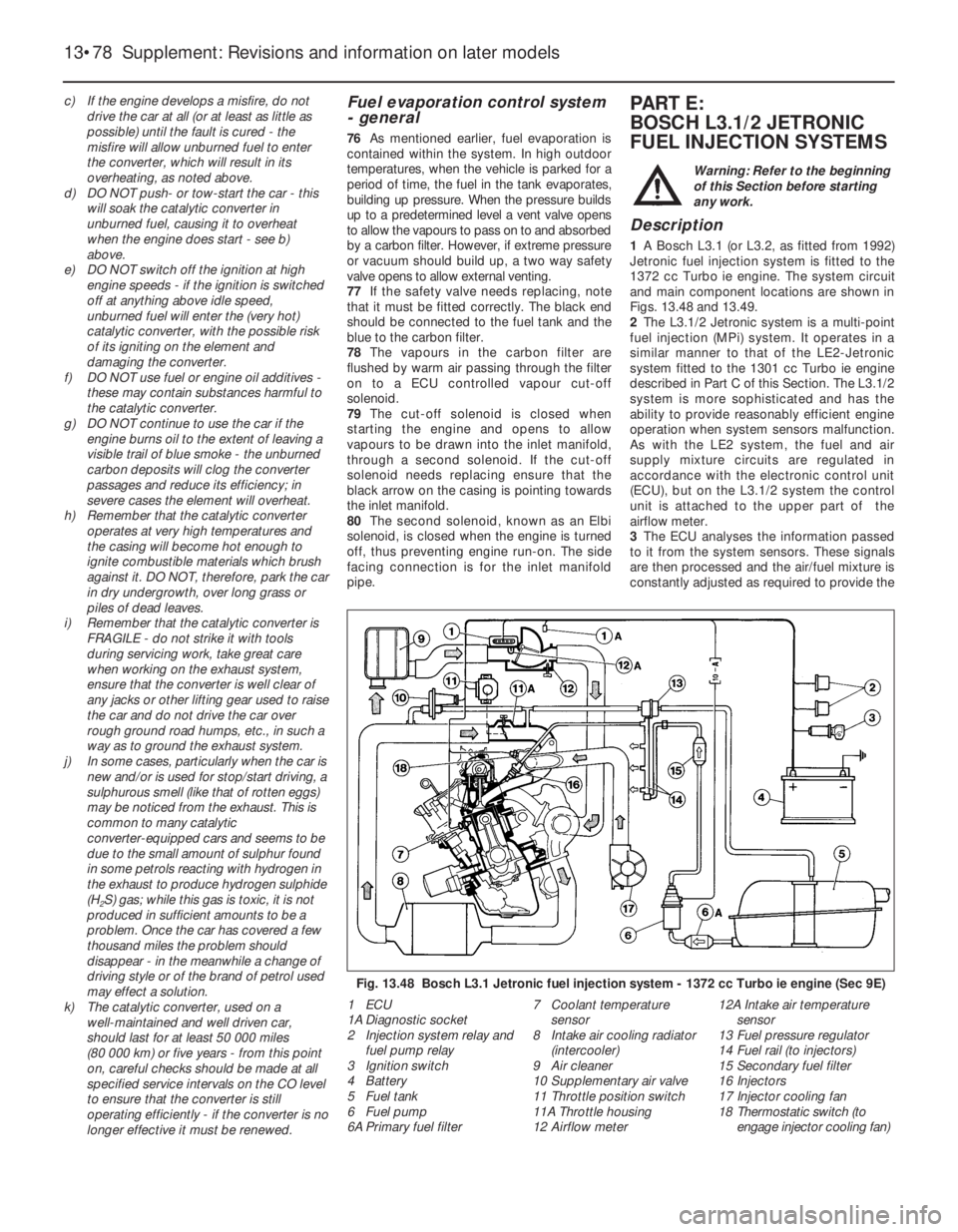
1A Bosch L3.1 (or L3.2, as fitted from 1992)
Jetronic fuel injection system is fitted to the
1372 cc Turbo ie engine. The system circuit
and main component locations are shown in
Figs. 13.48 and 13.49.
2The L3.1/2 Jetronic system is a multi-point
fuel injection (MPi) system. It operates in a
similar manner to that of the LE2-Jetronic
system fitted to the 1301 cc Turbo ie engine
described in Part C of this Section. The L3.1/2
system is more sophisticated and has the
ability to provide reasonably efficient engine
operation when system sensors malfunction.
As with the LE2 system, the fuel and air
supply mixture circuits are regulated in
accordance with the electronic control unit
(ECU), but on the L3.1/2 system the control
unit is attached to the upper part of the
airflow meter.
3The ECU analyses the information passed
to it from the system sensors. These signals
are then processed and the air/fuel mixture is
constantly adjusted as required to provide the
13•78 Supplement: Revisions and information on later models
Fig. 13.48 Bosch L3.1 Jetronic fuel injection system - 1372 cc Turbo ie engine (Sec 9E)
1 ECU
1A Diagnostic socket
2 Injection system relay and
fuel pump relay
3 Ignition switch
4 Battery
5 Fuel tank
6 Fuel pump
6A Primary fuel filter7 Coolant temperature
sensor
8 Intake air cooling radiator
(intercooler)
9 Air cleaner
10 Supplementary air valve
11 Throttle position switch
11A Throttle housing
12 Airflow meter12A Intake air temperature
sensor
13 Fuel pressure regulator
14 Fuel rail (to injectors)
15 Secondary fuel filter
16 Injectors
17 Injector cooling fan
18 Thermostatic switch (to
engage injector cooling fan)
Page 205 of 303
operation twice. Also prior to making
adjustments ensure that the supplementary
air valve pipe is in good condition, with no
leaks. Compress the air valve pipe using a
pair of grips to prevent incorrect adjustment
caused by a defective supplementary air
valve.
15The air cleaner must be connected when
checking and/or adjusting the engine idle
speed. To adjust, turn the adjuster screw in
the required direction to set the engine idle
speed to that specified.
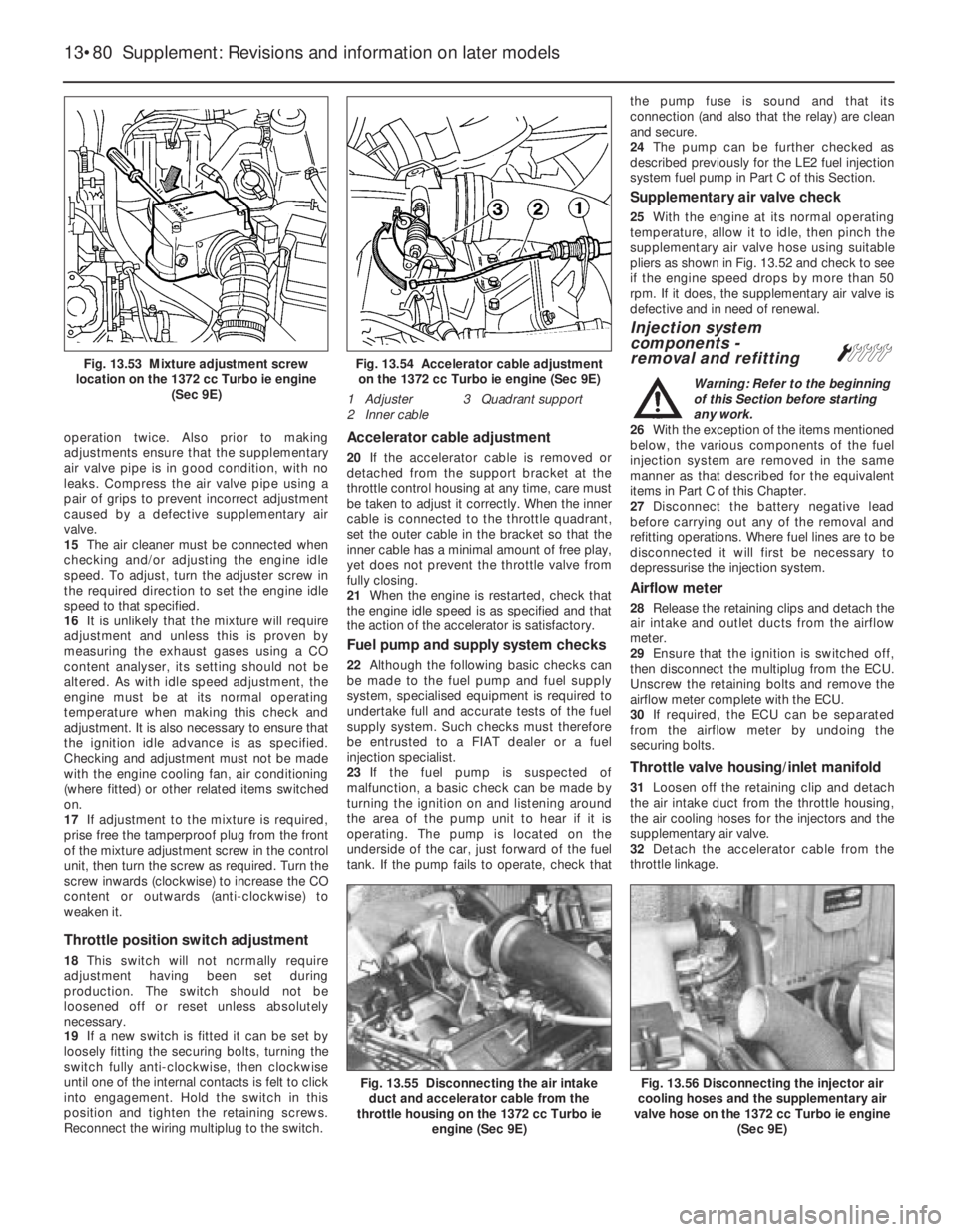
16It is unlikely that the mixture will require
adjustment and unless this is proven by
measuring the exhaust gases using a CO
content analyser, its setting should not be
altered. As with idle speed adjustment, the
engine must be at its normal operating
temperature when making this check and
adjustment. It is also necessary to ensure that
the ignition idle advance is as specified.
Checking and adjustment must not be made
with the engine cooling fan, air conditioning
(where fitted) or other related items switched
on.
17If adjustment to the mixture is required,
prise free the tamperproof plug from the front
of the mixture adjustment screw in the control
unit, then turn the screw as required. Turn the
screw inwards (clockwise) to increase the CO
content or outwards (anti-clockwise) to
weaken it.
Throttle position switch adjustment
18This switch will not normally require
adjustment having been set during
production. The switch should not be
loosened off or reset unless absolutely
necessary.
19If a new switch is fitted it can be set by
loosely fitting the securing bolts, turning the
switch fully anti-clockwise, then clockwise
until one of the internal contacts is felt to click
into engagement. Hold the switch in this
position and tighten the retaining screws.
Reconnect the wiring multiplug to the switch.
Accelerator cable adjustment
20If the accelerator cable is removed or
detached from the support bracket at the
throttle control housing at any time, care must
be taken to adjust it correctly. When the inner
cable is connected to the throttle quadrant,
set the outer cable in the bracket so that the
inner cable has a minimal amount of free play,
yet does not prevent the throttle valve from
fully closing.
21When the engine is restarted, check that
the engine idle speed is as specified and that
the action of the accelerator is satisfactory.
Fuel pump and supply system checks
22Although the following basic checks can
be made to the fuel pump and fuel supply
system, specialised equipment is required to
undertake full and accurate tests of the fuel
supply system. Such checks must therefore
be entrusted to a FIAT dealer or a fuel
injection specialist.
23If the fuel pump is suspected of
malfunction, a basic check can be made by
turning the ignition on and listening around
the area of the pump unit to hear if it is
operating. The pump is located on the
underside of the car, just forward of the fuel
tank. If the pump fails to operate, check thatthe pump fuse is sound and that its
connection (and also that the relay) are clean
and secure.
24The pump can be further checked as
described previously for the LE2 fuel injection
system fuel pump in Part C of this Section.
Supplementary air valve check
25With the engine at its normal operating
temperature, allow it to idle, then pinch the
supplementary air valve hose using suitable
pliers as shown in Fig. 13.52 and check to see
if the engine speed drops by more than 50
rpm. If it does, the supplementary air valve is
defective and in need of renewal.
Injection system
components -
removal and refitting
Á
Warning: Refer to the beginning
of this Section before starting
any work.
26With the exception of the items mentioned
below, the various components of the fuel
injection system are removed in the same
manner as that described for the equivalent
items in Part C of this Chapter.
27Disconnect the battery negative lead
before carrying out any of the removal and
refitting operations. Where fuel lines are to be
disconnected it will first be necessary to
depressurise the injection system.
Airflow meter
28Release the retaining clips and detach the
air intake and outlet ducts from the airflow
meter.
29Ensure that the ignition is switched off,
then disconnect the multiplug from the ECU.
Unscrew the retaining bolts and remove the
airflow meter complete with the ECU.
30If required, the ECU can be separated
from the airflow meter by undoing the
securing bolts.
Throttle valve housing/inlet manifold
31Loosen off the retaining clip and detach
the air intake duct from the throttle housing,
the air cooling hoses for the injectors and the
supplementary air valve.
32Detach the accelerator cable from the
throttle linkage.
13•80 Supplement: Revisions and information on later models
Fig. 13.56 Disconnecting the injector air
cooling hoses and the supplementary air
valve hose on the 1372 cc Turbo ie engine
(Sec 9E)Fig. 13.55 Disconnecting the air intake
duct and accelerator cable from the
throttle housing on the 1372 cc Turbo ie
engine (Sec 9E)
Fig. 13.54 Accelerator cable adjustment
on the 1372 cc Turbo ie engine (Sec 9E)
1 Adjuster 3 Quadrant support
2 Inner cableFig. 13.53 Mixture adjustment screw
location on the 1372 cc Turbo ie engine
(Sec 9E)
Page 213 of 303

13•88 Supplement: Revisions and information on later models
Fig. 13.73 Wiring diagram of the Microplex ignition system on the 1301 cc Turbo ie
engine (Sec 10)Fig. 13.74 Wiring diagram of the Microplex ignition system on the 1372 cc Turbo ie
engine (Sec 10)1 ECU
2 Safety pressure switch
3 Ignition unit with coil
4 Distributor
5 Anti-knock sensor
6 Vacuum/pressure pick-up in engine inlet
manifold
7 Socket for diagnostic equipment8 Tachometer
9 Spark plugs
10 Switch to earth (to retard advance
curve if necessary)
11 Turbocharger operation warning light
12 Anti-theft relay (where fitted)
13 Hidden anti-theft switch (where fitted)1 ECU
2 Pipe (pressure/vacuum
in inlet manifold to
control unit)
3 Spark plug
4 Distributor
5 Ignition coil (with
control unit)6 Tachometer
7 Ignition switch
8 Connector
9 TDC sensor
10 Engine speed
11 Anti-knock sensor
12 Air pressure safety
switch13 Speedometer signal
for electronic injection
14 Connector
15 Diagnostic socket
a Crankshaft pulley
b Flywheel
Page 228 of 303
Vacuum servo unit and master
cylinder - general
54Access to the vacuum servo unit and the
master cylinder can only be obtained after the
cooling system expansion tank has been
released and moved aside (photo).
Antiskid system - description
55This system is available as an option on
the Turbo ie models only.
56The purpose of the system is to prevent
the wheel(s) locking during heavy brake
applications. This is achieved by automatic
release of the brake on a roadwheel which is
about to lock up, after which the brake is
re-applied. This cycle is carried out many
times per second under heavy braking,
retaining full steering control to avoid any
hazards.
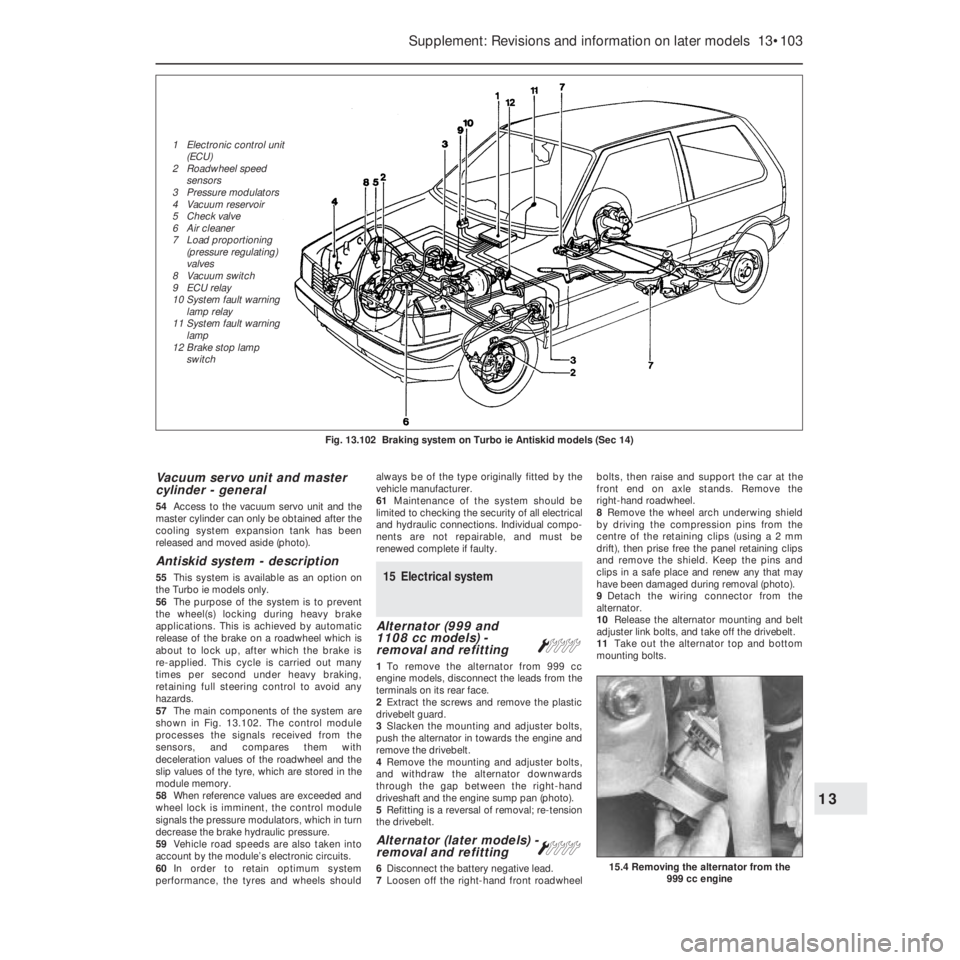
57The main components of the system are
shown in Fig. 13.102. The control module
processes the signals received from the
sensors, and compares them with
deceleration values of the roadwheel and the
slip values of the tyre, which are stored in the
module memory.
58When reference values are exceeded and
wheel lock is imminent, the control module
signals the pressure modulators, which in turn
decrease the brake hydraulic pressure.
59Vehicle road speeds are also taken into
account by the module’s electronic circuits.
60In order to retain optimum system
performance, the tyres and wheels shouldalways be of the type originally fitted by the
vehicle manufacturer.
61Maintenance of the system should be
limited to checking the security of all electrical
and hydraulic connections. Individual compo-
nents are not repairable, and must be
renewed complete if faulty.15 Electrical system
Alternator (999 and
1108 cc models) -
removal and refitting
Á
1To remove the alternator from 999 cc
engine models, disconnect the leads from the
terminals on its rear face.
2Extract the screws and remove the plastic
drivebelt guard.
3Slacken the mounting and adjuster bolts,
push the alternator in towards the engine and
remove the drivebelt.
4Remove the mounting and adjuster bolts,
and withdraw the alternator downwards
through the gap between the right-hand
driveshaft and the engine sump pan (photo).
5Refitting is a reversal of removal; re-tension
the drivebelt.
Alternator (later models) -
removal and refitting Á
6Disconnect the battery negative lead.
7Loosen off the right-hand front roadwheelbolts, then raise and support the car at the
front end on axle stands. Remove the
right-hand roadwheel.
8Remove the wheel arch underwing shield
by driving the compression pins from the
centre of the retaining clips (using a 2 mm
drift), then prise free the panel retaining clips
and remove the shield. Keep the pins and
clips in a safe place and renew any that may
have been damaged during removal (photo).
9Detach the wiring connector from the
alternator.
10Release the alternator mounting and belt
adjuster link bolts, and take off the drivebelt.
11Take out the alternator top and bottom
mounting bolts.
Supplement: Revisions and information on later models 13•103
15.4 Removing the alternator from the
999 cc engine
Fig. 13.102 Braking system on Turbo ie Antiskid models (Sec 14)
13
1 Electronic control unit
(ECU)
2 Roadwheel speed
sensors
3 Pressure modulators
4 Vacuum reservoir
5 Check valve
6 Air cleaner
7 Load proportioning
(pressure regulating)
valves
8 Vacuum switch
9 ECU relay
10 System fault warning
lamp relay
11 System fault warning
lamp
12 Brake stop lamp
switch
Page 235 of 303
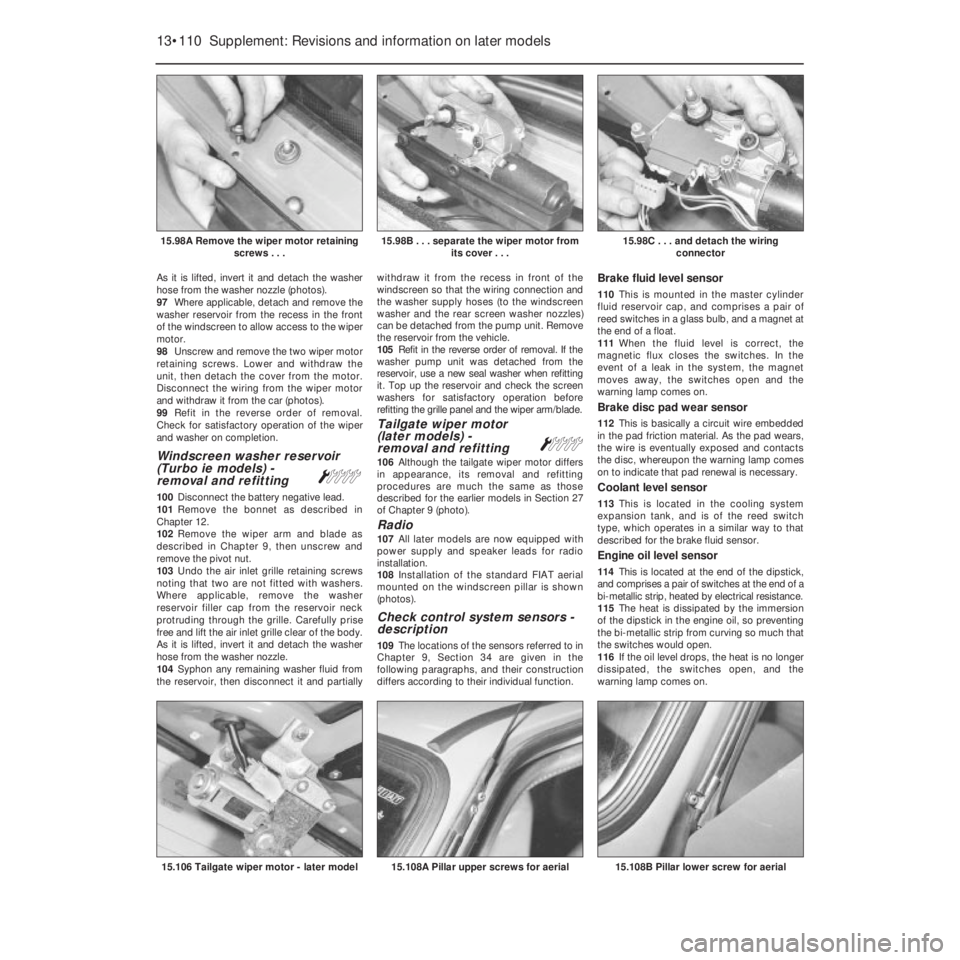
As it is lifted, invert it and detach the washer
hose from the washer nozzle (photos).
97Where applicable, detach and remove the
washer reservoir from the recess in the front
of the windscreen to allow access to the wiper
motor.
98Unscrew and remove the two wiper motor
retaining screws. Lower and withdraw the
unit, then detach the cover from the motor.
Disconnect the wiring from the wiper motor
and withdraw it from the car (photos).
99Refit in the reverse order of removal.
Check for satisfactory operation of the wiper
and washer on completion.
Windscreen washer reservoir
(Turbo ie models) -
removal and refitting
Á
100Disconnect the battery negative lead.
101Remove the bonnet as described in
Chapter 12.
102Remove the wiper arm and blade as
described in Chapter 9, then unscrew and
remove the pivot nut.
103Undo the air inlet grille retaining screws
noting that two are not fitted with washers.
Where applicable, remove the washer
reservoir filler cap from the reservoir neck
protruding through the grille. Carefully prise
free and lift the air inlet grille clear of the body.
As it is lifted, invert it and detach the washer
hose from the washer nozzle.
104Syphon any remaining washer fluid from
the reservoir, then disconnect it and partiallywithdraw it from the recess in front of the
windscreen so that the wiring connection and
the washer supply hoses (to the windscreen
washer and the rear screen washer nozzles)
can be detached from the pump unit. Remove
the reservoir from the vehicle.
105Refit in the reverse order of removal. If the
washer pump unit was detached from the
reservoir, use a new seal washer when refitting
it. Top up the reservoir and check the screen
washers for satisfactory operation before
refitting the grille panel and the wiper arm/blade.
Tailgate wiper motor
(later models) -
removal and refitting
Á
106Although the tailgate wiper motor differs
in appearance, its removal and refitting
procedures are much the same as those
described for the earlier models in Section 27
of Chapter 9 (photo).
Radio
107All later models are now equipped with
power supply and speaker leads for radio
installation.
108Installation of the standard FIAT aerial
mounted on the windscreen pillar is shown
(photos).
Check control system sensors -
description
109The locations of the sensors referred to in
Chapter 9, Section 34 are given in the
following paragraphs, and their construction
differs according to their individual function.
Brake fluid level sensor
110This is mounted in the master cylinder
fluid reservoir cap, and comprises a pair of
reed switches in a glass bulb, and a magnet at
the end of a float.
111When the fluid level is correct, the
magnetic flux closes the switches. In the
event of a leak in the system, the magnet
moves away, the switches open and the
warning lamp comes on.
Brake disc pad wear sensor
112This is basically a circuit wire embedded
in the pad friction material. As the pad wears,
the wire is eventually exposed and contacts
the disc, whereupon the warning lamp comes
on to indicate that pad renewal is necessary.
Coolant level sensor
113This is located in the cooling system
expansion tank, and is of the reed switch
type, which operates in a similar way to that
described for the brake fluid sensor.
Engine oil level sensor
114This is located at the end of the dipstick,
and comprises a pair of switches at the end of a
bi-metallic strip, heated by electrical resistance.
115The heat is dissipated by the immersion
of the dipstick in the engine oil, so preventing
the bi-metallic strip from curving so much that
the switches would open.
116If the oil level drops, the heat is no longer
dissipated, the switches open, and the
warning lamp comes on.
13•110 Supplement: Revisions and information on later models
15.108B Pillar lower screw for aerial15.108A Pillar upper screws for aerial15.106 Tailgate wiper motor - later model
15.98C . . . and detach the wiring
connector15.98B . . . separate the wiper motor from
its cover . . .15.98A Remove the wiper motor retaining
screws . . .
Page 236 of 303
Door closure sensor
117The sensor consists of a microswitch
within the lock. The switch actuates the
warning lamp according to whether the lock is
in the open or closed mode.
Check control system sensors -
testing
Brake fluid level sensor
118With the fluid level correct, switch on the
ignition and depress the centre of the
reservoir cap. If the sensor switches are
working correctly, then “FAULT” should be
indicated on the check panel.
Coolant level sensor
119With the coolant level in the expansion
tank correct, switch on the ignition and then
pull the wiring plug from the sensor. “FAULT”
should be indicated on the check panel. If it is
not, then it is the panel which is faulty.
120An ohmmeter should be used to check
for continuity, holding the float in both the full
and low level positions.
Engine oil level sensor
121With the oil level correct, disconnect the
wiring plug from the dipstick, and then bridge
the plug terminals (not dipstick side) with a 12
ohm resistor. Switch on the ignition.
122If the red light on the check panel goes
out, then the fault is due to the sensor.
123If the light stays on, then it is the check
panel module which is faulty.
Door closure sensor
124Any fault in the lock microswitch can best
be detected using an ohmmeter.
16 Suspension
Front anti-roll bar -
removal and refittingª
1A front anti-roll bar is fitted to the 1301 cc,
1372 cc ie and 1372 cc Turbo ie engined
models. Removal of the bar on all models isas follows. Firstly loosen off the front
roadwheel bolts, then raise the front of the
car, securely support it on axle stands and
remove the front roadwheels.
2Disconnect the two gearchange rods from
the transmission.
3Unbolt and disconnect the anti-roll bar
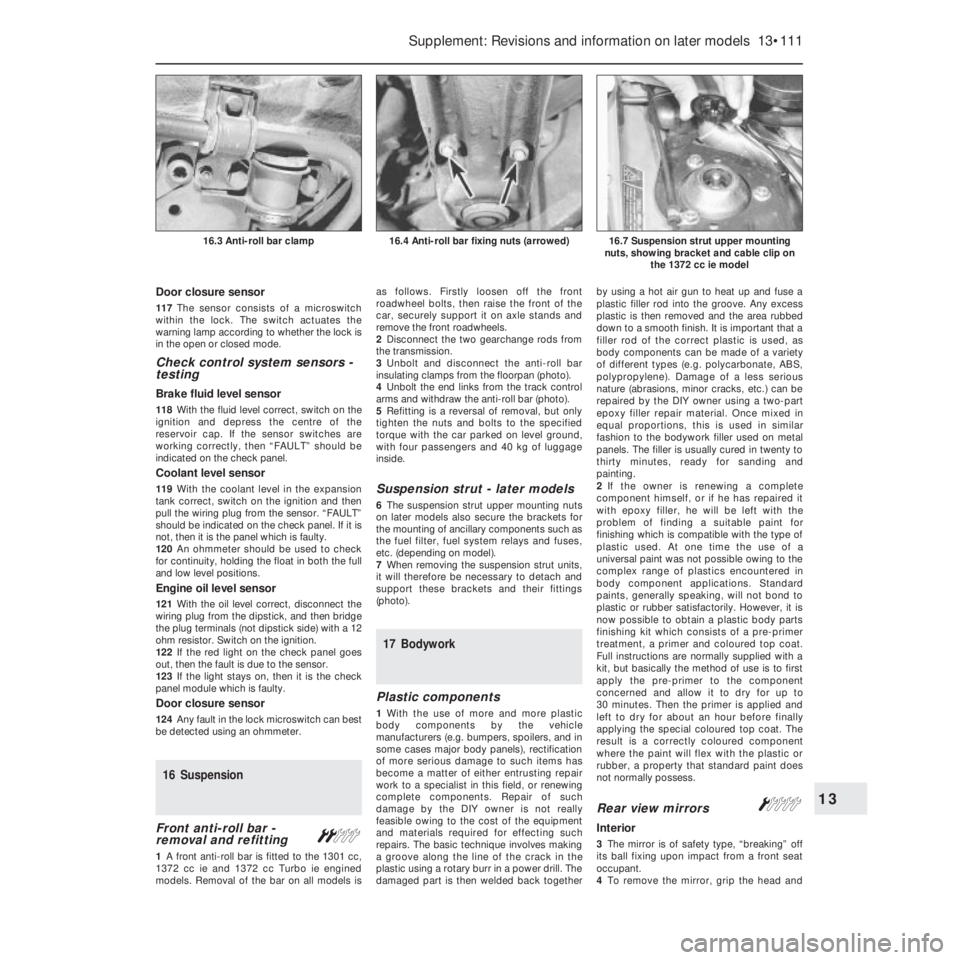
insulating clamps from the floorpan (photo).
4Unbolt the end links from the track control
arms and withdraw the anti-roll bar (photo).
5Refitting is a reversal of removal, but only
tighten the nuts and bolts to the specified
torque with the car parked on level ground,
with four passengers and 40 kg of luggage
inside.
Suspension strut - later models
6The suspension strut upper mounting nuts
on later models also secure the brackets for
the mounting of ancillary components such as
the fuel filter, fuel system relays and fuses,
etc. (depending on model).
7When removing the suspension strut units,
it will therefore be necessary to detach and
support these brackets and their fittings
(photo).
17 Bodywork
Plastic components
1With the use of more and more plastic
body components by the vehicle
manufacturers (e.g. bumpers, spoilers, and in
some cases major body panels), rectification
of more serious damage to such items has
become a matter of either entrusting repair
work to a specialist in this field, or renewing
complete components. Repair of such
damage by the DIY owner is not really
feasible owing to the cost of the equipment
and materials required for effecting such
repairs. The basic technique involves making
a groove along the line of the crack in the
plastic using a rotary burr in a power drill. The
damaged part is then welded back togetherby using a hot air gun to heat up and fuse a
plastic filler rod into the groove. Any excess
plastic is then removed and the area rubbed
down to a smooth finish. It is important that a
filler rod of the correct plastic is used, as
body components can be made of a variety
of different types (e.g. polycarbonate, ABS,
polypropylene). Damage of a less serious
nature (abrasions, minor cracks, etc.) can be
repaired by the DIY owner using a two-part
epoxy filler repair material. Once mixed in
equal proportions, this is used in similar
fashion to the bodywork filler used on metal
panels. The filler is usually cured in twenty to
thirty minutes, ready for sanding and
painting.
2If the owner is renewing a complete
component himself, or if he has repaired it
with epoxy filler, he will be left with the
problem of finding a suitable paint for
finishing which is compatible with the type of
plastic used. At one time the use of a
universal paint was not possible owing to the
complex range of plastics encountered in
body component applications. Standard
paints, generally speaking, will not bond to
plastic or rubber satisfactorily. However, it is
now possible to obtain a plastic body parts
finishing kit which consists of a pre-primer
treatment, a primer and coloured top coat.
Full instructions are normally supplied with a
kit, but basically the method of use is to first
apply the pre-primer to the component
concerned and allow it to dry for up to
30 minutes. Then the primer is applied and
left to dry for about an hour before finally
applying the special coloured top coat. The
result is a correctly coloured component
where the paint will flex with the plastic or
rubber, a property that standard paint does
not normally possess.
Rear view mirrors Á
Interior
3The mirror is of safety type, “breaking” off
its ball fixing upon impact from a front seat
occupant.
4To remove the mirror, grip the head and
Supplement: Revisions and information on later models 13•111
16.7 Suspension strut upper mounting
nuts, showing bracket and cable clip on
the 1372 cc ie model16.4 Anti-roll bar fixing nuts (arrowed)16.3 Anti-roll bar clamp
13