wheel FIAT UNO 1983 Service Manual Online
[x] Cancel search | Manufacturer: FIAT, Model Year: 1983, Model line: UNO, Model: FIAT UNO 1983Pages: 303, PDF Size: 10.36 MB
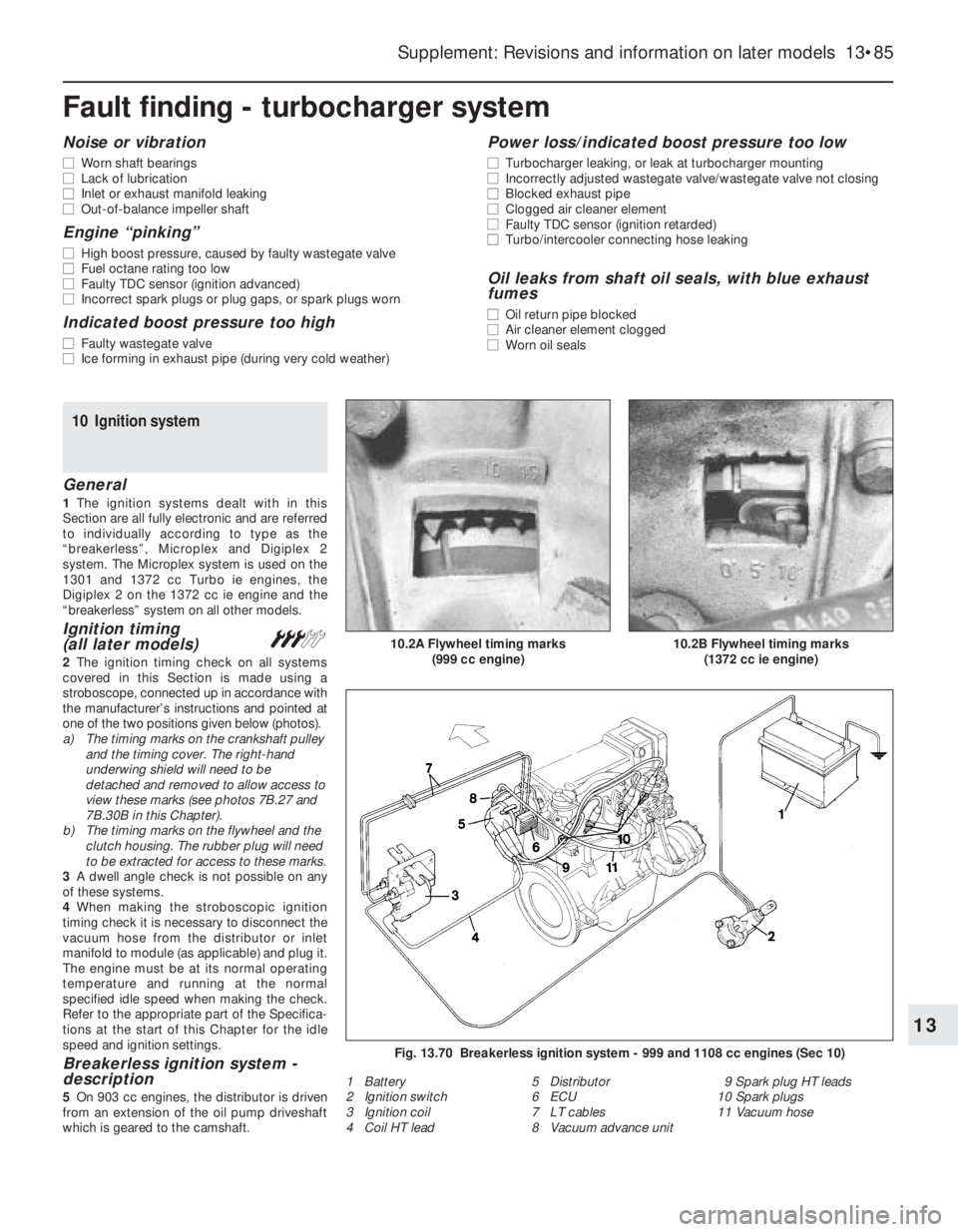
Page 175 of 303
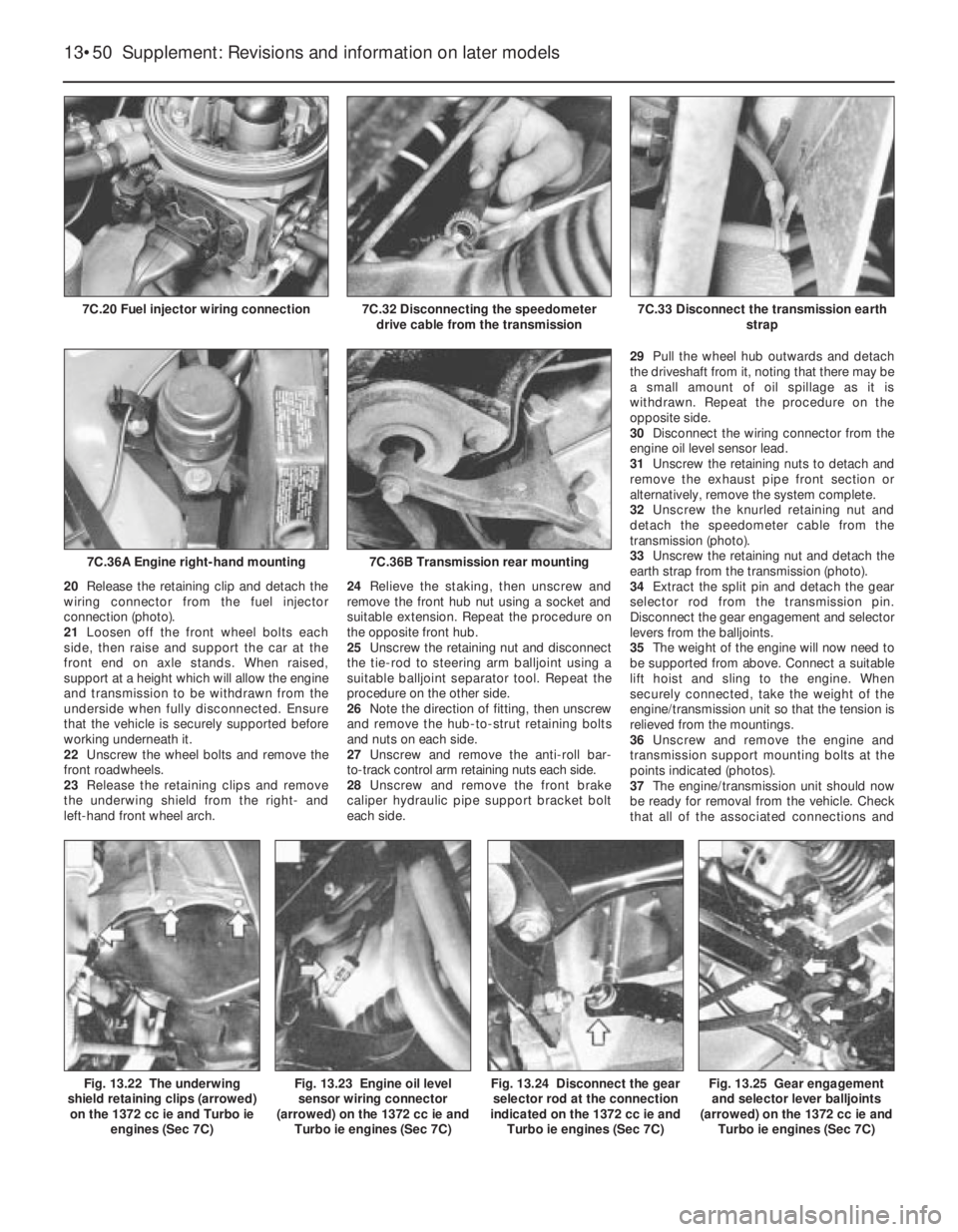
20Release the retaining clip and detach the
wiring connector from the fuel injector
connection (photo).
21Loosen off the front wheel bolts each
side, then raise and support the car at the
front end on axle stands. When raised,
support at a height which will allow the engine
and transmission to be withdrawn from the
underside when fully disconnected. Ensure
that the vehicle is securely supported before
working underneath it.
22Unscrew the wheel bolts and remove the
front roadwheels.
23Release the retaining clips and remove
the underwing shield from the right- and
left-hand front wheel arch.24Relieve the staking, then unscrew and
remove the front hub nut using a socket and
suitable extension. Repeat the procedure on
the opposite front hub.
25Unscrew the retaining nut and disconnect
the tie-rod to steering arm balljoint using a
suitable balljoint separator tool. Repeat the
procedure on the other side.
26Note the direction of fitting, then unscrew
and remove the hub-to-strut retaining bolts
and nuts on each side.
27Unscrew and remove the anti-roll bar-
to-track control arm retaining nuts each side.
28Unscrew and remove the front brake
caliper hydraulic pipe support bracket bolt
each side.29Pull the wheel hub outwards and detach
the driveshaft from it, noting that there may be
a small amount of oil spillage as it is
withdrawn. Repeat the procedure on the
opposite side.
30Disconnect the wiring connector from the
engine oil level sensor lead.
31Unscrew the retaining nuts to detach and
remove the exhaust pipe front section or
alternatively, remove the system complete.
32Unscrew the knurled retaining nut and
detach the speedometer cable from the
transmission (photo).
33Unscrew the retaining nut and detach the
earth strap from the transmission (photo).
34Extract the split pin and detach the gear
selector rod from the transmission pin.
Disconnect the gear engagement and selector
levers from the balljoints.
35The weight of the engine will now need to
be supported from above. Connect a suitable
lift hoist and sling to the engine. When
securely connected, take the weight of the
engine/transmission unit so that the tension is
relieved from the mountings.
36Unscrew and remove the engine and
transmission support mounting bolts at the
points indicated (photos).
37The engine/transmission unit should now
be ready for removal from the vehicle. Check
that all of the associated connections and
13•50 Supplement: Revisions and information on later models
Fig. 13.22 The underwing
shield retaining clips (arrowed)
on the 1372 cc ie and Turbo ie
engines (Sec 7C)Fig. 13.25 Gear engagement
and selector lever balljoints
(arrowed) on the 1372 cc ie and
Turbo ie engines (Sec 7C)Fig. 13.23 Engine oil level
sensor wiring connector
(arrowed) on the 1372 cc ie and
Turbo ie engines (Sec 7C)Fig. 13.24 Disconnect the gear
selector rod at the connection
indicated on the 1372 cc ie and
Turbo ie engines (Sec 7C)
7C.33 Disconnect the transmission earth
strap7C.32 Disconnecting the speedometer
drive cable from the transmission7C.20 Fuel injector wiring connection
7C.36B Transmission rear mounting7C.36A Engine right-hand mounting
Page 177 of 303
61Refer to Part B of this Section for details
and remove the flywheel.
62Refer to the previous sub-Section for
details and remove the auxiliary shaft.
63Refer to Part B of this Section for details
and remove the sump.
64Refer to Part B of this Section for details
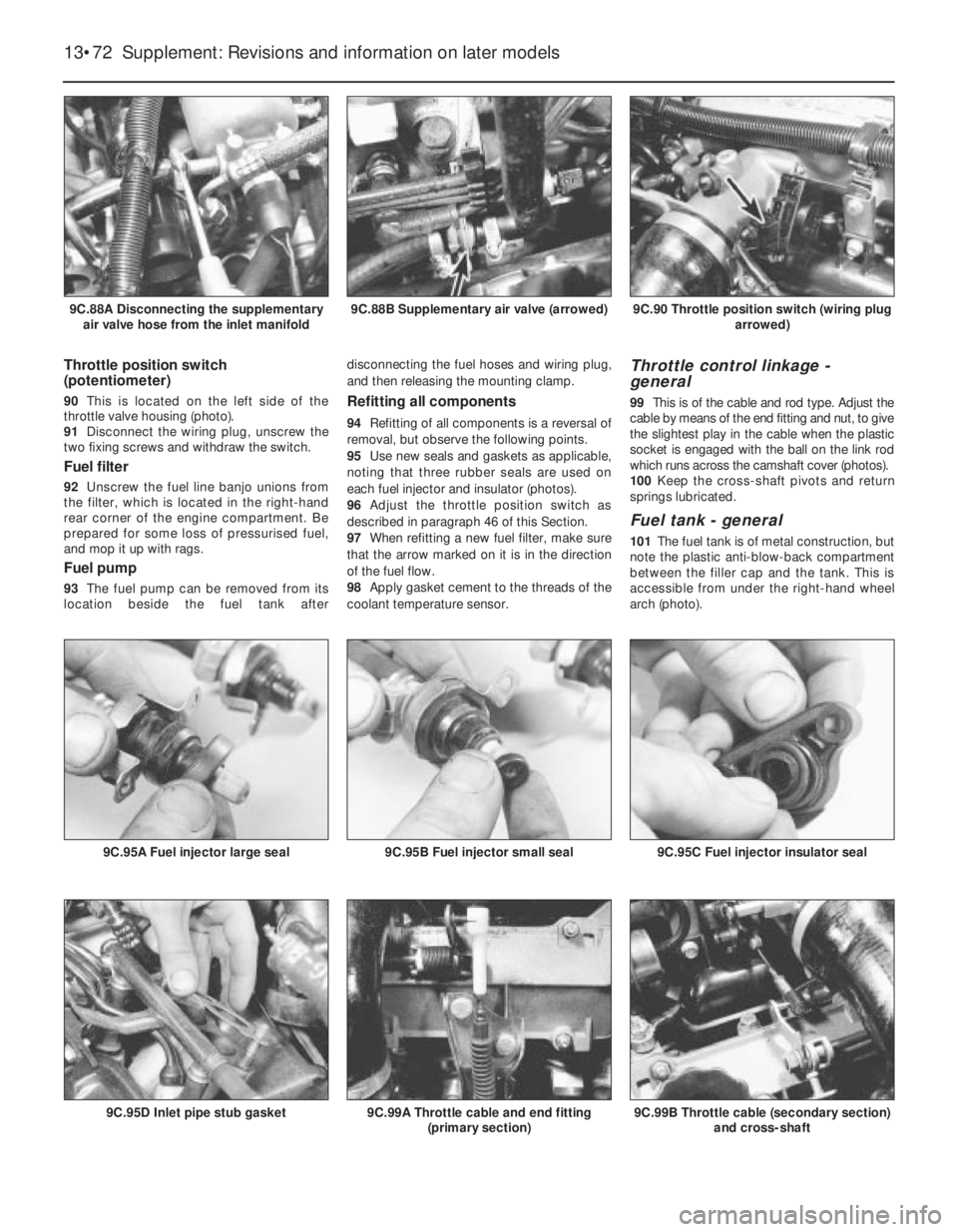
and remove the oil pump unit.
65Refer to Part B of this Section for details
and remove the front and rear crankshaft oil
seals.
66Refer to Part B of this Section and remove
the piston/connecting rod assemblies.
67Refer to Part B of this Section for details
and remove the crankshaft and main bearing
assemblies.
Crankshaft and main
bearings - removal#
68Unscrew the securing bolts and remove
the front and rear crankshaft oil seal housings.
Recover the gaskets.
69Check the main bearing caps for identifi-
cation marks and if necessary use a
centre-punch to identify them. Normally the
caps have identifying notches cut into their
top face nearest the timing belt end of the
engine, with the exception of No 5 cap
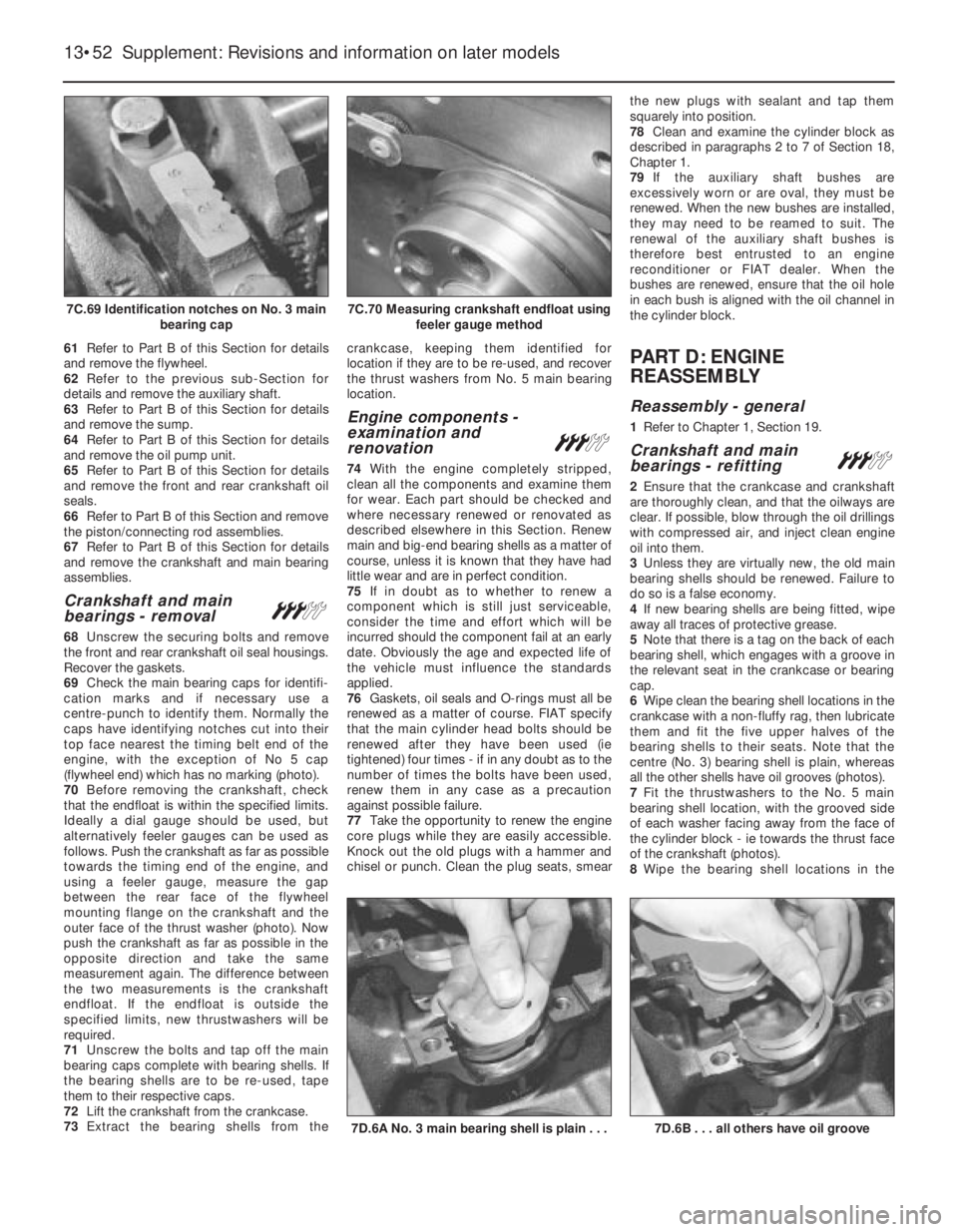
(flywheel end) which has no marking (photo).
70Before removing the crankshaft, check
that the endfloat is within the specified limits.
Ideally a dial gauge should be used, but
alternatively feeler gauges can be used as
follows. Push the crankshaft as far as possible
towards the timing end of the engine, and
using a feeler gauge, measure the gap
between the rear face of the flywheel
mounting flange on the crankshaft and the
outer face of the thrust washer (photo). Now
push the crankshaft as far as possible in the
opposite direction and take the same
measurement again. The difference between
the two measurements is the crankshaft
endfloat. If the endfloat is outside the
specified limits, new thrustwashers will be
required.
71Unscrew the bolts and tap off the main
bearing caps complete with bearing shells. If
the bearing shells are to be re-used, tape
them to their respective caps.
72Lift the crankshaft from the crankcase.
73Extract the bearing shells from thecrankcase, keeping them identified for
location if they are to be re-used, and recover
the thrust washers from No. 5 main bearing
location.
Engine components -
examination and
renovation
#
74With the engine completely stripped,
clean all the components and examine them
for wear. Each part should be checked and
where necessary renewed or renovated as
described elsewhere in this Section. Renew
main and big-end bearing shells as a matter of
course, unless it is known that they have had
little wear and are in perfect condition.
75If in doubt as to whether to renew a
component which is still just serviceable,
consider the time and effort which will be
incurred should the component fail at an early
date. Obviously the age and expected life of
the vehicle must influence the standards
applied.
76Gaskets, oil seals and O-rings must all be
renewed as a matter of course. FIAT specify
that the main cylinder head bolts should be
renewed after they have been used (ie
tightened) four times - if in any doubt as to the
number of times the bolts have been used,
renew them in any case as a precaution
against possible failure.
77Take the opportunity to renew the engine
core plugs while they are easily accessible.
Knock out the old plugs with a hammer and
chisel or punch. Clean the plug seats, smearthe new plugs with sealant and tap them
squarely into position.
78Clean and examine the cylinder block as
described in paragraphs 2 to 7 of Section 18,
Chapter 1.
79If the auxiliary shaft bushes are
excessively worn or are oval, they must be
renewed. When the new bushes are installed,
they may need to be reamed to suit. The
renewal of the auxiliary shaft bushes is
therefore best entrusted to an engine
reconditioner or FIAT dealer. When the
bushes are renewed, ensure that the oil hole
in each bush is aligned with the oil channel in
the cylinder block.
PART D: ENGINE
REASSEMBLY
Reassembly - general
1Refer to Chapter 1, Section 19.
Crankshaft and main
bearings - refitting#
2Ensure that the crankcase and crankshaft
are thoroughly clean, and that the oilways are
clear. If possible, blow through the oil drillings
with compressed air, and inject clean engine
oil into them.
3Unless they are virtually new, the old main
bearing shells should be renewed. Failure to
do so is a false economy.
4If new bearing shells are being fitted, wipe
away all traces of protective grease.
5Note that there is a tag on the back of each
bearing shell, which engages with a groove in
the relevant seat in the crankcase or bearing
cap.
6Wipe clean the bearing shell locations in the
crankcase with a non-fluffy rag, then lubricate
them and fit the five upper halves of the
bearing shells to their seats. Note that the
centre (No. 3) bearing shell is plain, whereas
all the other shells have oil grooves (photos).
7Fit the thrustwashers to the No. 5 main
bearing shell location, with the grooved side
of each washer facing away from the face of
the cylinder block - ie towards the thrust face
of the crankshaft (photos).
8Wipe the bearing shell locations in the
13•52 Supplement: Revisions and information on later models
7D.6B . . . all others have oil groove7D.6A No. 3 main bearing shell is plain . . .
7C.70 Measuring crankshaft endfloat using
feeler gauge method7C.69 Identification notches on No. 3 main
bearing cap
Page 178 of 303
bearing caps with a soft non-fluffy rag, then fit
the lower halves of the bearing shells to their
seats. Again, note that the centre (No. 3)
bearing shell is plain, whereas all the other
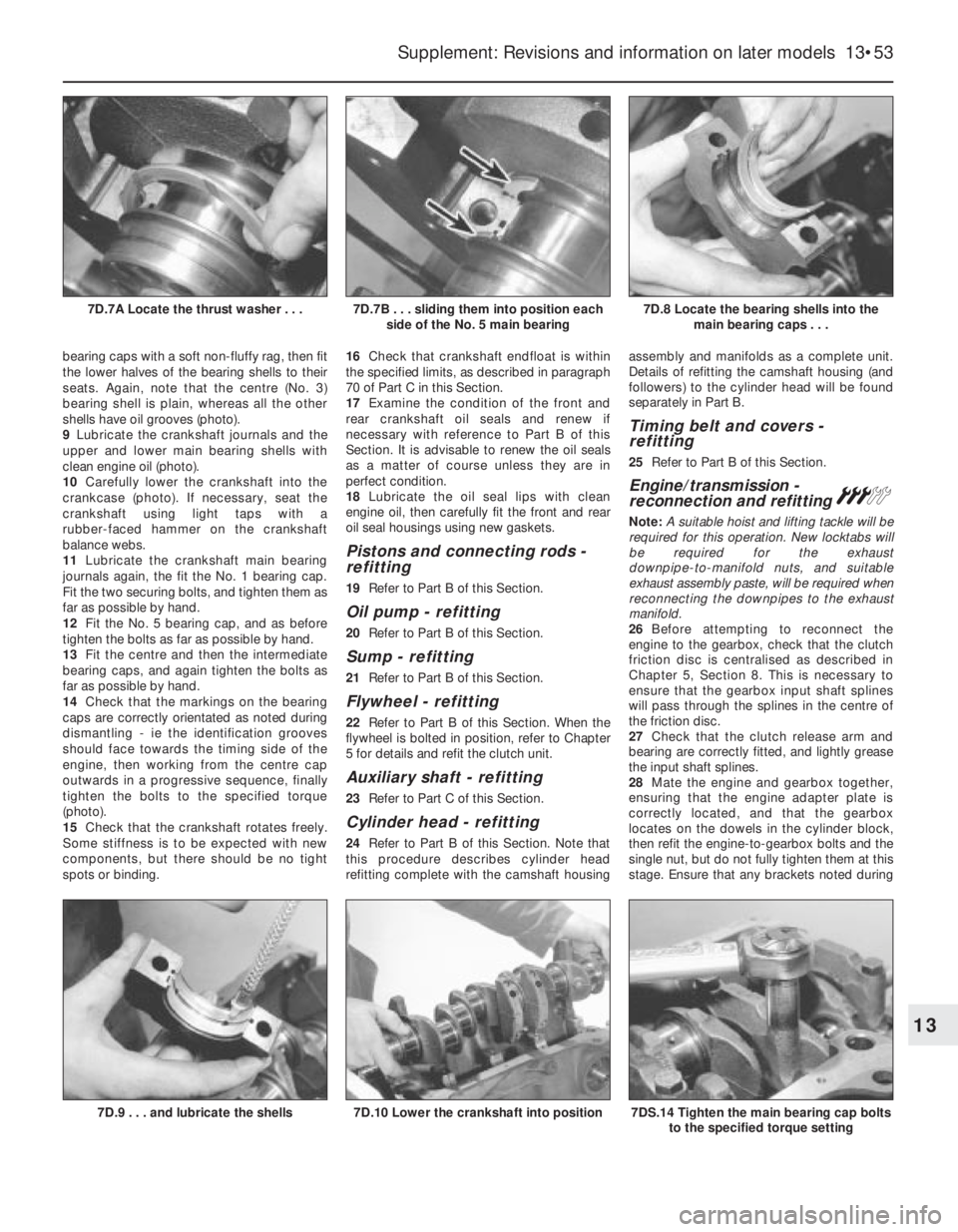
shells have oil grooves (photo).
9Lubricate the crankshaft journals and the
upper and lower main bearing shells with
clean engine oil (photo).
10Carefully lower the crankshaft into the
crankcase (photo). If necessary, seat the
crankshaft using light taps with a
rubber-faced hammer on the crankshaft
balance webs.
11Lubricate the crankshaft main bearing
journals again, the fit the No. 1 bearing cap.
Fit the two securing bolts, and tighten them as
far as possible by hand.
12Fit the No. 5 bearing cap, and as before
tighten the bolts as far as possible by hand.
13Fit the centre and then the intermediate
bearing caps, and again tighten the bolts as
far as possible by hand.
14Check that the markings on the bearing
caps are correctly orientated as noted during
dismantling - ie the identification grooves
should face towards the timing side of the
engine, then working from the centre cap
outwards in a progressive sequence, finally
tighten the bolts to the specified torque
(photo).
15Check that the crankshaft rotates freely.
Some stiffness is to be expected with new
components, but there should be no tight
spots or binding.16Check that crankshaft endfloat is within
the specified limits, as described in paragraph
70 of Part C in this Section.
17Examine the condition of the front and
rear crankshaft oil seals and renew if
necessary with reference to Part B of this
Section. It is advisable to renew the oil seals
as a matter of course unless they are in
perfect condition.
18Lubricate the oil seal lips with clean
engine oil, then carefully fit the front and rear
oil seal housings using new gaskets.
Pistons and connecting rods -
refitting
19Refer to Part B of this Section.
Oil pump - refitting
20Refer to Part B of this Section.
Sump - refitting
21Refer to Part B of this Section.
Flywheel - refitting
22Refer to Part B of this Section. When the
flywheel is bolted in position, refer to Chapter
5 for details and refit the clutch unit.
Auxiliary shaft - refitting
23Refer to Part C of this Section.
Cylinder head - refitting
24Refer to Part B of this Section. Note that
this procedure describes cylinder head
refitting complete with the camshaft housingassembly and manifolds as a complete unit.
Details of refitting the camshaft housing (and
followers) to the cylinder head will be found
separately in Part B.
Timing belt and covers -
refitting
25Refer to Part B of this Section.
Engine/transmission -
reconnection and refitting#
Note: A suitable hoist and lifting tackle will be
required for this operation. New locktabs will
be required for the exhaust
downpipe-to-manifold nuts, and suitable
exhaust assembly paste, will be required when
reconnecting the downpipes to the exhaust
manifold.
26Before attempting to reconnect the
engine to the gearbox, check that the clutch
friction disc is centralised as described in
Chapter 5, Section 8. This is necessary to
ensure that the gearbox input shaft splines
will pass through the splines in the centre of
the friction disc.
27Check that the clutch release arm and
bearing are correctly fitted, and lightly grease
the input shaft splines.
28Mate the engine and gearbox together,
ensuring that the engine adapter plate is
correctly located, and that the gearbox
locates on the dowels in the cylinder block,
then refit the engine-to-gearbox bolts and the
single nut, but do not fully tighten them at this
stage. Ensure that any brackets noted during
Supplement: Revisions and information on later models 13•53
7D.8 Locate the bearing shells into the
main bearing caps . . .7D.7B . . . sliding them into position each
side of the No. 5 main bearing
7DS.14 Tighten the main bearing cap bolts
to the specified torque setting7D.10 Lower the crankshaft into position7D.9 . . . and lubricate the shells
13
7D.7A Locate the thrust washer . . .
Page 183 of 303
35Clean the mating faces of the thermostat
cover and cylinder head, and use a new
gasket when refitting the cover.
36Refill the cooling system as described
earlier in this Section.
Coolant pump -
removal and refittingÁ
Note: A new coolant pump gasket must be
used on refitting. If the pump is found to be
worn it must be renewed as a complete unit as
dismantling and repair is not possible.
37Disconnect the battery negative lead.
38Drain the cooling system as described
earlier in this Section.
39Remove the coolant/alternator drivebelt
as described in the next sub-Section.
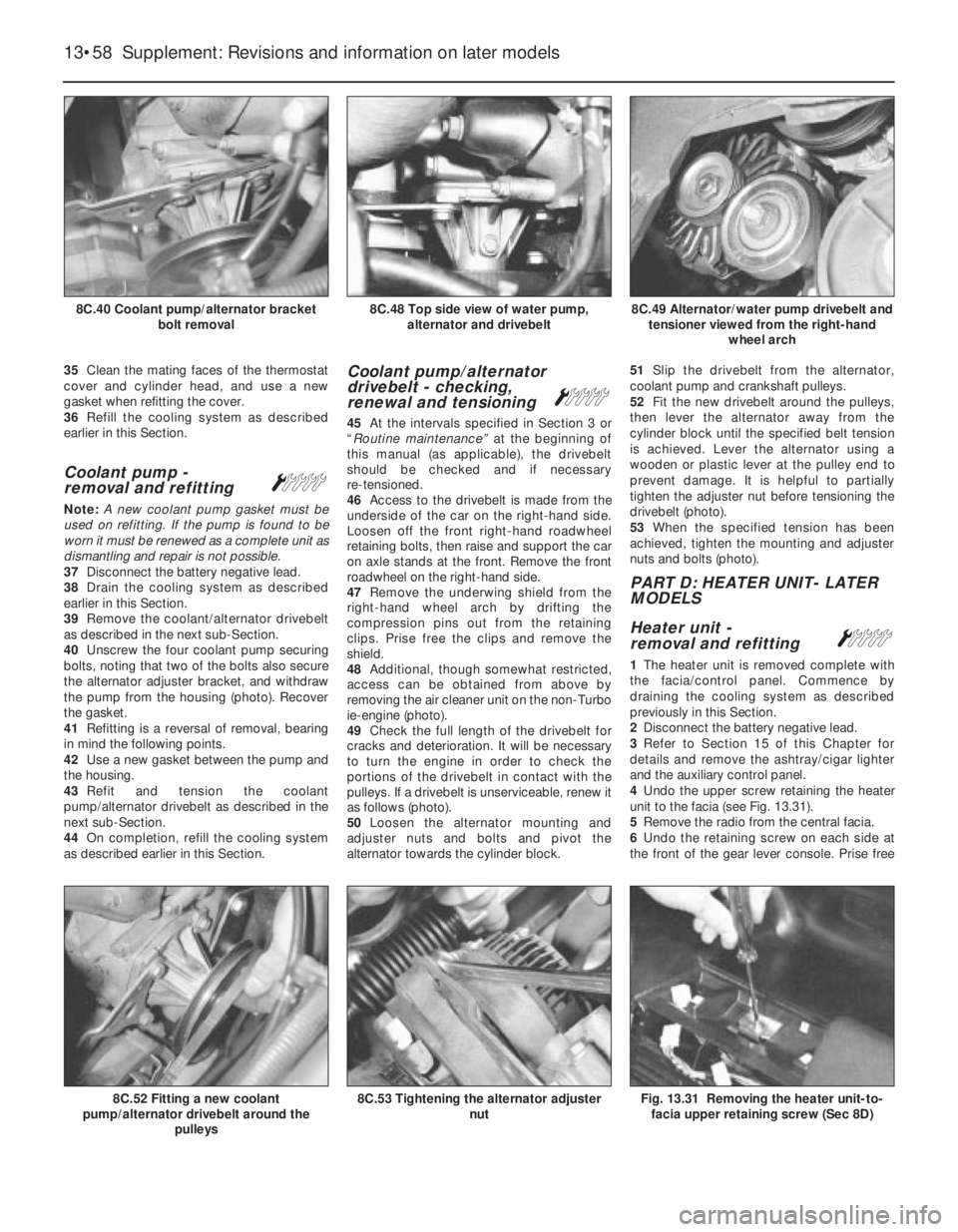
40Unscrew the four coolant pump securing
bolts, noting that two of the bolts also secure
the alternator adjuster bracket, and withdraw
the pump from the housing (photo). Recover
the gasket.
41Refitting is a reversal of removal, bearing
in mind the following points.
42Use a new gasket between the pump and
the housing.
43Refit and tension the coolant
pump/alternator drivebelt as described in the
next sub-Section.
44On completion, refill the cooling system
as described earlier in this Section.
Coolant pump/alternator
drivebelt - checking,
renewal and tensioning
Á
45At the intervals specified in Section 3 or
“Routine maintenance” at the beginning of
this manual (as applicable), the drivebelt
should be checked and if necessary
re-tensioned.
46Access to the drivebelt is made from the
underside of the car on the right-hand side.
Loosen off the front right-hand roadwheel
retaining bolts, then raise and support the car
on axle stands at the front. Remove the front
roadwheel on the right-hand side.
47Remove the underwing shield from the
right-hand wheel arch by drifting the
compression pins out from the retaining
clips. Prise free the clips and remove the
shield.
48Additional, though somewhat restricted,
access can be obtained from above by
removing the air cleaner unit on the non-Turbo
ie-engine (photo).
49Check the full length of the drivebelt for
cracks and deterioration. It will be necessary
to turn the engine in order to check the
portions of the drivebelt in contact with the
pulleys. If a drivebelt is unserviceable, renew it
as follows (photo).
50Loosen the alternator mounting and
adjuster nuts and bolts and pivot the
alternator towards the cylinder block.51Slip the drivebelt from the alternator,
coolant pump and crankshaft pulleys.
52Fit the new drivebelt around the pulleys,
then lever the alternator away from the
cylinder block until the specified belt tension
is achieved. Lever the alternator using a
wooden or plastic lever at the pulley end to
prevent damage. It is helpful to partially
tighten the adjuster nut before tensioning the
drivebelt (photo).
53When the specified tension has been
achieved, tighten the mounting and adjuster
nuts and bolts (photo).
PART D: HEATER UNIT- LATER
MODELS
Heater unit -
removal and refitting
Á
1The heater unit is removed complete with
the facia/control panel. Commence by
draining the cooling system as described
previously in this Section.
2Disconnect the battery negative lead.
3Refer to Section 15 of this Chapter for
details and remove the ashtray/cigar lighter
and the auxiliary control panel.
4Undo the upper screw retaining the heater
unit to the facia (see Fig. 13.31).
5Remove the radio from the central facia.
6Undo the retaining screw on each side at
the front of the gear lever console. Prise free
13•58 Supplement: Revisions and information on later models
Fig. 13.31 Removing the heater unit-to-
facia upper retaining screw (Sec 8D)8C.53 Tightening the alternator adjuster
nut8C.52 Fitting a new coolant
pump/alternator drivebelt around the
pulleys
8C.49 Alternator/water pump drivebelt and
tensioner viewed from the right-hand
wheel arch8C.48 Top side view of water pump,
alternator and drivebelt8C.40 Coolant pump/alternator bracket
bolt removal
Page 197 of 303
Throttle position switch
(potentiometer)
90This is located on the left side of the
throttle valve housing (photo).
91Disconnect the wiring plug, unscrew the
two fixing screws and withdraw the switch.
Fuel filter
92Unscrew the fuel line banjo unions from
the filter, which is located in the right-hand
rear corner of the engine compartment. Be
prepared for some loss of pressurised fuel,
and mop it up with rags.
Fuel pump
93The fuel pump can be removed from its
location beside the fuel tank afterdisconnecting the fuel hoses and wiring plug,
and then releasing the mounting clamp.
Refitting all components
94Refitting of all components is a reversal of
removal, but observe the following points.
95Use new seals and gaskets as applicable,
noting that three rubber seals are used on
each fuel injector and insulator (photos).
96Adjust the throttle position switch as
described in paragraph 46 of this Section.
97When refitting a new fuel filter, make sure
that the arrow marked on it is in the direction
of the fuel flow.
98Apply gasket cement to the threads of the
coolant temperature sensor.
Throttle control linkage -
general
99This is of the cable and rod type. Adjust the
cable by means of the end fitting and nut, to give
the slightest play in the cable when the plastic
socket is engaged with the ball on the link rod
which runs across the camshaft cover (photos).
100Keep the cross-shaft pivots and return
springs lubricated.
Fuel tank - general
101The fuel tank is of metal construction, but
note the plastic anti-blow-back compartment
between the filler cap and the tank. This is
accessible from under the right-hand wheel
arch (photo).
13•72 Supplement: Revisions and information on later models
9C.99B Throttle cable (secondary section)
and cross-shaft9C.99A Throttle cable and end fitting
(primary section)9C.95D Inlet pipe stub gasket
9C.95C Fuel injector insulator seal9C.95B Fuel injector small seal9C.95A Fuel injector large seal
9C.90 Throttle position switch (wiring plug
arrowed)9C.88B Supplementary air valve (arrowed)9C.88A Disconnecting the supplementary
air valve hose from the inlet manifold
Page 210 of 303
Fault finding - turbocharger system
Supplement: Revisions and information on later models 13•85
13
Noise or vibration
m mWorn shaft bearings
m mLack of lubrication
m mInlet or exhaust manifold leaking
m mOut-of-balance impeller shaft
Engine “pinking”
m
mHigh boost pressure, caused by faulty wastegate valve
m mFuel octane rating too low
m mFaulty TDC sensor (ignition advanced)
m mIncorrect spark plugs or plug gaps, or spark plugs worn
Indicated boost pressure too high
m
mFaulty wastegate valve
m mIce forming in exhaust pipe (during very cold weather)
Power loss/indicated boost pressure too low
m
mTurbocharger leaking, or leak at turbocharger mounting
m mIncorrectly adjusted wastegate valve/wastegate valve not closing
m mBlocked exhaust pipe
m mClogged air cleaner element
m mFaulty TDC sensor (ignition retarded)
m mTurbo/intercooler connecting hose leaking
Oil leaks from shaft oil seals, with blue exhaust
fumes
m mOil return pipe blocked
m mAir cleaner element clogged
m mWorn oil seals
10 Ignition system
General
1The ignition systems dealt with in this
Section are all fully electronic and are referred
to individually according to type as the
“breakerless”, Microplex and Digiplex 2
system. The Microplex system is used on the
1301 and 1372 cc Turbo ie engines, the
Digiplex 2 on the 1372 cc ie engine and the
“breakerless” system on all other models.
Ignition timing
(all later models)#
2The ignition timing check on all systems
covered in this Section is made using a
stroboscope, connected up in accordance with
the manufacturer’s instructions and pointed at
one of the two positions given below (photos).
a) The timing marks on the crankshaft pulley
and the timing cover. The right-hand
underwing shield will need to be
detached and removed to allow access to
view these marks (see photos 7B.27 and
7B.30B in this Chapter).
b) The timing marks on the flywheel and the
clutch housing. The rubber plug will need
to be extracted for access to these marks.
3A dwell angle check is not possible on any
of these systems.
4When making the stroboscopic ignition
timing check it is necessary to disconnect the
vacuum hose from the distributor or inlet
manifold to module (as applicable) and plug it.
The engine must be at its normal operating
temperature and running at the normal
specified idle speed when making the check.
Refer to the appropriate part of the Specifica-
tions at the start of this Chapter for the idle
speed and ignition settings.
Breakerless ignition system -
description
5On 903 cc engines, the distributor is driven
from an extension of the oil pump driveshaft
which is geared to the camshaft.
10.2B Flywheel timing marks
(1372 cc ie engine)10.2A Flywheel timing marks
(999 cc engine)
Fig. 13.70 Breakerless ignition system - 999 and 1108 cc engines (Sec 10)
1 Battery
2 Ignition switch
3 Ignition coil
4 Coil HT lead5 Distributor
6 ECU
7 LT cables
8 Vacuum advance unit9 Spark plug HT leads
10 Spark plugs
11 Vacuum hose
Page 213 of 303
13•88 Supplement: Revisions and information on later models
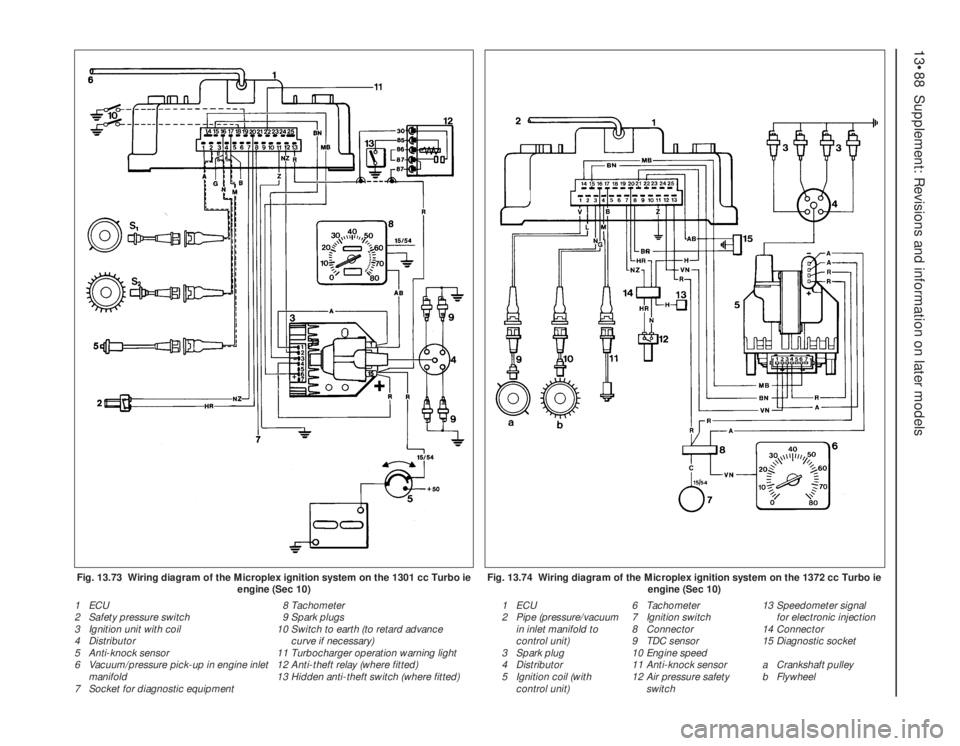
Fig. 13.73 Wiring diagram of the Microplex ignition system on the 1301 cc Turbo ie
engine (Sec 10)Fig. 13.74 Wiring diagram of the Microplex ignition system on the 1372 cc Turbo ie
engine (Sec 10)1 ECU
2 Safety pressure switch
3 Ignition unit with coil
4 Distributor
5 Anti-knock sensor
6 Vacuum/pressure pick-up in engine inlet
manifold
7 Socket for diagnostic equipment8 Tachometer
9 Spark plugs
10 Switch to earth (to retard advance
curve if necessary)
11 Turbocharger operation warning light
12 Anti-theft relay (where fitted)
13 Hidden anti-theft switch (where fitted)1 ECU
2 Pipe (pressure/vacuum
in inlet manifold to
control unit)
3 Spark plug
4 Distributor
5 Ignition coil (with
control unit)6 Tachometer
7 Ignition switch
8 Connector
9 TDC sensor
10 Engine speed
11 Anti-knock sensor
12 Air pressure safety
switch13 Speedometer signal
for electronic injection
14 Connector
15 Diagnostic socket
a Crankshaft pulley
b Flywheel
Page 214 of 303
Ignition unit
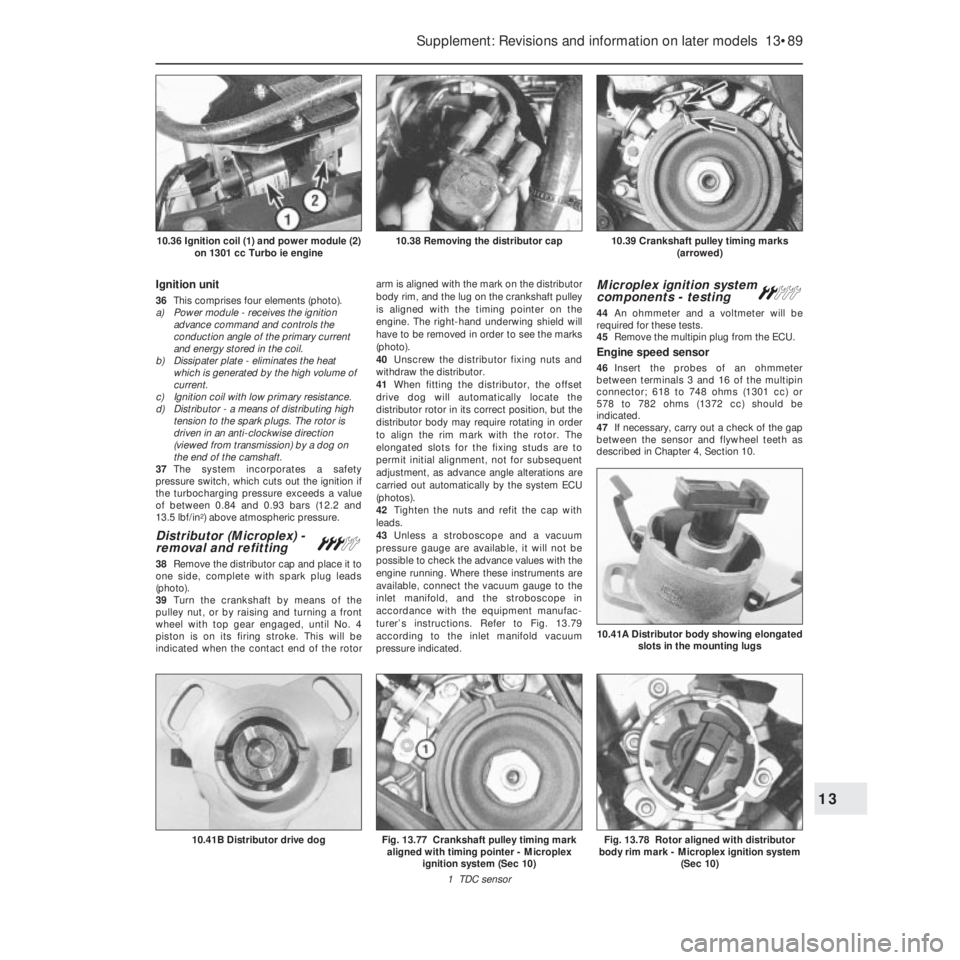
36This comprises four elements (photo).
a) Power module - receives the ignition
advance command and controls the
conduction angle of the primary current
and energy stored in the coil.
b) Dissipater plate - eliminates the heat
which is generated by the high volume of
current.
c) Ignition coil with low primary resistance.
d) Distributor - a means of distributing high
tension to the spark plugs. The rotor is
driven in an anti-clockwise direction
(viewed from transmission) by a dog on
the end of the camshaft.
37The system incorporates a safety
pressure switch, which cuts out the ignition if
the turbocharging pressure exceeds a value
of between 0.84 and 0.93 bars (12.2 and
13.5 lbf/in
2) above atmospheric pressure.
Distributor (Microplex) -
removal and refitting#
38Remove the distributor cap and place it to
one side, complete with spark plug leads
(photo).
39Turn the crankshaft by means of the
pulley nut, or by raising and turning a front
wheel with top gear engaged, until No. 4
piston is on its firing stroke. This will be
indicated when the contact end of the rotorarm is aligned with the mark on the distributor
body rim, and the lug on the crankshaft pulley
is aligned with the timing pointer on the
engine. The right-hand underwing shield will
have to be removed in order to see the marks
(photo).
40Unscrew the distributor fixing nuts and
withdraw the distributor.
41When fitting the distributor, the offset
drive dog will automatically locate the
distributor rotor in its correct position, but the
distributor body may require rotating in order
to align the rim mark with the rotor. The
elongated slots for the fixing studs are to
permit initial alignment, not for subsequent
adjustment, as advance angle alterations are
carried out automatically by the system ECU
(photos).
42Tighten the nuts and refit the cap with
leads.
43Unless a stroboscope and a vacuum
pressure gauge are available, it will not be
possible to check the advance values with the
engine running. Where these instruments are
available, connect the vacuum gauge to the
inlet manifold, and the stroboscope in
accordance with the equipment manufac-
turer’s instructions. Refer to Fig. 13.79
according to the inlet manifold vacuum
pressure indicated.
Microplex ignition system
components - testing ª
44An ohmmeter and a voltmeter will be
required for these tests.
45Remove the multipin plug from the ECU.
Engine speed sensor
46Insert the probes of an ohmmeter
between terminals 3 and 16 of the multipin
connector; 618 to 748 ohms (1301 cc) or
578 to 782 ohms (1372 cc) should be
indicated.
47If necessary, carry out a check of the gap
between the sensor and flywheel teeth as
described in Chapter 4, Section 10.
Supplement: Revisions and information on later models 13•89
10.39 Crankshaft pulley timing marks
(arrowed)10.38 Removing the distributor cap10.36 Ignition coil (1) and power module (2)
on 1301 cc Turbo ie engine
Fig. 13.78 Rotor aligned with distributor
body rim mark - Microplex ignition system
(Sec 10)
10.41A Distributor body showing elongated
slots in the mounting lugs
Fig. 13.77 Crankshaft pulley timing mark
aligned with timing pointer - Microplex
ignition system (Sec 10)
1 TDC sensor10.41B Distributor drive dog
13
Page 216 of 303
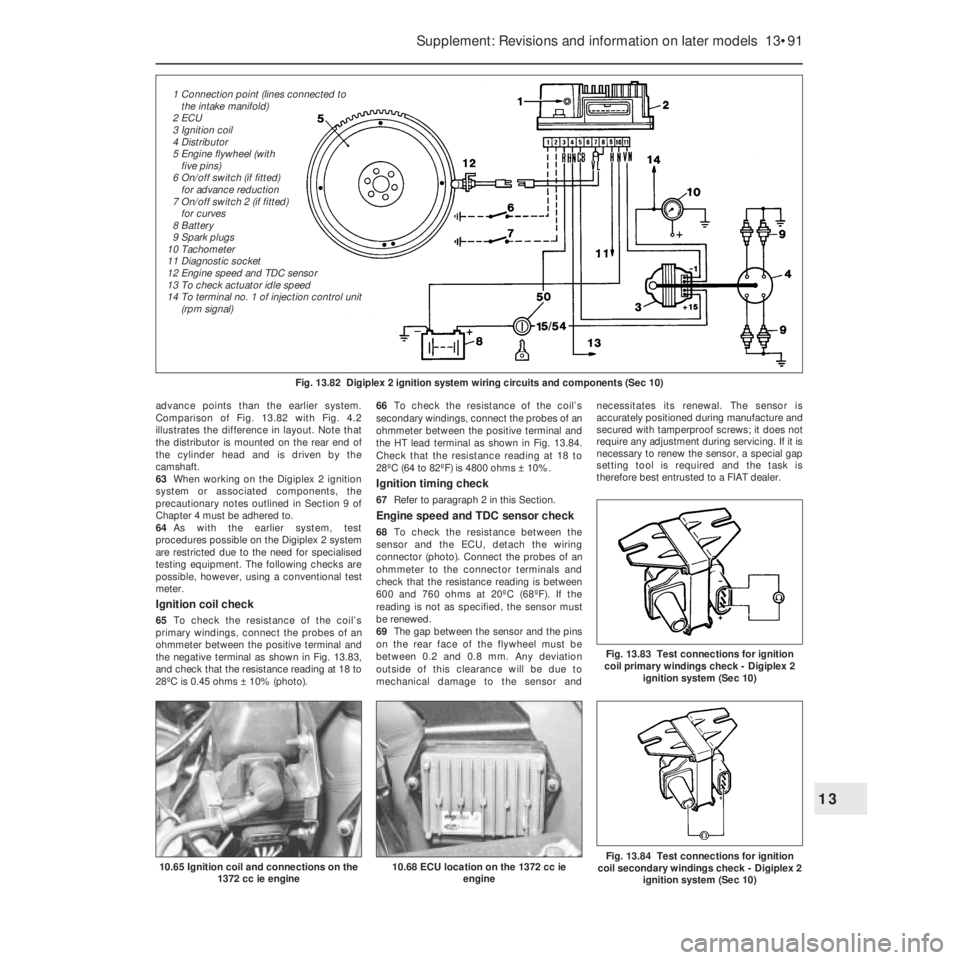
advance points than the earlier system.
Comparison of Fig. 13.82 with Fig. 4.2
illustrates the difference in layout. Note that
the distributor is mounted on the rear end of
the cylinder head and is driven by the
camshaft.
63When working on the Digiplex 2 ignition
system or associated components, the
precautionary notes outlined in Section 9 of
Chapter 4 must be adhered to.
64As with the earlier system, test
procedures possible on the Digiplex 2 system
are restricted due to the need for specialised
testing equipment. The following checks are
possible, however, using a conventional test
meter.
Ignition coil check
65To check the resistance of the coil’s
primary windings, connect the probes of an
ohmmeter between the positive terminal and
the negative terminal as shown in Fig. 13.83,
and check that the resistance reading at 18 to
28ºC is 0.45 ohms ± 10% (photo).66To check the resistance of the coil’s
secondary windings, connect the probes of an
ohmmeter between the positive terminal and
the HT lead terminal as shown in Fig. 13.84.
Check that the resistance reading at 18 to
28ºC (64 to 82ºF) is 4800 ohms ± 10%.
Ignition timing check
67Refer to paragraph 2 in this Section.
Engine speed and TDC sensor check
68To check the resistance between the
sensor and the ECU, detach the wiring
connector (photo). Connect the probes of an
ohmmeter to the connector terminals and
check that the resistance reading is between
600 and 760 ohms at 20ºC (68ºF). If the
reading is not as specified, the sensor must
be renewed.
69The gap between the sensor and the pins
on the rear face of the flywheel must be
between 0.2 and 0.8 mm. Any deviation
outside of this clearance will be due to
mechanical damage to the sensor andnecessitates its renewal. The sensor is
accurately positioned during manufacture and
secured with tamperproof screws; it does not
require any adjustment during servicing. If it is
necessary to renew the sensor, a special gap
setting tool is required and the task is
therefore best entrusted to a FIAT dealer.
Supplement: Revisions and information on later models 13•91
Fig. 13.82 Digiplex 2 ignition system wiring circuits and components (Sec 10)
10.68 ECU location on the 1372 cc ie
engine10.65 Ignition coil and connections on the
1372 cc ie engineFig. 13.84 Test connections for ignition
coil secondary windings check - Digiplex 2
ignition system (Sec 10)
Fig. 13.83 Test connections for ignition
coil primary windings check - Digiplex 2
ignition system (Sec 10)
13
1 Connection point (lines connected to
the intake manifold)
2 ECU
3 Ignition coil
4 Distributor
5 Engine flywheel (with
five pins)
6 On/off switch (if fitted)
for advance reduction
7 On/off switch 2 (if fitted)
for curves
8 Battery
9 Spark plugs
10 Tachometer
11 Diagnostic socket
12 Engine speed and TDC sensor
13 To check actuator idle speed
14 To terminal no. 1 of injection control unit
(rpm signal)
Page 221 of 303
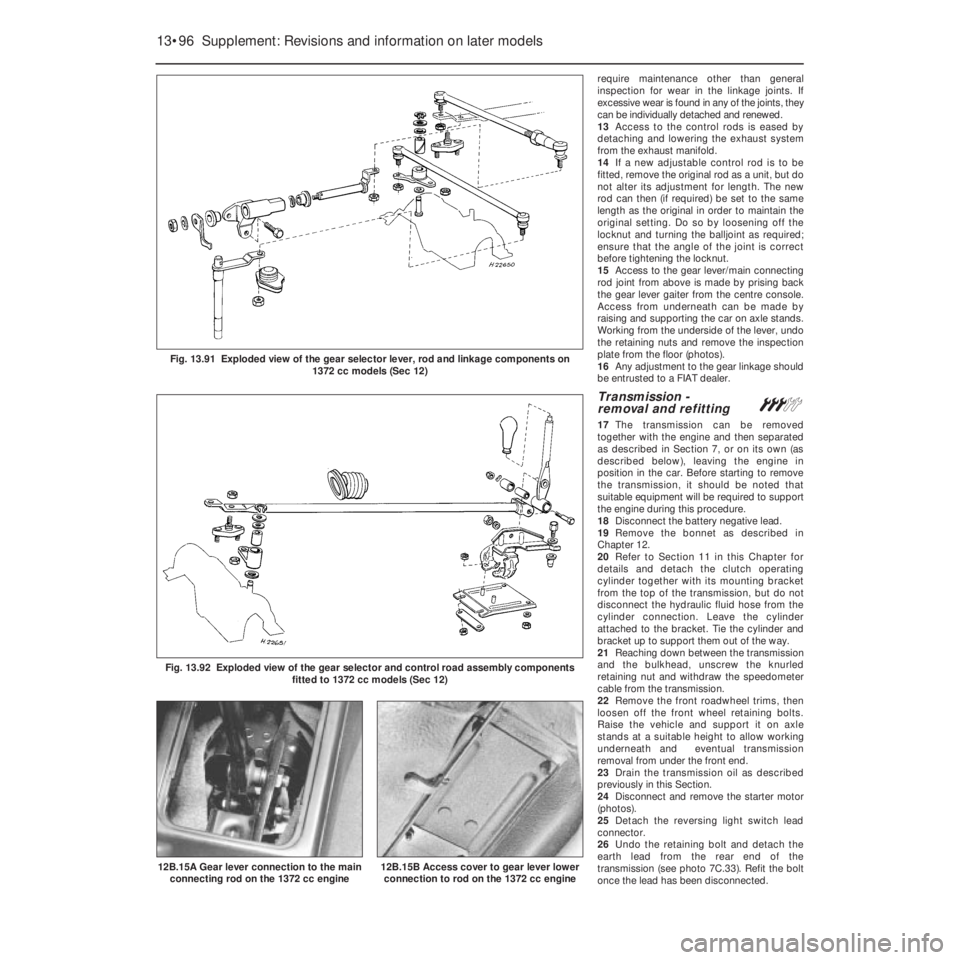
require maintenance other than general
inspection for wear in the linkage joints. If
excessive wear is found in any of the joints, they
can be individually detached and renewed.
13Access to the control rods is eased by
detaching and lowering the exhaust system
from the exhaust manifold.
14If a new adjustable control rod is to be
fitted, remove the original rod as a unit, but do
not alter its adjustment for length. The new
rod can then (if required) be set to the same
length as the original in order to maintain the
original setting. Do so by loosening off the
locknut and turning the balljoint as required;
ensure that the angle of the joint is correct
before tightening the locknut.
15Access to the gear lever/main connecting
rod joint from above is made by prising back
the gear lever gaiter from the centre console.
Access from underneath can be made by
raising and supporting the car on axle stands.
Working from the underside of the lever, undo
the retaining nuts and remove the inspection
plate from the floor (photos).
16Any adjustment to the gear linkage should
be entrusted to a FIAT dealer.
Transmission -
removal and refitting#
17The transmission can be removed
together with the engine and then separated
as described in Section 7, or on its own (as
described below), leaving the engine in
position in the car. Before starting to remove
the transmission, it should be noted that
suitable equipment will be required to support
the engine during this procedure.
18Disconnect the battery negative lead.
19Remove the bonnet as described in
Chapter 12.
20Refer to Section 11 in this Chapter for
details and detach the clutch operating
cylinder together with its mounting bracket
from the top of the transmission, but do not
disconnect the hydraulic fluid hose from the
cylinder connection. Leave the cylinder
attached to the bracket. Tie the cylinder and
bracket up to support them out of the way.
21Reaching down between the transmission
and the bulkhead, unscrew the knurled
retaining nut and withdraw the speedometer
cable from the transmission.
22Remove the front roadwheel trims, then
loosen off the front wheel retaining bolts.
Raise the vehicle and support it on axle
stands at a suitable height to allow working
underneath and eventual transmission
removal from under the front end.
23Drain the transmission oil as described
previously in this Section.
24Disconnect and remove the starter motor
(photos).
25Detach the reversing light switch lead
connector.
26Undo the retaining bolt and detach the
earth lead from the rear end of the
transmission (see photo 7C.33). Refit the bolt
once the lead has been disconnected.
13•96 Supplement: Revisions and information on later models
12B.15B Access cover to gear lever lower
connection to rod on the 1372 cc engine
Fig. 13.92 Exploded view of the gear selector and control road assembly components
fitted to 1372 cc models (Sec 12)
12B.15A Gear lever connection to the main
connecting rod on the 1372 cc engine
Fig. 13.91 Exploded view of the gear selector lever, rod and linkage components on
1372 cc models (Sec 12)