wheel FIAT UNO 1983 Service Workshop Manual
[x] Cancel search | Manufacturer: FIAT, Model Year: 1983, Model line: UNO, Model: FIAT UNO 1983Pages: 303, PDF Size: 10.36 MB
Page 107 of 303
Note: Before diagnosing steering faults, be
sure that trouble is not due to incorrect or
uneven tyre pressures, inappropriate tyre
combinations, or braking system or
suspension defects.
Car pulls to one side
m mIncorrect steering geometry
m mCollision damage
Vibration at steering wheel
m
mRoadwheels out of balance or loose
m mTyre damage
m mLoose driveshaft-to-hub nuts
Car wanders
m
mPlay in steering gear
m mWear in steering balljoints
Heavy or stiff steering
m
mLack of lubricant in steering gear or balljoints
m mIncorrect steering geometry
m mCollision damage
Play at steering wheel
m
mWear in steering rack or balljoints
m mLoose steering shaft coupling pinch-bolt or
worn splines
m mWorn steering column/shaft universal joints
Rattles from steering
m
mSteering damper defective or in need of
adjustment
m mLoose steering column mounting bolts
m mLoose steering column/shaft coupling
pinch-bolts
m mLoose steering rack housing mounting bolts
m mWorn steering shaft bushes
Excessive or uneven tyre wear
m
mIncorrect steering geometry
m mWorn steering components
m mCollision damage wear. Before considering the steering angles,
check that the tyres are correctly inflated, that
the front wheels are not buckled, the hub
bearings are not worn or incorrectly adjusted
and that the steering linkage is in good order,
without slackness or wear at the joints.
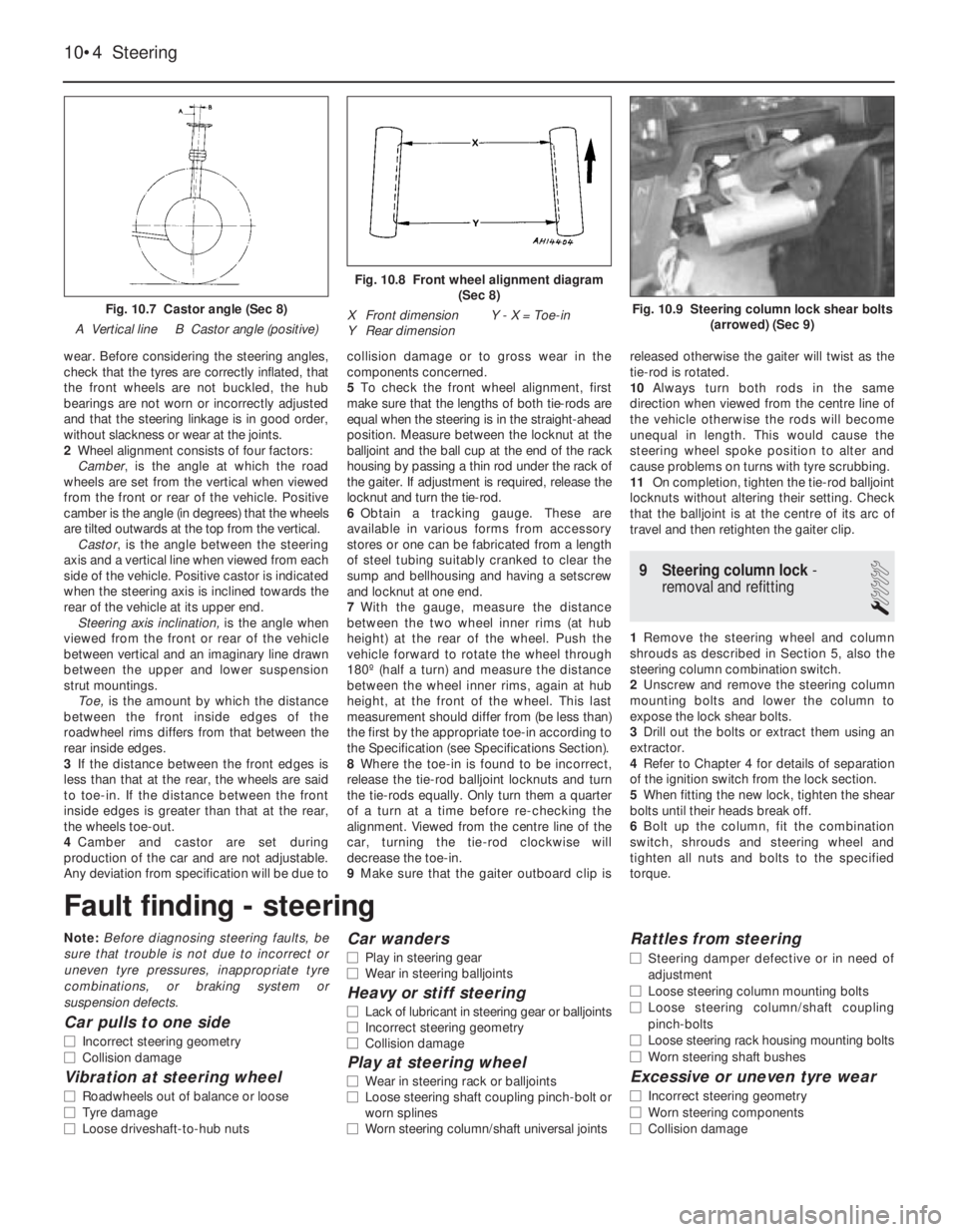
2Wheel alignment consists of four factors:
Camber, is the angle at which the road
wheels are set from the vertical when viewed
from the front or rear of the vehicle. Positive
camber is the angle (in degrees) that the wheels
are tilted outwards at the top from the vertical.
Castor, is the angle between the steering
axis and a vertical line when viewed from each
side of the vehicle. Positive castor is indicated
when the steering axis is inclined towards the
rear of the vehicle at its upper end.
Steering axis inclination, is the angle when
viewed from the front or rear of the vehicle
between vertical and an imaginary line drawn
between the upper and lower suspension
strut mountings.
Toe,is the amount by which the distance
between the front inside edges of the
roadwheel rims differs from that between the
rear inside edges.
3If the distance between the front edges is
less than that at the rear, the wheels are said
to toe-in. If the distance between the front
inside edges is greater than that at the rear,
the wheels toe-out.
4Camber and castor are set during
production of the car and are not adjustable.
Any deviation from specification will be due tocollision damage or to gross wear in the
components concerned.
5To check the front wheel alignment, first
make sure that the lengths of both tie-rods are
equal when the steering is in the straight-ahead
position. Measure between the locknut at the
balljoint and the ball cup at the end of the rack
housing by passing a thin rod under the rack of
the gaiter. If adjustment is required, release the
locknut and turn the tie-rod.
6Obtain a tracking gauge. These are
available in various forms from accessory
stores or one can be fabricated from a length
of steel tubing suitably cranked to clear the
sump and bellhousing and having a setscrew
and locknut at one end.
7With the gauge, measure the distance
between the two wheel inner rims (at hub
height) at the rear of the wheel. Push the
vehicle forward to rotate the wheel through
180º (half a turn) and measure the distance
between the wheel inner rims, again at hub
height, at the front of the wheel. This last
measurement should differ from (be less than)
the first by the appropriate toe-in according to
the Specification (see Specifications Section).
8Where the toe-in is found to be incorrect,
release the tie-rod balljoint locknuts and turn
the tie-rods equally. Only turn them a quarter
of a turn at a time before re-checking the
alignment. Viewed from the centre line of the
car, turning the tie-rod clockwise will
decrease the toe-in.
9Make sure that the gaiter outboard clip isreleased otherwise the gaiter will twist as the
tie-rod is rotated.
10Always turn both rods in the same
direction when viewed from the centre line of
the vehicle otherwise the rods will become
unequal in length. This would cause the
steering wheel spoke position to alter and
cause problems on turns with tyre scrubbing.
11On completion, tighten the tie-rod balljoint
locknuts without altering their setting. Check
that the balljoint is at the centre of its arc of
travel and then retighten the gaiter clip.
9 Steering column lock-
removal and refitting
1
1Remove the steering wheel and column
shrouds as described in Section 5, also the
steering column combination switch.
2Unscrew and remove the steering column
mounting bolts and lower the column to
expose the lock shear bolts.
3Drill out the bolts or extract them using an
extractor.
4Refer to Chapter 4 for details of separation
of the ignition switch from the lock section.
5When fitting the new lock, tighten the shear
bolts until their heads break off.
6Bolt up the column, fit the combination
switch, shrouds and steering wheel and
tighten all nuts and bolts to the specified
torque.
10•4 Steering
Fig. 10.9 Steering column lock shear bolts
(arrowed) (Sec 9)
Fig. 10.8 Front wheel alignment diagram
(Sec 8)
X Front dimension Y - X = Toe-in
Y Rear dimension
Fig. 10.7 Castor angle (Sec 8)
A Vertical line B Castor angle (positive)
Fault finding - steering
Page 108 of 303
11
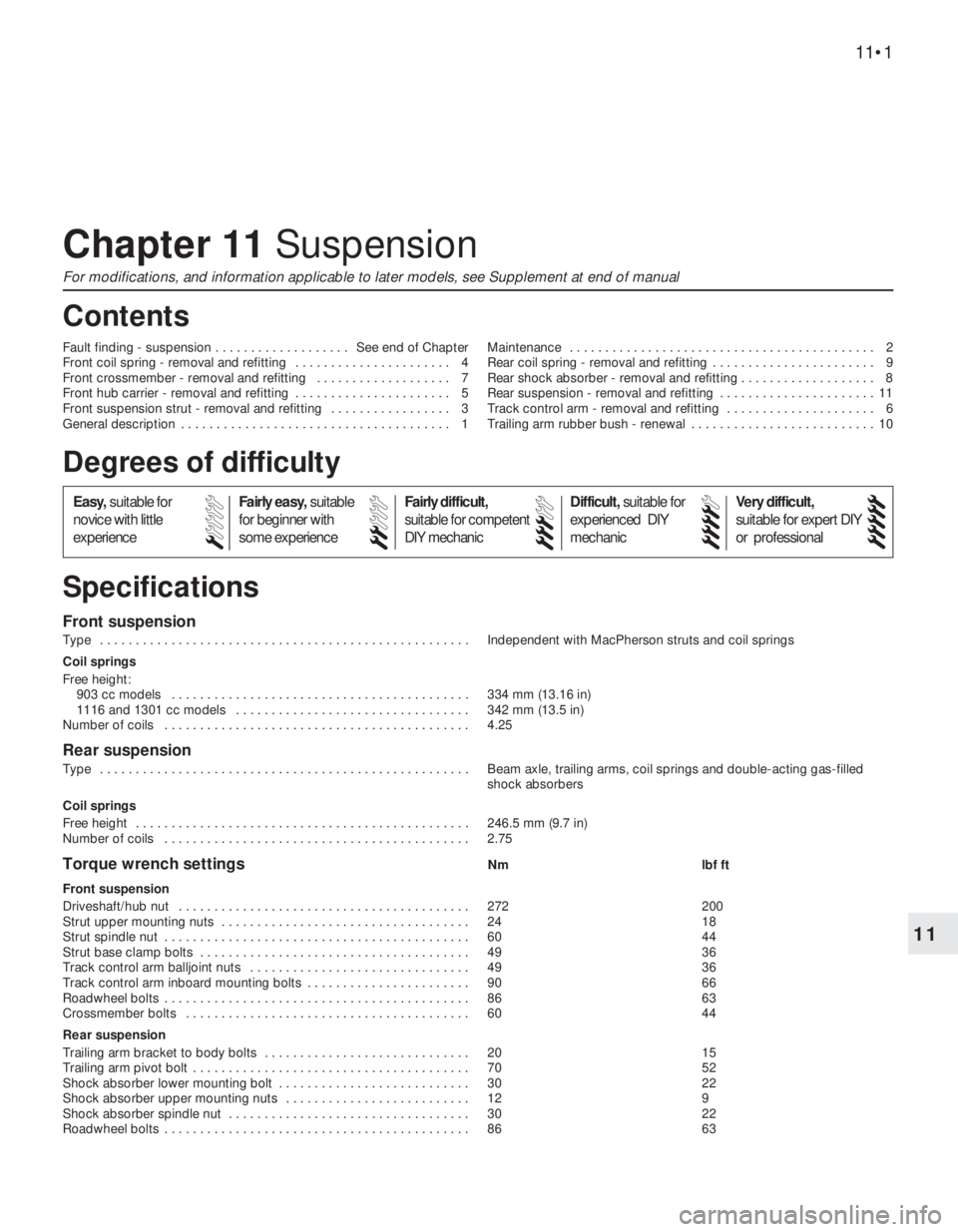
Front suspension
Type . . . . . . . . . . . . . . . . . . . . . . . . . . . . . . . . . . . . . . . . . . . . . . . . . . . . Independent with MacPherson struts and coil springs
Coil springs
Free height:
903 cc models . . . . . . . . . . . . . . . . . . . . . . . . . . . . . . . . . . . . . . . . . . 334 mm (13.16 in)
1116 and 1301 cc models . . . . . . . . . . . . . . . . . . . . . . . . . . . . . . . . . 342 mm (13.5 in)
Number of coils . . . . . . . . . . . . . . . . . . . . . . . . . . . . . . . . . . . . . . . . . . . 4.25
Rear suspension
Type . . . . . . . . . . . . . . . . . . . . . . . . . . . . . . . . . . . . . . . . . . . . . . . . . . . . Beam axle, trailing arms, coil springs and double-acting gas-filled
shock absorbers
Coil springs
Free height . . . . . . . . . . . . . . . . . . . . . . . . . . . . . . . . . . . . . . . . . . . . . . . 246.5 mm (9.7 in)
Number of coils . . . . . . . . . . . . . . . . . . . . . . . . . . . . . . . . . . . . . . . . . . . 2.75
Torque wrench settingsNm lbf ft
Front suspension
Driveshaft/hub nut . . . . . . . . . . . . . . . . . . . . . . . . . . . . . . . . . . . . . . . . . 272 200
Strut upper mounting nuts . . . . . . . . . . . . . . . . . . . . . . . . . . . . . . . . . . . 24 18
Strut spindle nut . . . . . . . . . . . . . . . . . . . . . . . . . . . . . . . . . . . . . . . . . . . 60 44
Strut base clamp bolts . . . . . . . . . . . . . . . . . . . . . . . . . . . . . . . . . . . . . . 49 36
Track control arm balljoint nuts . . . . . . . . . . . . . . . . . . . . . . . . . . . . . . . 49 36
Track control arm inboard mounting bolts . . . . . . . . . . . . . . . . . . . . . . . 90 66
Roadwheel bolts . . . . . . . . . . . . . . . . . . . . . . . . . . . . . . . . . . . . . . . . . . . 86 63
Crossmember bolts . . . . . . . . . . . . . . . . . . . . . . . . . . . . . . . . . . . . . . . . 60 44
Rear suspension
Trailing arm bracket to body bolts . . . . . . . . . . . . . . . . . . . . . . . . . . . . . 20 15
Trailing arm pivot bolt . . . . . . . . . . . . . . . . . . . . . . . . . . . . . . . . . . . . . . . 70 52
Shock absorber lower mounting bolt . . . . . . . . . . . . . . . . . . . . . . . . . . . 30 22
Shock absorber upper mounting nuts . . . . . . . . . . . . . . . . . . . . . . . . . . 12 9
Shock absorber spindle nut . . . . . . . . . . . . . . . . . . . . . . . . . . . . . . . . . . 30 22
Roadwheel bolts . . . . . . . . . . . . . . . . . . . . . . . . . . . . . . . . . . . . . . . . . . . 86 63
Chapter 11 Suspension
For modifications, and information applicable to later models, see Supplement at end of manual
Fault finding - suspension . . . . . . . . . . . . . . . . . . . See end of Chapter
Front coil spring - removal and refitting . . . . . . . . . . . . . . . . . . . . . . 4
Front crossmember - removal and refitting . . . . . . . . . . . . . . . . . . . 7
Front hub carrier - removal and refitting . . . . . . . . . . . . . . . . . . . . . . 5
Front suspension strut - removal and refitting . . . . . . . . . . . . . . . . . 3
General description . . . . . . . . . . . . . . . . . . . . . . . . . . . . . . . . . . . . . . 1Maintenance . . . . . . . . . . . . . . . . . . . . . . . . . . . . . . . . . . . . . . . . . . . 2
Rear coil spring - removal and refitting . . . . . . . . . . . . . . . . . . . . . . . 9
Rear shock absorber - removal and refitting . . . . . . . . . . . . . . . . . . . 8
Rear suspension - removal and refitting . . . . . . . . . . . . . . . . . . . . . . 11
Track control arm - removal and refitting . . . . . . . . . . . . . . . . . . . . . 6
Trailing arm rubber bush - renewal . . . . . . . . . . . . . . . . . . . . . . . . . . 10
11•1
Specifications Contents
Easy,suitable for
novice with little
experienceFairly easy,suitable
for beginner with
some experienceFairly difficult,
suitable for competent
DIY mechanic
Difficult,suitable for
experienced DIY
mechanicVery difficult,
suitable for expert DIY
or professional
Degrees of difficulty
54321
Page 109 of 303
1 General description
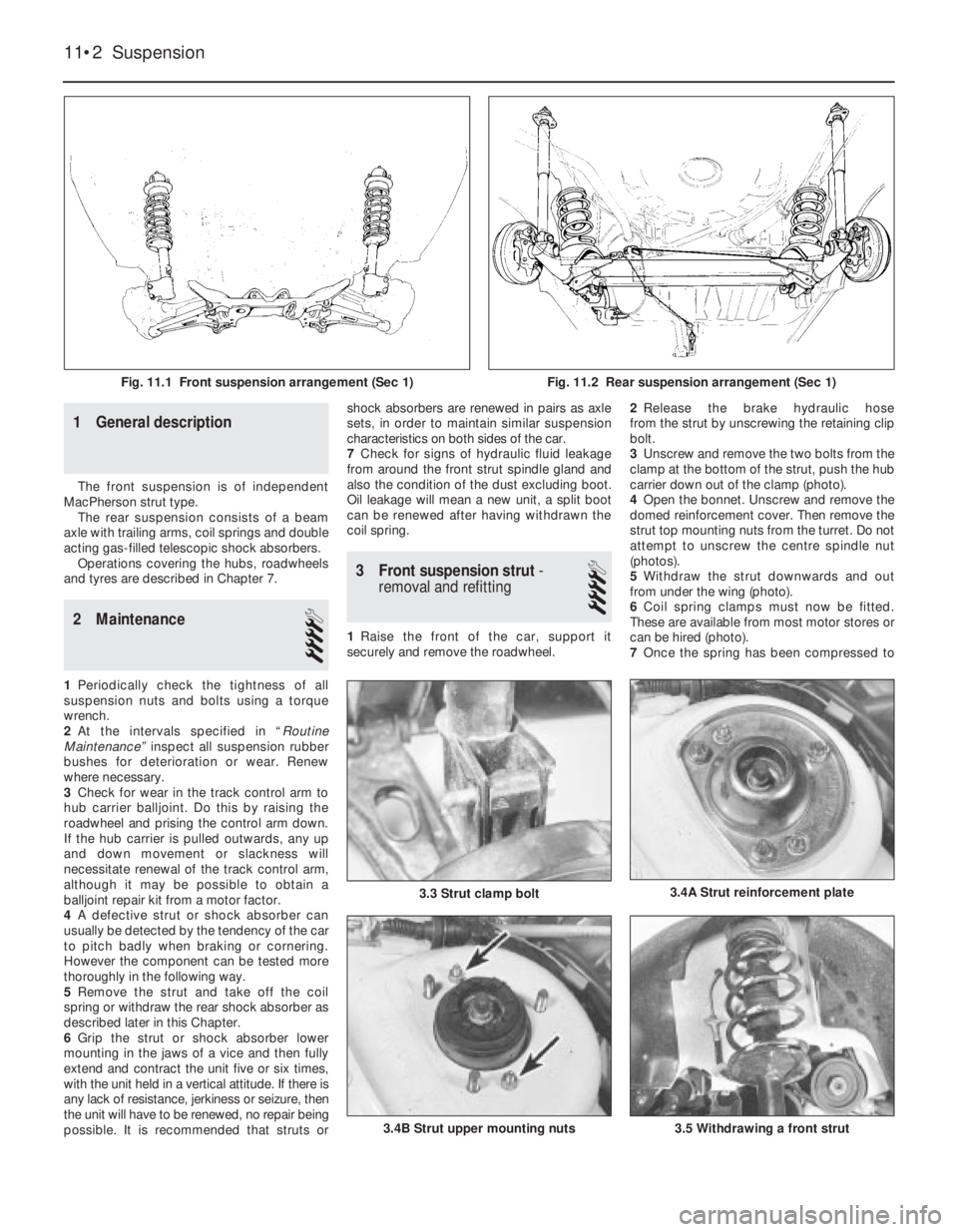
The front suspension is of independent
MacPherson strut type.
The rear suspension consists of a beam
axle with trailing arms, coil springs and double
acting gas-filled telescopic shock absorbers.
Operations covering the hubs, roadwheels
and tyres are described in Chapter 7.
2 Maintenance
4
1Periodically check the tightness of all
suspension nuts and bolts using a torque
wrench.
2At the intervals specified in “Routine
Maintenance” inspect all suspension rubber
bushes for deterioration or wear. Renew
where necessary.
3Check for wear in the track control arm to
hub carrier balljoint. Do this by raising the
roadwheel and prising the control arm down.
If the hub carrier is pulled outwards, any up
and down movement or slackness will
necessitate renewal of the track control arm,
although it may be possible to obtain a
balljoint repair kit from a motor factor.
4A defective strut or shock absorber can
usually be detected by the tendency of the car
to pitch badly when braking or cornering.
However the component can be tested more
thoroughly in the following way.
5Remove the strut and take off the coil
spring or withdraw the rear shock absorber as
described later in this Chapter.
6Grip the strut or shock absorber lower
mounting in the jaws of a vice and then fully
extend and contract the unit five or six times,
with the unit held in a vertical attitude. If there is
any lack of resistance, jerkiness or seizure, then
the unit will have to be renewed, no repair being
possible. It is recommended that struts orshock absorbers are renewed in pairs as axle
sets, in order to maintain similar suspension
characteristics on both sides of the car.
7Check for signs of hydraulic fluid leakage
from around the front strut spindle gland and
also the condition of the dust excluding boot.
Oil leakage will mean a new unit, a split boot
can be renewed after having withdrawn the
coil spring.
3 Front suspension strut-
removal and refitting
4
1Raise the front of the car, support it
securely and remove the roadwheel.2Release the brake hydraulic hose
from the strut by unscrewing the retaining clip
bolt.
3Unscrew and remove the two bolts from the
clamp at the bottom of the strut, push the hub
carrier down out of the clamp (photo).
4Open the bonnet. Unscrew and remove the
domed reinforcement cover. Then remove the
strut top mounting nuts from the turret. Do not
attempt to unscrew the centre spindle nut
(photos).
5Withdraw the strut downwards and out
from under the wing (photo).
6Coil spring clamps must now be fitted.
These are available from most motor stores or
can be hired (photo).
7Once the spring has been compressed to
11•2 Suspension
3.5 Withdrawing a front strut3.4B Strut upper mounting nuts
3.4A Strut reinforcement plate3.3 Strut clamp bolt
Fig. 11.1 Front suspension arrangement (Sec 1)Fig. 11.2 Rear suspension arrangement (Sec 1)
Page 111 of 303
balljoint from the hub carrier using a suitable
“splitter” tool. If such a tool is not available,
support the base of the brake disc and drive
the balljoint taper pin downwards, but screw
on the nut to protect the threads.
4Remove the hub carrier.
5Refitting is a reversal of removal, use a new
driveshaft nut and tighten all nuts and bolts to
the specified torque. Stake the driveshaft nut
after tightening.
6 Track control arm-
removal and refitting
3
1Raise the front of the car and support it
securely.
2Unless a special tool is available to press
the track control arm balljoint from the hub
carrier, the driveshaft will have to be
disconnected as described in Chapter 7,
Section 2, paragraphs 1 to 8 to provide more
space to enable the balljoint taper pin to be
driven from the hub carrier. This should now
be done as described in the preceding
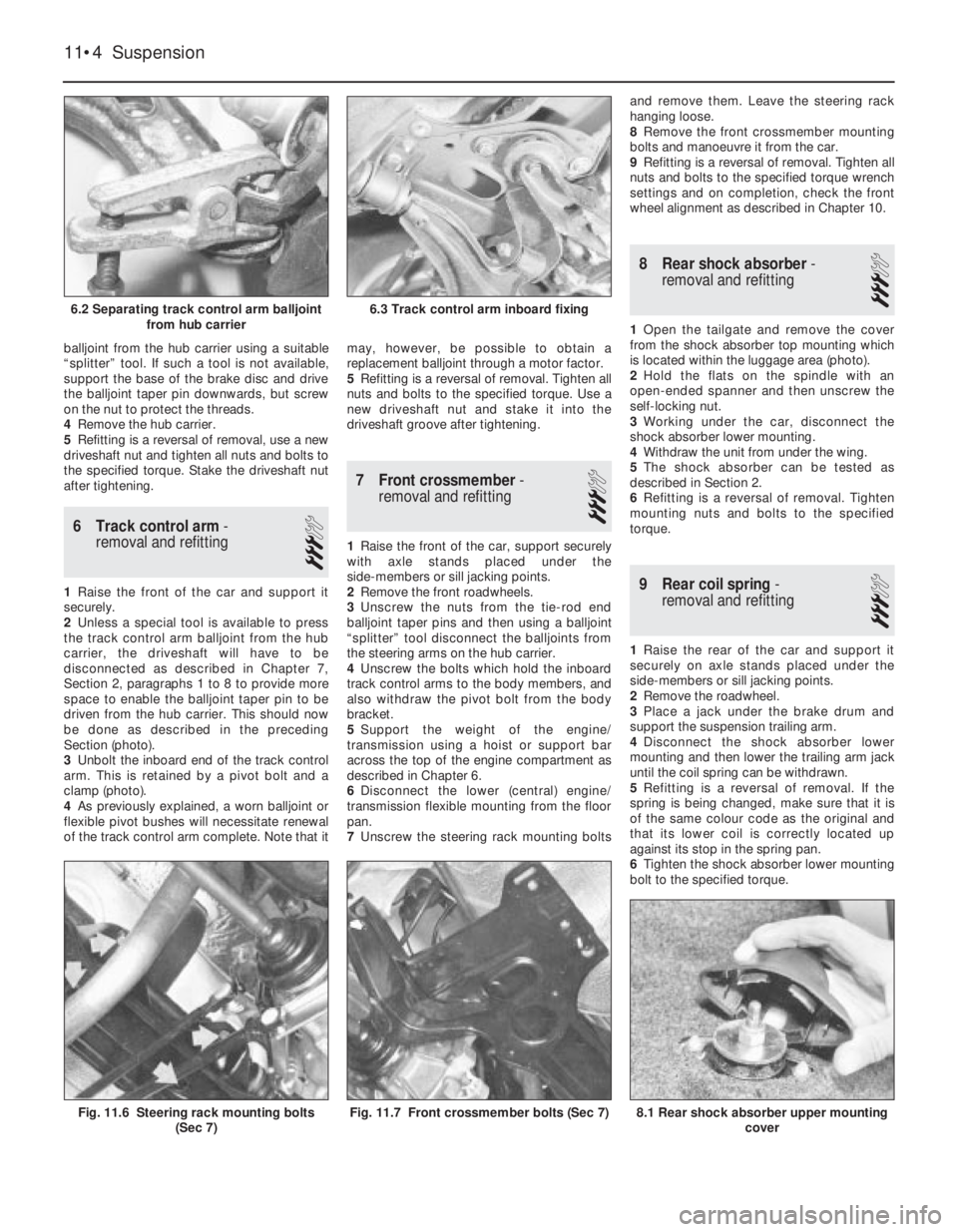
Section (photo).
3Unbolt the inboard end of the track control
arm. This is retained by a pivot bolt and a
clamp (photo).
4As previously explained, a worn balljoint or
flexible pivot bushes will necessitate renewal
of the track control arm complete. Note that itmay, however, be possible to obtain a
replacement balljoint through a motor factor.
5Refitting is a reversal of removal. Tighten all
nuts and bolts to the specified torque. Use a
new driveshaft nut and stake it into the
driveshaft groove after tightening.
7 Front crossmember-
removal and refitting
3
1Raise the front of the car, support securely
with axle stands placed under the
side-members or sill jacking points.
2Remove the front roadwheels.
3Unscrew the nuts from the tie-rod end
balljoint taper pins and then using a balljoint
“splitter” tool disconnect the balljoints from
the steering arms on the hub carrier.
4Unscrew the bolts which hold the inboard
track control arms to the body members, and
also withdraw the pivot bolt from the body
bracket.
5Support the weight of the engine/
transmission using a hoist or support bar
across the top of the engine compartment as
described in Chapter 6.
6Disconnect the lower (central) engine/
transmission flexible mounting from the floor
pan.
7Unscrew the steering rack mounting boltsand remove them. Leave the steering rack
hanging loose.
8Remove the front crossmember mounting
bolts and manoeuvre it from the car.
9Refitting is a reversal of removal. Tighten all
nuts and bolts to the specified torque wrench
settings and on completion, check the front
wheel alignment as described in Chapter 10.
8 Rear shock absorber-
removal and refitting
3
1Open the tailgate and remove the cover
from the shock absorber top mounting which
is located within the luggage area (photo).
2Hold the flats on the spindle with an
open-ended spanner and then unscrew the
self-locking nut.
3Working under the car, disconnect the
shock absorber lower mounting.
4Withdraw the unit from under the wing.
5The shock absorber can be tested as
described in Section 2.
6Refitting is a reversal of removal. Tighten
mounting nuts and bolts to the specified
torque.
9 Rear coil spring-
removal and refitting
3
1Raise the rear of the car and support it
securely on axle stands placed under the
side-members or sill jacking points.
2Remove the roadwheel.
3Place a jack under the brake drum and
support the suspension trailing arm.
4Disconnect the shock absorber lower
mounting and then lower the trailing arm jack
until the coil spring can be withdrawn.
5Refitting is a reversal of removal. If the
spring is being changed, make sure that it is
of the same colour code as the original and
that its lower coil is correctly located up
against its stop in the spring pan.
6Tighten the shock absorber lower mounting
bolt to the specified torque.
11•4 Suspension
8.1 Rear shock absorber upper mounting
coverFig. 11.7 Front crossmember bolts (Sec 7)Fig. 11.6 Steering rack mounting bolts
(Sec 7)
6.3 Track control arm inboard fixing6.2 Separating track control arm balljoint
from hub carrier
Page 112 of 303
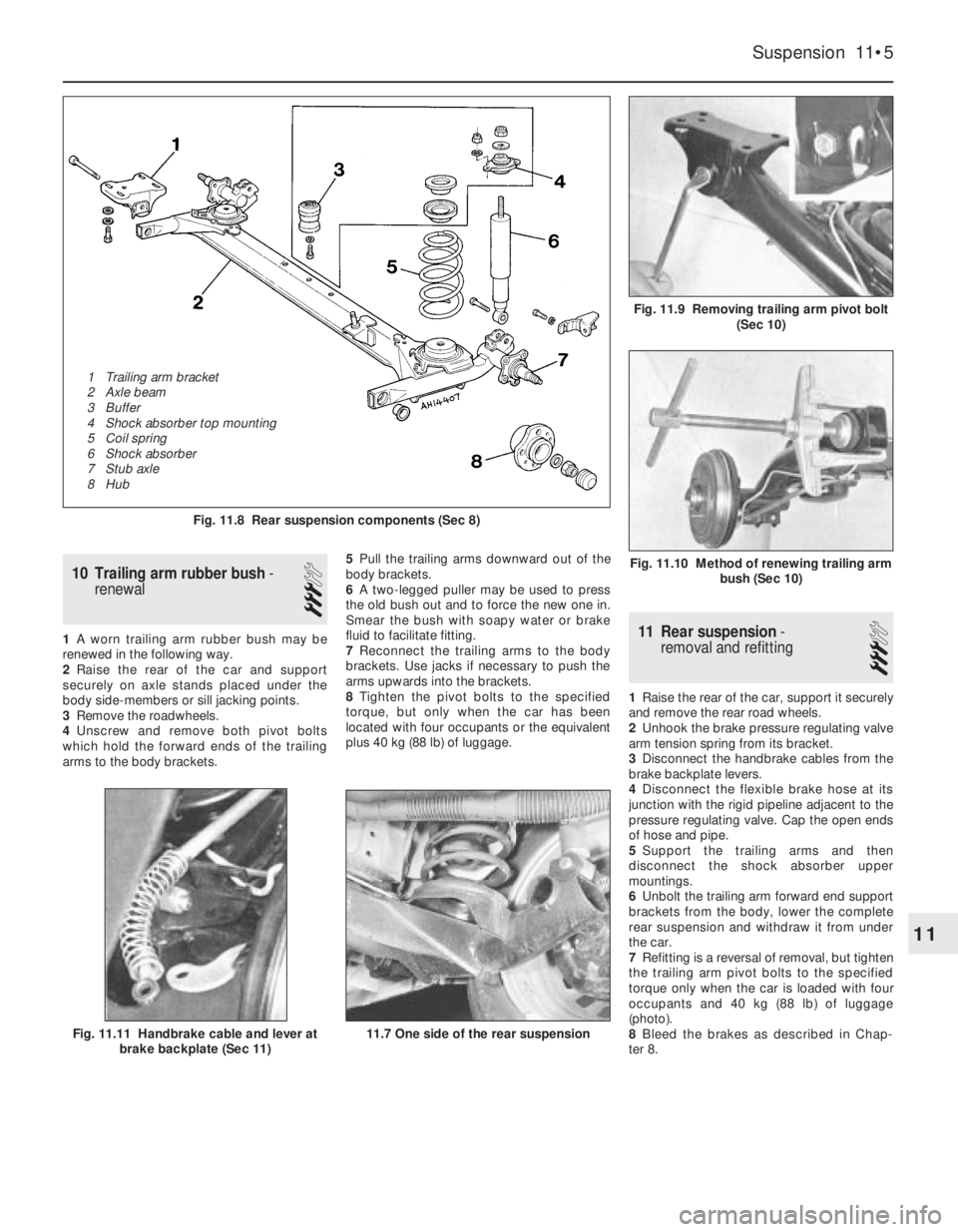
10 Trailing arm rubber bush-
renewal
3
1A worn trailing arm rubber bush may be
renewed in the following way.
2Raise the rear of the car and support
securely on axle stands placed under the
body side-members or sill jacking points.
3Remove the roadwheels.
4Unscrew and remove both pivot bolts
which hold the forward ends of the trailing
arms to the body brackets.5Pull the trailing arms downward out of the
body brackets.
6A two-legged puller may be used to press
the old bush out and to force the new one in.
Smear the bush with soapy water or brake
fluid to facilitate fitting.
7Reconnect the trailing arms to the body
brackets. Use jacks if necessary to push the
arms upwards into the brackets.
8Tighten the pivot bolts to the specified
torque, but only when the car has been
located with four occupants or the equivalent
plus 40 kg (88 lb) of luggage.11 Rear suspension-
removal and refitting
3
1Raise the rear of the car, support it securely
and remove the rear road wheels.
2Unhook the brake pressure regulating valve
arm tension spring from its bracket.
3Disconnect the handbrake cables from the
brake backplate levers.
4Disconnect the flexible brake hose at its
junction with the rigid pipeline adjacent to the
pressure regulating valve. Cap the open ends
of hose and pipe.
5Support the trailing arms and then
disconnect the shock absorber upper
mountings.
6Unbolt the trailing arm forward end support
brackets from the body, lower the complete
rear suspension and withdraw it from under
the car.
7Refitting is a reversal of removal, but tighten
the trailing arm pivot bolts to the specified
torque only when the car is loaded with four
occupants and 40 kg (88 lb) of luggage
(photo).
8Bleed the brakes as described in Chap-
ter 8.
Suspension 11•5
Fig. 11.9 Removing trailing arm pivot bolt
(Sec 10)
Fig. 11.8 Rear suspension components (Sec 8)
11.7 One side of the rear suspensionFig. 11.11 Handbrake cable and lever at
brake backplate (Sec 11)
Fig. 11.10 Method of renewing trailing arm
bush (Sec 10)
11
1 Trailing arm bracket
2 Axle beam
3 Buffer
4 Shock absorber top mounting
5 Coil spring
6 Shock absorber
7 Stub axle
8 Hub
Page 113 of 303
Car pulls to one side
m mWorn or weak shock absorbers or struts on one side
Excessive roll on corners
m
mWeak shock absorbers or struts
m mCoil spring weak or cracked
Car wanders or skips on rough surfaces
m
mDefective shock absorbers or struts
Vibration and wheel wobble
m
mLoose or defective shock absorbers or struts
Excessive or uneven tyre wear
m
mWorn suspension components
Fault finding - suspension
Note: Before diagnosing suspension defects, be sure that trouble is not due to incorrect or uneven tyre pressures, in inappropriate combinations.
11•6 Suspension
Page 114 of 303
12
For dimensions, weights etc. refer to the Introductory Section of this Manual.
Chapter 12 Bodywork
For modifications, and information applicable to later models, see Supplement at end of manual
Bonnet - removal and refitting . . . . . . . . . . . . . . . . . . . . . . . . . . . . . 7
Bonnet - lock and release . . . . . . . . . . . . . . . . . . . . . . . . . . . . . . . . . 8
Centre console - removal and refitting . . . . . . . . . . . . . . . . . . . . . . . 21
Door - dismantling . . . . . . . . . . . . . . . . . . . . . . . . . . . . . . . . . . . . . . . 12
Door - removal and refitting . . . . . . . . . . . . . . . . . . . . . . . . . . . . . . . 13
Door trim panel - removal and refitting . . . . . . . . . . . . . . . . . . . . . . . 11
Facia panel - removal and refitting . . . . . . . . . . . . . . . . . . . . . . . . . . 22
Fixed side window (five-door) - removal and refitting . . . . . . . . . . . . 17
Front bumpers - removal and refitting . . . . . . . . . . . . . . . . . . . . . . . 9
Front seat - removal and refitting . . . . . . . . . . . . . . . . . . . . . . . . . . . 19
Front wing - removal and refitting . . . . . . . . . . . . . . . . . . . . . . . . . . . 10
General description . . . . . . . . . . . . . . . . . . . . . . . . . . . . . . . . . . . . . . 1
Grab handles . . . . . . . . . . . . . . . . . . . . . . . . . . . . . . . . . . . . . . . . . . . 25
Maintenance - bodywork and underframe . . . . . . . . . . . . . . . . . . . . 2Maintenance - upholstery and carpets . . . . . . . . . . . . . . . . . . . . . . . 3
Major body damage - repair . . . . . . . . . . . . . . . . . . . . . . . . . . . . . . . 5
Minor body damage - repair . . . . . . . . . . . . . . . . . . . . . . . . . . . . . . . 4
Opening side window (three-door) - removal and refitting . . . . . . . . 18
Radiator grille - removal and refitting . . . . . . . . . . . . . . . . . . . . . . . . 6
Rear bumpers - removal and refitting . . . . . . . . . . . . . . . . . . . . . . . . 26
Rear seat - removal and refitting . . . . . . . . . . . . . . . . . . . . . . . . . . . . 20
Rear view mirrors . . . . . . . . . . . . . . . . . . . . . . . . . . . . . . . . . . . . . . . 24
Roof rack . . . . . . . . . . . . . . . . . . . . . . . . . . . . . . . . . . . . . . . . . . . . . . 27
Seat belts . . . . . . . . . . . . . . . . . . . . . . . . . . . . . . . . . . . . . . . . . . . . . 23
Sunroof - operation and maintenance . . . . . . . . . . . . . . . . . . . . . . . 28
Tailgate - removal and refitting . . . . . . . . . . . . . . . . . . . . . . . . . . . . . 14
Tailgate glass - removal and refitting . . . . . . . . . . . . . . . . . . . . . . . . 16
Windscreen glass - removal and refitting . . . . . . . . . . . . . . . . . . . . . 15
12•1
Specifications Contents
Easy,suitable for
novice with little
experienceFairly easy,suitable
for beginner with
some experienceFairly difficult,
suitable for competent
DIY mechanic
Difficult,suitable for
experienced DIY
mechanicVery difficult,
suitable for expert DIY
or professional
Degrees of difficulty
54321
1 General description
The Uno is an all steel, welded Hatchback
of unitary construction available in three- or
five-door versions.
Various levels of trim and equipment are
available depending upon model.
Factory fitted options include a sunroof,
central door locking and electrically-operated
front windows.
2 Maintenance-
bodywork and underframe
1
The general condition of a vehicle’s
bodywork is the one thing that significantly
affects its value. Maintenance is easy, but
needs to be regular. Neglect, particularly after
minor damage, can lead quickly to further
deterioration and costly repair bills. It is
important also to keep watch on those parts
of the vehicle not immediately visible, for
instance the underside, inside all the wheel
arches, and the lower part of the engine
compartment.The basic maintenance routine for the
bodywork is washing - preferably with a lot of
water, from a hose. This will remove all the
loose solids which may have stuck to the
vehicle. It is important to flush these off in
such a way as to prevent grit from scratching
the finish. The wheel arches and underframe
need washing in the same way, to remove any
accumulated mud, which will retain moisture
and tend to encourage rust. Paradoxically
enough, the best time to clean the underframe
and wheel arches is in wet weather, when the
mud is thoroughly wet and soft. In very wet
weather, the underframe is usually cleaned of
large accumulations automatically, and this is
a good time for inspection.
Periodically, except on vehicles with a wax-
based underbody protective coating, it is a
good idea to have the whole of the
underframe of the vehicle steam-cleaned,
engine compartment included, so that a
thorough inspection can be carried out to see
what minor repairs and renovations are
necessary. Steam-cleaning is available at
many garages, and is necessary for the
removal of the accumulation of oily grime,
which sometimes is allowed to become thick
in certain areas. If steam-cleaning facilities are
not available, there are some excellent grease
solvents available which can be brush-applied; the dirt can then be simply hosed off.
Note that these methods should not be used
on vehicles with wax-based underbody
protective coating, or the coating will be
removed. Such vehicles should be inspected
annually, preferably just prior to Winter, when
the underbody should be washed down, and
any damage to the wax coating repaired.
Ideally, a completely fresh coat should be
applied. It would also be worth considering
the use of such wax-based protection for
injection into door panels, sills, box sections,
etc, as an additional safeguard against rust
damage, where such protection is not
provided by the vehicle manufacturer.
After washing paintwork, wipe off with a
chamois leather to give an unspotted clear
finish. A coat of clear protective wax polish
will give added protection against chemical
pollutants in the air. If the paintwork sheen
has dulled or oxidised, use a cleaner/polisher
combination to restore the brilliance of the
shine. This requires a little effort, but such
dulling is usually caused because regular
washing has been neglected. Care needs to
be taken with metallic paintwork, as special
non-abrasive cleaner/polisher is required to
avoid damage to the finish. Always check that
the door and ventilator opening drain holes
and pipes are completely clear, so that water
Page 118 of 303
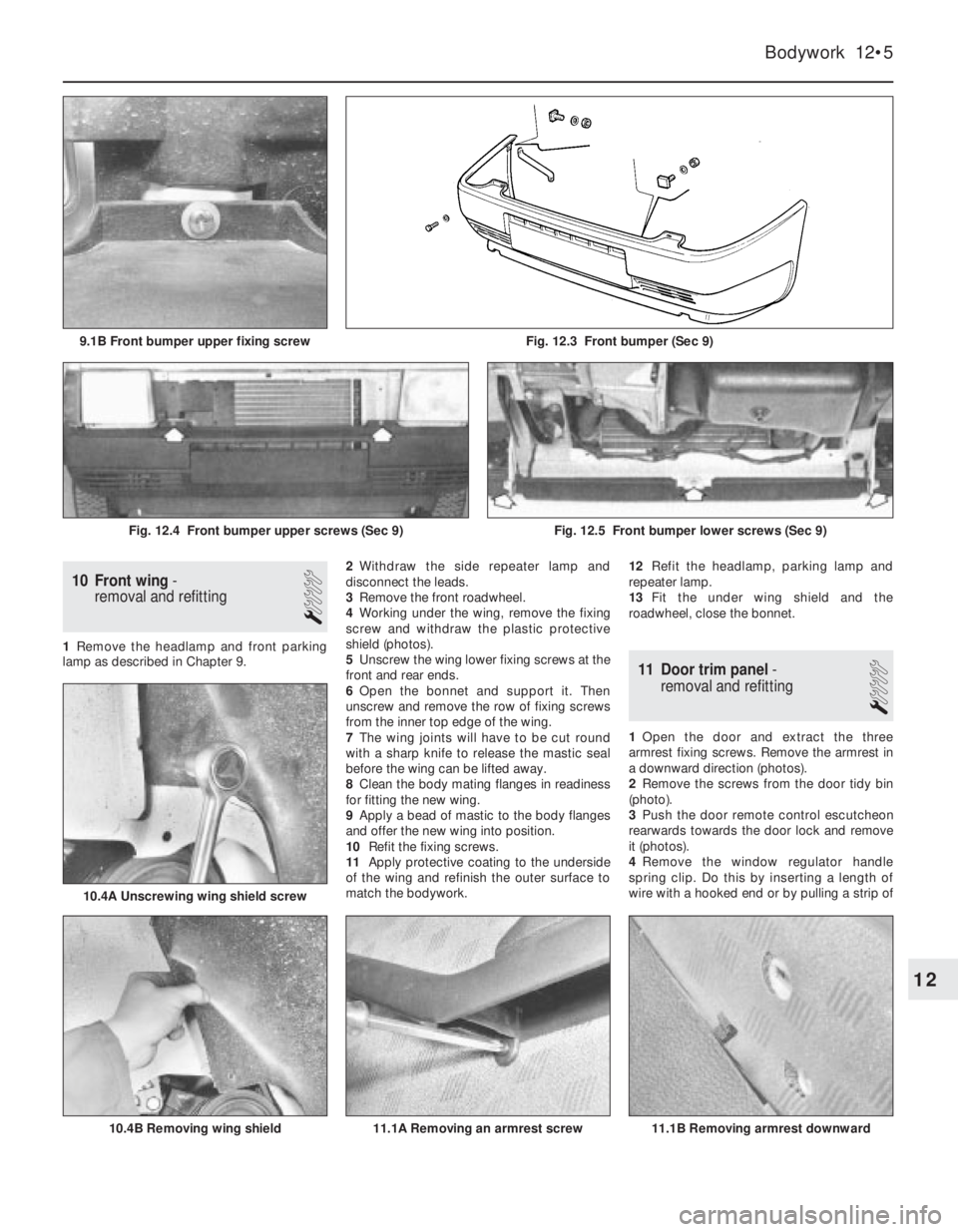
10 Front wing-
removal and refitting
1
1Remove the headlamp and front parking
lamp as described in Chapter 9. 2Withdraw the side repeater lamp and
disconnect the leads.
3Remove the front roadwheel.
4Working under the wing, remove the fixing
screw and withdraw the plastic protective
shield (photos).
5Unscrew the wing lower fixing screws at the
front and rear ends.
6Open the bonnet and support it. Then
unscrew and remove the row of fixing screws
from the inner top edge of the wing.
7The wing joints will have to be cut round
with a sharp knife to release the mastic seal
before the wing can be lifted away.
8Clean the body mating flanges in readiness
for fitting the new wing.
9Apply a bead of mastic to the body flanges
and offer the new wing into position.
10Refit the fixing screws.
11Apply protective coating to the underside
of the wing and refinish the outer surface to
match the bodywork. 12Refit the headlamp, parking lamp and
repeater lamp.
13Fit the under wing shield and the
roadwheel, close the bonnet.
11 Door trim panel-
removal and refitting
1
1Open the door and extract the three
armrest fixing screws. Remove the armrest in
a downward direction (photos).
2Remove the screws from the door tidy bin
(photo).
3Push the door remote control escutcheon
rearwards towards the door lock and remove
it (photos).
4Remove the window regulator handle
spring clip. Do this by inserting a length of
wire with a hooked end or by pulling a strip of
Bodywork 12•5
Fig. 12.3 Front bumper (Sec 9)9.1B Front bumper upper fixing screw
11.1B Removing armrest downward11.1A Removing an armrest screw
10.4A Unscrewing wing shield screw
10.4B Removing wing shield
Fig. 12.4 Front bumper upper screws (Sec 9)Fig. 12.5 Front bumper lower screws (Sec 9)
12
Page 123 of 303
4Reach up behind the facia panel on the side
opposite to the glove box and unscrew the
remaining console fixing screw.
5Withdraw the console downwards and
disconnect the fibre optics from their source.
6Refitting is a reversal of removal.
22 Facia panel-
removal and refitting
1
1Remove the instrument panel as described
in Chapter 9.
2Remove the steering wheel (Chapter 10). 3Disconnect the choke control lever and
cable from the facia panel as described in
Chapter 3.
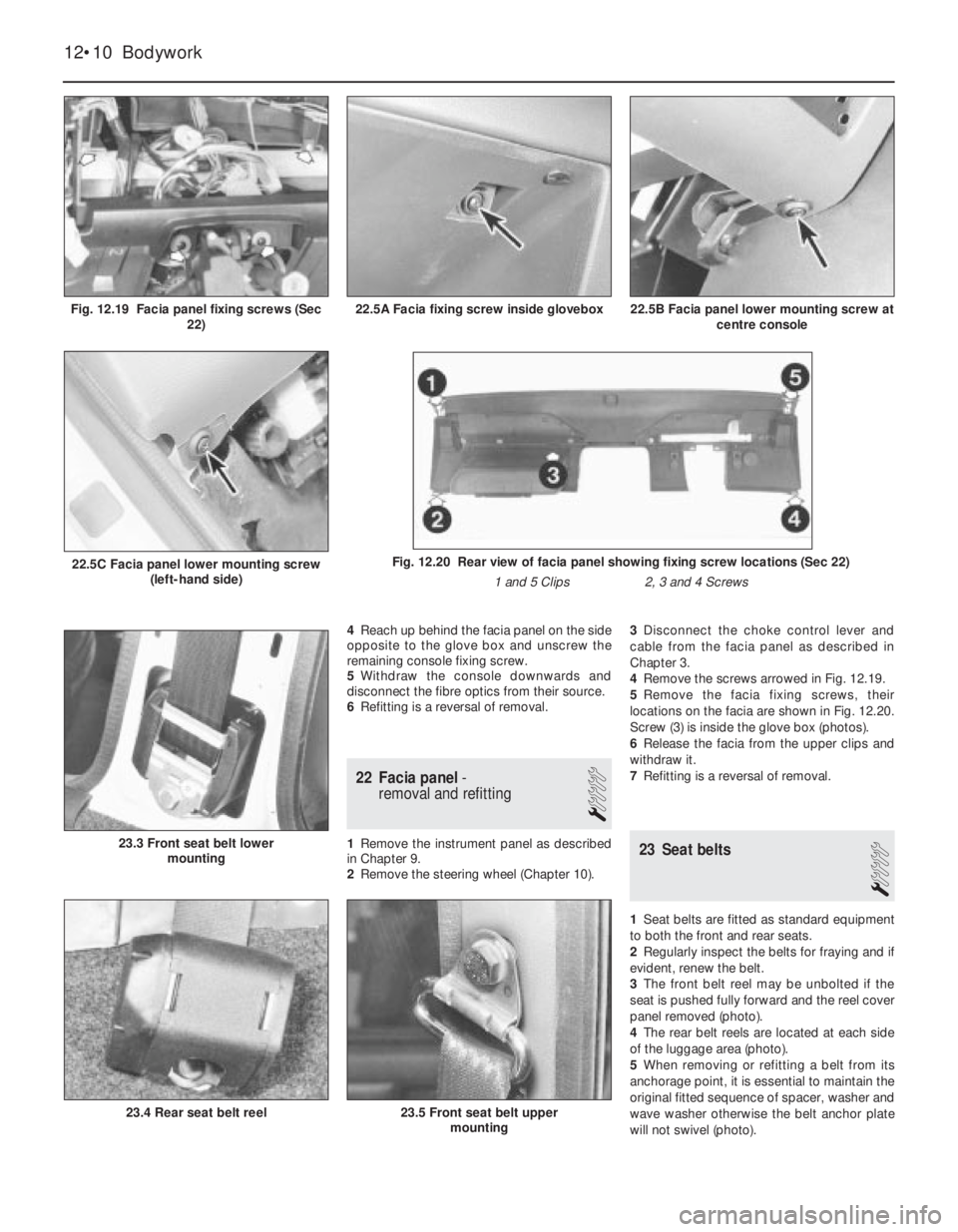
4Remove the screws arrowed in Fig. 12.19.
5Remove the facia fixing screws, their
locations on the facia are shown in Fig. 12.20.
Screw (3) is inside the glove box (photos).
6Release the facia from the upper clips and
withdraw it.
7Refitting is a reversal of removal.23 Seat belts
1
1Seat belts are fitted as standard equipment
to both the front and rear seats.
2Regularly inspect the belts for fraying and if
evident, renew the belt.
3The front belt reel may be unbolted if the
seat is pushed fully forward and the reel cover
panel removed (photo).
4The rear belt reels are located at each side
of the luggage area (photo).
5When removing or refitting a belt from its
anchorage point, it is essential to maintain the
original fitted sequence of spacer, washer and
wave washer otherwise the belt anchor plate
will not swivel (photo).
23.4 Rear seat belt reel
23.3 Front seat belt lower
mounting
12•10 Bodywork
23.5 Front seat belt upper
mounting
Fig. 12.20 Rear view of facia panel showing fixing screw locations (Sec 22)
1 and 5 Clips 2, 3 and 4 Screws22.5C Facia panel lower mounting screw
(left-hand side)
22.5B Facia panel lower mounting screw at
centre console22.5A Facia fixing screw inside gloveboxFig. 12.19 Facia panel fixing screws (Sec
22)
Page 126 of 303
13
Chapter 13 Supplement:
Revisions and information on later models
Introduction . . . . . . . . . . . . . . . . . . . . . . . . . . . . . . . . . . . . . . . . . . . 1
Specifications . . . . . . . . . . . . . . . . . . . . . . . . . . . . . . . . . . . . . . . . . 2
Routine maintenance - all models from June 1991 . . . . . . . . . . . 3
Engine 903 and 1299/1301 cc . . . . . . . . . . . . . . . . . . . . . . . . . . . . . 4
Sump pan sealing strips (903 cc engine) - modification
1299 cc engine - description
Rocker cover (903 cc engine) - removal
Cylinder head (903 cc engine) - refitting
Engine - 999 and 1108 cc (FIRE) . . . . . . . . . . . . . . . . . . . . . . . . . . 5
Part A: General
Description
Part B: Operations possible with engine in car
Valve clearances - adjustment
Timing belt - renewal
Camshaft - removal and refitting
Cylinder head - removal and refitting
Sump pan - removal and refitting
Oil pump - removal, checking and refitting
Pistons/connecting rods - removal and refitting
Pistons/connecting rods - separation and piston ring renewal
Engine/transmission mountings - renewal
Part C: Engine removal and dismantling
Method of removal - general
Engine/transmission - removal and separation
Dismantling - general
Complete dismantling
Examination and renovation
Part D: Engine reassembly and refitting
Reassembly - general
Complete reassembly
Engine/transmission - reconnection and refitting
Initial start-up after major overhaul
Engine 1301 cc Turbo ie.................................................................. 6
Part A: General
Description
Lubrication system - description
Part B: Operations possible with engine in car
Camshaft and camshaft carrier - removal and refitting
Cylinder head - removal and refitting
Piston rings
Engine mountings - renewal
Timing belt - renewal
Oil pump drivegear cover plate
Engine oil cooler - removal and refittingPart C: Engine removal, dismantling, reassembly and refitting
Engine/transmission - removal and separation
Engine - dismantling and reassembly
Engine/transmission - reconnection and refitting
Initial start-up after major overhaul
Engine 1372 cc ie and 1372 cc Turbo ie......................................... 7
Part A: General
Description
Maintenance
Part B: Operations possible with the engine in car
Valve clearances - checking and adjustment
Timing belt, tensioner and sprockets - removal and refitting
Camshaft front oil seal - renewal
Camshaft, housing and followers - removal and refitting
Camshaft housing, camshaft and cam followers - dismantling,
inspection and reassembly
Cylinder head (1372 cc ie engine) - removal and refitting
Cylinder head (1372 cc Turbo ie engine) - removal and refitting
Cylinder head - inspection and renovation
Crankshaft front oil seal - removal and renewal
Crankshaft rear oil seal - removal and renewal
Flywheel - removal, inspection and refitting
Sump - removal and refitting
Oil pump - removal, checking and refitting
Pistons/connecting rods - removal and refitting
Pistons/connecting rods - examination and renovation
Engine/transmission mountings - renewal
Part C: Engine removal and dismantling
Method of removal - general
1372 cc ie engine/transmission - removal and separation
1372 cc Turbo ie engine/transmission - removal and separation
Engine dismantling - general
Auxiliary shaft - removal, inspection and refitting
Engine - complete dismantling
Crankshaft and main bearings - removal
Engine components - examination and renovation
Part D: Engine reassembly
Reassembly - general
Crankshaft and main bearings - refitting
Pistons and connecting rods - refitting
Oil pump - refitting
Sump - refitting
Flywheel - refitting
Auxiliary shaft - refitting
Cylinder head - refitting
Timing belt and covers - refitting
Engine/transmission - reconnection and refitting
Initial start-up after major overhaul
13•1
Contents