steering wheel FORD B MAX 2013 1.G User Guide
[x] Cancel search | Manufacturer: FORD, Model Year: 2013, Model line: B MAX, Model: FORD B MAX 2013 1.GPages: 298, PDF Size: 20.63 MB
Page 92 of 298
Downloaded from www.Manualslib.com manuals search engine GENERAL INFORMATION
WARNINGS
Extended idling at high enginespeeds can produce very hightemperatures in the engine andexhaust system, creating the risk of fire orother damage.
Do not park, idle or drive your vehicleon dry grass or other dry groundcover. The emission system heats upthe engine compartment and exhaustsystem, creating the risk of fire.
Do not start the engine in a closedgarage or in other enclosed areas.Exhaust fumes can be toxic. Alwaysopen the garage door before you start theengine.
If you smell exhaust fumes insideyour vehicle, have your vehiclechecked by an authorized dealerimmediately. Do not drive your vehicle ifyou smell exhaust fumes.
If you disconnect the battery, your vehiclemay exhibit some unusual drivingcharacteristics for approximately 5 miles(8 kilometers) after you reconnect it. Thisis because the engine management systemmust realign itself with the engine. You candisregard any unusual drivingcharacteristics during this period.
The powertrain control system meets allCanadian interference-causing equipmentstandard requirements regulating theimpulse electrical field or radio noise.
When you start the engine, avoid pressingthe accelerator pedal before and duringoperation. Only use the accelerator pedalwhen you have difficulty starting theengine.
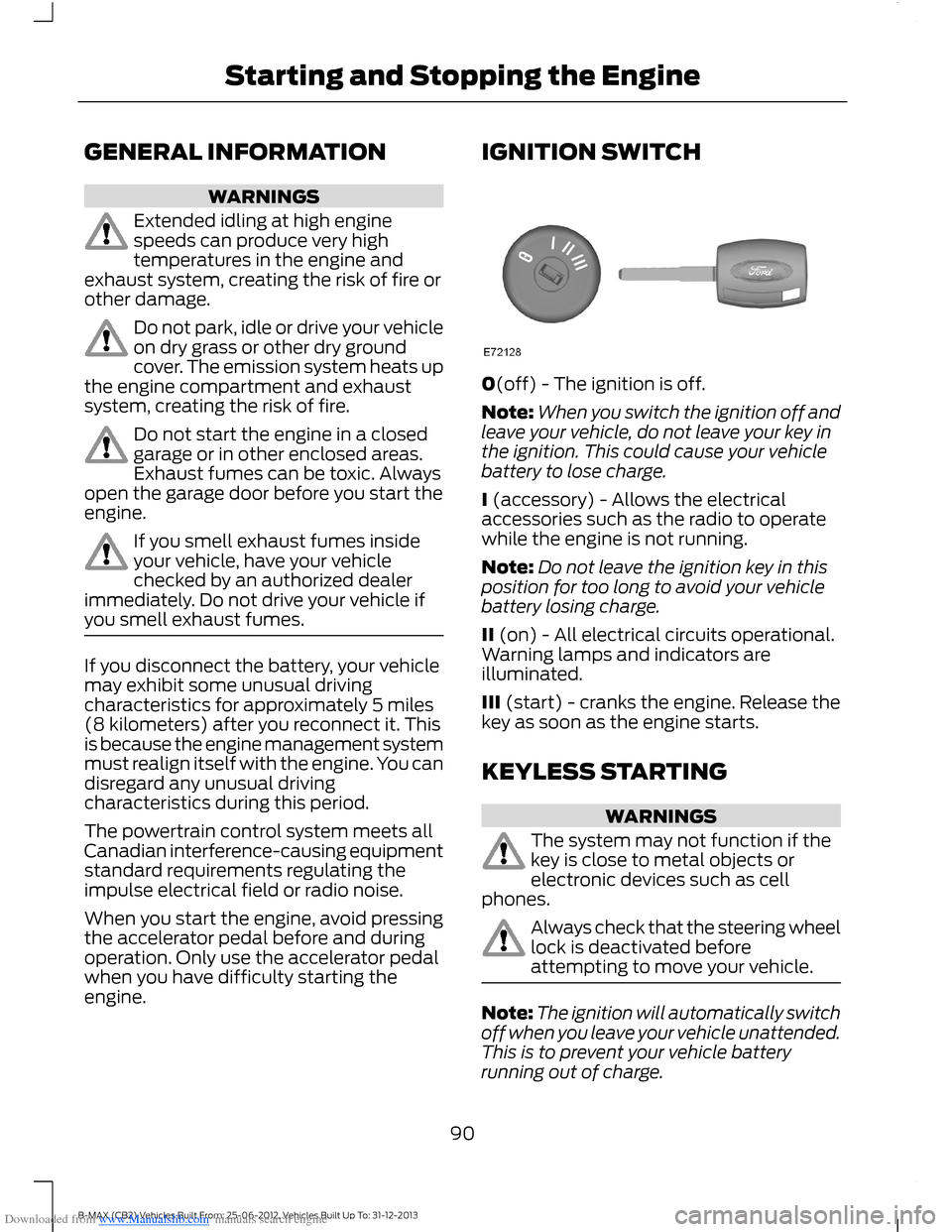
IGNITION SWITCH
0(off) - The ignition is off.
Note:When you switch the ignition off andleave your vehicle, do not leave your key inthe ignition. This could cause your vehiclebattery to lose charge.
I (accessory) - Allows the electricalaccessories such as the radio to operatewhile the engine is not running.
Note:Do not leave the ignition key in thisposition for too long to avoid your vehiclebattery losing charge.
II (on) - All electrical circuits operational.Warning lamps and indicators areilluminated.
III (start) - cranks the engine. Release thekey as soon as the engine starts.
KEYLESS STARTING
WARNINGS
The system may not function if thekey is close to metal objects orelectronic devices such as cellphones.
Always check that the steering wheellock is deactivated beforeattempting to move your vehicle.
Note:The ignition will automatically switchoff when you leave your vehicle unattended.This is to prevent your vehicle batteryrunning out of charge.
90B-MAX (CB2) Vehicles Built From: 25-06-2012, Vehicles Built Up To: 31-12-2013Starting and Stopping the Engine
Page 93 of 298
Downloaded from www.Manualslib.com manuals search engine Note:A valid key must be located insideyour vehicle to switch the ignition on andstart the engine.
Ignition On
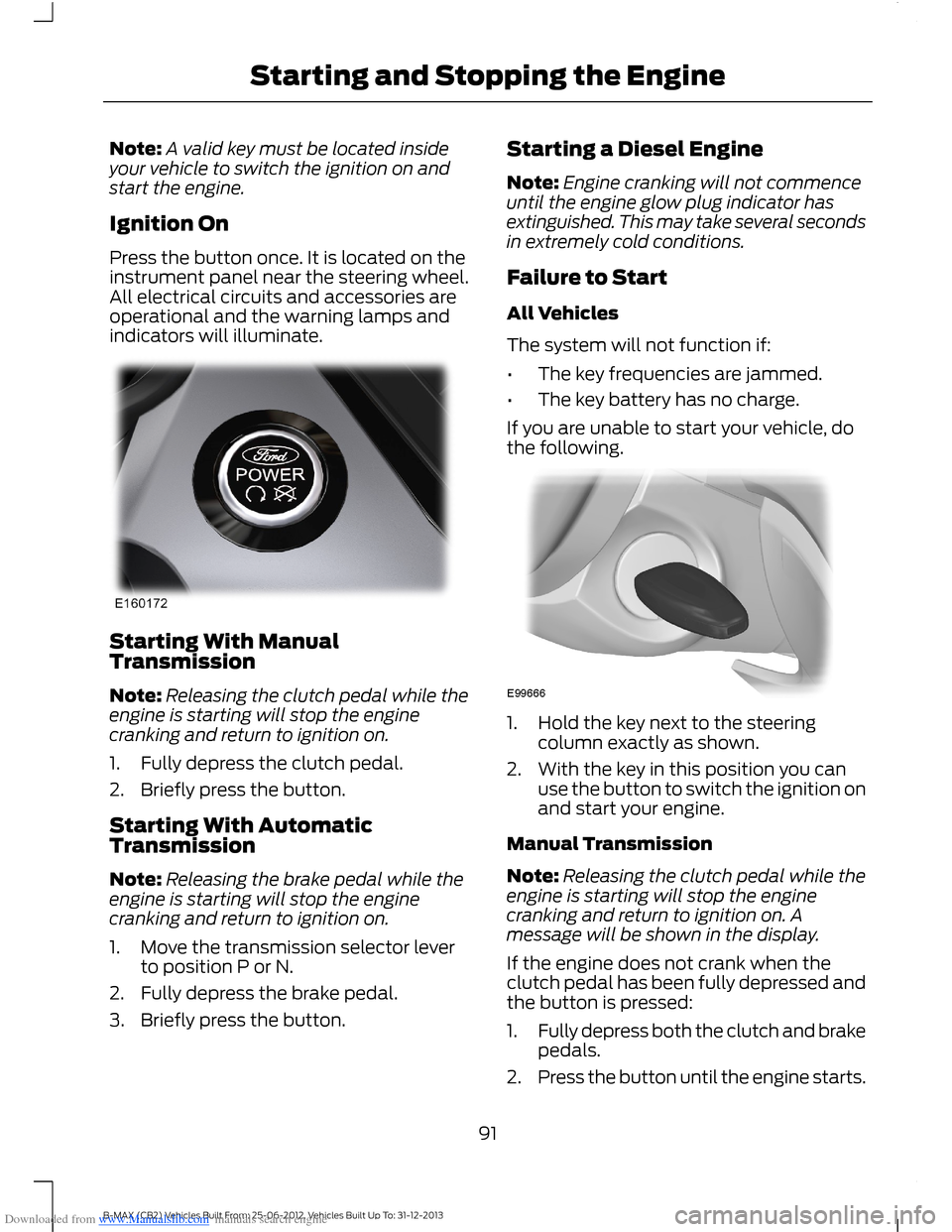
Press the button once. It is located on theinstrument panel near the steering wheel.All electrical circuits and accessories areoperational and the warning lamps andindicators will illuminate.
Starting With ManualTransmission
Note:Releasing the clutch pedal while theengine is starting will stop the enginecranking and return to ignition on.
1.Fully depress the clutch pedal.
2.Briefly press the button.
Starting With AutomaticTransmission
Note:Releasing the brake pedal while theengine is starting will stop the enginecranking and return to ignition on.
1.Move the transmission selector leverto position P or N.
2.Fully depress the brake pedal.
3.Briefly press the button.
Starting a Diesel Engine
Note:Engine cranking will not commenceuntil the engine glow plug indicator hasextinguished. This may take several secondsin extremely cold conditions.
Failure to Start
All Vehicles
The system will not function if:
•The key frequencies are jammed.
•The key battery has no charge.
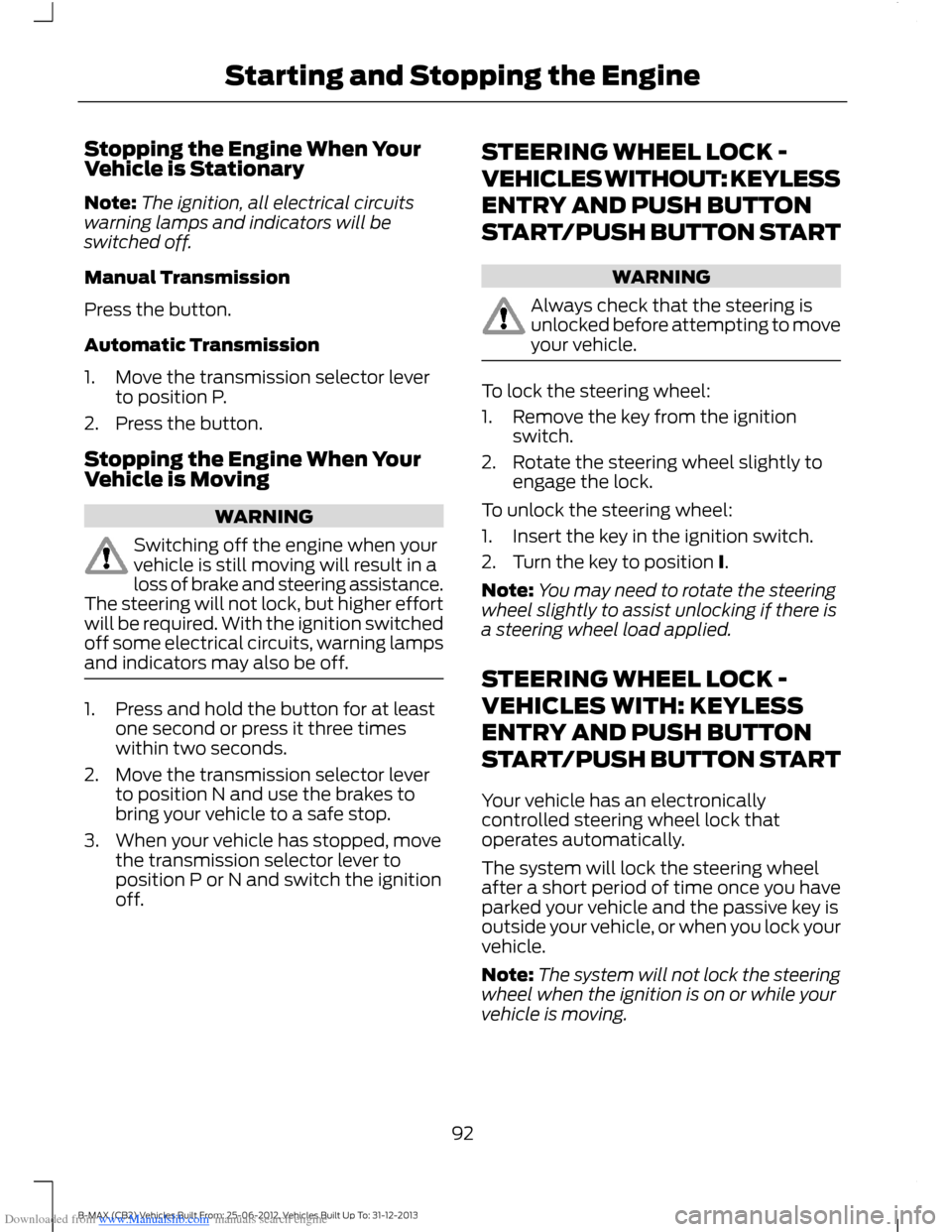
If you are unable to start your vehicle, dothe following.
1.Hold the key next to the steeringcolumn exactly as shown.
2.With the key in this position you canuse the button to switch the ignition onand start your engine.
Manual Transmission
Note:Releasing the clutch pedal while theengine is starting will stop the enginecranking and return to ignition on. Amessage will be shown in the display.
If the engine does not crank when theclutch pedal has been fully depressed andthe button is pressed:
1.Fully depress both the clutch and brakepedals.
2.Press the button until the engine starts.
91B-MAX (CB2) Vehicles Built From: 25-06-2012, Vehicles Built Up To: 31-12-2013Starting and Stopping the Engine
Page 94 of 298
Downloaded from www.Manualslib.com manuals search engine Stopping the Engine When YourVehicle is Stationary
Note:The ignition, all electrical circuitswarning lamps and indicators will beswitched off.
Manual Transmission
Press the button.
Automatic Transmission
1.Move the transmission selector leverto position P.
2.Press the button.
Stopping the Engine When YourVehicle is Moving
WARNING
Switching off the engine when yourvehicle is still moving will result in aloss of brake and steering assistance.The steering will not lock, but higher effortwill be required. With the ignition switchedoff some electrical circuits, warning lampsand indicators may also be off.
1.Press and hold the button for at leastone second or press it three timeswithin two seconds.
2.Move the transmission selector leverto position N and use the brakes tobring your vehicle to a safe stop.
3.When your vehicle has stopped, movethe transmission selector lever toposition P or N and switch the ignitionoff.
STEERING WHEEL LOCK -
VEHICLES WITHOUT: KEYLESS
ENTRY AND PUSH BUTTON
START/PUSH BUTTON START
WARNING
Always check that the steering isunlocked before attempting to moveyour vehicle.
To lock the steering wheel:
1.Remove the key from the ignitionswitch.
2.Rotate the steering wheel slightly toengage the lock.
To unlock the steering wheel:
1.Insert the key in the ignition switch.
2.Turn the key to position I.
Note:You may need to rotate the steeringwheel slightly to assist unlocking if there isa steering wheel load applied.
STEERING WHEEL LOCK -
VEHICLES WITH: KEYLESS
ENTRY AND PUSH BUTTON
START/PUSH BUTTON START
Your vehicle has an electronicallycontrolled steering wheel lock thatoperates automatically.
The system will lock the steering wheelafter a short period of time once you haveparked your vehicle and the passive key isoutside your vehicle, or when you lock yourvehicle.
Note:The system will not lock the steeringwheel when the ignition is on or while yourvehicle is moving.
92B-MAX (CB2) Vehicles Built From: 25-06-2012, Vehicles Built Up To: 31-12-2013Starting and Stopping the Engine
Page 95 of 298
Downloaded from www.Manualslib.com manuals search engine Unlocking the Steering Wheel
Switch the ignition on to unlock thesteering wheel.
Note:You may have to rotate the steeringwheel slightly to assist unlocking.
STARTING A GASOLINE
ENGINE
Note:You can only operate the starter fora limited period of time, for example 10seconds. The number of start attempts islimited to approximately six. If you exceedthis limit, the system will not allow you totry again until a period of time has elapsed,for example 30 minutes.
Cold or Hot Engine
Vehicles with Manual Transmission
Note:Do not touch the accelerator pedal.
Note:Releasing the clutch pedal while theengine is starting will stop the enginecranking and return to ignition on.
1.Fully depress the clutch pedal.
2.Start the engine.
Vehicles with Automatic Transmission
Note:Do not touch the accelerator pedal.
1.Move the transmission selector leverto position P or N.
2.Start the engine.
All Vehicles
If the engine does not start within 10seconds, wait for a short period and tryagain.
If the engine does not start after threeattempts, wait 10 seconds and follow theflooded engine procedure.
If you have difficulty starting the enginewhen the temperature is below -13°F(-25°C), press the accelerator pedal to themid-way point of its travel and try again.
Flooded Engine
Vehicles with Manual Transmission
1.Fully depress the clutch pedal.
2.Fully depress the accelerator pedal andhold it there.
3.Start the engine.
Vehicles with Automatic Transmission
1.Move the transmission selector leverto position P or N.
2.Fully depress the accelerator pedal andhold it there.
3.Start the engine.
All Vehicles
If the engine does not start, repeat the coldor hot engine procedure.
Engine Idle Speed after Starting
The speed at which the engine idlesimmediately after starting is optimized tominimize vehicle emissions and maximizecabin comfort and fuel economy.
The idle speed will vary depending oncertain factors. These include vehiclecomponent and ambient temperatures aswell as electrical and climate systemdemands.
Failure to Start
Vehicles with Manual Transmission
If the engine does not crank when theclutch pedal has been fully depressed andthe ignition key is turned to position III.
1.Fully depress the clutch and brakepedals.
93B-MAX (CB2) Vehicles Built From: 25-06-2012, Vehicles Built Up To: 31-12-2013Starting and Stopping the Engine
Page 111 of 298
Downloaded from www.Manualslib.com manuals search engine GENERAL INFORMATION
WARNING
The system does not relieve you ofyour responsibility to drive with duecare and attention.
Note:Occasional brake noise is normal. Ifa metal-to-metal, continuous grinding orcontinuous squeal sound is present, thebrake linings may be worn-out. If the vehiclehas continuous vibration or shudder in thesteering wheel while braking, have yourvehicle checked by an authorized dealer.
Note:Brake dust may accumulate on thewheels, even under normal drivingconditions. Some dust is inevitable as thebrakes wear. See Cleaning the AlloyWheels (page 173).
Wet brakes result in reduced brakingefficiency. Gently press the brake pedal afew times when driving from a car wash orstanding water to dry the brakes.
Emergency Brake Assist
Emergency brake assist detects when youbrake heavily by measuring the rate atwhich you press the brake pedal. Itprovides maximum braking efficiency aslong as you press the pedal. Emergencybrake assist can reduce stopping distancesin critical situations.
Anti-lock Brake System
This system helps you maintain steeringcontrol and vehicle stability duringemergency stops by keeping the brakesfrom locking.
HINTS ON DRIVING WITH
ANTI-LOCK BRAKES
Note:When the system is operating, thebrake pedal will pulse and may travelfurther. Maintain pressure on the brakepedal. You may also hear a noise from thesystem. This is normal.
The anti-lock braking system will noteliminate the risks when:
•you drive too closely to the vehicle infront of you
•your vehicle is hydroplaning
•you take corners too fast
•the road surface is poor.
PARKING BRAKE
Vehicles With AutomaticTransmission
WARNING
Always set the parking brake fullyand leave your vehicle with thetransmission selector lever inposition P.
Note:If you park your vehicle on a hill andfacing uphill move the transmission selectorlever to position P and turn the steeringwheel away from the curb.
Note:If you park your vehicle on a hill andfacing downhill move the transmissionselector lever to position P and turn thesteering wheel toward the curb.
Vehicles With ManualTransmission
Note:If you park your vehicle on a hill andfacing uphill select first gear and turn thesteering wheel away from the curb.
109B-MAX (CB2) Vehicles Built From: 25-06-2012, Vehicles Built Up To: 31-12-2013Brakes
Page 112 of 298
Downloaded from www.Manualslib.com manuals search engine Note:If you park your vehicle on a hill andfacing downhill select reverse gear and turnthe steering wheel toward the curb.
All Vehicles
Note:Do not press the release button whilepulling the lever up.
To apply the parking brake:
1.Press the foot brake pedal firmly.
2.Pull the parking brake lever up to itsfullest extent.
To release the parking brake:
1.Press the brake pedal firmly.
2.Pull the lever up slightly.
3.Press the release button and push thelever down.
110B-MAX (CB2) Vehicles Built From: 25-06-2012, Vehicles Built Up To: 31-12-2013Brakes
Page 119 of 298
Downloaded from www.Manualslib.com manuals search engine PRINCIPLE OF OPERATION
WARNING
The system does not relieve you ofyour responsibility to drive with duecare and attention.
Cruise control allows you to control yourspeed using the switches on the steeringwheel. You can use cruise control whenyou exceed approximately 20 mph (30km/h).
USING CRUISE CONTROL
WARNINGS
Do not use cruise control in heavytraffic, on winding roads or when theroad surface is slippery. This couldresult in loss of vehicle control, seriousinjury or death.
When you are going downhill, yourspeed may increase above the setspeed. The system will not apply thebrakes. Change down a gear to assist thesystem in maintaining the set speed.Failure to do so could result in loss ofvehicle control, serious injury or death.
Note:Cruise control will disengage if yourvehicle speed decreases more than 10 mph(16 km/h) below your set speed whiledriving uphill.
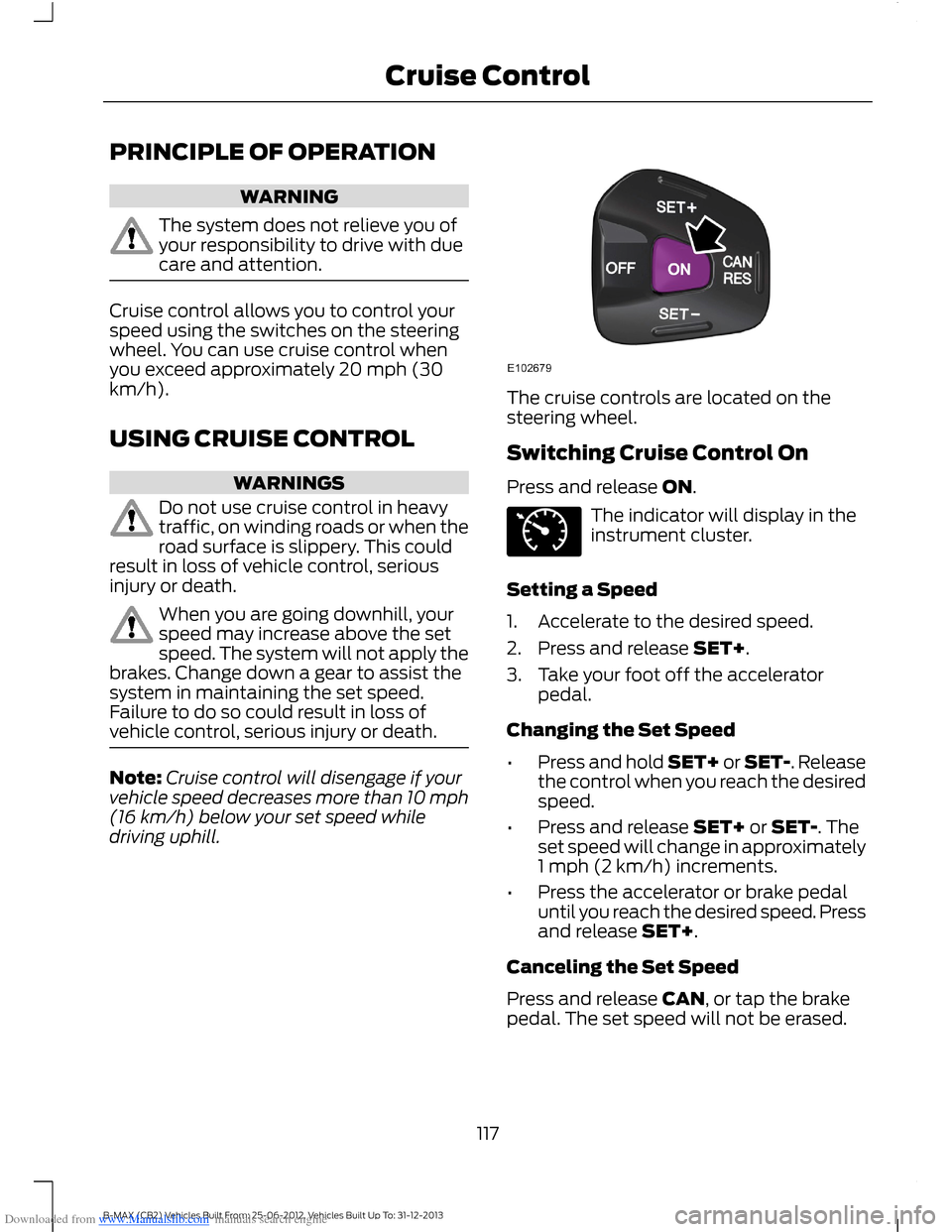
The cruise controls are located on thesteering wheel.
Switching Cruise Control On
Press and release ON.
The indicator will display in theinstrument cluster.
Setting a Speed
1.Accelerate to the desired speed.
2.Press and release SET+.
3.Take your foot off the acceleratorpedal.
Changing the Set Speed
•Press and hold SET+ or SET-. Releasethe control when you reach the desiredspeed.
•Press and release SET+ or SET-. Theset speed will change in approximately1 mph (2 km/h) increments.
•Press the accelerator or brake pedaluntil you reach the desired speed. Pressand release SET+.
Canceling the Set Speed
Press and release CAN, or tap the brakepedal. The set speed will not be erased.
117B-MAX (CB2) Vehicles Built From: 25-06-2012, Vehicles Built Up To: 31-12-2013Cruise Control
Page 130 of 298
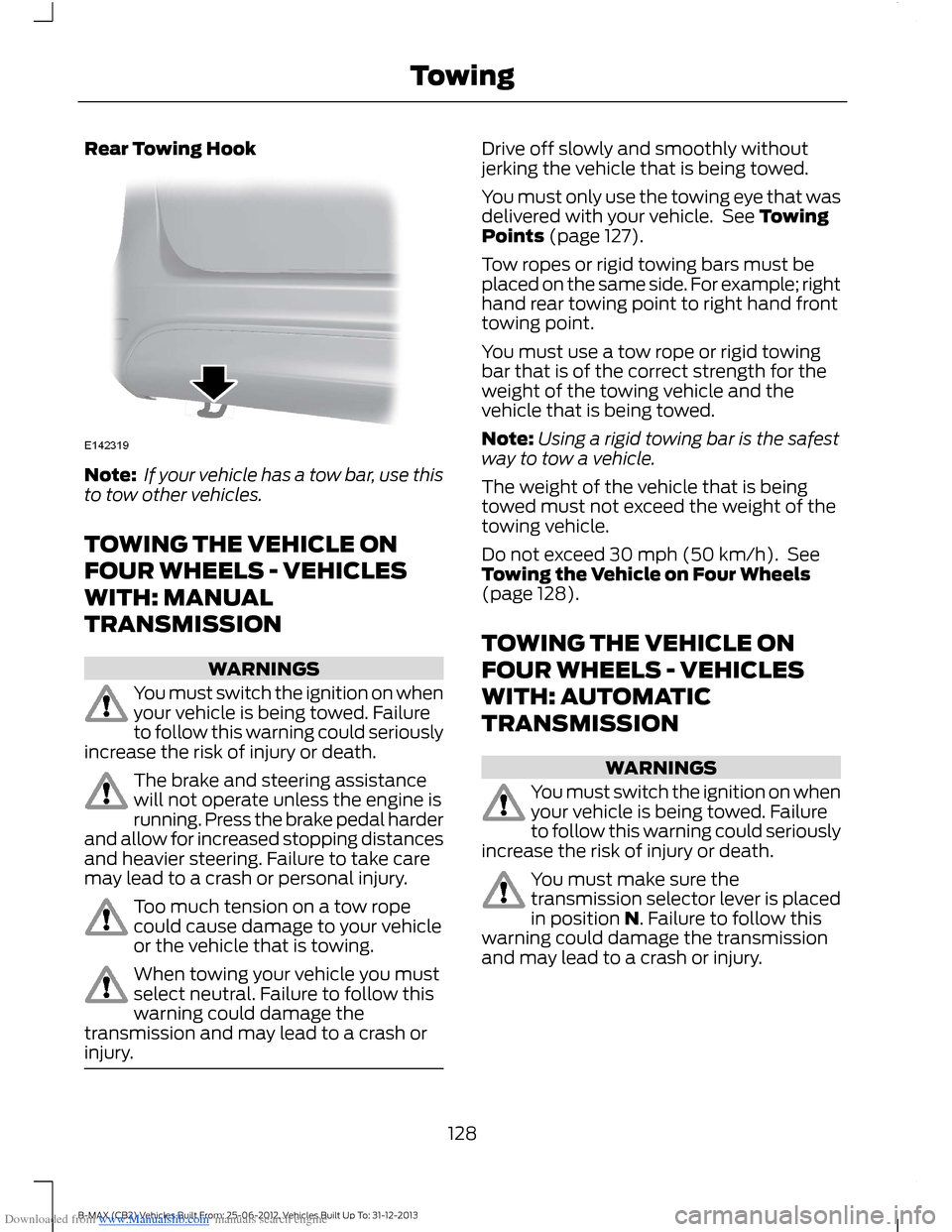
Downloaded from www.Manualslib.com manuals search engine Rear Towing Hook
Note: If your vehicle has a tow bar, use thisto tow other vehicles.
TOWING THE VEHICLE ON
FOUR WHEELS - VEHICLES
WITH: MANUAL
TRANSMISSION
WARNINGS
You must switch the ignition on whenyour vehicle is being towed. Failureto follow this warning could seriouslyincrease the risk of injury or death.
The brake and steering assistancewill not operate unless the engine isrunning. Press the brake pedal harderand allow for increased stopping distancesand heavier steering. Failure to take caremay lead to a crash or personal injury.
Too much tension on a tow ropecould cause damage to your vehicleor the vehicle that is towing.
When towing your vehicle you mustselect neutral. Failure to follow thiswarning could damage thetransmission and may lead to a crash orinjury.
Drive off slowly and smoothly withoutjerking the vehicle that is being towed.
You must only use the towing eye that wasdelivered with your vehicle. See TowingPoints (page 127).
Tow ropes or rigid towing bars must beplaced on the same side. For example; righthand rear towing point to right hand fronttowing point.
You must use a tow rope or rigid towingbar that is of the correct strength for theweight of the towing vehicle and thevehicle that is being towed.
Note:Using a rigid towing bar is the safestway to tow a vehicle.
The weight of the vehicle that is beingtowed must not exceed the weight of thetowing vehicle.
Do not exceed 30 mph (50 km/h). SeeTowing the Vehicle on Four Wheels(page 128).
TOWING THE VEHICLE ON
FOUR WHEELS - VEHICLES
WITH: AUTOMATIC
TRANSMISSION
WARNINGS
You must switch the ignition on whenyour vehicle is being towed. Failureto follow this warning could seriouslyincrease the risk of injury or death.
You must make sure thetransmission selector lever is placedin position N. Failure to follow thiswarning could damage the transmissionand may lead to a crash or injury.
128B-MAX (CB2) Vehicles Built From: 25-06-2012, Vehicles Built Up To: 31-12-2013Towing
Page 131 of 298
Downloaded from www.Manualslib.com manuals search engine WARNINGS
The brake and steering assistancewill not operate unless the engine isrunning. Press the brake pedal harderand allow for increased stopping distancesand heavier steering. Failure to take caremay lead to a crash or personal injury.
Too much tension on a tow ropecould cause damage to your vehicleor the vehicle that is towing.
Emergency Towing
If your vehicle is disabled without accessto wheel dollies, a car-hauling trailer, or aflatbed transport vehicle it can beflat-towed with all wheels on the ground.
You may do this under the followingconditions:
•Your vehicle is facing forward so thatit is towed in a forward direction.
•The transmission selector lever isplaced in position N. If the transmissiongear shift lever cannot be moved toposition N, it may need to beoverridden. See AutomaticTransmission (page 104).
•Maximum speed is 35 mph (56 km/h).
•Maximum distance is 50 miles (80kilometers).
Drive off slowly and smoothly withoutjerking the vehicle that is being towed.
You must only use the towing eye that wasdelivered with your vehicle. See TowingPoints (page 127).
Tow ropes or rigid towing bars must beplaced on the same side. For example; righthand rear towing point to right hand fronttowing point.
You must use a tow rope or rigid towingbar that is of the correct strength for theweight of the towing vehicle and thevehicle that is being towed.
Note:Using a rigid towing bar is the safestway to tow a vehicle.
The weight of the vehicle that is beingtowed must not exceed the weight of thetowing vehicle.
129B-MAX (CB2) Vehicles Built From: 25-06-2012, Vehicles Built Up To: 31-12-2013Towing
Page 176 of 298
Downloaded from www.Manualslib.com manuals search engine GENERAL INFORMATION
A decal with tire pressure data is locatedin the driver’s door opening.
Check and set the tire pressure at theambient temperature in which you areintending to drive your vehicle and whenthe tires are cold.
Note:Check your tire pressures regularly tooptimize fuel economy.
Note:Use only approved wheel and tiresizes. Using other sizes could damage yourvehicle and will make the National TypeApproval invalid.
Note:If you change the diameter of the tiresfrom that fitted at the factory, thespeedometer may not display the correctspeed. Take your vehicle to an authorizeddealer to have the engine managementsystem reprogrammed.
Note:If you intend to change the size of thewheels from that fitted at the factory, checkthe suitability with an authorized dealer.
TEMPORARY MOBILITY KIT
Your vehicle may not have a spare tire.Therefore you will have a temporarymobility kit which will only repair onedamaged tire.
The kit is located in the spare wheel well.
General Information
WARNINGS
Depending on the type and extent oftire damage, some tires can only bepartially sealed or not sealed at all.Loss of tire pressure can affect vehiclehandling, leading to loss of vehicle control.
Do not use the kit on a previouslydamaged tire, for example when ithas been driven under inflated.
WARNINGS
Do not use the kit on run flat tires.
Do not try to seal damage to thetire’s sidewall.
The kit seals most tire punctures [with adiameter of up to ¼ inch (six millimeters)]to temporarily restore mobility.
You must observe the following rules whenusing the kit:
•Drive with caution and avoid makingsudden steering or driving manoeuvres,especially if your vehicle is heavilyladen or you are towing a trailer.
•The kit will provide you with anemergency temporary repair, enablingyou to continue your journey to the nextvehicle or tire dealer, or to drive amaximum distance of 125 miles(200 kilometers).
•Do not exceed a maximum speed of50 mph (80 km/h).
•Keep the kit out of the reach ofchildren.
•Only use the kit when the ambienttemperature is between -40°F(–40°C) and +158°F (+70°C).
Using the Kit
WARNINGS
Compressed air can act as anexplosive or propellant.
Never leave the kit unattended whilein use.
Do not keep the compressoroperating for more than 10 minutes.
You must only use the kit for thevehicle with which it was supplied.
174B-MAX (CB2) Vehicles Built From: 25-06-2012, Vehicles Built Up To: 31-12-2013Wheels and Tires