after driving off-road FORD BRONCO 2022 Owners Manual
[x] Cancel search | Manufacturer: FORD, Model Year: 2022, Model line: BRONCO, Model: FORD BRONCO 2022Pages: 562, PDF Size: 73 MB
Page 248 of 562
NORMAL
For everyday driving. This modeis the perfect balance ofexcitement, comfort andconvenience. This is the default mode aftereach ignition cycle, the driveline settingsremain the same prior to the ignition cycle.
Two-wheel drive high (2H) is the defaultfour-wheel drive mode. All four-wheel drivemodes are selectable when in normalmode.
The front electronic locking differential isavailable below 25 mph (40 km/h) whenin four-wheel drive low (4L). The rearelectronic locking differential is availablebelow 25 mph (40 km/h).
Note:The rear electronic locking differentialis available at any speed when in four-wheeldrive low (4L).
The stabilizer bar disconnect is availablein four-wheel drive high (4H) or four-wheeldrive low (4L).
ROCK CRAWL
For off-road driving andoptimum rock-climbing ability.Rock crawl mode optimizes thethrottle and transmission response toprovide you additional control of yourvehicle.
Four-wheel drive low (4L) is the onlydriveline configuration available in rockcrawl, the system prompts you to put yourvehicle into four-wheel drive low (4L) uponselection.
The front electronic locking differential isavailable below 25 mph (40 km/h) whenin four-wheel drive low (4L). The rearelectronic locking differential is engagedwhen in rock crawl mode and is availableat any speed.
The stabilizer bar disconnects when in rockcrawl mode.
Note:When using rock crawl mode ondry/hard pavement, your vehicle couldexperience vibration, driveline bind up,damage and potential excessive tire andvehicle wear.
SAND
For off-road driving on soft, drysand or deep snow. This modemay help get your vehicleunstuck from deep snow or sand.
Four-wheel drive high (4H) is the defaultfour-wheel drive mode. Four-wheel drivelow (4L) is selectable in sand mode.
The front electronic locking differential isavailable below 25 mph (40 km/h) whenin four-wheel drive low (4L). The rearelectronic locking differential is engagedwhen in sand mode and is available at anyspeed in all selectable four-wheel drivemodes.
The stabilizer bar disconnect is availablein four-wheel drive high (4H) or four-wheeldrive low (4L).
Note:The front camera system switcheson when you are in sand mode and yourspeed is less than 15 mph (24 km/h). If youexceed 15 mph (24 km/h), the camera shutsoff until your vehicle speed is below 12 mph(20 km/h).
Note:When using Sand mode on dry/hardpavement, your vehicle could experiencevibration, driveline bind up, damage andpotential excessive tire and vehicle wear.
Note:Sand mode is not intended for useon firm, slippery surfaces, such as pavedroads covered with snow or ice. For slippery,firm surfaces use slippery mode.
244
2022 Bronco (TG1) Canada/United States of America, enUSA, Edition date: 202109, First-PrintingG.O.A.T. Mode ControlE317283 E322413 E332185
Page 299 of 562
Crossing A Ravine, Gully, Ditch,Washout Or Rut
Review the path ahead before attemptingto cross any obstacle. Review the obstaclefrom outside the vehicle for anunderstanding of the terrain condition infront of and behind the obstacle. Approachobstacles slowly and inch the vehicle over.Ditches and washouts should be crossedat a 45 degree angle when possible.
Driving Over Logs
Review the path ahead before attemptingto cross any obstacle. Review the obstaclefrom outside the vehicle for anunderstanding of the terrain condition infront of and behind the obstacle.
Approach obstacles slowly and inch thevehicle over, approaching at a 15 degreeangle.
Note:It is best to have a front tire on top ofthe log when the other begins to climb over.
If a large obstacle near the log such as arock cannot be avoided, choose a path thatplaces the rock directly under the tirerather than the undercarriage of thevehicle. This helps prevent damage to thevehicle.
DRIVING YOUR VEHICLE AT HIGHSPEEDS
Before off-road driving in unfamiliar areasat high speeds, do a low speedreconnaissance run to become aware ofany obstacles that you could encounter.
Your vehicle can incur damage if drivenbeyond its capabilities. Skid plates androck rails are designed to help limitdamage to vital components and exteriorfinishes, but cannot prevent all damage ifdriven in extreme off-road conditions.Damage to skid plates, rock rails andexterior finishes as well as bent, crackedor broken body, frame and chassiscomponents may not be covered bywarranty.
It is important that you take the time tobecome familiar with the controls anddynamics of your vehicle beforeattempting higher speed off-road driving.
Some points to consider:
•Slowly build up speed. Initially, drive ata speed that allows ample time to fullyassess the terrain around you and tounderstand how the vehicle respondsto both the terrain and your inputs.Increase speed as comfort increases,being mindful of how the vehicleresponds to various conditions atdifferent speeds.
•Find a wide open place to experimentwith different functions on your vehicleand different driving techniques. Try agiven maneuver with differentfunctions, such as drive modes,four-wheel drive modes or switchingthe electronic locking differential onand off and see how your vehicleresponds. If the vehicle is tending topush straight ahead when trying tonegotiate a turn, a light application ofthe brake when turning could help turnyour vehicle. A wider entry to a corneror entering a corner more slowly couldhelp your vehicle turn and allow you toapply the throttle sooner afternegotiating the turn.
295
2022 Bronco (TG1) Canada/United States of America, enUSA, Edition date: 202109, First-PrintingDriving Hints
Page 301 of 562
Using the Front and RearDifferential Lock
When engaged, the front and reardifferential lock provides additionaltraction to your vehicle by forcing eitherthe two rear wheels or two front wheels toturn at the same speed.
You can activate and deactivate the frontand rear differential lock on the fly withinthe operating speed range. See ElectronicLocking Differential (page 190).
Using Trail Control
The system works in a similar manner tocruise control in off-road conditions. TrailControl provides you the ability tomaneuver the vehicle without using thethrottle and brake pedals.
Trail Control allows you to set a speedbetween 1 mph (1.6 km/h) to 14 mph(23 km/h) in a forward motion and 1 mph(1.6 km/h) to 5 mph (8 km/h) in reverse.The system controls acceleration andbraking in difficult off-road environments,which allows you to focus on steering. SeeTrail Control (page 207).
Trail Control Performance:
•Manages wheel slip to maximizetraction.
•Removes the need for you to use bothfeet when driving in off-road situations.
•Provides braking to maximize tractionin descents.
•Gives you confidence in difficultenvironments.
Using Trail One Pedal Drive
Trail one pedal drive coordinatespropulsive and braking torque through yourapplication of the accelerator pedal tosimulate a two footed driving technique.
Use this when driving over large obstacles,such as rocks or logs, to help maintain aconstant vehicle speed.
In 4H, the system offers lift pedal brakingand auto hill hold functionality. See WhatIs Trail One Pedal Drive (page 208).
Note:Trail one pedal drive is only availablewhen the vehicle is in 4H or 4L.
Using Trail Turn Assist
The feature reduces the turn radius of thevehicle on off-road surfaces.
The system reduces driver effort tonegotiate difficult off-road terrain byallowing the vehicle to make a tight turnin a single maneuver that might otherwiserequire a three point turn. See Trail TurnAssist (page 212).
Note:Trail turn assist is only available whenthe vehicle is in 4H or 4L.
Note:Trail turn assist cannot activate if therear differential is locked.
What Are Rock Rails (If Equipped)
Rock rails protect the rocker and body sidefrom damage and provide a sliding surfaceto allow the vehicle to cross boulders androck ledges.
Rock rails also can act as a pivot point tosharply turn the vehicle in tight spaces withhigh walls or rocks present.
AFTER DRIVING YOUR VEHICLEOFF-ROAD
WARNING: After off-road use,before returning to the road, check thewheels and tires for damage. Off-roaduse may cause damage to your wheelsand tires that can lead to tire failure, lossof vehicle control, serious injury or death.
297
2022 Bronco (TG1) Canada/United States of America, enUSA, Edition date: 202109, First-PrintingDriving Hints
Page 302 of 562
Driving off-road places more stress on yourvehicle than most on-road driving. Afterdriving off-road, check for damage to thewheels, chassis and underbody.
Inspect the underbody of your vehicle bychecking tires, body structure, steering,suspension, and exhaust system fordamage.
Inspect the tires for any cuts in the treador sidewall area. Also inspect the sidewallfor any bulge indicating damage to the tire.
Make sure the tires are inflated to propertire pressure as indicated on the tireplacard.
Check the radiator for mud and debris andclean as needed.
Check that the air filter is clean and dry.
Remove accumulations of plants or brush.These things could be a fire hazard or hidedamage to the fuel lines, brake hoses andpropeller shafts.
Make sure the grille and radiator are clearof any obstructions that may affectcooling.
After extended operation in mud, sand,water, or similar dirty conditions, inspectthe wipers and washers to make sure theyare working.
Note:Mud caked windows are hard to seethrough and can damage wiper blades ormotor.
Check wipers for debris or anything thatmay scratch the windshield.
If you experience unusual vibration afterdriving in mud, slush or similar conditions,check the wheels for impacted material.Impacted material can cause vibrationswhen driving and wheel imbalance.Remove the material to reduce thevibration.
Note:If you have removed the impactedmaterial from the wheels and your vehiclestill has a vibration check your vehicle fordamage or see an authorized dealer.
Inspect the exhaust system for damage orlooseness.
Make sure that the brakes are in properworking order and free of any mud, stonesand debris, which can become trappedaround the brake rotor, backing plate andcaliper.
Inspect the wheels for dents, cracks, orother damage.
Inspect undercarriage fasteners. If any areloose or damaged, tighten or replaceensuring that the proper torquespecification is used.
Inspect for torn or punctured boots on balljoints, half shafts, steering gears.
Refit the front license plate if removedpreviously.
COLD WEATHER
PRECAUTIONS
The functional operation of somecomponents and systems can be affectedat temperatures below approximately-13°F (-25°C).
BREAKING-IN
Your vehicle requires a break-in period. Forthe first 1,000 mi (1,600 km), avoid drivingat high speeds, heavy braking, aggressiveshifting or using your vehicle to tow. Duringthis time, your vehicle may exhibit someunusual driving characteristics.
298
2022 Bronco (TG1) Canada/United States of America, enUSA, Edition date: 202109, First-PrintingDriving Hints
Page 471 of 562
Off-Road Driving
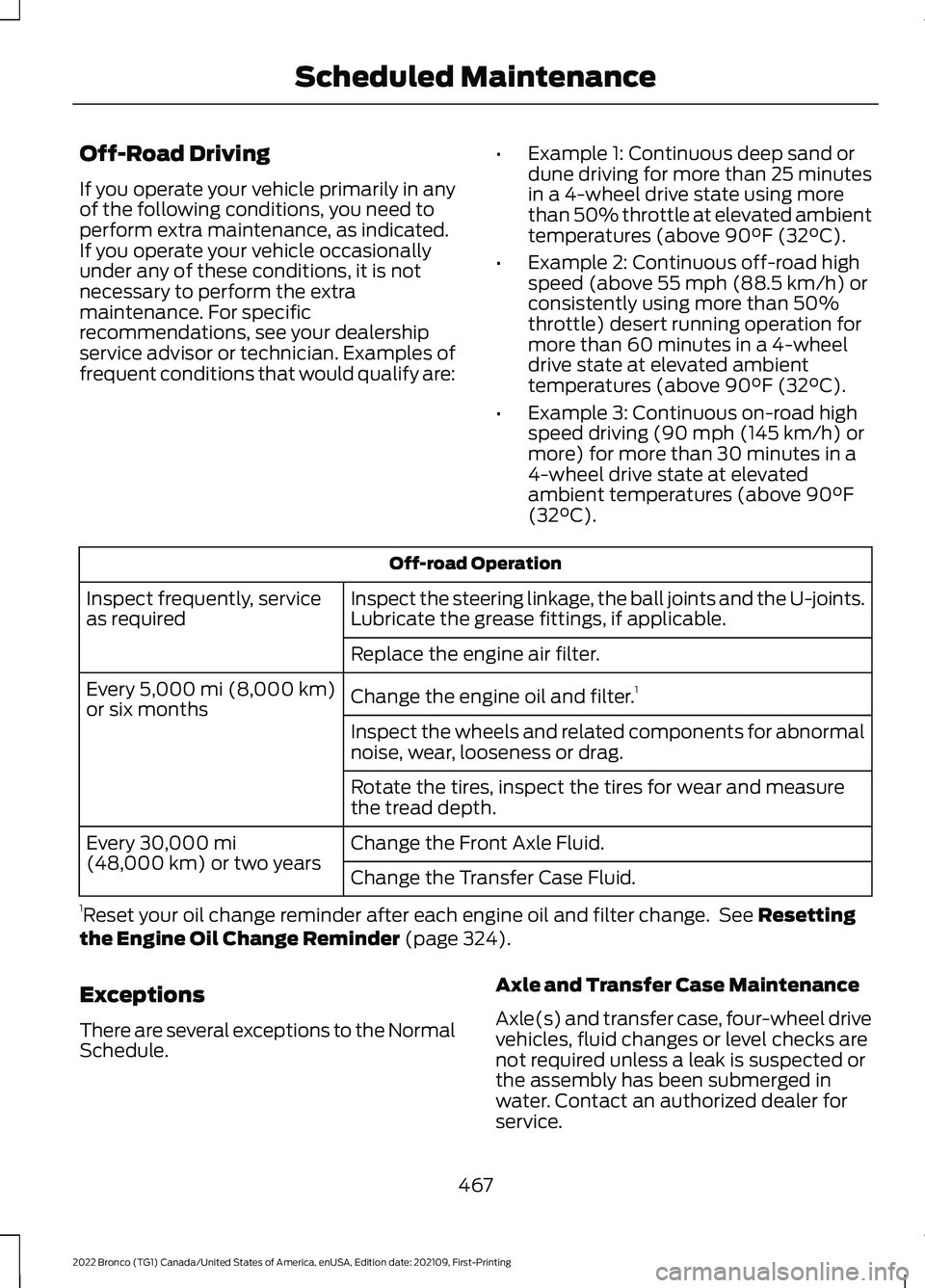
If you operate your vehicle primarily in anyof the following conditions, you need toperform extra maintenance, as indicated.If you operate your vehicle occasionallyunder any of these conditions, it is notnecessary to perform the extramaintenance. For specificrecommendations, see your dealershipservice advisor or technician. Examples offrequent conditions that would qualify are:
•Example 1: Continuous deep sand ordune driving for more than 25 minutesin a 4-wheel drive state using morethan 50% throttle at elevated ambienttemperatures (above 90°F (32°C).
•Example 2: Continuous off-road highspeed (above 55 mph (88.5 km/h) orconsistently using more than 50%throttle) desert running operation formore than 60 minutes in a 4-wheeldrive state at elevated ambienttemperatures (above 90°F (32°C).
•Example 3: Continuous on-road highspeed driving (90 mph (145 km/h) ormore) for more than 30 minutes in a4-wheel drive state at elevatedambient temperatures (above 90°F(32°C).
Off-road Operation
Inspect the steering linkage, the ball joints and the U-joints.Lubricate the grease fittings, if applicable.Inspect frequently, serviceas required
Replace the engine air filter.
Change the engine oil and filter.1Every 5,000 mi (8,000 km)or six monthsInspect the wheels and related components for abnormalnoise, wear, looseness or drag.
Rotate the tires, inspect the tires for wear and measurethe tread depth.
Change the Front Axle Fluid.Every 30,000 mi(48,000 km) or two yearsChange the Transfer Case Fluid.
1Reset your oil change reminder after each engine oil and filter change. See Resettingthe Engine Oil Change Reminder (page 324).
Exceptions
There are several exceptions to the NormalSchedule.
Axle and Transfer Case Maintenance
Axle(s) and transfer case, four-wheel drivevehicles, fluid changes or level checks arenot required unless a leak is suspected orthe assembly has been submerged inwater. Contact an authorized dealer forservice.
467
2022 Bronco (TG1) Canada/United States of America, enUSA, Edition date: 202109, First-PrintingScheduled Maintenance
Page 473 of 562
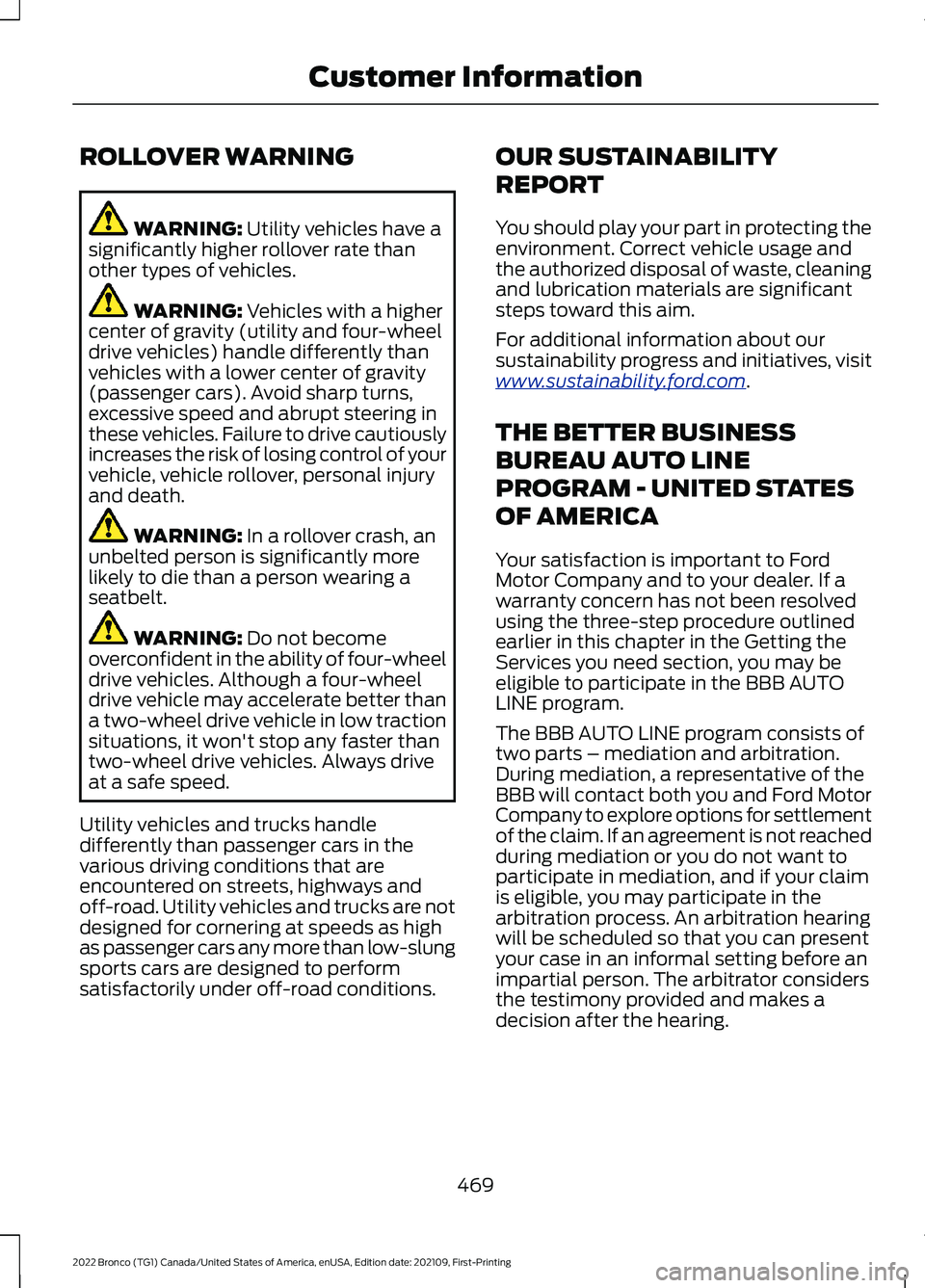
ROLLOVER WARNING
WARNING: Utility vehicles have asignificantly higher rollover rate thanother types of vehicles.
WARNING: Vehicles with a highercenter of gravity (utility and four-wheeldrive vehicles) handle differently thanvehicles with a lower center of gravity(passenger cars). Avoid sharp turns,excessive speed and abrupt steering inthese vehicles. Failure to drive cautiouslyincreases the risk of losing control of yourvehicle, vehicle rollover, personal injuryand death.
WARNING: In a rollover crash, anunbelted person is significantly morelikely to die than a person wearing aseatbelt.
WARNING: Do not becomeoverconfident in the ability of four-wheeldrive vehicles. Although a four-wheeldrive vehicle may accelerate better thana two-wheel drive vehicle in low tractionsituations, it won't stop any faster thantwo-wheel drive vehicles. Always driveat a safe speed.
Utility vehicles and trucks handledifferently than passenger cars in thevarious driving conditions that areencountered on streets, highways andoff-road. Utility vehicles and trucks are notdesigned for cornering at speeds as highas passenger cars any more than low-slungsports cars are designed to performsatisfactorily under off-road conditions.
OUR SUSTAINABILITY
REPORT
You should play your part in protecting theenvironment. Correct vehicle usage andthe authorized disposal of waste, cleaningand lubrication materials are significantsteps toward this aim.
For additional information about oursustainability progress and initiatives, visitwww.sustainability.ford.com.
THE BETTER BUSINESS
BUREAU AUTO LINE
PROGRAM - UNITED STATES
OF AMERICA
Your satisfaction is important to FordMotor Company and to your dealer. If awarranty concern has not been resolvedusing the three-step procedure outlinedearlier in this chapter in the Getting theServices you need section, you may beeligible to participate in the BBB AUTOLINE program.
The BBB AUTO LINE program consists oftwo parts – mediation and arbitration.During mediation, a representative of theBBB will contact both you and Ford MotorCompany to explore options for settlementof the claim. If an agreement is not reachedduring mediation or you do not want toparticipate in mediation, and if your claimis eligible, you may participate in thearbitration process. An arbitration hearingwill be scheduled so that you can presentyour case in an informal setting before animpartial person. The arbitrator considersthe testimony provided and makes adecision after the hearing.
469
2022 Bronco (TG1) Canada/United States of America, enUSA, Edition date: 202109, First-PrintingCustomer Information
Page 551 of 562
Manual Transmission Precautions.........174Manual Transmission –Troubleshooting..........................................177Manual Transmission – Frequently AskedQuestions..........................................................177Map Pocket.....................................................150Locating the Map Pocket................................150Mislock................................................................79Mislock Limitations..............................................79Switching Mislock On and Off.........................79What Is Mislock.....................................................79Mobile CommunicationsEquipment..................................................504Mobile Device Data........................................25Motorcraft Parts - 2.3LEcoBoost™................................................403Motorcraft Parts - 2.7LEcoBoost™................................................404Muting the Audio.........................................423MyKey Settings................................................74Configurable MyKey Settings...........................74Non-Configurable MyKey Settings................74MyKey – Troubleshooting...........................76MyKey – Frequently Asked Questions..........77MyKey – Information Messages......................76MyKey™.............................................................74MyKey Settings......................................................74MyKey – Troubleshooting..................................76
N
Navigation Map Updates..........................447Navigation......................................................447Adjusting the Map.............................................447Live Traffic............................................................447Route Guidance.................................................448Setting a Destination........................................447Waypoints............................................................448Normal Scheduled Maintenance..........462
O
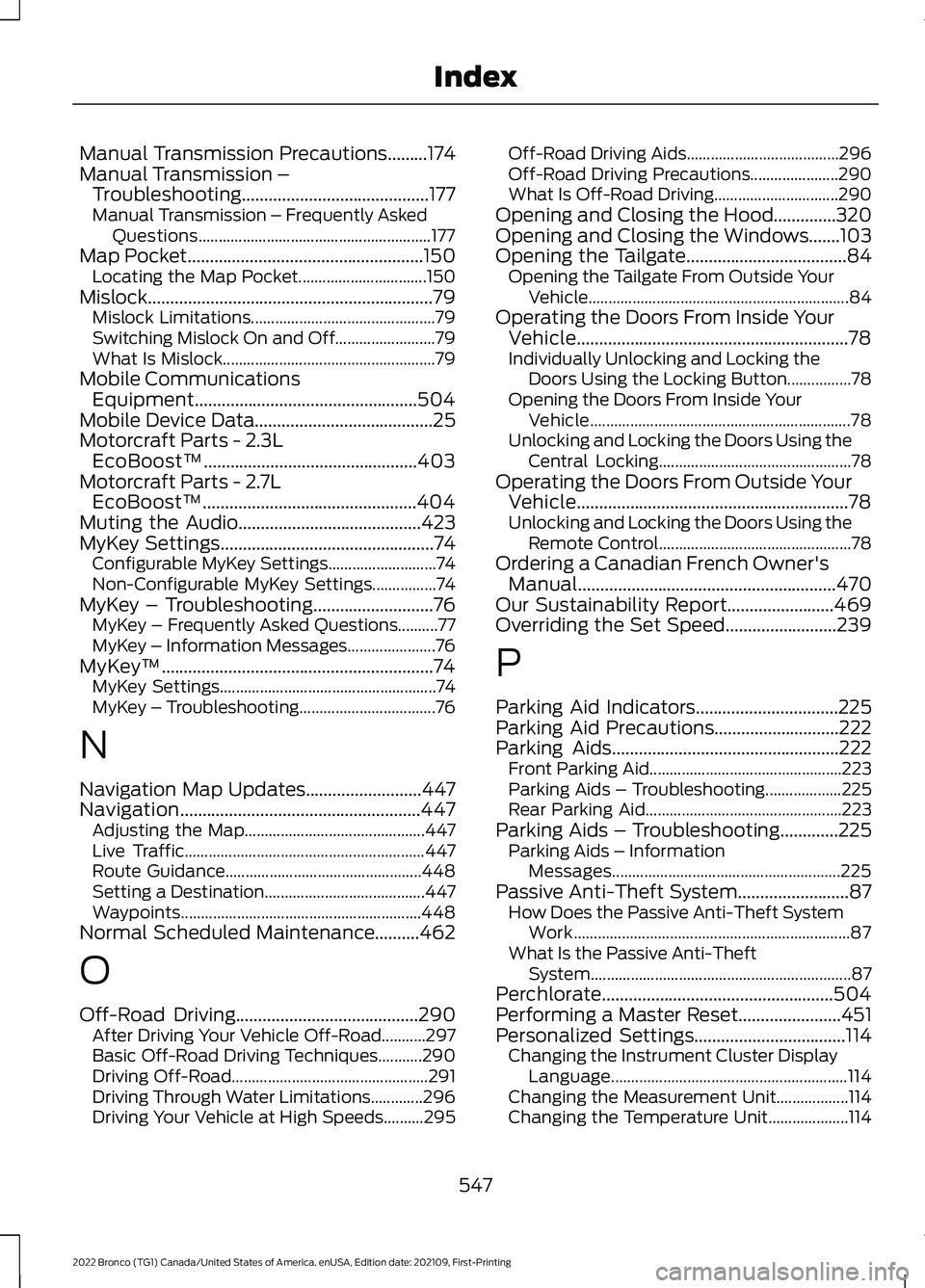
Off-Road Driving.........................................290After Driving Your Vehicle Off-Road...........297Basic Off-Road Driving Techniques...........290Driving Off-Road.................................................291Driving Through Water Limitations.............296Driving Your Vehicle at High Speeds..........295
Off-Road Driving Aids......................................296Off-Road Driving Precautions......................290What Is Off-Road Driving...............................290Opening and Closing the Hood..............320Opening and Closing the Windows.......103Opening the Tailgate....................................84Opening the Tailgate From Outside YourVehicle.................................................................84Operating the Doors From Inside YourVehicle.............................................................78Individually Unlocking and Locking theDoors Using the Locking Button................78Opening the Doors From Inside YourVehicle.................................................................78Unlocking and Locking the Doors Using theCentral Locking................................................78Operating the Doors From Outside YourVehicle.............................................................78Unlocking and Locking the Doors Using theRemote Control................................................78Ordering a Canadian French Owner'sManual..........................................................470Our Sustainability Report........................469Overriding the Set Speed.........................239
P
Parking Aid Indicators................................225Parking Aid Precautions............................222Parking Aids...................................................222Front Parking Aid................................................223Parking Aids – Troubleshooting...................225Rear Parking Aid.................................................223Parking Aids – Troubleshooting.............225Parking Aids – InformationMessages.........................................................225Passive Anti-Theft System.........................87How Does the Passive Anti-Theft SystemWork.....................................................................87What Is the Passive Anti-TheftSystem.................................................................87Perchlorate....................................................504Performing a Master Reset.......................451Personalized Settings..................................114Changing the Instrument Cluster DisplayLanguage...........................................................114Changing the Measurement Unit..................114Changing the Temperature Unit....................114
547
2022 Bronco (TG1) Canada/United States of America, enUSA, Edition date: 202109, First-PrintingIndex