clutch FORD BRONCO 2023 User Guide
[x] Cancel search | Manufacturer: FORD, Model Year: 2023, Model line: BRONCO, Model: FORD BRONCO 2023Pages: 642, PDF Size: 14.71 MB
Page 192 of 642
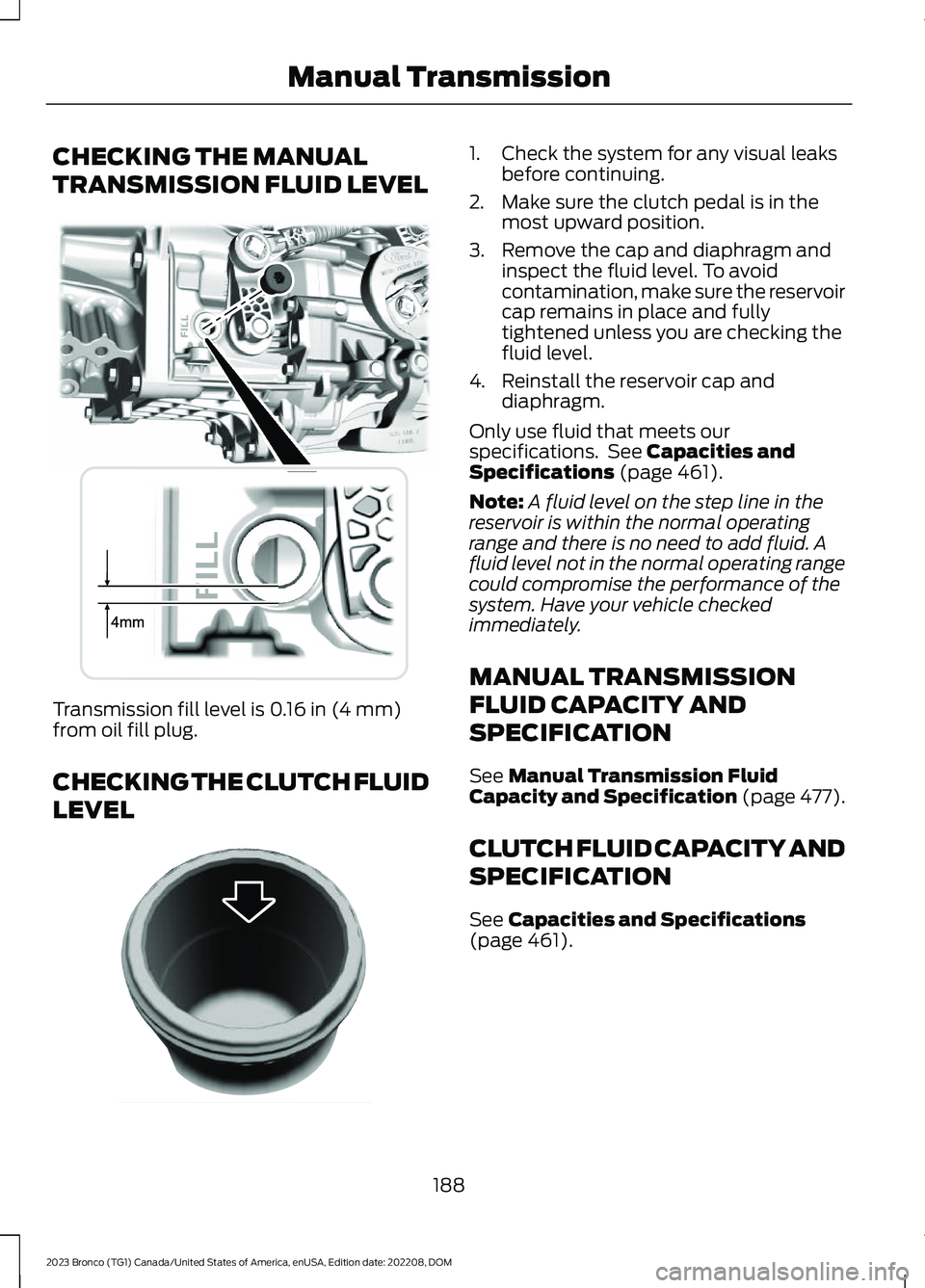
CHECKING THE MANUAL
TRANSMISSION FLUID LEVEL
Transmission fill level is 0.16 in (4 mm)from oil fill plug.
CHECKING THE CLUTCH FLUID
LEVEL
1.Check the system for any visual leaksbefore continuing.
2.Make sure the clutch pedal is in themost upward position.
3.Remove the cap and diaphragm andinspect the fluid level. To avoidcontamination, make sure the reservoircap remains in place and fullytightened unless you are checking thefluid level.
4.Reinstall the reservoir cap anddiaphragm.
Only use fluid that meets ourspecifications. See Capacities andSpecifications (page 461).
Note:A fluid level on the step line in thereservoir is within the normal operatingrange and there is no need to add fluid. Afluid level not in the normal operating rangecould compromise the performance of thesystem. Have your vehicle checkedimmediately.
MANUAL TRANSMISSION
FLUID CAPACITY AND
SPECIFICATION
See Manual Transmission FluidCapacity and Specification (page 477).
CLUTCH FLUID CAPACITY AND
SPECIFICATION
See Capacities and Specifications(page 461).
188
2023 Bronco (TG1) Canada/United States of America, enUSA, Edition date: 202208, DOMManual TransmissionE339771 E310419
Page 201 of 642
For vehicles with an electronicshift-on-the-fly transfer case, whenshifting into two-wheel drive high on dry,hard surfaced roads, we recommend thatyou follow the following procedure toreduce the likelihood of a mechanical shiftblock:
1.When driving straight, come to acomplete stop on a flat, horizontalsurface.
2.For vehicles with an automatictransmission, shift into park (P). Forvehicles with a manual transmission,press the clutch.
3.Select 2H and wait for the 2H LED tobecome solid.
4.For vehicles with an automatictransmission, shift into reverse (R). Forvehicles with a manual transmission,select reverse (R) and release theclutch. Let the vehicle roll backward upto 3 ft (1 m) and press the brake.
5.For vehicles with an automatictransmission, shift into drive (D). Forvehicles with a manual transmission,press the clutch in again, select aforward gear and release the clutch.Let the vehicle roll forward up to 3 ft(1 m).
If the system is mechanically blocked, oneor more of the following actions can relievethe mechanical shift block:
•Momentary acceleration.
•Momentary braking.
•Bringing the vehicle to a stop.
•Shifting the transmission to neutral andback to drive.
•Shifting the transmission to reverseand back to drive.
•Driving the vehicle around a tight turnat a slow speed.
SWITCHING FOUR-WHEEL
DRIVE ON AND OFF
A vehicle that comes with four-wheel drive,when selected, has the ability to use allfour wheels to power itself. This increasestraction, which may enable you to safelydrive over terrain and road conditions thata conventional two-wheel drive vehiclecannot.
On some four-wheel drive models, theinitial shift from two-wheel drive tofour-wheel drive while the vehicle ismoving can cause a momentary clunk andratcheting sound. These sounds are normalas the front drivetrain comes up to speedand are not cause for concern.
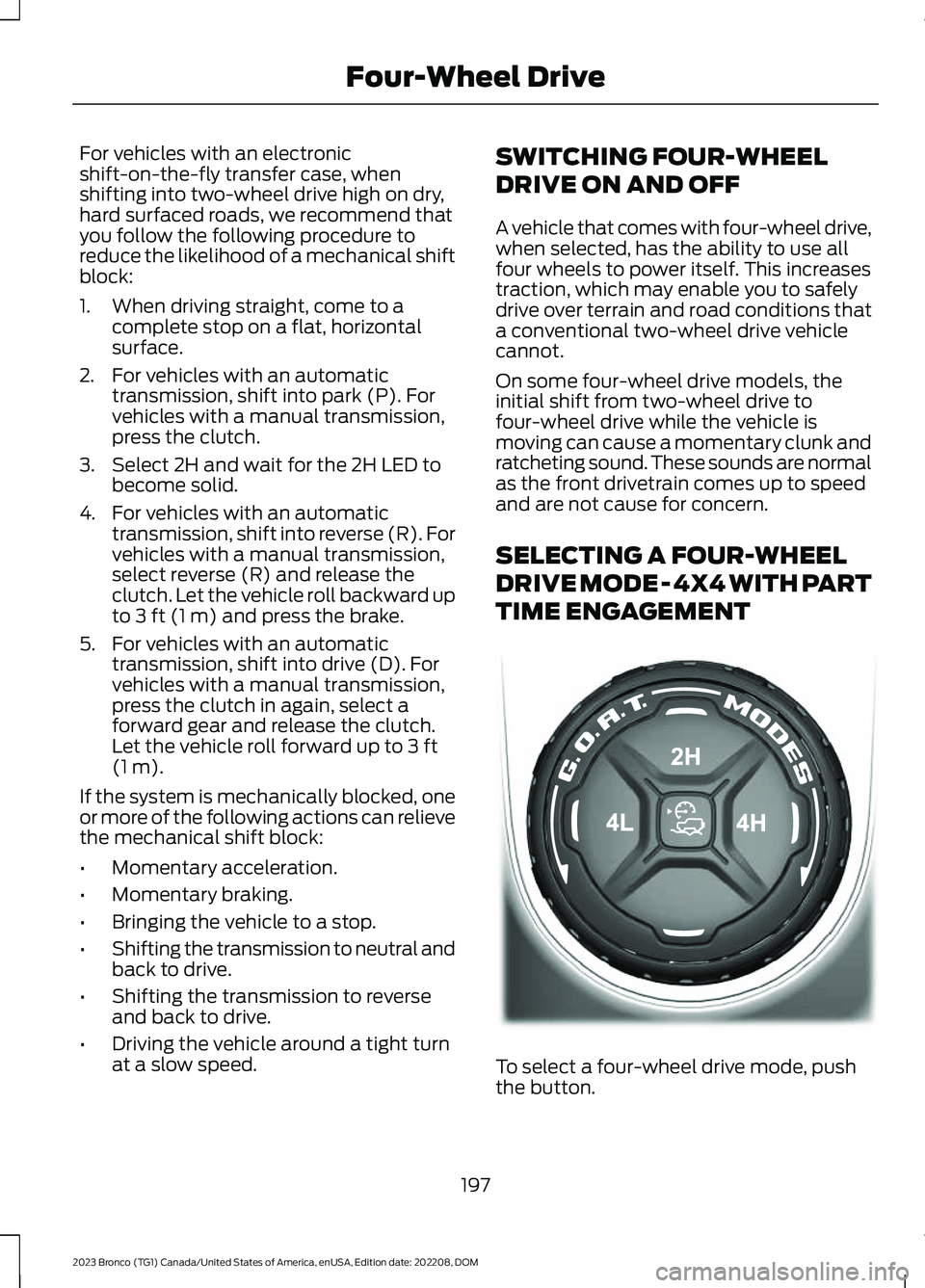
SELECTING A FOUR-WHEEL
DRIVE MODE - 4X4 WITH PART
TIME ENGAGEMENT
To select a four-wheel drive mode, pushthe button.
197
2023 Bronco (TG1) Canada/United States of America, enUSA, Edition date: 202208, DOMFour-Wheel DriveE345849
Page 202 of 642
•2H - Two-wheel drive high.
•4H - Four-wheel drive high. SeeFour-Wheel Drive High (page 199).
•4L - Four-wheel drive low. SeeFour-Wheel Drive Low (page 200).
Note:Do not perform this operation whenyou have cruise control or trail controlselected and active. The system may notshift as expected.
Note:Do not perform this operation if therear wheels are slipping or when applyingthe accelerator pedal or when driving in atight turn.
Note:Momentarily releasing the acceleratorpedal when a shift in progress messagedisplays can improve engagement ordisengagement performance.
Note:When the light is solid, the systemhas achieved the desired four-wheel drivemode. When a selected four-wheel drivemode light is blinking, the system isattempting to shift to that specificfour-wheel drive mode.
Note:When you achieve recreationaltowing, all lights are off and Neutral TowEnabled Leave Transmission in Neutralappears in the instrument cluster display.
Shifting to or from Four-WheelDrive Low
1.Bring your vehicle to a stop.
2.For vehicles with an automatictransmission, place in neutral (N). Forvehicles with a manual transmission,fully press the clutch pedal.
3.Push 4L on the four-wheel drive modeselector.
Note: A 4x4 Shift in Progress messageappears in the instrument cluster displayindicating the shift is in progress. If any ofthe previous shift conditions are not met,the shift should not occur and theinstrument cluster display can guide youthrough the proper shifting procedures.
Note: If Shift Delayed Drive Forwarddisplays in the instrument cluster display,place the transmission in a forward gear,move your vehicle forward approximately5 ft (1.5 m), and shift the transmission backto neutral (N) to allow the transfer case tocomplete the range shift.
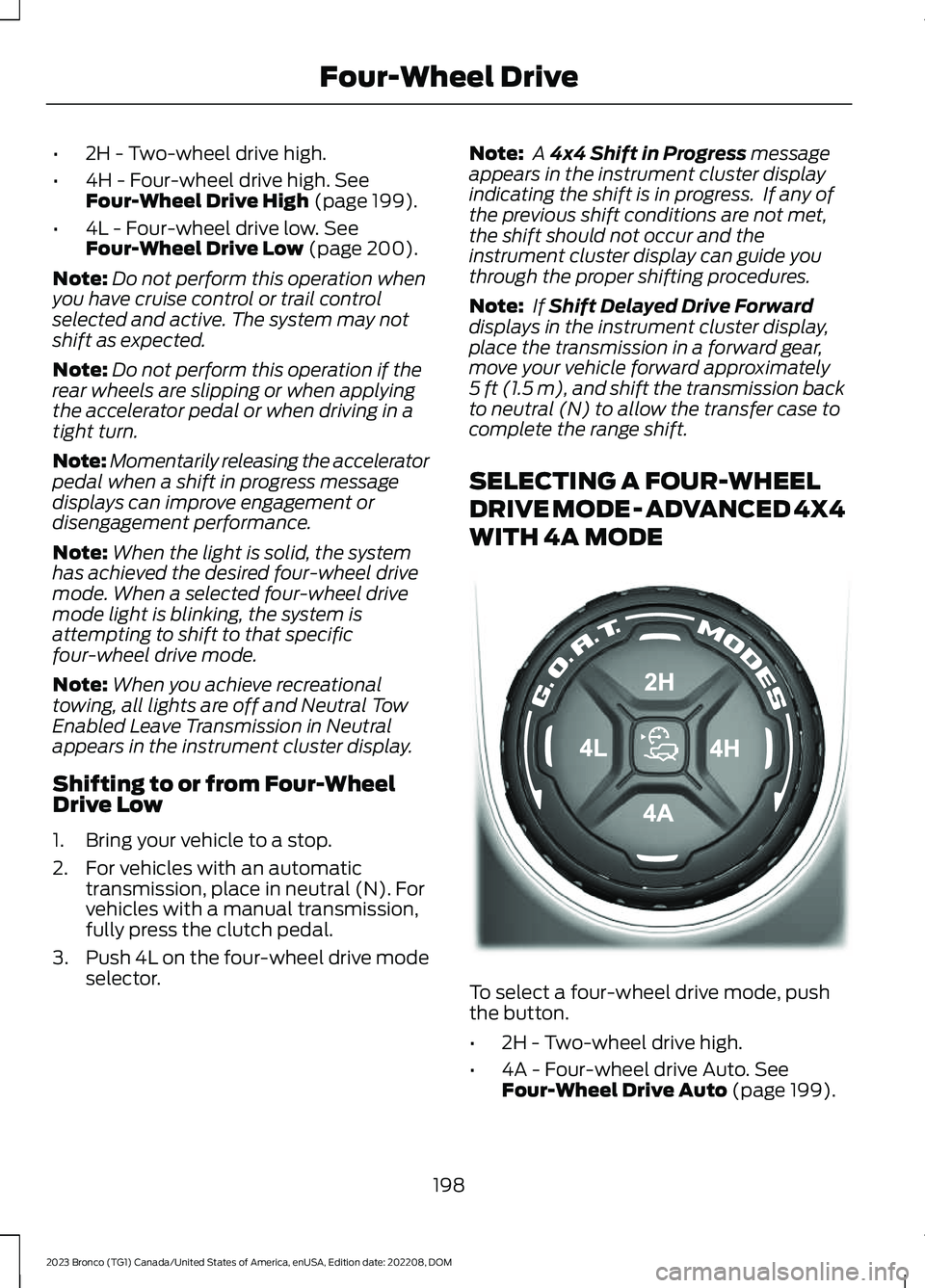
SELECTING A FOUR-WHEEL
DRIVE MODE - ADVANCED 4X4
WITH 4A MODE
To select a four-wheel drive mode, pushthe button.
•2H - Two-wheel drive high.
•4A - Four-wheel drive Auto. SeeFour-Wheel Drive Auto (page 199).
198
2023 Bronco (TG1) Canada/United States of America, enUSA, Edition date: 202208, DOMFour-Wheel DriveE324543
Page 203 of 642
•4H - Four-wheel drive high. SeeFour-Wheel Drive High (page 199).
•4L - Four-wheel drive low. SeeFour-Wheel Drive Low (page 200).
Note:Do not perform this operation whenyou have cruise control or trail controlselected and active. The system may notshift as expected.
Note: Do not perform this operation if therear wheels are slipping or when applyingthe accelerator pedal.
Note:When the light is solid, the systemhas achieved the desired four-wheel drivemode. When a selected four-wheel drivemode LED is blinking, the system isattempting to shift to that specificfour-wheel drive mode.
Note:When all lights are blinking, have yourvehicle serviced as soon as possible.
Note:When you achieve recreationaltowing, all lights are off and Neutral TowEnabled Leave Transmission in Neutralappears in the instrument cluster display.
Shifting to or from Four-WheelDrive Low
1.Bring your vehicle to a stop.
2.For vehicles with an automatictransmission, place in neutral (N). Forvehicles with a manual transmission,fully press the clutch pedal.
3.Push 4L on the four-wheel drive modeselector.
Note: A 4x4 Shift in Progress messageappears in the instrument cluster displayindicating the shift is in progress. If any ofthe previous shift conditions are not met,the shift should not occur and theinstrument cluster display can guide youthrough the proper shifting procedures.
Note: If Shift Delayed Drive Forwarddisplays in the instrument cluster display,place the transmission in a forward gear,move your vehicle forward approximately5 ft (1.5 m), and shift the transmission backto neutral (N) to allow the transfer case tocomplete the range shift.
FOUR-WHEEL DRIVE MODES
TWO-WHEEL DRIVE HIGH
Two-wheel drive high is for generalon-road driving. Power is sent to the rearwheels only.
Note:Two-wheel drive high can turn on oroff based on Drive Mode selection SeeG.O.A.T. Mode Control (page 260).
FOUR-WHEEL DRIVE AUTO (If
Equipped)
Four-wheel drive auto provideselectronically controlled four-wheel drivepower to both the front and rear wheels,as required, for increased traction in varyingon-road conditions. The four-wheel driveauto tuning varies based on selected DriveMode. See Selecting a Four-Wheel DriveMode (page 197).
Note:Four-wheel drive auto can turn on oroff automatically based on Drive Modeselection. See Selecting a Four-WheelDrive Mode (page 197).
FOUR-WHEEL DRIVE HIGH
Four-wheel drive high provideselectronically or mechanically lockedfour-wheel drive power to both the frontand rear wheels for use in off-road orwinter conditions such as deep snow, sandor mud. This mode is not for use on drypavement.
199
2023 Bronco (TG1) Canada/United States of America, enUSA, Edition date: 202208, DOMFour-Wheel Drive
Page 205 of 642
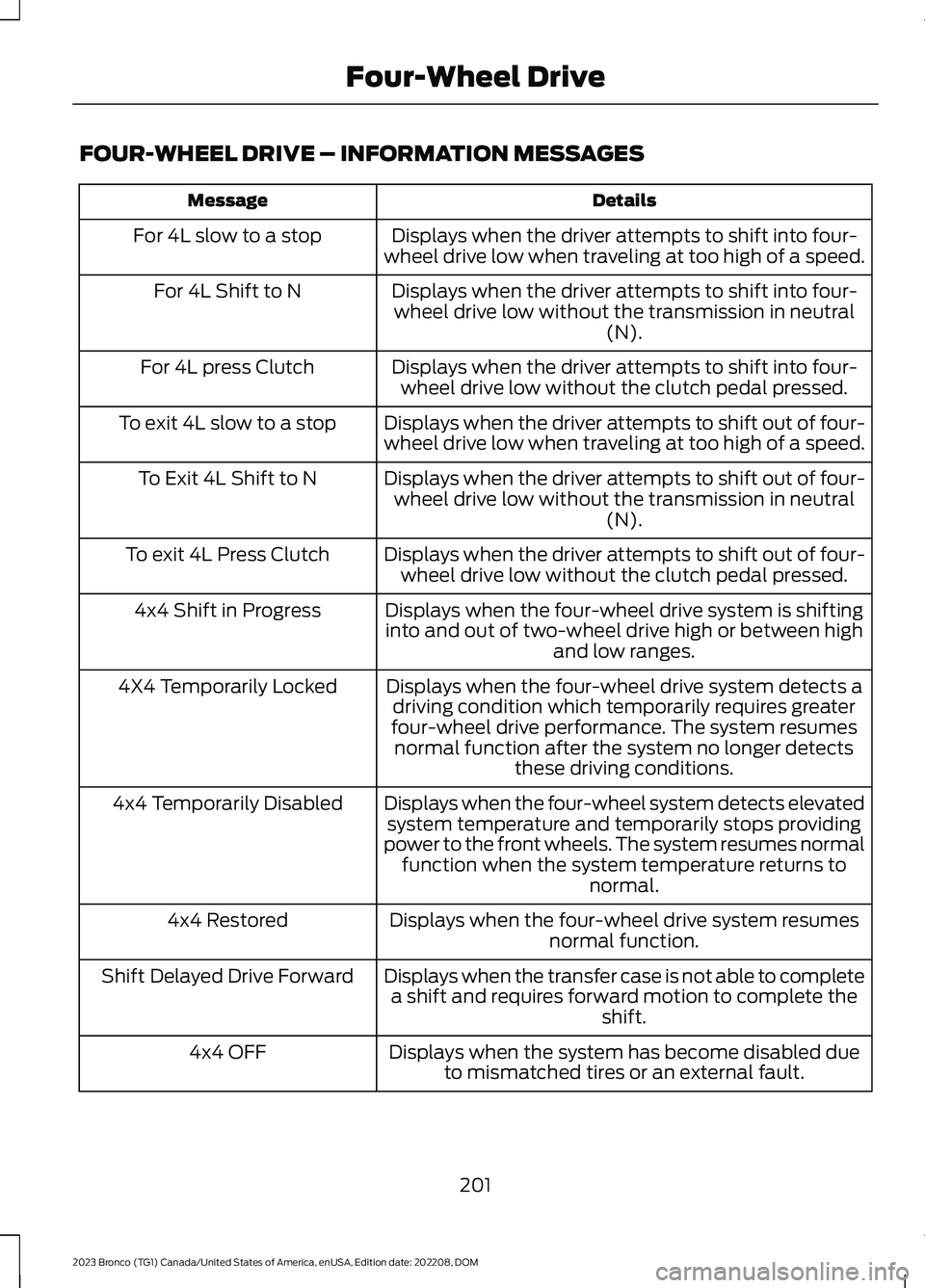
FOUR-WHEEL DRIVE – INFORMATION MESSAGES
DetailsMessage
Displays when the driver attempts to shift into four-wheel drive low when traveling at too high of a speed.For 4L slow to a stop
Displays when the driver attempts to shift into four-wheel drive low without the transmission in neutral(N).
For 4L Shift to N
Displays when the driver attempts to shift into four-wheel drive low without the clutch pedal pressed.For 4L press Clutch
Displays when the driver attempts to shift out of four-wheel drive low when traveling at too high of a speed.To exit 4L slow to a stop
Displays when the driver attempts to shift out of four-wheel drive low without the transmission in neutral(N).
To Exit 4L Shift to N
Displays when the driver attempts to shift out of four-wheel drive low without the clutch pedal pressed.To exit 4L Press Clutch
Displays when the four-wheel drive system is shiftinginto and out of two-wheel drive high or between highand low ranges.
4x4 Shift in Progress
Displays when the four-wheel drive system detects adriving condition which temporarily requires greaterfour-wheel drive performance. The system resumesnormal function after the system no longer detectsthese driving conditions.
4X4 Temporarily Locked
Displays when the four-wheel system detects elevatedsystem temperature and temporarily stops providingpower to the front wheels. The system resumes normalfunction when the system temperature returns tonormal.
4x4 Temporarily Disabled
Displays when the four-wheel drive system resumesnormal function.4x4 Restored
Displays when the transfer case is not able to completea shift and requires forward motion to complete theshift.
Shift Delayed Drive Forward
Displays when the system has become disabled dueto mismatched tires or an external fault.4x4 OFF
201
2023 Bronco (TG1) Canada/United States of America, enUSA, Edition date: 202208, DOMFour-Wheel Drive
Page 318 of 642
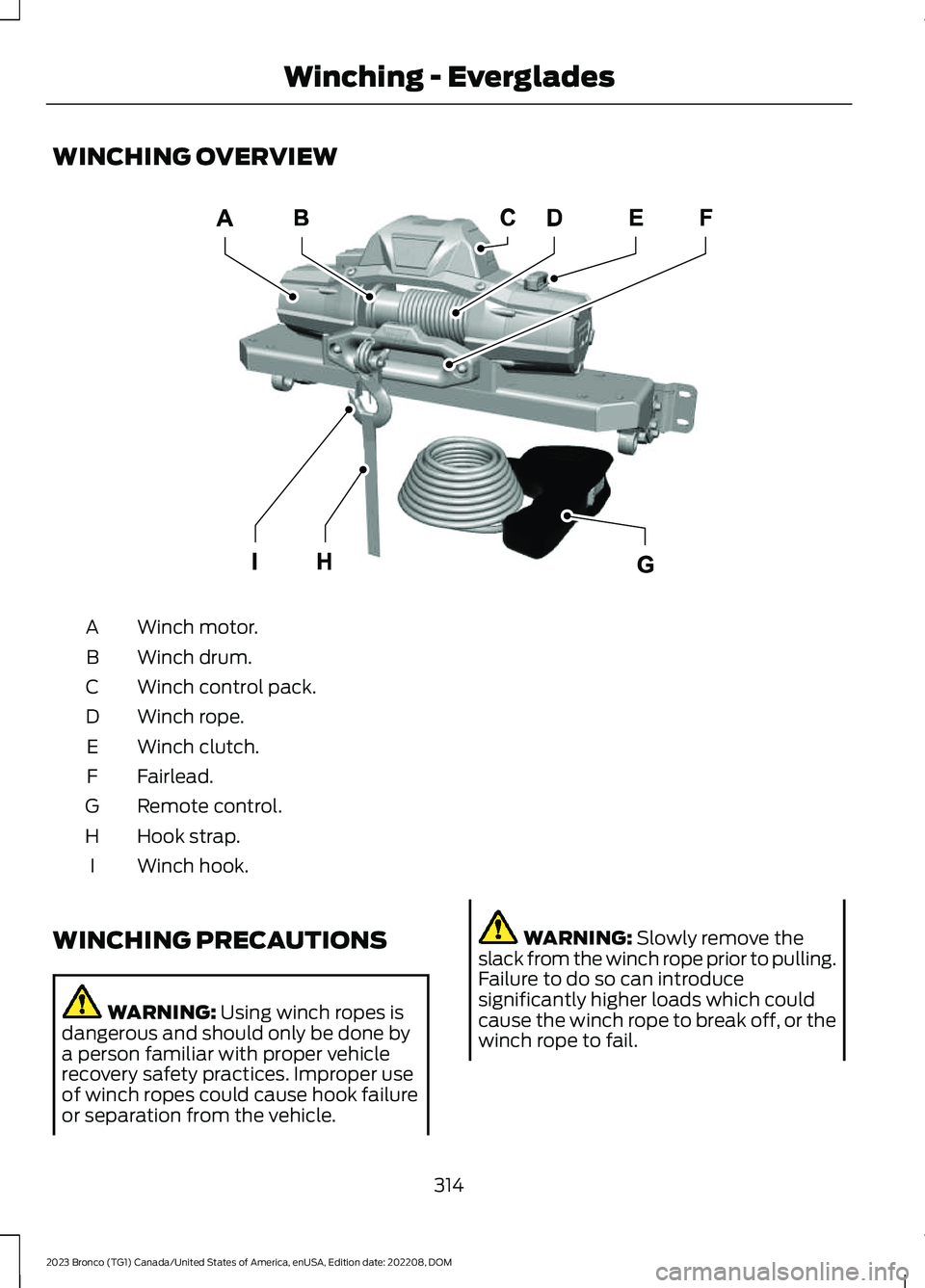
WINCHING OVERVIEW
Winch motor.A
Winch drum.B
Winch control pack.C
Winch rope.D
Winch clutch.E
Fairlead.F
Remote control.G
Hook strap.H
Winch hook.I
WINCHING PRECAUTIONS
WARNING: Using winch ropes isdangerous and should only be done bya person familiar with proper vehiclerecovery safety practices. Improper useof winch ropes could cause hook failureor separation from the vehicle.
WARNING: Slowly remove theslack from the winch rope prior to pulling.Failure to do so can introducesignificantly higher loads which couldcause the winch rope to break off, or thewinch rope to fail.
314
2023 Bronco (TG1) Canada/United States of America, enUSA, Edition date: 202208, DOMWinching - EvergladesE368414
Page 319 of 642
WARNING: Never link two winchropes together with a clevis pin. Theseheavy metal objects could becomeprojectiles if the winch rope breaks.
WARNING: When using the winch,take care not to get your fingers or handscaught in the mechanism. Failure tofollow this instruction could result inpersonal injury.
WARNING: Avoid wearing loosefitting clothing or jewelry when winching.
WARNING: Make sure to wear eyeprotection when winching.
WARNING: Do not exceed thewinch or winch rope capacity. Failure tofollow this instruction could result inpersonal injury.
WARNING: Wear gloves whenhandling the winch rope. Failure to followthis instruction could result in personalinjury.
WARNING: Do not use the winchto secure loads.
WARNING: Do not use the winchto tow a trailer. This can damage,overload and break the winch rope.
WARNING: Make sure the anchorpoint can properly support the load andsecure the winching equipment. Failureto follow this instruction could result inpersonal injury.
WARNING: Only use theequipment supplied with the winch whenwinching.
WARNING: Do not engage ordisengage the winch clutch when thewinch is in use.
WARNING: The winch andassociated components become hotwhen in use. Let them cool down beforeremoving them.
WARNING: Do not attempt toservice, repair or modify the winchingsystem. Failure to follow this instructioncould result in personal injury or death.
WARNING: Make sure to properlystore the winch rope to the shackle pointor fairlead when not in use. Failure toproperly store the winch rope couldcause it to become a projectile.
WINCHING REQUIREMENTS
To winch your vehicle, make sure of thefollowing:
•The intended anchor point is secure.The anchor point must be strongenough to hold the weight of yourvehicle when winching.
•The intended anchor point allows youto pull your vehicle straight ahead.
•The intended anchor point is as faraway as possible, within the 100 ft(30 m) rope length. This allows thegreatest pulling power for the winch.
•The winch rope is in good condition andfree of visible cuts, tear or damage.
•Use a damper device such as a tarp,heavy blanket or piece of carpet, andplace it over the winch rope to helpabsorb the energy in the event thewinch rope breaks.
•Bystanders are to the sides of thevehicle, at a distance of at least twicethe length of the winch rope.
315
2023 Bronco (TG1) Canada/United States of America, enUSA, Edition date: 202208, DOMWinching - Everglades
Page 320 of 642
WINCHING LIMITATIONS
The following could impact winchoperation:
•Temperatures below 32°F (0°C).
•Low battery charge.
•Winching without the engine runningor for sustained pulls of a minute ormore.
•Try winching using shorter pullswith breaks, both to check setupand to allow the vehicle's batteryto recharge.
•Exceeding the winch or winch roperating.
You may see messages on your instrumentcluster if the system voltage drops belowa set threshold, specifically if batteryhealth is poor, winching occurs in freezingtemperatures, and/or a continuouswinching cycle. These messages go awayonce vehicle system voltage returns tonormal.
WINCHING YOUR VEHICLE
For more information, refer to The BasicGuide to Winching Techniques.
1.Put on gloves.
2.Switch the clutch to the freespoolposition.
3.Pull the winch rope to the anchor point.
4.Secure the winch rope to the anchorpoint using a tree trunk protector orchoker chain.
5.Secure the clevis to the tree trunkprotector or choker chain and the hookstrap by threading the two ends of thetree trunk protector or choker chain andthe hook strap loop through the clevis.Do not overtighten the clevis.
6.Switch the clutch to the lockedposition.
7.Remove the cap from the control boxand connect the remote control to thecontrol box.
8.Put the winch rope under tension byslowly winding it with the remotecontrol.
9.Check the anchor and make sure allthe connections are secure and free ofdebris.
10.Make sure the winch rope is neatlywound around the spooling drum.
11.Place an energy absorber, such as atree limb, heavy jacket, chain orbackpack, over the winch rope,halfway between the winch andanchor point.
12.Make sure that everyone in theimmediate area is clear of thewinching vehicle.
13.With your vehicle switched on, beginwinching slowly and steadily with theremote control.
14.Continue winching your vehicle untilit is on stable ground.
15.Place your vehicle in park (P).
Note:If your vehicle is manual transmission,place it in first gear.
16.Disconnect the winch rope from theanchor.
17.Wind the winch rope back onto thewinch drum by walking it back withthe remote control. Keep tension onthe rope when rewinding it onto thedrum to evenly distribute the winchrope on the drum.
18.Secure the winch hook to the shacklepoint or the fairlead.
19.Disconnect the remote control fromthe control box. Store the remote ina clean, dry place. Place the cap backon the control box.
316
2023 Bronco (TG1) Canada/United States of America, enUSA, Edition date: 202208, DOMWinching - Everglades
Page 325 of 642
If your vehicle stalls, do not try to turnaround because this could cause yourvehicle to roll over. It is better to reverseback to a safe location.
Do not drive over the crest of a hill withoutseeing what conditions are on the otherside. Do not drive in reverse over a hillwithout the aid of an observer.
If the vehicle is unable to make it up thehill, do not attempt to turn back down theslope.
Apply the accelerator just enough for thewheels to climb the hill.
Note:Too much acceleration can causethe tires to slip, spin or lose traction,resulting in loss of vehicle control.
Descending A Hill:
•Use the same gear you would use toclimb the hill.
•Do not descend in neutral.
•Disengage overdrive.
•Avoid sudden and excessive braking.
Note:The front wheels have to be turningin order to steer your vehicle.
When descending a steep hill in a manualtransmission vehicle do not leave thevehicle in gear with the clutch pressed. Thiscould cause damage to your driveline.
Driving Through Water
WARNING: Do not attempt tocross a deep, fast flowing body of water.Failure to follow this instruction couldresult in the loss of control of yourvehicle, personal injury or death.
As the water depth increases, you mustreduce your vehicle speed to avoidpotential vehicle damage.
The key to a safe crossing is the waterdepth, current and bottom of the water'scondition. On soft bottoms, the vehiclesinks in, effectively increasing the waterlevel on the vehicle. Make sure to considerthis when determining the depth of water.
Determine the depth and speed of thecurrent before attempting a water crossing.
Be aware that obstacles and debris maybe beneath the water’s surface.
Note:Cross flowing water at an angleheading slightly upstream.
Note:You should tread lightly and avoiddamage to the environment.
Drive slowly when crossing water. Proceedwith a constant slow speed lightly pressingon the accelerator.
Drive through the water very slowly whenentering, then build up momentum. Keepyour vehicle moving at a steady pace.
Note:Do not try to accelerate through thewater crossing.
When driving too fast in water or throughdeep water, the engine, transmission,transfer case, axles, electrical componentsor vehicle interior could ingest water. Watercan cause permanent damage that maynot be covered by your vehicle warranty.See Driving Through Water Limitations(page 323).
Note:Failure to follow the recommendedspeeds can result in vehicle damage.
Never stop or shut a vehicle off whencrossing deep water unless your vehicleingested water into the engine air intake.If the engine stalls, do not attempt torestart it.
Ease off the accelerator as you reach theother side to diminish the front wave. Applythe accelerator slowly and as necessaryto climb out of the other side.
321
2023 Bronco (TG1) Canada/United States of America, enUSA, Edition date: 202208, DOMDriving Hints
Page 341 of 642
TOWING YOUR VEHICLE
PRECAUTIONS
Use the following guidelines when towingyour vehicle. Failure to follow thisinstruction could result in vehicle damagenot covered by the vehicle warranty.
Note:Make sure you properly secure yourvehicle to the tow vehicle.
Note:If you are unsure of the vehicle’sconfiguration, contact an authorized dealer.
RECREATIONALLY TOWING
YOUR VEHICLE - MANUAL
TRANSMISSION
WARNING: Do not disconnect thebattery when recreationally towing yourvehicle. This prevents the transfer casefrom shifting properly and could causethe vehicle to roll, even if thetransmission is in gear.
WARNING: Placing the transfercase in its neutral position could causeyour vehicle to freely roll. Make sure youpress and hold the brake pedal and thevehicle is in a secure, safe position whenyou place the transfer case in its neutralposition.
Follow these guidelines if you have a needfor recreational towing. An example ofrecreational towing would be towing yourvehicle behind a motorhome. Theseguidelines are to make sure that you donot damage the transmission.
You can only tow your vehicle with all fourwheels on the ground by placing thetransfer case in its neutral position byengaging the recreational tow feature.Perform the following steps afterpositioning your vehicle behind the towvehicle and properly securing themtogether.
Note:Put your climate control system inrecirculated air mode to prevent exhaustfumes from entering your vehicle.
Note:Failure to put the transfer case in itsneutral position can damage vehiclecomponents.
Note: You can check the towing status atany time by opening the driver door orturning the ignition to the accessory or onposition.Neutral Tow Enabled LeaveTransmission in Neutral appears in theinstrument cluster display to confirm youcan recreationally tow your vehicle.
Note:If your vehicle has an anti-theftalarm, make sure you switch perimetersensing on when towing.
Note:A tone could sound for up to 30minutes if you recreationally tow with thedoors removed.
Switching Neutral Tow On
1.Switch your vehicle to accessory modeby pressing the push button ignitionswitch without pressing any pedals.
2.Press the 2H button on the four-wheeldrive mode control.
3.Leave the gearshift lever in the neutralposition and fully press and hold boththe clutch and the brake pedal.
4.Using the instrument cluster controlson the steering wheel, select Settings.
5.Select Neutral Tow.
6.Press and hold the OK button until aconfirmation message appears in theinformation display.
337
2023 Bronco (TG1) Canada/United States of America, enUSA, Edition date: 202208, DOMTowing Your Vehicle