lock FORD BRONCO 2023 User Guide
[x] Cancel search | Manufacturer: FORD, Model Year: 2023, Model line: BRONCO, Model: FORD BRONCO 2023Pages: 642, PDF Size: 14.71 MB
Page 54 of 642
WARNING: Do not allow apassenger to hold a child on their lapwhen your vehicle is moving. Failure tofollow this instruction could result inpersonal injury or death in the event of asudden stop or crash.
WARNING: Do not use pillows,books or towels to boost your child'sheight. Failure to follow this instructioncould result in personal injury or death.
WARNING: Properly secure childrestraints or booster seats when they arenot in use. They could become projectilesin a sudden stop or crash. Failure tofollow this instruction could result inpersonal injury or death.
WARNING: Do not put the shouldersection of the seatbelt or allow the childto put the shoulder section of theseatbelt under their arm or behind theirback. Failure to follow this instructioncould reduce the effectiveness of theseatbelt and increase the risk of injury ordeath in a crash.
WARNING: Do not leave childrenor pets unattended in your vehicle.Failure to follow this instruction couldresult in personal injury or death.
When installing a child restraint withseatbelts:
•Place the vehicle seat in the uprightposition before you install the childrestraint.
•Use the correct seatbelt buckle for thatseating position.
•Insert the belt tongue into the buckle.Make sure the tongue is securelyfastened in the buckle.
•Keep the buckle release buttonpointing up and away from the childrestraint, with the tongue between thechild restraint and the release button,to prevent accidental unbuckling.
•Put the seatbelt in the automaticlocking mode.
CHILD RESTRAINT ANCHOR
POINTS
WHAT ARE THE CHILD RESTRAINTANCHOR POINTS
LATCH (Lower Anchors and Tethers forCHildren)
Anchor points allow you to quickly andsafely install a child restraint.
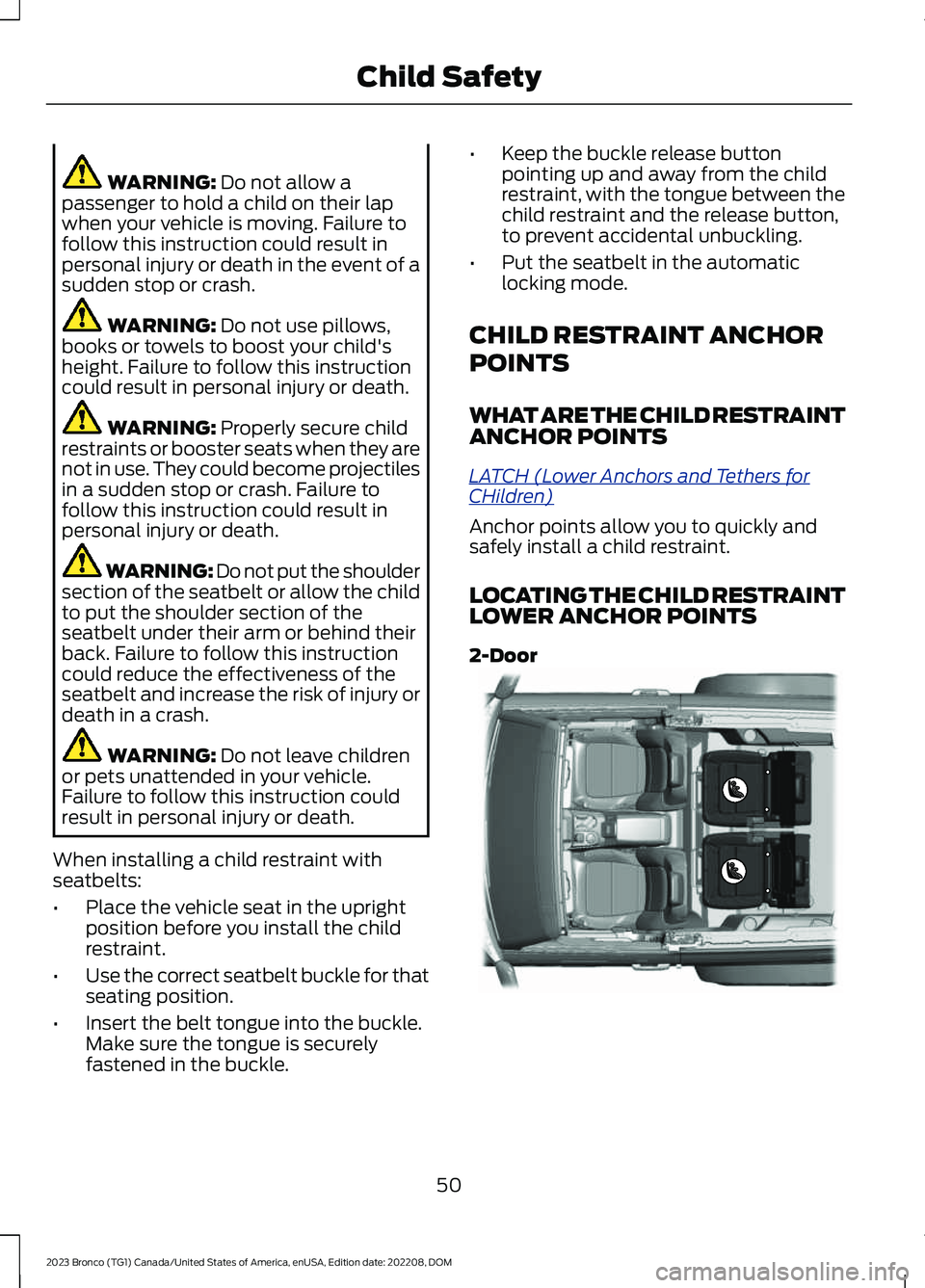
LOCATING THE CHILD RESTRAINTLOWER ANCHOR POINTS
2-Door
50
2023 Bronco (TG1) Canada/United States of America, enUSA, Edition date: 202208, DOMChild SafetyE328020
Page 57 of 642
CHILD RESTRAINTS RECOMMENDATION
Recommended Restraint TypeChild Size, Height, Weight, or Age
Use a child restraint (sometimescalled an infant carrier, convertibleseat, or toddler seat).
Children weighing 40 lb (18 kg) or less (generallyage four or younger).
Use a belt-positioning boosterseat.
Children who have outgrown or no longer properlyfit in a child restraint (generally children who areless than 57 in (1.45 m) tall, are greater than agefour and less than age 12, and between 40 lb (18 kg)and 80 lb (36 kg) and upward to 100 lb (45 kg) ifrecommended by your child restraint manufacturer).
Use a vehicle seatbelt having thelap belt snug and low across thehips, shoulder belt centered acrossthe shoulder and chest, and seatbackrest upright.
Children who have outgrown or no longer properlyfit in a belt-positioning booster seat (generally chil-dren who are at least 57 in (1.45 m) tall or greaterthan 80 lb (36 kg) or 100 lb (45 kg) if recommendedby child restraint manufacturer).
You are required by law to properly usechild restraints for infants and toddlers inthe United States, Canada and Mexico.
Many states and provinces require thatsmall children use approved booster seatsuntil they reach age eight, a height of 57 in(1.45 m) tall, or 80 lb (36 kg). Check yourlocal and state or provincial laws forspecific requirements about the safety ofchildren in your vehicle.
When possible, properly restrain children12 years of age and under in a rear seatingposition of your vehicle. Accident statisticssuggest that children are safer whenproperly restrained in the rear seatingpositions than in a front seating position.
When installing a rear facing child restraint,adjust the vehicle seats to avoidinterference between the child restraintand the vehicle seat in front of the childrestraint.
INSTALLING CHILD
RESTRAINTS
USING SEATBELTS
WARNING: Depending on whereyou secure a child restraint, anddepending on the child restraint design,you may block access to certain seatbeltbuckle assemblies and LATCH loweranchors, rendering those featurespotentially unusable. To avoid risk ofinjury, make sure occupants only useseating positions where they are able tobe properly restrained.
Note:Although the child restraintillustrated is a forward facing child restraint,the steps are the same for installing a rearfacing child restraint.
Perform the following steps wheninstalling a child restraint with seatbelts.
53
2023 Bronco (TG1) Canada/United States of America, enUSA, Edition date: 202208, DOMChild Safety
Page 58 of 642
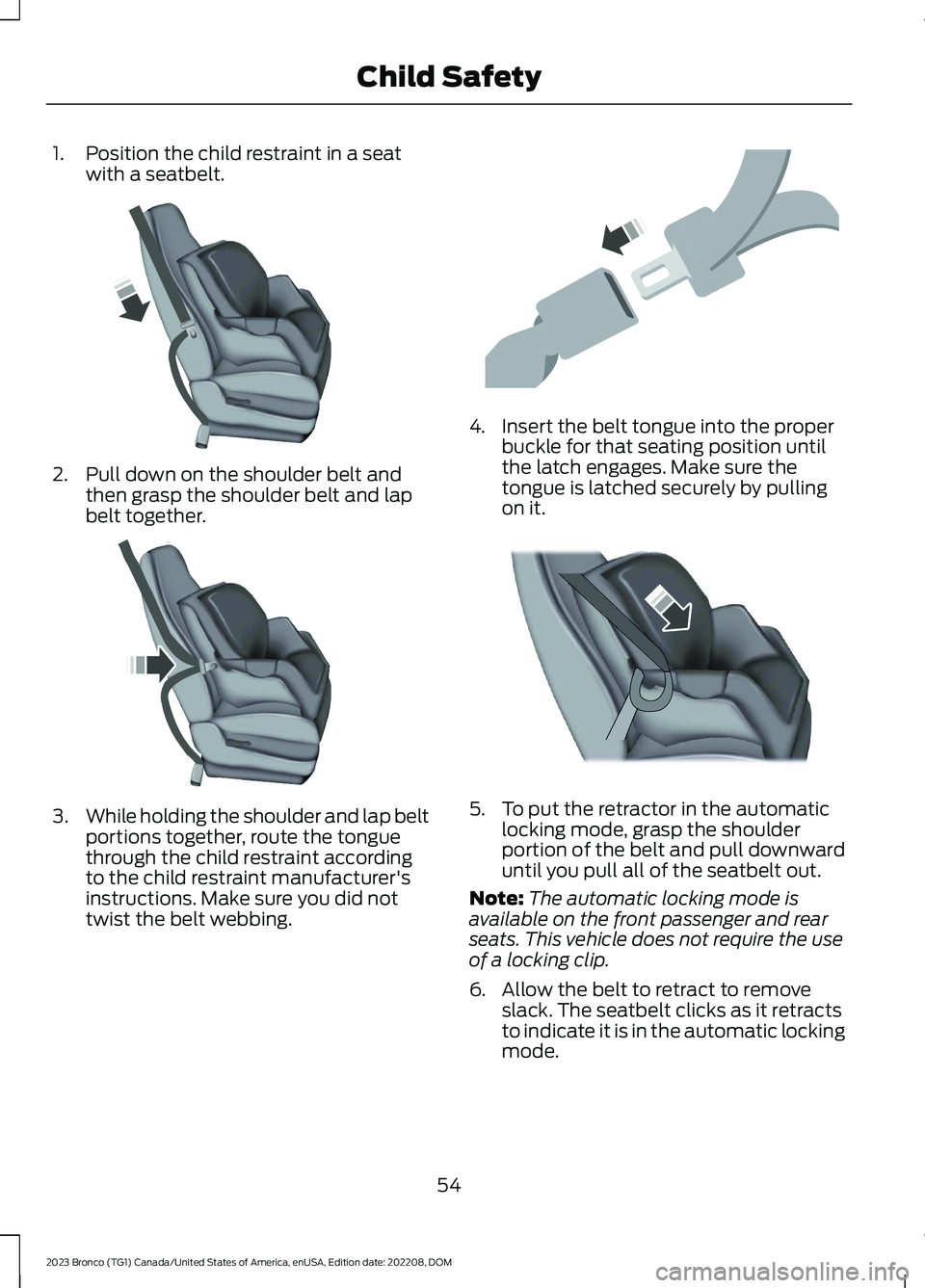
1.Position the child restraint in a seatwith a seatbelt.
2.Pull down on the shoulder belt andthen grasp the shoulder belt and lapbelt together.
3.While holding the shoulder and lap beltportions together, route the tonguethrough the child restraint accordingto the child restraint manufacturer'sinstructions. Make sure you did nottwist the belt webbing.
4.Insert the belt tongue into the properbuckle for that seating position untilthe latch engages. Make sure thetongue is latched securely by pullingon it.
5.To put the retractor in the automaticlocking mode, grasp the shoulderportion of the belt and pull downwarduntil you pull all of the seatbelt out.
Note:The automatic locking mode isavailable on the front passenger and rearseats. This vehicle does not require the useof a locking clip.
6.Allow the belt to retract to removeslack. The seatbelt clicks as it retractsto indicate it is in the automatic lockingmode.
54
2023 Bronco (TG1) Canada/United States of America, enUSA, Edition date: 202208, DOMChild SafetyE142529 E142530 E142531 E142875
Page 59 of 642
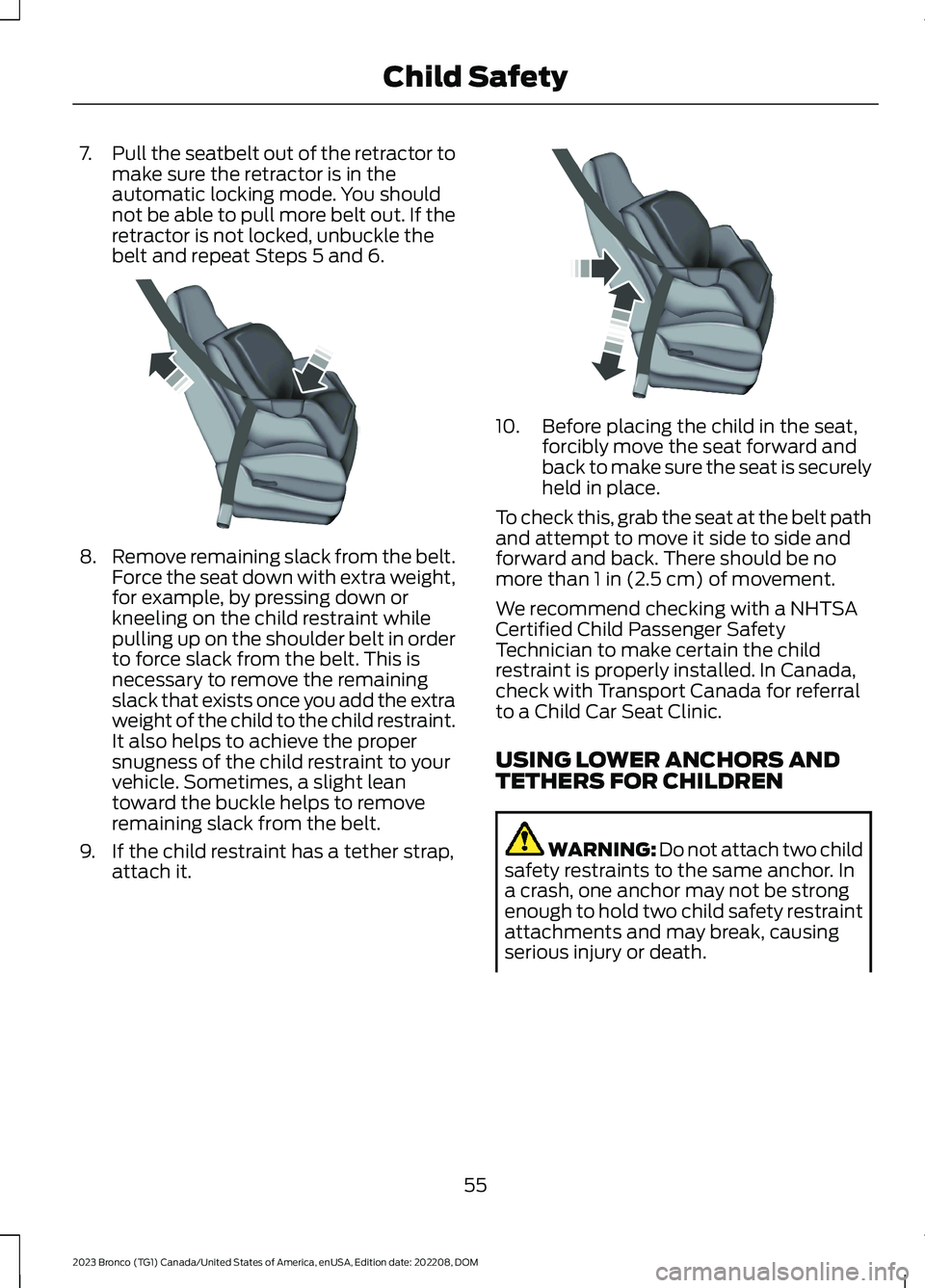
7.Pull the seatbelt out of the retractor tomake sure the retractor is in theautomatic locking mode. You shouldnot be able to pull more belt out. If theretractor is not locked, unbuckle thebelt and repeat Steps 5 and 6.
8.Remove remaining slack from the belt.Force the seat down with extra weight,for example, by pressing down orkneeling on the child restraint whilepulling up on the shoulder belt in orderto force slack from the belt. This isnecessary to remove the remainingslack that exists once you add the extraweight of the child to the child restraint.It also helps to achieve the propersnugness of the child restraint to yourvehicle. Sometimes, a slight leantoward the buckle helps to removeremaining slack from the belt.
9.If the child restraint has a tether strap,attach it.
10.Before placing the child in the seat,forcibly move the seat forward andback to make sure the seat is securelyheld in place.
To check this, grab the seat at the belt pathand attempt to move it side to side andforward and back. There should be nomore than 1 in (2.5 cm) of movement.
We recommend checking with a NHTSACertified Child Passenger SafetyTechnician to make certain the childrestraint is properly installed. In Canada,check with Transport Canada for referralto a Child Car Seat Clinic.
USING LOWER ANCHORS ANDTETHERS FOR CHILDREN
WARNING: Do not attach two childsafety restraints to the same anchor. Ina crash, one anchor may not be strongenough to hold two child safety restraintattachments and may break, causingserious injury or death.
55
2023 Bronco (TG1) Canada/United States of America, enUSA, Edition date: 202208, DOMChild SafetyE142533 E142534
Page 60 of 642
WARNING: Depending on whereyou secure a child restraint, anddepending on the child restraint design,you may block access to certain seatbeltbuckle assemblies and LATCH loweranchors, rendering those featurespotentially unusable. To avoid risk ofinjury, make sure occupants only useseating positions where they are able tobe properly restrained.
The Lower Anchors and Tethers forCHildren (LATCH) system has threevehicle anchor points:
•Two lower anchors where the vehicleseat backrest and seat cushion meet,called the seat bight.
•One top tether anchor behind thatseating position.
LATCH compatible child restraints havetwo rigid or webbing mountedattachments. These attachments connectto the two lower anchors at the LATCHequipped seating positions in your vehicle.This type of attachment methodeliminates the need to use seatbelts toattach the child restraint.
However, you can still use the seatbelt toattach the child restraint if the loweranchors are not used. For forward facingchild restraints, you must also attach thetop tether strap to the proper top tetheranchor if a top tether strap has beenprovided with your child restraint.
Follow the instructions later in this chapteron attaching child restraints with tetherstraps.
INSTALLING A CHILD RESTRAINTIN A CENTER SEAT
WARNING: The standardizedspacing for LATCH lower anchors is 11 in(280 mm) center to center. Do not useLATCH lower anchors for the centerseating position unless the child restraintmanufacturer's instructions permit andspecify using anchors spaced at least asfar apart as those in this vehicle.
You cannot install a child restraint withrigid LATCH attachments at the centerseating position. You can only use LATCHcompatible child restraints, withattachments on belt webbing, at thisseating position provided that the childrestraint manufacturer's instructionspermit use with the anchor spacing stated.Do not attach a child restraint to any loweranchor if another child restraint is attachedto that anchor.
Each time you use the child restraint, checkthat the seat is properly attached to thelower anchors and tether anchor, ifapplicable. Tug the child restraint from sideto side and forward and back where it issecured to the vehicle. The seat shouldmove less than 1 in (2.5 cm).
If you did not properly anchor the childrestraint, the risk of a child being injured ina crash greatly increases.
COMBINING THE SEATBELT ANDLOWER ANCHORS FORATTACHING CHILD RESTRAINTS
When used in combination, you may attachthe seatbelt or the LATCH lower anchorsfirst, provided a proper installation isachieved. Attach the tether strap afterwardif it is included with the child restraint.
56
2023 Bronco (TG1) Canada/United States of America, enUSA, Edition date: 202208, DOMChild Safety
Page 63 of 642
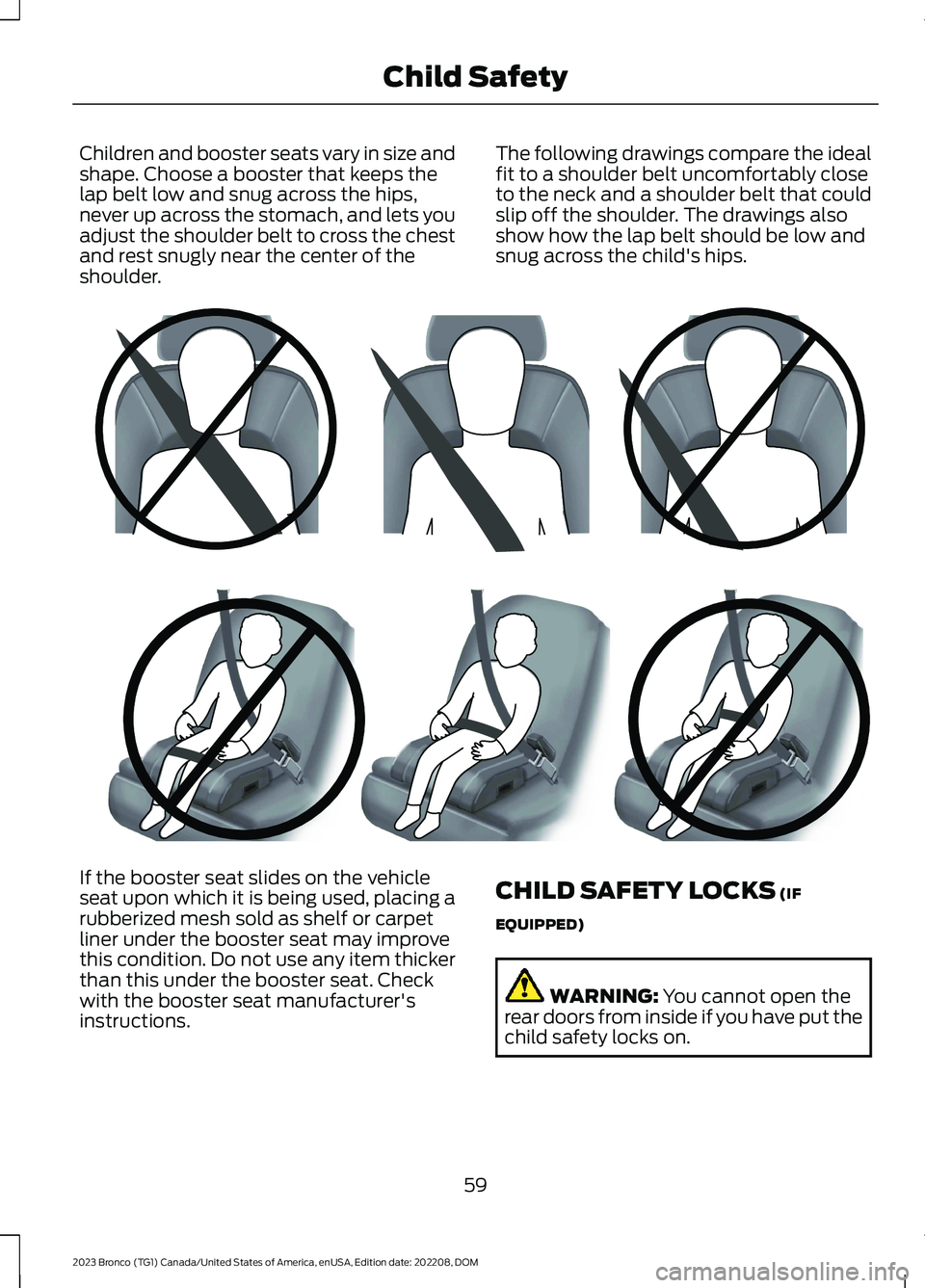
Children and booster seats vary in size andshape. Choose a booster that keeps thelap belt low and snug across the hips,never up across the stomach, and lets youadjust the shoulder belt to cross the chestand rest snugly near the center of theshoulder.
The following drawings compare the idealfit to a shoulder belt uncomfortably closeto the neck and a shoulder belt that couldslip off the shoulder. The drawings alsoshow how the lap belt should be low andsnug across the child's hips.
If the booster seat slides on the vehicleseat upon which it is being used, placing arubberized mesh sold as shelf or carpetliner under the booster seat may improvethis condition. Do not use any item thickerthan this under the booster seat. Checkwith the booster seat manufacturer'sinstructions.
CHILD SAFETY LOCKS (IF
EQUIPPED)
WARNING: You cannot open therear doors from inside if you have put thechild safety locks on.
59
2023 Bronco (TG1) Canada/United States of America, enUSA, Edition date: 202208, DOMChild SafetyE142596 E142597
Page 64 of 642
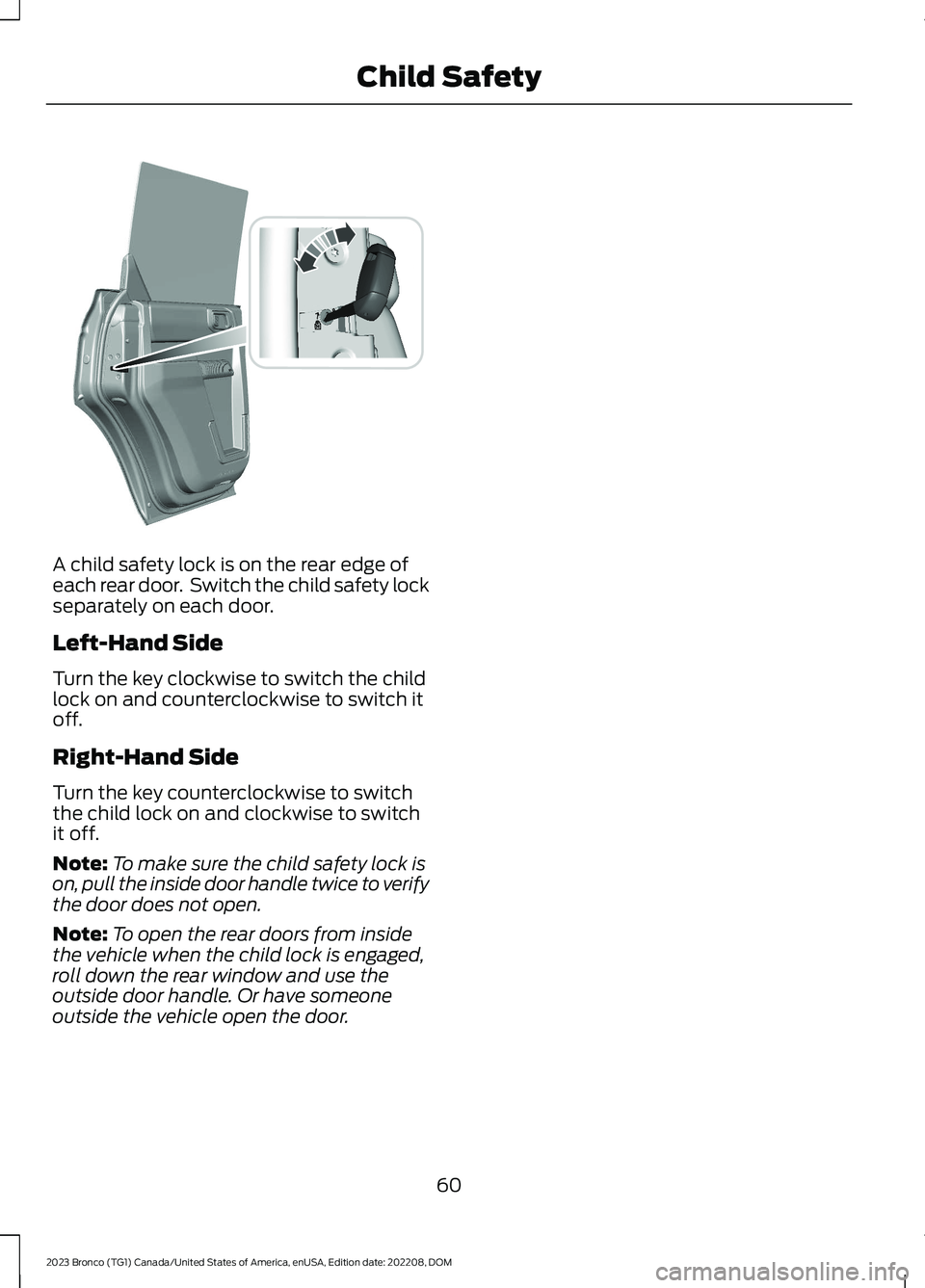
A child safety lock is on the rear edge ofeach rear door. Switch the child safety lockseparately on each door.
Left-Hand Side
Turn the key clockwise to switch the childlock on and counterclockwise to switch itoff.
Right-Hand Side
Turn the key counterclockwise to switchthe child lock on and clockwise to switchit off.
Note:To make sure the child safety lock ison, pull the inside door handle twice to verifythe door does not open.
Note:To open the rear doors from insidethe vehicle when the child lock is engaged,roll down the rear window and use theoutside door handle. Or have someoneoutside the vehicle open the door.
60
2023 Bronco (TG1) Canada/United States of America, enUSA, Edition date: 202208, DOMChild SafetyE373050
Page 65 of 642
SEATBELT PRECAUTIONS
WARNING: Always drive and ridewith your seatback upright and the lapbelt snug and low across the hips.
WARNING: Children must alwaysbe properly restrained.
WARNING: Do not allow apassenger to hold a child on their lapwhen your vehicle is moving. Failure tofollow this instruction could result inpersonal injury or death in the event of asudden stop or crash.
WARNING: All occupants of yourvehicle, including the driver, shouldalways properly wear their seatbelts,even when an airbag supplementalrestraint system is provided. Failure toproperly wear your seatbelt couldseriously increase the risk of injury ordeath.
WARNING: It is extremelydangerous to ride in a cargo area, insideor outside of a vehicle. In a crash, peopleriding in these areas are more likely to beseriously injured or killed. Do not allowpeople to ride in any area of your vehiclethat is not equipped with seats andseatbelts. Make sure everyone in yourvehicle is in a seat and properly using aseatbelt. Failure to follow this warningcould result in serious personal injury ordeath.
WARNING: In a rollover crash, anunbelted person is significantly morelikely to die than a person wearing aseatbelt.
WARNING: Each seating positionin your vehicle has a specific seatbeltassembly made up of one buckle andone tongue designed to be used as a pair.Use the shoulder belt on the outsideshoulder only. Never wear the shoulderbelt under the arm. Never use a singleseatbelt for more than one person.
WARNING: Even with advancedrestraints systems, properly restrainchildren 12 and under in a rear seatingposition. Failure to follow this couldseriously increase the risk of injury ordeath.
WARNING: Seatbelts and seatsmay be hot in a vehicle that is in thesunshine. The hot seatbelts or seats mayburn a small child. Check seat covers andbuckles before you place a childanywhere near them.
WARNING: If your vehicle isinvolved in a crash, have the seatbeltsand associated components inspectedas soon as possible. Failure to follow thisinstruction could result in personal injuryor death.
All seating positions in this vehicle havelap and shoulder seatbelts. All occupantsof the vehicle should properly wear theirseatbelts, even when an airbagsupplemental restraint system is provided.
The seatbelt system consists of:
•Lap and shoulder seatbelts.
•A shoulder seatbelt with automaticlocking mode, except driver seatbelt.
•Seatbelt pretensioners at the frontoutermost and rear outermost seatingpositions.
·A seatbelt warning light andchime.
61
2023 Bronco (TG1) Canada/United States of America, enUSA, Edition date: 202208, DOMSeatbeltsE71880
Page 66 of 642
· Crash sensors and monitoringsystem with readiness indicator.
The seatbelt pretensioners are designedto tighten the seatbelts when activated. Infrontal and near-frontal crashes, theseatbelt pretensioners may be activatedalone or, if the crash is of sufficient severity,together with the front airbags. In sidecrashes and rollovers, the pretensionerswill be activated when the Safety Canopyis activated.
FASTENING AND
UNFASTENING THE
SEATBELTS
All seatbelts in your vehicle are athree-point combination lap and shoulderseatbelt.
Seatbelt tongue.A
Seatbelt buckle.B
1.Pull the seatbelt out steadily.
Note:It may lock if you pull it sharply or ifthe vehicle is on a slope.
2.Insert the tongue into the buckle.
3.Pull the seatbelt tight to remove anyslack.
Unfastening the Seatbelts
1.Press the red button on the buckle torelease the seatbelt.
2.Hold the seatbelt tongue and let itretract completely and smoothly to itsstowed position.
SENSITIVE LOCKING MODE
WHAT IS SENSITIVE LOCKINGMODE
Sensitive locking mode is a seatbeltretractor feature that allows shoulder beltlength adjustment according to yourmovements and locking in response tovehicle movement.
HOW DOES SENSITIVE LOCKINGMODE WORK
If the driver suddenly brakes, turns a cornersharply, or the vehicle receives an impactof about 5 mph (8 km/h) or more, theseatbelts lock to help reduce forwardmovement of the driver and passengers.
In addition, the seatbelt retractor locks ifyou pull the seatbelt webbing out tooquickly. If the retractor does not unlock,pull the seatbelt out slowly then feed asmall length of webbing back toward thestowed position.
Note:When driving off-road or at a severeangle, the seatbelt mechanism locks. It doesnot allow you to pull the seatbelt webbingout until your vehicle is on nearly levelground.
62
2023 Bronco (TG1) Canada/United States of America, enUSA, Edition date: 202208, DOMSeatbeltsE67017 BA E338014
Page 67 of 642
AUTOMATIC LOCKING MODE
WHAT IS AUTOMATIC LOCKINGMODE
This is a safety feature built into theseatbelt retractors that keeps theseatbelts pre-locked.
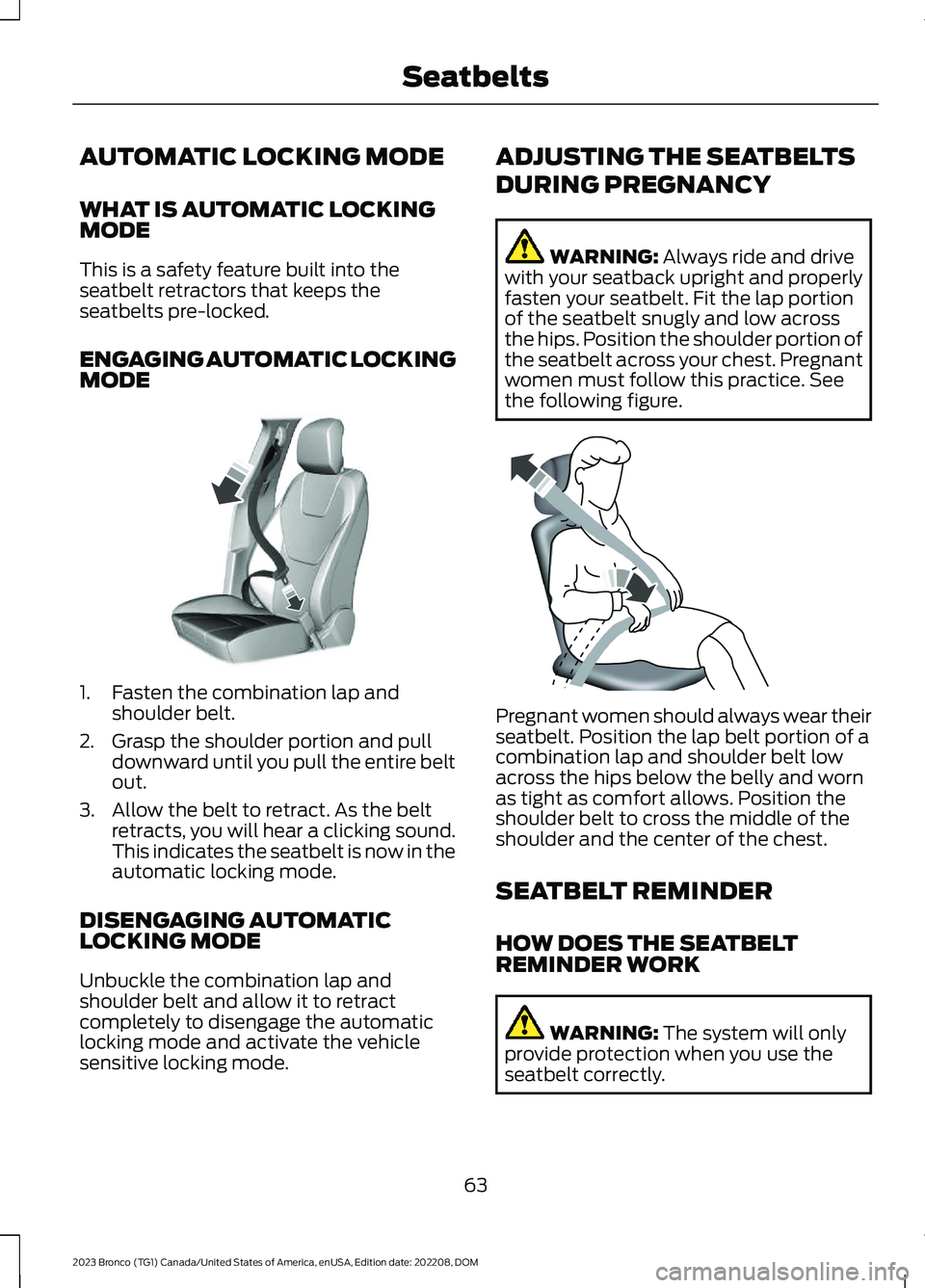
ENGAGING AUTOMATIC LOCKINGMODE
1.Fasten the combination lap andshoulder belt.
2.Grasp the shoulder portion and pulldownward until you pull the entire beltout.
3.Allow the belt to retract. As the beltretracts, you will hear a clicking sound.This indicates the seatbelt is now in theautomatic locking mode.
DISENGAGING AUTOMATICLOCKING MODE
Unbuckle the combination lap andshoulder belt and allow it to retractcompletely to disengage the automaticlocking mode and activate the vehiclesensitive locking mode.
ADJUSTING THE SEATBELTS
DURING PREGNANCY
WARNING: Always ride and drivewith your seatback upright and properlyfasten your seatbelt. Fit the lap portionof the seatbelt snugly and low acrossthe hips. Position the shoulder portion ofthe seatbelt across your chest. Pregnantwomen must follow this practice. Seethe following figure.
Pregnant women should always wear theirseatbelt. Position the lap belt portion of acombination lap and shoulder belt lowacross the hips below the belly and wornas tight as comfort allows. Position theshoulder belt to cross the middle of theshoulder and the center of the chest.
SEATBELT REMINDER
HOW DOES THE SEATBELTREMINDER WORK
WARNING: The system will onlyprovide protection when you use theseatbelt correctly.
63
2023 Bronco (TG1) Canada/United States of America, enUSA, Edition date: 202208, DOMSeatbeltsE142591 E142590