seats FORD E SERIES 2015 4.G User Guide
[x] Cancel search | Manufacturer: FORD, Model Year: 2015, Model line: E SERIES, Model: FORD E SERIES 2015 4.GPages: 360, PDF Size: 3.28 MB
Page 24 of 360
INSTALLING CHILD SEATS
Child Seats
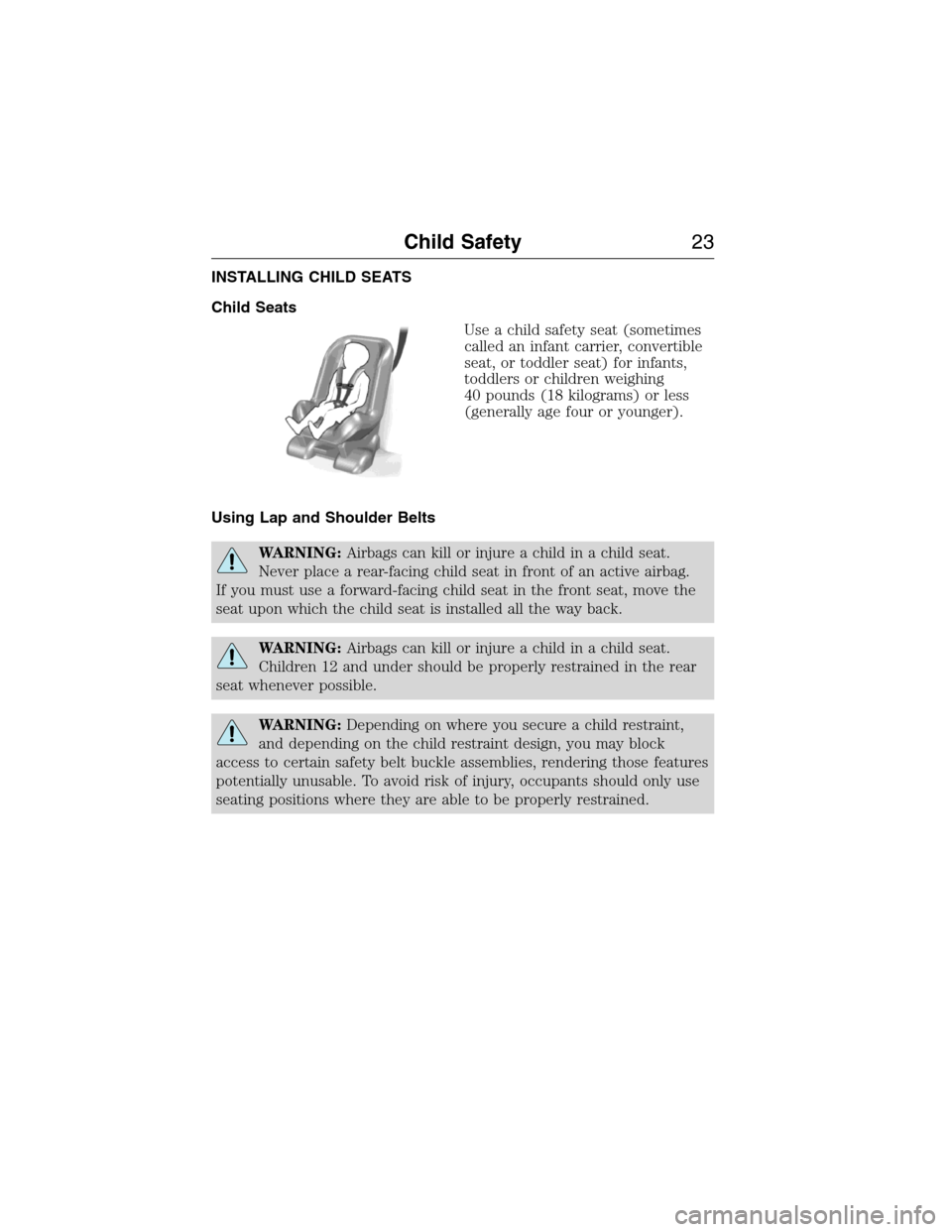
Use a child safety seat (sometimes
called an infant carrier, convertible
seat, or toddler seat) for infants,
toddlers or children weighing
40 pounds (18 kilograms) or less
(generally age four or younger).
Using Lap and Shoulder Belts
WARNING:Airbags can kill or injure a child in a child seat.
Never place a rear-facing child seat in front of an active airbag.
If you must use a forward-facing child seat in the front seat, move the
seat upon which the child seat is installed all the way back.
WARNING:Airbags can kill or injure a child in a child seat.
Children 12 and under should be properly restrained in the rear
seat whenever possible.
WARNING:Depending on where you secure a child restraint,
and depending on the child restraint design, you may block
access to certain safety belt buckle assemblies, rendering those features
potentially unusable. To avoid risk of injury, occupants should only use
seating positions where they are able to be properly restrained.
Child Safety23
2015 Econoline(eco)
Owners Guide gf, 1st Printing, June 2014
USA(fus)
Page 26 of 360
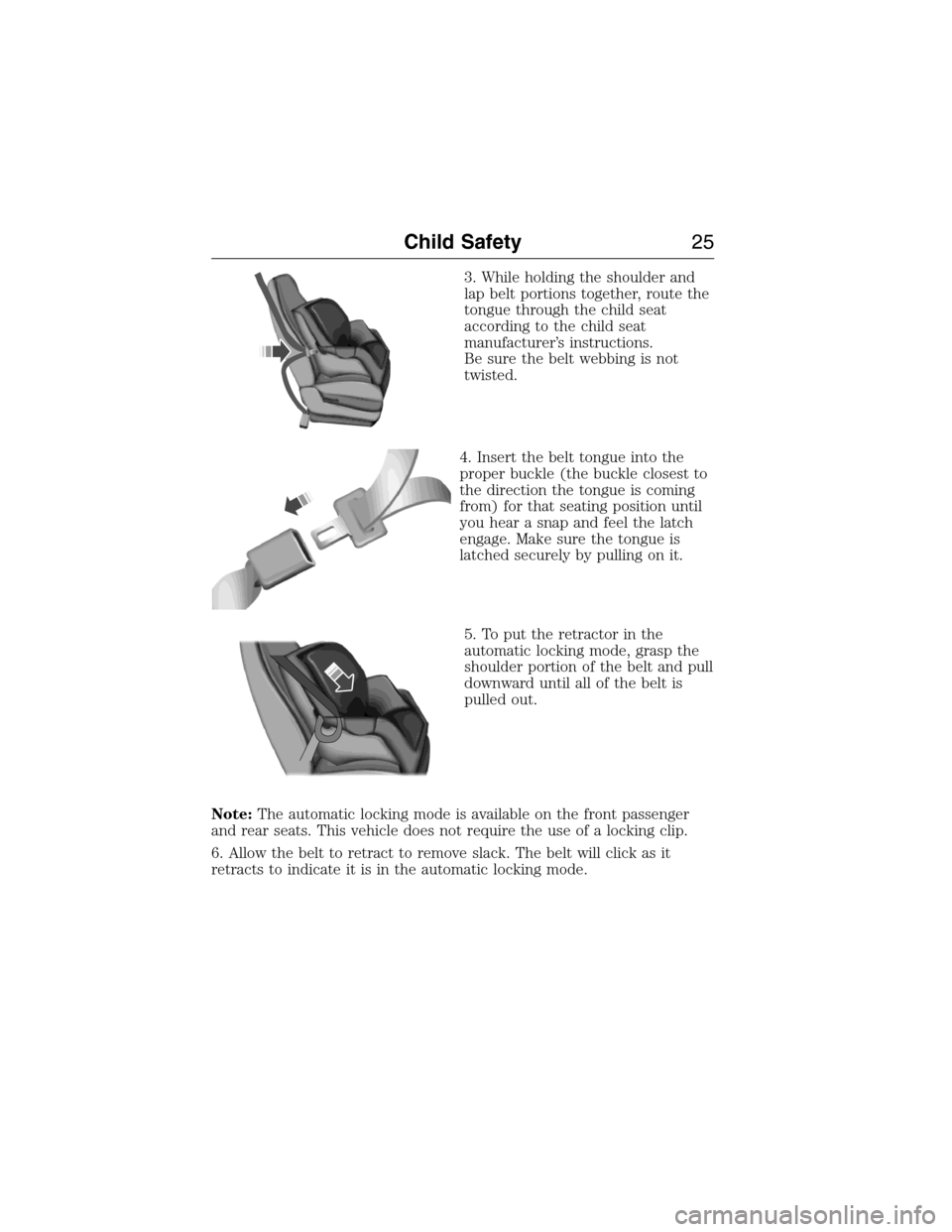
3. While holding the shoulder and
lap belt portions together, route the
tongue through the child seat
according to the child seat
manufacturer’s instructions.
Be sure the belt webbing is not
twisted.
4. Insert the belt tongue into the
proper buckle (the buckle closest to
the direction the tongue is coming
from) for that seating position until
you hear a snap and feel the latch
engage. Make sure the tongue is
latched securely by pulling on it.
5. To put the retractor in the
automatic locking mode, grasp the
shoulder portion of the belt and pull
downward until all of the belt is
pulled out.
Note:The automatic locking mode is available on the front passenger
and rear seats. This vehicle does not require the use of a locking clip.
6. Allow the belt to retract to remove slack. The belt will click as it
retracts to indicate it is in the automatic locking mode.
Child Safety25
2015 Econoline(eco)
Owners Guide gf, 1st Printing, June 2014
USA(fus)
Page 28 of 360
Using Tether Straps
Many forward-facing child safety seats include a tether strap
which extends from the back of the child safety seat and hooks
to an anchoring point called the top tether anchor. Tether
straps are available as an accessory for many older safety seats.
Contact the manufacturer of your child seat for information about
ordering a tether strap, or to obtain a longer tether strap if the tether
strap on your safety seat does not reach the appropriate top tether
anchor in the vehicle.
Attach the tether strap only to the appropriate tether anchor as shown.
The tether strap may not work properly if attached somewhere other
than the correct tether anchor.
Note:If you install a child seat with rigid LATCH attachments, and have
attached the top tether strap to the proper top tether anchor, do not
tighten the tether strap enough to lift the child seat off the vehicle seat
cushion when the child is seated in it. Keep the tether strap just snug
without lifting the front of the child seat. Keeping the child seat just
touching the vehicle seat gives the best protection in a severe crash.
Perform the following steps to install a child safety seat with tether
anchors:
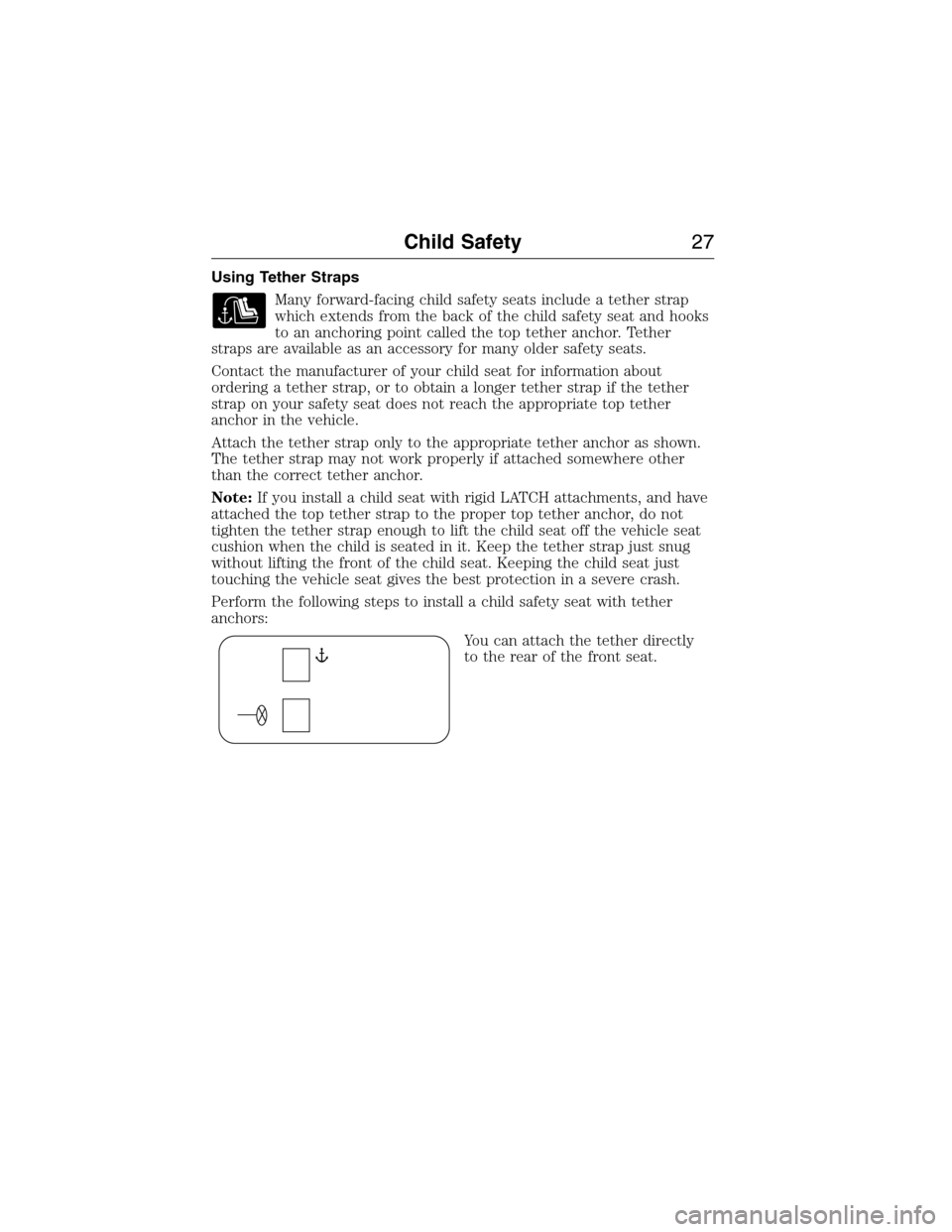
You can attach the tether directly
to the rear of the front seat.
Child Safety27
2015 Econoline(eco)
Owners Guide gf, 1st Printing, June 2014
USA(fus)
Page 30 of 360
PRINCIPLES OF OPERATION
WARNING:Always drive and ride with your seatback upright
and the lap belt snug and low across the hips.
WARNING:Never let a passenger hold a child on his or her lap
while the vehicle is moving. The passenger cannot protect the
child from injury in a crash.
WARNING:To reduce the risk of injury, make sure children sit
where they can be properly restrained.
WARNING:All occupants of the vehicle, including the driver,
should always properly wear their safety belts, even when an
airbag supplemental restraint system is provided. Failure to properly
wear your safety belt could seriously increase the risk of injury or
death.
WARNING:It is extremely dangerous to ride in a cargo area,
inside or outside of a vehicle. In a crash, people riding in these
areas are more likely to be seriously injured or killed. Do not allow
people to ride in any area of your vehicle that is not equipped with
seats and safety belts. Be sure everyone in your vehicle is in a seat and
using a safety belt properly.
WARNING:In a rollover crash, an unbelted person is significantly
more likely to die than a person wearing a safety belt.
WARNING:Each seating position in your vehicle has a specific
safety belt assembly which is made up of one buckle and one
tongue that are designed to be used as a pair. 1) Use the shoulder belt
on the outside shoulder only. Never wear the shoulder belt under the
arm. 2) Never swing the safety belt around your neck over the inside
shoulder. 3) Never use a single belt for more than one person.
Safety Belts29
2015 Econoline(eco)
Owners Guide gf, 1st Printing, June 2014
USA(fus)
Page 31 of 360
WARNING:Safety belts and seats can become hot in a vehicle
that has been closed up in sunny weather; they could burn a
small child. Check seat covers and buckles before you place a child
anywhere near them.
WARNING:Front seat occupants, including pregnant women,
should wear safety belts for optimum protection in an accident.
All seating positions in this vehicle have lap and shoulder safety belts.
All occupants of the vehicle should always properly wear their safety
belts, even when an airbag supplemental restraint system is provided.
The safety belt system consists of:
•Lap and shoulder safety belts.
•Shoulder safety belt with automatic locking mode (except driver
safety belt).
•Height adjuster at the front outboard seating positions.
•Safety belt pretensioner at the front outboard seating positions.
•Safety belt warning light and chime. SeeSafety belt warning
light and indicator chime.
•Crash sensors and monitoring system with readiness
indicator. SeeCrash sensors and airbag indicatorin the
Supplemental Restraints Systemchapter.
The safety belt pretensioners are designed to activate in frontal or
near-frontal crashes and may deploy in rollovers if the vehicle is
equipped with roll stability control. The safety belt pretensioners at the
front seating positions are designed to tighten the safety belts firmly
against the occupant’s body when activated. This helps increase the
effectiveness of the safety belts.
30Safety Belts
2015 Econoline(eco)
Owners Guide gf, 1st Printing, June 2014
USA(fus)
Page 33 of 360
Using Safety Belts During Pregnancy
WARNING:Always ride and drive with your seatback upright
and the safety belt properly fastened. The lap portion of the
safety belt should fit snug and be positioned low across the hips.
The shoulder portion of the safety belt should be positioned across the
chest. Pregnant women should also follow this practice. See the
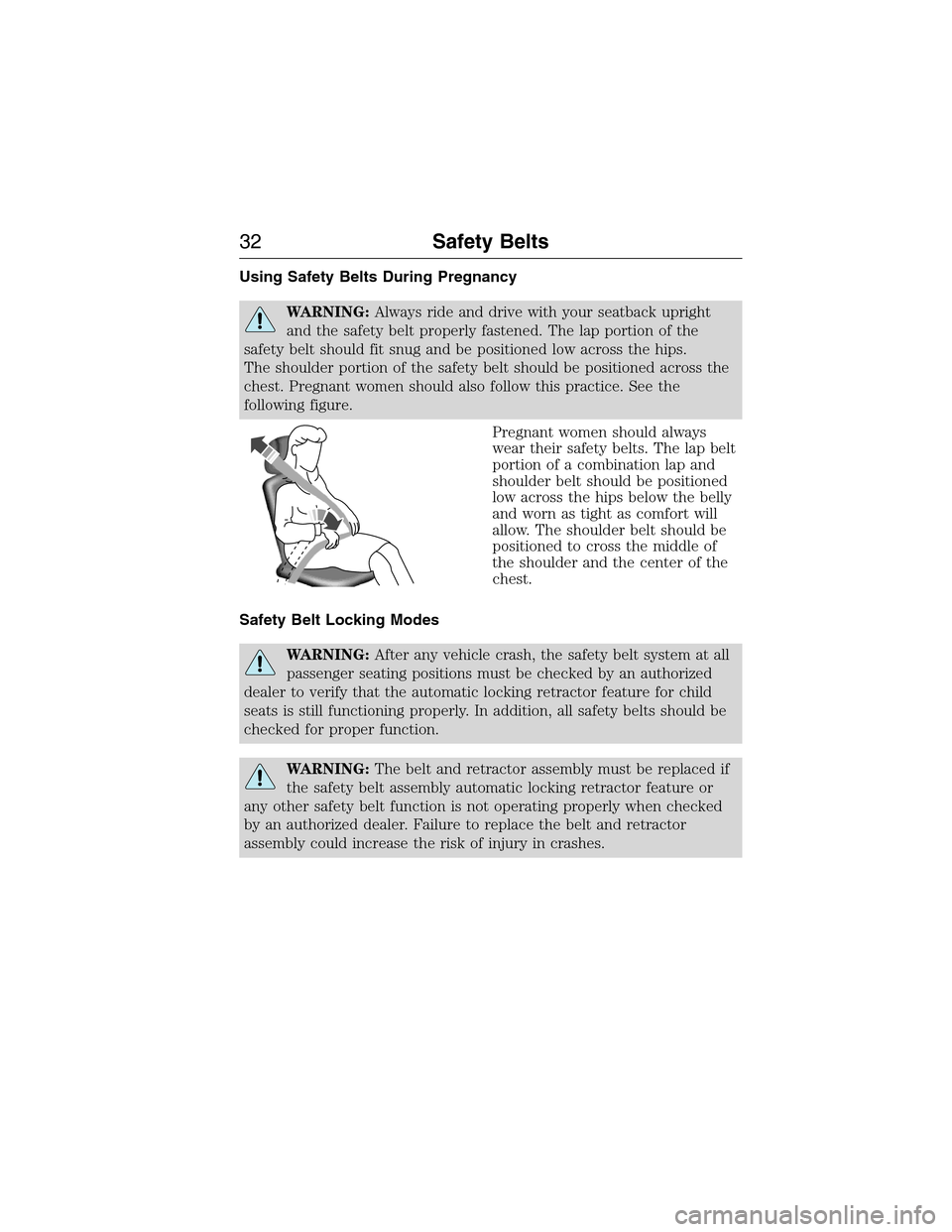
following figure.
Pregnant women should always
wear their safety belts. The lap belt
portion of a combination lap and
shoulder belt should be positioned
low across the hips below the belly
and worn as tight as comfort will
allow. The shoulder belt should be
positioned to cross the middle of
the shoulder and the center of the
chest.
Safety Belt Locking Modes
WARNING:After any vehicle crash, the safety belt system at all
passenger seating positions must be checked by an authorized
dealer to verify that the automatic locking retractor feature for child
seats is still functioning properly. In addition, all safety belts should be
checked for proper function.
WARNING:The belt and retractor assembly must be replaced if
the safety belt assembly automatic locking retractor feature or
any other safety belt function is not operating properly when checked
by an authorized dealer. Failure to replace the belt and retractor
assembly could increase the risk of injury in crashes.
32Safety Belts
2015 Econoline(eco)
Owners Guide gf, 1st Printing, June 2014
USA(fus)
Page 42 of 360
After all occupants have adjusted their seats and put on safety belts,
it is very important that they continue to sit properly. Properly seated
occupants sit upright, lean against the seat back, and center themselves
on the seat cushion, with their feet comfortably extended on the floor.
Sitting improperly can increase the chance of injury in a crash event. For
example, if an occupant slouches, lies down, turns sideways, sits forward,
leans forward or sideways, or puts one or both feet up, the chance of
injury during a crash is greatly increased.
Children and Airbags
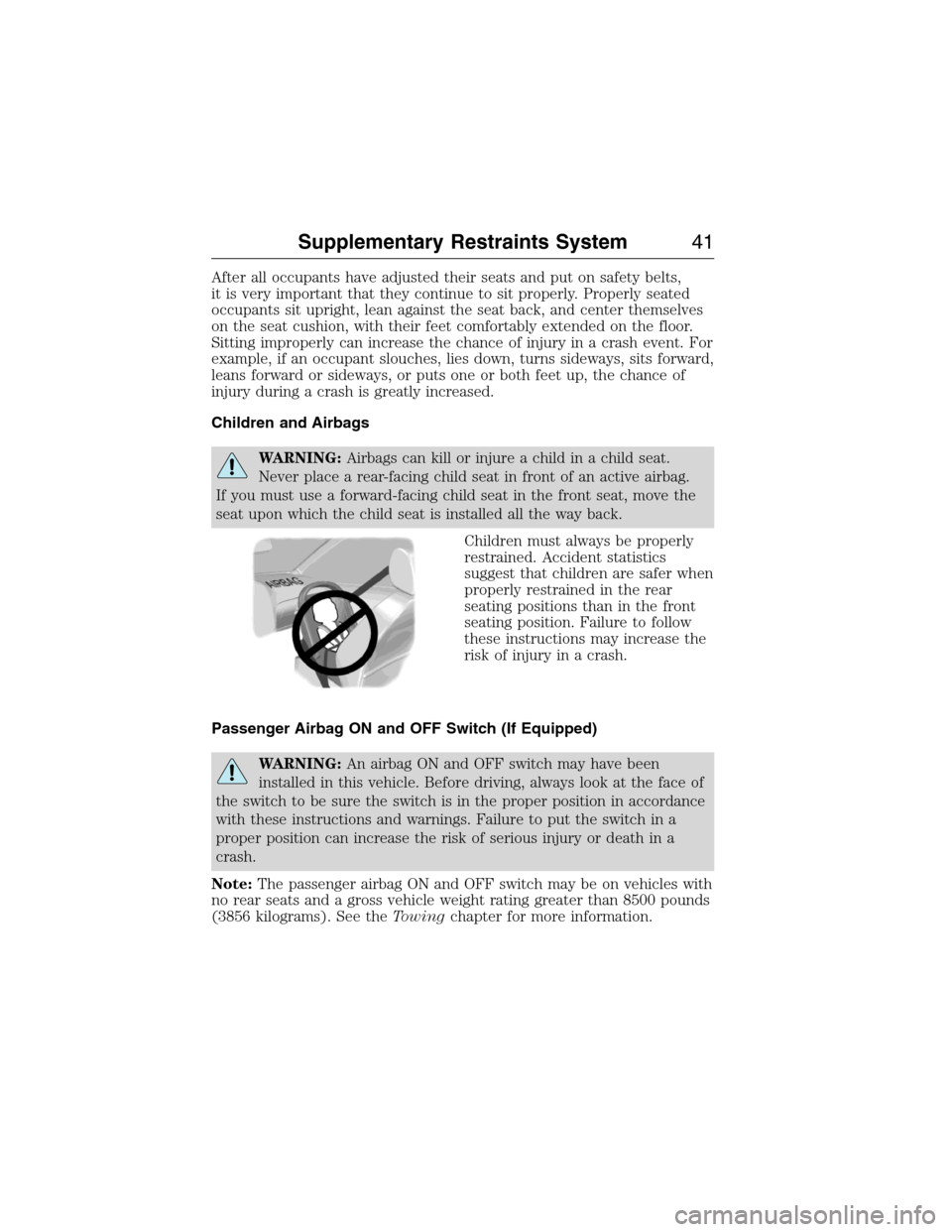
WARNING:Airbags can kill or injure a child in a child seat.
Never place a rear-facing child seat in front of an active airbag.
If you must use a forward-facing child seat in the front seat, move the
seat upon which the child seat is installed all the way back.
Children must always be properly
restrained. Accident statistics
suggest that children are safer when
properly restrained in the rear
seating positions than in the front
seating position. Failure to follow
these instructions may increase the
risk of injury in a crash.
Passenger Airbag ON and OFF Switch (If Equipped)
WARNING:An airbag ON and OFF switch may have been
installed in this vehicle. Before driving, always look at the face of
the switch to be sure the switch is in the proper position in accordance
with these instructions and warnings. Failure to put the switch in a
proper position can increase the risk of serious injury or death in a
crash.
Note:The passenger airbag ON and OFF switch may be on vehicles with
no rear seats and a gross vehicle weight rating greater than 8500 pounds
(3856 kilograms). See theTowingchapter for more information.
Supplementary Restraints System41
2015 Econoline(eco)
Owners Guide gf, 1st Printing, June 2014
USA(fus)
Page 43 of 360
Turning the Passenger Airbag Off
WARNING:If the light fails to illuminate when the passenger air
bag switch is in the OFF position and the ignition switch is in
ON, contact your authorized dealer as soon as possible.
WARNING:In order to avoid inadvertent activation of the
switch, always remove the ignition key from the passenger air
bag ON and OFF switch.
WARNING:An infant in a rear-facing seat faces a high risk of
serious or fatal injuries from a deploying passenger airbag. Rear
facing infant seats should never be placed in the front seats, unless the
passenger airbag is turned off.
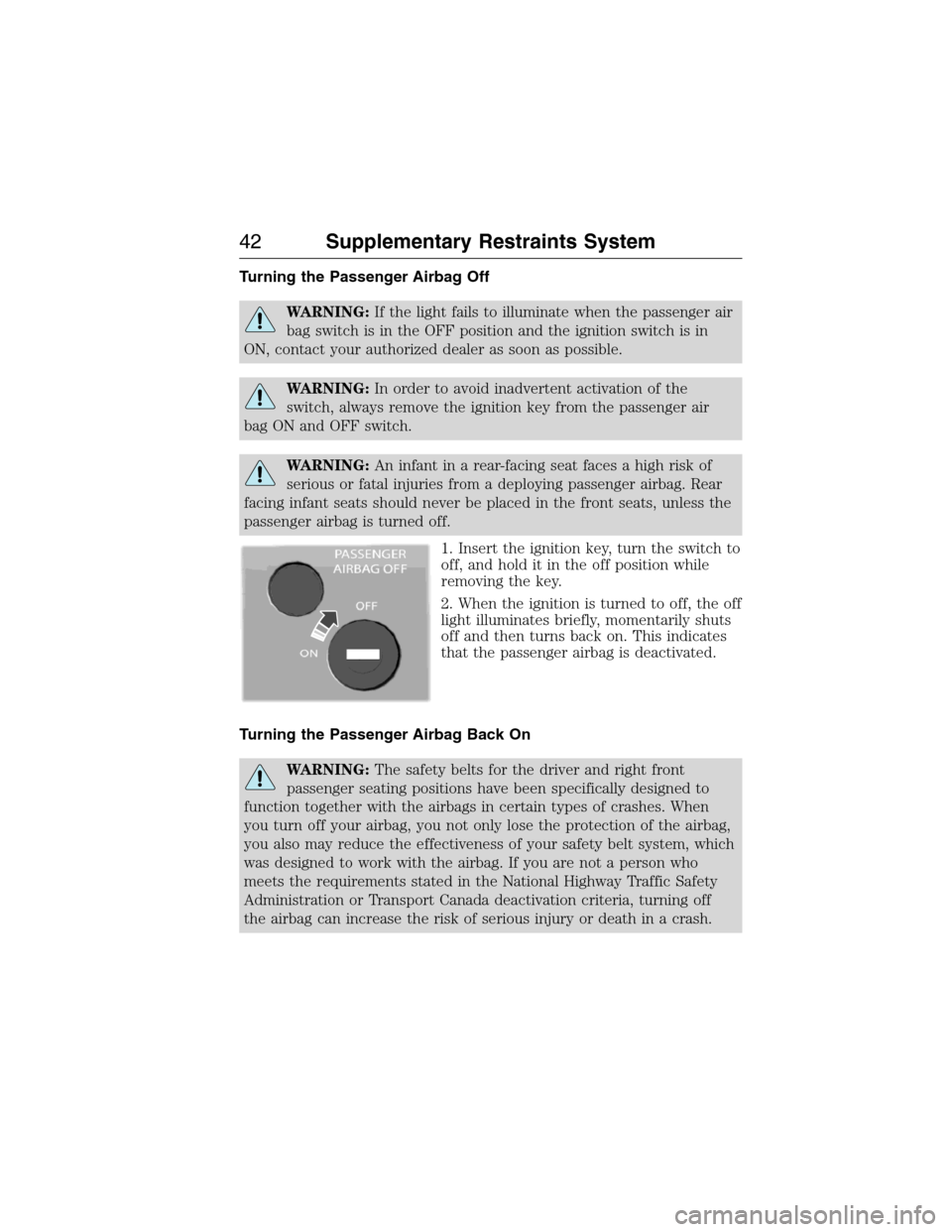
1. Insert the ignition key, turn the switch to
off, and hold it in the off position while
removing the key.
2. When the ignition is turned to off, the off
light illuminates briefly, momentarily shuts
off and then turns back on. This indicates
that the passenger airbag is deactivated.
Turning the Passenger Airbag Back On
WARNING:The safety belts for the driver and right front
passenger seating positions have been specifically designed to
function together with the airbags in certain types of crashes. When
you turn off your airbag, you not only lose the protection of the airbag,
you also may reduce the effectiveness of your safety belt system, which
was designed to work with the airbag. If you are not a person who
meets the requirements stated in the National Highway Traffic Safety
Administration or Transport Canada deactivation criteria, turning off
the airbag can increase the risk of serious injury or death in a crash.
42Supplementary Restraints System
2015 Econoline(eco)
Owners Guide gf, 1st Printing, June 2014
USA(fus)
Page 44 of 360
WARNING:If your vehicle has rear seats, always transport
children who are 12 and younger in a rear seating position.
Always use safety belts and child restraints properly. Do not place a
child in a rear facing infant seat in the front seat unless your vehicle is
equipped with an airbag ON and OFF switch and the passenger airbag
is turned off. This is because the back of the infant seat is too close to
the inflating airbag and the risk of a fatal injury to the infant when the
airbag inflates is substantial.
WARNING:If the OFF light is illuminated when the passenger
airbag switch is in the ON position and the ignition switch is in
ON, have the passenger airbag switch serviced at an authorized dealer
immediately.
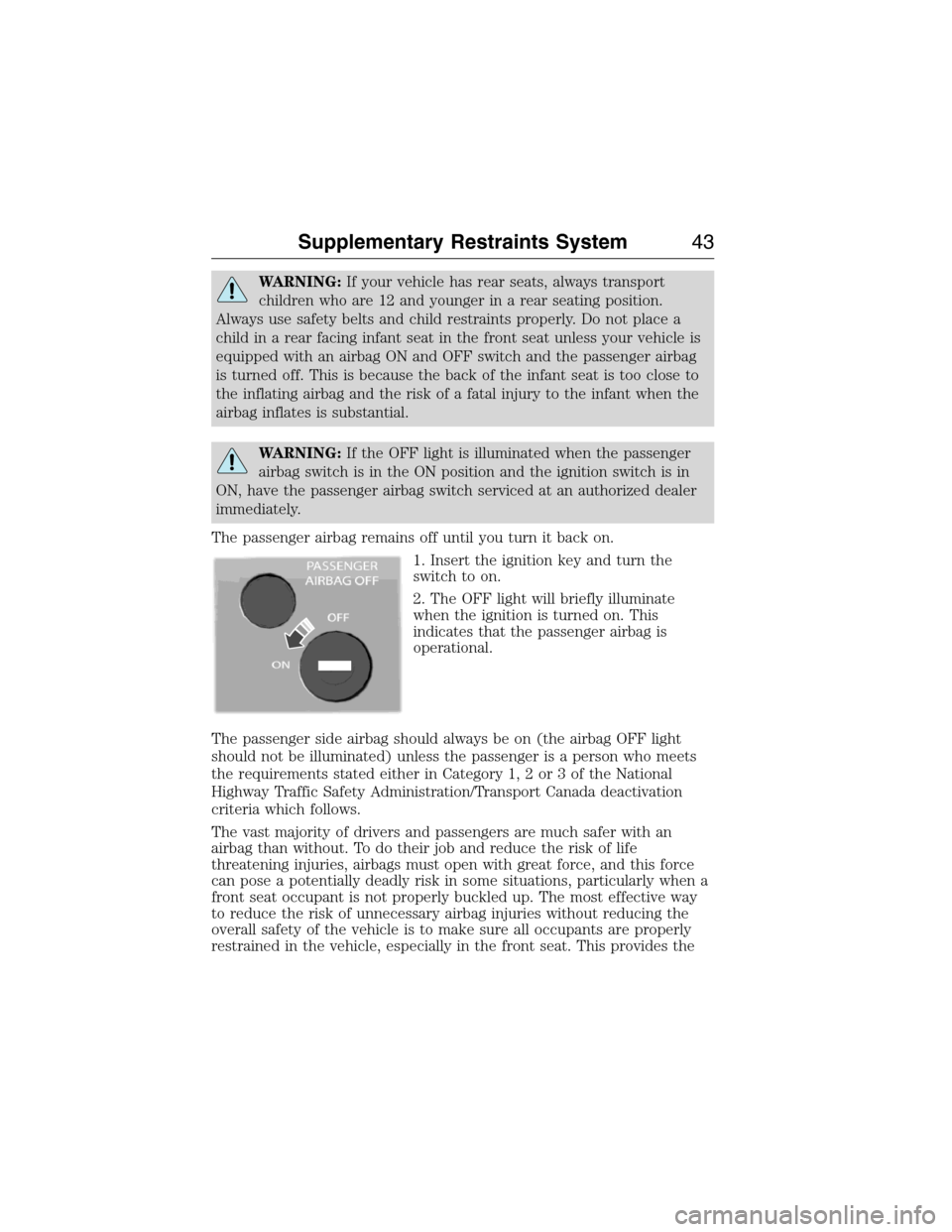
The passenger airbag remains off until you turn it back on.
1. Insert the ignition key and turn the
switch to on.
2. The OFF light will briefly illuminate
when the ignition is turned on. This
indicates that the passenger airbag is
operational.
The passenger side airbag should always be on (the airbag OFF light
should not be illuminated) unless the passenger is a person who meets
the requirements stated either in Category 1, 2 or 3 of the National
Highway Traffic Safety Administration/Transport Canada deactivation
criteria which follows.
The vast majority of drivers and passengers are much safer with an
airbag than without. To do their job and reduce the risk of life
threatening injuries, airbags must open with great force, and this force
can pose a potentially deadly risk in some situations, particularly when a
front seat occupant is not properly buckled up. The most effective way
to reduce the risk of unnecessary airbag injuries without reducing the
overall safety of the vehicle is to make sure all occupants are properly
restrained in the vehicle, especially in the front seat. This provides the
Supplementary Restraints System43
2015 Econoline(eco)
Owners Guide gf, 1st Printing, June 2014
USA(fus)
Page 85 of 360
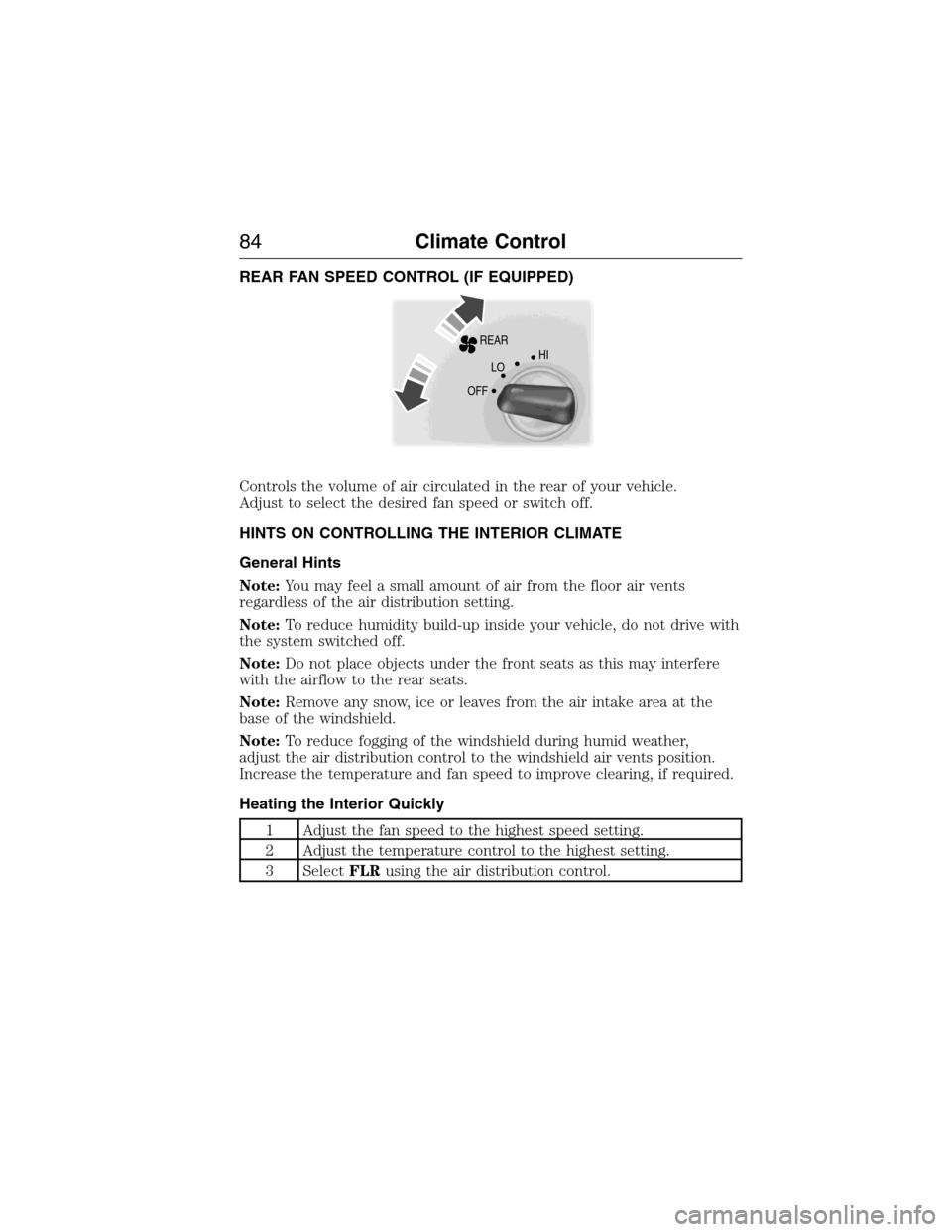
REAR FAN SPEED CONTROL (IF EQUIPPED)
Controls the volume of air circulated in the rear of your vehicle.
Adjust to select the desired fan speed or switch off.
HINTS ON CONTROLLING THE INTERIOR CLIMATE
General Hints
Note:You may feel a small amount of air from the floor air vents
regardless of the air distribution setting.
Note:To reduce humidity build-up inside your vehicle, do not drive with
the system switched off.
Note:Do not place objects under the front seats as this may interfere
with the airflow to the rear seats.
Note:Remove any snow, ice or leaves from the air intake area at the
base of the windshield.
Note:To reduce fogging of the windshield during humid weather,
adjust the air distribution control to the windshield air vents position.
Increase the temperature and fan speed to improve clearing, if required.
Heating the Interior Quickly
1 Adjust the fan speed to the highest speed setting.
2 Adjust the temperature control to the highest setting.
3 SelectFLRusing the air distribution control.
REAR
HI
LO
OFF
84Climate Control
2015 Econoline(eco)
Owners Guide gf, 1st Printing, June 2014
USA(fus)