recommended oil FORD E SERIES 2015 4.G Owners Manual
[x] Cancel search | Manufacturer: FORD, Model Year: 2015, Model line: E SERIES, Model: FORD E SERIES 2015 4.GPages: 360, PDF Size: 3.28 MB
Page 77 of 360
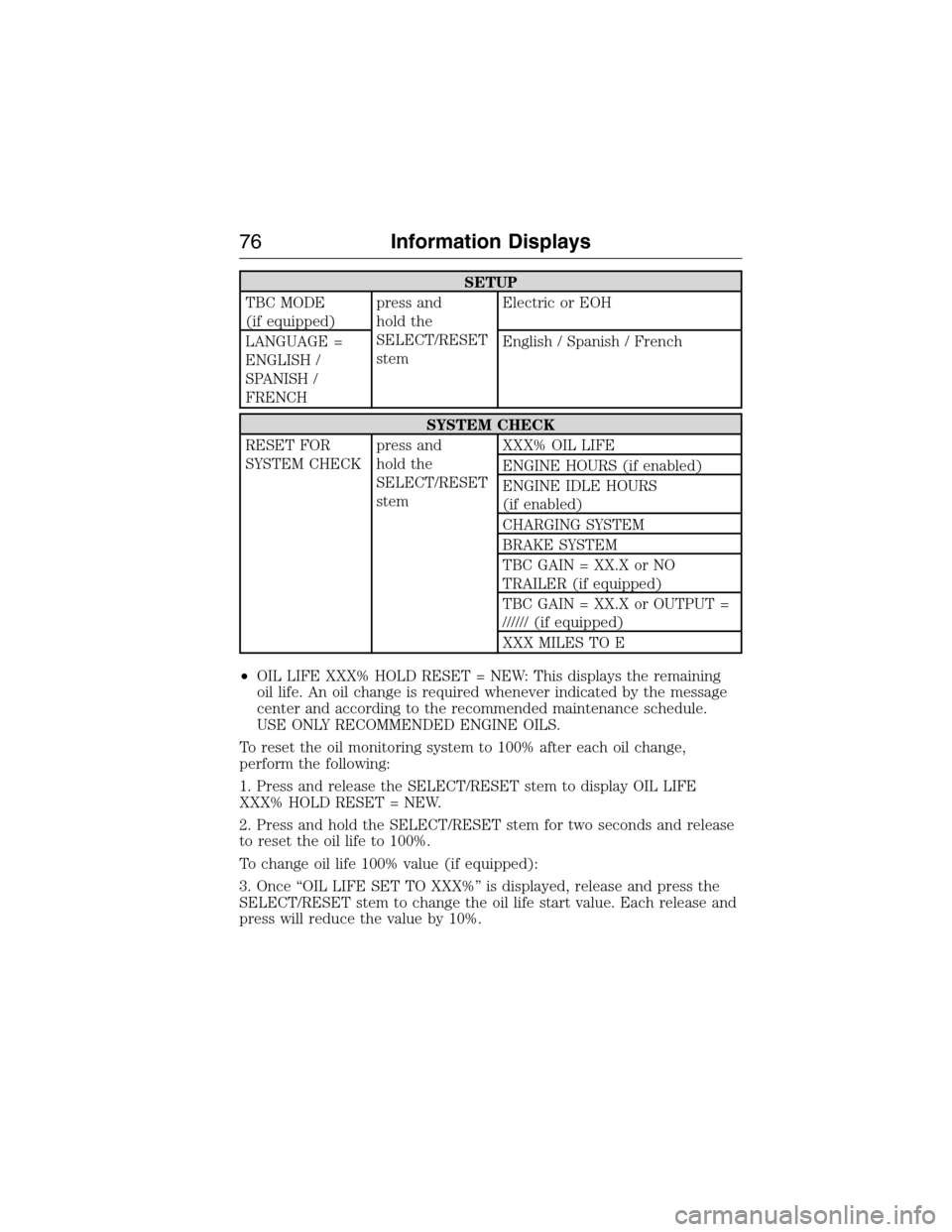
SETUP
TBC MODE
(if equipped)press and
hold the
SELECT/RESET
stemElectric or EOH
LANGUAGE =
ENGLISH /
SPANISH /
FRENCHEnglish / Spanish / French
SYSTEM CHECK
RESET FOR
SYSTEM CHECKpress and
hold the
SELECT/RESET
stemXXX% OIL LIFE
ENGINE HOURS (if enabled)
ENGINE IDLE HOURS
(if enabled)
CHARGING SYSTEM
BRAKE SYSTEM
TBC GAIN = XX.X or NO
TRAILER (if equipped)
TBC GAIN = XX.X or OUTPUT =
////// (if equipped)
XXX MILES TO E
•OIL LIFE XXX% HOLD RESET = NEW: This displays the remaining
oil life. An oil change is required whenever indicated by the message
center and according to the recommended maintenance schedule.
USE ONLY RECOMMENDED ENGINE OILS.
To reset the oil monitoring system to 100% after each oil change,
perform the following:
1. Press and release the SELECT/RESET stem to display OIL LIFE
XXX% HOLD RESET = NEW.
2. Press and hold the SELECT/RESET stem for two seconds and release
to reset the oil life to 100%.
To change oil life 100% value (if equipped):
3. Once “OIL LIFE SET TO XXX%” is displayed, release and press the
SELECT/RESET stem to change the oil life start value. Each release and
press will reduce the value by 10%.
76Information Displays
2015 Econoline(eco)
Owners Guide gf, 1st Printing, June 2014
USA(fus)
Page 143 of 360
•Keep the tires properly inflated and use only the recommended size.
•Use the recommended engine oil.
•Perform all regularly scheduled maintenance.
There are also some things you may not want to do because they may
reduce your fuel economy:
•Sudden or hard accelerations.
•Rev the engine before turning it off.
•Idle for periods longer than one minute.
•Warm up your vehicle on cold mornings.
•Use the air conditioner or front defroster.
•Use the speed control in hilly terrain.
•Rest your foot on the brake pedal while driving.
•Drive a heavily loaded vehicle or tow a trailer.
•Carry unnecessary weight (approximately 1 mpg [0.4 km/L] is lost for
every 400 pounds [180 kilograms] of weight carried).
•Add particular accessories to your vehicle (e.g.; bug deflectors,
rollbars or light bars, running boards, ski racks).
•Drive with the wheels out of alignment.
DRIVING THROUGH WATER
WARNING:Do not drive through flowing or deep water as you
may lose control of your vehicle.
Note:Driving through standing water can cause vehicle damage.
Note:Engine damage can occur if water enters the air filter.
142Driving Hints
2015 Econoline(eco)
Owners Guide gf, 1st Printing, June 2014
USA(fus)
Page 210 of 360
Body
•Wash vehicle thoroughly to remove dirt, grease, oil, tar or mud from
exterior surfaces, rear-wheel housing and underside of front fenders.
•Periodically wash vehicles stored in exposed locations.
•Touch up raw or primed metal to prevent rust.
•Cover chrome and stainless steel parts with a thick coat of auto wax
to prevent discoloration. Re-wax as necessary when the vehicle is
washed.
•Lubricate hood latch, all door latches and trunk lid hinges with a light
grade oil.
•Cover interior trim to prevent fading.
•Keep all rubber parts free from oil and solvents.
Engine
•The engine oil and filter should be changed prior to storage, as used
engine oil contains contaminates that may cause engine damage.
•Start the engine every 15 days. Run at fast idle until it reaches normal
operating temperature.
•With your foot on the brake, shift through all the gears while the
engine is running.
Fuel system
•Fill the fuel tank with high-quality fuel until the first automatic shutoff
of the fuel pump nozzle.
Cooling system
•Protect against freezing temperatures.
•When removing vehicle from storage, check coolant fluid level.
Confirm there are no cooling system leaks, and fluid is at the
recommended level.
Battery
•Check and recharge as necessary. Keep connections clean.
•If storing your vehicle for more than 30 days without recharging the
battery, it may be advisable to disconnect the battery cables to ensure
battery charge is maintained for quick starting.
Note:If battery cables are disconnected, it will be necessary to reset
memory features.
Vehicle Care209
2015 Econoline(eco)
Owners Guide gf, 1st Printing, June 2014
USA(fus)
Page 211 of 360
Brakes
•Make sure brakes and parking brake are fully released.
Tires
•Maintain recommended air pressure.
Miscellaneous
•Make sure all linkages, cables, levers and pins under vehicle are
covered with grease to prevent rust.
•Move vehicles at least 25 feet (8 meters) every 15 days to lubricate
working parts and prevent corrosion.
Removing Vehicle from Storage
When your vehicle is ready to come out of storage, do the following:
•Wash your vehicle to remove any dirt or grease film build-up on
window surfaces.
•Check windshield wipers for any deterioration.
•Check under the hood for any foreign material that may have collected
during storage (mice/squirrel nests).
•Check the exhaust for any foreign material that may have collected
during storage.
•Check tire pressures and set tire inflation per the Tire Label.
•Check brake pedal operation. Drive the vehicle 15 feet (4.5 meters)
back and forth to remove rust build-up.
•Check fluid levels (including coolant, oil and gas) to make sure there
are no leaks and fluids are at recommended levels.
•If the battery was removed, clean the battery cable ends and inspect.
Contact your authorized dealer if you have any concerns or issues.
210Vehicle Care
2015 Econoline(eco)
Owners Guide gf, 1st Printing, June 2014
USA(fus)
Page 248 of 360
Bolt size and wheel
lug nut typeWheel lug nut torque*
ft-lb N•m
9/16 x 18 conical lug
nut150 200
9/16 x 18 two-piece
lug nut140 190
* Torque specifications are for nut and bolt threads free of dirt and
rust. Use only Ford recommended replacement fasteners.
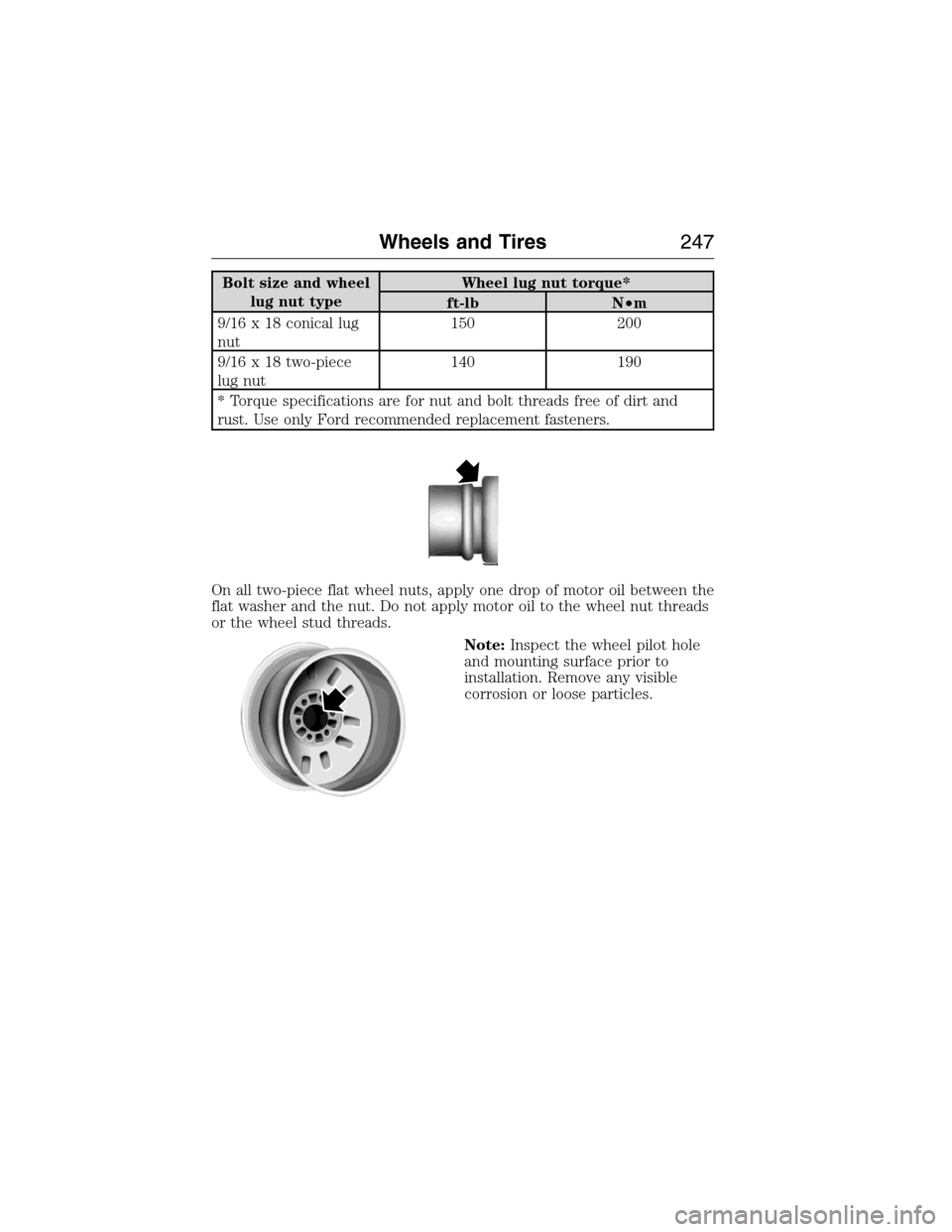
On all two-piece flat wheel nuts, apply one drop of motor oil between the
flat washer and the nut. Do not apply motor oil to the wheel nut threads
or the wheel stud threads.
Note:Inspect the wheel pilot hole
and mounting surface prior to
installation. Remove any visible
corrosion or loose particles.
Wheels and Tires247
2015 Econoline(eco)
Owners Guide gf, 1st Printing, June 2014
USA(fus)
Page 255 of 360
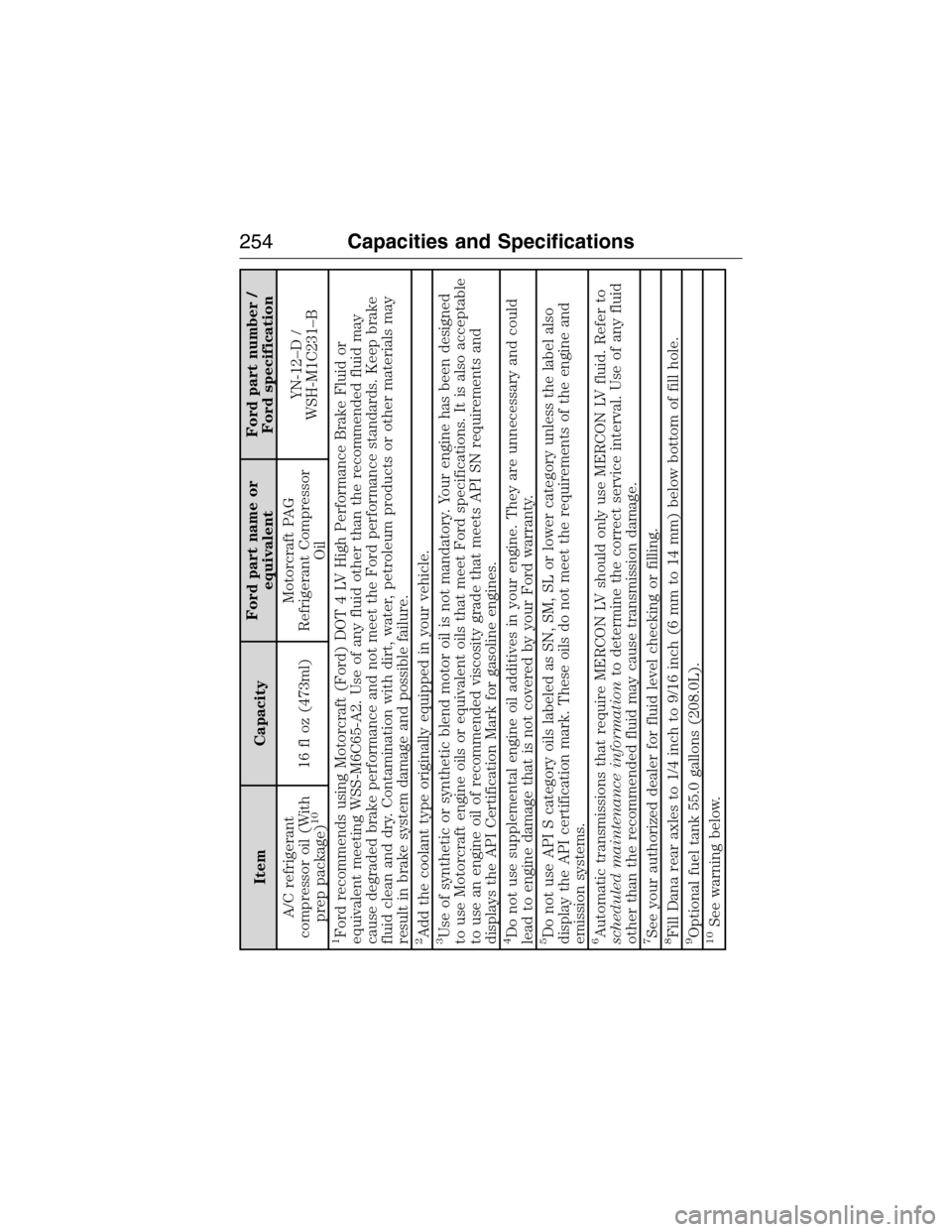
Item CapacityFord part name or
equivalentFord part number /
Ford specification
A/C refrigerant
compressor oil (With
prep package)
10
16 fl oz (473ml)Motorcraft PAG
Refrigerant Compressor
OilYN-12–D /
WSH-M1C231–B
1Ford recommends using Motorcraft (Ford) DOT 4 LV High Performance Brake Fluid or
equivalent meeting WSS-M6C65-A2. Use of any fluid other than the recommended fluid may
cause degraded brake performance and not meet the Ford performance standards. Keep brake
fluid clean and dry. Contamination with dirt, water, petroleum products or other materials may
result in brake system damage and possible failure.2Add the coolant type originally equipped in your vehicle.3Use of synthetic or synthetic blend motor oil is not mandatory. Your engine has been designed
to use Motorcraft engine oils or equivalent oils that meet Ford specifications. It is also acceptable
to use an engine oil of recommended viscosity grade that meets API SN requirements and
displays the API Certification Mark for gasoline engines.4Do not use supplemental engine oil additives in your engine. They are unnecessary and could
lead to engine damage that is not covered by your Ford warranty.5Do not use API S category oils labeled as SN, SM, SL or lower category unless the label also
display the API certification mark. These oils do not meet the requirements of the engine and
emission systems.6Automatic transmissions that require MERCON LV should only use MERCON LV fluid. Refer to
scheduled maintenance informationto determine the correct service interval. Use of any fluid
other than the recommended fluid may cause transmission damage.7See your authorized dealer for fluid level checking or filling.8Fill Dana rear axles to 1/4 inch to 9/16 inch (6 mm to 14 mm) below bottom of fill hole.9Optional fuel tank 55.0 gallons (208.0L).10
See warning below.
254Capacities and Specifications
2015 Econoline(eco)
Owners Guide gf, 1st Printing, June 2014
USA(fus)
Page 256 of 360
WARNING:The air conditioning refrigerant system contains
refrigerant R–134a under high pressure. Opening the air
conditioning refrigerant system can cause personal injury. Only qualified
personnel should service the air conditioning refrigerant system.
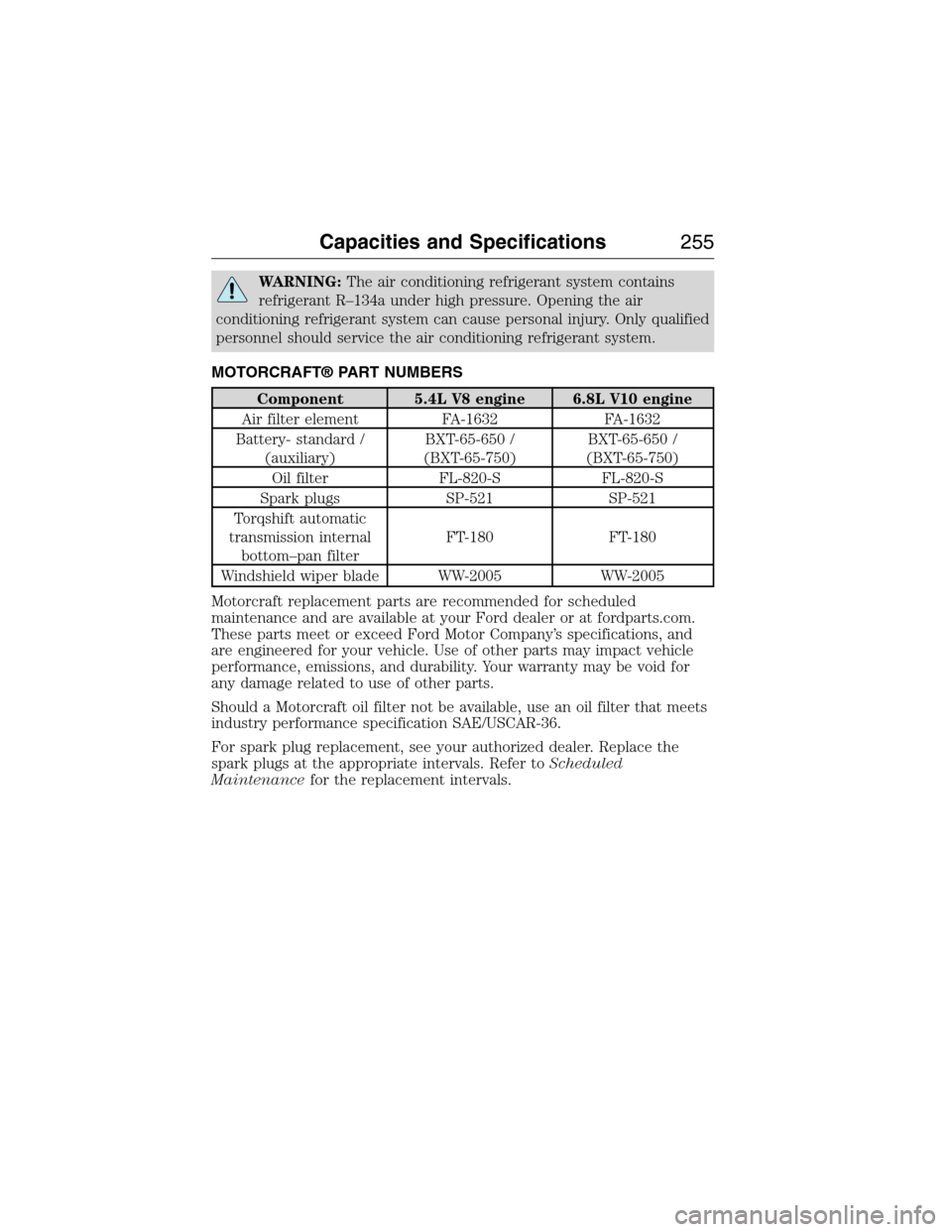
MOTORCRAFT® PART NUMBERS
Component 5.4L V8 engine 6.8L V10 engine
Air filter element FA-1632 FA-1632
Battery- standard /
(auxiliary)BXT-65-650 /
(BXT-65-750)BXT-65-650 /
(BXT-65-750)
Oil filter FL-820-S FL-820-S
Spark plugs SP-521 SP-521
Torqshift automatic
transmission internal
bottom–pan filterFT-180 FT-180
Windshield wiper blade WW-2005 WW-2005
Motorcraft replacement parts are recommended for scheduled
maintenance and are available at your Ford dealer or at fordparts.com.
These parts meet or exceed Ford Motor Company’s specifications, and
are engineered for your vehicle. Use of other parts may impact vehicle
performance, emissions, and durability. Your warranty may be void for
any damage related to use of other parts.
Should a Motorcraft oil filter not be available, use an oil filter that meets
industry performance specification SAE/USCAR-36.
For spark plug replacement, see your authorized dealer. Replace the
spark plugs at the appropriate intervals. Refer toScheduled
Maintenancefor the replacement intervals.
Capacities and Specifications255
2015 Econoline(eco)
Owners Guide gf, 1st Printing, June 2014
USA(fus)
Page 340 of 360
Protecting Your Investment
Maintenance is an investment that pays dividends in the form of
improved reliability, durability and resale value. To maintain the proper
performance of your vehicle and its emission control systems, it is
imperative that scheduled maintenance be completed at the designated
intervals.
Your vehicle is very sophisticated and built with multiple complex
performance systems. Every manufacturer develops these systems using
different specifications and performance features. That is why it is
important to rely upon your dealership to properly diagnose and repair
your vehicle.
Ford Motor Company has recommended maintenance intervals for
various parts and component systems based upon engineering testing.
Ford Motor Company relies upon this testing to determine the most
appropriate mileage for replacement of oils and fluids to protect your
vehicle at the lowest overall cost to you and recommends against
maintenance schedules that deviate from the scheduled maintenance
information.
Ford strongly recommends using only genuine Ford, Motorcraft or
Ford-authorized remanufactured replacement parts because they are
engineered for your vehicle.
Additives and Chemicals
Ford Motor Company recommended additives and chemicals are listed in
this book and in theWorkshop Manual.Additional chemicals or
additives not approved by Ford Motor Company are not recommended as
part of normal maintenance. Please consult your warranty information.
Oils, Fluids and Flushing
In many cases, fluid discoloration is a normal operating characteristic
and, by itself, does not necessarily indicate a concern or that the fluid
needs to be changed. However, discolored fluids that also show signs of
overheating and/or foreign material contamination should be inspected
immediately by a qualified expert such as the factory-trained technicians
at your dealership. Your vehicle’s oils and fluids should be changed at the
specified intervals or in conjunction with a repair. Flushing is a viable
way to change fluid for many vehicle sub-systems during scheduled
maintenance. It is critical that systems are flushed only with new fluid
that is the same as that required to fill and operate the system, or using
a Ford-approved flushing chemical.
Scheduled Maintenance339
2015 Econoline(eco)
Owners Guide gf, 1st Printing, June 2014
USA(fus)
Page 344 of 360
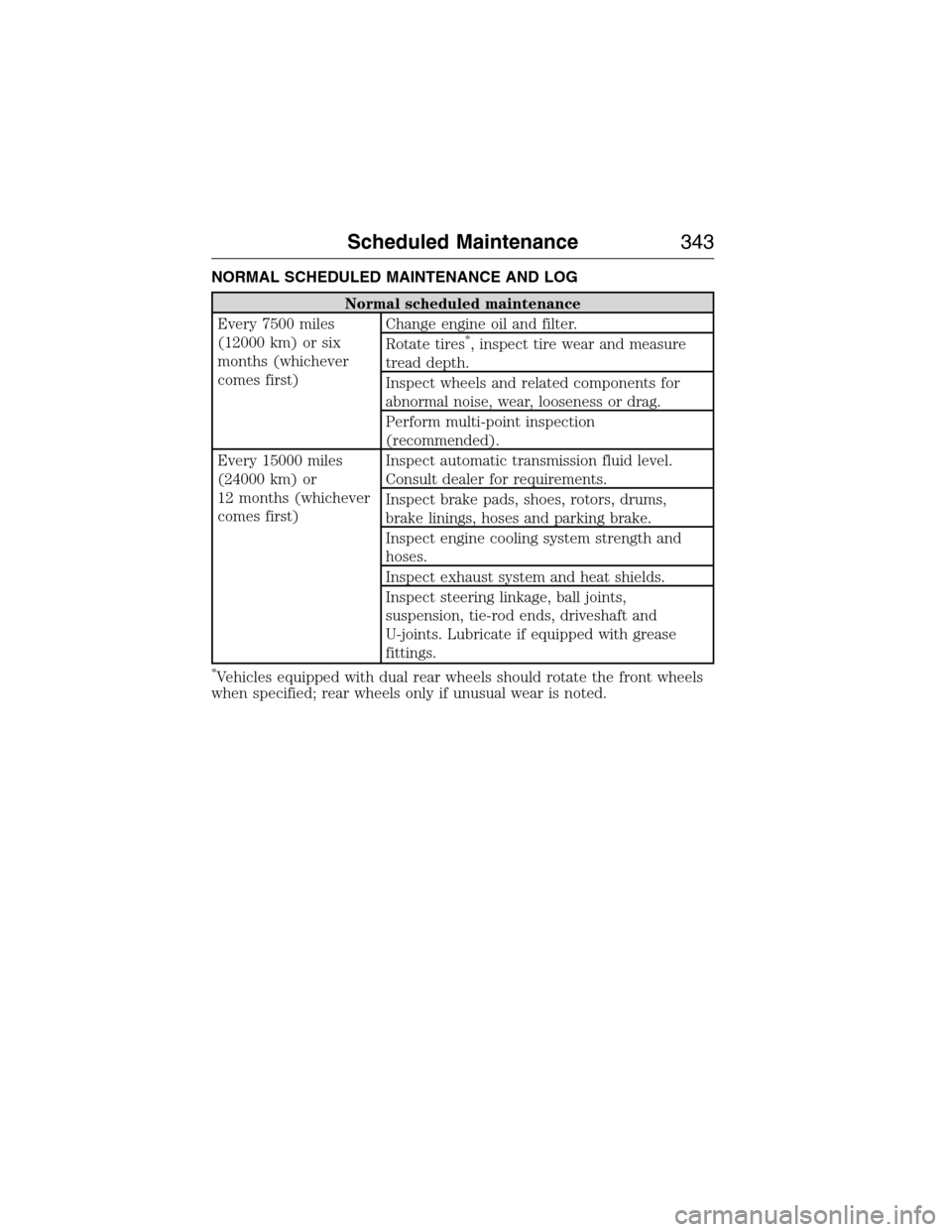
NORMAL SCHEDULED MAINTENANCE AND LOG
Normal scheduled maintenance
Every 7500 miles
(12000 km) or six
months (whichever
comes first)Change engine oil and filter.
Rotate tires
*, inspect tire wear and measure
tread depth.
Inspect wheels and related components for
abnormal noise, wear, looseness or drag.
Perform multi-point inspection
(recommended).
Every 15000 miles
(24000 km) or
12 months (whichever
comes first)Inspect automatic transmission fluid level.
Consult dealer for requirements.
Inspect brake pads, shoes, rotors, drums,
brake linings, hoses and parking brake.
Inspect engine cooling system strength and
hoses.
Inspect exhaust system and heat shields.
Inspect steering linkage, ball joints,
suspension, tie-rod ends, driveshaft and
U-joints. Lubricate if equipped with grease
fittings.
*Vehicles equipped with dual rear wheels should rotate the front wheels
when specified; rear wheels only if unusual wear is noted.
Scheduled Maintenance343
2015 Econoline(eco)
Owners Guide gf, 1st Printing, June 2014
USA(fus)
Page 353 of 360
EXCEPTIONS
Normal Vehicle Axle Maintenance
Rear axles and power take-off units with synthetic fluid and light-duty
trucks equipped with Ford-design axles are lubricated for life; do not
check or change fluid unless a leak is suspected, service is required or
the assembly has been submerged in water. During long periods of trailer
towing with outside temperatures above 70°F (21°C) and at wide-open
throttle for long periods above 45 mph (72 km/h), non-synthetic rear
axle fluids should be changed every 3000 miles (4800 kilometers) or
three months, whichever comes first. This interval can be waived if the
axle is filled with 75W140 synthetic gear fluid meeting Ford specification
WSL-M2C192-A, part number F1TZ-19580-B or equivalent. Add friction
modifier XL-3 (EST-M2C118-A) or equivalent for complete refill of
Traction-Lok rear axles (seeTechnical specificationsin theCapacities
and Specificationschapter for details).
Axle Maintenance
Change the axle fluid anytime an axle is submerged in water.
California Fuel Filter Replacement
If you register your vehicle in California, the California Air Resources
Board has determined that the failure to perform this maintenance item
does not nullify the emission warranty or limit recall liability before the
completion of your vehicle’s useful life. Ford Motor Company, however,
urges you to have all recommended maintenance services performed at
the specified intervals and to record all vehicle service.
Hot Climate Oil Change Intervals
Vehicles operating in the Middle East, North Africa, Sub-Saharan Africa
or locations with similar climates using an American Petroleum Institute
(API) Certified for Gasoline Engines (Certification mark) oil of SM or SN
quality, the normal oil change interval is 3000 miles (5000 kilometers).
If the available API SM or SN oils are not available, then the oil change
interval is 1800 miles (3000 kilometers).
Engine Air Filter and Cabin Air Filter Replacement
The life of the engine air filter and cabin air filter is dependent on
exposure to dusty and dirty conditions. Vehicles operated in these
conditions require frequent inspection and replacement of the engine air
filter and cabin air filter.
352Scheduled Maintenance
2015 Econoline(eco)
Owners Guide gf, 1st Printing, June 2014
USA(fus)