height FORD E SERIES 2024 Owners Manual
[x] Cancel search | Manufacturer: FORD, Model Year: 2024, Model line: E SERIES, Model: FORD E SERIES 2024Pages: 303, PDF Size: 6.95 MB
Page 5 of 303
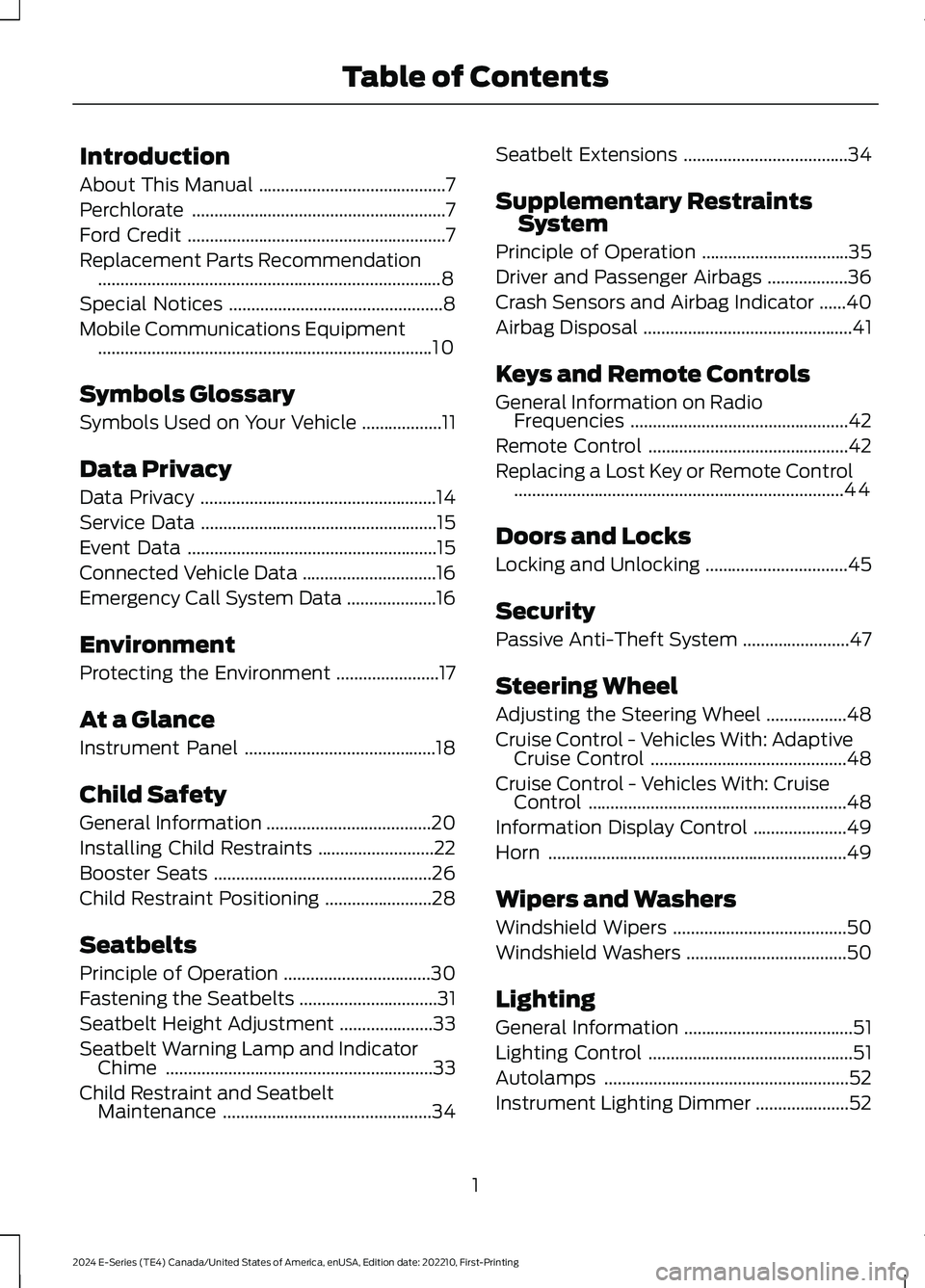
Introduction
About This Manual..........................................7
Perchlorate.........................................................7
Ford Credit..........................................................7
Replacement Parts Recommendation.............................................................................8
Special Notices................................................8
Mobile Communications Equipment...........................................................................10
Symbols Glossary
Symbols Used on Your Vehicle..................11
Data Privacy
Data Privacy.....................................................14
Service Data.....................................................15
Event Data........................................................15
Connected Vehicle Data..............................16
Emergency Call System Data....................16
Environment
Protecting the Environment.......................17
At a Glance
Instrument Panel...........................................18
Child Safety
General Information.....................................20
Installing Child Restraints..........................22
Booster Seats.................................................26
Child Restraint Positioning........................28
Seatbelts
Principle of Operation.................................30
Fastening the Seatbelts...............................31
Seatbelt Height Adjustment.....................33
Seatbelt Warning Lamp and IndicatorChime............................................................33
Child Restraint and SeatbeltMaintenance...............................................34
Seatbelt Extensions.....................................34
Supplementary RestraintsSystem
Principle of Operation.................................35
Driver and Passenger Airbags..................36
Crash Sensors and Airbag Indicator......40
Airbag Disposal...............................................41
Keys and Remote Controls
General Information on RadioFrequencies.................................................42
Remote Control.............................................42
Replacing a Lost Key or Remote Control..........................................................................44
Doors and Locks
Locking and Unlocking................................45
Security
Passive Anti-Theft System........................47
Steering Wheel
Adjusting the Steering Wheel..................48
Cruise Control - Vehicles With: AdaptiveCruise Control............................................48
Cruise Control - Vehicles With: CruiseControl..........................................................48
Information Display Control.....................49
Horn...................................................................49
Wipers and Washers
Windshield Wipers.......................................50
Windshield Washers....................................50
Lighting
General Information......................................51
Lighting Control..............................................51
Autolamps.......................................................52
Instrument Lighting Dimmer.....................52
1
2024 E-Series (TE4) Canada/United States of America, enUSA, Edition date: 202210, First-PrintingTable of Contents
Page 24 of 303
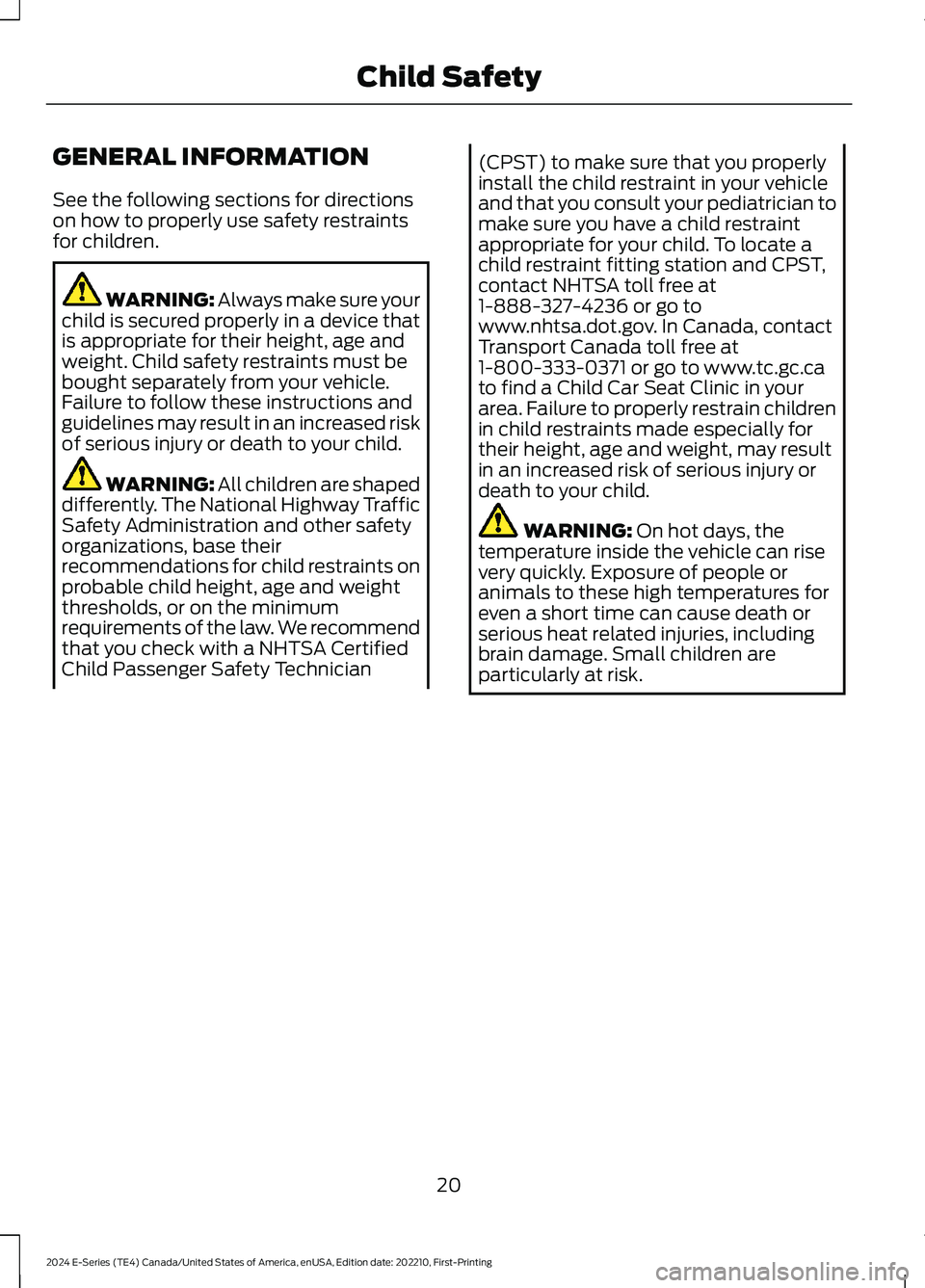
GENERAL INFORMATION
See the following sections for directionson how to properly use safety restraintsfor children.
WARNING: Always make sure yourchild is secured properly in a device thatis appropriate for their height, age andweight. Child safety restraints must bebought separately from your vehicle.Failure to follow these instructions andguidelines may result in an increased riskof serious injury or death to your child.
WARNING: All children are shapeddifferently. The National Highway TrafficSafety Administration and other safetyorganizations, base theirrecommendations for child restraints onprobable child height, age and weightthresholds, or on the minimumrequirements of the law. We recommendthat you check with a NHTSA CertifiedChild Passenger Safety Technician
(CPST) to make sure that you properlyinstall the child restraint in your vehicleand that you consult your pediatrician tomake sure you have a child restraintappropriate for your child. To locate achild restraint fitting station and CPST,contact NHTSA toll free at1-888-327-4236 or go towww.nhtsa.dot.gov. In Canada, contactTransport Canada toll free at1-800-333-0371 or go to www.tc.gc.cato find a Child Car Seat Clinic in yourarea. Failure to properly restrain childrenin child restraints made especially fortheir height, age and weight, may resultin an increased risk of serious injury ordeath to your child.
WARNING: On hot days, thetemperature inside the vehicle can risevery quickly. Exposure of people oranimals to these high temperatures foreven a short time can cause death orserious heat related injuries, includingbrain damage. Small children areparticularly at risk.
20
2024 E-Series (TE4) Canada/United States of America, enUSA, Edition date: 202210, First-PrintingChild Safety
Page 25 of 303
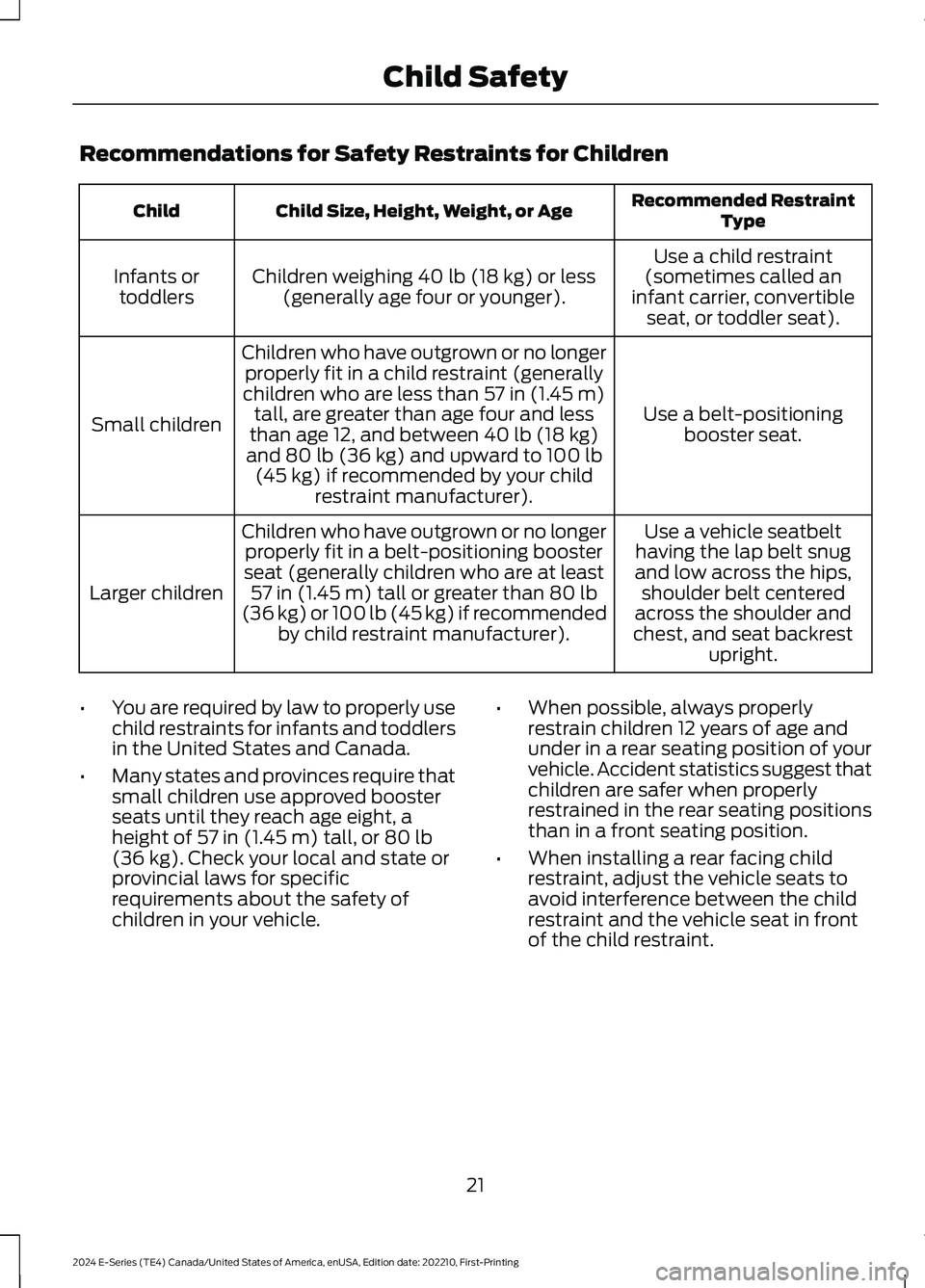
Recommendations for Safety Restraints for Children
Recommended RestraintTypeChild Size, Height, Weight, or AgeChild
Use a child restraint(sometimes called aninfant carrier, convertibleseat, or toddler seat).
Children weighing 40 lb (18 kg) or less(generally age four or younger).Infants ortoddlers
Use a belt-positioningbooster seat.
Children who have outgrown or no longerproperly fit in a child restraint (generallychildren who are less than 57 in (1.45 m)tall, are greater than age four and lessthan age 12, and between 40 lb (18 kg)and 80 lb (36 kg) and upward to 100 lb(45 kg) if recommended by your childrestraint manufacturer).
Small children
Use a vehicle seatbelthaving the lap belt snugand low across the hips,shoulder belt centeredacross the shoulder andchest, and seat backrestupright.
Children who have outgrown or no longerproperly fit in a belt-positioning boosterseat (generally children who are at least57 in (1.45 m) tall or greater than 80 lb(36 kg) or 100 lb (45 kg) if recommendedby child restraint manufacturer).
Larger children
•You are required by law to properly usechild restraints for infants and toddlersin the United States and Canada.
•Many states and provinces require thatsmall children use approved boosterseats until they reach age eight, aheight of 57 in (1.45 m) tall, or 80 lb(36 kg). Check your local and state orprovincial laws for specificrequirements about the safety ofchildren in your vehicle.
•When possible, always properlyrestrain children 12 years of age andunder in a rear seating position of yourvehicle. Accident statistics suggest thatchildren are safer when properlyrestrained in the rear seating positionsthan in a front seating position.
•When installing a rear facing childrestraint, adjust the vehicle seats toavoid interference between the childrestraint and the vehicle seat in frontof the child restraint.
21
2024 E-Series (TE4) Canada/United States of America, enUSA, Edition date: 202210, First-PrintingChild Safety
Page 30 of 303
BOOSTER SEATS
WARNING: Do not put the shouldersection of the seatbelt or allow the childto put the shoulder section of theseatbelt under their arm or behind theirback. Failure to follow this instructioncould reduce the effectiveness of theseatbelt and increase the risk of injury ordeath in a crash.
Use a belt-positioning booster seat forchildren who have outgrown or no longerproperly fit in a child safety restraint(generally children who are less than 57 in(1.45 m) tall, are greater than age 4 andless than age 12, and between 40 lb (18 kg)and 80 lb (36 kg) and upward to 100 lb(45 kg) if recommended by your childrestraint manufacturer). Many state andprovincial laws require that children useapproved booster seats until they reachage eight, a height of 57 in (1.45 m) tall, or80 lb (36 kg).
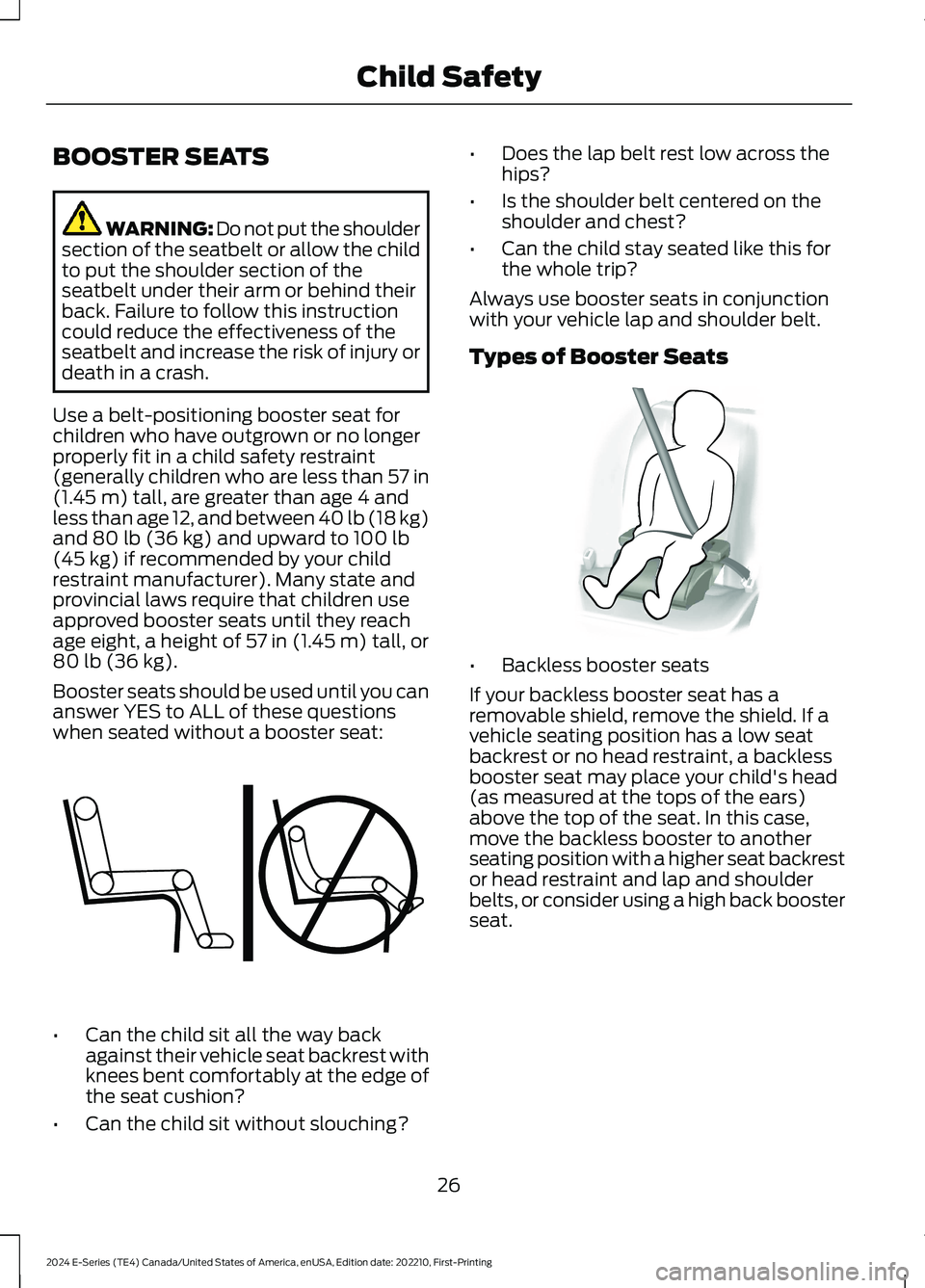
Booster seats should be used until you cananswer YES to ALL of these questionswhen seated without a booster seat:
•Can the child sit all the way backagainst their vehicle seat backrest withknees bent comfortably at the edge ofthe seat cushion?
•Can the child sit without slouching?
•Does the lap belt rest low across thehips?
•Is the shoulder belt centered on theshoulder and chest?
•Can the child stay seated like this forthe whole trip?
Always use booster seats in conjunctionwith your vehicle lap and shoulder belt.
Types of Booster Seats
•Backless booster seats
If your backless booster seat has aremovable shield, remove the shield. If avehicle seating position has a low seatbackrest or no head restraint, a backlessbooster seat may place your child's head(as measured at the tops of the ears)above the top of the seat. In this case,move the backless booster to anotherseating position with a higher seat backrestor head restraint and lap and shoulderbelts, or consider using a high back boosterseat.
26
2024 E-Series (TE4) Canada/United States of America, enUSA, Edition date: 202210, First-PrintingChild SafetyE142595 E68924
Page 32 of 303
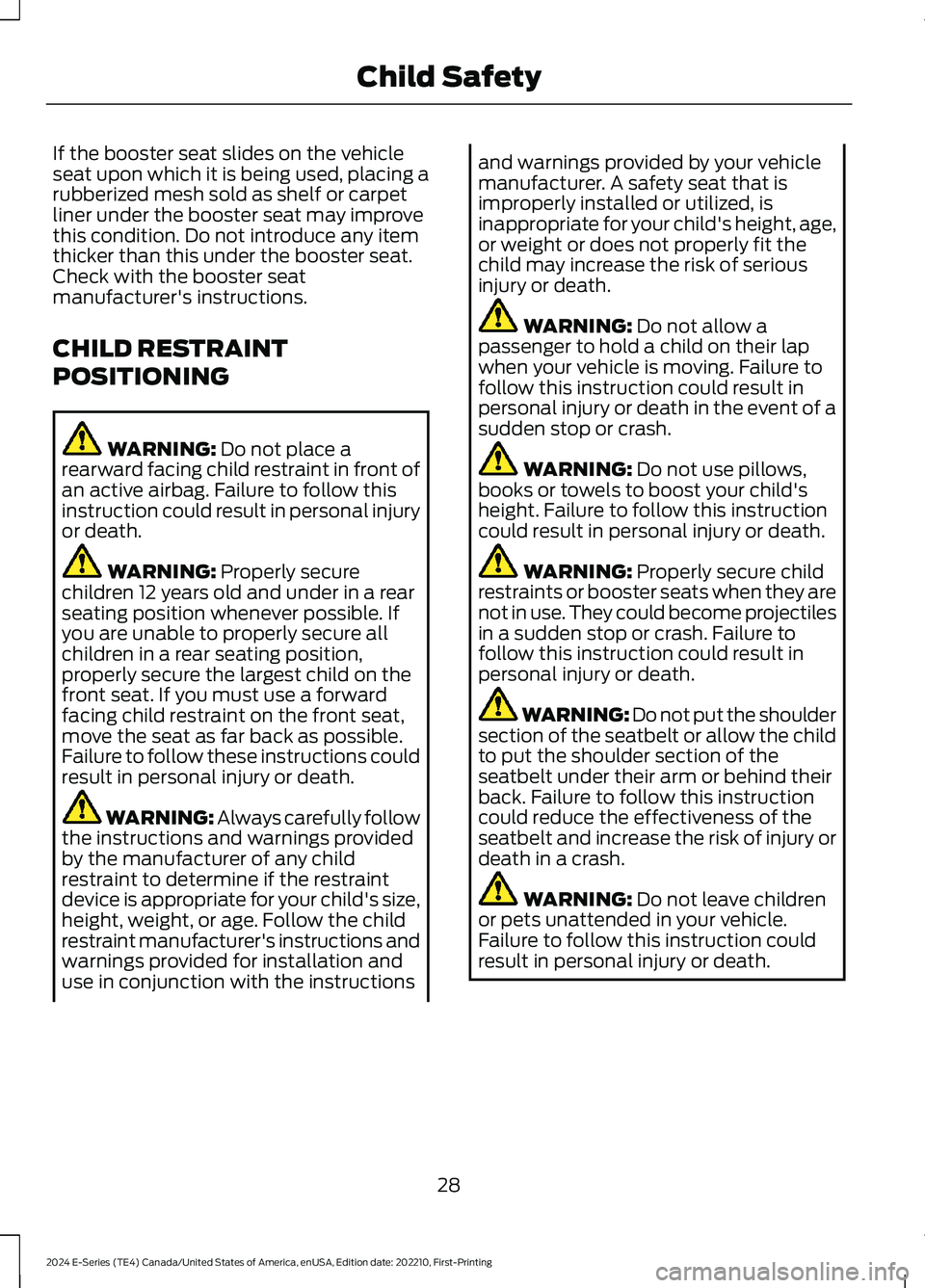
If the booster seat slides on the vehicleseat upon which it is being used, placing arubberized mesh sold as shelf or carpetliner under the booster seat may improvethis condition. Do not introduce any itemthicker than this under the booster seat.Check with the booster seatmanufacturer's instructions.
CHILD RESTRAINT
POSITIONING
WARNING: Do not place arearward facing child restraint in front ofan active airbag. Failure to follow thisinstruction could result in personal injuryor death.
WARNING: Properly securechildren 12 years old and under in a rearseating position whenever possible. Ifyou are unable to properly secure allchildren in a rear seating position,properly secure the largest child on thefront seat. If you must use a forwardfacing child restraint on the front seat,move the seat as far back as possible.Failure to follow these instructions couldresult in personal injury or death.
WARNING: Always carefully followthe instructions and warnings providedby the manufacturer of any childrestraint to determine if the restraintdevice is appropriate for your child's size,height, weight, or age. Follow the childrestraint manufacturer's instructions andwarnings provided for installation anduse in conjunction with the instructions
and warnings provided by your vehiclemanufacturer. A safety seat that isimproperly installed or utilized, isinappropriate for your child's height, age,or weight or does not properly fit thechild may increase the risk of seriousinjury or death.
WARNING: Do not allow apassenger to hold a child on their lapwhen your vehicle is moving. Failure tofollow this instruction could result inpersonal injury or death in the event of asudden stop or crash.
WARNING: Do not use pillows,books or towels to boost your child'sheight. Failure to follow this instructioncould result in personal injury or death.
WARNING: Properly secure childrestraints or booster seats when they arenot in use. They could become projectilesin a sudden stop or crash. Failure tofollow this instruction could result inpersonal injury or death.
WARNING: Do not put the shouldersection of the seatbelt or allow the childto put the shoulder section of theseatbelt under their arm or behind theirback. Failure to follow this instructioncould reduce the effectiveness of theseatbelt and increase the risk of injury ordeath in a crash.
WARNING: Do not leave childrenor pets unattended in your vehicle.Failure to follow this instruction couldresult in personal injury or death.
28
2024 E-Series (TE4) Canada/United States of America, enUSA, Edition date: 202210, First-PrintingChild Safety
Page 35 of 303
•Height adjuster at the front outboardseating positions.
•Safety belt pretensioner at the frontoutboard seating positions.
•Safety belt warning light and chime.
•Crash sensors and monitoring systemwith readiness indicator.
The safety belt pretensioners at the frontseating positions are designed to tightenthe safety belts when activated. In frontaland near-frontal crashes, the safety beltpretensioners may be activated alone or,if the crash is of sufficient severity, togetherwith the front airbags.
FASTENING THE SEATBELTS
The front outboard safety restraints in thevehicle are combination lap and shoulderbelts.
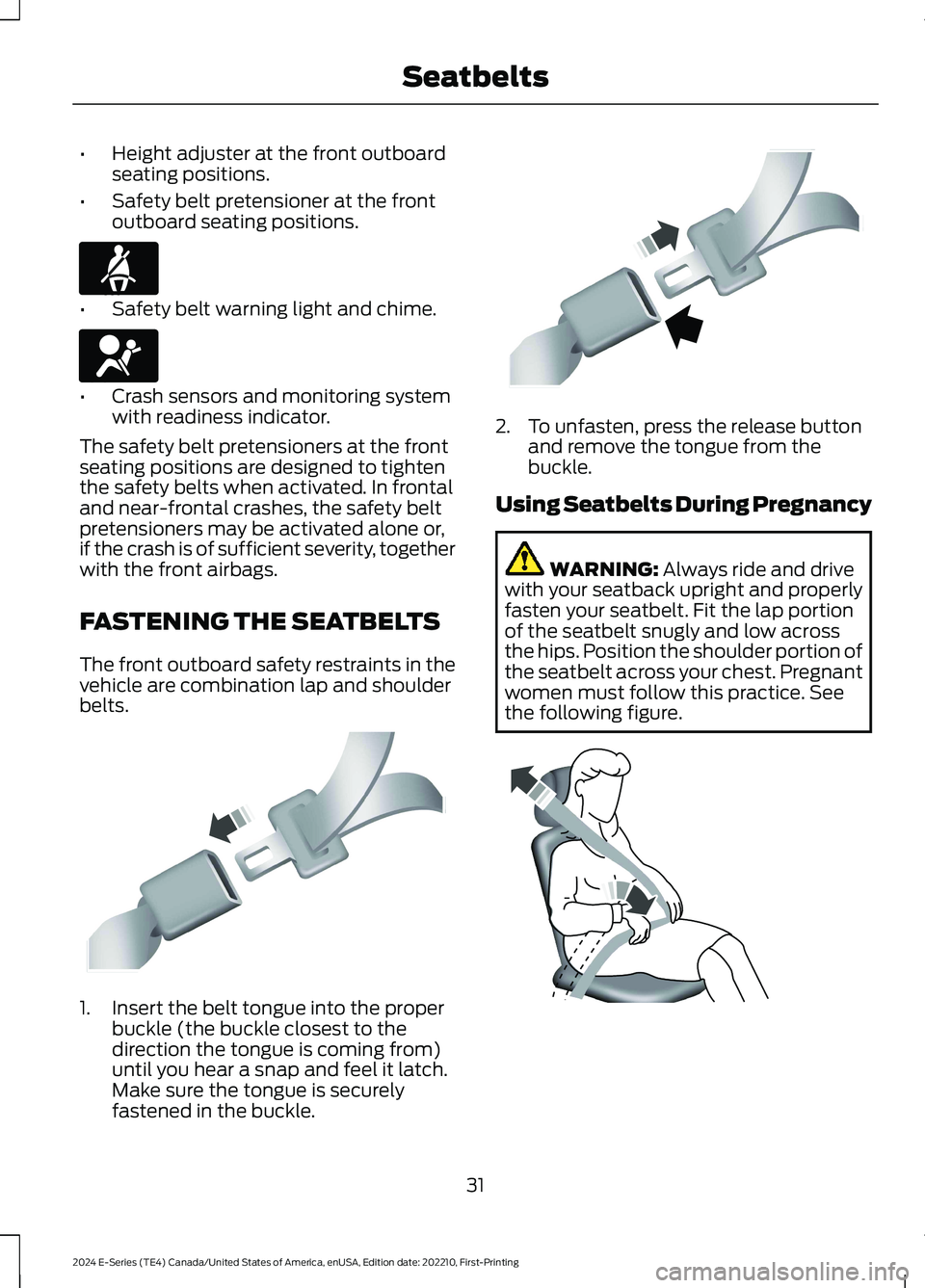
1.Insert the belt tongue into the properbuckle (the buckle closest to thedirection the tongue is coming from)until you hear a snap and feel it latch.Make sure the tongue is securelyfastened in the buckle.
2.To unfasten, press the release buttonand remove the tongue from thebuckle.
Using Seatbelts During Pregnancy
WARNING: Always ride and drivewith your seatback upright and properlyfasten your seatbelt. Fit the lap portionof the seatbelt snugly and low acrossthe hips. Position the shoulder portion ofthe seatbelt across your chest. Pregnantwomen must follow this practice. Seethe following figure.
31
2024 E-Series (TE4) Canada/United States of America, enUSA, Edition date: 202210, First-PrintingSeatbeltsE71880 E67017 E142587 E142588 E142590
Page 36 of 303
Pregnant women should always wear theirseatbelt. Position the lap belt portion of acombination lap and shoulder belt lowacross the hips below the belly and wornas tight as comfort allows. Position theshoulder belt to cross the middle of theshoulder and the center of the chest.
Seatbelt Locking Modes
WARNING: If your vehicle isinvolved in a crash, have the seatbeltsand associated components inspectedas soon as possible. Failure to follow thisinstruction could result in personal injuryor death.
All safety restraints in the vehicle arecombination lap and shoulder belts. Thedriver seatbelt has the first type of lockingmode. The front outboard passengerseatbelt has both types of locking modesdescribed as follows:
Vehicle Sensitive Mode
This is the normal retractor mode, whichallows free shoulder belt lengthadjustment to your movements andlocking in response to vehicle movement.For example, if the driver brakes suddenlyor turns a corner sharply, or the vehiclereceives an impact of about 5 mph(8 km/h) or more, the combinationseatbelts lock to help reduce forwardmovement of the driver and passengers.
In addition, the retractor is designed to lockif you pull the webbing out too quickly. Ifthe seatbelt retractor locks, slowly lowerthe height adjuster to allow the seatbeltto retract. If the retractor does not unlock,pull the seatbelt out slowly then feed a
small length of webbing back toward thestowed position. For rear seatbelts, reclinethe rear seat backrest or push the seatbackrest cushion away from the seatbelt.Feed a small length of webbing backtoward the stowed position.
Automatic Locking Mode
In this mode, the shoulder beltautomatically pre-locks. The belt will stillretract to remove any slack in the shoulderbelt. The automatic locking mode is notavailable on the driver seatbelt.
When to Use the Automatic LockingMode
Use this mode any time a child safety seat,except a booster, is installed in thepassenger front seating position. SeeChild Safety (page 20).
How to Use the Automatic LockingMode
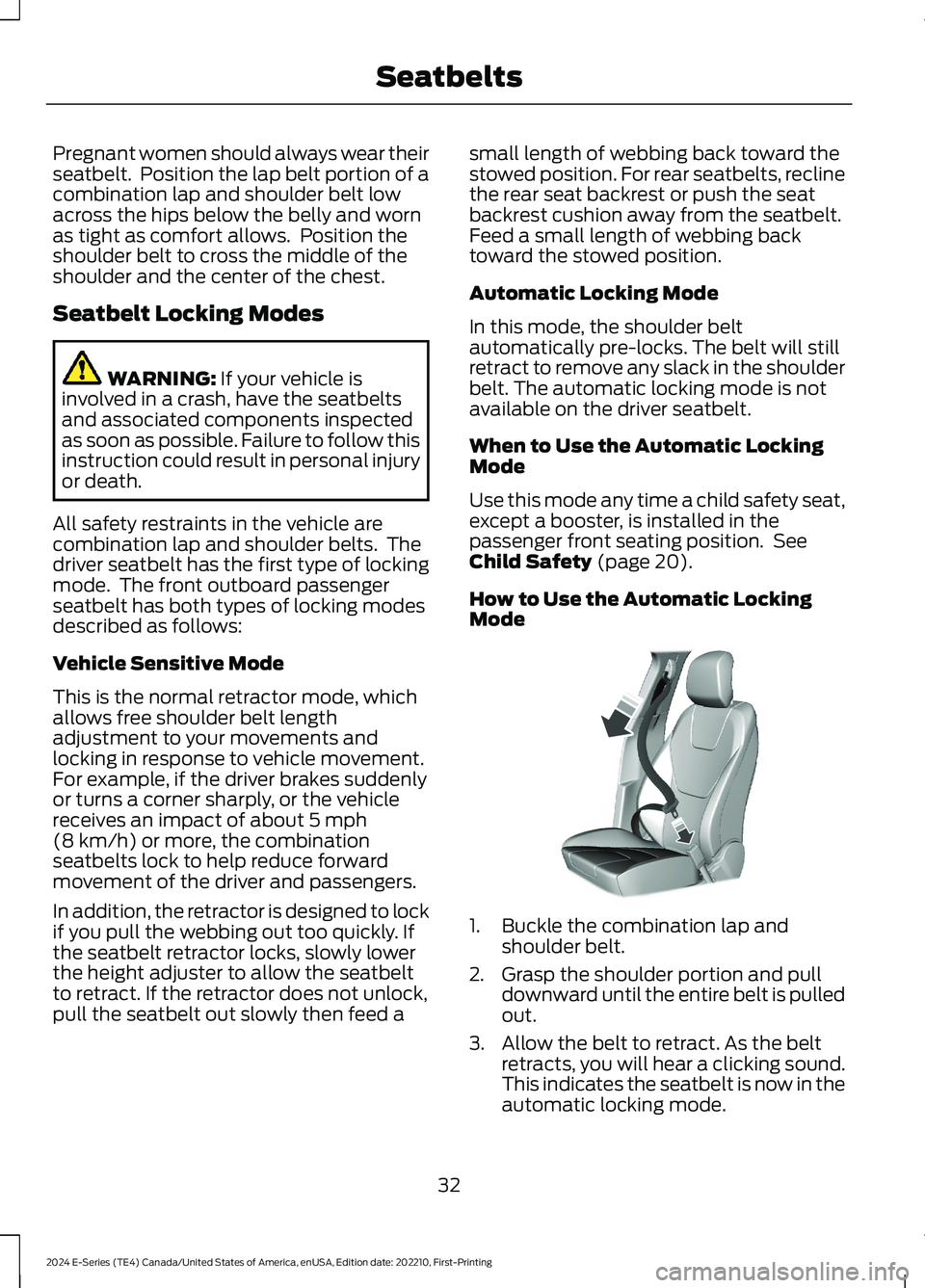
1.Buckle the combination lap andshoulder belt.
2.Grasp the shoulder portion and pulldownward until the entire belt is pulledout.
3.Allow the belt to retract. As the beltretracts, you will hear a clicking sound.This indicates the seatbelt is now in theautomatic locking mode.
32
2024 E-Series (TE4) Canada/United States of America, enUSA, Edition date: 202210, First-PrintingSeatbeltsE142591
Page 37 of 303
How to Disengage the AutomaticLocking Mode
Unbuckle the combination lap andshoulder belt and allow it to retractcompletely to disengage the automaticlocking mode and activate the vehiclesensitive (emergency) locking mode.
SEATBELT HEIGHT
ADJUSTMENT
WARNING: Position the safety beltheight adjuster so that the belt restsacross the middle of your shoulder.Failure to adjust the safety belt properlycould reduce the effectiveness of thesafety belt and increase the risk of injuryin a crash.
Adjust the height of the shoulder belt sothe belt rests across the middle of yourshoulder.
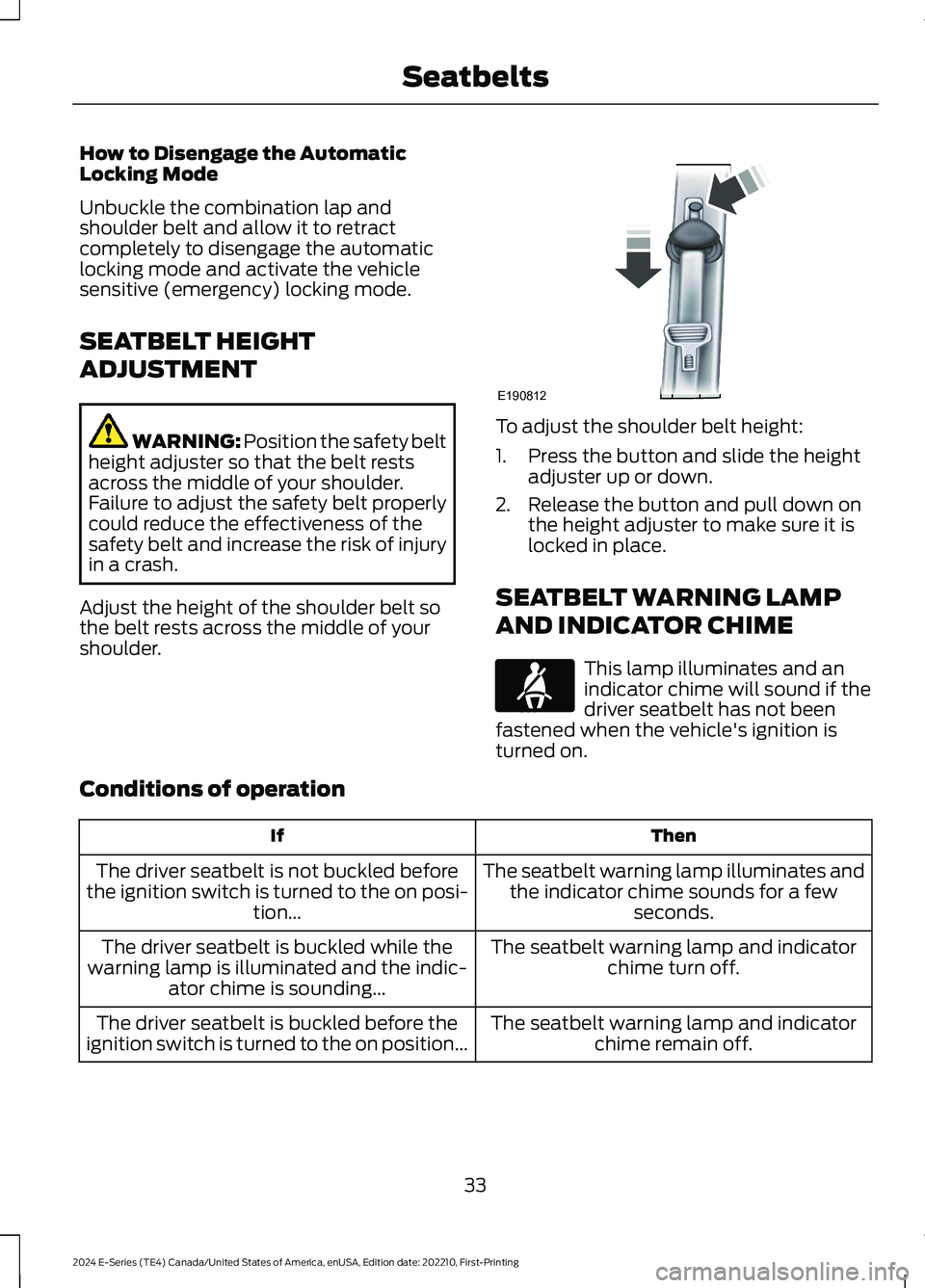
To adjust the shoulder belt height:
1.Press the button and slide the heightadjuster up or down.
2.Release the button and pull down onthe height adjuster to make sure it islocked in place.
SEATBELT WARNING LAMP
AND INDICATOR CHIME
This lamp illuminates and anindicator chime will sound if thedriver seatbelt has not beenfastened when the vehicle's ignition isturned on.
Conditions of operation
ThenIf
The seatbelt warning lamp illuminates andthe indicator chime sounds for a fewseconds.
The driver seatbelt is not buckled beforethe ignition switch is turned to the on posi-tion...
The seatbelt warning lamp and indicatorchime turn off.The driver seatbelt is buckled while thewarning lamp is illuminated and the indic-ator chime is sounding...
The seatbelt warning lamp and indicatorchime remain off.The driver seatbelt is buckled before theignition switch is turned to the on position...
33
2024 E-Series (TE4) Canada/United States of America, enUSA, Edition date: 202210, First-PrintingSeatbeltsE190812 E71880
Page 38 of 303
CHILD RESTRAINT AND
SEATBELT MAINTENANCE
Inspect the vehicle seatbelts and childrestraint systems periodically to make surethey work properly and are not damaged.Inspect the vehicle seatbelts to make surethere are no nicks, tears or cuts. Replace ifnecessary. All vehicle seatbelt assemblies,including retractors, buckles, front seatbeltbuckle assemblies, buckle supportassemblies (slide bar-if equipped),shoulder belt height adjusters (ifequipped), shoulder belt guide on seatback(if equipped), rear inflatable seatbelts (ifequipped), child restraint LATCH andtether anchors, and attaching hardware,should be inspected after a crash. Readthe child restraint manufacturer'sinstructions for additional inspection andmaintenance information specific to thechild restraint.
We recommend that all seatbeltassemblies in use in vehicles involved in acrash be replaced. However, if the crashwas minor and an authorized dealer findsthat the belts do not show damage andcontinue to operate properly, they do notneed to be replaced. Seatbelt assembliesnot in use during a crash should also beinspected and replaced if either damageor improper operation is noted.
Properly care for seatbelts. See Cleaningthe Interior (page 185).
SEATBELT EXTENSIONS
WARNING: Persons who fit intothe vehicle's seatbelt should not use anextension. Unnecessary use could resultin serious personal injury in the event ofa crash.
WARNING: Only use extensionsprovided free of charge by our dealers.The dealer will provide an extensiondesigned specifically for this vehicle,model year and seating position. The useof an extension intended for anothervehicle, model year or seating positionmay not offer you the full protection ofyour vehicle's seatbelt restraint system.
WARNING: Never use seatbeltextensions to install child restraints.
WARNING: Do not use extensionsto change the way the seatbelt fitsacross the torso, over the lap or to makethe seatbelt buckle easier to reach.
If, because of body size or driving position,it is not possible to properly fasten theseatbelt over your lap and shoulder, anextension that is compatible with theseatbelts is available free of charge fromour dealers. Only use our seatbeltextensions made by the original equipmentseatbelt manufacturer with our seatbelts.Ask your authorized dealer if your extensionis compatible with your vehicle restraintsystem.
34
2024 E-Series (TE4) Canada/United States of America, enUSA, Edition date: 202210, First-PrintingSeatbelts
Page 58 of 303
WHAT IS AUTOMATIC HIGH
BEAM CONTROL
The system turns on high beams if it is darkenough and no other traffic is present. If itdetects an approaching vehicle’sheadlamps or tail lamps, or street lightingahead, the system turns the high beamsoff. Low beams remain on.
A camera sensor, centrally mountedbehind the windshield of your vehicle,continuously monitors conditions to turnthe high beams on and off.
SWITCHING AUTOMATIC HIGH
BEAM CONTROL ON AND OFF
Switch the system on or off using theinformation display. See GeneralInformation (page 64).
Activating the Automatic HighBeam Control
Switch the lighting control to theautolamps position to activate.See Autolamps (page 52).
Note:Automatic high beams are notavailable when you do not turn onautolamps.
When active, the high beams turn on if allof the following occur:
•The ambient light level is low enough.
•There is no traffic in front of yourvehicle.
•The vehicle speed is greater thanapproximately 32 mph (52 km/h).
When active, the high beams turn off if anyof the following occur:
•The ambient light level is high enoughthat it does not require high beams.
•The system detects an approachingvehicle's headlamps or tail lamps.
•The system detects severe rain, snowor fog.
•The camera is blocked.
•The vehicle speed falls belowapproximately 27 mph (44 km/h).
Note:The deactivation speed is lower oncurves.
Note:There could be a delay in high beamreactivation in certain curvy road situations.
Note:If you have a blocked sensor, thesystem may not operate properly. Keep thewindshield free from obstruction or damage.
Note:The system may not operate properlyin cold or inclement conditions. You canswitch on the high beams by overriding thesystem.
Note:If the system detects a blockage, forexample bird droppings, bug splatter, snowor ice, the system goes into low beam modeuntil you clear the blockage. If you have ablocked camera, a message may appear inthe information display.
Note:Using much larger tires or equippingvehicle accessories such as snowplows canmodify your vehicle's ride height anddegrade automatic high beam controlperformance.
AUTOMATIC HIGH BEAM
CONTROL INDICATORS
The indicator illuminates toconfirm when the system isready to assist.
54
2024 E-Series (TE4) Canada/United States of America, enUSA, Edition date: 202210, First-PrintingAutomatic High Beam Control (If Equipped) E146105