weight FORD ESCAPE 2013 3.G Owner's Manual
[x] Cancel search | Manufacturer: FORD, Model Year: 2013, Model line: ESCAPE, Model: FORD ESCAPE 2013 3.GPages: 423, PDF Size: 4.59 MB
Page 194 of 423
BREAKING-IN
You need to break in new tires for
approximately 300 miles (480
kilometers). During this time, your vehicle
may exhibit some unusual driving
characteristics.
Avoid driving too fast during the first 1000
miles (1600 kilometers). Vary your speed
frequently and change up through the
gears early. Do not labor the engine.
Do not tow during the first 1000 miles
(1600 kilometers).
ECONOMICAL DRIVING
Fuel economy is affected by several things
such as how you drive, the conditions you
drive under and how you maintain your
vehicle.
There are some things to keep in mind that
may improve your fuel economy:
•Accelerate and slow down in a smooth,
moderate fashion.
• Drive at steady speeds without
stopping.
• Anticipate stops; slowing down may
eliminate the need to stop.
• Combine errands and minimize
stop-and-go driving.
• Close the windows for high-speed
driving.
• Drive at reasonable speeds (traveling
at 55 mph [88 km/h] uses 15% less
fuel than traveling at 65 mph [105
km/h]).
• Keep the tires properly inflated and use
only the recommended size.
• Use the recommended engine oil.
• Perform all regularly scheduled
maintenance. There are also some things you may not
want to do because they may reduce your
fuel economy:
•
Sudden accelerations or hard
accelerations.
• Rev the engine before turning it off.
• Idle for periods longer than one minute.
• Warm up your vehicle on cold
mornings.
• Use the air conditioner or front
defroster.
• Use the speed control in hilly terrain.
• Rest your foot on the brake pedal while
driving.
• Drive a heavily loaded vehicle or tow a
trailer.
• Carry unnecessary weight
(approximately 1 mpg [0.4 km/L] is
lost for every 400 lb [180 kg] of weight
carried).
• Add particular accessories to your
vehicle (e.g. bug deflectors,
rollbars/light bars, running boards, ski
racks).
• Drive with the wheels out of alignment.
DRIVING THROUGH WATER
Note: Driving through deep water above
the recommended levels can cause vehicle
damage.
Note: Once through the water, always dry
the brakes by moving your vehicle slowly
while applying light pressure on the brake
pedal. Wet brakes do not stop the vehicle
as quickly as dry brakes.
194
Driving Hints
Page 218 of 423
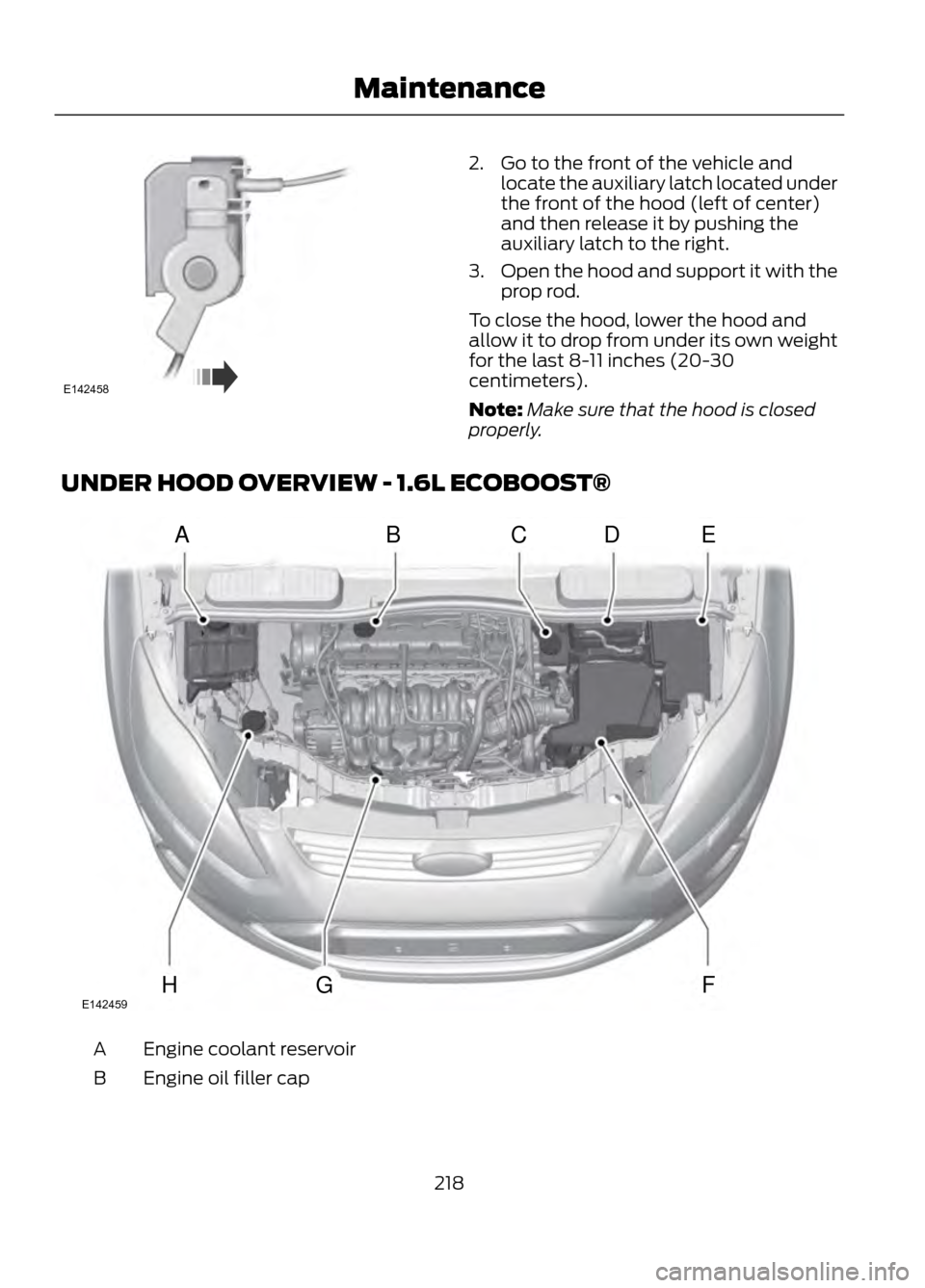
2. Go to the front of the vehicle andlocate the auxiliary latch located under
the front of the hood (left of center)
and then release it by pushing the
auxiliary latch to the right.
3. Open the hood and support it with the
prop rod.
To close the hood, lower the hood and
allow it to drop from under its own weight
for the last 8-11 inches (20-30
centimeters).
Note: Make sure that the hood is closed
properly.
UNDER HOOD OVERVIEW - 1.6L ECOBOOST®
Engine coolant reservoir
A
Engine oil filler cap
B
218
Maintenance
E142458
AB C D E
F
G
HE142459
Page 246 of 423
The temperature grades are A (the
highest), B and C, representing the tire’s
resistance to the generation of heat and
its ability to dissipate heat when tested
under controlled conditions on a specified
indoor laboratory test wheel. Sustained
high temperature can cause the material
of the tire to degenerate and reduce tire
life, and excessive temperature can lead
to sudden tire failure. The grade C
corresponds to a level of performance
which all passenger car tires must meet
under the Federal Motor Vehicle Safety
Standard No. 139. Grades B and A
represent higher levels of performance on
the laboratory test wheel than the
minimum required by law.
Glossary of Tire Terminology
• Tire label: A label showing the OE
(Original Equipment) tire sizes,
recommended inflation pressure and
the maximum weight the vehicle can
carry.
• Tire Identification Number (TIN): A
number on the sidewall of each tire
providing information about the tire
brand and manufacturing plant, tire
size and date of manufacture. Also
referred to as DOT code.
• Inflation pressure: A measure of the
amount of air in a tire.
• Standard load: A class of P-metric or
Metric tires designed to carry a
maximum load at 35 psi [37 psi (2.5
bar) for Metric tires]. Increasing the
inflation pressure beyond this pressure
will not increase the tire ’s load carrying
capability.
• Extra load: A class of P-metric or
Metric tires designed to carry a heavier
maximum load at 41 psi [43 psi (2.9
bar) for Metric tires]. Increasing the
inflation pressure beyond this pressure
will not increase the tire ’s load carrying
capability. •
kPa: Kilopascal, a metric unit of air
pressure.
• PSI: Pounds per square inch, a
standard unit of air pressure.
• Cold inflation pressure: The tire
pressure when the vehicle has been
stationary and out of direct sunlight for
an hour or more and prior to the vehicle
being driven for 1 mile (1.6 km).
• Recommended inflation pressure:
The cold inflation pressure found on
the Safety Compliance Certification
Label (affixed to either the door hinge
pillar, door-latch post, or the door edge
that meets the door-latch post, next
to the driver's seating position), or Tire
Label located on the B-Pillar or the
edge of the driver ’s door.
• B-pillar: The structural member at the
side of the vehicle behind the front
door
• Bead area of the tire: Area of the tire
next to the rim.
• Sidewall of the tire: Area between
the bead area and the tread.
• Tread area of the tire: Area of the
perimeter of the tire that contacts the
road when mounted on the vehicle.
• Rim: The metal support (wheel) for a
tire or a tire and tube assembly upon
which the tire beads are seated.
Information Contained on the Tire
Sidewall
Both U.S. and Canada Federal regulations
require tire manufacturers to place
standardized information on the sidewall
of all tires. This information identifies and
describes the fundamental characteristics
of the tire and also provides a U.S. DOT
Tire Identification Number for safety
standard certification and in case of a
recall.
246
Wheels and Tires
Page 247 of 423
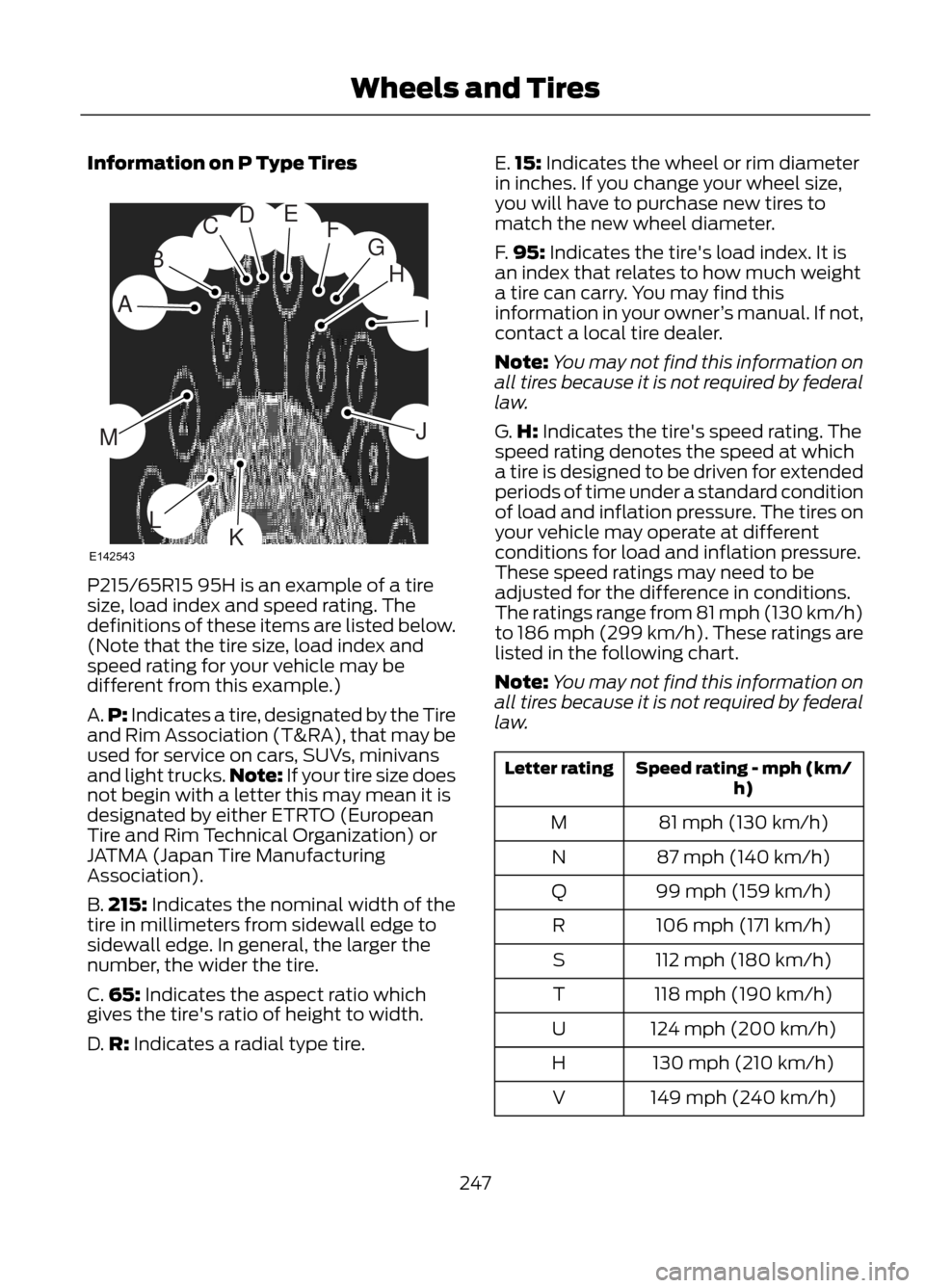
Information on P Type Tires
P215/65R15 95H is an example of a tire
size, load index and speed rating. The
definitions of these items are listed below.
(Note that the tire size, load index and
speed rating for your vehicle may be
different from this example.)
A.P: Indicates a tire, designated by the Tire
and Rim Association (T&RA), that may be
used for service on cars, SUVs, minivans
and light trucks. Note: If your tire size does
not begin with a letter this may mean it is
designated by either ETRTO (European
Tire and Rim Technical Organization) or
JATMA (Japan Tire Manufacturing
Association).
B. 215: Indicates the nominal width of the
tire in millimeters from sidewall edge to
sidewall edge. In general, the larger the
number, the wider the tire.
C. 65: Indicates the aspect ratio which
gives the tire's ratio of height to width.
D. R: Indicates a radial type tire. E.
15: Indicates the wheel or rim diameter
in inches. If you change your wheel size,
you will have to purchase new tires to
match the new wheel diameter.
F. 95: Indicates the tire's load index. It is
an index that relates to how much weight
a tire can carry. You may find this
information in your owner ’s manual. If not,
contact a local tire dealer.
Note: You may not find this information on
all tires because it is not required by federal
law.
G. H: Indicates the tire's speed rating. The
speed rating denotes the speed at which
a tire is designed to be driven for extended
periods of time under a standard condition
of load and inflation pressure. The tires on
your vehicle may operate at different
conditions for load and inflation pressure.
These speed ratings may need to be
adjusted for the difference in conditions.
The ratings range from 81 mph (130 km/h)
to 186 mph (299 km/h). These ratings are
listed in the following chart.
Note: You may not find this information on
all tires because it is not required by federal
law.
Speed rating - mph (km/ h)
Letter rating
81 mph (130 km/h)
M
87 mph (140 km/h)
N
99 mph (159 km/h)
Q
106 mph (171 km/h)
R
112 mph (180 km/h)
S
118 mph (190 km/h)
T
124 mph (200 km/h)
U
130 mph (210 km/h)
H
149 mph (240 km/h)
V
247
Wheels and Tires
H
I
J
KL
M
A
B
CDEFG
E142543
Page 269 of 423
VEHICLE IDENTIFICATION
NUMBER
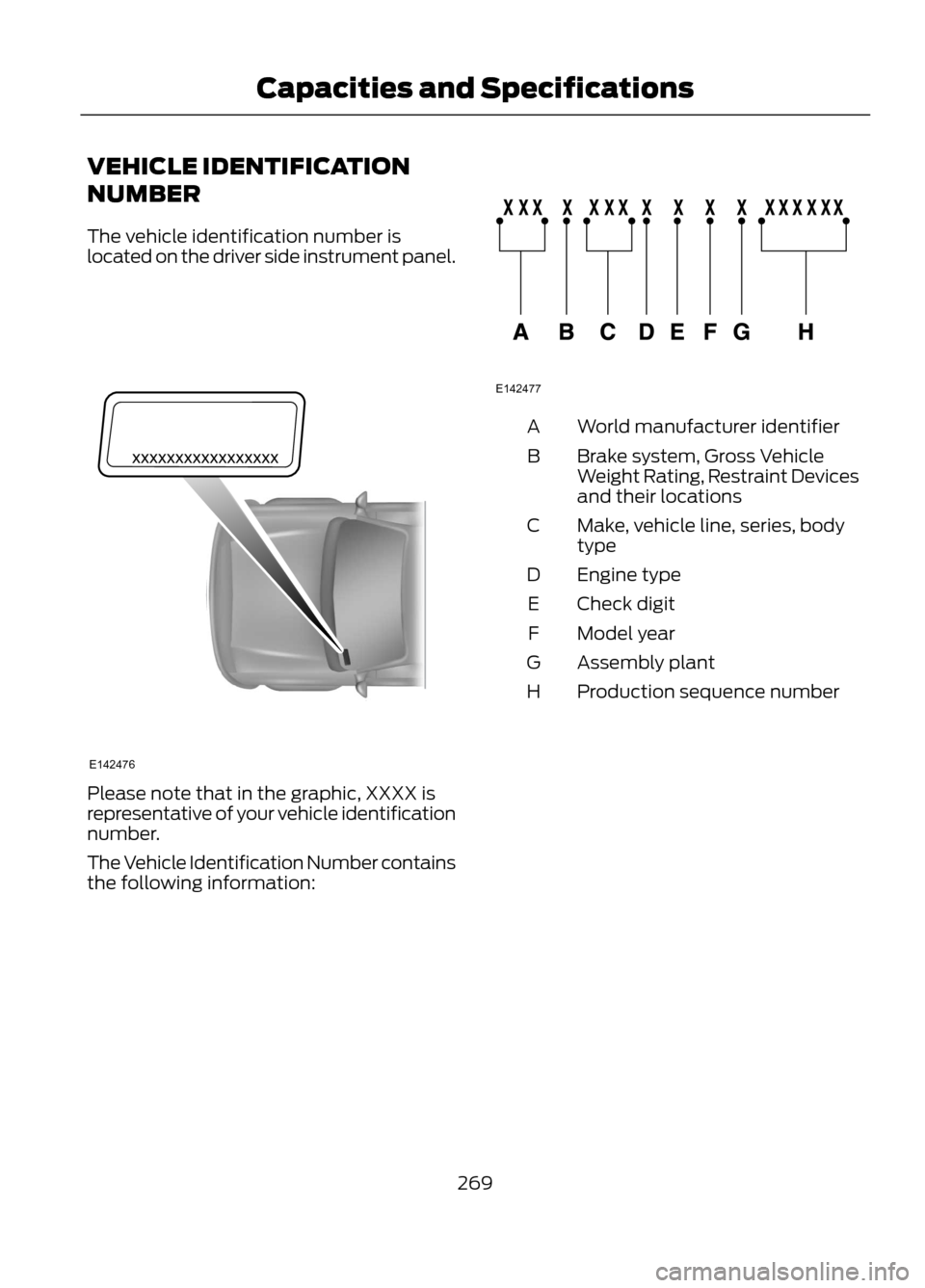
The vehicle identification number is
located on the driver side instrument panel.
Please note that in the graphic, XXXX is
representative of your vehicle identification
number.
The Vehicle Identification Number contains
the following information:
World manufacturer identifier
A
Brake system, Gross Vehicle
Weight Rating, Restraint Devices
and their locations
B
Make, vehicle line, series, body
type
C
Engine type
D
Check digit
E
Model year
F
Assembly plant
G
Production sequence number
H
269
Capacities and Specifications
E142476
E142477
Page 274 of 423
For a complete listing of the accessories
that are available for your vehicle, please
contact your dealer or visit our online store
at: Accessories.Ford.com (U.S. only).
Ford Custom Accessories are available for
your vehicle through your local Ford or Ford
of Canada dealer. Ford Motor Company
will repair or replace any properly
dealer-installed Ford Custom Accessories
found to be defective in factory-supplied
materials or workmanship during the
warranty period, as well as any component
damaged by the defective accessories. The
accessories will be warranted for
whichever provides you the greatest
benefit:
•12 months or 12,000 miles (20,000
km) (whichever occurs first), or
• the remainder of your new vehicle
limited warranty.
Contact your dealer for details and a copy
of the warranty.
Exterior style
• Asterisk hood deflectors
• Side window deflectors
• Splash guards
• Custom graphics*
Interior style
• Floor mats
Lifestyle
• Ash cup / smoker's packages
• Soft cargo organizers
• Cargo net*
• Roof racks and carriers*
Peace of mind
• Keyless entry keypad
• Remote start •
Vehicle security systems
• Wheel locks
• Bumper mounted parking assist
system*
*Ford Licensed Accessories (FLA) are
warranted by the accessory
manufacturer's warranty. Ford Licensed
Accessories are fully designed and
developed by the accessory manufacturer
and have not been designed or tested to
Ford Motor Company engineering
requirements. Contact your Ford dealer for
details regarding the manufacturer's
limited warranty and a copy of the FLA
product limited warranty offered by the
accessory manufacturer.
For maximum vehicle performance, keep
the following information in mind when
adding accessories or equipment to your
vehicle:
• When adding accessories, equipment,
passengers and luggage to your
vehicle, do not exceed the total weight
capacity of the vehicle or of the front
or rear axle (GVWR or GAWR as
indicated on the Safety Compliance
Certification label). Consult your
authorized dealer for specific weight
information.
• The Federal Communications
Commission (FCC) and Canadian
Radio Telecommunications
Commission (CRTC) regulate the use
of mobile communications systems —
such as two-way radios, telephones
and theft alarms - that are equipped
with radio transmitters. Any such
equipment installed in your vehicle
should comply with FCC or CRTC
regulations and should be installed
only by a qualified service technician.
• Mobile communications systems may
harm the operation of your vehicle,
particularly if they are not properly
designed for automotive use.
274
Accessories
Page 419 of 423
Power Door LocksSee: Locking and Unlocking............................. 54
Power Liftgate..................................................57 Obstacle Detection............................................. 59
Opening and Closing the Liftgate..................58
Setting the Liftgate Open Height................... 59
Power Seats....................................................124 Power Lumbar...................................................... 125
Power Steering Fluid Check.....................225
Power Windows..............................................74 Accessory Delay.................................................... 75
Bounce-Back.......................................................... 74
One-Touch Down................................................. 74
One-Touch Up....................................................... 74
Window Lock.......................................................... 74
R
Rear Seat Armrest.........................................127
Rear Seats.......................................................126 Folding the Seatback........................................ 126
Recline Adjustment........................................... 126
Unfolding the Seatback................................... 126
Rear Under Floor Storage...........................177 Adjustable Load Floor........................................ 177
Cargo Management System........................... 177
Passenger Compartment Floor...................... 177
Rear View Camera........................................167 Using the Rear View Camera System.........167
Rear View Camera See: Rear View Camera.................................... 167
Rear Window Wiper and Washers..........69 Rear Window Washer......................................... 69
Rear Window Wiper............................................ 69
Recommended Towing Weights............188
Refueling..........................................................142 Easy Fuel® No Cap Fuel System..................143
Remote Control..............................................44 Car Finder................................................................ 46
Integrated Keyhead Transmitters .................44
Intelligent Access Key......................................... 45
Remote Start ......................................................... 47
Replacing the Battery......................................... 45
Sounding a Panic Alarm.................................... 47
Remote Start...................................................119 Automatic Settings............................................ 120
Heated and Cooled Devices........................... 120
Last Settings........................................................ 120Removing a Headlamp...............................231
Repairing Minor Paint Damage...............237
Replacement Parts
Recommendation.........................................11
Collision Repairs..................................................... 11
Scheduled Maintenance and Mechanical Repairs................................................................... 11
Warranty on Replacement Parts...................... 11
Replacing a Lost Key or Remote Control............................................................48
Reporting Safety Defects (Canada Only).............................................................206
Reporting Safety Defects (U.S. Only)..............................................................205
Roadside Assistance...................................197 Vehicles Sold In Canada : Getting Roadside
Assistance........................................................ 197
Vehicles Sold In Canada : Using Roadside Assistance........................................................ 197
Vehicles Sold In The U.S.: Getting Roadside Assistance........................................................ 197
Vehicles Sold In The U.S. : Using Roadside Assistance........................................................ 197
Roadside Emergencies...............................197
Roof Racks and Load Carriers..................178 Adjusting the Crossbar..................................... 178
Running Out of Fuel......................................141 Refilling With a Portable Fuel
Container........................................................... 141
S
Safety Belt Height Adjustment................30
Safety Belt Minder..........................................31 Belt-Minder®.......................................................... 31
Safety Belts......................................................26 Principle of Operation........................................ 26
Safety Belt Warning Lamp and Indicator Chime..............................................................30
Conditions of operation..................................... 30
Safety Canopy®..............................................41
Safety Precautions......................................140
Satellite Radio................................................110 Satellite Radio Electronic Serial Number
(ESN).................................................................... 111
Satellite Radio Reception Factors..................111
SIRIUS® Satellite Radio Service..................... 111
Troubleshooting................................................... 112
419
Index