engine coolant FORD ESCAPE 2015 3.G User Guide
[x] Cancel search | Manufacturer: FORD, Model Year: 2015, Model line: ESCAPE, Model: FORD ESCAPE 2015 3.GPages: 449, PDF Size: 5.36 MB
Page 220 of 449
Note:
Automotive fluids are not
interchangeable. Do not use engine coolant
or antifreeze or windshield washer fluid
outside of its specified function and vehicle
location.
Adding Engine Coolant
• Do not mix different colors or types of
coolant in your vehicle. Make sure the
correct coolant is used. Mixing of
engine coolants may harm your
engine ’s cooling system. The use of an
improper coolant may harm engine and
cooling system components and may
void the warranty. Use prediluted
engine coolant meeting the Ford
specification. See Capacities and
Specifications (page 264).
• In case of emergency, a large amount
of water without engine coolant may
be added in order to reach a vehicle
service location. In this instance, the
cooling system must be drained,
chemically cleaned with Motorcraft
Premium Cooling System Flush, and
refilled with engine coolant as soon as
possible. Water alone (without engine
coolant) can cause engine damage
from corrosion, overheating or freezing.
• Do not use alcohol, methanol, brine or
any engine coolants mixed with alcohol
or methanol antifreeze (coolant).
Alcohol and other liquids can cause
engine damage from overheating or
freezing.
• Do not add extra inhibitors or additives
to the coolant. These can be harmful
and compromise the corrosion
protection of the engine coolant.
Unscrew the cap slowly. Any pressure will
escape as you unscrew the cap.
Add prediluted engine coolant meeting the
Ford specification. See
Capacities and
Specifications (page 264). Whenever coolant has been added, the
coolant level in the coolant reservoir
should be checked the next few times you
drive the vehicle. If necessary, add enough
prediluted engine coolant to bring the
coolant level to the proper level.
Recycled Engine Coolant
Ford Motor Company does not recommend
the use of recycled engine coolant since a
Ford-approved recycling process is not yet
available.
Used engine coolant should be disposed
of in an appropriate manner. Follow your
community
’s regulations and standards
for recycling and disposing of automotive
fluids.
Severe Climates
If you drive in extremely cold climates:
• It may be necessary to have a Ford
authorized dealer increase the coolant
concentration above 50%.
• A coolant concentration of 60% will
provide improved freeze point
protection. Engine coolant
concentrations above 60% will
decrease the overheat protection
characteristics of the engine coolant
and may cause engine damage.
If you drive in extremely hot climates:
• It may be necessary to have a Ford
authorized dealer decrease the coolant
concentration to 40%.
• A coolant concentration of 40% will
provide improved overheat protection.
Engine coolant concentrations below
40% will decrease the freeze and
corrosion protection characteristics of
the engine coolant and may cause
engine damage.
217
Escape (TM2), enUSA, First Printing Maintenance
Page 221 of 449
Vehicles driven year-round in non-extreme
climates should use prediluted engine
coolant for optimum cooling system and
engine protection.
What You Should Know About Fail-
Safe Cooling
If the engine coolant supply is depleted,
this feature allows the vehicle to be driven
temporarily before incremental component
damage is incurred. The
“fail-safe”
distance depends on ambient
temperatures, vehicle load and terrain.
How Fail-Safe Cooling Works
If the engine begins to overheat, the engine
coolant temperature gauge will move to
the red (hot) area and: A high engine temperature
message will appear in the
information display.
The service engine soon
indicator will light.
If the engine reaches a preset
over-temperature condition, the engine
will automatically switch to alternating
cylinder operation. Each disabled cylinder
acts as an air pump and cools the engine.
When this occurs the vehicle will still
operate. However:
• The engine power will be limited.
• The air conditioning system will be
disabled.
Continued operation will increase the
engine temperature and the engine will
completely shut down, causing steering
and braking effort to increase.
Once the engine temperature cools, the
engine can be re-started. Take your vehicle
to an authorized dealer as soon as possible
to minimize engine damage. When Fail-Safe Mode Is Activated WARNINGS
Fail-safe mode is for use during
emergencies only. Operate your
vehicle in fail-safe mode only as long
as necessary to bring your vehicle to rest
in a safe location and seek immediate
repairs. When in fail-safe mode, the vehicle
will have limited power, will not be able to
maintain high-speed operation, and may
completely shut down without warning,
potentially losing engine power, power
steering assist, and power brake assist,
which may increase the possibility of a
crash resulting in serious injury. Never remove the coolant reservoir
cap while the engine is running or hot.
You have limited engine power when in the
fail-safe mode, so drive your vehicle with
caution. Your vehicle will not be able to
maintain high-speed operation and the
engine will run rough. Remember that the
engine is capable of completely shutting
down automatically to prevent engine
damage, therefore:
1. Pull off the road as soon as safely
possible and switch the engine off.
2. Arrange for your vehicle to be taken to an authorized dealer.
3. If this is not possible, wait a short period for the engine to cool.
4. Check the coolant level and replenish if low.
5. Re-start the engine and take your vehicle to an authorized dealer.
Note: Driving your vehicle without repairing
the engine problem increases the chance of
engine damage. Take your vehicle to an
authorized dealer as soon as possible.
218
Escape (TM2), enUSA, First Printing Maintenance
Page 239 of 449
We engineer and test all motor vehicles
and their components for reliable, regular
driving. Under various conditions,
long-term storage may lead to degraded
engine performance or failure unless you
use specific precautions to preserve engine
components.
General
•
Store all vehicles in a dry, ventilated
place.
• Protect from sunlight, if possible.
• If vehicles are stored outside, they
require regular maintenance to protect
against rust and damage.
Body
• Wash your vehicle thoroughly to
remove dirt, grease, oil, tar or mud from
exterior surfaces, rear-wheel housing
and the underside of front fenders.
• Periodically wash your vehicle if it is
stored in exposed locations.
• Touch-up exposed or primed metal to
prevent rust.
• Cover chrome and stainless steel parts
with a thick coat of auto wax to prevent
discoloration. Re-wax as necessary
when you wash your vehicle.
• Lubricate all hood, door and luggage
compartment hinges and latches with
a light grade oil.
• Cover interior trim to prevent fading.
• Keep all rubber parts free from oil and
solvents. Engine
•
Change the engine oil and filter prior to
storage because used engine oil
contains contaminates which may
cause engine damage.
• Start the engine every 15 days for a
minimum of 15 minutes. Run at fast idle
with the climate controls set to defrost
until the engine reaches normal
operating temperature.
• With your foot on the brake, shift
through all the gears while the engine
is running.
• We recommend that you change the
engine oil before you use your vehicle
again.
Fuel system
• Fill the fuel tank with high-quality fuel
until the first automatic shutoff of the
fuel pump nozzle.
Cooling system
• Protect against freezing temperatures.
• When removing your vehicle from
storage, check coolant fluid level.
Confirm that there are no cooling
system leaks and that fluid is at the
recommended level.
Battery
• Check and recharge as necessary. Keep
connections clean.
• If storing your vehicle for more than 30
days without recharging the battery,
we recommend that you disconnect
the battery cables to maintain battery
charge for quick starting.
Note: It is necessary to reset memory
features if battery cables are disconnected.
236
Escape (TM2), enUSA, First Printing Vehicle Care
Page 272 of 449
Ford part number /
Ford specification
Ford part name or
equivalent
Capacity
Item
XO-5W20-QFS orXO-5W20-QSP (U.S.);
Motorcraft SAE 5W-
20 Full Synthetic Motor Oil or
4.3 qt (4.1 L)
Engine oil
1.6L EcoBoost
5.7 qt (5.4 L)
Engine oil
CXO-5W20-LFS12 or
CXO-5W20-LSP12 (Canada) /
Motorcraft SAE 5W-
20 Premium
Synthetic Blend Motor Oil
2.5L
WSS-M2C945-A
VC-3DIL-B (U.S.);
Motorcraft Orange
Antifreeze / Coolant Prediluted
9.7 qt (9.2 L)
Engine coolant 5
2.0L EcoBoost CVC-3DIL-B
(Canada) /
8.5 qt (8 L)
Engine coolant 5
WSS-M97B44-D2
1.6L EcoBoost
9.2 qt (8.7 L)
Engine coolant 5
2.5L
ZC-32-B2 (U.S.)
Motorcraft Premium
Windshield Washer
Concentrates (U.S.)
Fill as required
Windshield
washer fluid / WSS-M14P19-A
CXC-37-(A, B, D, and F) (Canada)
Premium Quality
Windshield Washer Fluid (Canada) / WSS-M14P19-A
–
–
15.5 gal (58.5 L)
Fuel tank
YN-19 (U.S.); CYN-16-R(Canada) /WSH-M17B19-A
Motorcraft R-134a
Refrigerant
1.5 lb (0.68 kg)
A/C refrigerant
1.6L EcoBoost and 2.5L
269
Escape (TM2), enUSA, First Printing Capacities and Specifications
Page 273 of 449
Ford part number /
Ford specification
Ford part name or
equivalent
Capacity
Item
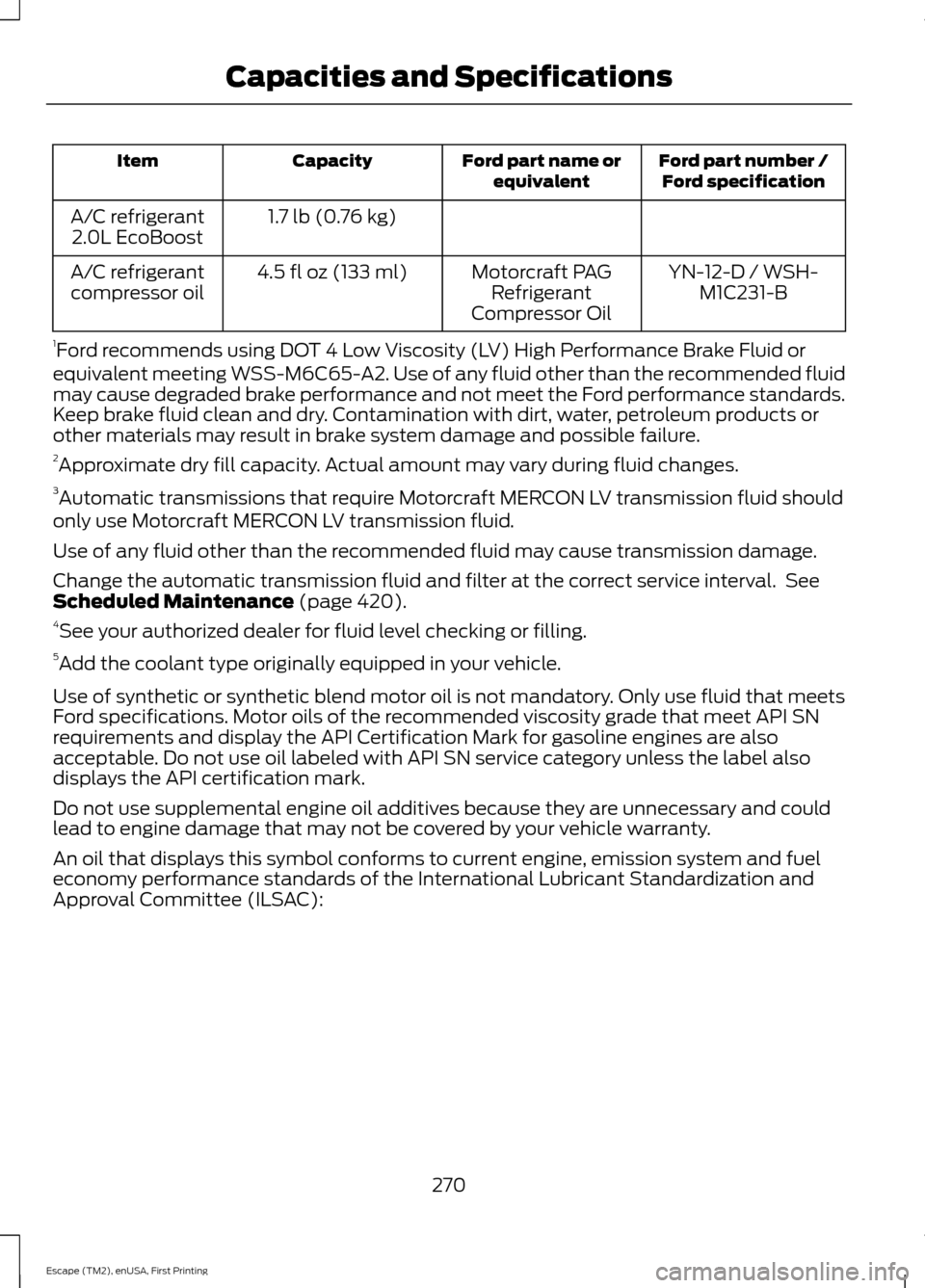
1.7 lb (0.76 kg)
A/C refrigerant
2.0L EcoBoost
YN-12-D / WSH-M1C231-B
Motorcraft PAG
Refrigerant
Compressor Oil
4.5 fl oz (133 ml)
A/C refrigerant
compressor oil
1 Ford recommends using DOT 4 Low Viscosity (LV) High Performance Brake Fluid or
equivalent meeting WSS-M6C65-A2. Use of any fluid other than the recommended fluid
may cause degraded brake performance and not meet the Ford performance standards.
Keep brake fluid clean and dry. Contamination with dirt, water, petroleum products or
other materials may result in brake system damage and possible failure.
2 Approximate dry fill capacity. Actual amount may vary during fluid changes.
3 Automatic transmissions that require Motorcraft MERCON LV transmission fluid should
only use Motorcraft MERCON LV transmission fluid.
Use of any fluid other than the recommended fluid may cause transmission damage.
Change the automatic transmission fluid and filter at the correct service interval. See
Scheduled Maintenance (page 420).
4 See your authorized dealer for fluid level checking or filling.
5 Add the coolant type originally equipped in your vehicle.
Use of synthetic or synthetic blend motor oil is not mandatory. Only use fluid that meets
Ford specifications. Motor oils of the recommended viscosity grade that meet API SN
requirements and display the API Certification Mark for gasoline engines are also
acceptable. Do not use oil labeled with API SN service category unless the label also
displays the API certification mark.
Do not use supplemental engine oil additives because they are unnecessary and could
lead to engine damage that may not be covered by your vehicle warranty.
An oil that displays this symbol conforms to current engine, emission system and fuel
economy performance standards of the International Lubricant Standardization and
Approval Committee (ILSAC):
270
Escape (TM2), enUSA, First Printing Capacities and Specifications
Page 425 of 449
Check every month
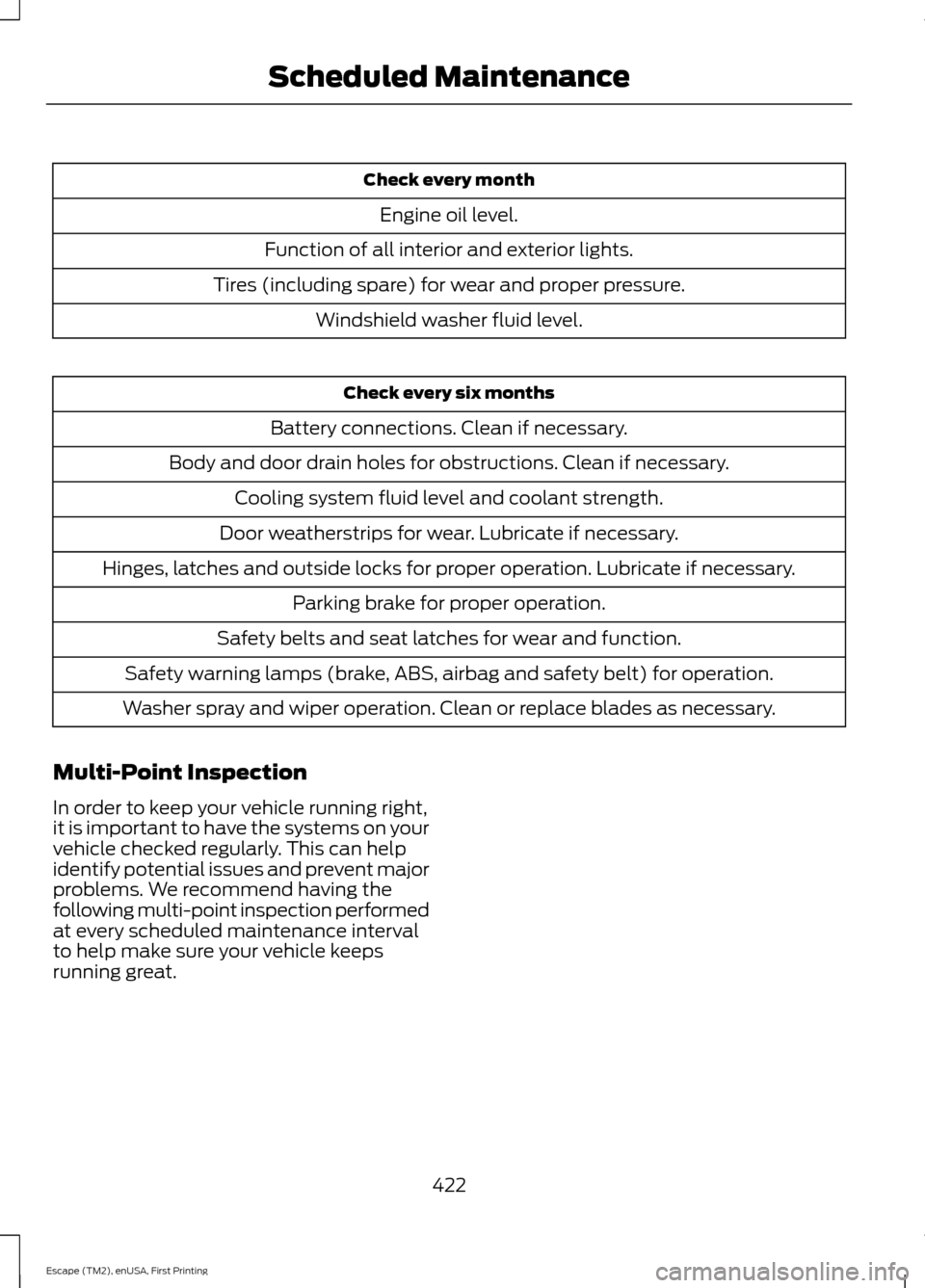
Engine oil level.
Function of all interior and exterior lights.
Tires (including spare) for wear and proper pressure. Windshield washer fluid level. Check every six months
Battery connections. Clean if necessary.
Body and door drain holes for obstructions. Clean if necessary. Cooling system fluid level and coolant strength.
Door weatherstrips for wear. Lubricate if necessary.
Hinges, latches and outside locks for proper operation. Lubricate if necessary. Parking brake for proper operation.
Safety belts and seat latches for wear and function.
Safety warning lamps (brake, ABS, airbag and safety belt) for operation.
Washer spray and wiper operation. Clean or replace blades as necessary.
Multi-Point Inspection
In order to keep your vehicle running right,
it is important to have the systems on your
vehicle checked regularly. This can help
identify potential issues and prevent major
problems. We recommend having the
following multi-point inspection performed
at every scheduled maintenance interval
to help make sure your vehicle keeps
running great.
422
Escape (TM2), enUSA, First Printing Scheduled Maintenance
Page 426 of 449
Multi-Point inspection
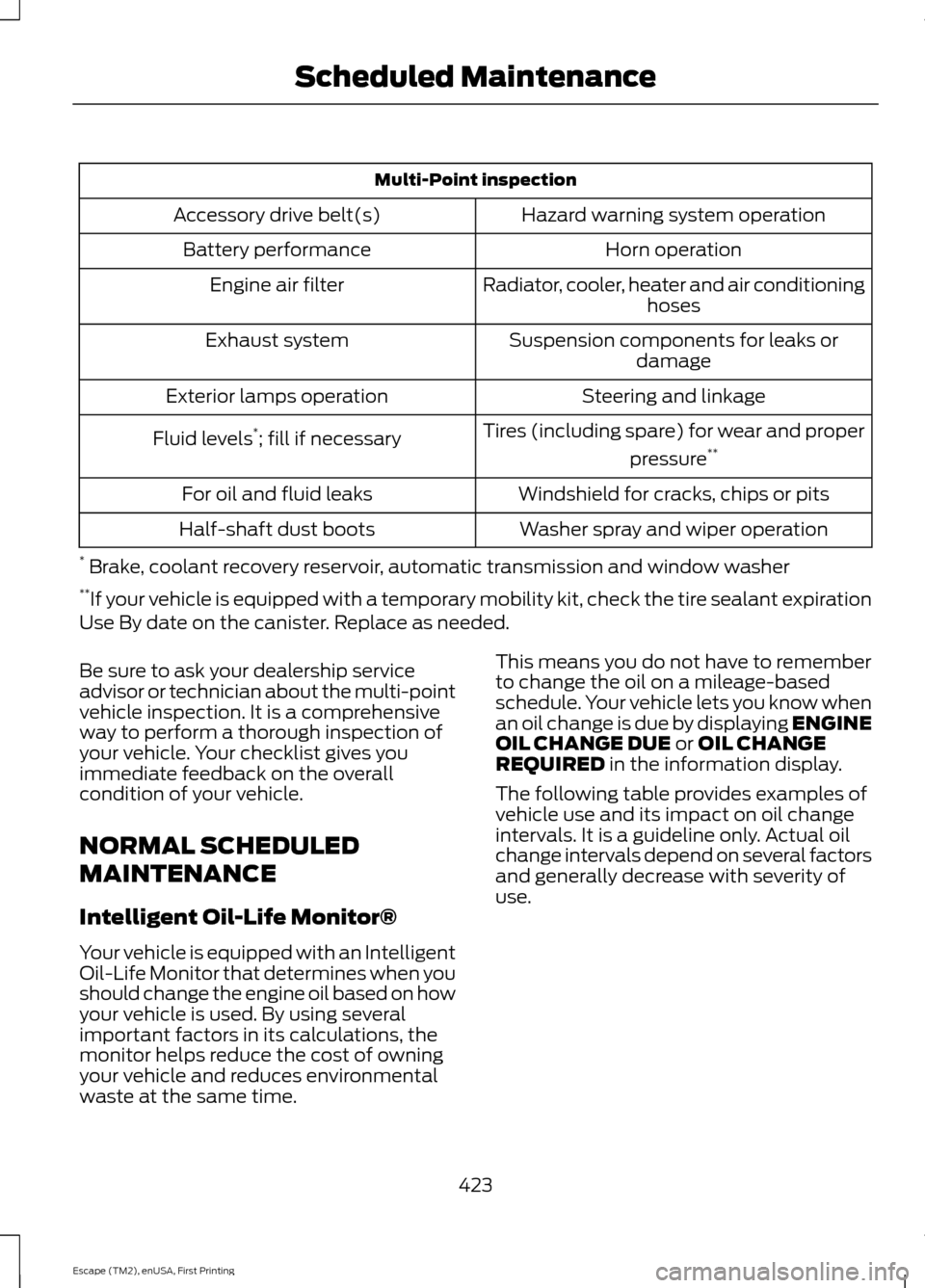
Hazard warning system operation
Accessory drive belt(s)
Horn operation
Battery performance
Radiator, cooler, heater and air conditioninghoses
Engine air filter
Suspension components for leaks ordamage
Exhaust system
Steering and linkage
Exterior lamps operation
Tires (including spare) for wear and properpressure**
Fluid levels *
; fill if necessary
Windshield for cracks, chips or pits
For oil and fluid leaks
Washer spray and wiper operation
Half-shaft dust boots
* Brake, coolant recovery reservoir, automatic transmission and window washer
** If your vehicle is equipped with a temporary mobility kit, check the tire sealant expiration
Use By date on the canister. Replace as needed.
Be sure to ask your dealership service
advisor or technician about the multi-point
vehicle inspection. It is a comprehensive
way to perform a thorough inspection of
your vehicle. Your checklist gives you
immediate feedback on the overall
condition of your vehicle.
NORMAL SCHEDULED
MAINTENANCE
Intelligent Oil-Life Monitor®
Your vehicle is equipped with an Intelligent
Oil-Life Monitor that determines when you
should change the engine oil based on how
your vehicle is used. By using several
important factors in its calculations, the
monitor helps reduce the cost of owning
your vehicle and reduces environmental
waste at the same time. This means you do not have to remember
to change the oil on a mileage-based
schedule. Your vehicle lets you know when
an oil change is due by displaying ENGINE
OIL CHANGE DUE or OIL CHANGE
REQUIRED in the information display.
The following table provides examples of
vehicle use and its impact on oil change
intervals. It is a guideline only. Actual oil
change intervals depend on several factors
and generally decrease with severity of
use.
423
Escape (TM2), enUSA, First Printing Scheduled Maintenance
Page 428 of 449
At every oil change interval as indicated by the information display
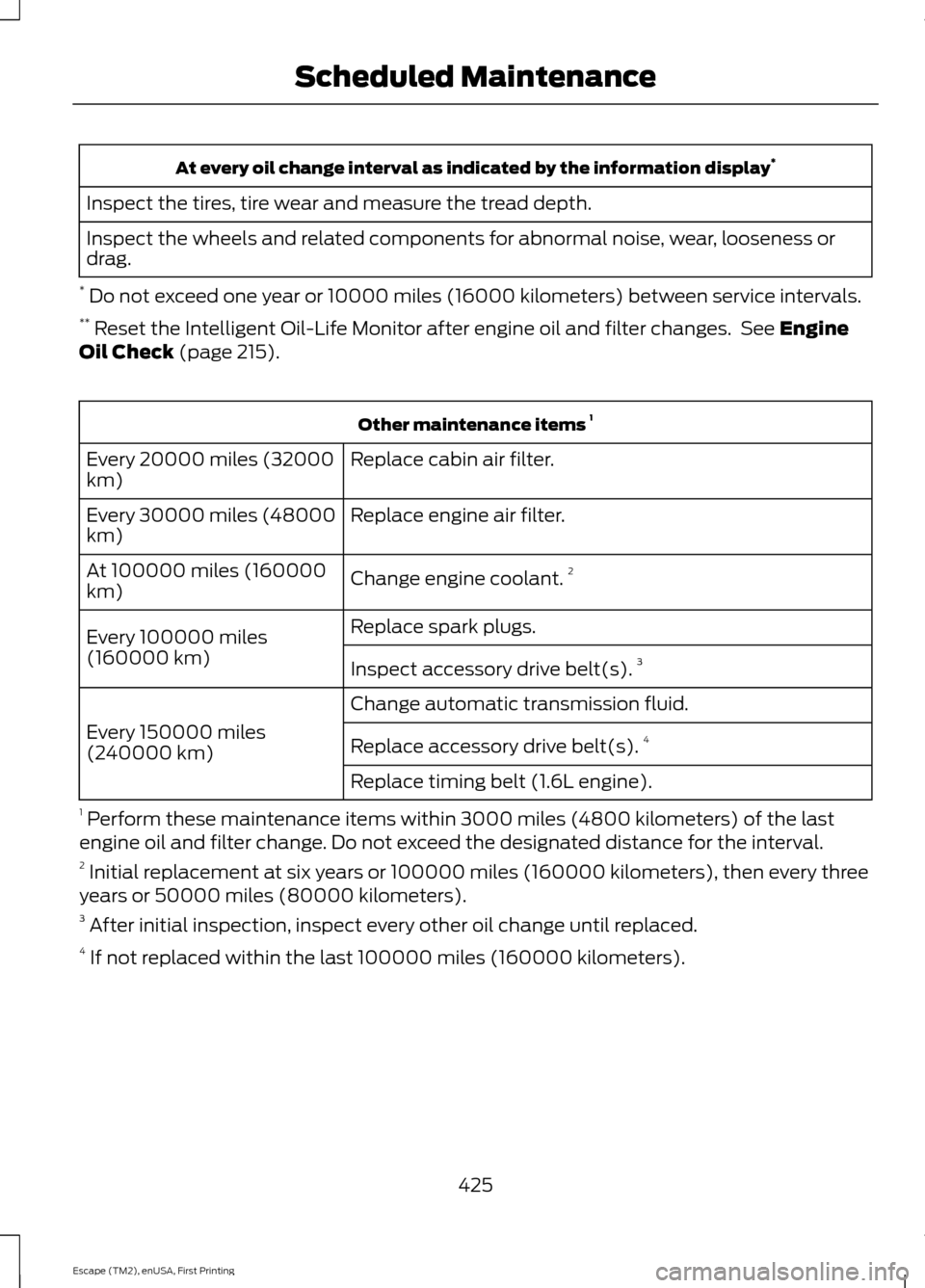
*
Inspect the tires, tire wear and measure the tread depth.
Inspect the wheels and related components for abnormal noise, wear, looseness or
drag.
* Do not exceed one year or 10000 miles (16000 kilometers) between service intervals.
** Reset the Intelligent Oil-Life Monitor after engine oil and filter changes. See Engine
Oil Check (page 215). Other maintenance items
1
Replace cabin air filter.
Every 20000 miles (32000
km)
Replace engine air filter.
Every 30000 miles (48000
km)
Change engine coolant.2
At 100000 miles (160000
km)
Replace spark plugs.
Every 100000 miles
(160000 km) Inspect accessory drive belt(s). 3
Change automatic transmission fluid.
Every 150000 miles
(240000 km) Replace accessory drive belt(s). 4
Replace timing belt (1.6L engine).
1 Perform these maintenance items within 3000 miles (4800 kilometers) of the last
engine oil and filter change. Do not exceed the designated distance for the interval.
2 Initial replacement at six years or 100000 miles (160000 kilometers), then every three
years or 50000 miles (80000 kilometers).
3 After initial inspection, inspect every other oil change until replaced.
4 If not replaced within the last 100000 miles (160000 kilometers).
425
Escape (TM2), enUSA, First Printing Scheduled Maintenance
Page 441 of 449
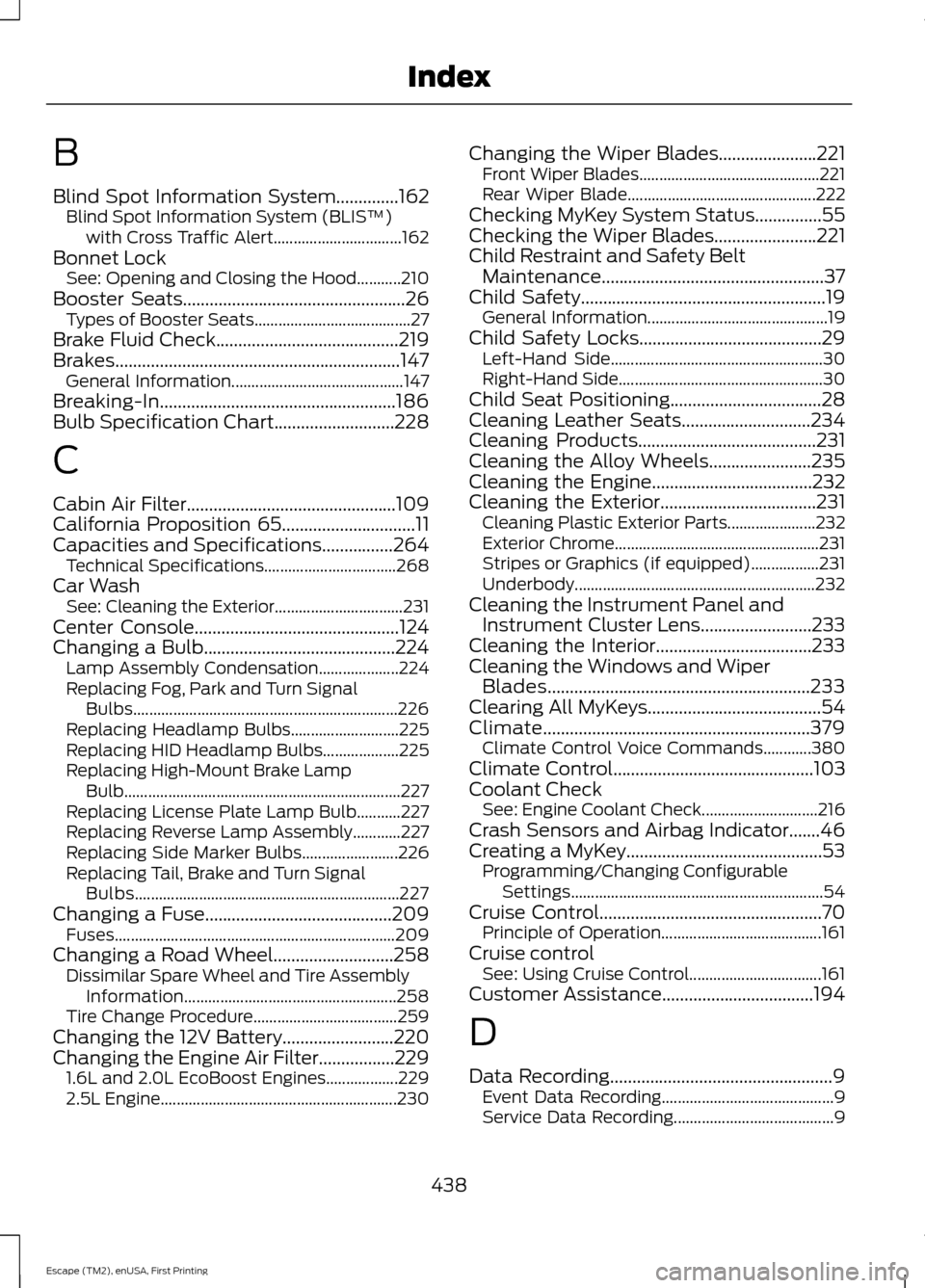
B
Blind Spot Information System..............162
Blind Spot Information System (BLIS ™)
with Cross Traffic Alert................................ 162
Bonnet Lock See: Opening and Closing the Hood...........210
Booster Seats..................................................26 Types of Booster Seats....................................... 27
Brake Fluid Check.........................................219
Brakes................................................................147 General Information........................................... 147
Breaking-In.....................................................186
Bulb Specification Chart...........................228
C
Cabin Air Filter...............................................109
California Proposition 65..............................11
Capacities and Specifications
................264
Technical Specifications................................. 268
Car Wash See: Cleaning the Exterior................................ 231
Center Console
..............................................124
Changing a Bulb...........................................224 Lamp Assembly Condensation.................... 224
Replacing Fog, Park and Turn Signal Bulbs.................................................................. 226
Replacing Headlamp Bulbs........................... 225
Replacing HID Headlamp Bulbs................... 225
Replacing High-Mount Brake Lamp Bulb..................................................................... 227
Replacing License Plate Lamp Bulb...........227
Replacing Reverse Lamp Assembly............227
Replacing Side Marker Bulbs........................ 226
Replacing Tail, Brake and Turn Signal Bulbs.................................................................. 227
Changing a Fuse..........................................209 Fuses...................................................................... 209
Changing a Road Wheel...........................258 Dissimilar Spare Wheel and Tire Assembly
Information..................................................... 258
Tire Change Procedure.................................... 259
Changing the 12V Battery.........................220
Changing the Engine Air Filter.................229 1.6L and 2.0L EcoBoost Engines.................. 229
2.5L Engine........................................................... 230Changing the Wiper Blades
......................221
Front Wiper Blades............................................. 221
Rear Wiper Blade............................................... 222
Checking MyKey System Status...............55
Checking the Wiper Blades
.......................221
Child Restraint and Safety Belt Maintenance..................................................37
Child Safety
.......................................................19
General Information............................................. 19
Child Safety Locks
.........................................29
Left-Hand Side..................................................... 30
Right-Hand Side................................................... 30
Child Seat Positioning
..................................28
Cleaning Leather Seats.............................234
Cleaning Products
........................................231
Cleaning the Alloy Wheels.......................235
Cleaning the Engine
....................................232
Cleaning the Exterior...................................231 Cleaning Plastic Exterior Parts...................... 232
Exterior Chrome................................................... 231
Stripes or Graphics (if equipped).................231
Underbody............................................................ 232
Cleaning the Instrument Panel and Instrument Cluster Lens.........................233
Cleaning the Interior...................................233
Cleaning the Windows and Wiper Blades...........................................................233
Clearing All MyKeys
.......................................54
Climate............................................................379 Climate Control Voice Commands............380
Climate Control
.............................................103
Coolant Check See: Engine Coolant Check............................. 216
Crash Sensors and Airbag Indicator.......46
Creating a MyKey............................................53 Programming/Changing Configurable
Settings............................................................... 54
Cruise Control
..................................................70
Principle of Operation........................................ 161
Cruise control See: Using Cruise Control................................. 161
Customer Assistance
..................................194
D
Data Recording
..................................................9
Event Data Recording........................................... 9
Service Data Recording........................................ 9
438
Escape (TM2), enUSA, First Printing Index
Page 442 of 449
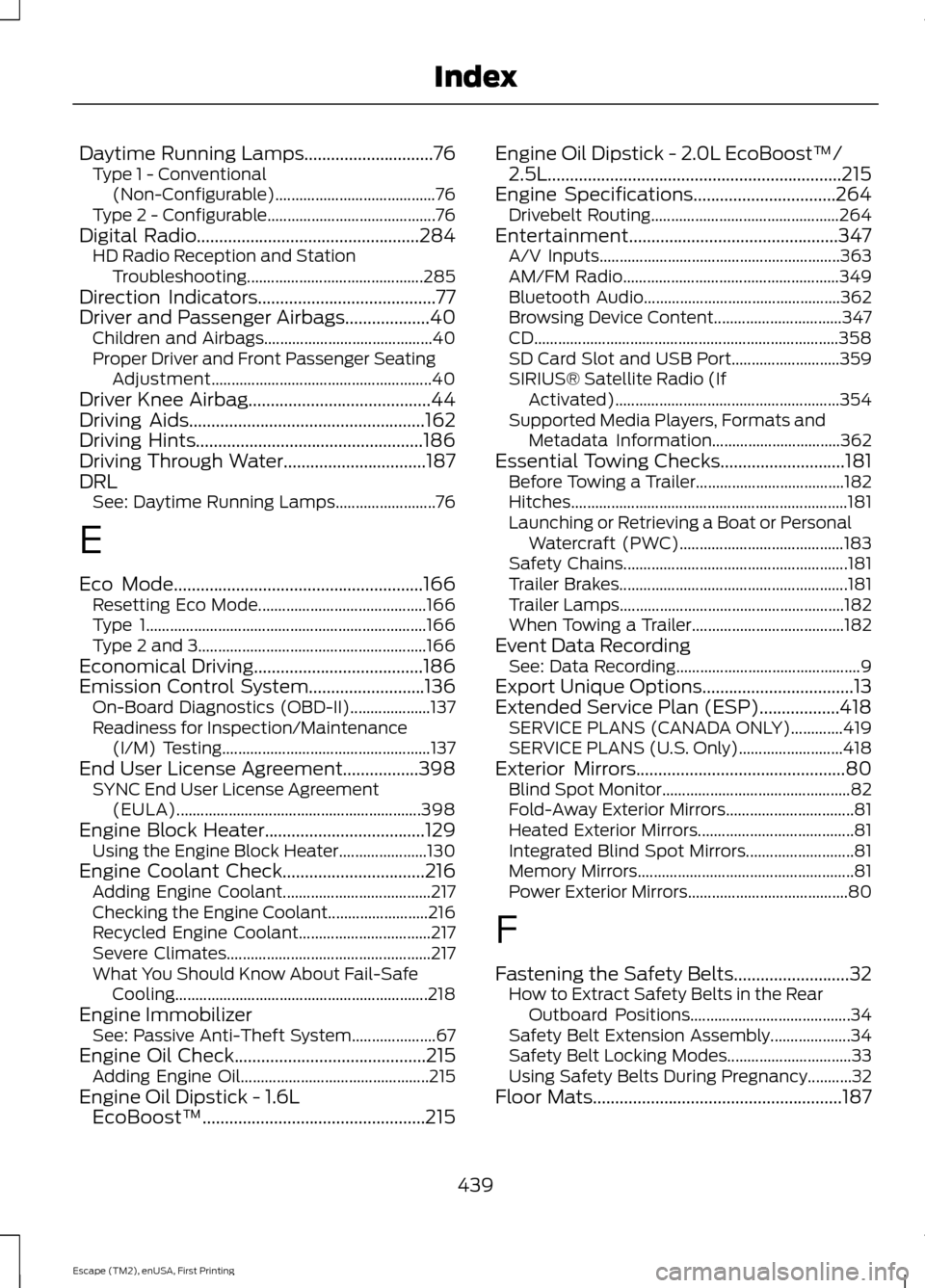
Daytime Running Lamps.............................76
Type 1 - Conventional
(Non-Configurable)........................................ 76
Type 2 - Configurable.......................................... 76
Digital Radio..................................................284
HD Radio Reception and Station
Troubleshooting............................................ 285
Direction Indicators
........................................77
Driver and Passenger Airbags...................40
Children and Airbags.......................................... 40
Proper Driver and Front Passenger Seating Adjustment....................................................... 40
Driver Knee Airbag
.........................................44
Driving Aids.....................................................162
Driving Hints...................................................186
Driving Through Water................................187
DRL See: Daytime Running Lamps......................... 76
E
Eco Mode
........................................................166
Resetting Eco Mode.......................................... 166
Type 1...................................................................... 166
Type 2 and 3......................................................... 166
Economical Driving
......................................186
Emission Control System..........................136 On-Board Diagnostics (OBD-II).................... 137
Readiness for Inspection/Maintenance (I/M) Testing.................................................... 137
End User License Agreement
.................398
SYNC End User License Agreement
(EULA)............................................................. 398
Engine Block Heater....................................129 Using the Engine Block Heater...................... 130
Engine Coolant Check
................................216
Adding Engine Coolant..................................... 217
Checking the Engine Coolant......................... 216
Recycled Engine Coolant................................. 217
Severe Climates................................................... 217
What You Should Know About Fail-Safe Cooling............................................................... 218
Engine Immobilizer See: Passive Anti-Theft System..................... 67
Engine Oil Check
...........................................215
Adding Engine Oil............................................... 215
Engine Oil Dipstick - 1.6L EcoBoost™..................................................215 Engine Oil Dipstick - 2.0L EcoBoost™/
2.5L..................................................................215
Engine Specifications
................................264
Drivebelt Routing............................................... 264
Entertainment...............................................347 A/V Inputs............................................................ 363
AM/FM Radio...................................................... 349
Bluetooth Audio................................................. 362
Browsing Device Content................................ 347
CD........................................................................\
.... 358
SD Card Slot and USB Port........................... 359
SIRIUS® Satellite Radio (If Activated)........................................................ 354
Supported Media Players, Formats and Metadata Information................................ 362
Essential Towing Checks
............................181
Before Towing a Trailer..................................... 182
Hitches..................................................................... 181
Launching or Retrieving a Boat or Personal Watercraft (PWC)......................................... 183
Safety Chains........................................................ 181
Trailer Brakes......................................................... 181
Trailer Lamps........................................................ 182
When Towing a Trailer...................................... 182
Event Data Recording See: Data Recording.............................................. 9
Export Unique Options..................................13
Extended Service Plan (ESP)..................418 SERVICE PLANS (CANADA ONLY).............419
SERVICE PLANS (U.S. Only).......................... 418
Exterior Mirrors
...............................................80
Blind Spot Monitor............................................... 82
Fold-Away Exterior Mirrors................................ 81
Heated Exterior Mirrors....................................... 81
Integrated Blind Spot Mirrors........................... 81
Memory Mirrors...................................................... 81
Power Exterior Mirrors........................................ 80
F
Fastening the Safety Belts..........................32 How to Extract Safety Belts in the Rear
Outboard Positions........................................ 34
Safety Belt Extension Assembly.................... 34
Safety Belt Locking Modes............................... 33
Using Safety Belts During Pregnancy...........32
Floor Mats........................................................187
439
Escape (TM2), enUSA, First Printing Index