engine coolant FORD ESCAPE 2015 3.G Owners Manual
[x] Cancel search | Manufacturer: FORD, Model Year: 2015, Model line: ESCAPE, Model: FORD ESCAPE 2015 3.GPages: 449, PDF Size: 5.36 MB
Page 7 of 449
Reporting Safety Defects (U.S.
Only).............................................................198
Reporting Safety Defects (Canada Only).............................................................199
Fuses
Fuse Specification Chart..........................200
Changing a Fuse..........................................209
Maintenance
General Information
....................................210
Opening and Closing the Hood
...............210
Under Hood Overview -
1.6L
EcoBoost™.................................................212
Under Hood Overview -
2.0L
EcoBoost™.................................................213
Under Hood Overview - 2.5L....................214
Engine Oil Dipstick -
2.0L EcoBoost™/
2.5L.................................................................215
Engine Oil Dipstick -
1.6L
EcoBoost™.................................................215
Engine Oil Check
...........................................215
Engine Coolant Check
................................216
Automatic Transmission Fluid Check............................................................219
Brake Fluid Check.........................................219
Power Steering Fluid Check......................219
Washer Fluid Check
.....................................219
Fuel Filter
.........................................................219
Changing the 12V Battery.........................220
Checking the Wiper Blades
.......................221
Changing the Wiper Blades
......................221
Adjusting the Headlamps
.........................222
Removing a Headlamp..............................224
Changing a Bulb...........................................224
Bulb Specification Chart...........................228
Changing the Engine Air Filter.................229
Vehicle Care
General Information
....................................231
Cleaning Products
........................................231 Cleaning the Exterior...................................231
Waxing.............................................................232
Cleaning the Engine
....................................232
Cleaning the Windows and Wiper Blades..........................................................233
Cleaning the Interior...................................233
Cleaning the Instrument Panel and Instrument Cluster Lens........................233
Cleaning Leather Seats.............................234
Repairing Minor Paint Damage
...............235
Cleaning the Alloy Wheels.......................235
Vehicle Storage
.............................................235
Wheels and Tires
General Information
...................................238
Tire Care..........................................................240
Using Snow Chains.....................................254
Tire Pressure Monitoring System...........255
Changing a Road Wheel...........................258
Technical Specifications...........................262
Capacities and Specific- ations
Engine Specifications
................................264
Motorcraft Parts
...........................................265
Vehicle Identification Number
................265
Vehicle Certification Label.......................266
Transmission Code Designation............267
Technical Specifications
..........................268
Audio System
General Information
....................................272
Audio Unit -
Vehicles With: AM/FM/
CD..................................................................273
Audio Unit - Vehicles With: AM/FM/CD/ SYNC............................................................275
Audio Unit - Vehicles With: AM/FM/CD/ SYNC/
Satellite Radio.............................277
Audio Unit - Vehicles With: Premium AM/ FM/
CD..........................................................279
4
Escape (TM2), enUSA, First Printing Table of Contents
Page 11 of 449
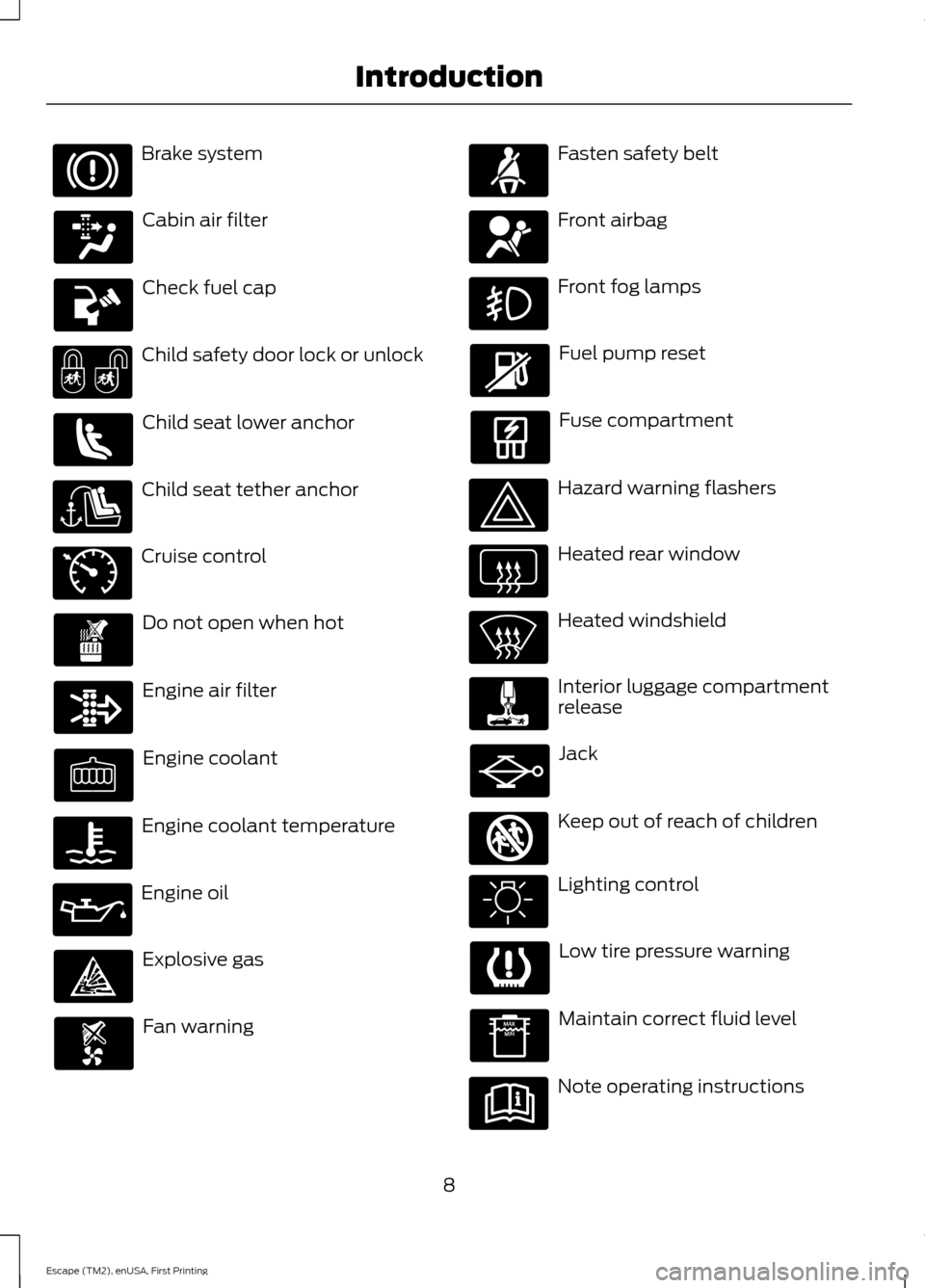
Brake system
Cabin air filter
Check fuel cap
Child safety door lock or unlock
Child seat lower anchor
Child seat tether anchor
Cruise control
Do not open when hot
Engine air filter
Engine coolant
Engine coolant temperature
Engine oil
Explosive gas
Fan warning Fasten safety belt
Front airbag
Front fog lamps
Fuel pump reset
Fuse compartment
Hazard warning flashers
Heated rear window
Heated windshield
Interior luggage compartment
release
Jack
Keep out of reach of children
Lighting control
Low tire pressure warning
Maintain correct fluid level
Note operating instructions
8
Escape (TM2), enUSA, First Printing Introduction E71340 E161353
Page 87 of 449
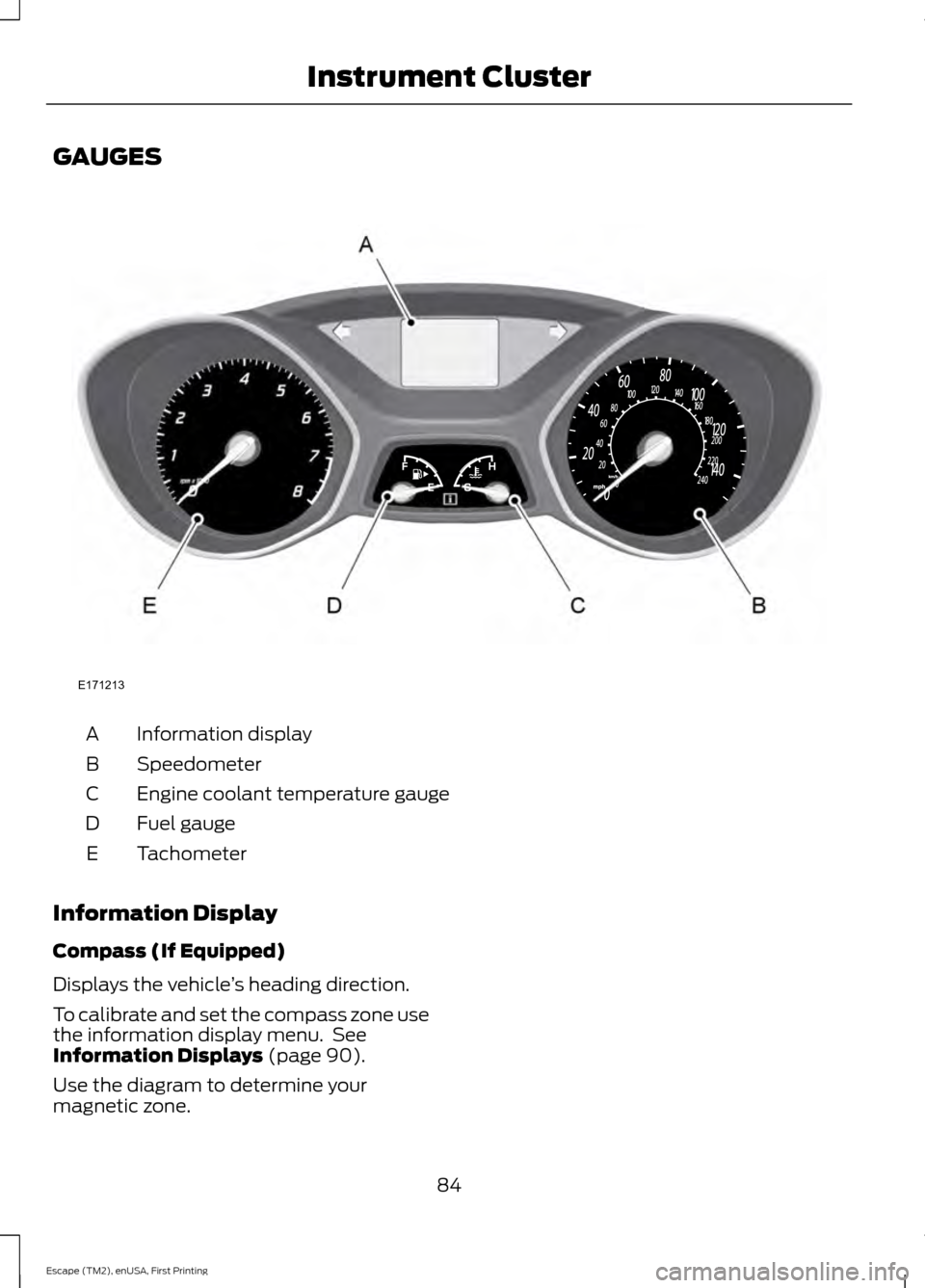
GAUGES
Information display
A
Speedometer
B
Engine coolant temperature gauge
C
Fuel gauge
D
Tachometer
E
Information Display
Compass (If Equipped)
Displays the vehicle ’s heading direction.
To calibrate and set the compass zone use
the information display menu. See
Information Displays (page 90).
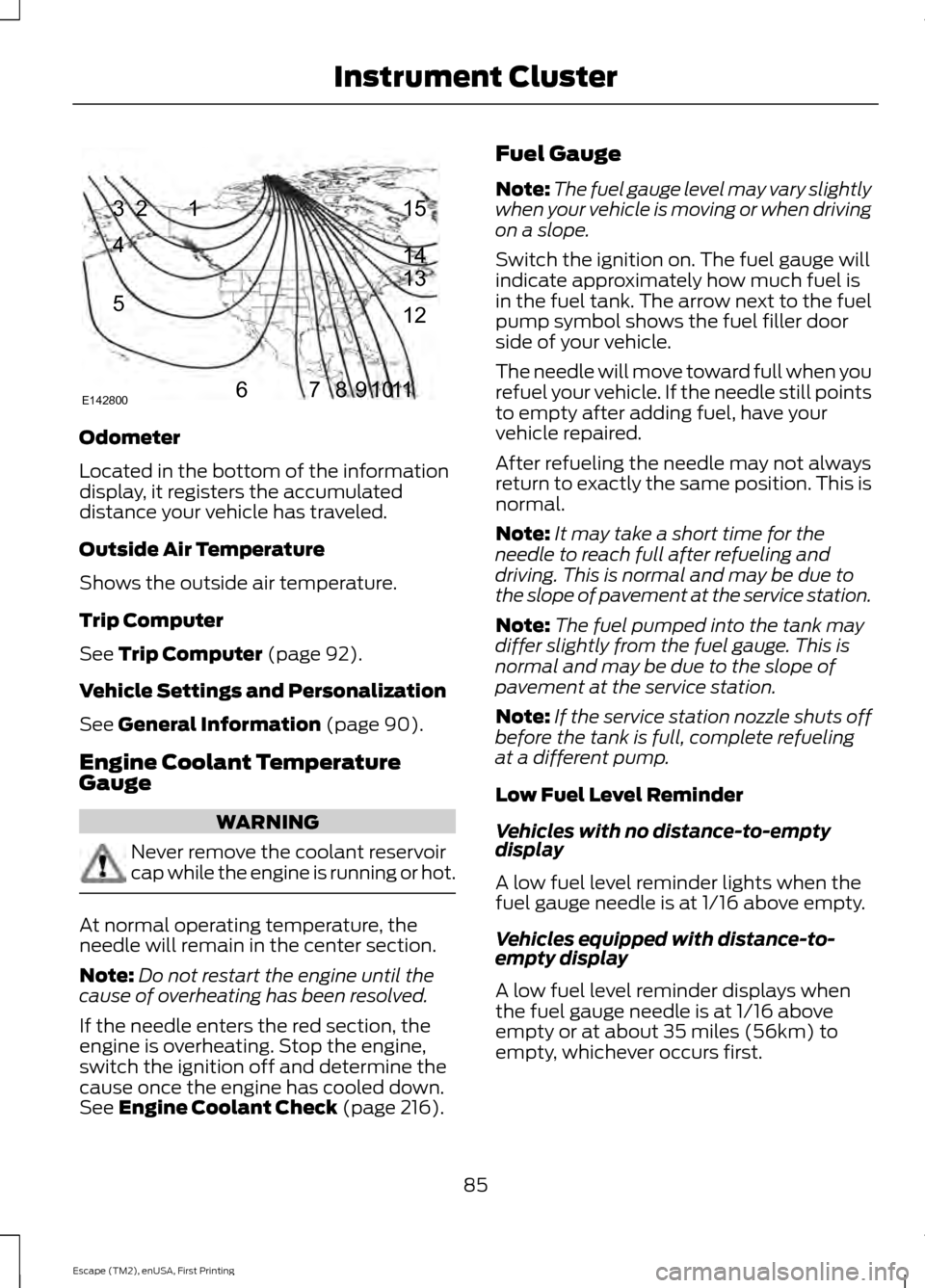
Use the diagram to determine your
magnetic zone.
84
Escape (TM2), enUSA, First Printing Instrument ClusterE171213
Page 88 of 449
Odometer
Located in the bottom of the information
display, it registers the accumulated
distance your vehicle has traveled.
Outside Air Temperature
Shows the outside air temperature.
Trip Computer
See Trip Computer (page 92).
Vehicle Settings and Personalization
See
General Information (page 90).
Engine Coolant Temperature
Gauge WARNING
Never remove the coolant reservoir
cap while the engine is running or hot.
At normal operating temperature, the
needle will remain in the center section.
Note:
Do not restart the engine until the
cause of overheating has been resolved.
If the needle enters the red section, the
engine is overheating. Stop the engine,
switch the ignition off and determine the
cause once the engine has cooled down.
See
Engine Coolant Check (page 216). Fuel Gauge
Note:
The fuel gauge level may vary slightly
when your vehicle is moving or when driving
on a slope.
Switch the ignition on. The fuel gauge will
indicate approximately how much fuel is
in the fuel tank. The arrow next to the fuel
pump symbol shows the fuel filler door
side of your vehicle.
The needle will move toward full when you
refuel your vehicle. If the needle still points
to empty after adding fuel, have your
vehicle repaired.
After refueling the needle may not always
return to exactly the same position. This is
normal.
Note: It may take a short time for the
needle to reach full after refueling and
driving. This is normal and may be due to
the slope of pavement at the service station.
Note: The fuel pumped into the tank may
differ slightly from the fuel gauge. This is
normal and may be due to the slope of
pavement at the service station.
Note: If the service station nozzle shuts off
before the tank is full, complete refueling
at a different pump.
Low Fuel Level Reminder
Vehicles with no distance-to-empty
display
A low fuel level reminder lights when the
fuel gauge needle is at 1/16 above empty.
Vehicles equipped with distance-to-
empty display
A low fuel level reminder displays when
the fuel gauge needle is at 1/16 above
empty or at about 35 miles (56km) to
empty, whichever occurs first.
85
Escape (TM2), enUSA, First Printing Instrument Cluster1
2
3
4
5
678910 1112 13 14 15
E142800
Page 99 of 449
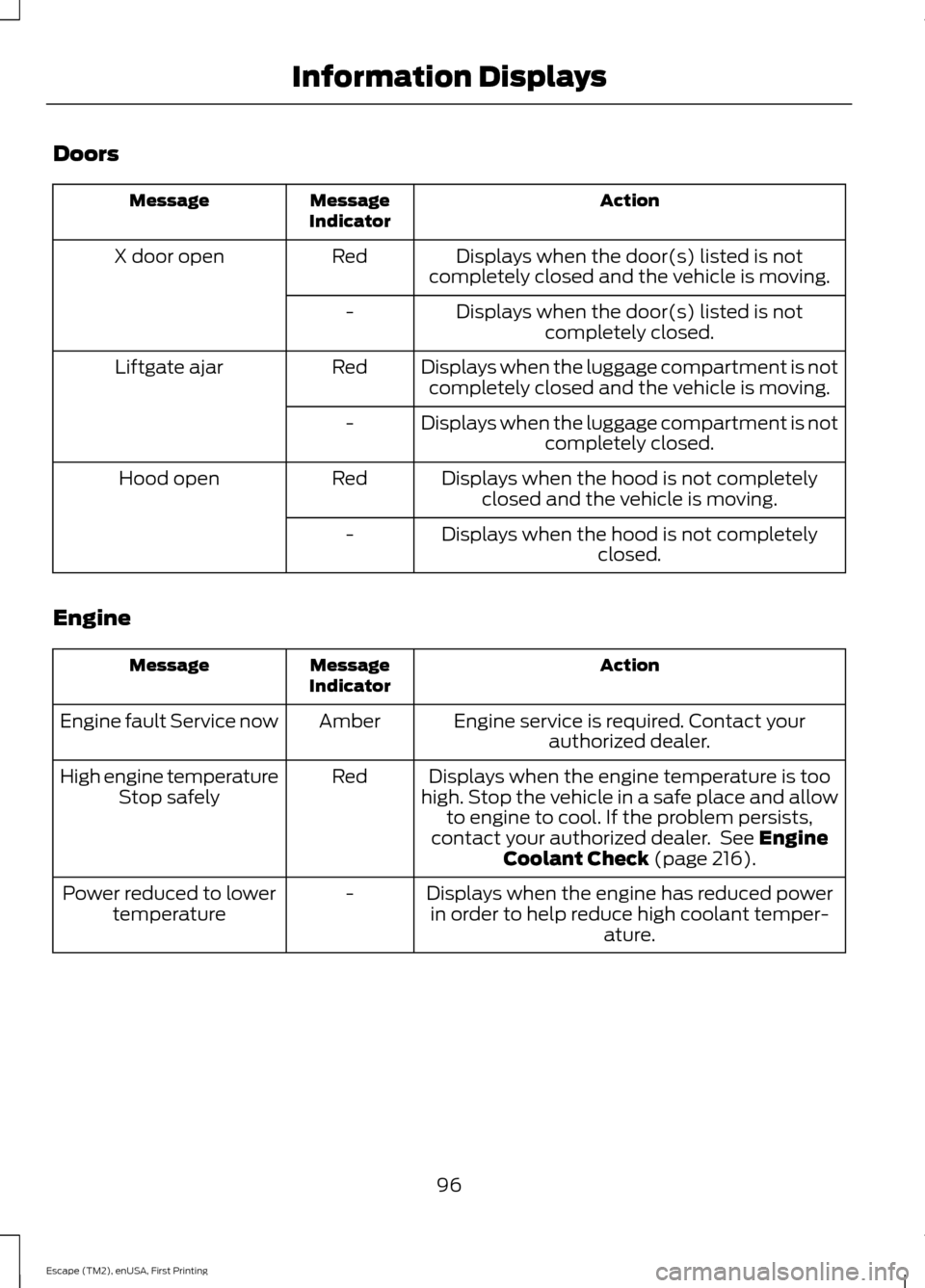
Doors
Action
Message
Indicator
Message
Displays when the door(s) listed is not
completely closed and the vehicle is moving.
Red
X door open
Displays when the door(s) listed is notcompletely closed.
-
Displays when the luggage compartment is notcompletely closed and the vehicle is moving.
Red
Liftgate ajar
Displays when the luggage compartment is notcompletely closed.
-
Displays when the hood is not completelyclosed and the vehicle is moving.
Red
Hood open
Displays when the hood is not completelyclosed.
-
Engine Action
Message
Indicator
Message
Engine service is required. Contact yourauthorized dealer.
Amber
Engine fault Service now
Displays when the engine temperature is too
high. Stop the vehicle in a safe place and allow to engine to cool. If the problem persists,
contact your authorized dealer. See Engine
Coolant Check (page 216).
Red
High engine temperature
Stop safely
Displays when the engine has reduced powerin order to help reduce high coolant temper- ature.
-
Power reduced to lower
temperature
96
Escape (TM2), enUSA, First Printing Information Displays
Page 132 of 449
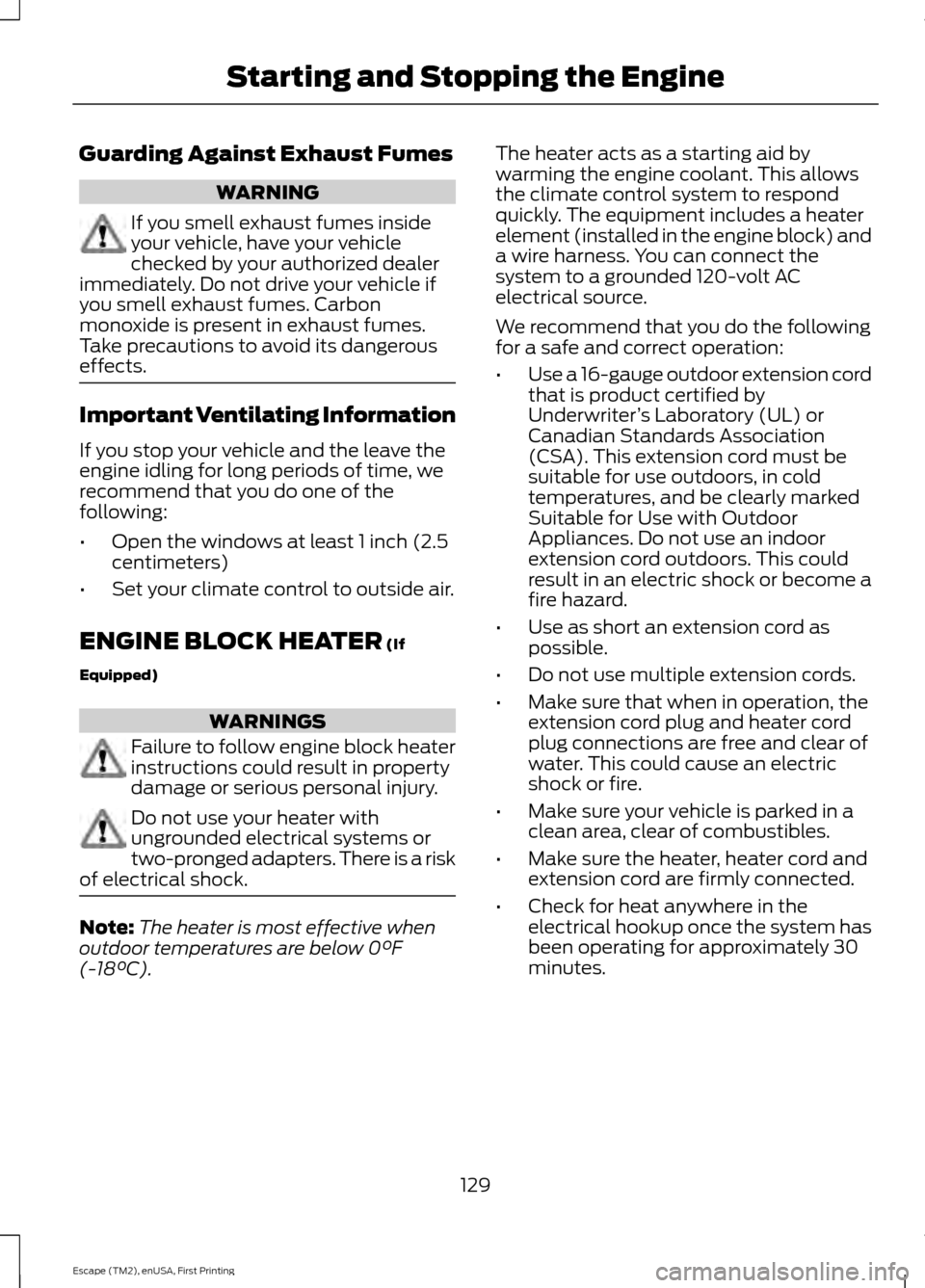
Guarding Against Exhaust Fumes
WARNING
If you smell exhaust fumes inside
your vehicle, have your vehicle
checked by your authorized dealer
immediately. Do not drive your vehicle if
you smell exhaust fumes. Carbon
monoxide is present in exhaust fumes.
Take precautions to avoid its dangerous
effects. Important Ventilating Information
If you stop your vehicle and the leave the
engine idling for long periods of time, we
recommend that you do one of the
following:
•
Open the windows at least 1 inch (2.5
centimeters)
• Set your climate control to outside air.
ENGINE BLOCK HEATER (If
Equipped) WARNINGS
Failure to follow engine block heater
instructions could result in property
damage or serious personal injury.
Do not use your heater with
ungrounded electrical systems or
two-pronged adapters. There is a risk
of electrical shock. Note:
The heater is most effective when
outdoor temperatures are below 0°F
(-18°C). The heater acts as a starting aid by
warming the engine coolant. This allows
the climate control system to respond
quickly. The equipment includes a heater
element (installed in the engine block) and
a wire harness. You can connect the
system to a grounded 120-volt AC
electrical source.
We recommend that you do the following
for a safe and correct operation:
•
Use a 16-gauge outdoor extension cord
that is product certified by
Underwriter ’s Laboratory (UL) or
Canadian Standards Association
(CSA). This extension cord must be
suitable for use outdoors, in cold
temperatures, and be clearly marked
Suitable for Use with Outdoor
Appliances. Do not use an indoor
extension cord outdoors. This could
result in an electric shock or become a
fire hazard.
• Use as short an extension cord as
possible.
• Do not use multiple extension cords.
• Make sure that when in operation, the
extension cord plug and heater cord
plug connections are free and clear of
water. This could cause an electric
shock or fire.
• Make sure your vehicle is parked in a
clean area, clear of combustibles.
• Make sure the heater, heater cord and
extension cord are firmly connected.
• Check for heat anywhere in the
electrical hookup once the system has
been operating for approximately 30
minutes.
129
Escape (TM2), enUSA, First Printing Starting and Stopping the Engine
Page 215 of 449
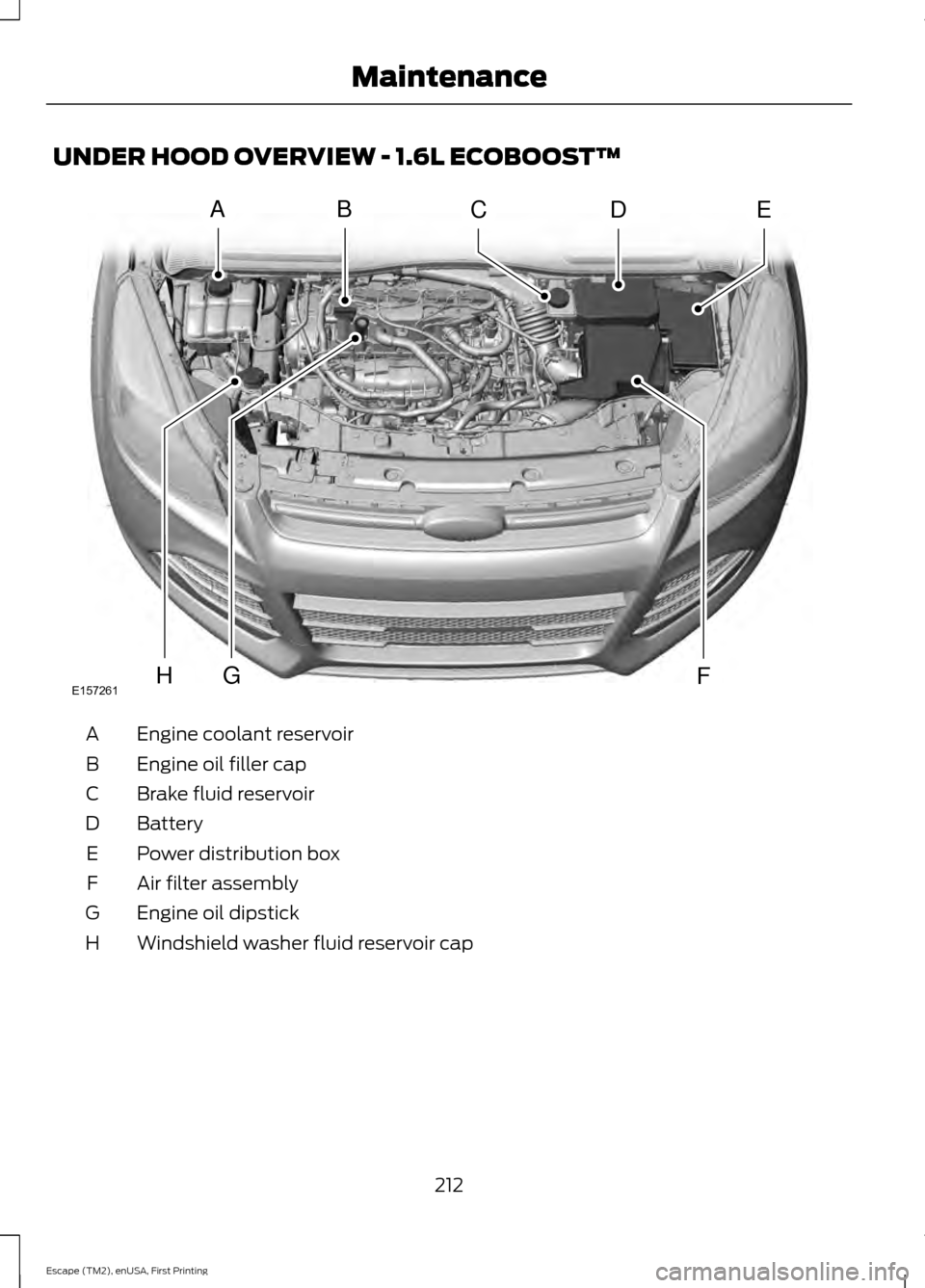
UNDER HOOD OVERVIEW - 1.6L ECOBOOST™
Engine coolant reservoir
A
Engine oil filler cap
B
Brake fluid reservoir
C
Battery
D
Power distribution box
E
Air filter assembly
F
Engine oil dipstick
G
Windshield washer fluid reservoir cap
H
212
Escape (TM2), enUSA, First Printing MaintenanceCABED
E157261FHG
Page 216 of 449
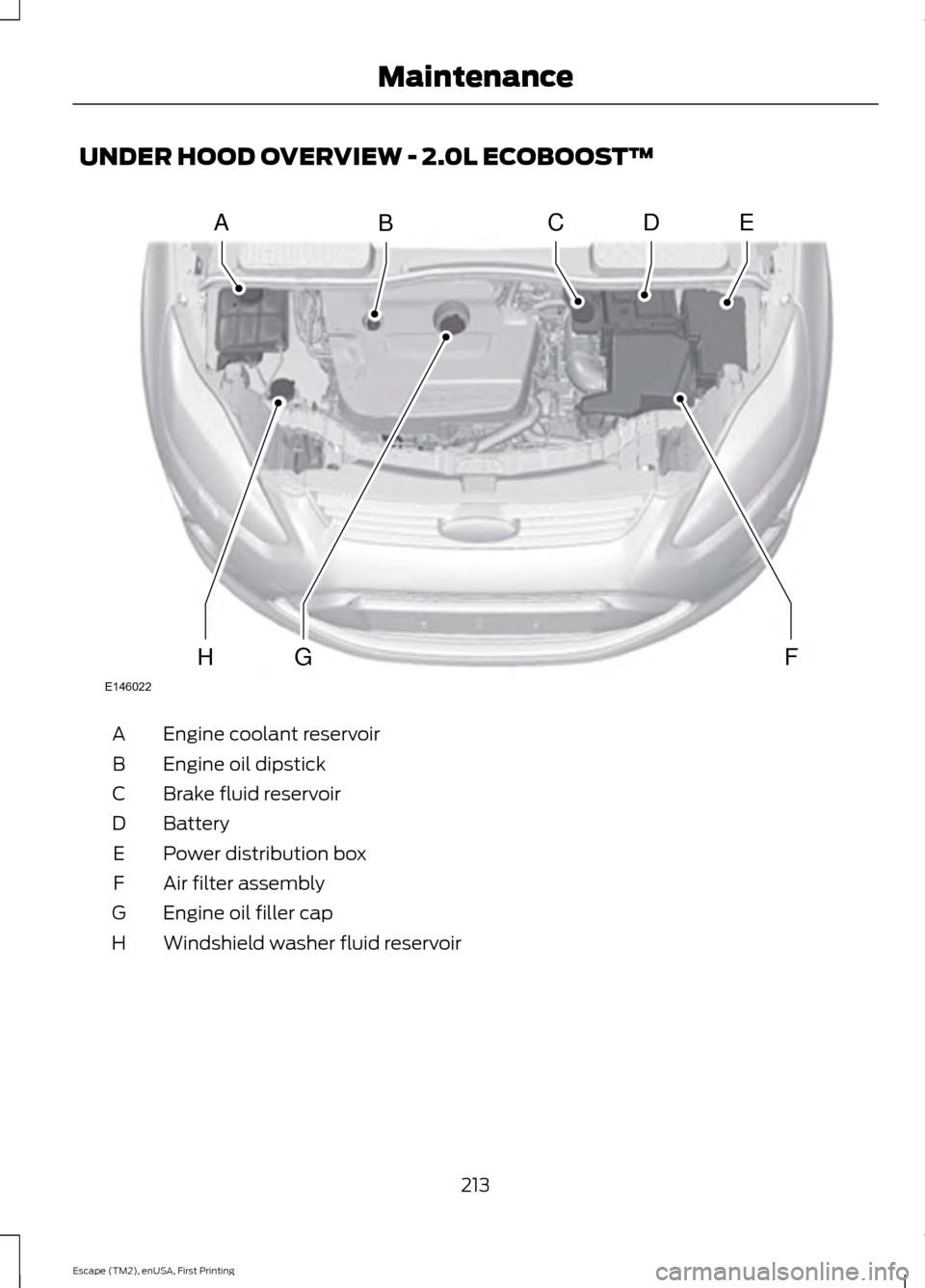
UNDER HOOD OVERVIEW - 2.0L ECOBOOST™
Engine coolant reservoir
A
Engine oil dipstick
B
Brake fluid reservoir
C
Battery
D
Power distribution box
E
Air filter assembly
F
Engine oil filler cap
G
Windshield washer fluid reservoir
H
213
Escape (TM2), enUSA, First Printing MaintenanceABCDE
FGH
E146022
Page 217 of 449
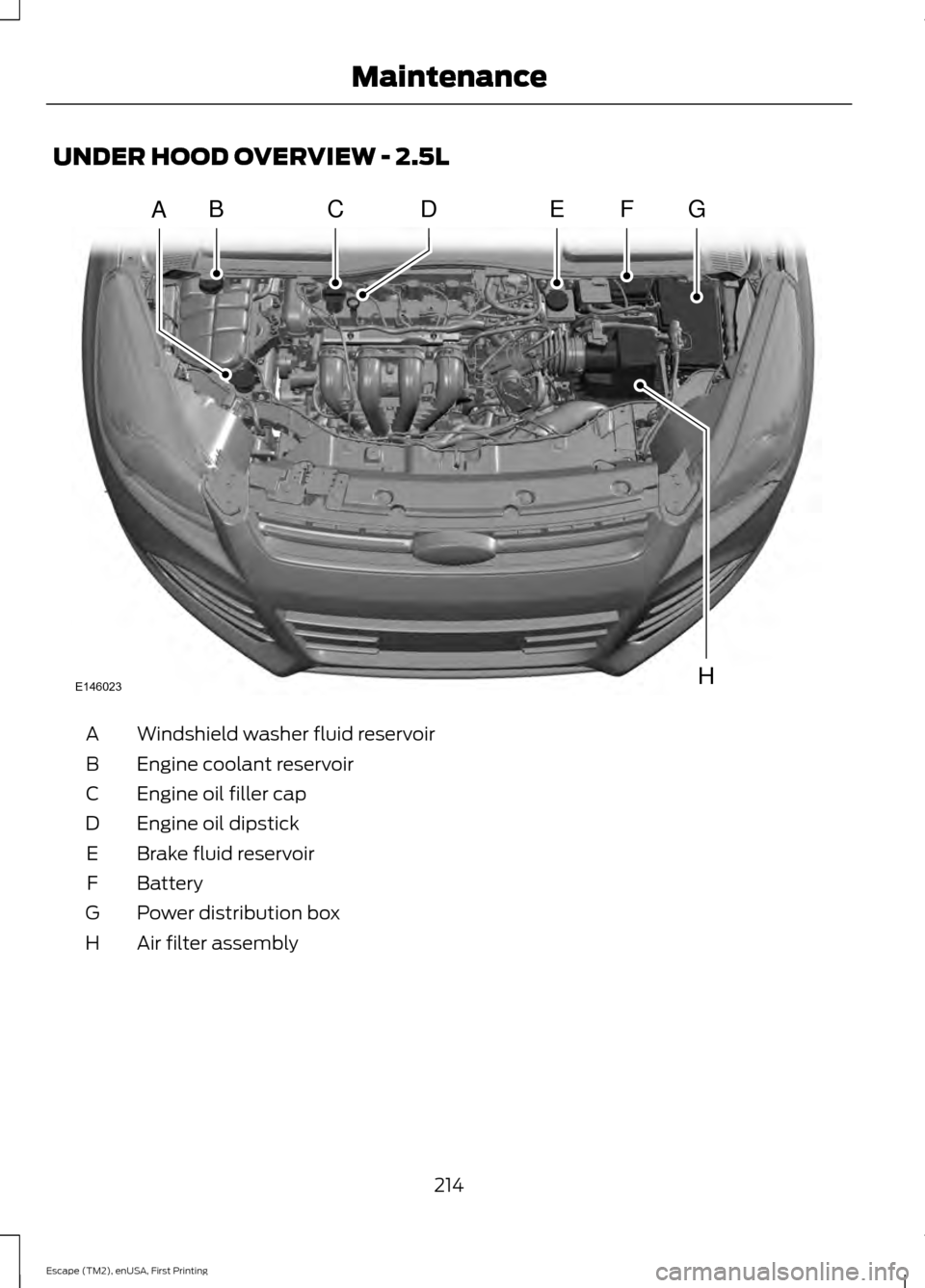
UNDER HOOD OVERVIEW - 2.5L
Windshield washer fluid reservoir
A
Engine coolant reservoir
B
Engine oil filler cap
C
Engine oil dipstick
D
Brake fluid reservoir
E
Battery
F
Power distribution box
G
Air filter assembly
H
214
Escape (TM2), enUSA, First Printing MaintenanceABCEFGD
HE146023
Page 219 of 449
WARNINGS
Only add oil when the engine is cold.
If the engine is hot, wait 10 minutes
for the engine to cool down.
Do not remove the filler cap when
the engine is running.
1. Remove the engine oil filler cap.
2. Add engine oil that meets Ford
specifications. See Capacities and
Specifications (page 264).
3. Replace the engine oil filler cap. Turn it clockwise until you feel a strong
resistance.
Note: Do not add oil further than the
maximum mark. Oil levels above the
maximum mark may cause engine damage.
Note: Soak up any spillage with an
absorbent cloth immediately.
ENGINE COOLANT CHECK
Checking the Engine Coolant WARNINGS
Do not add engine coolant when the
engine is hot. Steam and scalding
liquids released from a hot cooling
system can burn you badly. Also, you can
be burned if you spill coolant on hot engine
parts. Do not put engine coolant in the
windshield washer fluid container. If
sprayed on the windshield, engine
coolant could make it difficult to see
through the windshield. To reduce the risk of personal injury,
make sure the engine is cool before
unscrewing the coolant pressure
relief cap. The cooling system is under
pressure; steam and hot liquid can come
out forcefully when the cap is loosened
slightly. WARNINGS
Do not add coolant further than the
MAX mark.
Note:
Do not use stop leak pellets, cooling
system sealants, or additives as they can
cause damage to the engine cooling or
heating systems. This damage would not
be covered under your vehicle ’s warranty.
Note: During normal vehicle operation, the
engine coolant may change color from
orange to pink or light red. As long as the
engine coolant is clear and uncontaminated,
this color change does not indicate the
engine coolant has degraded nor does it
require the engine coolant to be drained, the
system to be flushed, or the engine coolant
to be replaced.
When the engine is cold, check the
concentration and level of the engine
coolant at the intervals listed in the
scheduled maintenance information. See
Scheduled Maintenance
(page 420).
Note: Make sure that the level is between
the MIN and MAX marks on the coolant
reservoir.
Note: Coolant expands when it is hot. The
level may extend beyond the MAX mark.
Note: If the level is at the MIN mark, below
the MIN mark, or empty, add coolant
immediately. See
Adding Engine Coolant
in this chapter.
The coolant concentration should be
maintained within 48% to 50%, which
equates to a freeze point between -30°F
(-34°C) and -34°F (-37°C).
Note: For best results, coolant
concentration should be tested with a
refractometer such as Robinair Coolant and
Battery Refractometer 75240. We do not
recommend the use of hydrometers or
coolant test strips for measuring coolant
concentrations.
216
Escape (TM2), enUSA, First Printing Maintenance