service schedule FORD ESCAPE 2022 User Guide
[x] Cancel search | Manufacturer: FORD, Model Year: 2022, Model line: ESCAPE, Model: FORD ESCAPE 2022Pages: 585, PDF Size: 6.15 MB
Page 491 of 585
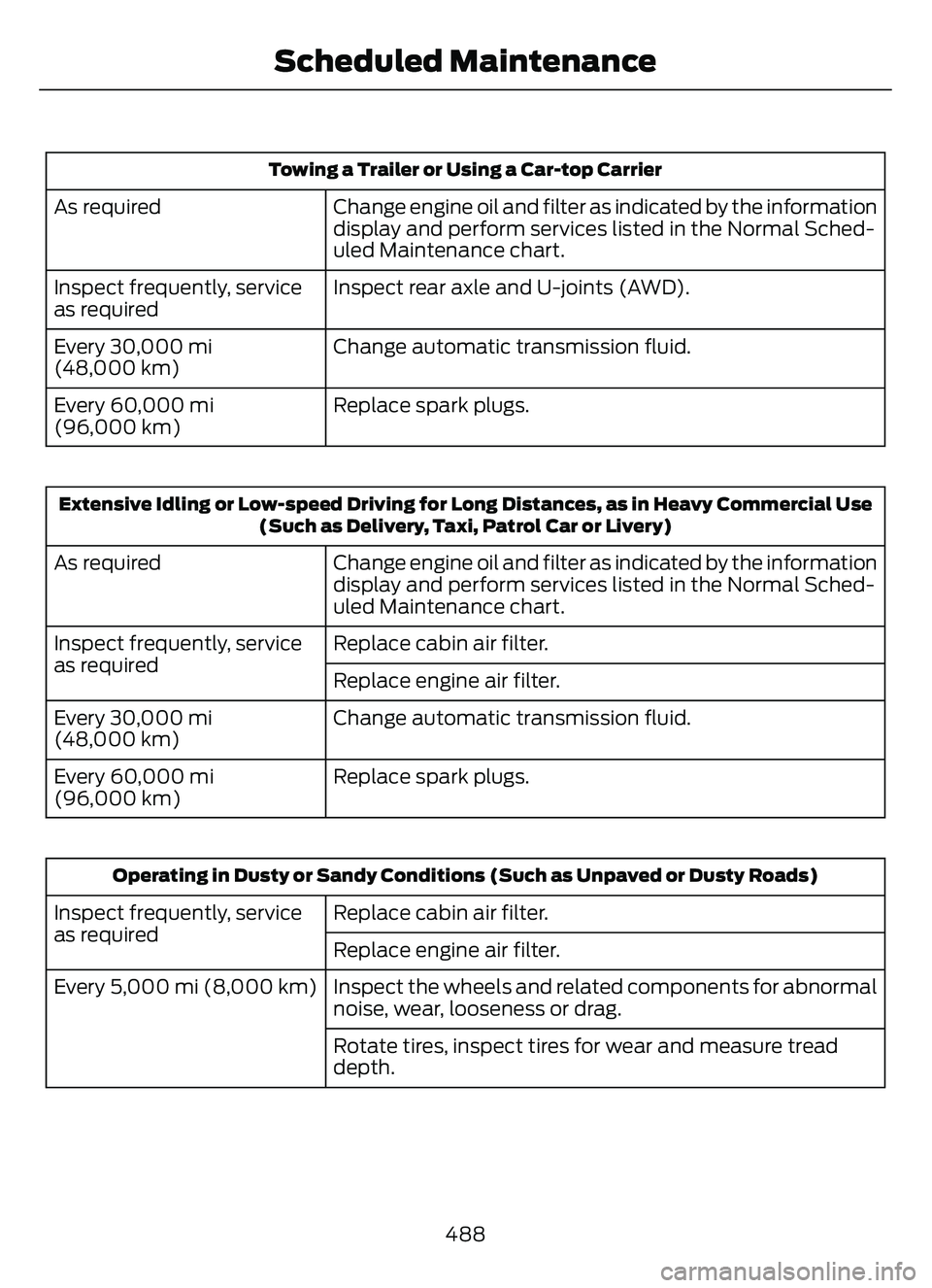
Towing a Trailer or Using a Car-top Carrier
Change engine oil and filter as indicated by the information
display and perform services listed in the Normal Sched-
uled Maintenance chart.
As required
Inspect rear axle and U-joints (AWD).
Inspect frequently, service
as required
Change automatic transmission fluid.
Every 30,000 mi
(48,000 km)
Replace spark plugs.
Every 60,000 mi
(96,000 km)
Extensive Idling or Low-speed Driving for Long Distances, as in Heavy Commercial Use
(Such as Delivery, Taxi, Patrol Car or Livery)
Change engine oil and filter as indicated by the information
display and perform services listed in the Normal Sched-
uled Maintenance chart.
As required
Replace cabin air filter.
Inspect frequently, service
as required
Replace engine air filter.
Change automatic transmission fluid.
Every 30,000 mi
(48,000 km)
Replace spark plugs.
Every 60,000 mi
(96,000 km)
Operating in Dusty or Sandy Conditions (Such as Unpaved or Dusty Roads)
Replace cabin air filter.
Inspect frequently, service
as required
Replace engine air filter.
Inspect the wheels and related components for abnormal
noise, wear, looseness or drag.
Every 5,000 mi (8,000 km)
Rotate tires, inspect tires for wear and measure tread
depth.
488
Scheduled Maintenance
Page 492 of 585
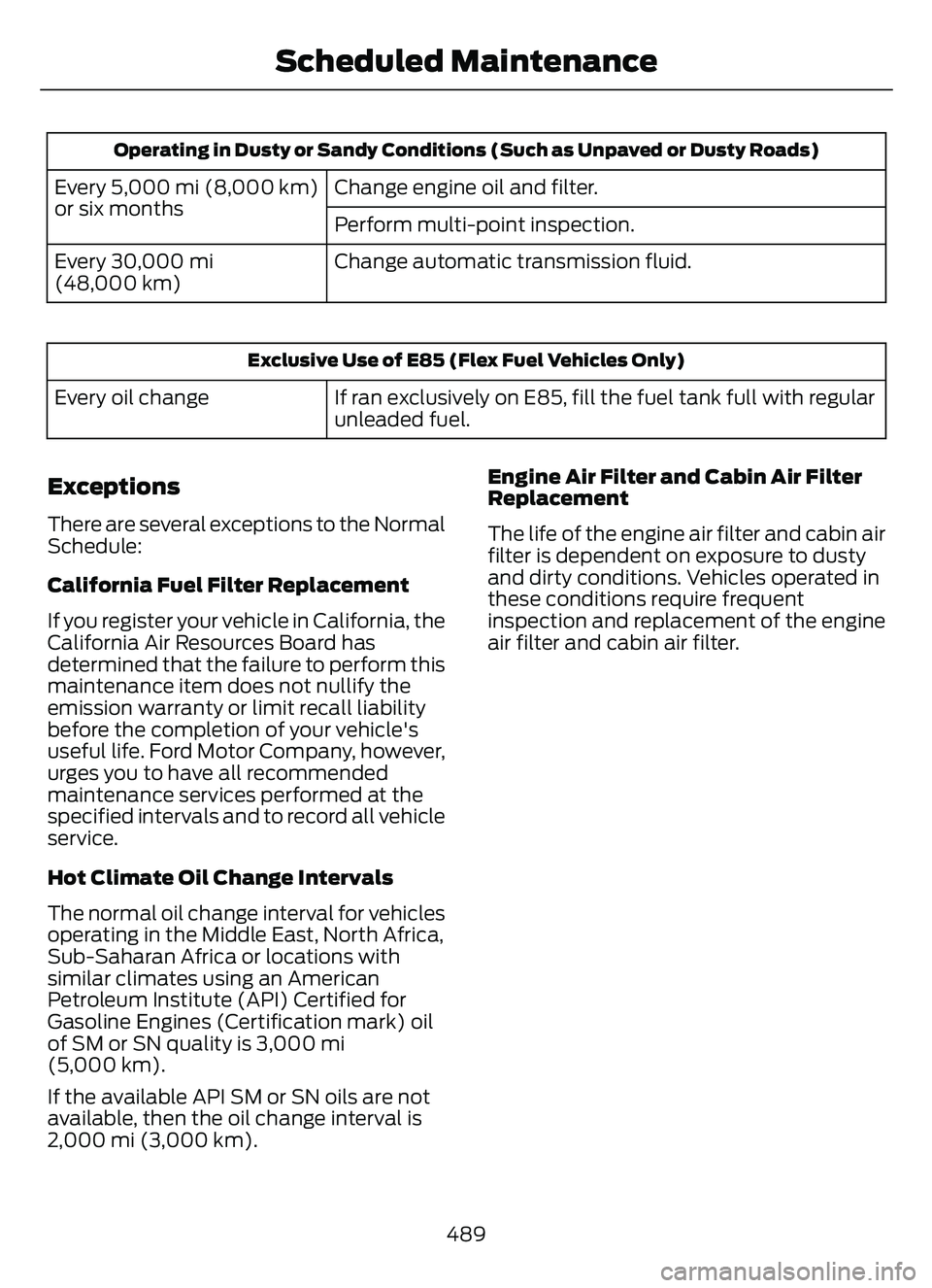
Operating in Dusty or Sandy Conditions (Such as Unpaved or Dusty Roads)
Change engine oil and filter.
Every 5,000 mi (8,000 km)
or six months
Perform multi-point inspection.
Change automatic transmission fluid.
Every 30,000 mi
(48,000 km)
Exclusive Use of E85 (Flex Fuel Vehicles Only)
If ran exclusively on E85, fill the fuel tank full with regular
unleaded fuel.
Every oil change
Exceptions
There are several exceptions to the Normal
Schedule:
California Fuel Filter Replacement
If you register your vehicle in California, the
California Air Resources Board has
determined that the failure to perform this
maintenance item does not nullify the
emission warranty or limit recall liability
before the completion of your vehicle's
useful life. Ford Motor Company, however,
urges you to have all recommended
maintenance services performed at the
specified intervals and to record all vehicle
service.
Hot Climate Oil Change Intervals
The normal oil change interval for vehicles
operating in the Middle East, North Africa,
Sub-Saharan Africa or locations with
similar climates using an American
Petroleum Institute (API) Certified for
Gasoline Engines (Certification mark) oil
of SM or SN quality is 3,000 mi
(5,000 km).
If the available API SM or SN oils are not
available, then the oil change interval is
2,000 mi (3,000 km). Engine Air Filter and Cabin Air Filter
Replacement
The life of the engine air filter and cabin air
filter is dependent on exposure to dusty
and dirty conditions. Vehicles operated in
these conditions require frequent
inspection and replacement of the engine
air filter and cabin air filter.
489
Scheduled Maintenance
Page 493 of 585
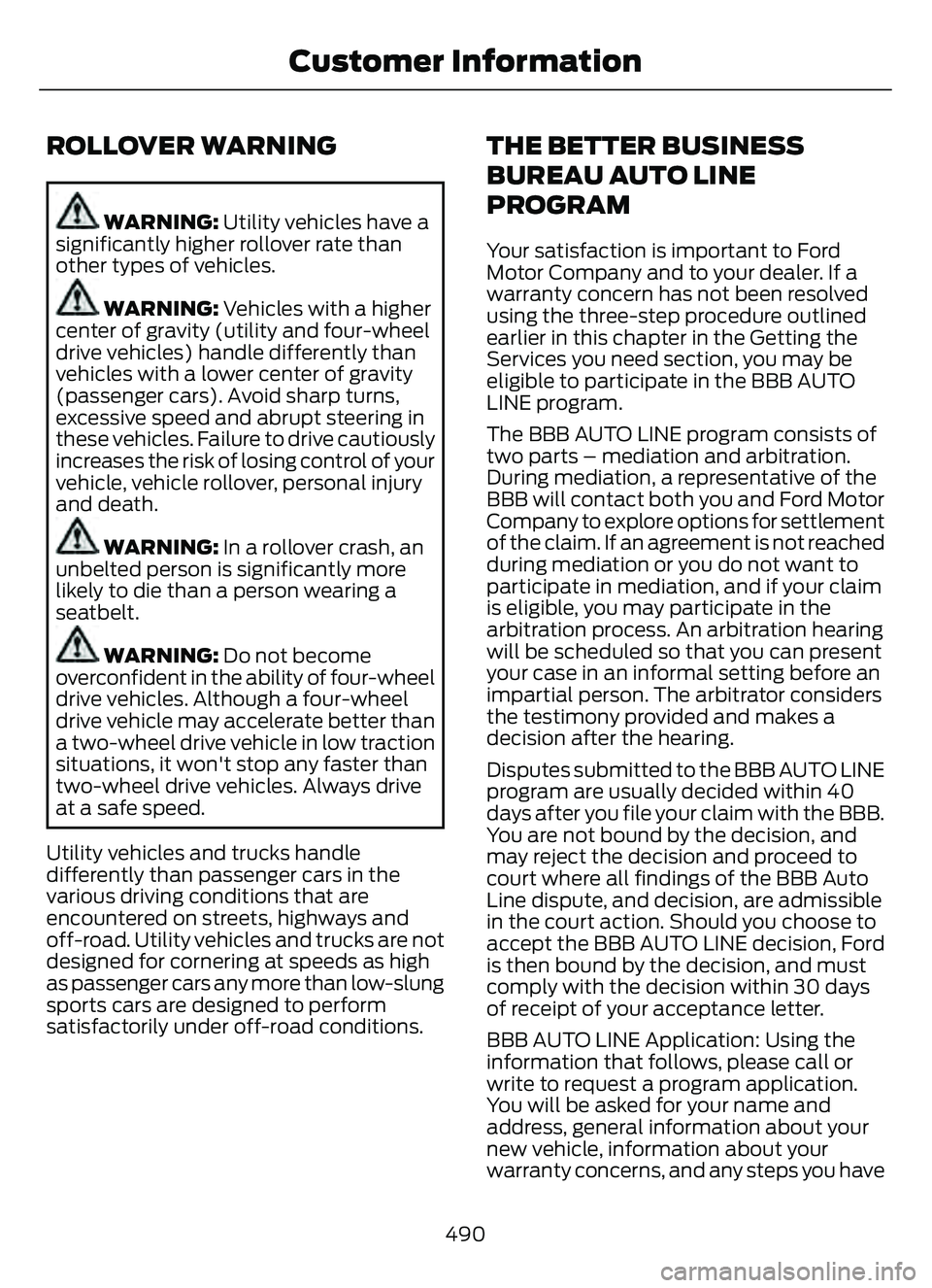
ROLLOVER WARNING
WARNING: Utility vehicles have a
significantly higher rollover rate than
other types of vehicles.
WARNING: Vehicles with a higher
center of gravity (utility and four-wheel
drive vehicles) handle differently than
vehicles with a lower center of gravity
(passenger cars). Avoid sharp turns,
excessive speed and abrupt steering in
these vehicles. Failure to drive cautiously
increases the risk of losing control of your
vehicle, vehicle rollover, personal injury
and death.
WARNING: In a rollover crash, an
unbelted person is significantly more
likely to die than a person wearing a
seatbelt.
WARNING: Do not become
overconfident in the ability of four-wheel
drive vehicles. Although a four-wheel
drive vehicle may accelerate better than
a two-wheel drive vehicle in low traction
situations, it won't stop any faster than
two-wheel drive vehicles. Always drive
at a safe speed.
Utility vehicles and trucks handle
differently than passenger cars in the
various driving conditions that are
encountered on streets, highways and
off-road. Utility vehicles and trucks are not
designed for cornering at speeds as high
as passenger cars any more than low-slung
sports cars are designed to perform
satisfactorily under off-road conditions.
THE BETTER BUSINESS
BUREAU AUTO LINE
PROGRAM
Your satisfaction is important to Ford
Motor Company and to your dealer. If a
warranty concern has not been resolved
using the three-step procedure outlined
earlier in this chapter in the Getting the
Services you need section, you may be
eligible to participate in the BBB AUTO
LINE program.
The BBB AUTO LINE program consists of
two parts – mediation and arbitration.
During mediation, a representative of the
BBB will contact both you and Ford Motor
Company to explore options for settlement
of the claim. If an agreement is not reached
during mediation or you do not want to
participate in mediation, and if your claim
is eligible, you may participate in the
arbitration process. An arbitration hearing
will be scheduled so that you can present
your case in an informal setting before an
impartial person. The arbitrator considers
the testimony provided and makes a
decision after the hearing.
Disputes submitted to the BBB AUTO LINE
program are usually decided within 40
days after you file your claim with the BBB.
You are not bound by the decision, and
may reject the decision and proceed to
court where all findings of the BBB Auto
Line dispute, and decision, are admissible
in the court action. Should you choose to
accept the BBB AUTO LINE decision, Ford
is then bound by the decision, and must
comply with the decision within 30 days
of receipt of your acceptance letter.
BBB AUTO LINE Application: Using the
information that follows, please call or
write to request a program application.
You will be asked for your name and
address, general information about your
new vehicle, information about your
warranty concerns, and any steps you have
490
Customer Information
Page 533 of 585
Zambia
E340659
PERCHLORATE
Certain components in your vehicle such
as airbag modules, seatbelt pretensioners
and remote control batteries may contain
perchlorate material. Special handling
may apply for service or vehicle end of life
disposal.
For more information visit:
www.dtsc.ca.gov/hazardouswaste/perchlorate.
REPLACEMENT PARTS
RECOMMENDATION
We have built your vehicle to the highest
standards using quality parts. We
recommend that you demand the use of
genuine Ford and Motorcraft parts
whenever your vehicle requires scheduled
maintenance or repair. You can clearly
identify genuine Ford and Motorcraft parts
by looking for the Ford, FoMoCo or
Motorcraft branding on the parts or their
packaging.
Scheduled Maintenance and
Mechanical Repairs
One of the best ways for you to make sure
that your vehicle provides years of service
is to have it maintained in line with our
recommendations using parts that
conform to the specifications detailed in
this Owner’s Manual.
Genuine Ford and Motorcraft parts meet
or exceed these specifications.
Collision Repairs
We hope that you never experience a
collision, but accidents happen sometimes.
Genuine Ford replacement collision parts
meet our stringent requirements for fit,
finish, structural integrity, corrosion
protection and dent resistance. During
vehicle development we validate that
these parts deliver the intended level of
protection as a whole system. A great way
to know for sure you are getting this level
of protection is to use genuine Ford
replacement collision parts.
Warranty on Replacement Parts
Genuine Ford and Motorcraft replacement
parts are the only replacement parts that
benefit from a Ford Warranty.
The Ford Warranty may not cover damage
caused to your vehicle as a result of failed
non-Ford parts.
For additional information, refer to the
terms and conditions of the Ford Warranty.
530
Customer Information
Page 581 of 585
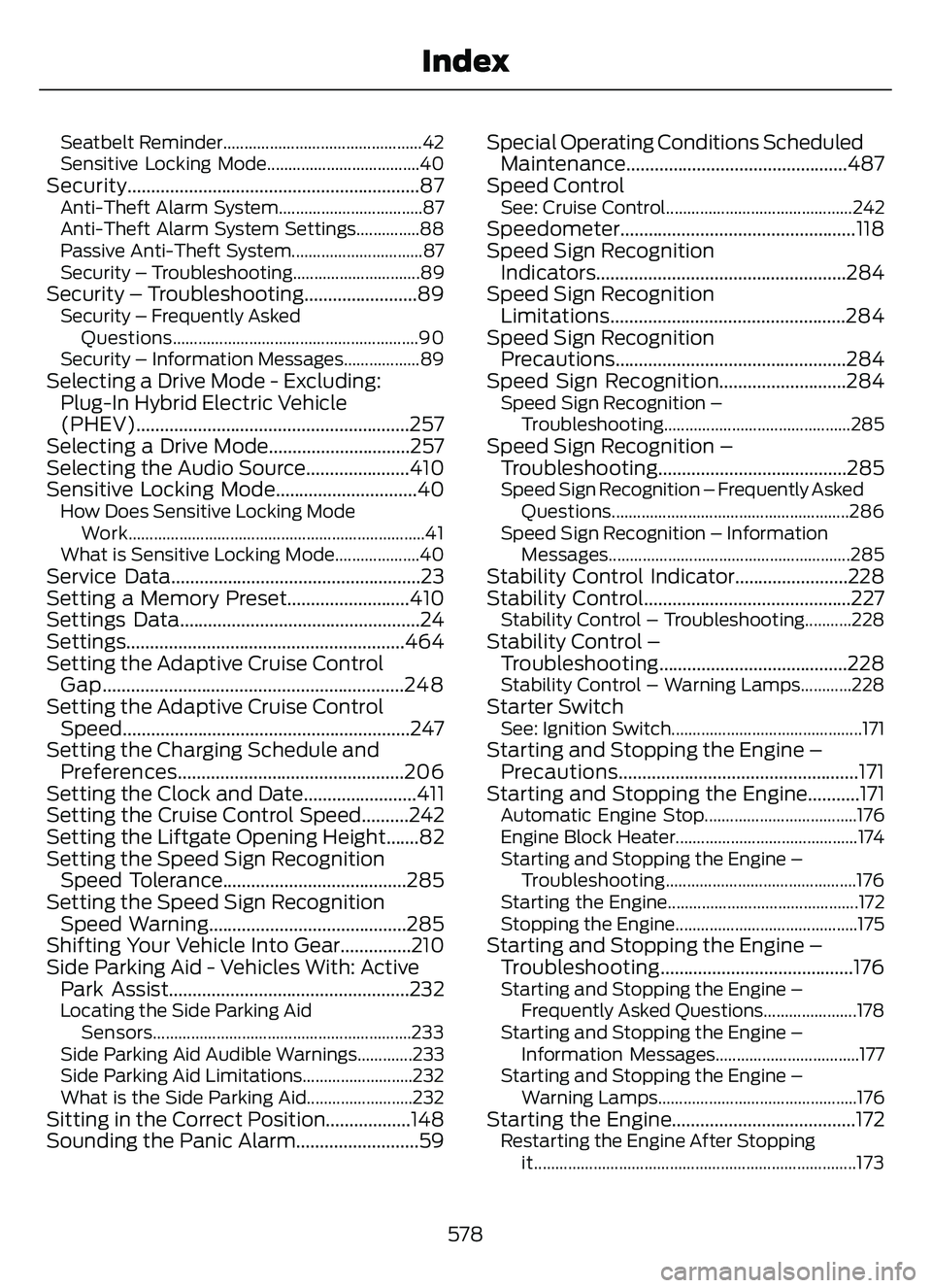
Seatbelt Reminder...............................................42
Sensitive Locking Mode....................................40
Security..............................................................87Anti-Theft Alarm System..................................87
Anti-Theft Alarm System Settings...............88
Passive Anti-Theft System...............................87
Security – Troubleshooting..............................89
Security – Troubleshooting........................89Security – Frequently AskedQuestions ..........................................................90
Security – Information Messages..................89
Selecting a Drive Mode - Excluding: Plug-In Hybrid Electric Vehicle
(PHEV)..........................................................257
Selecting a Drive Mode..............................257
Selecting the Audio Source......................410
Sensitive Locking Mode..............................40
How Does Sensitive Locking Mode
Work......................................................................41
What is Sensitive Locking Mode....................40
Service Data.....................................................23
Setting a Memory Preset..........................410
Settings Data...................................................24
Settings...........................................................464
Setting the Adaptive Cruise Control Gap................................................................248
Setting the Adaptive Cruise Control Speed.............................................................247
Setting the Charging Schedule and Preferences................................................206
Setting the Clock and Date........................411
Setting the Cruise Control Speed..........242
Setting the Liftgate Opening Height.......82
Setting the Speed Sign Recognition Speed Tolerance.......................................285
Setting the Speed Sign Recognition Speed Warning..........................................285
Shifting Your Vehicle Into Gear...............210
Side Parking Aid - Vehicles With: Active Park Assist...................................................232
Locating the Side Parking Aid
Sensors.............................................................233
Side Parking Aid Audible Warnings.............233
Side Parking Aid Limitations..........................232
What is the Side Parking Aid.........................232
Sitting in the Correct Position..................148
Sounding the Panic Alarm..........................59 Special Operating Conditions Scheduled
Maintenance...............................................487
Speed Control
See: Cruise Control............................................242Speedomet er.................................................. 118
Speed Sign Recognition Indicator s.....................................................284
Speed Sign Recognition Limitations..................................................284
Speed Sign Recognition Precautions.................................................284
Speed Sign Recognition...........................284
Speed Sign Recognition –
Troubleshooting............................................285
Speed Sign Recognition –Troubleshooting........................................285
Speed Sign Recognition – Frequently Asked
Questions........................................................286
Speed Sign Recognition – Information Messages.........................................................285
Stability Control Indicator........................228
Stability Control............................................227
Stability Control – Troubleshooting...........228Stability Control –Troubleshooting........................................228
Stability Control – Warning Lamps............228Starter SwitchSee: Ignition Switch.............................................171Starting and Stopping the Engine –Precautions...................................................171
Starting and Stopping the Engine...........171
Automatic Engine Stop....................................176
Engine Block Heater...........................................174
Starting and Stopping the Engine –
Troubleshooting.............................................176
Starting the Engine.............................................172
Stopping the Engine...........................................175
Starting and Stopping the Engine – Troubleshooting .........................................176
Starting and Stopping the Engine –
Frequently Asked Questions......................178
Starting and Stopping the Engine – Information Messages..................................177
Starting and Stopping the Engine – Warning Lamps...............................................176
Starting the Engine.......................................172Restarting the Engine After Stoppingit........................................................................\
....173
578
Index