tow FORD EXPEDITION 1997 1.G User Guide
[x] Cancel search | Manufacturer: FORD, Model Year: 1997, Model line: EXPEDITION, Model: FORD EXPEDITION 1997 1.GPages: 224, PDF Size: 2.2 MB
Page 76 of 224
To minimize the risk of personal
injury, the EZ entry seat should
not be left in the forward, stowed
position while the vehicle is in
motion. Please ensure that the seat
is in the upright, fully latched
position before putting the vehicle
in motion.
1. Locate the lever at the bottom
of the passenger side seatback
marked ª1º.
2. Press down on the front of lever
ª1º while pressing the seatback
down onto the cushion.
3. Locate and lift the lever marked
ª2º while rotating the seat toward
the front row seat.
4. After entering the seat, reverse
this procedure; ensure that the
latch tub and surrounding areas
are clear.
Removing the third row seat
From the rear of the vehicle, with
the liftgate open:
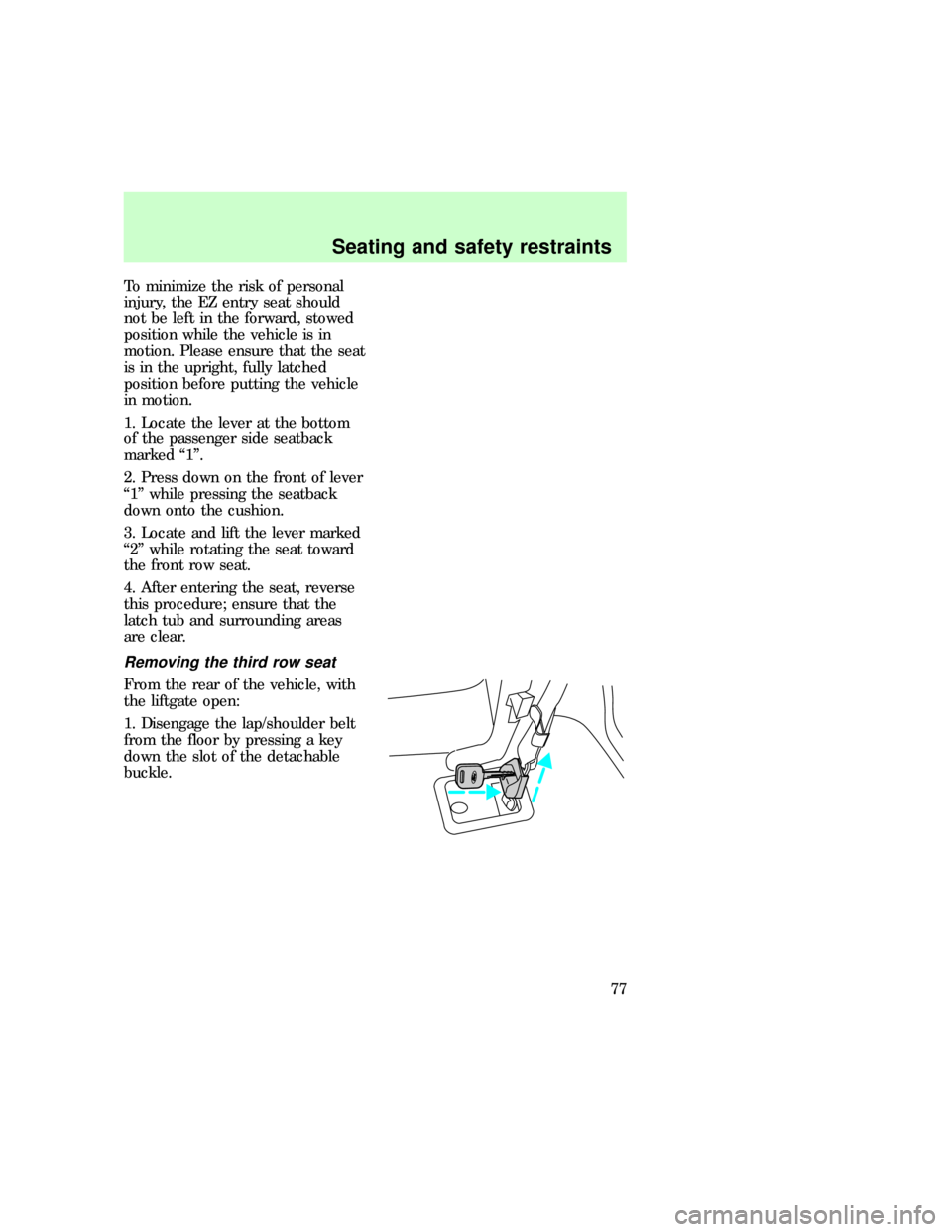
1. Disengage the lap/shoulder belt
from the floor by pressing a key
down the slot of the detachable
buckle.
exd_removal_third_seat
Seating and safety restraints
77
Page 77 of 224
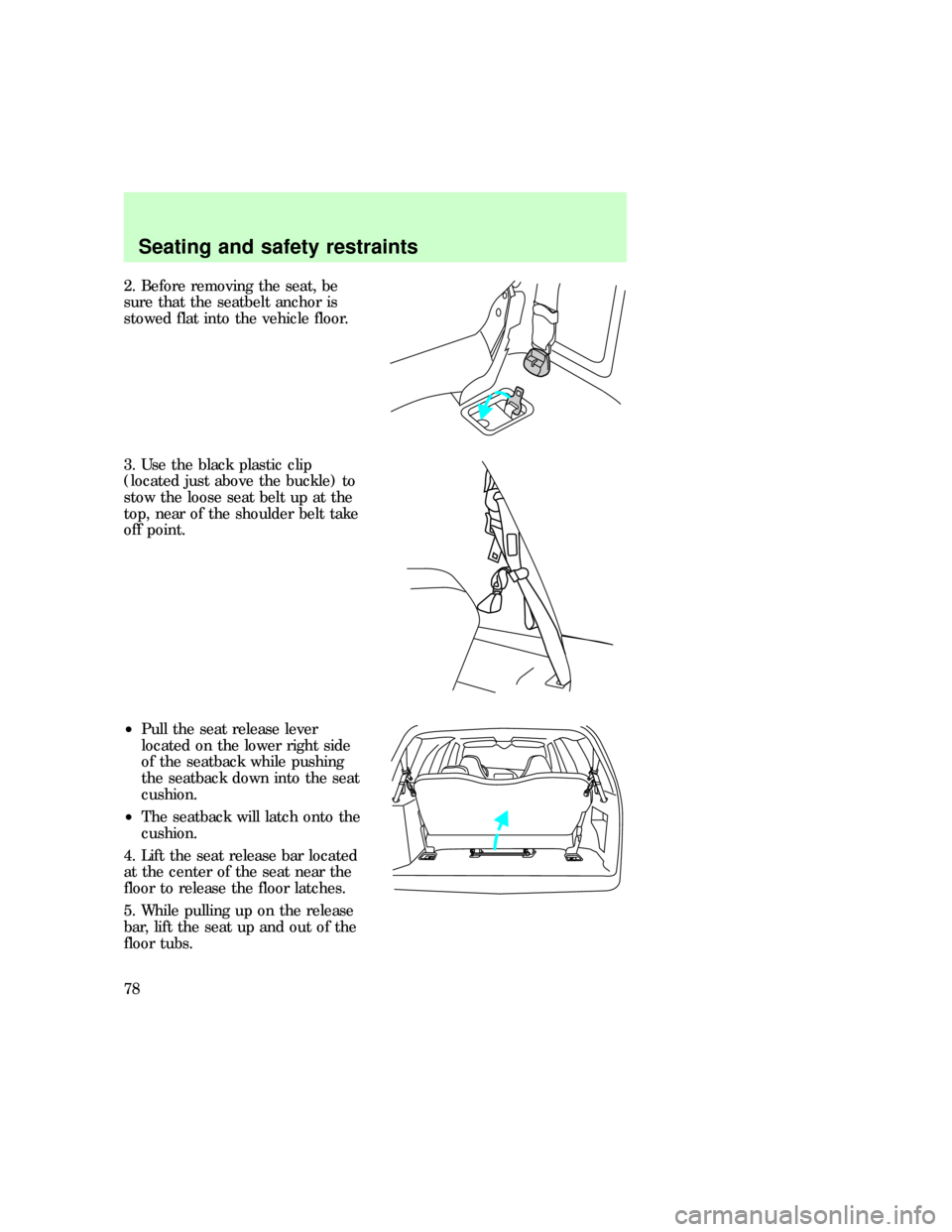
2. Before removing the seat, be
sure that the seatbelt anchor is
stowed flat into the vehicle floor.
3. Use the black plastic clip
(located just above the buckle) to
stow the loose seat belt up at the
top, near of the shoulder belt take
off point.
²Pull the seat release lever
located on the lower right side
of the seatback while pushing
the seatback down into the seat
cushion.
²The seatback will latch onto the
cushion.
4. Lift the seat release bar located
at the center of the seat near the
floor to release the floor latches.
5. While pulling up on the release
bar, lift the seat up and out of the
floor tubs.
Seating and safety restraints
78
Page 78 of 224
6. With assistance, lift the seat out
of the vehicle.
Installing the third row seat
Before installing your thrid row
seat, ensure that the seat belt
anchors are stowed into the floor
and the loose belts are stored out
of the way. For proper latching,
ensure that the floor tubs are clear
of debris.
From the rear of the vehicle, with
the liftgate open:
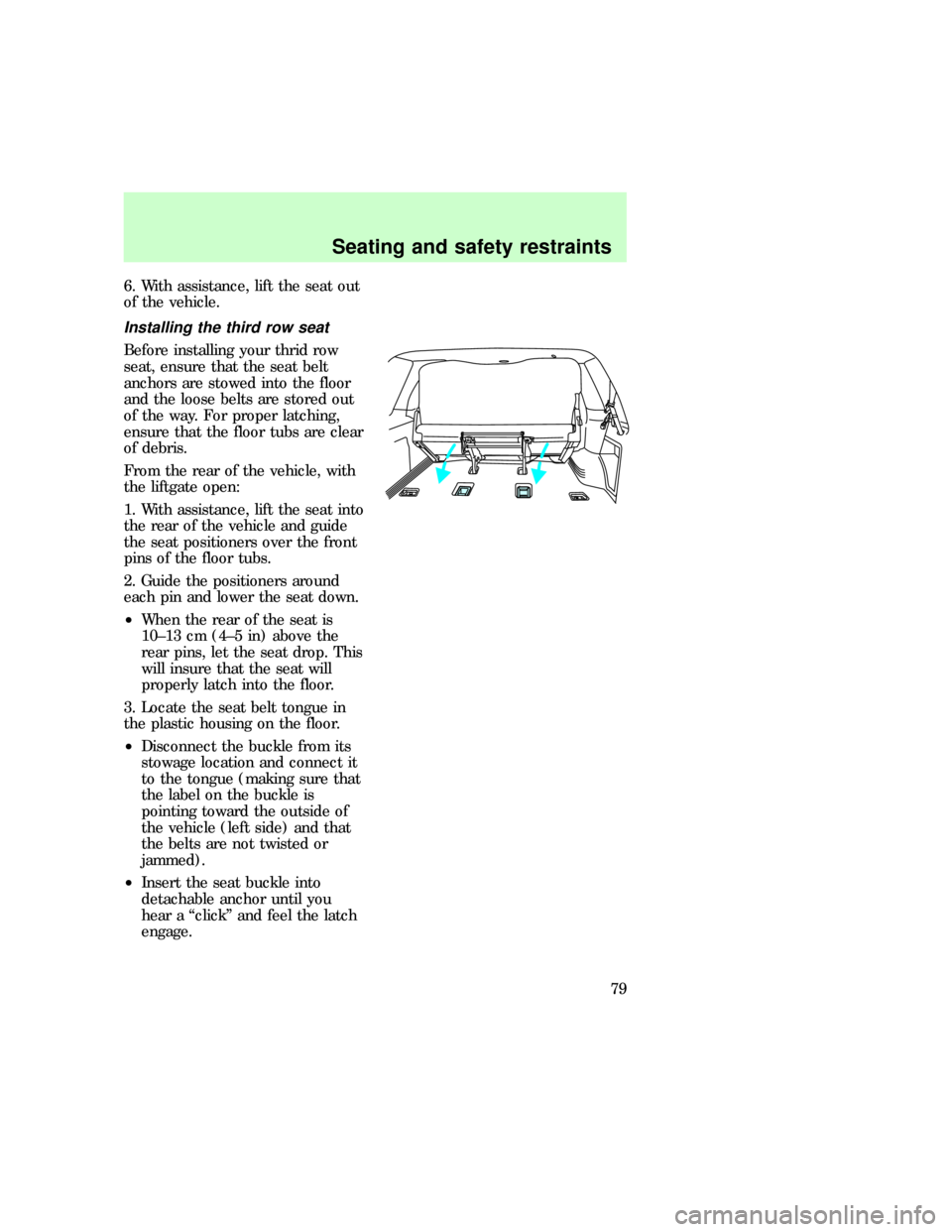
1. With assistance, lift the seat into
the rear of the vehicle and guide
the seat positioners over the front
pins of the floor tubs.
2. Guide the positioners around
each pin and lower the seat down.
²When the rear of the seat is
10±13 cm (4±5 in) above the
rear pins, let the seat drop. This
will insure that the seat will
properly latch into the floor.
3. Locate the seat belt tongue in
the plastic housing on the floor.
²Disconnect the buckle from its
stowage location and connect it
to the tongue (making sure that
the label on the buckle is
pointing toward the outside of
the vehicle (left side) and that
the belts are not twisted or
jammed).
²Insert the seat buckle into
detachable anchor until you
hear a ªclickº and feel the latch
engage.
exd_installation_third
Seating and safety restraints
79
Page 96 of 224
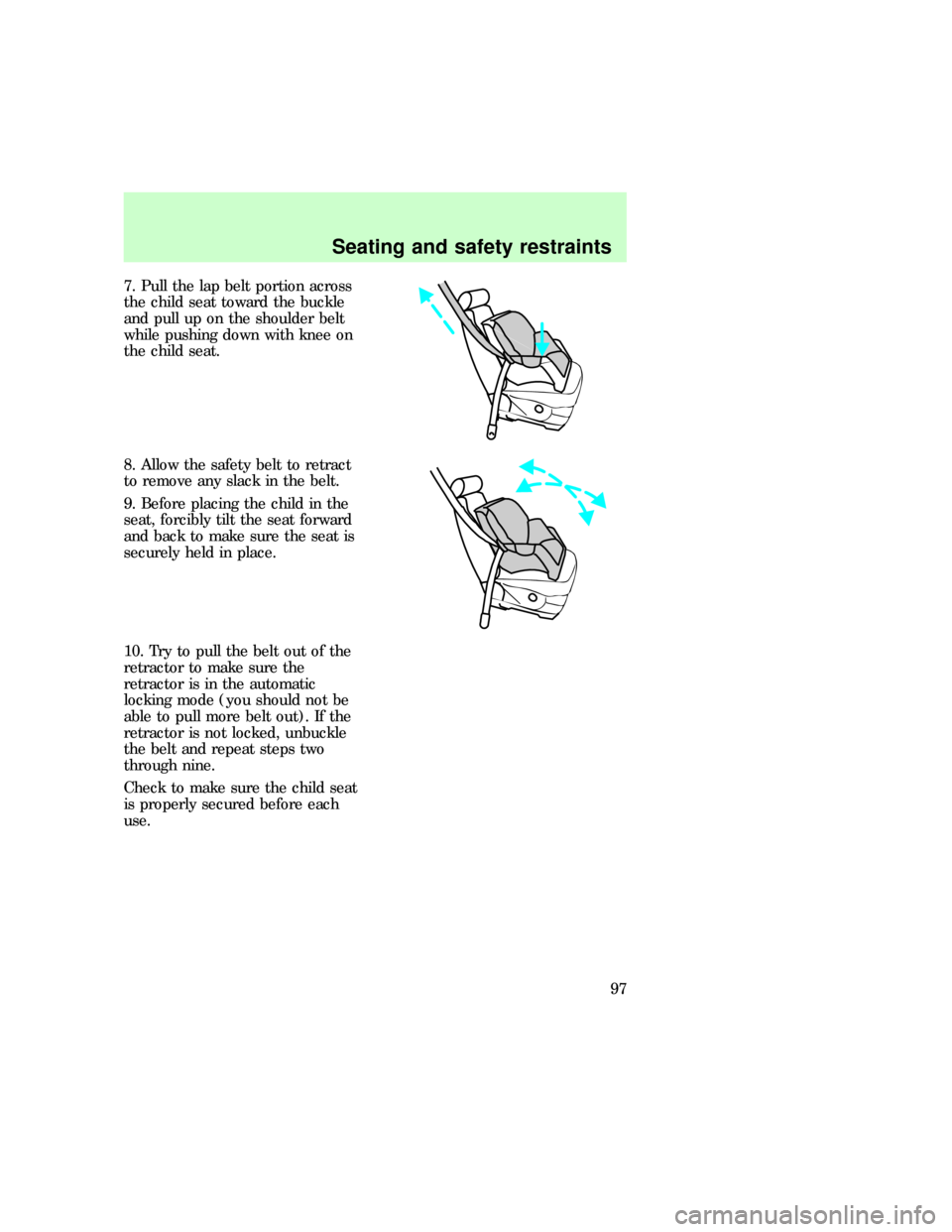
7. Pull the lap belt portion across
the child seat toward the buckle
and pull up on the shoulder belt
while pushing down with knee on
the child seat.
8. Allow the safety belt to retract
to remove any slack in the belt.
9. Before placing the child in the
seat, forcibly tilt the seat forward
and back to make sure the seat is
securely held in place.
10. Try to pull the belt out of the
retractor to make sure the
retractor is in the automatic
locking mode (you should not be
able to pull more belt out). If the
retractor is not locked, unbuckle
the belt and repeat steps two
through nine.
Check to make sure the child seat
is properly secured before each
use.
com_safety_seats.01
Seating and safety restraints
97
Page 112 of 224
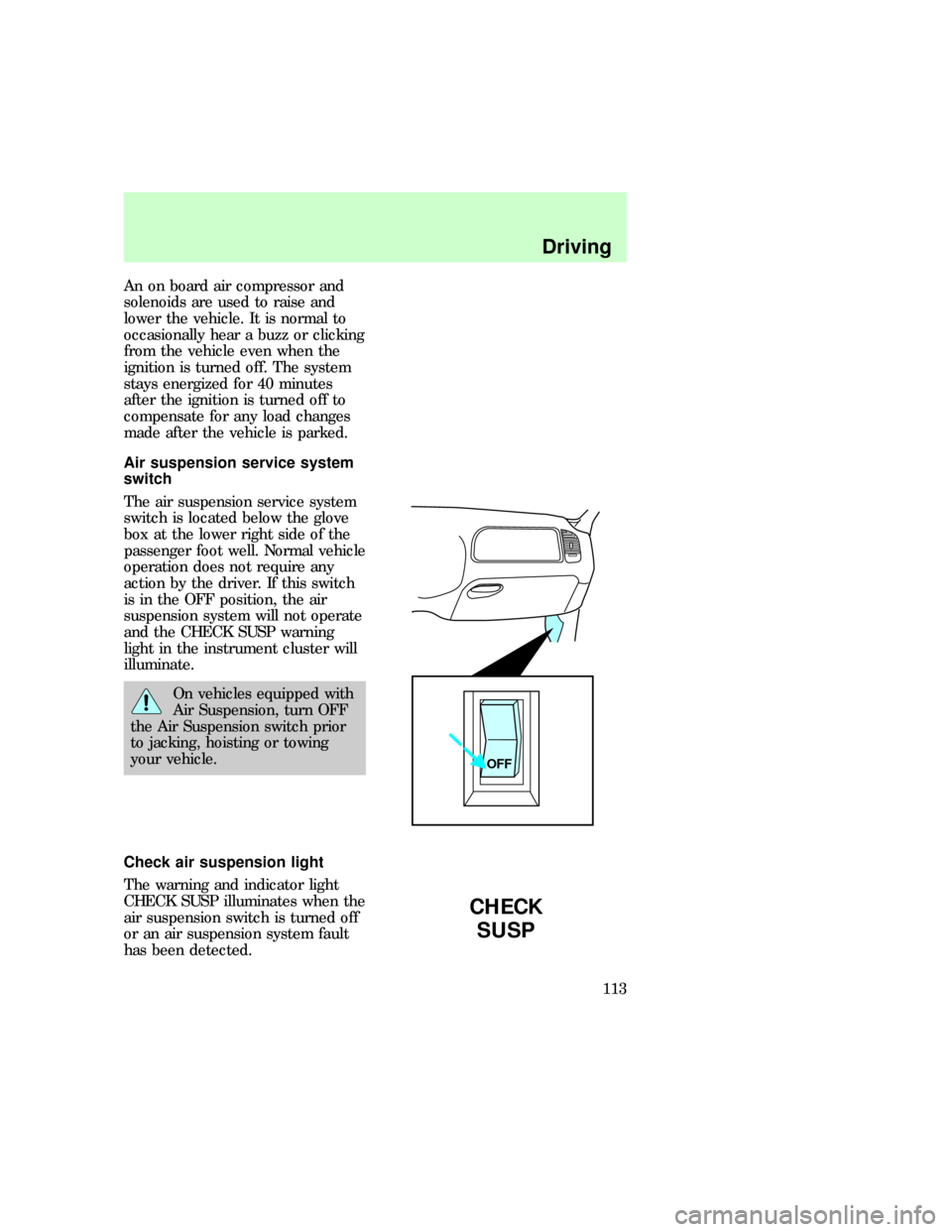
An on board air compressor and
solenoids are used to raise and
lower the vehicle. It is normal to
occasionally hear a buzz or clicking
from the vehicle even when the
ignition is turned off. The system
stays energized for 40 minutes
after the ignition is turned off to
compensate for any load changes
made after the vehicle is parked.
Air suspension service system
switch
The air suspension service system
switch is located below the glove
box at the lower right side of the
passenger foot well. Normal vehicle
operation does not require any
action by the driver. If this switch
is in the OFF position, the air
suspension system will not operate
and the CHECK SUSP warning
light in the instrument cluster will
illuminate.
On vehicles equipped with
Air Suspension, turn OFF
the Air Suspension switch prior
to jacking, hoisting or towing
your vehicle.
Check air suspension light
The warning and indicator light
CHECK SUSP illuminates when the
air suspension switch is turned off
or an air suspension system fault
has been detected.
OFF
CHECK
SUSP
exd_air_susp_service_switch
exd_check_air_susp_light
Driving
113
Page 114 of 224
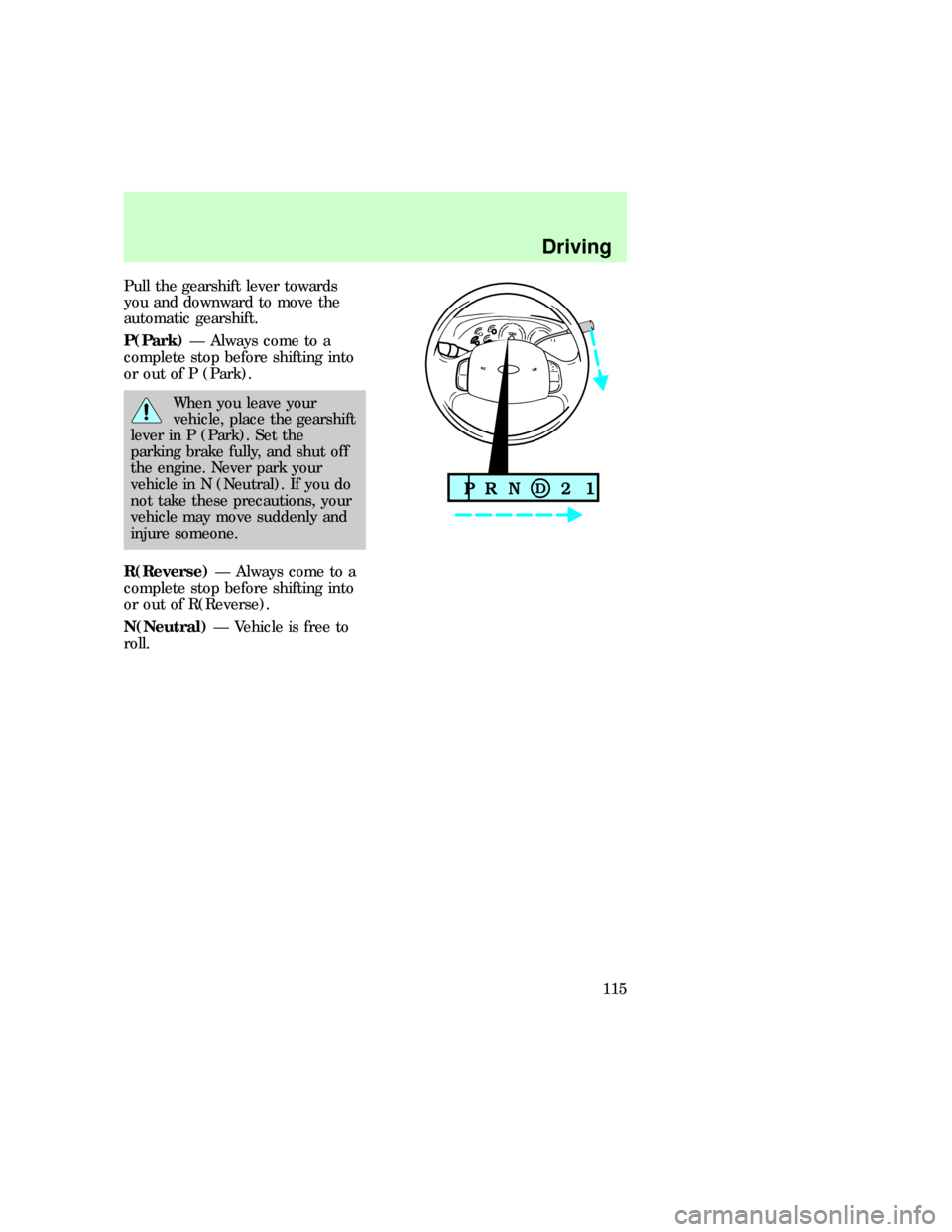
Pull the gearshift lever towards
you and downward to move the
automatic gearshift.
P(Park)Ð Always come to a
complete stop before shifting into
or out of P (Park).
When you leave your
vehicle, place the gearshift
lever in P (Park). Set the
parking brake fully, and shut off
the engine. Never park your
vehicle in N (Neutral). If you do
not take these precautions, your
vehicle may move suddenly and
injure someone.
R(Reverse)Ð Always come to a
complete stop before shifting into
or out of R(Reverse).
N(Neutral)Ð Vehicle is free to
roll.
Driving
115
Page 115 of 224
D(Overdrive)Ð The normal
driving position for the best fuel
economy. Transmission operates in
gears one through four.
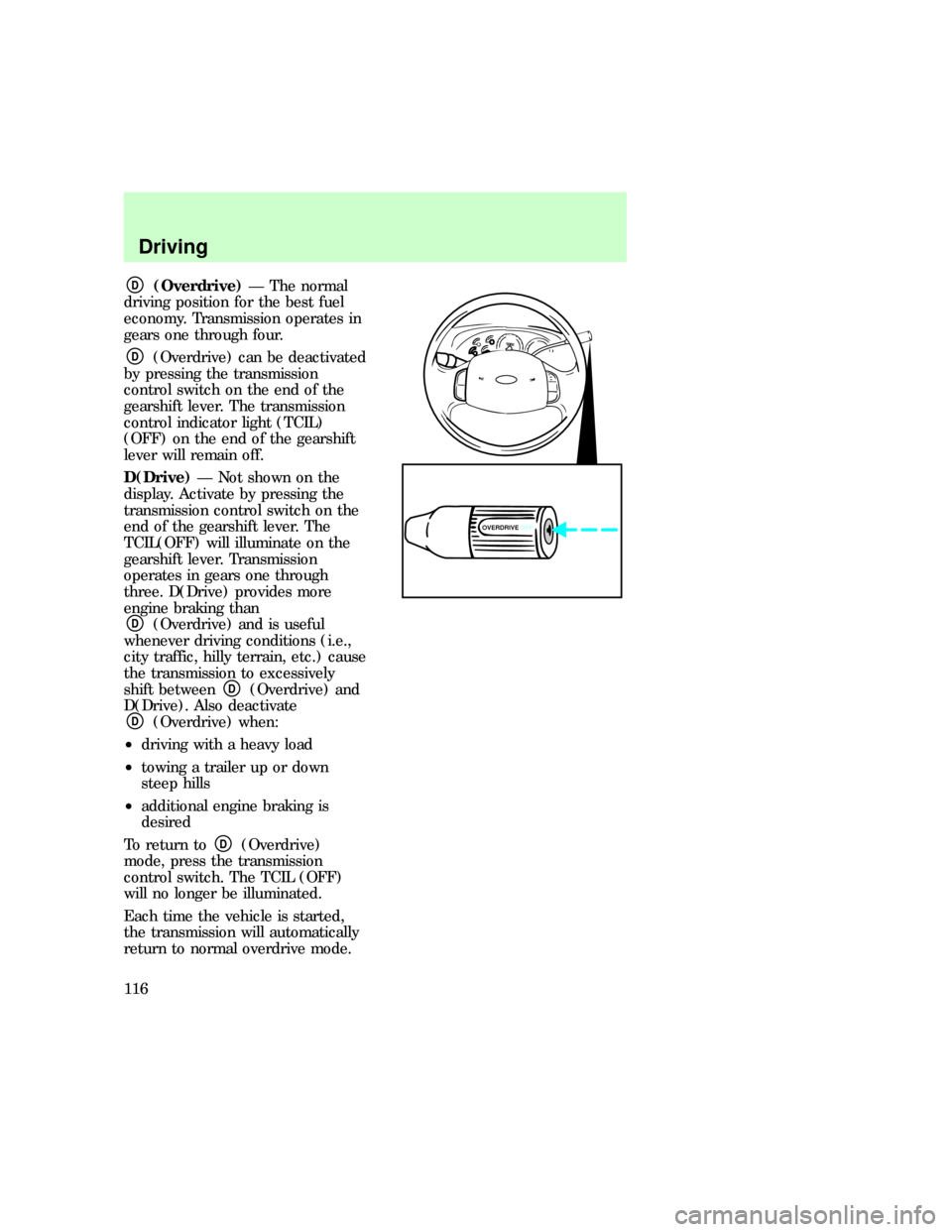
D(Overdrive) can be deactivated
by pressing the transmission
control switch on the end of the
gearshift lever. The transmission
control indicator light (TCIL)
(OFF) on the end of the gearshift
lever will remain off.
D(Drive)Ð Not shown on the
display. Activate by pressing the
transmission control switch on the
end of the gearshift lever. The
TCIL(OFF) will illuminate on the
gearshift lever. Transmission
operates in gears one through
three. D(Drive) provides more
engine braking than
D(Overdrive) and is useful
whenever driving conditions (i.e.,
city traffic, hilly terrain, etc.) cause
the transmission to excessively
shift between
D(Overdrive) and
D(Drive). Also deactivate
D(Overdrive) when:
²driving with a heavy load
²towing a trailer up or down
steep hills
²additional engine braking is
desired
To return to
D(Overdrive)
mode, press the transmission
control switch. The TCIL (OFF)
will no longer be illuminated.
Each time the vehicle is started,
the transmission will automatically
return to normal overdrive mode.
OVERDRIVE OFF
Driving
116
Page 123 of 224

Rating):Carrying capacity for
each axle system (front and
rear). The GAWR is specific to
each vehicle and is listed on the
Safety Compliance Certification
Label on the driver's door.
²GCWR (Gross combined weight
rating ):Maximum combined
weight of the towing vehicle
(including passengers and
cargo) and the trailer. The
GCWR indicates the maximum
loaded weight that the vehicle is
allowed to tow.
²Maximum trailer weight:
Maximum weight of a trailer the
loaded vehicle (including
passengers and cargo) is
permitted to tow. It is
determined by subtracting the
weight of the loaded towing
vehicle from the GCWR of the
towing vehicle.
²Trailer weight range:Specified
weight range that the trailer
must fall within that ranges from
zero to the maximum trailer
weight rating.
Payload = GVWR minus Base
curb weight
To obtain the correct weights for
your vehicle, try taking your
vehicle to a shipping company or
an inspection station for trucks.
Do not use replacement tires with
lower weight capacities than the
originals because they might lower
the vehicle's GVWR and GAWR.
Replacement tires with a higher
Driving
124
Page 125 of 224
Using the luggage rack if
equipped)
Load luggage at the front crossbar
and adjust the rear crossbar as
necessary.
²Do not exceed 90.7 kg (200 lb)
of luggage if the weight is
placed directly on the crossbars.
²Do not exceed 68 kg (150 lb) of
luggage if the weight is resting
on the roof itself.
²Be sure that the weight is
evenly distributed, particularly
when loading at or near the roof
or luggage rack crossbars
maximum capacity.
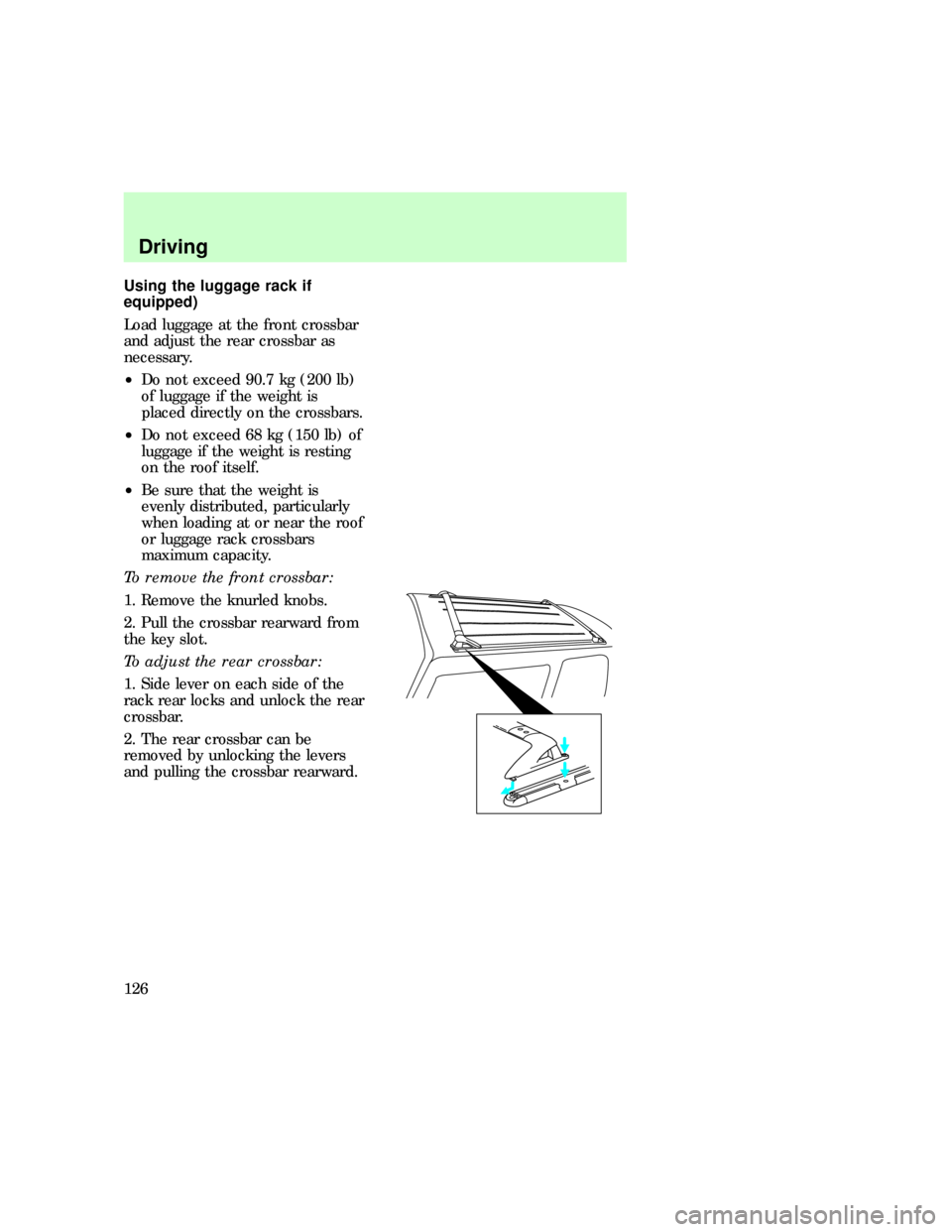
To remove the front crossbar:
1. Remove the knurled knobs.
2. Pull the crossbar rearward from
the key slot.
To adjust the rear crossbar:
1. Side lever on each side of the
rack rear locks and unlock the rear
crossbar.
2. The rear crossbar can be
removed by unlocking the levers
and pulling the crossbar rearward.
exd_trailer_towing
Driving
126
Page 126 of 224
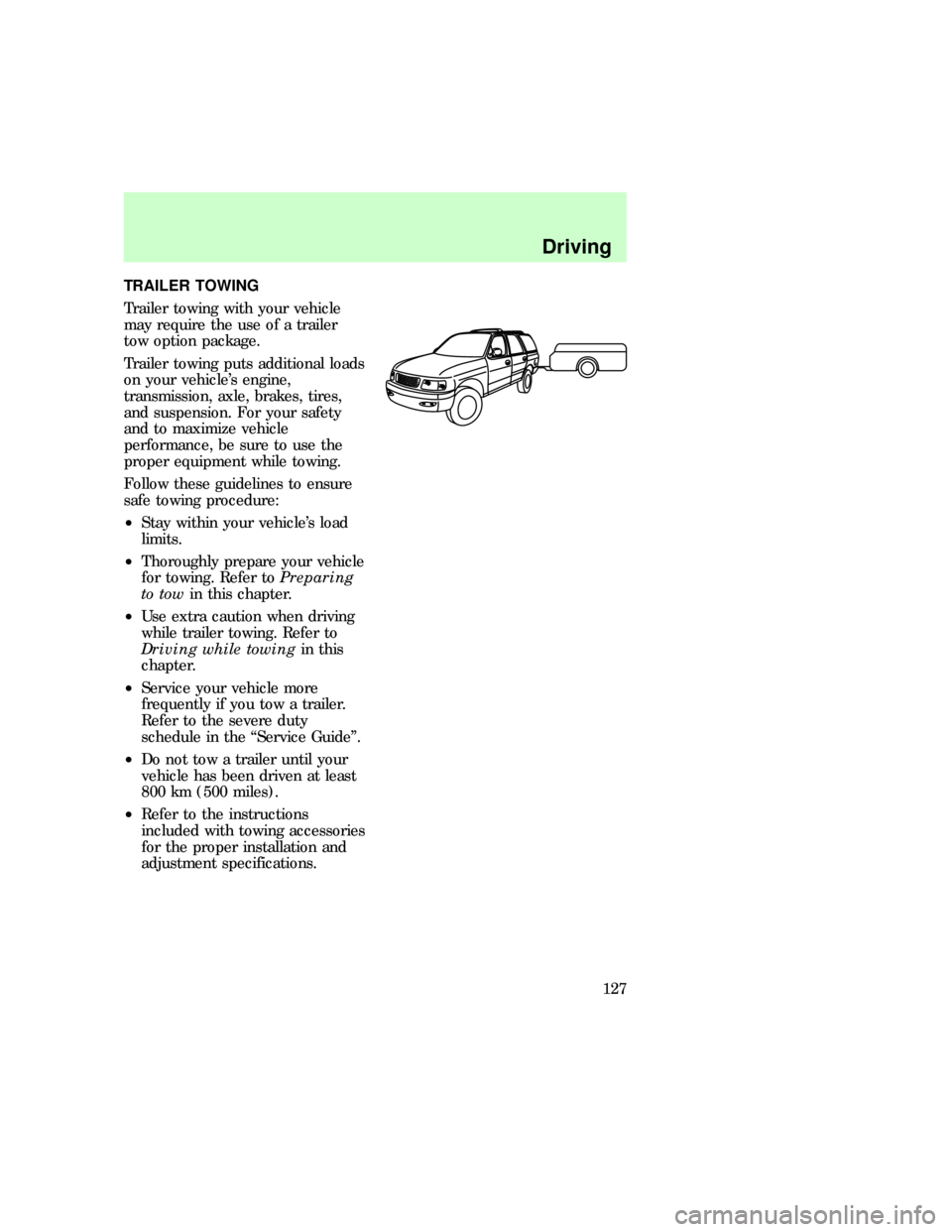
TRAILER TOWING
Trailer towing with your vehicle
may require the use of a trailer
tow option package.
Trailer towing puts additional loads
on your vehicle's engine,
transmission, axle, brakes, tires,
and suspension. For your safety
and to maximize vehicle
performance, be sure to use the
proper equipment while towing.
Follow these guidelines to ensure
safe towing procedure:
²Stay within your vehicle's load
limits.
²Thoroughly prepare your vehicle
for towing. Refer toPreparing
to towin this chapter.
²Use extra caution when driving
while trailer towing. Refer to
Driving while towingin this
chapter.
²Service your vehicle more
frequently if you tow a trailer.
Refer to the severe duty
schedule in the ªService Guideº.
²Do not tow a trailer until your
vehicle has been driven at least
800 km (500 miles).
²Refer to the instructions
included with towing accessories
for the proper installation and
adjustment specifications.
Driving
127