tires FORD EXPLORER 2006 4.G Workshop Manual
[x] Cancel search | Manufacturer: FORD, Model Year: 2006, Model line: EXPLORER, Model: FORD EXPLORER 2006 4.GPages: 328, PDF Size: 3.59 MB
Page 233 of 328

Driving on snow and ice
4WD vehicles have advantages over 2WD vehicles in snow and ice but
can skid like any other vehicle.
Should you start to slide while driving on snowy or icy roads, turn the
steering wheel in the direction of the slide until you regain control.
Avoid sudden applications of power and quick changes of direction on
snow and ice. Apply the accelerator slowly and steadily when starting
from a full stop.
Avoid sudden braking as well. Although a 4WD vehicle may accelerate
better than a two-wheel drive vehicle in snow and ice, it won't stop any
faster, because as in other vehicles, braking occurs at all four wheels. Do
not become overconfident as to road conditions.
Make sure you allow sufficient distance between you and other vehicles
for stopping. Drive slower than usual and consider using one of the lower
gears. In emergency stopping situations, avoid locking of the wheels. Use
a ªsqueezeº technique, push on the brake pedal with a steadily increasing
force which allows the wheels to brake yet continue to roll so that you
may steer in the direction you want to travel. If you lock the wheels,
release the brake pedal and repeat the squeeze technique. If your vehicle
is equipped with a Four Wheel Anti-Lock Brake System (ABS), apply the
brake steadily. Do not ªpumpº the brakes. Refer to theBrakessection of
this chapter for additional information on the operation of the anti-lock
brake system.
Never drive with chains on the front tires of 4WD vehicles without also
putting them on the rear tires. This could cause the rear to slide and
swing around during braking.
Maintenance and Modifications
The suspension and steering systems on your vehicle have been designed
and tested to provide predictable performance whether loaded or empty
and durable load carrying capability. For this reason, Ford Motor
Company strongly recommends that you do not make modifications such
as adding or removing parts (such as lift kits or stabilizer bars) or by
using replacement parts not equivalent to the original factory equipment.
Any modifications to a vehicle that raise the center of gravity can make
it more likely the vehicle will roll over as a result of a loss of control.
Ford Motor Company recommends that caution be used with any vehicle
equipped with a high load or device (such as ladder racks or pickup box
cover).
Driving
233
Page 246 of 328
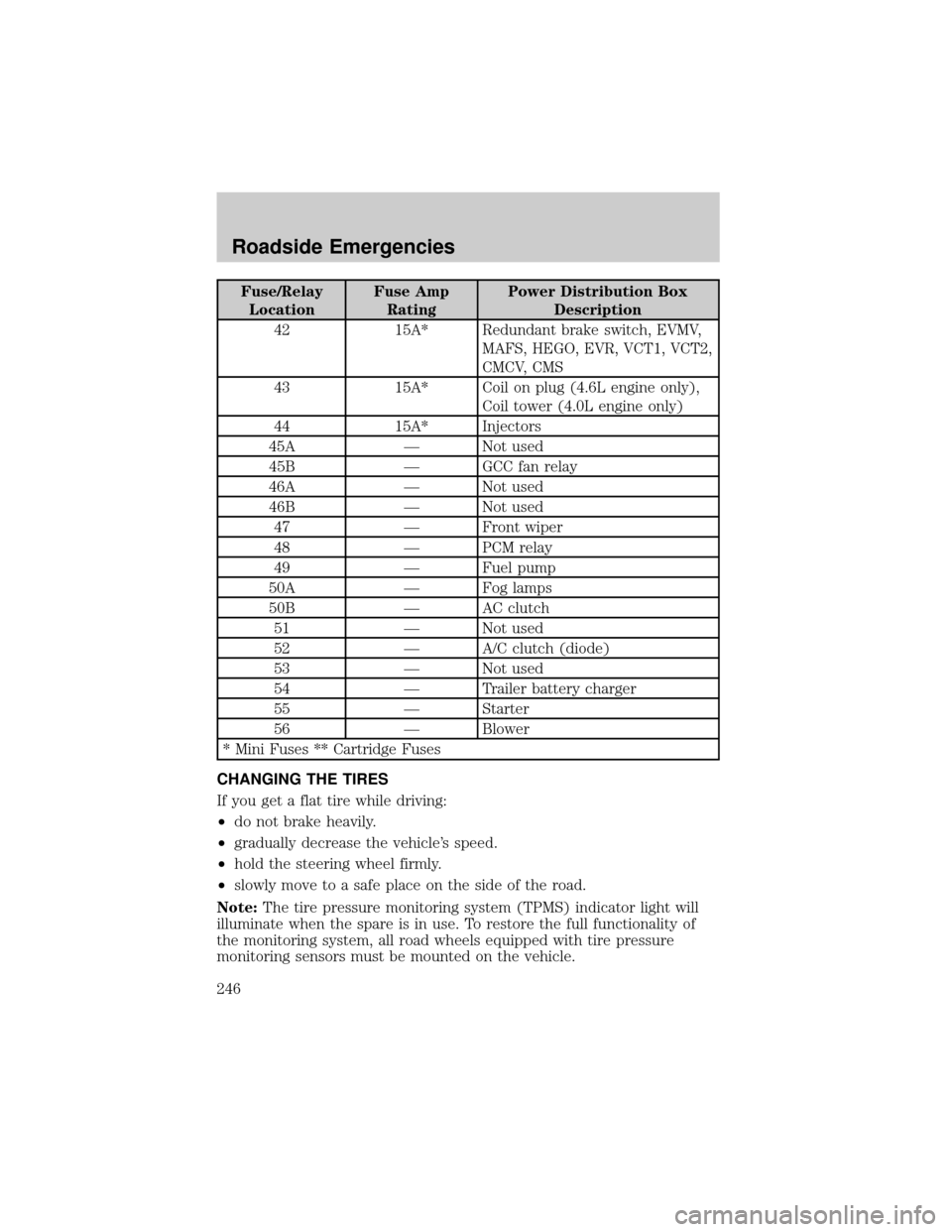
Fuse/Relay
LocationFuse Amp
RatingPower Distribution Box
Description
42 15A* Redundant brake switch, EVMV,
MAFS, HEGO, EVR, VCT1, VCT2,
CMCV, CMS
43 15A* Coil on plug (4.6L engine only),
Coil tower (4.0L engine only)
44 15A* Injectors
45A Ð Not used
45B Ð GCC fan relay
46A Ð Not used
46B Ð Not used
47 Ð Front wiper
48 Ð PCM relay
49 Ð Fuel pump
50A Ð Fog lamps
50B Ð AC clutch
51 Ð Not used
52 Ð A/C clutch (diode)
53 Ð Not used
54 Ð Trailer battery charger
55 Ð Starter
56 Ð Blower
* Mini Fuses ** Cartridge Fuses
CHANGING THE TIRES
If you get a flat tire while driving:
²do not brake heavily.
²gradually decrease the vehicle's speed.
²hold the steering wheel firmly.
²slowly move to a safe place on the side of the road.
Note:The tire pressure monitoring system (TPMS) indicator light will
illuminate when the spare is in use. To restore the full functionality of
the monitoring system, all road wheels equipped with tire pressure
monitoring sensors must be mounted on the vehicle.
Roadside Emergencies
246
Page 247 of 328
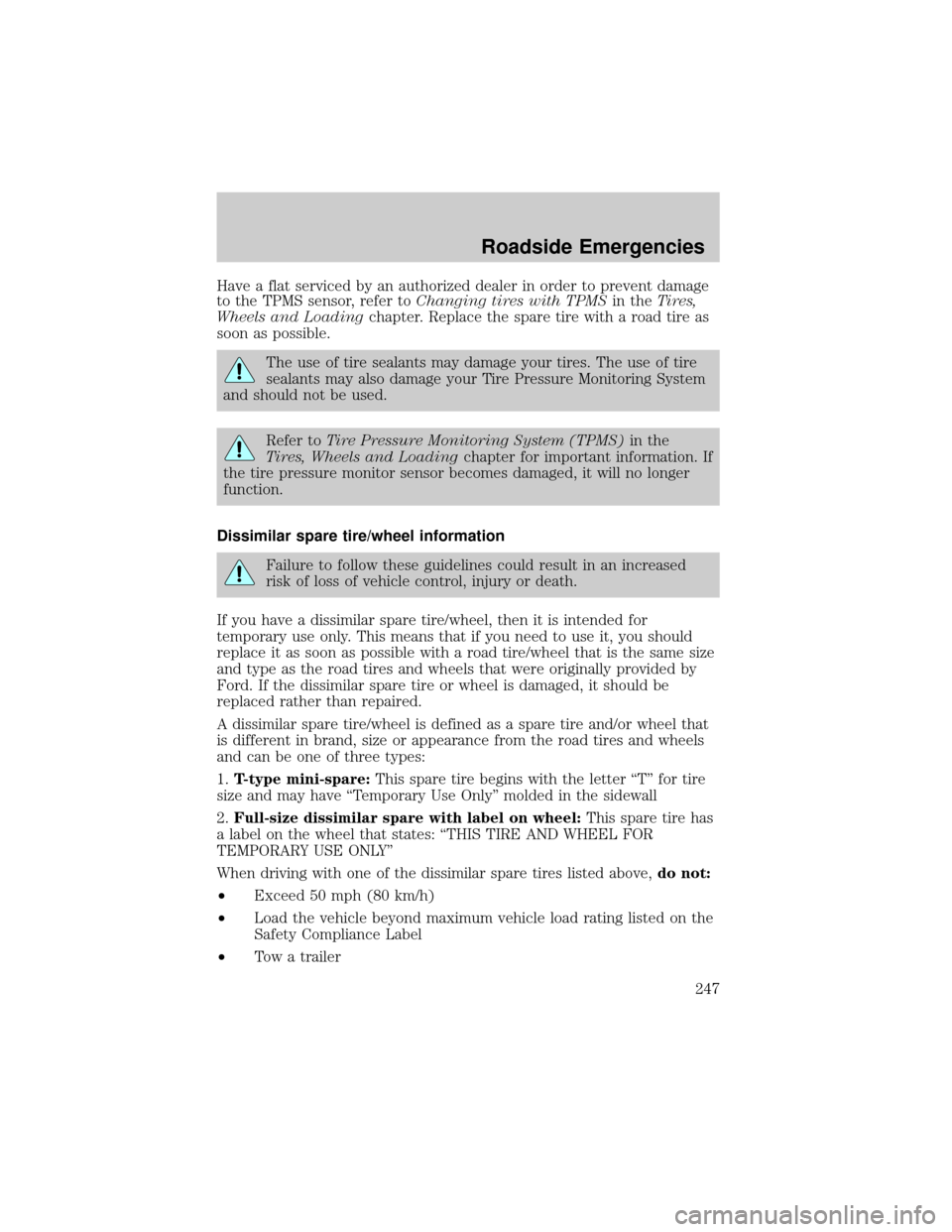
Have a flat serviced by an authorized dealer in order to prevent damage
to the TPMS sensor, refer toChanging tires with TPMSin theTires,
Wheels and Loadingchapter. Replace the spare tire with a road tire as
soon as possible.
The use of tire sealants may damage your tires. The use of tire
sealants may also damage your Tire Pressure Monitoring System
and should not be used.
Refer toTire Pressure Monitoring System (TPMS)in the
Tires, Wheels and Loadingchapter for important information. If
the tire pressure monitor sensor becomes damaged, it will no longer
function.
Dissimilar spare tire/wheel information
Failure to follow these guidelines could result in an increased
risk of loss of vehicle control, injury or death.
If you have a dissimilar spare tire/wheel, then it is intended for
temporary use only. This means that if you need to use it, you should
replace it as soon as possible with a road tire/wheel that is the same size
and type as the road tires and wheels that were originally provided by
Ford. If the dissimilar spare tire or wheel is damaged, it should be
replaced rather than repaired.
A dissimilar spare tire/wheel is defined as a spare tire and/or wheel that
is different in brand, size or appearance from the road tires and wheels
and can be one of three types:
1.T-type mini-spare:This spare tire begins with the letter ªTº for tire
size and may have ªTemporary Use Onlyº molded in the sidewall
2.Full-size dissimilar spare with label on wheel:This spare tire has
a label on the wheel that states: ªTHIS TIRE AND WHEEL FOR
TEMPORARY USE ONLYº
When driving with one of the dissimilar spare tires listed above,do not:
²Exceed 50 mph (80 km/h)
²Load the vehicle beyond maximum vehicle load rating listed on the
Safety Compliance Label
²Tow a trailer
Roadside Emergencies
247
Page 248 of 328

²Use snow chains on the end of the vehicle with the dissimilar spare
tire
²Use more than one dissimilar spare tire at a time
²Use commercial car washing equipment
²Try to repair the dissimilar spare tire
Use of one of the dissimilar spare tires listed above at any one wheel
location can lead to impairment of the following:
²Handling, stability and braking performance
²Comfort and noise
²Ground clearance and parking at curbs
²Winter weather driving capability
²Wet weather driving capability
For vehicles equipped with 4WD, it is not recommended that the vehicle
be operated in 4WD modes with a temporary emergency spare tire. If
4WD operation is necessary, do not operate above speeds of 10 mph (16
km/h) or for distances above 50 miles (80 km).
3.Full-size dissimilar spare without label on wheel
When driving with the full-size dissimilar spare tire/wheel,do not:
²Exceed 70 mph (113 km/h)
²Use more than one dissimilar spare tire/wheel at a time
²Use commercial car washing equipment
²Use snow chains on the end of the vehicle with the dissimilar spare
tire/wheel
The usage of a full-size dissimilar spare tire/wheel can lead to
impairment of the following:
²Handling, stability and braking performance
²Comfort and noise
²Ground clearance and parking at curbs
²Winter weather driving capability
²Wet weather driving capability
²All-Wheel driving capability (if applicable)
²Load leveling adjustment (if applicable)
Roadside Emergencies
248
Page 250 of 328
If your vehicle is equipped with TPMS, have a flat tire serviced by an
authorized dealer in order to prevent damage to the TPMS sensor, refer
toChanging tires with TPMSin theTires, Wheels and Loading
chapter. Replace the spare tire with a road tire as soon as possible.
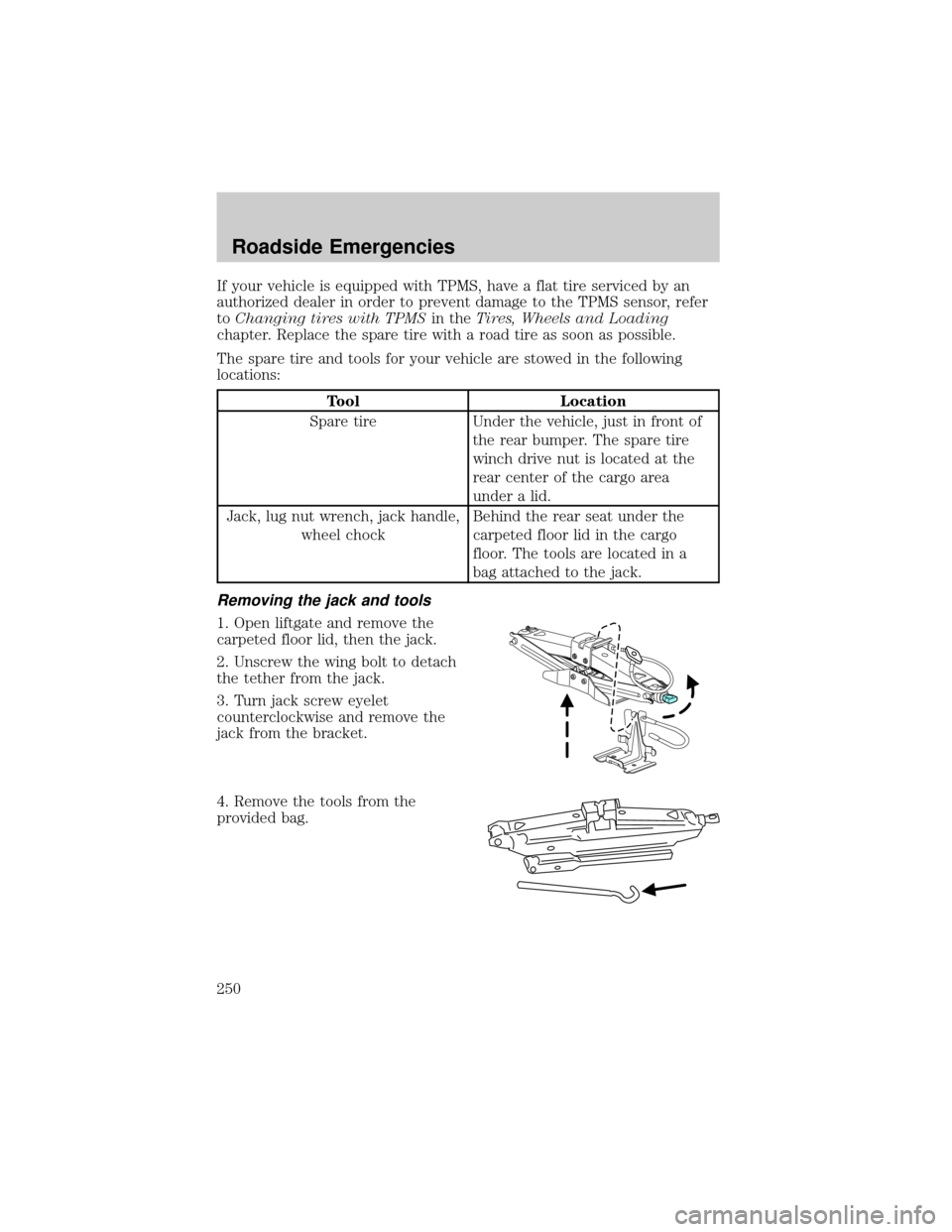
The spare tire and tools for your vehicle are stowed in the following
locations:
Tool Location
Spare tire Under the vehicle, just in front of
the rear bumper. The spare tire
winch drive nut is located at the
rear center of the cargo area
under a lid.
Jack, lug nut wrench, jack handle,
wheel chockBehind the rear seat under the
carpeted floor lid in the cargo
floor. The tools are located in a
bag attached to the jack.
Removing the jack and tools
1. Open liftgate and remove the
carpeted floor lid, then the jack.
2. Unscrew the wing bolt to detach
the tether from the jack.
3. Turn jack screw eyelet
counterclockwise and remove the
jack from the bracket.
4. Remove the tools from the
provided bag.
Roadside Emergencies
250
Page 301 of 328

²Revving the engine before turning it off may reduce fuel economy.
²Using the air conditioner or defroster may reduce fuel economy.
²
You may want to turn off the speed control in hilly terrain if unnecessary
shifting between third and fourth gear occurs. Unnecessary shifting of
this type could result in reduced fuel economy.
²Warming up a vehicle on cold mornings is not required and may
reduce fuel economy.
²Resting your foot on the brake pedal while driving may reduce fuel
economy.
²Combine errands and minimize stop-and-go driving.
Maintenance
²Keep tires properly inflated and use only recommended size.
²Operating a vehicle with the wheels out of alignment will reduce fuel
economy.
²Use recommended engine oil. Refer toLubricant specificationsin
this chapter.
²Perform all regularly scheduled maintenance items. Follow the
recommended maintenance schedule and owner maintenance checks
found inscheduled maintenance information.
Conditions
²Heavily loading a vehicle or towing a trailer may reduce fuel economy
at any speed.
²Carrying unnecessary weight may reduce fuel economy (approximately
1 mpg [0.4 km/L] is lost for every 400 lb [180 kg] of weight carried).
²Adding certain accessories to your vehicle (for example bug
deflectors, rollbars/light bars, running boards, ski/luggage racks) may
reduce fuel economy.
²Fuel economy may decrease with lower temperatures during the first
8±10 miles (12±16 km) of driving.
²Driving on flat terrain offers improved fuel economy as compared to
driving on hilly terrain.
²Transmissions give their best fuel economy when operated in the top
cruise gear and with steady pressure on the gas pedal.
²Four-wheel-drive operation (if equipped) is less fuel efficient than
two-wheel-drive operation.
Maintenance and Specifications
301
Page 324 of 328

Power mirrors .............................58
Power point .................................55
Power steering ..........................215
fluid, checking and adding ....304
fluid, refill capacity ................308
fluid, specifications .........310, 313
Power Windows ...........................57
Preparing to drive your
vehicle ........................................216
R
Radio ................................21, 25, 29
Rear window defroster ...............41
Relays ........................................238
Remote entry system ...............101
illuminated entry ....................105
opening the trunk ...................102
Reverse sensing system ...........224
Roadside assistance ..................235
Roof rack .....................................97
S
Safety Belt Maintenance ..........140
Safety belts
(see Safety restraints) ............126,
129±134
Safety Canopy ...........150, 152±153
Safety defects, reporting ..........268
Safety restraints ........126, 129±134
belt minder .............................136
extension assembly ................135
for adults .........................130±133
for children .....................155±156
Occupant Classification
Sensor ......................................127safety belt maintenance .........140
warning light and chime ........136
Safety seats for children ..........160
Safety Compliance
Certification Label ....................315
Seat belts
(see Safety restraints) .............126
Seats ..........................................114
child safety seats ....................160
front seats ...............................115
heated ......................................119
memory seat ...................102, 118
Setting the clock
AM/FM/In-dash 6 CD ................29
Snowplowing .................................8
Spark plugs,
specifications .....................307, 313
Special notice
ambulance conversions ..............8
utility-type vehicles ....................8
Specification chart,
lubricants ...........................310, 313
Speed control ..............................60
Starting your vehicle ........207, 209
jump starting ..........................256
Steering wheel
controls ......................................62
tilting .........................................53
T
Tilt steering wheel ......................53
Tire Pressure Monitoring
System (TPMS)
Driving .....................................230
Roadside Emergencies ...........246
Tires, Wheels and Loading ....186
Warning Displays ..........18, 77, 91
Index
324
Page 325 of 328

Tires ...........................172±174, 246
alignment ................................184
care ..........................................181
changing ..........................246, 252
checking the pressure ............177
inspecting and inflating .........175
label .........................................181
replacing ..........................183, 252
rotating ....................................185
safety practices .......................184
sidewall information ...............177
snow tires and chains ............192
spare tire .................247, 249, 251
terminology .............................174
tire grades ...............................173
treadwear ........................173, 182
Towing .......................................199
recreational towing .................205
trailer towing ..........................199
wrecker ....................................261
Transfer case
fluid checking .........................306
Transmission .............................217
brake-shift interlock (BSI) ....217
fluid, checking and adding
(automatic) .............................305
fluid, refill capacities ..............308lubricant specifications ..310, 313
Trunk .........................................102
Turn signal ..................................45
V
Vehicle dimensions ...................313
Vehicle Identification Number
(VIN) ..........................................315
Vehicle loading ..........................192
Ventilating your vehicle ...........209
W
Warning lights (see Lights) .......12
Washer fluid ..............................280
Water, Driving through .............234
Windows
power .........................................57
rear wiper/washer .....................53
Windshield washer fluid and
wipers ..........................................52
checking and adding fluid .....280
liftgate reservoir .....................280
replacing wiper blades ...........281
Wrecker towing .........................261
Index
325