steering FORD F-150 2021 Owners Manual
[x] Cancel search | Manufacturer: FORD, Model Year: 2021, Model line: F-150, Model: FORD F-150 2021Pages: 796, PDF Size: 13.89 MB
Page 479 of 796
Using Trail Control
Trail Control provides you the ability to
maneuver the vehicle without using the
throttle and brake pedals.
The system controls acceleration and
braking in difficult off-road environments,
which allows you to focus on steering. See
Trail Control (page 324).
Trail Control Performance:
• Manages wheel slip to maximize
traction.
• Provides braking to maximize traction
in descents.
Using Trail One Pedal Drive
(If
Equipped)
Trail one pedal drive allows you to
accelerate and brake using only the
accelerator pedal.
Use this when driving over large obstacles,
such as rocks or logs, to help maintain a
constant vehicle speed.
In 4H, the system offers lift pedal braking
and auto hill hold functionality. See
What
Is Trail One Pedal Drive (page 325).
Note: Trail one pedal drive is only available
when the vehicle is in 4H or 4L.
AFTER DRIVING YOUR VEHICLE
OFF-ROAD - RAPTOR WARNING:
After off-road use,
before returning to the road, check the
wheels and tires for damage. Off-road
use may cause damage to your wheels
and tires that can lead to tire failure, loss
of vehicle control, serious injury or death. WARNING:
Always re-inflate tires
to recommended tire pressures before
the vehicle is operated on-road. The
recommended pressure is located on the
tire label or safety certification label,
located on the B-pillar, inside the driver's
door.
Driving off-road places more stress on your
vehicle than most on-road driving. After
driving off-road, check for damage and, if
necessary, have your vehicle repaired by
an authorized dealer.
Inspect the underbody of your vehicle by
checking tires, body structure, steering,
suspension, and exhaust system for
damage.
Check the radiator for mud and debris and
clean as needed.
Remove accumulations of plants or brush.
These things could be a fire hazard or hide
damage to the fuel lines, brake hoses, and
propeller shafts.
After operation in mud, sand, water, or
similar dirty conditions, inspect the
underbody and clean your vehicle.
AFTER DRIVING YOUR VEHICLE
OFF-ROAD WARNING:
After off-road use,
before returning to the road, check the
wheels and tires for damage. Off-road
use may cause damage to your wheels
and tires that can lead to tire failure, loss
of vehicle control, serious injury or death.
475
F-150 (TFD) Canada/United States of America, enUSA, Edition date: 202104, Second-Printing Driving Hints
Page 480 of 796
WARNING: Always re-inflate tires
to recommended tire pressures before
the vehicle is operated on-road. The
recommended pressure is located on the
tire label or safety certification label,
located on the B-pillar, inside the driver's
door.
Driving off-road places more stress on your
vehicle than most on-road driving. After
driving off-road check for damage to your
vehicle and, if necessary, have your vehicle
fixed as soon as possible.
Inspect the underbody of your vehicle by
checking tires, body structure, steering,
suspension, and exhaust system for
damage.
Check the radiator for mud and debris and
clean as needed.
Remove accumulations of plants or brush.
These things could be a fire hazard or hide
damage to the fuel lines, brake hoses, and
propeller shafts.
After extended operation in mud, sand,
water, or similar dirty conditions, inspect
the underbody and clean your vehicle as
soon as possible.
If you experience unusual vibration after
driving in mud, slush or similar conditions,
check the wheels for impacted material.
Impacted material can cause vibrations
while driving and wheel imbalance.
Remove the material to resolve the
problem.
COLD WEATHER
PRECAUTIONS
The functional operation of some
components and systems can be affected
at temperatures below approximately
-13°F (-25°C)
. DRIVING ON SNOW AND ICE WARNING:
If you are driving in
slippery conditions that require tire
chains or cables, then it is critical that
you drive cautiously. Keep speeds down,
allow for longer stopping distances and
avoid aggressive steering to reduce the
chances of a loss of vehicle control
which can lead to serious injury or death.
If the rear end of your vehicle slides while
cornering, steer in the direction of the
slide until you regain control of your
vehicle.
On ice and snow, you should drive more
slowly than usual. Your vehicle has a four
wheel anti-lock brake system, do not pump
the brake pedal.
See Anti-Lock Braking
System Limitations (page 308).
BREAKING-IN
Your vehicle requires a break-in period. For
the first 1,000 mi (1,600 km), avoid driving
at high speeds, heavy braking, aggressive
shifting or using your vehicle to tow. During
this time, your vehicle may exhibit some
unusual driving characteristics.
DRIVING ECONOMICALLY
The following helps to improve fuel
consumption:
• There is no need to wait for your engine
to warm up. The vehicle is ready to
drive immediately after starting.
• Your fuel consumption should improve
throughout your hybrid's break-in
period.
• Accelerate and slow down in a smooth,
moderate fashion.
476
F-150 (TFD) Canada/United States of America, enUSA, Edition date: 202104, Second-Printing Driving Hints
Page 481 of 796
•
Moderate braking is particularly
important since it allows you to
maximize the energy captured by the
regenerative braking system.
• Drive at steady speeds without
stopping.
• Anticipate stops; slowing down may
eliminate the need to stop.
• Driving on flat terrain.
• Drive at reasonable speeds and
observe posted speed limits.
• Shut all windows when driving at high
speeds.
• Combine errands and minimize
stop-and-go driving.
• Drive with the tonneau cover installed
if your vehicle comes with one.
• Keep the tires properly inflated and use
only the recommended size.
• Use the recommended engine oil.
• Follow the recommended maintenance
schedule and carry out the
recommended checks.
• Perform all scheduled maintenance.
Note: Having your engine running is not
always an indication of inefficiency. In some
cases, it is actually more efficient than
driving in electric mode.
Avoid these actions; they reduce your fuel
consumption:
• Revving the engine.
• Aggressive driving increases the
amount of energy required to move
your vehicle.
• Driving in lower temperatures during
the first 5–10 mi (12 –16 km) of driving.
• Idle for periods longer than one minute.
• Use the air conditioner or front
defroster. •
Adding certain accessories to your
vehicle like bug deflectors, rollbars,
light bars, running boards, ski racks or
luggage racks.
• Use the speed control in hilly terrain.
• Using fuel blended with alcohol.
• Drive a heavily loaded vehicle or tow a
trailer.
• Driving with the wheels out of
alignment.
DRIVING IN SPECIAL
CONDITIONS
EMERGENCY MANEUVERS
In an unavoidable emergency where you
must make a sudden sharp maneuver, turn
the steering wheel only as rapidly and as
far as required to avoid the emergency.
Apply smooth pressure to the accelerator
pedal or brake pedal as needed. Avoid
abrupt steering, acceleration and braking
changes. Abrupt changes could increase
the risk of vehicle roll over, loss of vehicle
control and personal injury. If possible, use
any available road surfaces to bring your
vehicle under control.
FLOOR MATS WARNING:
Use a floor mat
designed to fit the footwell of your
vehicle that does not obstruct the pedal
area. Failure to follow this instruction
could result in the loss of control of your
vehicle, personal injury or death. WARNING:
Pedals that cannot
move freely can cause loss of vehicle
control and increase the risk of serious
personal injury.
477
F-150 (TFD) Canada/United States of America, enUSA, Edition date: 202104, Second-Printing Driving Hints
Page 484 of 796
SNOW PLOWING
PRECAUTIONS
WARNING: Modifying or adding
equipment to the front of your vehicle
could affect the performance of the
airbag system, increasing the risk of
injury. This includes the hood, bumper
system, frame, front body structure, tow
hooks, hood pins, push bar and
snowplows. WARNING:
Do not attempt to
service, repair, or modify the
supplementary restraint system or
associated components. Failure to
follow this instruction could result in
personal injury or death. WARNING:
All occupants of your
vehicle, including the driver, should
always properly wear their seatbelts,
even when an airbag supplemental
restraint system is provided. Failure to
properly wear your seatbelt could
seriously increase the risk of injury or
death. WARNING:
Do not spin the wheels
at over 34 mph (55 km/h). The tires may
fail and injure a passenger or bystander.
Note: Look for an alterer ’s label on your
vehicle from the snowplow installer
certifying that the installation meets all
applicable Federal Motor Vehicle Safety
Standards (FMVSS).
Note: Federal and some local regulations
require additional exterior lamps for
snowplow-equipped vehicles. Contact an
authorized dealer for additional information. Note:
Do not remove or defeat the tripping
mechanisms designed into the snow
removal equipment by its manufacturer.
Doing so could cause damage to your
vehicle and the snow removal equipment
as well as possible airbag deployment.
OPERATING YOUR VEHICLE
WITH A SNOWPLOW
Weight limits and guidelines for selecting
and installing the snowplow are in the Ford
Truck Body Builders Layout Book. For
additional information, visit
www .f or dbb a s. c om .
A typical snowplow installation affects the
following:
• Front gross axle weight rating. See
What Is the Gross Axle Weight
Rating
(page 413).
• Gross vehicle weight rating. See
What
Is the Gross Vehicle Weight Rating
(page
413).
• Braking and steering.
• Front wheel toe. See the
Ford
Workshop Manual.
• Headlight aim. See
Adjusting the
Headlamps (page 521).
• Tire air pressure. See Information on
the Tire Sidewall
(page 543).
Note: Do not exceed the front gross axle
weight rating or gross vehicle weight rating.
Note: Your vehicle may require rear ballast
weight for proper braking and steering.
Your vehicle has a driver and passenger
airbag supplemental restraint system. The
supplemental restraint system activates
in certain frontal and offset frontal
collisions when the vehicle sustains
sufficient longitudinal deceleration.
480
F-150 (TFD) Canada/United States of America, enUSA, Edition date: 202104, Second-Printing Snow Plowing - Vehicles With: Snow Plow Mode
Page 495 of 796
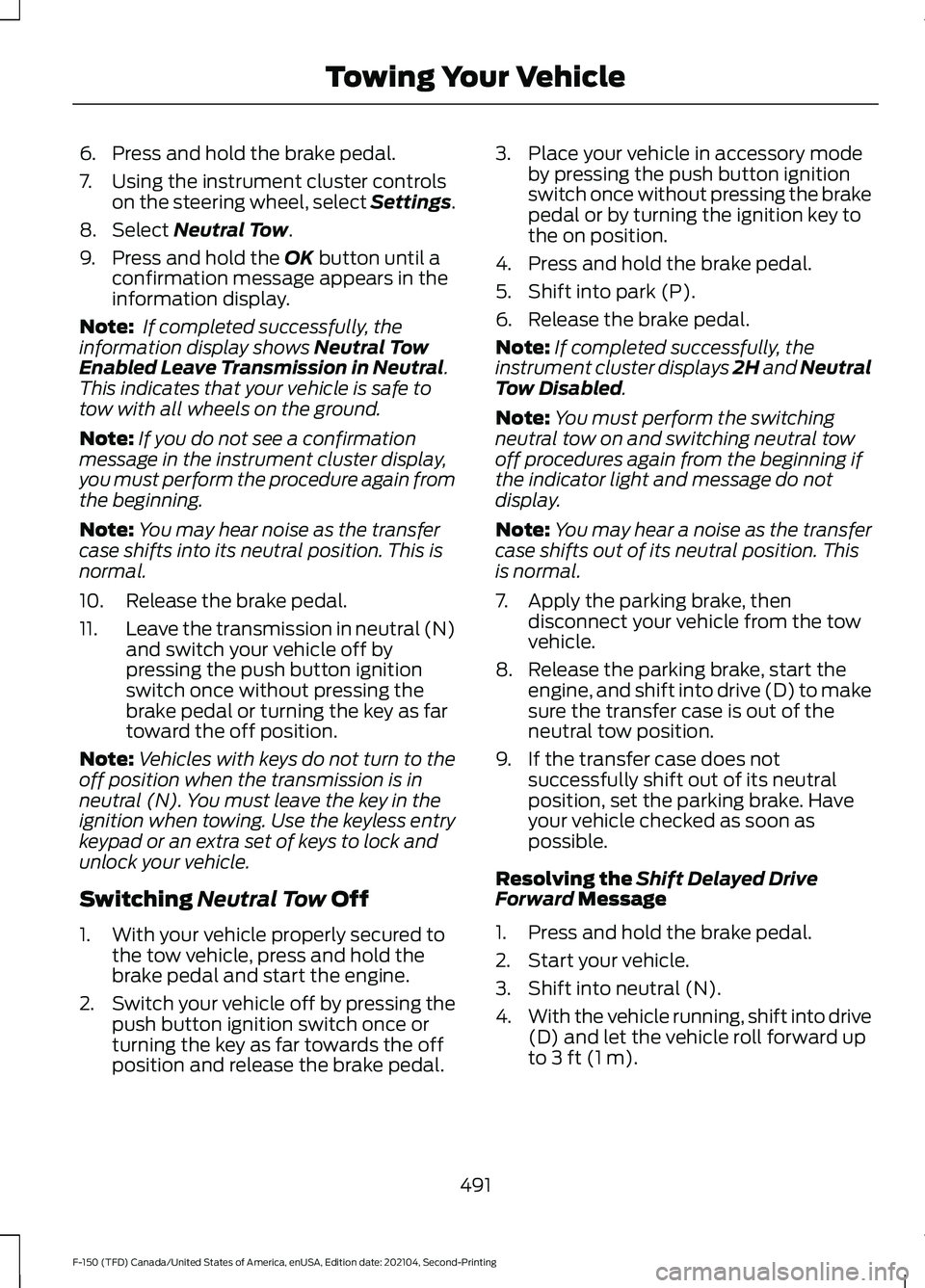
6. Press and hold the brake pedal.
7. Using the instrument cluster controls
on the steering wheel, select Settings.
8. Select Neutral Tow.
9. Press and hold the
OK button until a
confirmation message appears in the
information display.
Note: If completed successfully, the
information display shows
Neutral Tow
Enabled Leave Transmission in Neutral.
This indicates that your vehicle is safe to
tow with all wheels on the ground.
Note: If you do not see a confirmation
message in the instrument cluster display,
you must perform the procedure again from
the beginning.
Note: You may hear noise as the transfer
case shifts into its neutral position. This is
normal.
10. Release the brake pedal.
11. Leave the transmission in neutral (N)
and switch your vehicle off by
pressing the push button ignition
switch once without pressing the
brake pedal or turning the key as far
toward the off position.
Note: Vehicles with keys do not turn to the
off position when the transmission is in
neutral (N). You must leave the key in the
ignition when towing. Use the keyless entry
keypad or an extra set of keys to lock and
unlock your vehicle.
Switching
Neutral Tow Off
1. With your vehicle properly secured to the tow vehicle, press and hold the
brake pedal and start the engine.
2. Switch your vehicle off by pressing the
push button ignition switch once or
turning the key as far towards the off
position and release the brake pedal. 3. Place your vehicle in accessory mode
by pressing the push button ignition
switch once without pressing the brake
pedal or by turning the ignition key to
the on position.
4. Press and hold the brake pedal.
5. Shift into park (P).
6. Release the brake pedal.
Note: If completed successfully, the
instrument cluster displays 2H and Neutral
Tow Disabled
.
Note: You must perform the switching
neutral tow on and switching neutral tow
off procedures again from the beginning if
the indicator light and message do not
display.
Note: You may hear a noise as the transfer
case shifts out of its neutral position. This
is normal.
7. Apply the parking brake, then disconnect your vehicle from the tow
vehicle.
8. Release the parking brake, start the engine, and shift into drive (D) to make
sure the transfer case is out of the
neutral tow position.
9. If the transfer case does not successfully shift out of its neutral
position, set the parking brake. Have
your vehicle checked as soon as
possible.
Resolving the
Shift Delayed Drive
Forward Message
1. Press and hold the brake pedal.
2. Start your vehicle.
3. Shift into neutral (N).
4. With the vehicle running, shift into drive
(D) and let the vehicle roll forward up
to
3 ft (1 m).
491
F-150 (TFD) Canada/United States of America, enUSA, Edition date: 202104, Second-Printing Towing Your Vehicle
Page 499 of 796
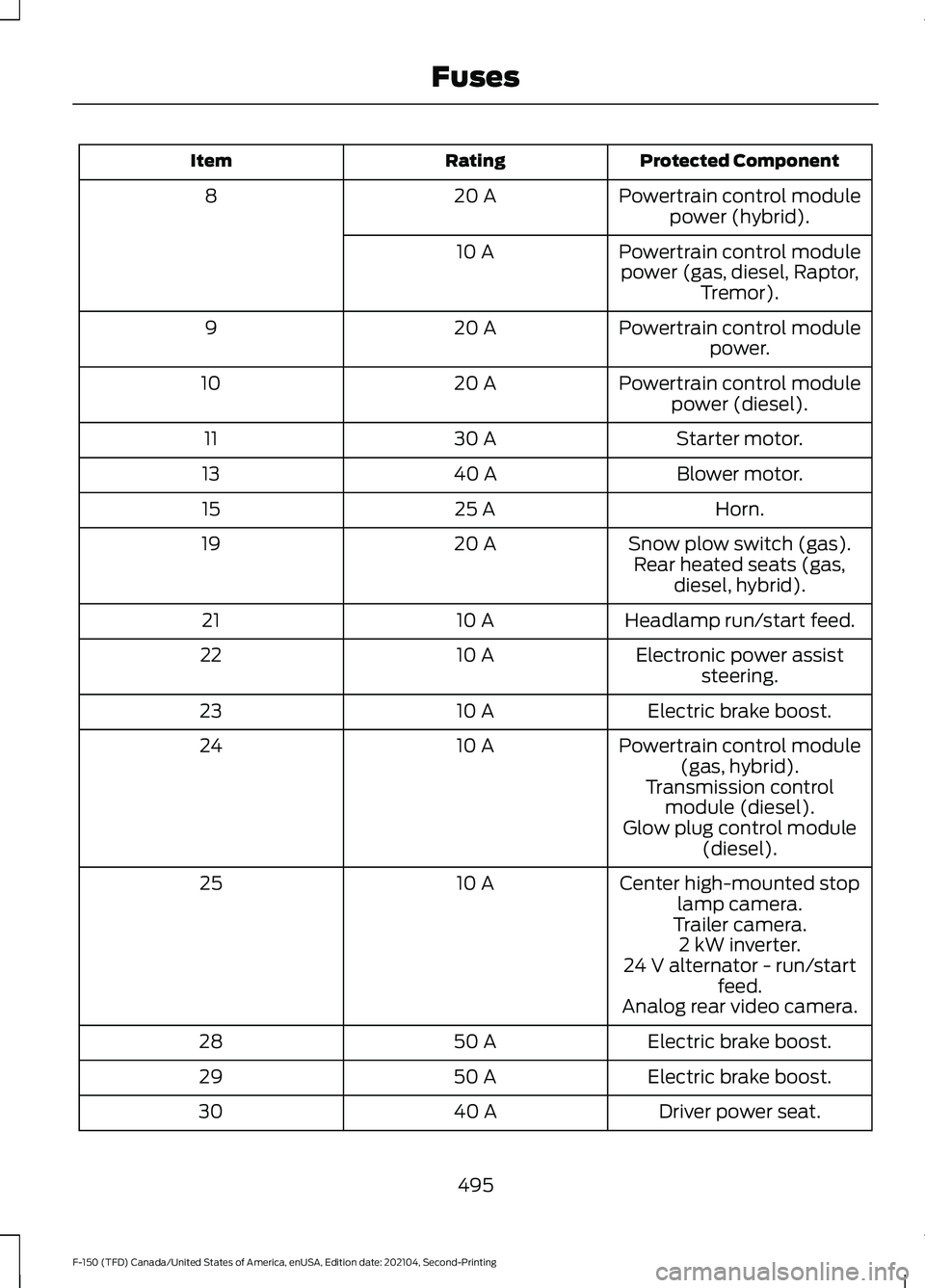
Protected Component
Rating
Item
Powertrain control modulepower (hybrid).
20 A
8
Powertrain control modulepower (gas, diesel, Raptor, Tremor).
10 A
Powertrain control modulepower.
20 A
9
Powertrain control modulepower (diesel).
20 A
10
Starter motor.
30 A
11
Blower motor.
40 A
13
Horn.
25 A
15
Snow plow switch (gas).
20 A
19
Rear heated seats (gas,diesel, hybrid).
Headlamp run/start feed.
10 A
21
Electronic power assiststeering.
10 A
22
Electric brake boost.
10 A
23
Powertrain control module(gas, hybrid).
10 A
24
Transmission controlmodule (diesel).
Glow plug control module (diesel).
Center high-mounted stop lamp camera.
10 A
25
Trailer camera.2 kW inverter.
24 V alternator - run/start feed.
Analog rear video camera.
Electric brake boost.
50 A
28
Electric brake boost.
50 A
29
Driver power seat.
40 A
30
495
F-150 (TFD) Canada/United States of America, enUSA, Edition date: 202104, Second-Printing Fuses
Page 501 of 796
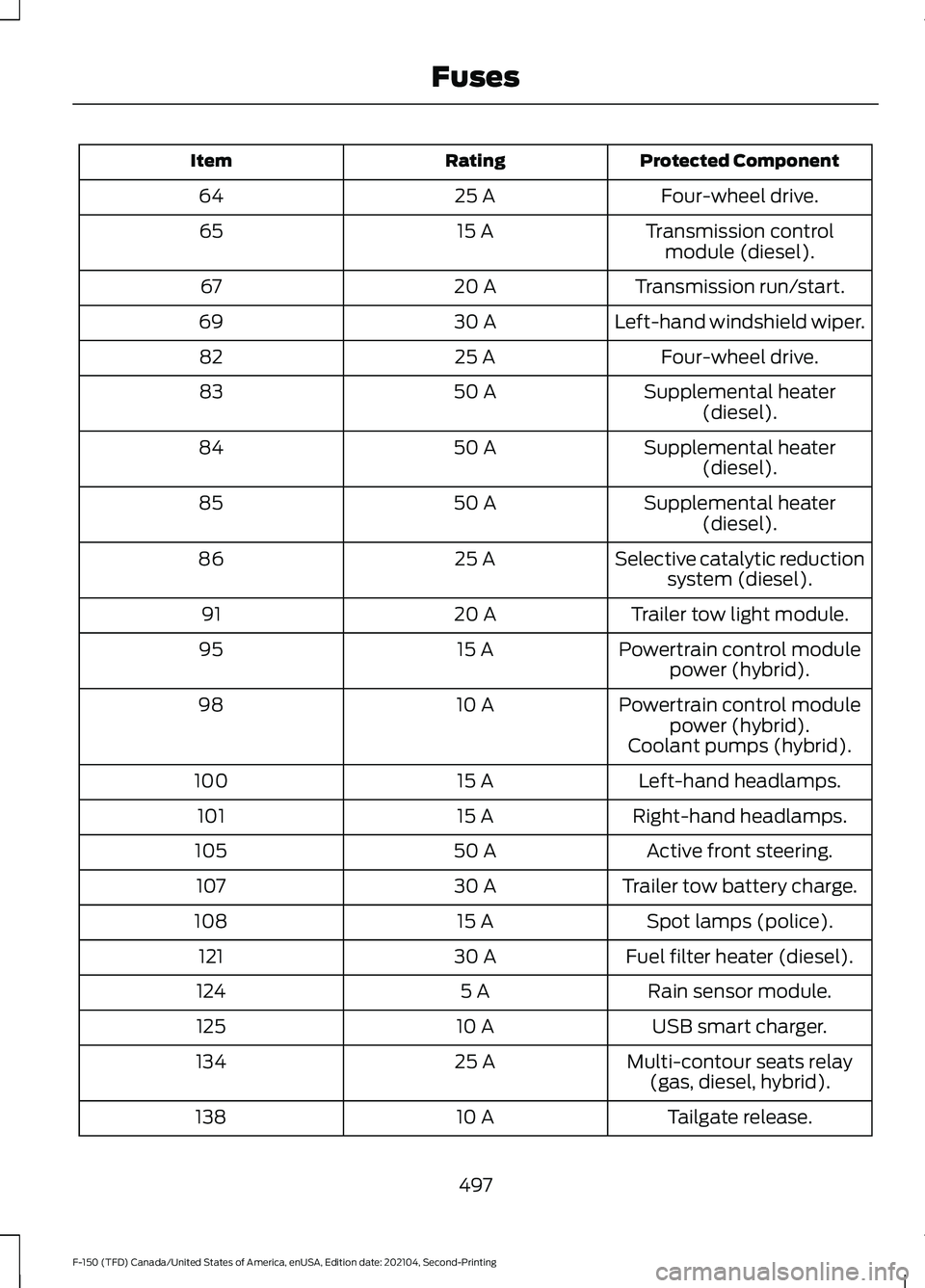
Protected Component
Rating
Item
Four-wheel drive.
25 A
64
Transmission controlmodule (diesel).
15 A
65
Transmission run/start.
20 A
67
Left-hand windshield wiper.
30 A
69
Four-wheel drive.
25 A
82
Supplemental heater(diesel).
50 A
83
Supplemental heater(diesel).
50 A
84
Supplemental heater(diesel).
50 A
85
Selective catalytic reductionsystem (diesel).
25 A
86
Trailer tow light module.
20 A
91
Powertrain control modulepower (hybrid).
15 A
95
Powertrain control modulepower (hybrid).
10 A
98
Coolant pumps (hybrid).Left-hand headlamps.
15 A
100
Right-hand headlamps.
15 A
101
Active front steering.
50 A
105
Trailer tow battery charge.
30 A
107
Spot lamps (police).
15 A
108
Fuel filter heater (diesel).
30 A
121
Rain sensor module.
5 A
124
USB smart charger.
10 A
125
Multi-contour seats relay(gas, diesel, hybrid).
25 A
134
Tailgate release.
10 A
138
497
F-150 (TFD) Canada/United States of America, enUSA, Edition date: 202104, Second-Printing Fuses
Page 504 of 796
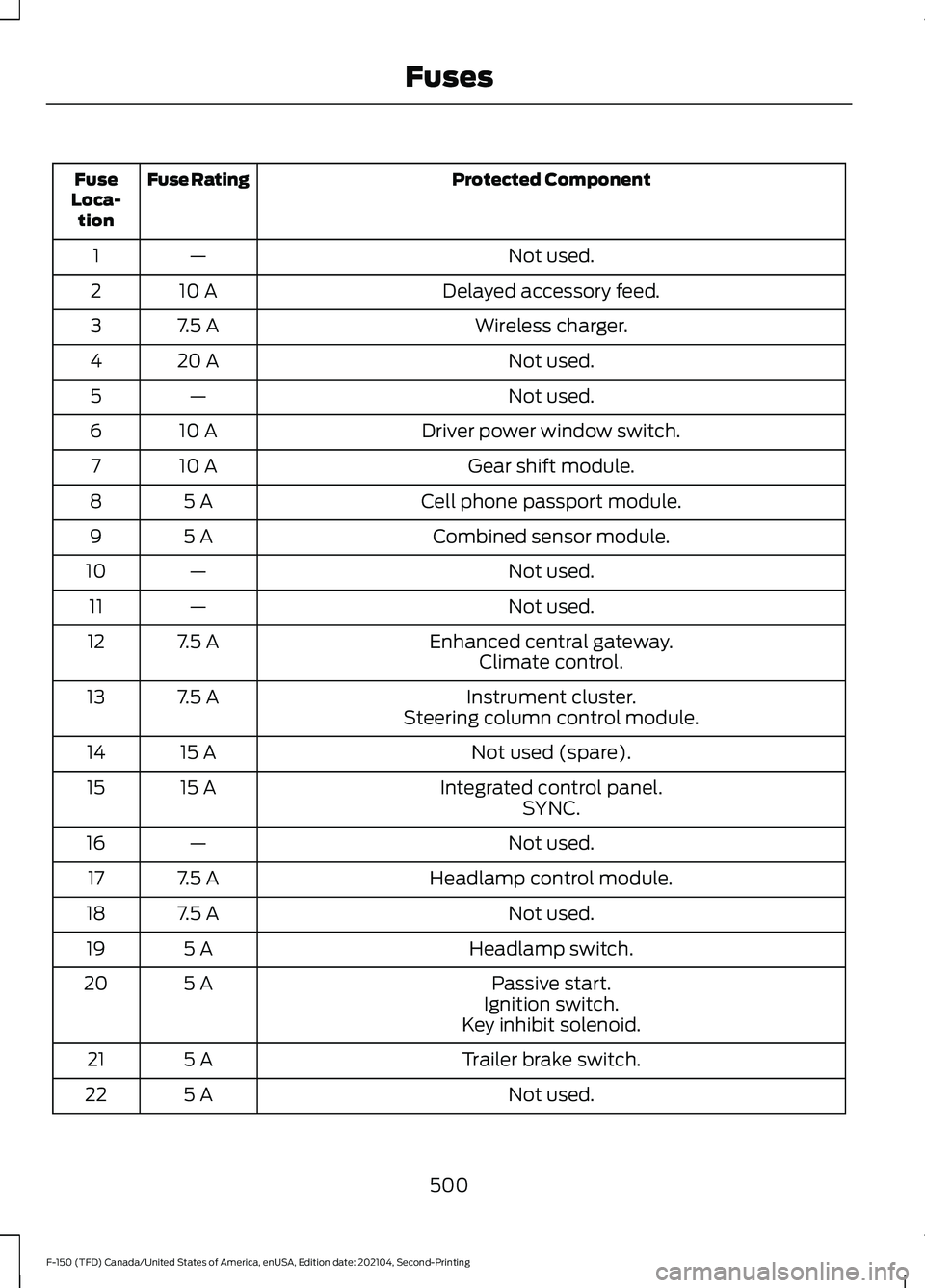
Protected Component
Fuse Rating
Fuse
Loca- tion
Not used.
—
1
Delayed accessory feed.
10 A
2
Wireless charger.
7.5 A
3
Not used.
20 A
4
Not used.
—
5
Driver power window switch.
10 A
6
Gear shift module.
10 A
7
Cell phone passport module.
5 A
8
Combined sensor module.
5 A
9
Not used.
—
10
Not used.
—
11
Enhanced central gateway.
7.5 A
12
Climate control.
Instrument cluster.
7.5 A
13
Steering column control module.
Not used (spare).
15 A
14
Integrated control panel.
15 A
15
SYNC.
Not used.
—
16
Headlamp control module.
7.5 A
17
Not used.
7.5 A
18
Headlamp switch.
5 A
19
Passive start.
5 A
20
Ignition switch.
Key inhibit solenoid.
Trailer brake switch.
5 A
21
Not used.
5 A
22
500
F-150 (TFD) Canada/United States of America, enUSA, Edition date: 202104, Second-Printing Fuses
Page 505 of 796
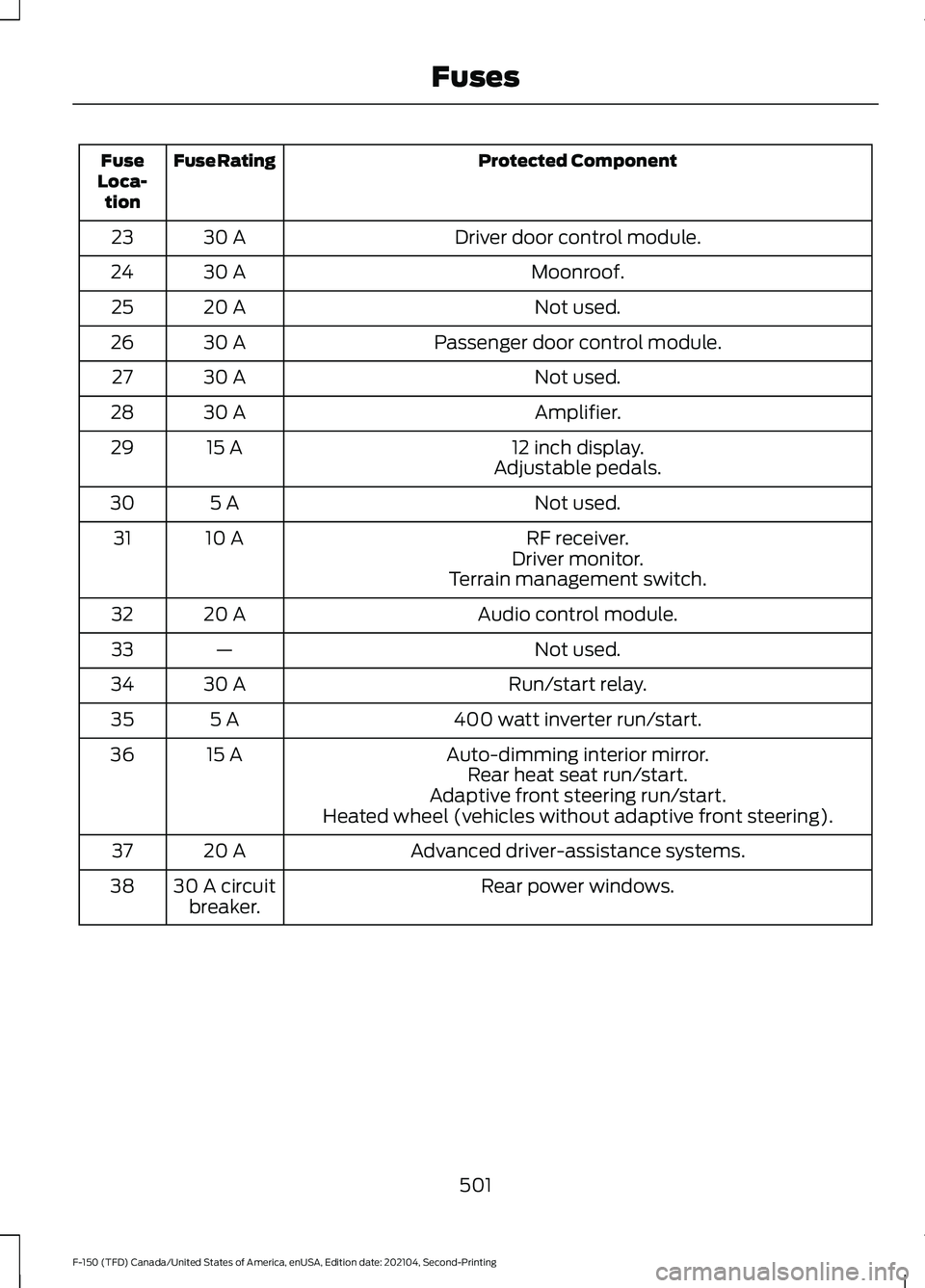
Protected Component
Fuse Rating
Fuse
Loca- tion
Driver door control module.
30 A
23
Moonroof.
30 A
24
Not used.
20 A
25
Passenger door control module.
30 A
26
Not used.
30 A
27
Amplifier.
30 A
28
12 inch display.
15 A
29
Adjustable pedals.
Not used.
5 A
30
RF receiver.
10 A
31
Driver monitor.
Terrain management switch.
Audio control module.
20 A
32
Not used.
—
33
Run/start relay.
30 A
34
400 watt inverter run/start.
5 A
35
Auto-dimming interior mirror.
15 A
36
Rear heat seat run/start.
Adaptive front steering run/start.
Heated wheel (vehicles without adaptive front steering).
Advanced driver-assistance systems.
20 A
37
Rear power windows.
30 A circuit
breaker.
38
501
F-150 (TFD) Canada/United States of America, enUSA, Edition date: 202104, Second-Printing Fuses
Page 515 of 796
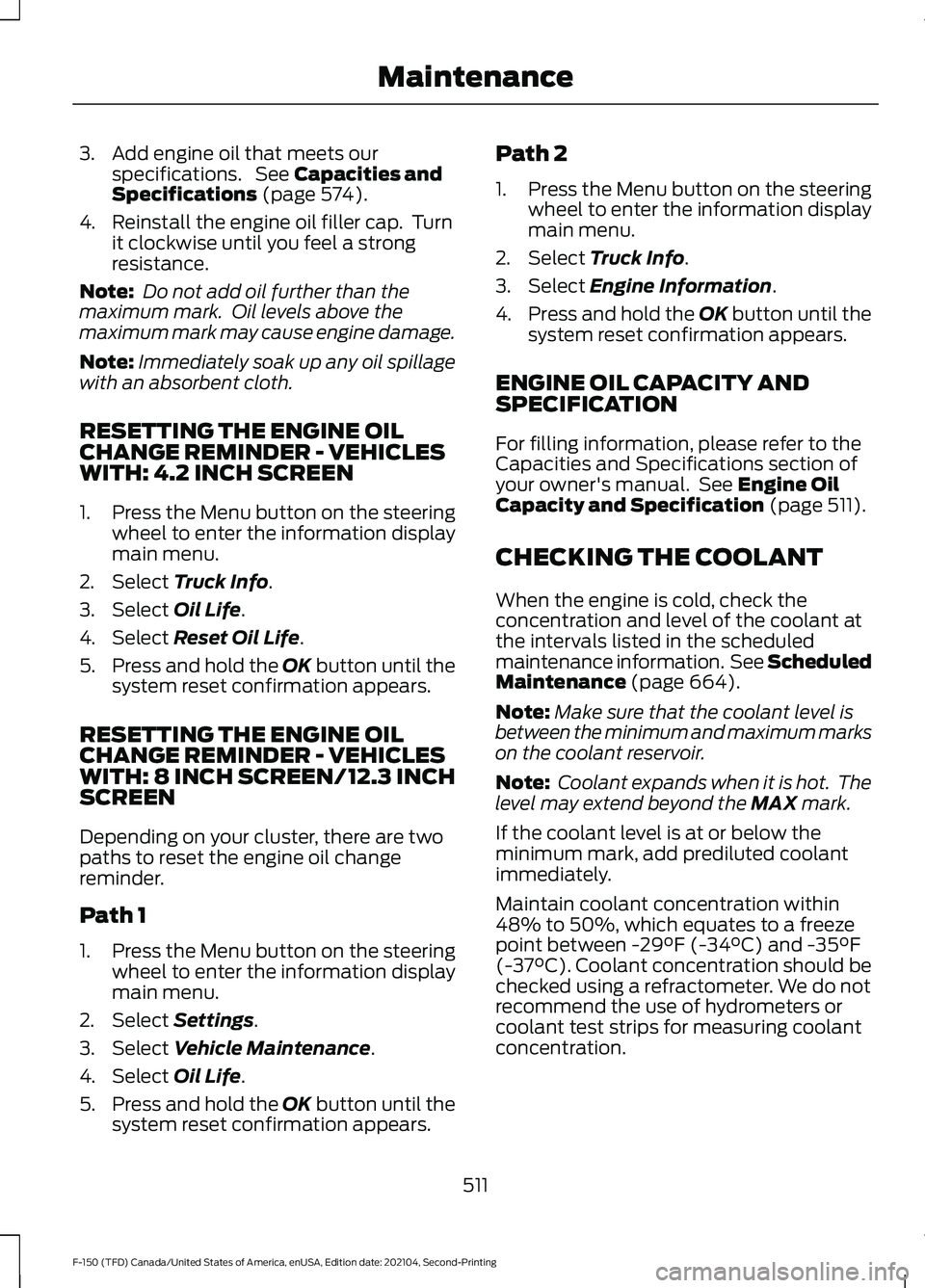
3. Add engine oil that meets our
specifications. See Capacities and
Specifications (page 574).
4. Reinstall the engine oil filler cap. Turn it clockwise until you feel a strong
resistance.
Note: Do not add oil further than the
maximum mark. Oil levels above the
maximum mark may cause engine damage.
Note: Immediately soak up any oil spillage
with an absorbent cloth.
RESETTING THE ENGINE OIL
CHANGE REMINDER - VEHICLES
WITH: 4.2 INCH SCREEN
1. Press the Menu button on the steering
wheel to enter the information display
main menu.
2. Select
Truck Info.
3. Select
Oil Life.
4. Select
Reset Oil Life.
5. Press and hold the OK button until the
system reset confirmation appears.
RESETTING THE ENGINE OIL
CHANGE REMINDER - VEHICLES
WITH: 8 INCH SCREEN/12.3 INCH
SCREEN
Depending on your cluster, there are two
paths to reset the engine oil change
reminder.
Path 1
1. Press the Menu button on the steering
wheel to enter the information display
main menu.
2. Select
Settings.
3. Select
Vehicle Maintenance.
4. Select
Oil Life.
5. Press and hold the OK button until the
system reset confirmation appears. Path 2
1.
Press the Menu button on the steering
wheel to enter the information display
main menu.
2. Select
Truck Info.
3. Select
Engine Information.
4. Press and hold the OK button until the
system reset confirmation appears.
ENGINE OIL CAPACITY AND
SPECIFICATION
For filling information, please refer to the
Capacities and Specifications section of
your owner's manual. See
Engine Oil
Capacity and Specification (page 511).
CHECKING THE COOLANT
When the engine is cold, check the
concentration and level of the coolant at
the intervals listed in the scheduled
maintenance information. See Scheduled
Maintenance
(page 664).
Note: Make sure that the coolant level is
between the minimum and maximum marks
on the coolant reservoir.
Note: Coolant expands when it is hot. The
level may extend beyond the
MAX mark.
If the coolant level is at or below the
minimum mark, add prediluted coolant
immediately.
Maintain coolant concentration within
48% to 50%, which equates to a freeze
point between
-29°F (-34°C) and -35°F
(-37°C). Coolant concentration should be
checked using a refractometer. We do not
recommend the use of hydrometers or
coolant test strips for measuring coolant
concentration.
511
F-150 (TFD) Canada/United States of America, enUSA, Edition date: 202104, Second-Printing Maintenance