oil FORD F-150 2021 User Guide
[x] Cancel search | Manufacturer: FORD, Model Year: 2021, Model line: F-150, Model: FORD F-150 2021Pages: 796, PDF Size: 13.89 MB
Page 263 of 796
Biodiesel
WARNING: Do not mix diesel with
gasoline, gasohol or alcohol. This could
cause an explosion.
Note: Do not use home heating oil,
agricultural fuel, raw fats and oils, waste
cooking greases, biodiesel greater than 20%
or any diesel not intended for highway use.
Damage to the fuel injection system, engine
and exhaust catalyst, and diesel particulate
filter can occur if you use an improper fuel.
Red dye is used to identify fuels intended
for agricultural and non-highway use.
You can operate your vehicle on diesel
fuels containing up to 20% biodiesel, also
known as B20.
Biodiesel fuel is a chemically converted
product from renewable fuel sources, such
as vegetable oils, animal fats and waste
cooking greases.
To help achieve acceptable engine
performance and durability when using
biodiesel in your vehicle:
• Confirm the biodiesel content of the
fuel to be B20 (20% biodiesel) or less.
• Only use biodiesel fuel of good quality
that complies with industry standards.
• Follow the recommended service
maintenance intervals. See
General
Maintenance Information (page 664).
• Do not store biodiesel fuel in the fuel
tank for more than 1 month.
• Consider changing brands or reducing
biodiesel content if you have cold
temperature fuel gelling issues or a
frequently appearing LOW FUEL
PRESSURE message. Use of biodiesel in concentrations greater
than 20% can cause damage to your
vehicle, including engine and/or exhaust
after-treatment hardware (exhaust
catalyst and particulate filter) failures.
Concentrations greater than 20% can also
cause fuel filter restrictions that could
result in a lack of power or damage to fuel
system components, including fuel pump
and fuel injector failures.
We recommend SAE 5W-40 oil for fuels
with greater than 5% biodiesel (B5). For
more information about oil change
intervals and other maintenance when
operating on biodiesel.
See Special
Operating Conditions Scheduled
Maintenance
(page 675).
Look for a label on the fuel pump to
confirm the amount of biodiesel contained
in diesel fuel. Ask the service station
attendant to confirm the biodiesel content
of diesel fuel, if you do not see a label on
the fuel pump.
If you plan to park or store your vehicle for
more than 1 month, then you should empty
your vehicle fuel tank of biodiesel fuel. You
should fill the tank with a pure
petroleum-based diesel fuel and run your
vehicle for a minimum of 30 minutes.
Note: Degraded or oxidized biodiesel can
damage fuel system seals and plastics and
corrode steel parts.
During cold weather, if you have problems
operating on biodiesel, you may need to
use diesel fuel with lower biodiesel
content, try another brand or discontinue
the use of biodiesel.
Diesel Fuel Additives
It should not be necessary to add any
aftermarket additives to your fuel if you
use a high-quality diesel fuel that conforms
to ASTM industry specifications.
Aftermarket additives can damage the fuel
injector system or engine.
259
F-150 (TFD) Canada/United States of America, enUSA, Edition date: 202104, Second-Printing Fuel and Refueling
Page 264 of 796

Use Motorcraft® cetane booster or an
equivalent cetane booster additive if you
suspect fuel has low cetane. Use
Motorcraft® anti-gel and performance
improver or an equivalent additive if there
is fuel gelling.
Do not use alcohol-based additives to
improve cetane quality, to prevent fuel
gelling or any other use. The use of alcohol
additives could result in damage to the fuel
injectors and system.
Your Warranty may not cover repairs
needed to correct the effects of using an
aftermarket product that does not meet
our specifications in your fuel.
SWITCHING BETWEEN E85 AND
GASOLINE
We do not recommend repeatedly
alternating between E85 and gasoline. If
you switch from using E85 to gasoline, or
from gasoline to E85, add as much fuel as
possible, at least half a tank. Drive your
vehicle immediately for a minimum of 5 mi
(8 km) to allow it to adapt to the change
in ethanol concentration. If you use E85
exclusively, we recommend that you fill
the fuel tank with regular unleaded
gasoline at each scheduled oil change.
LOCATING THE FUEL FILLER
FUNNEL
Regular Cab
The fuel filler funnel is behind the
right-hand front seat.
Super Cab/Crew Cab
The fuel filler funnel is under the second
row right-hand rear seat. RUNNING OUT OF FUEL
FILLING A PORTABLE FUEL
CONTAINER WARNING:
Flow of fuel through a
fuel pump nozzle can produce static
electricity. This can cause a fire if you are
filling an ungrounded fuel container.
Use the following guidelines to avoid
electrostatic charge build-up, which can
produce a spark, when filling an
ungrounded fuel container:
• Only use an approved fuel container to
transfer fuel to your vehicle. Place the
container on the ground when filling it.
• Do not fill a fuel container when it is
inside your vehicle (including the cargo
area).
• Keep the fuel pump nozzle in contact
with the fuel container when filling it.
• Do not use a device that holds the fuel
pump nozzle lever in the fill position.
ADDING FUEL FROM A PORTABLE
FUEL CONTAINER WARNING: Do not insert the nozzle
of a fuel container or an aftermarket
funnel into the fuel filler neck. This may
damage the fuel system filler neck or its
seal and cause fuel to run onto the
ground. WARNING:
Do not pry open the
fuel tank filler valve. This could damage
the fuel system. Failure to follow this
instruction could result in fire, personal
injury or death.
260
F-150 (TFD) Canada/United States of America, enUSA, Edition date: 202104, Second-Printing Fuel and Refueling
Page 481 of 796
•
Moderate braking is particularly
important since it allows you to
maximize the energy captured by the
regenerative braking system.
• Drive at steady speeds without
stopping.
• Anticipate stops; slowing down may
eliminate the need to stop.
• Driving on flat terrain.
• Drive at reasonable speeds and
observe posted speed limits.
• Shut all windows when driving at high
speeds.
• Combine errands and minimize
stop-and-go driving.
• Drive with the tonneau cover installed
if your vehicle comes with one.
• Keep the tires properly inflated and use
only the recommended size.
• Use the recommended engine oil.
• Follow the recommended maintenance
schedule and carry out the
recommended checks.
• Perform all scheduled maintenance.
Note: Having your engine running is not
always an indication of inefficiency. In some
cases, it is actually more efficient than
driving in electric mode.
Avoid these actions; they reduce your fuel
consumption:
• Revving the engine.
• Aggressive driving increases the
amount of energy required to move
your vehicle.
• Driving in lower temperatures during
the first 5–10 mi (12 –16 km) of driving.
• Idle for periods longer than one minute.
• Use the air conditioner or front
defroster. •
Adding certain accessories to your
vehicle like bug deflectors, rollbars,
light bars, running boards, ski racks or
luggage racks.
• Use the speed control in hilly terrain.
• Using fuel blended with alcohol.
• Drive a heavily loaded vehicle or tow a
trailer.
• Driving with the wheels out of
alignment.
DRIVING IN SPECIAL
CONDITIONS
EMERGENCY MANEUVERS
In an unavoidable emergency where you
must make a sudden sharp maneuver, turn
the steering wheel only as rapidly and as
far as required to avoid the emergency.
Apply smooth pressure to the accelerator
pedal or brake pedal as needed. Avoid
abrupt steering, acceleration and braking
changes. Abrupt changes could increase
the risk of vehicle roll over, loss of vehicle
control and personal injury. If possible, use
any available road surfaces to bring your
vehicle under control.
FLOOR MATS WARNING:
Use a floor mat
designed to fit the footwell of your
vehicle that does not obstruct the pedal
area. Failure to follow this instruction
could result in the loss of control of your
vehicle, personal injury or death. WARNING:
Pedals that cannot
move freely can cause loss of vehicle
control and increase the risk of serious
personal injury.
477
F-150 (TFD) Canada/United States of America, enUSA, Edition date: 202104, Second-Printing Driving Hints
Page 485 of 796
When operating your vehicle with a
snowplow:
•
Do not exceed 45 mph (72 km/h).
• Your engine could run at a higher
temperature than normal.
•If you are driving more than
15 mi
(24 km) at temperatures above
freezing, angle the plow blade
either full left or full right to provide
maximum airflow to the radiator.
• If you are driving less than
15 mi
(24 km) at speeds up to 45 mph
(72 km/h) in cold weather, you do
not need to worry about blade
position to provide maximum
airflow.
• Shift to 4L when plowing in small areas
at speeds below
5 mph (8 km/h).
• Shift to
4H when plowing larger areas
or light snow at higher speeds above
5 mph (8 km/h)
. Do not exceed
15 mph (24 km/h).
• Do not shift the transmission from a
forward gear to reverse (R) until the
engine is at idle and the wheels have
stopped.
Note: Careless or high-speed driving when
snowplowing, which results in significant
vehicle decelerations, can deploy the airbag.
Such driving also increases the risk of
accidents.
Note: Drive your vehicle at least
500 mi
(800 km) before using your vehicle for
snowplowing.
Note: Follow the severe duty schedule for
engine oil and transmission fluid change
intervals. See
Special Operating
Conditions Scheduled Maintenance (page
675
). SNOWPLOW MODE
WHAT IS SNOWPLOW MODE
Snowplow mode reduces vehicle electrical
load to allow the electrical system to have
sufficient power to support residential
snowplow use.
SWITCHING SNOWPLOW MODE
ON AND OFF
Vehicles receive a physical button in the
instrument panel or an option in the SYNC
menu to enable snowplow mode.
Snowplow mode does not remember the
setting when you switch your vehicle off.
You must re-enable the mode every time
you wish to use it.
The following features turn off and are
disabled in snowplow mode and cannot
be turned back on until snowplow mode
is switched off:
•
120 V
inverter.
• Fog lamps.
• Heated and cooled front seats.
The body module also activates the
snowplow relay that provides power to
aftermarket snowplow controls.
Note: The electrical system supports the
addition of a residential snowplow of up to
60 A
continuous, and snowplow lights of
up to 20 A continuous using snowplow
mode. The system does not support
snowplow usage with additional electrical
aftermarket accessories.
Push Button
(If Equipped)
Press the snowplow button on the
instrument panel to switch on snowplow
mode. The snowplow button illuminates
and a message displays.
481
F-150 (TFD) Canada/United States of America, enUSA, Edition date: 202104, Second-Printing Snow Plowing - Vehicles With: Snow Plow Mode
Page 498 of 796

IDENTIFYING THE FUSES IN THE UNDER HOOD FUSE BOX
Protected Component
Rating
Item
Body control module -
battery power in feed 1.
40 A
1
Body control module -
battery power in feed 2.
40 A
3
Fuel pump.
30 A
4
Powertrain control modulecoil.
5 A
5
Powertrain control modulepower.
25 A
6
Powertrain control modulepower.
20 A
7
494
F-150 (TFD) Canada/United States of America, enUSA, Edition date: 202104, Second-Printing FusesE346600
Page 508 of 796

3. Raise the hood until the lift cylinders
hold it open.
4. To close, lower the hood and make sure that it fully latches.
UNDER HOOD OVERVIEW - 2.7L ECOBOOST™ Engine compartment fuse box. See Fuses (page 493).
A.
Battery.
See Changing the 12V Battery (page 519).
B.
Engine oil filler cap.
See Checking the Engine Oil Level (page 510).
C.
504
F-150 (TFD) Canada/United States of America, enUSA, Edition date: 202104, Second-Printing MaintenanceE338089 E337516
Page 509 of 796
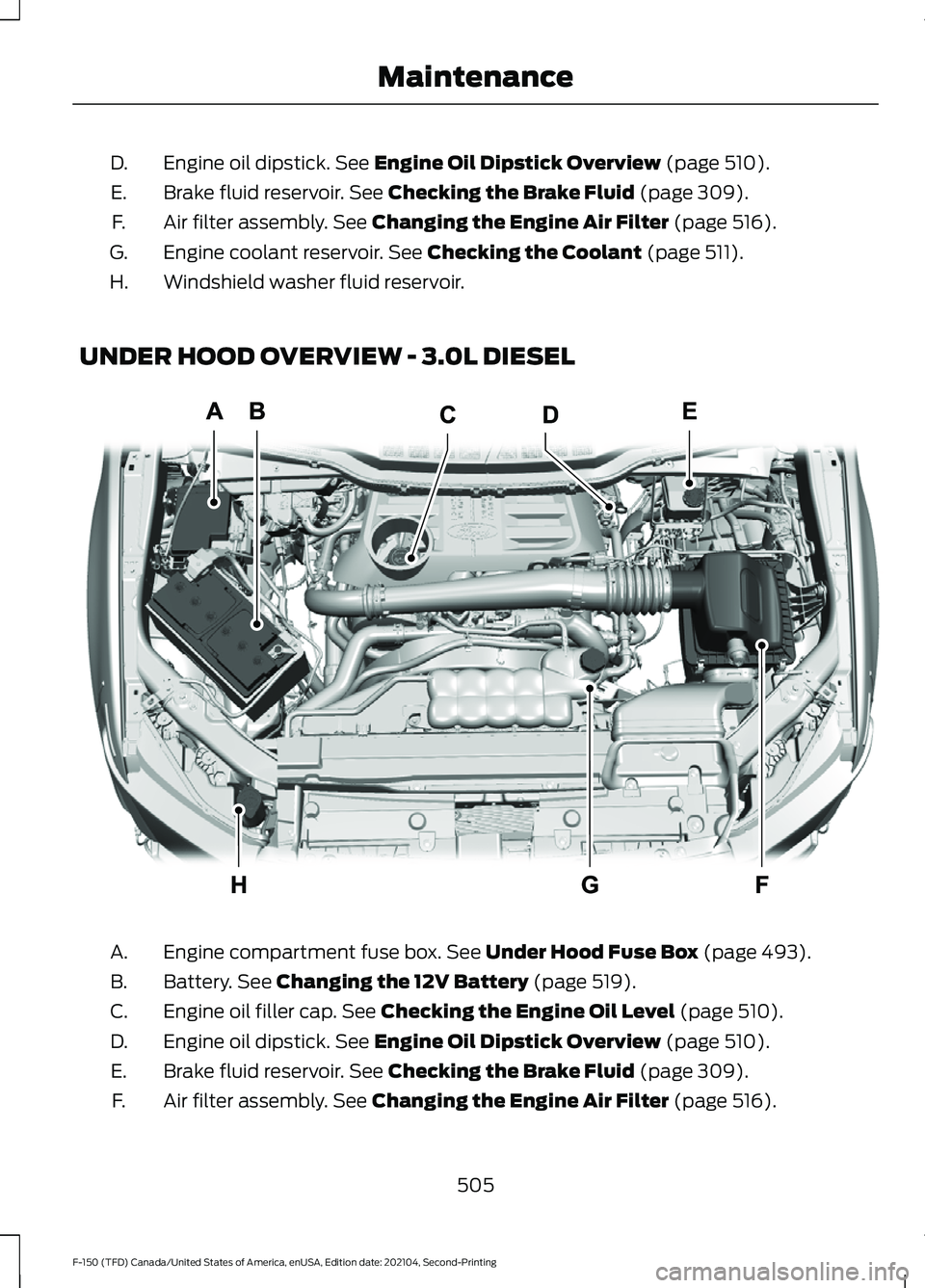
Engine oil dipstick. See Engine Oil Dipstick Overview (page 510).
D.
Brake fluid reservoir.
See Checking the Brake Fluid (page 309).
E.
Air filter assembly.
See Changing the Engine Air Filter (page 516).
F.
Engine coolant reservoir.
See Checking the Coolant (page 511).
G.
Windshield washer fluid reservoir.
H.
UNDER HOOD OVERVIEW - 3.0L DIESEL Engine compartment fuse box.
See Under Hood Fuse Box (page 493).
A.
Battery.
See Changing the 12V Battery (page 519).
B.
Engine oil filler cap.
See Checking the Engine Oil Level (page 510).
C.
Engine oil dipstick.
See Engine Oil Dipstick Overview (page 510).
D.
Brake fluid reservoir.
See Checking the Brake Fluid (page 309).
E.
Air filter assembly.
See Changing the Engine Air Filter (page 516).
F.
505
F-150 (TFD) Canada/United States of America, enUSA, Edition date: 202104, Second-Printing MaintenanceE337515
Page 510 of 796
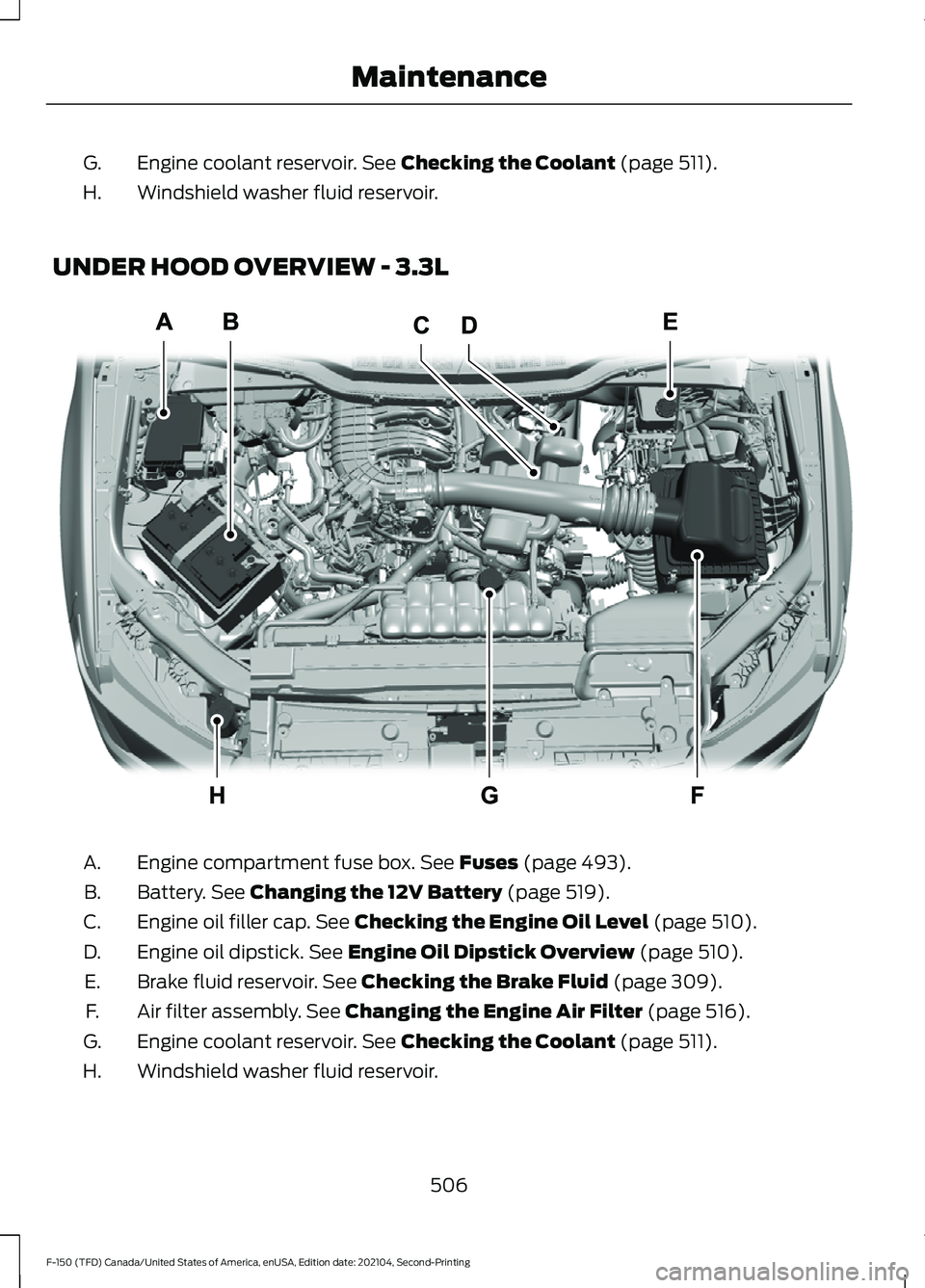
Engine coolant reservoir. See Checking the Coolant (page 511).
G.
Windshield washer fluid reservoir.
H.
UNDER HOOD OVERVIEW - 3.3L Engine compartment fuse box.
See Fuses (page 493).
A.
Battery.
See Changing the 12V Battery (page 519).
B.
Engine oil filler cap.
See Checking the Engine Oil Level (page 510).
C.
Engine oil dipstick.
See Engine Oil Dipstick Overview (page 510).
D.
Brake fluid reservoir.
See Checking the Brake Fluid (page 309).
E.
Air filter assembly.
See Changing the Engine Air Filter (page 516).
F.
Engine coolant reservoir.
See Checking the Coolant (page 511).
G.
Windshield washer fluid reservoir.
H.
506
F-150 (TFD) Canada/United States of America, enUSA, Edition date: 202104, Second-Printing MaintenanceE337514
Page 511 of 796
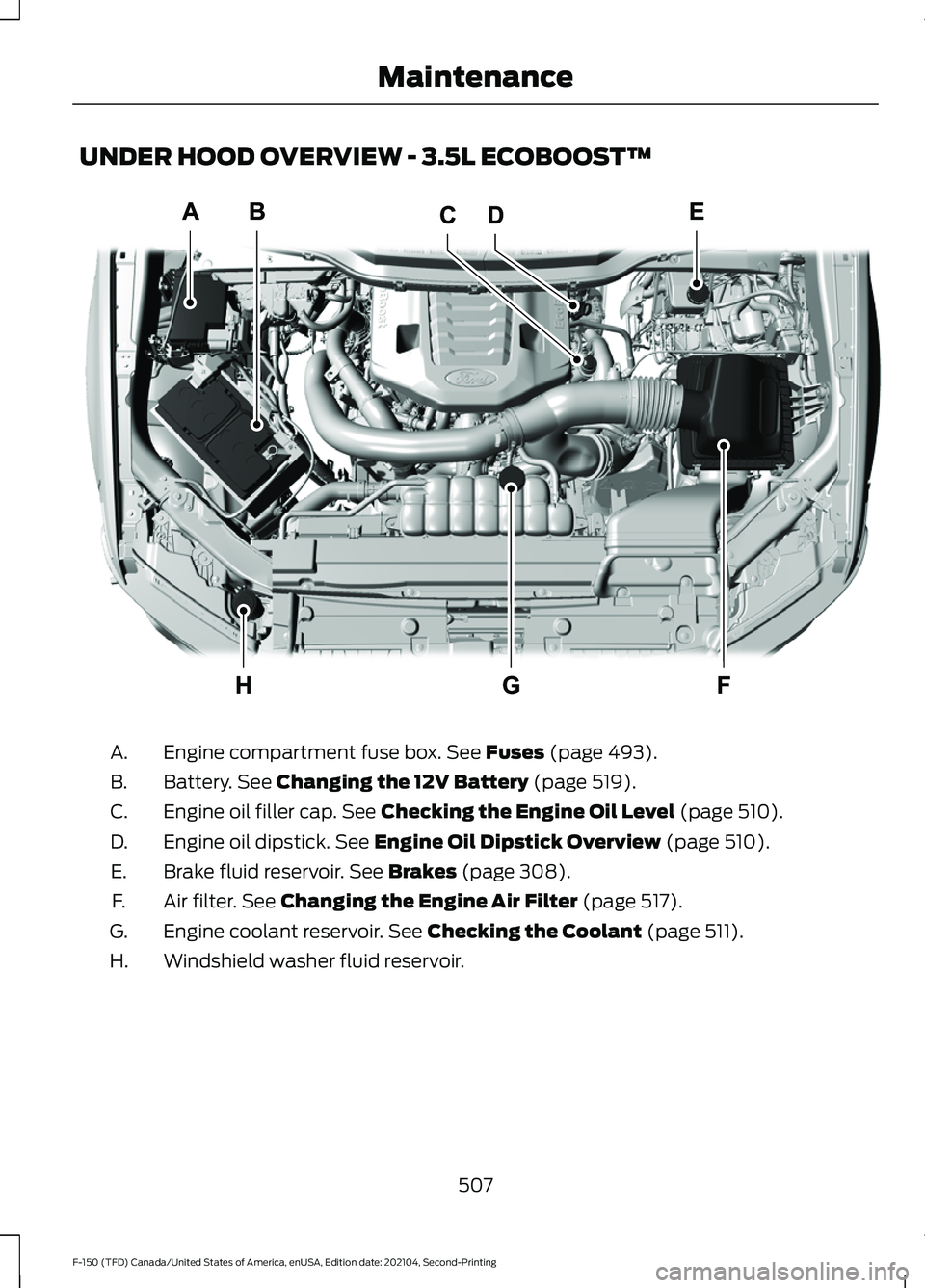
UNDER HOOD OVERVIEW - 3.5L ECOBOOST™
Engine compartment fuse box. See Fuses (page 493).
A.
Battery.
See Changing the 12V Battery (page 519).
B.
Engine oil filler cap.
See Checking the Engine Oil Level (page 510).
C.
Engine oil dipstick.
See Engine Oil Dipstick Overview (page 510).
D.
Brake fluid reservoir.
See Brakes (page 308).
E.
Air filter.
See Changing the Engine Air Filter (page 517).
F.
Engine coolant reservoir.
See Checking the Coolant (page 511).
G.
Windshield washer fluid reservoir.
H.
507
F-150 (TFD) Canada/United States of America, enUSA, Edition date: 202104, Second-Printing MaintenanceE313722
Page 512 of 796
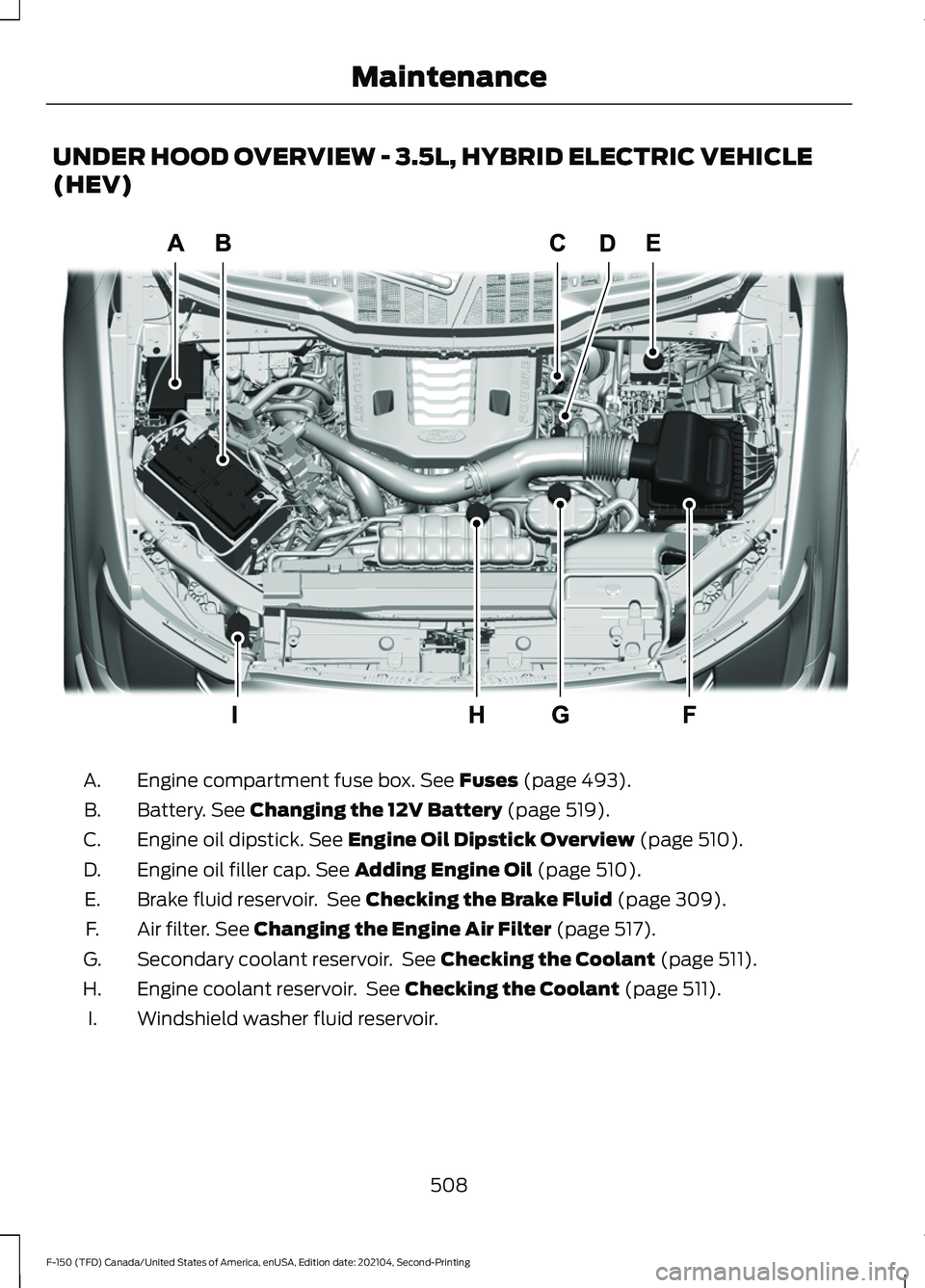
UNDER HOOD OVERVIEW - 3.5L, HYBRID ELECTRIC VEHICLE
(HEV)
Engine compartment fuse box. See Fuses (page 493).
A.
Battery.
See Changing the 12V Battery (page 519).
B.
Engine oil dipstick.
See Engine Oil Dipstick Overview (page 510).
C.
Engine oil filler cap.
See Adding Engine Oil (page 510).
D.
Brake fluid reservoir. See
Checking the Brake Fluid (page 309).
E.
Air filter.
See Changing the Engine Air Filter (page 517).
F.
Secondary coolant reservoir. See
Checking the Coolant (page 511).
G.
Engine coolant reservoir. See
Checking the Coolant (page 511).
H.
Windshield washer fluid reservoir.
I.
508
F-150 (TFD) Canada/United States of America, enUSA, Edition date: 202104, Second-Printing MaintenanceE333718