check engine FORD F650 2008 11.G Owner's Manual
[x] Cancel search | Manufacturer: FORD, Model Year: 2008, Model line: F650, Model: FORD F650 2008 11.GPages: 273, PDF Size: 1.71 MB
Page 147 of 273
4. Remove the jumper cable from the positive (+) terminal of the
disabled vehicle’s battery.
After the disabled vehicle has been started and the jumper cables
removed, allow it to idle for several minutes so the engine computer can
relearnits idle conditions.
WRECKER TOWING INSTRUCTIONS
Before moving the towed vehicle, check for adequate road clearance of
vehicle components. It is recommended the towed vehicle be unloaded
prior to being towed to reduce any abnormal load to the vehicle
components resulting from the towing procedures. Before towing, be
sure to fully release the parking brake. The spring-actuated type parking
brake can be reset by recharging the air system with at least 64 psi
(441 kPa) of air. If the brake system will not retain air pressure, then the
spring brakes must be released manually. Refer toParking brakein the
Drivingchapter
Note:For towing, make sure the vehicle is securely connected to the
tow vehicle and the tow vehicle parking brakes are applied before
releasing the disabled vehicle’s spring brakes.
To reduce the risk of personal injury or property damage when
manually releasing the spring brakes, be sure to block the wheels
so the vehicle cannot move once the brakes are released.
Towing the vehicle with the front wheels suspended
When it is necessary to tow a vehicle with the front wheels suspended,
extra precautions must be taken to avoid transmission or differential
damage. Proceed as follows:
•Remove the axle shafts from the axle assembly to prevent the wheels
from driving the differential and the transmission.
•The wheel hub ends must be covered to prevent loss of axle lubricant
and entrance of other contaminants. If the axle shafts are not
removed, removal of the driveshaft is required.
+–+–
2008 F-650/750(f67)
Supplement
USA(fus)
Roadside Emergencies
146
Page 161 of 273
GENERAL SERVICING GUIDELINES AND PRECAUTIONS
As with any machine, care should be taken to avoid being injured when
performing maintenance, repairs or system checks. Improper or
incomplete service could result in the vehicle not working properly
which, in turn, may result in personal injury or damage to the vehicle or
equipment. It is the operator’s responsibility to see that the vehicle
receives proper care and maintenance. If you have any questions about
performing some service, have the service done by a qualified technician.
Servicing guidelines
When servicing your vehicle, always:
•turn off the ignition unless the particular procedure calls for the
engine to be running.
•set the parking brake or chock the wheels.
•use support stands, not a jack, whenever you must be under a raised
vehicle.
•do not smoke.
•wear safety glasses for eye protection.
•operate the engine in a well-ventilated area
•do not work on the brakes or the clutch unless the proper precautions
are taken to avoid inhaling friction material dust.
•do not wear loose-fitting clothing, hanging jewelry, watches or rings.
•avoid contact with hot metal parts. Allow the hot components to cool
before working with, or around them.
Quality service parts are available through your dealer. If dealer parts are
not used, the owner must make sure that the parts that are being used
are equivalent quality to dealer parts.
The use of inferior parts can adversely affect the quality and
reliability of your vehicle which, in turn, can result in property
damage, personal injury or death.
Note:To avoid damage to the vehicle’s electrical components, disconnect
the positive (+) and negative (-) battery cables prior to electric welding.
Attach the welder ground cable as close as possible to the part being
welded. If it is necessary to weld close to an electrical component, it is
recommended that the electronic component be temporarily removed.
Follow the periodic lubrication procedures and regular inspection
intervals as outlined. Have your dealer or service center inspect your
2008 F-650/750(f67)
Supplement
USA(fus)
Maintenance and Specifications
160
Page 166 of 273
Air brakes - air dryer
Performance of desiccant or after-cooler type air dryers is dependent on
climatic conditions in which your vehicle is operating. Maintenance
schedules must be established for each specific operation.
The use of an air dryer on a vehicle does not eliminate the need to
periodically drain the air reservoirs.
Air brakes - desiccant air dryer
Inspect for moisture in the air system by opening reservoirs, drain cocks
or valves and checking for presence of water. The presence of small
amounts of water due to condensation is normal and should not be
considered as an indication that the dryer is not functioning properly.
The desiccant cartridge should be replaced or rebuilt when it has been
determined that the desiccant is contaminated and does not have
adequate water absorption capacity. The desiccant change interval may
vary; it is generally recommended that the desiccant be replaced every
12 months (yearly). If experience has shown that extended or shortened
life has resulted for a particular installation, then the yearly interval can
be increased or decreased accordingly.
Hydraulic brakes - inspection and adjustment
A regular schedule for periodic cleaning, lubrication, adjustment and
inspection should be established based on the type of vehicle operation.
It is difficult to predetermine an exact maintenance interval (time or
mileage), since vehicles will be used in a wide variety of applications and
conditions. If you are uncertain of the proper schedule and procedures
for your vehicle, contact your dealer.
Inspect the brake lining every maintenance interval. Establish inspection
intervals that provide for lining replacement before damage to the disc
occurs. Excessive lining wear may expose the backing plate to the disc
causing scoring of the disc faces.
This inspection should be performed by a qualified technician and must
be in accordance with instructions provided by the service manual.
Note:Hydraulic brake system are power assisted. Braking capabilities
will be greatly reduced without engine assist.
Hydraulic brakes - fluid level
Fluid level should be at the bottom edge of the ring on each reservoir fill
port. Do not fill the master cylinder to the top of the reservoir.
2008 F-650/750(f67)
Supplement
USA(fus)
Maintenance and Specifications
165
Page 167 of 273
Note:If brake fluid requires attention to maintain a proper master
cylinder level, this is an indication of either severe operation (pad wear)
or fluid system leakage. A more frequent and thorough brake inspection
will be required.
Hydraulic brakes - fluid precautions
The HydroMax brake system consists of two completely separate
hydraulic systems operating with two different and incompatible fluids;
power steering fluid and hydraulic brake fluid. Failure to observe
precautions preventing the contamination of either system with fluid
from the other will result in swelling and deterioration of rubber parts
leading to reduced brake performance and eventual brake failure.
To avoid fluid contamination, the following should always be observed:
1. Use only fluids specified (or equivalent) and properly identified.
2. Add fluids only to the following locations:
•Power steering fluid to the power steering fluid pump reservoir
•Brake fluid to the brake master cylinder
Hydraulic brakes - brake lines, hoses and fittings
Inspect these components every 4,000 miles (6,400 km).
•Check lines for kinks, dents, corrosion or rupture.
•Check hoses for abrasions, kinks, soft spots or rupture, collapse,
cracks, twists or loose frame supports. When replacing a hose, be sure
there is adequate clearance to the hose to avoid an abrasion to the
new hose.
•Examine all connections for leaks.
•Repair or replace brake line tubes, hoses or fittings as required.
Driveline parking brake
Parking brake adjustment should only be performed by a qualified
technician, and in accordance with the instructions in the service
manual.
Use wheel chocks and exercise caution when inspecting under
the vehicle. A vehicle roll-away could result in property damage,
personal injury or death.
Catalytic converter
If your diesel engine is equipped with a catalytic converter, it is
important to review the maintenance schedule to ensure proper
2008 F-650/750(f67)
Supplement
USA(fus)
Maintenance and Specifications
166
Page 168 of 273
functioning of the catalytic converter. Also, take precautions not to
damage the catalytic converter when servicing your engine or storing
your vehicle.
Note:If your vehicle is equipped with a catalytic converter/muffler,do
notblend waste oil with Diesel fuel. Operate only on ultra low sulfur
(less than 15 parts per million sulfur) diesel fuel with a cetane value of
45 or higher.
Air induction system
Once each year, perform a complete inspection of the air induction
system. In areas where road salt is used, the inspection consists of
disassembling the joints of each aluminum component and inspecting for
salt build-up, presence of chlorine that can cause aluminum particles to
flake off and enter the engine combustion chambers.
If evidence of corrosion is found (usually at the pipe connections), use a
wire brush to clean the inside of the pipes and inside the rubber hoses.
If the intake pipes are pitted at the joint ends, use Motorcraft Silicone
Gasket and Sealant TA-30 to seal the joints. Be certain that no excess
material is on the inside of the pipes that can be pulled into the engine.
If the service condition of the pipes, hoses or clamps is questionable,
replace the defective part(s).
Be sure that prior to reassembly all dust and debris has been cleaned out
of the pipes and couplings with a clean, damp rag.
When performing maintenance to any turbocharged engine with
engine air inlet piping disconnected, keep loose clothing, jewelry
and long hair away from the engine air inlet piping. A turbocharger
compressor air inlet protective shield should be installed over the
turbocharger air inlet to reduce the risk of personal injury or death.
Steering - general inspection
•Ask your service technician to examine the steering mechanism. Only
minor adjustments may be necessary.
•Check tie rod, drag link end clamp bolts and ball joints. They must be
tight.
•Check for installation and spread of cotter pins and tightness of nuts
at both ends of the tie rod and drag link.
•Check that pitman arm (steering arm at steering gear) mounting is
tight and locked. Check system for leaks or hose chafing. Repair at
once.
2008 F-650/750(f67)
Supplement
USA(fus)
Maintenance and Specifications
167
Page 169 of 273
•Maintain proper steering gear and power steering pump lubricant
levels.
•Regularly inspect steering column joint bolts and steering linkage,
particularly for body-to-chassis clearance.
Note:Have any steering problems corrected at once by a qualified
service technician.
Failure to maintain the steering system in proper condition can
cause reduced steering ability resulting in property damage,
personal injury or death.
Tightening steering column joint bolts
As a good maintenance practice, it is recommended that steering column
joint bolts be checked for tightness every 60,000 miles (96,000 km) or
annually, whichever occurs first. DO NOT OVERTIGHTEN.
Power steering
Whenever the power steering’s hydraulic system has been drained and
refilled for any reason, air must be bled from the system before returning
the vehicle to service. Failure to properly bleed the hydraulic system can
result in degradation of power system performance.
Consult your dealer who is aware of the proper procedures for filling and
bleeding the system.
OPENING THE HOOD
The hood and fenders are held in position by a latch located on each
fender.
The parking brake must be fully set before opening the hood or
possible personal injury may occur.
To reduce the risk of the possibility of personal injury, never
stand beneath the hood when it is being raised or lowered.
If you must leave the engine running while checking under the
hood, do not allow any loose clothing, jewelry, hair or other
items to get near moving engine components or possible personal
injury may occur.
2008 F-650/750(f67)
Supplement
USA(fus)
Maintenance and Specifications
168
Page 172 of 273
CHANGING THE WIPER BLADES
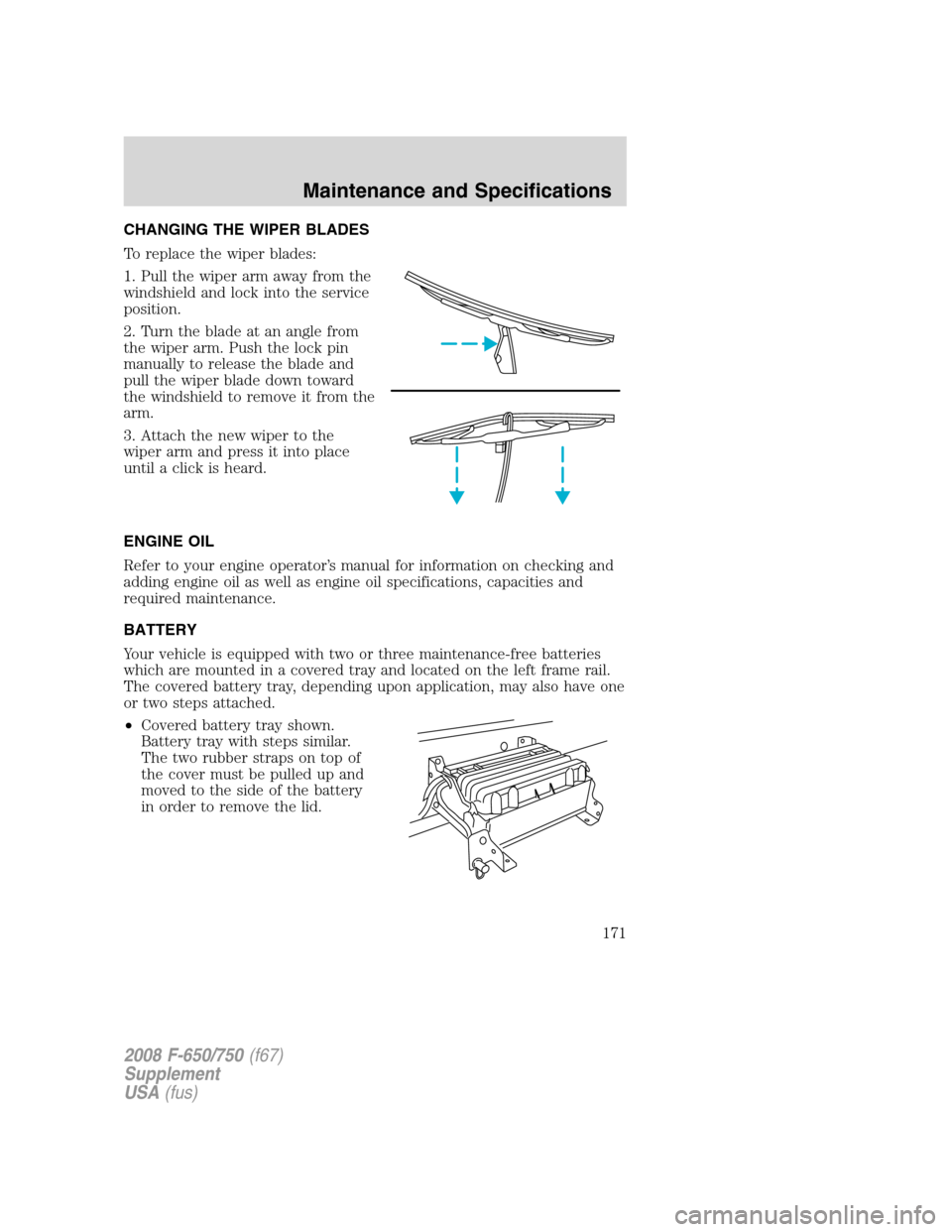
To replace the wiper blades:
1. Pull the wiper arm away from the
windshield and lock into the service
position.
2. Turn the blade at an angle from
the wiper arm. Push the lock pin
manually to release the blade and
pull the wiper blade down toward
the windshield to remove it from the
arm.
3. Attach the new wiper to the
wiper arm and press it into place
until a click is heard.
ENGINE OIL
Refer to your engine operator’s manual for information on checking and
adding engine oil as well as engine oil specifications, capacities and
required maintenance.
BATTERY
Your vehicle is equipped with two or three maintenance-free batteries
which are mounted in a covered tray and located on the left frame rail.
The covered battery tray, depending upon application, may also have one
or two steps attached.
•Covered battery tray shown.
Battery tray with steps similar.
The two rubber straps on top of
the cover must be pulled up and
moved to the side of the battery
in order to remove the lid.
2008 F-650/750(f67)
Supplement
USA(fus)
Maintenance and Specifications
171
Page 173 of 273
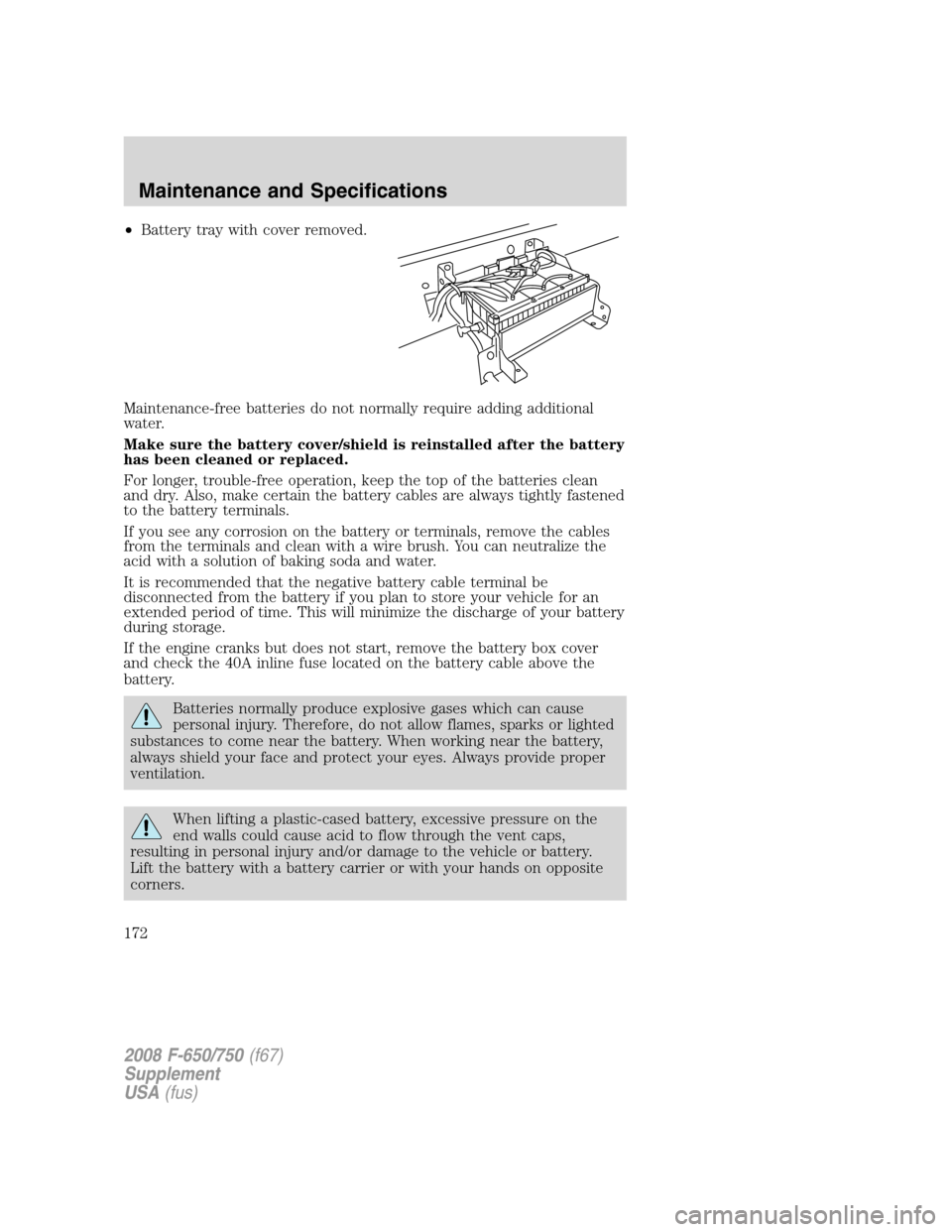
•Battery tray with cover removed.
Maintenance-free batteries do not normally require adding additional
water.
Make sure the battery cover/shield is reinstalled after the battery
has been cleaned or replaced.
For longer, trouble-free operation, keep the top of the batteries clean
and dry. Also, make certain the battery cables are always tightly fastened
to the battery terminals.
If you see any corrosion on the battery or terminals, remove the cables
from the terminals and clean with a wire brush. You can neutralize the
acid with a solution of baking soda and water.
It is recommended that the negative battery cable terminal be
disconnected from the battery if you plan to store your vehicle for an
extended period of time. This will minimize the discharge of your battery
during storage.
If the engine cranks but does not start, remove the battery box cover
and check the 40A inline fuse located on the battery cable above the
battery.
Batteries normally produce explosive gases which can cause
personal injury. Therefore, do not allow flames, sparks or lighted
substances to come near the battery. When working near the battery,
always shield your face and protect your eyes. Always provide proper
ventilation.
When lifting a plastic-cased battery, excessive pressure on the
end walls could cause acid to flow through the vent caps,
resulting in personal injury and/or damage to the vehicle or battery.
Lift the battery with a battery carrier or with your hands on opposite
corners.
2008 F-650/750(f67)
Supplement
USA(fus)
Maintenance and Specifications
172
Page 174 of 273
Keep batteries out of reach of children. Batteries contain sulfuric
acid. Avoid contact with skin, eyes or clothing. Shield your eyes
when working near the battery to protect against possible splashing of
acid solution. In case of acid contact with skin or eyes, flush
immediately with water for a minimum of 15 minutes and get prompt
medical attention. If acid is swallowed, call a physician immediately.
Battery posts, terminals and related accessories contain lead and
lead compounds.Wash hands after handling.
Always dispose of automotive
batteries in a responsible manner.
Follow your local authorized
standards for disposal. Call your
local authorized recycling center to
find out more about recycling
automotive batteries.
ENGINE COOLANT
Refer to your engine operator’s manual for engine coolant checking and
adding instructions as well as engine coolant specifications and
capacities.
Severe climates
If you drive in extremely cold climates (less than –34°F [–36°C]):
•It may be necessary to increase the coolant concentration
above 50%.
•NEVER increase the coolant concentration above 60%.
•Engine coolant concentrations above 60% will decrease the
overheat protection characteristics of the engine coolant and
may cause engine damage.
•If available, refer to the chart on the coolant container to
ensure the coolant concentration in your vehicle will provide
adequate freeze protection at the temperatures in which you
drive in the winter months.
L
E
A
D
RETURN
RECYCLE
2008 F-650/750(f67)
Supplement
USA(fus)
Maintenance and Specifications
173
Page 186 of 273
The exhaust outlet assembly on your vehicle is a uniquely functioning
device that accompanies the DPF assembly. It is designed to help control
the temperature of the exhaust during the DPF regeneration process.Do
not modify or remove this device. Modification of the system
and/or additions of aftermarket devices can reduce the
effectiveness of the system, as well as cause damage to the
exhaust system and/or engine. Any modifications may also
invalidate the vehicle and/or engine warranties. See the vehicle
and engine warranty guides for more information.
The inlet holes in the side of the assembly are functional. These holes
allow outside air to be drawn into the outlet assembly. The holes need to
be kept clear of mud and other foreign material to maintain proper
functionality of the system. One way to keep the holes clear is to spray
the outlet assembly with a hose when washing the vehicle. Failure to
keep the functional holes clear of foreign material may result in the holes
becoming blocked or plugged.Blocked/plugged holes or
modification/removal of the outlet assembly could result in
elevated exhaust temperatures which may result in
vehicle/property damage and/or personal injury.
NOISE EMISSIONS – EXTERIOR
In order to comply with the federal exterior noise regulations, your
vehicle may be equipped with noise emission items. Depending on the
vehicle configuration, it may have all or some of the following items:
Air Intake System
•Air Cleaner:should be inspected and its location should not be
altered. Do not alter inlet and outlet piping.
Body
•Wheel Well:splash shields, cab shields and under-hood insulation
should be inspected for deterioration, dislocation, and orientation.
Cooling System
•Check the fan for damage to blades; replace, if damaged, with the
recommended parts. Inspect for fan to shroud interference, and any
damage to shroud such as cracks and holes.
•The fan ratio should not be changed and the fan spacer dimensions
and positions should not be altered.
•Inspect the fan clutch for proper operation, make sure that the fan is
disengaged when cooling of the engine is not required.
2008 F-650/750(f67)
Supplement
USA(fus)
Maintenance and Specifications
185