lock FORD F650 2013 12.G Repair Manual
[x] Cancel search | Manufacturer: FORD, Model Year: 2013, Model line: F650, Model: FORD F650 2013 12.GPages: 378, PDF Size: 3.82 MB
Page 203 of 378
Relay
LocationRelay Description
R19 Shift interlock/EPRNDL display
R20 Selective Catalyst Reduction (SCR) system (NOx) (diesel
engine only)
R21 Run
R22 Door unlock
R23 ABS warning indicator
R24 DRL #2
R25 Park lights
R26 Spare
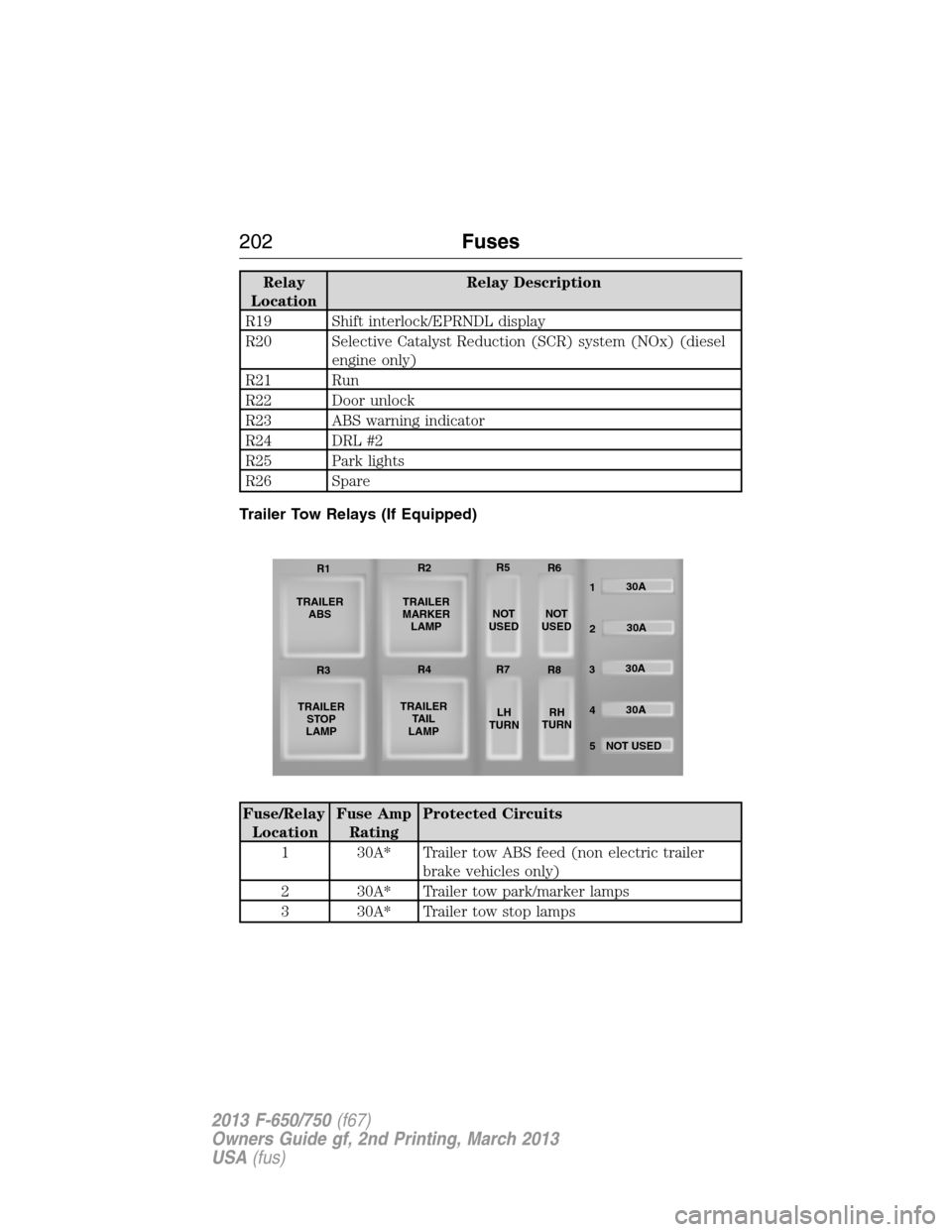
Trailer Tow Relays (If Equipped)
Fuse/Relay
LocationFuse Amp
RatingProtected Circuits
1 30A* Trailer tow ABS feed (non electric trailer
brake vehicles only)
2 30A* Trailer tow park/marker lamps
3 30A* Trailer tow stop lamps
TRAILER
ABS
TRAILER
STOP
LAMPTRAILER
MARKER
LAMP
TRAILER
TA I L
LAMPNOT
USEDNOT
USED
LH
TURNRH
TURN30A
30A
30A
30A
NOT USED
5 4 32 1 R1R2R5
R6
R3R4R7
R8
202Fuses
2013 F-650/750(f67)
Owners Guide gf, 2nd Printing, March 2013
USA(fus)
Page 208 of 378
Special applications may warrant a setting based on experience with the
type of tire operating loads and conditions. Radial tires are more
sensitive to toe-in setting than bias ply tires. While not insensitive to
vehicle alignment, fine tuning school bus alignment to line-haul truck
standards does not drastically improve tire tread life.
Rear Axle
Regular inspections should include:
•checking for proper tightness of axle mounting U-bolt nuts, attaching
or mounting bolts and nuts. SeeSpring U-bolt checkslater in this
chapter.
•checking the axle for damage, binding, worn parts and adequate
lubrication.
NoSpin Detroit Locker Positive Locking Differential
Vehicles equipped with this type differential have the operator’s manual
supplied with the vehicle. See that manual for maintenance inspections.
Maintenance207
2013 F-650/750(f67)
Owners Guide gf, 2nd Printing, March 2013
USA(fus)
Page 210 of 378
Air Brakes
WARNING:Do not manually adjust the automatic slack adjusters
to correct excessive push rod stroke as it may result in reduced
brake effectiveness and a vehicle crash. Excessive push rod stroke
indicates that a problem exists with the automatic adjuster, with the
installation of the adjuster, or with foundation brake components that
manual adjustment does not remedy. Seek service from a qualified
facility for excessive push rod stroke.
Inspection and adjustment:Establish a regular schedule for periodic
cleaning, lubrication and adjustment inspection based on vehicle use.
Exact maintenance intervals are difficult to predetermine since vehicles
are used in a wide variety of applications and conditions. If you are
uncertain of the proper schedule for your vehicle, contact your dealer.
Regular inspections should include:
•periodic checking (every service interval) of push rod travel or brake
adjustment. This is essential for effective braking. Brake chamber
push rods on original equipment chambers now incorporate an orange
paint marker near the base of the push rod as a stroke indicator to
aid in adjustment checks. If the push rod is clean and the brakes are
out of adjustment, the orange marker can be seen protruding from
the chamber when the brakes are applied.
•checking the brake lining (every service interval). When brake lining
or blocks are worn to within 1/16th inch (1.6 millimeters) of rivets,
replace the brake linings. This inspection or adjustment should only
be performed by a qualified technician and must be in accordance
with instructions provided by the service manual.
Do not back off or disconnect the front brakes so that they are less
effective, letting the rear brakes do all the stopping of the vehicle. Do
not overlook the brakes on the trailer either. Brake condition on the
trailer is just as important as the tractor. Proper brake balance on trucks
and tractor-trailers is essential for effective braking.
Once a year, the entire brake system must be inspected:
•Rubber components for deterioration. These components should be
inspected by a qualified technician and replaced as necessary.
Replacement intervals vary according to the severity and length of
vehicle service.
•Condition of brake drums, brake chambers and slack adjusters.
•System for air leaks.
•Hose or pipes for rust, damage and deterioration.
•Operation of service and parking brakes.
Maintenance209
2013 F-650/750(f67)
Owners Guide gf, 2nd Printing, March 2013
USA(fus)
Page 213 of 378
Steering System
WARNING:Failure to maintain the steering system in proper
condition can cause reduced steering ability resulting in property
damage, personal injury or death.
Note:Have any steering problems immediately corrected by a qualified
service technician.
Ask your service technician to examine the steering mechanism. Only
minor adjustments may be necessary. Regular inspections should include:
•checking the tie rod, drag link end clamp bolts and ball joints for
proper tightness.
•checking for installation and spread of cotter pins and tightness of
nuts at both ends of the tie rod and drag link.
•checking that the pitman arm (steering arm at steering gear)
mounting is tight and locked. Check system for leaks or hose chafing.
Repair immediately, if necessary.
•maintaining proper steering gear and power steering pump lubricant
levels.
•checking steering column joint bolts and steering linkage, particularly
for body-to-chassis clearance.
Steering Column Joint Bolts
As a good maintenance practice, it is recommended that steering column
joint bolts be checked for tightness every 60000 miles (96000 kilometers)
or annually, whichever occurs first. DO NOT OVERTIGHTEN.
Hydraulic System
Whenever the power steering’s hydraulic system has been drained and
refilled for any reason, air must be bled from the system before returning
the vehicle to service. Failure to properly bleed the hydraulic system can
result in degradation of power system performance.
Consult your dealer who is aware of the proper procedures for filling and
bleeding the system.
212Maintenance
2013 F-650/750(f67)
Owners Guide gf, 2nd Printing, March 2013
USA(fus)
Page 215 of 378
Chassis-mounted Charge Air Cooler
Visually inspect the core assembly for debris and clogging of external fins
with the engine off. Prior to engine operation, remove any debris
blocking the core.
•Turbocharger-to-charge air cooler
•Charge air cooler-to-intake manifold pipe
•Mounting bracket
•Chassis-mounted charge air cooler core
Inspect air intake piping:
•Check for accumulation of salt deposits (where applicable).
If present, disassemble and clean the complete air intake piping
system. If the intake piping is pitted, use Motorcraft® Silicone Gasket
and Sealant TA-30 to seal joints against leakage.
•Check for loose hoses and clamps.
•Check for ruptured or collapsed hoses.
•Check air cleaner housing for cracks.
Suspension Inspection
Note:Do not adjust air suspension height to any setting other than the
specified setting. Altering the height setting changes the driveline angle
and may result in unwarrantable component damage, such as
transmission component damage.
Verify drive axle air suspension height and height control valve
performance at engine oil change intervals.
Periodically check:
•Condition of spring leaves for evidence of fatigue, bending or
breakage.
•Condition of suspension mounting brackets and bushings.
•Torque rod mounting fasteners for tightness.
•For proper suspension alignment. This must be maintained at all
times.
•U-bolts. After the chassis has been operating under load for
1000 miles (1600 kilometers) or six months (whichever comes first),
the U-bolt nuts must be re-torqued. The U-bolt nuts must be
re-torqued every 36000 miles (60000 kilometers) thereafter. The
U-bolt and nut threads and seats should be cleaned and lubricated to
make sure a like new condition when re-torquing.
Note:SeeSpring U-bolt checklater in this chapter.
214Maintenance
2013 F-650/750(f67)
Owners Guide gf, 2nd Printing, March 2013
USA(fus)
Page 216 of 378
Supporting Your Vehicle for Service
WARNING:Do not use a jack when working under a vehicle. It
may give way, causing the vehicle to fall and result in property
damage, personal injury or death. Always use floor stands to support
the vehicle.
Prepare the vehicle for service repairs by doing the following:
1. Park the vehicle on a level, concrete floor.
2. Set the parking brake and block the wheels to prevent the vehicle
from moving.
3. Select a jack with a rated capacity sufficient to lift and hold up the
vehicle.
4. Raise the vehicle with the jack applied to the axle(s). DO NOT use
the bumper as a lifting point.
5. Support the vehicle with floor stands under the axle(s). If the axle or
the suspension is being serviced, support the vehicle with floor
stands under the frame side-members, preferably between the axles.
Frame and Tow Hooks
Your vehicle’s chassis is manufactured with frame rails of either HSLA
steel or heat-treated steel. Each must be handled in a specific manner to
make sure maximum service life. Consult the service manual or your
dealer before attempting frame repair or modification.
It is important, particularly on vehicles where the tow hooks are used
frequently, to inspect the front and rear tow hooks for damage or a loose
mounting.
OPENING AND CLOSING THE HOOD
WARNING:The parking brake must be fully set before opening
the hood or possible personal injury may occur.
WARNING:To reduce the risk of the possibility of personal
injury, never stand beneath the hood when it is being raised or
lowered.
WARNING:If you must leave the engine running while checking
under the hood, do not allow any loose clothing, jewelry, hair or
other items to get near moving engine components or possible personal
injury may occur.
Maintenance215
2013 F-650/750(f67)
Owners Guide gf, 2nd Printing, March 2013
USA(fus)
Page 218 of 378
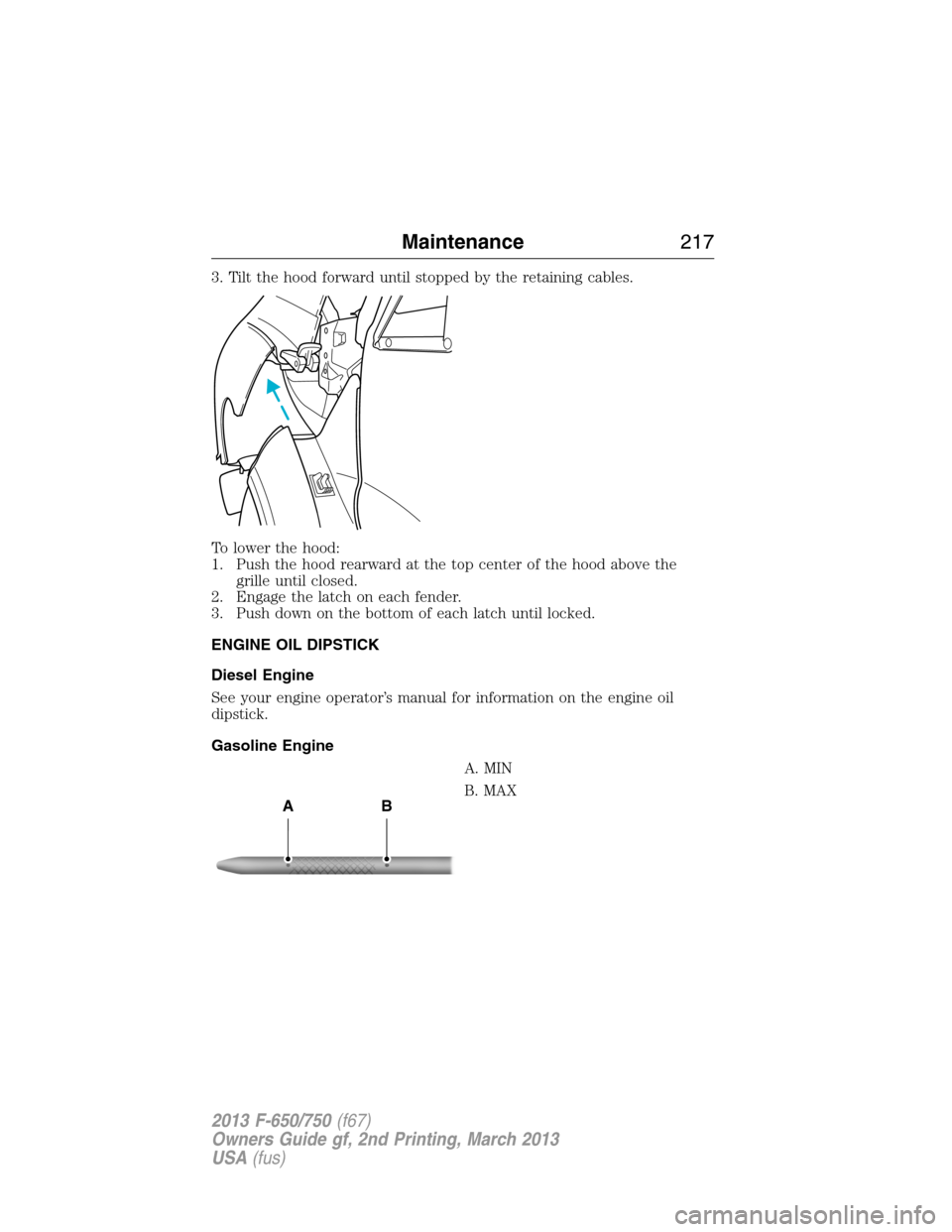
3. Tilt the hood forward until stopped by the retaining cables.
To lower the hood:
1. Push the hood rearward at the top center of the hood above the
grille until closed.
2. Engage the latch on each fender.
3. Push down on the bottom of each latch until locked.
ENGINE OIL DIPSTICK
Diesel Engine
See your engine operator’s manual for information on the engine oil
dipstick.
Gasoline Engine
A. MIN
B. MAX
AB
Maintenance217
2013 F-650/750(f67)
Owners Guide gf, 2nd Printing, March 2013
USA(fus)
Page 220 of 378
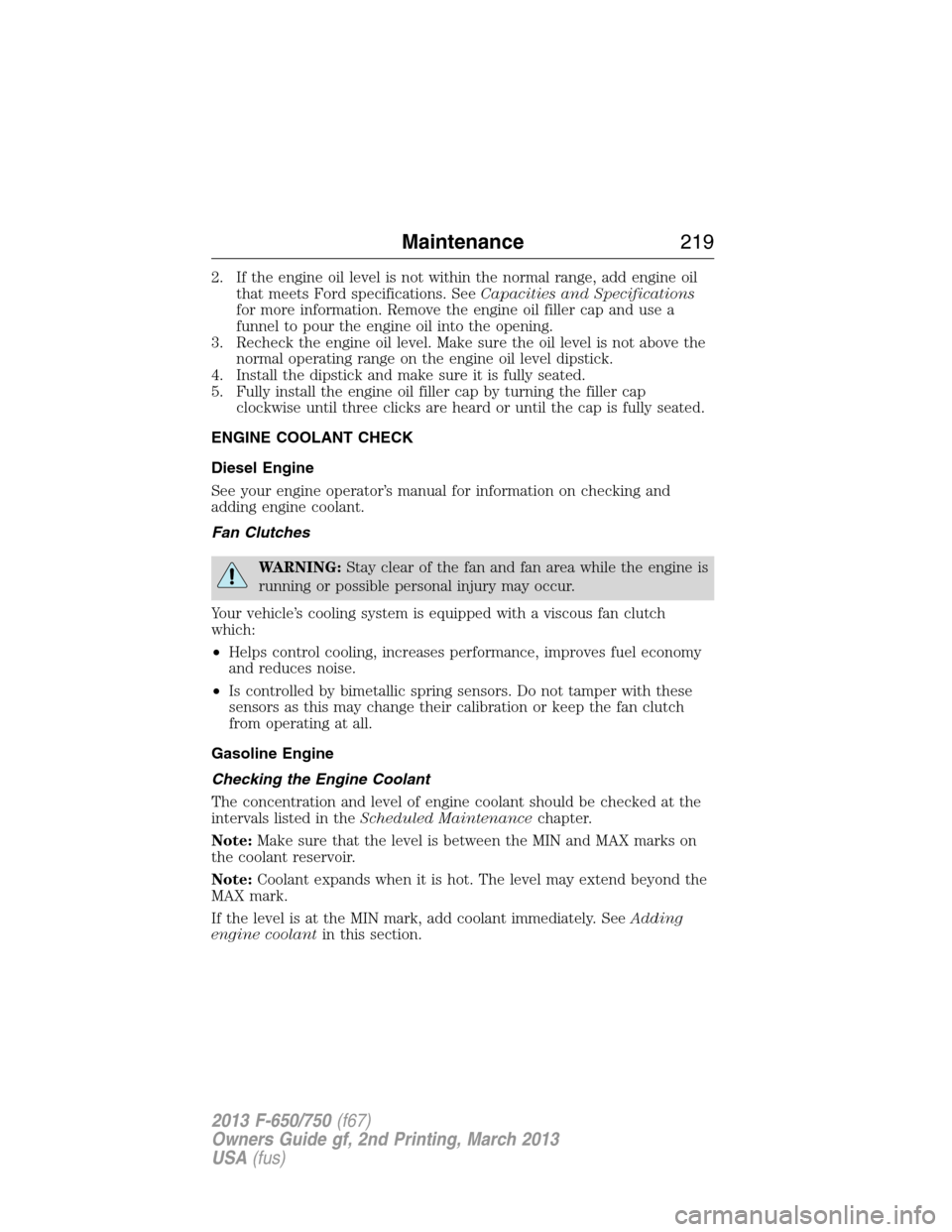
2. If the engine oil level is not within the normal range, add engine oil
that meets Ford specifications. SeeCapacities and Specifications
for more information. Remove the engine oil filler cap and use a
funnel to pour the engine oil into the opening.
3. Recheck the engine oil level. Make sure the oil level is not above the
normal operating range on the engine oil level dipstick.
4. Install the dipstick and make sure it is fully seated.
5. Fully install the engine oil filler cap by turning the filler cap
clockwise until three clicks are heard or until the cap is fully seated.
ENGINE COOLANT CHECK
Diesel Engine
See your engine operator’s manual for information on checking and
adding engine coolant.
Fan Clutches
WARNING:Stay clear of the fan and fan area while the engine is
running or possible personal injury may occur.
Your vehicle’s cooling system is equipped with a viscous fan clutch
which:
•Helps control cooling, increases performance, improves fuel economy
and reduces noise.
•Is controlled by bimetallic spring sensors. Do not tamper with these
sensors as this may change their calibration or keep the fan clutch
from operating at all.
Gasoline Engine
Checking the Engine Coolant
The concentration and level of engine coolant should be checked at the
intervals listed in theScheduled Maintenancechapter.
Note:Make sure that the level is between the MIN and MAX marks on
the coolant reservoir.
Note:Coolant expands when it is hot. The level may extend beyond the
MAX mark.
If the level is at the MIN mark, add coolant immediately. SeeAdding
engine coolantin this section.
Maintenance219
2013 F-650/750(f67)
Owners Guide gf, 2nd Printing, March 2013
USA(fus)
Page 236 of 378
6. Release the parking brake. With your foot on the brake pedal and
with the A/C on, put the vehicle in positionP(automatic
transmission) or neutral (manual transmission) and allow the engine
to idle for at least one minute.Note:If you do not allow the engine
to relearn its idle trim, the idle quality of your vehicle may be
adversely affected until the idle trim is eventually relearned.
7. Drive the vehicle to complete the relearning process.
If the battery has been disconnected or a new battery has been installed,
the clock and radio settings must be reset once the battery is
reconnected.
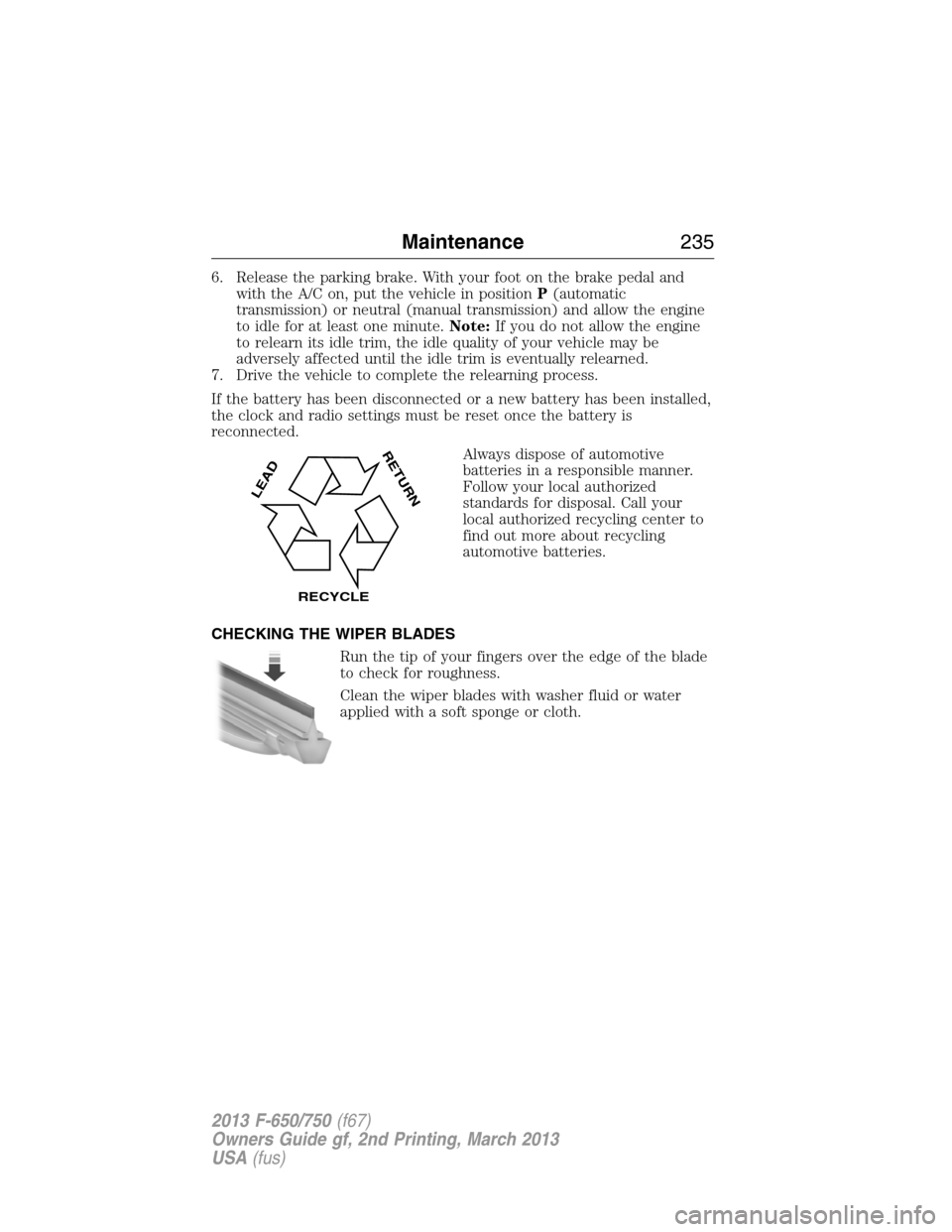
Always dispose of automotive
batteries in a responsible manner.
Follow your local authorized
standards for disposal. Call your
local authorized recycling center to
find out more about recycling
automotive batteries.
CHECKING THE WIPER BLADES
Run the tip of your fingers over the edge of the blade
to check for roughness.
Clean the wiper blades with washer fluid or water
applied with a soft sponge or cloth.
L
E
A
D
RETURN
RECYCLE
Maintenance235
2013 F-650/750(f67)
Owners Guide gf, 2nd Printing, March 2013
USA(fus)
Page 237 of 378
CHANGING THE WIPER BLADES
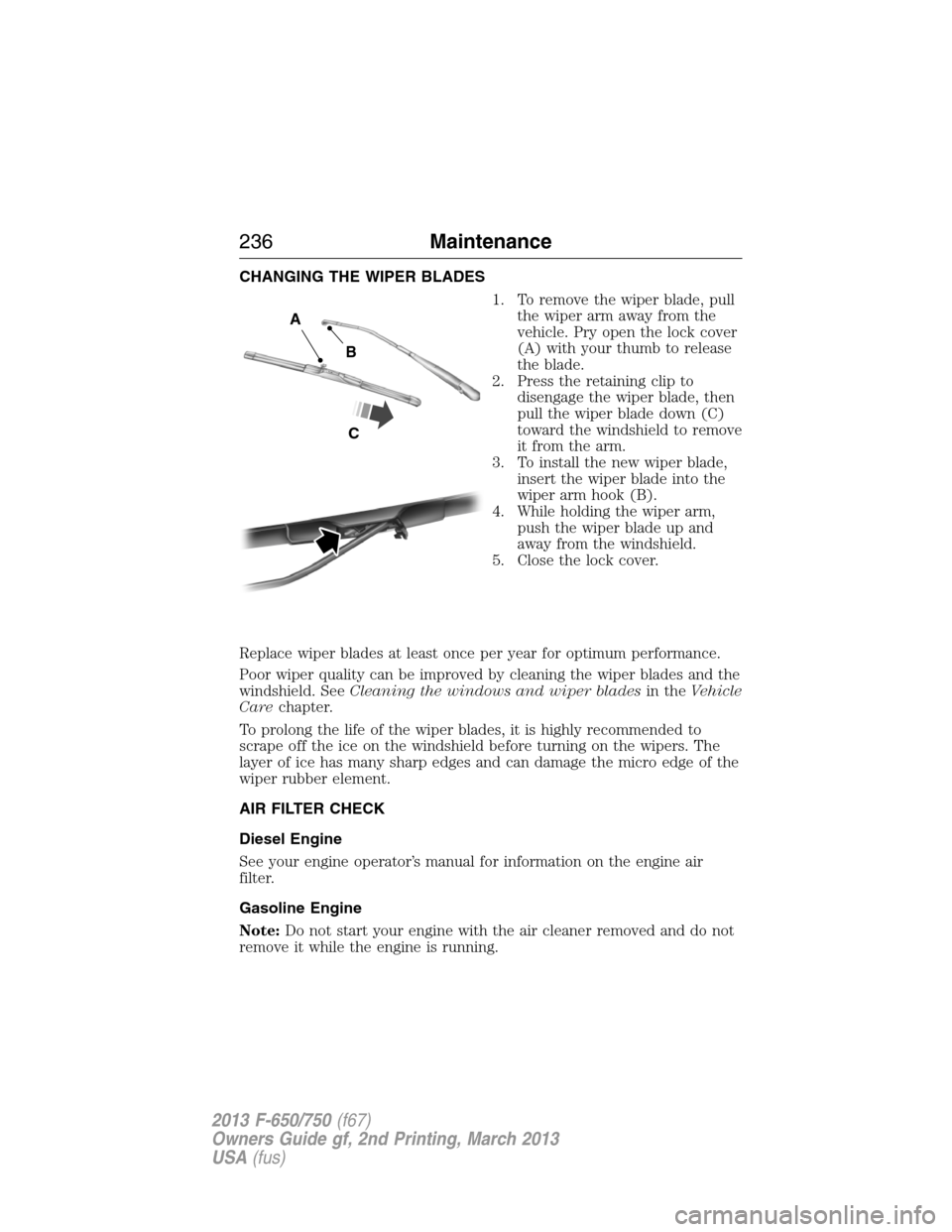
1. To remove the wiper blade, pull
the wiper arm away from the
vehicle. Pry open the lock cover
(A) with your thumb to release
the blade.
2. Press the retaining clip to
disengage the wiper blade, then
pull the wiper blade down (C)
toward the windshield to remove
it from the arm.
3. To install the new wiper blade,
insert the wiper blade into the
wiper arm hook (B).
4. While holding the wiper arm,
push the wiper blade up and
away from the windshield.
5. Close the lock cover.
Replace wiper blades at least once per year for optimum performance.
Poor wiper quality can be improved by cleaning the wiper blades and the
windshield. SeeCleaning the windows and wiper bladesin theVehicle
Carechapter.
To prolong the life of the wiper blades, it is highly recommended to
scrape off the ice on the windshield before turning on the wipers. The
layer of ice has many sharp edges and can damage the micro edge of the
wiper rubber element.
AIR FILTER CHECK
Diesel Engine
See your engine operator’s manual for information on the engine air
filter.
Gasoline Engine
Note:Do not start your engine with the air cleaner removed and do not
remove it while the engine is running.
A
B
C
236Maintenance
2013 F-650/750(f67)
Owners Guide gf, 2nd Printing, March 2013
USA(fus)