brake FORD F650 2015 13.G Owner's Manual
[x] Cancel search | Manufacturer: FORD, Model Year: 2015, Model line: F650, Model: FORD F650 2015 13.GPages: 384, PDF Size: 4.95 MB
Page 75 of 384
•TRIP A/B: Registers the distance of individual journeys. Press and
release the INFO button until the A or B trip appears in the display
(this represents the trip mode). Press the RESET button to reset.
SeeSystem check and vehicle feature customizationlater in this
section to switch the display from metric to English.
•MILES (KILOMETERS) TO E: This displays an estimate of
approximately how far you can drive with the fuel remaining in your
tank under normal driving conditions. Remember to turn the ignition
off when refueling to allow this feature to detect the added fuel
correctly. The distance to empty calculation uses a running average
fuel economy based on your recent driving history of 500 miles
(800 kilometers). This value is not the same as the average fuel
economy display. The running average fuel economy resets to a
factory default value if the battery is disconnected.
•AVG MPG (L/100 km): Average fuel economy displays your average
fuel economy in miles/gallon or liters/100 km.
•TIMER: Displays the trip elapsed drive time. Press and release
RESET to pause the timer. Press and hold RESET to reset the timer.
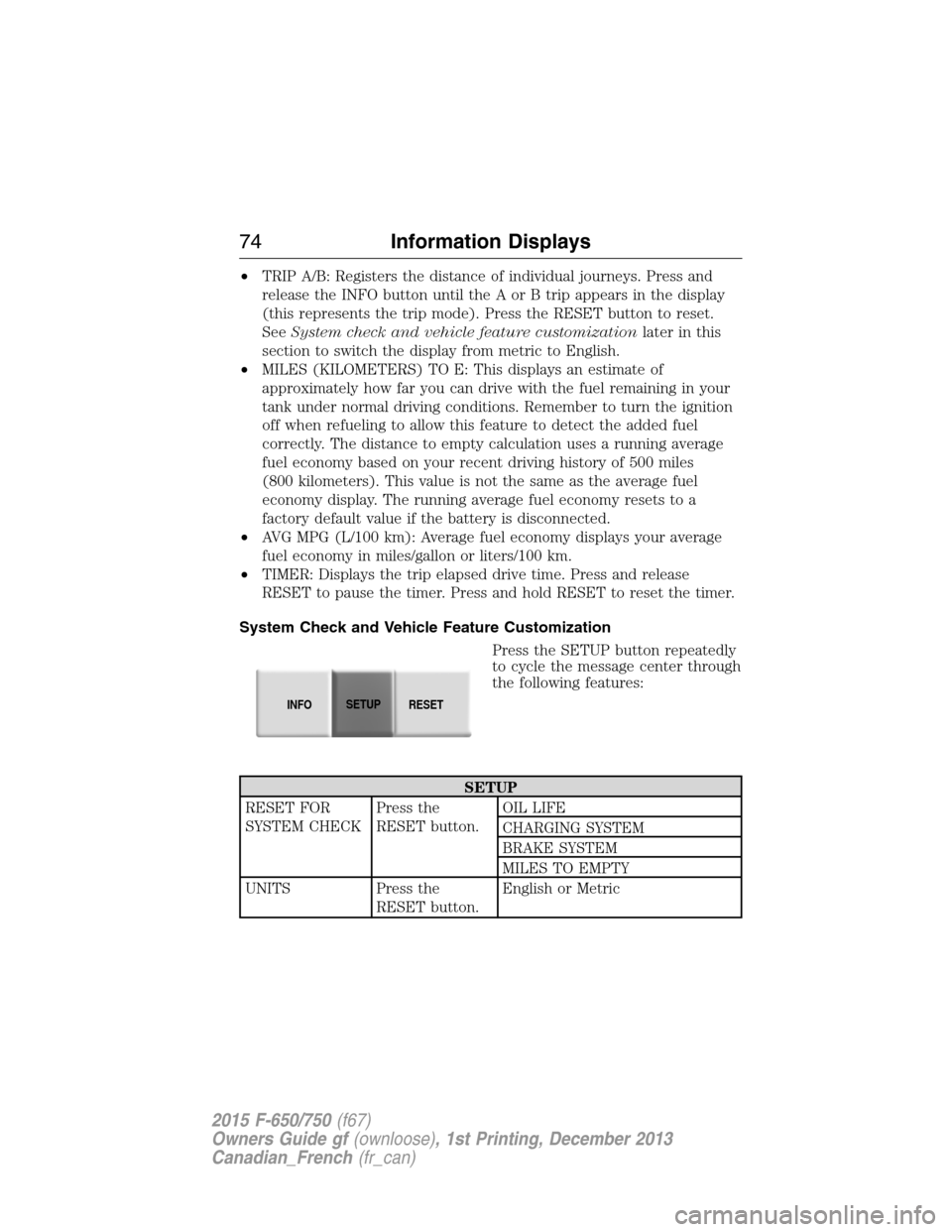
System Check and Vehicle Feature Customization
Press the SETUP button repeatedly
to cycle the message center through
the following features:
SETUP
RESET FOR
SYSTEM CHECKPress the
RESET button.OIL LIFE
CHARGING SYSTEM
BRAKE SYSTEM
MILES TO EMPTY
UNITS Press the
RESET button.English or Metric
INFOSETUP
RESET
74Information Displays
2015 F-650/750(f67)
Owners Guide gf(ownloose), 1st Printing, December 2013
Canadian_French(fr_can)
Page 76 of 384
SETUP
LANGUAGE =
ENGLISH /
SPANISH /
FRENCHPress the
RESET button.English / Spanish / French (Press
and hold to set.)
INFORMATION MESSAGES
Note:Depending on the options equipped with your vehicle, not all of
the messages display or are available. Certain messages appear
abbreviated or shortened depending upon which cluster type you have.
Press the OK button to acknowledge and remove some messages from
the information display. Other messages disappear automatically after a
short time. You need to confirm certain messages before you can access
the menus.
Battery and
Charging System
MessagesAction / Description
CHECK CHARGING
SYSTEMDisplays when the charging system needs
servicing. If the warning stays on or continues
to come on, contact an authorized dealer as
soon as possible.
Brake System
MessagesAction / Description
BRAKE FLUID
LEVEL LOWDisplays when the brake fluid level is low.
Have the brake system inspected immediately.
SeeBrake fluid checkin theMaintenance
chapter.
CHECK BRAKE
SYSTEMDisplays when the brake system needs
servicing. If the warning stays on or continues
to come on, contact an authorized dealer as
soon as possible.
PARK BRAKE
ENGAGEDDisplays when the parking brake is set and
your vehicle is moving.
Information Displays75
2015 F-650/750(f67)
Owners Guide gf(ownloose), 1st Printing, December 2013
Canadian_French(fr_can)
Page 94 of 384
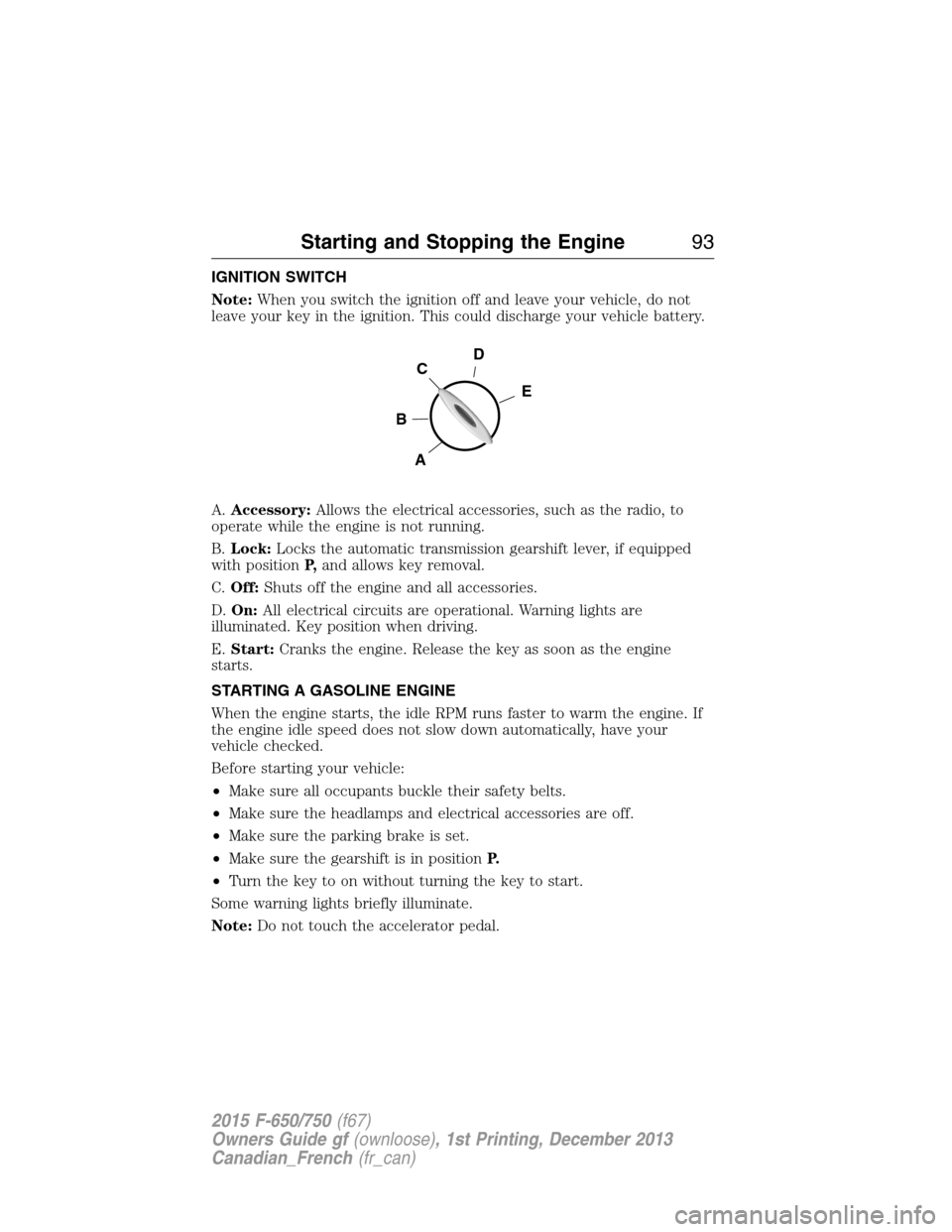
IGNITION SWITCH
Note:When you switch the ignition off and leave your vehicle, do not
leave your key in the ignition. This could discharge your vehicle battery.
A.Accessory:Allows the electrical accessories, such as the radio, to
operate while the engine is not running.
B.Lock:Locks the automatic transmission gearshift lever, if equipped
with positionP,and allows key removal.
C.Off:Shuts off the engine and all accessories.
D.On:All electrical circuits are operational. Warning lights are
illuminated. Key position when driving.
E.Start:Cranks the engine. Release the key as soon as the engine
starts.
STARTING A GASOLINE ENGINE
When the engine starts, the idle RPM runs faster to warm the engine. If
the engine idle speed does not slow down automatically, have your
vehicle checked.
Before starting your vehicle:
•Make sure all occupants buckle their safety belts.
•Make sure the headlamps and electrical accessories are off.
•Make sure the parking brake is set.
•Make sure the gearshift is in positionP.
•Turn the key to on without turning the key to start.
Some warning lights briefly illuminate.
Note:Do not touch the accelerator pedal.
D
E
C
B
A
Starting and Stopping the Engine93
2015 F-650/750(f67)
Owners Guide gf(ownloose), 1st Printing, December 2013
Canadian_French(fr_can)
Page 95 of 384
1. Fully press the brake pedal.
2. Turn the key to start the engine. The engine may continue cranking
for up to 15 seconds or until your vehicle starts.
Note:If the engine does not start on the first try, wait for a short period
and try again.
If you have difficulty starting the engine when the temperature is below
-13°F (-25°C), press the accelerator pedal slightly and try again.
If the engine does not start after three attempts, wait 10 seconds and
follow this flooded engine procedure.
1. Select positionPorN.
2. Fully press the accelerator pedal and hold it there.
3. Fully press the brake pedal.
4. Start the engine.
Guarding Against Exhaust Fumes
WARNING:If you smell exhaust fumes inside your vehicle, have
this checked immediately. Do not drive your vehicle if you smell
exhaust fumes. Carbon monoxide is present in exhaust fumes. Take
precautions to avoid its dangerous effects.
Important Ventilating Information
If you stop your vehicle and leave the engine idling for long periods, we
recommend that you do one of the following:
•Open the windows at least 1 inch (2.5 centimeters).
•Set your climate control to outside air.
94Starting and Stopping the Engine
2015 F-650/750(f67)
Owners Guide gf(ownloose), 1st Printing, December 2013
Canadian_French(fr_can)
Page 97 of 384
Note:Do not increase engine speed until the oil pressure gauge
indicates normal pressure. The oil pressure gauge should indicate this
within 15 seconds after starting.
Note:Idle the engine for three to five minutes before operating with a
full load.
Note:Try to limit engine idle to 10 minutes. Excessive idling reduces
fuel economy.
Vehicles with a Manual Transmission
Note:Do not touch the accelerator pedal.
1. Fully press the clutch pedal.
2. Start the engine.
Vehicles with an Automatic Transmission
Note:Do not touch the accelerator pedal.
1. Select positionN,orP(if equipped with a Park position).
2. Fully press the brake pedal.
3. Start the engine.
Starting the Engine with the Vehicle on a Steep Grade
When starting a diesel engine when the loaded vehicle is on a grade, the
engine RPM starts to fall slightly when you engage the clutch. Do not
disengage the clutch and try to increase engine RPM as this may damage
driveline components. The engine recovers as the vehicle begins moving.
DIESEL PARTICULATE FILTER (DPF)
WARNING:The normal operating temperature of the exhaust
system is very high. Never work around, or attempt to repair, any
part of the exhaust system until it has cooled. Use special care when
working around the diesel particulate filter. The DPF heats up to a high
temperature after only a short period of engine operation, and can
remain hot even after the engine is turned off. Failure to follow these
instructions may result in serious personal injury.
Your vehicle is equipped with a diesel particulate filter (DPF), as part of
the after-treatment exhaust system, to trap soot and other large particles
produced by the engine combustion process. You must periodically
reduce the soot that accumulates in the filter to prevent excessive
exhaust restriction. The engine and after-treatment system generally
perform the soot reduction process, also known as “filter regeneration,”
automatically.
96Starting and Stopping the Engine
2015 F-650/750(f67)
Owners Guide gf(ownloose), 1st Printing, December 2013
Canadian_French(fr_can)
Page 99 of 384
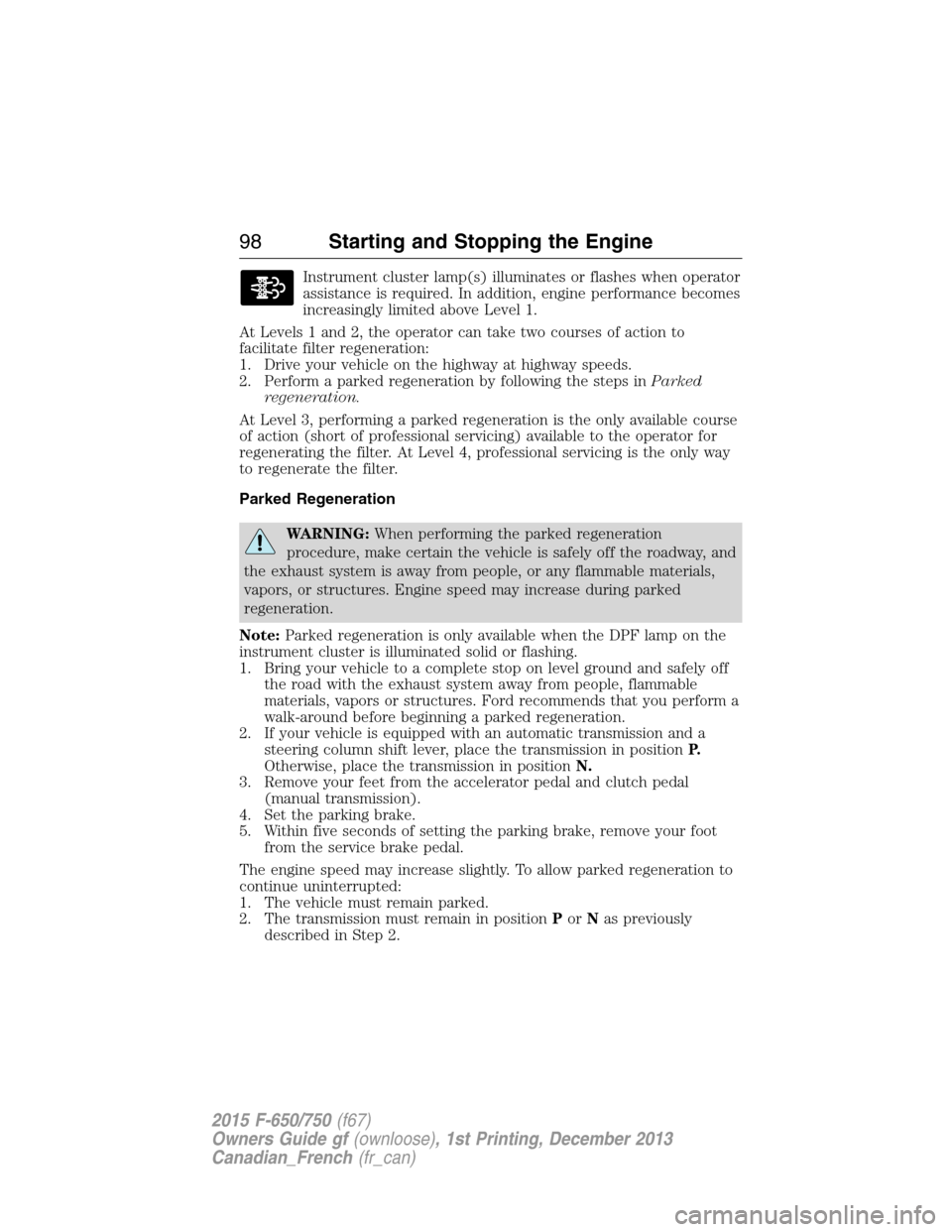
Instrument cluster lamp(s) illuminates or flashes when operator
assistance is required. In addition, engine performance becomes
increasingly limited above Level 1.
At Levels 1 and 2, the operator can take two courses of action to
facilitate filter regeneration:
1. Drive your vehicle on the highway at highway speeds.
2. Perform a parked regeneration by following the steps inParked
regeneration.
At Level 3, performing a parked regeneration is the only available course
of action (short of professional servicing) available to the operator for
regenerating the filter. At Level 4, professional servicing is the only way
to regenerate the filter.
Parked Regeneration
WARNING:When performing the parked regeneration
procedure, make certain the vehicle is safely off the roadway, and
the exhaust system is away from people, or any flammable materials,
vapors, or structures. Engine speed may increase during parked
regeneration.
Note:Parked regeneration is only available when the DPF lamp on the
instrument cluster is illuminated solid or flashing.
1. Bring your vehicle to a complete stop on level ground and safely off
the road with the exhaust system away from people, flammable
materials, vapors or structures. Ford recommends that you perform a
walk-around before beginning a parked regeneration.
2. If your vehicle is equipped with an automatic transmission and a
steering column shift lever, place the transmission in positionP.
Otherwise, place the transmission in positionN.
3. Remove your feet from the accelerator pedal and clutch pedal
(manual transmission).
4. Set the parking brake.
5. Within five seconds of setting the parking brake, remove your foot
from the service brake pedal.
The engine speed may increase slightly. To allow parked regeneration to
continue uninterrupted:
1. The vehicle must remain parked.
2. The transmission must remain in positionPorNas previously
described in Step 2.
98Starting and Stopping the Engine
2015 F-650/750(f67)
Owners Guide gf(ownloose), 1st Printing, December 2013
Canadian_French(fr_can)
Page 100 of 384
3. Do not press the accelerator pedal, service brake pedal, or clutch
pedal (manual transmission).
4. The parking brake must remain set.
On average, depending on filter level and other factors, the process takes
20–30 minutes to complete. The DPF lamp turns off when the process is
complete. Repeat Steps 1–5, if parked regeneration is interrupted.
To Discontinue Parked Regeneration
Press any of the floor pedals to discontinue parked regeneration.
Maintenance and Service
The DPF can retain a relatively large amount of residual ash and provide
many miles and hours of maintenance-free operation. At some point,
generally beyond 150000 miles (240000 kilometers) or 5000 hours of
operation (whichever comes first), the DPF requires professional
cleaning to remove the accumulated ash.
The exact number of miles or hours of operation vary greatly depending
upon vehicle and engine loading and operating conditions, ash content of
the engine oil, and quality of the diesel fuel used in your truck. Adhering
to your engine manufacturer’s recommended oil and fuel specifications
maximizes the miles and hours of operation before a DPF professional
cleaning is required. See your engine manufacturer’s owner’s manual for
more details about recommended maintenance and service of your DPF.
Exhaust Outlet Assembly
WARNING:The normal operating temperature of the exhaust
system is very high. Never work around or attempt to repair any
part of the exhaust system until it has cooled. Failure to follow these
instructions may result in serious personal injury.
Note:Do not modify or remove this device. Modification of the system
or additions of aftermarket devices can reduce the effectiveness of the
system, as well as cause damage to the exhaust system or engine. Any
modifications may also invalidate the vehicle or engine warranty. See
your warranty information.
Note:Blocked or plugged holes or modification to, or removal of, the
outlet assembly could result in elevated exhaust temperatures that may
result in vehicle or property damage or personal injury.
The exhaust outlet assembly on your vehicle is a uniquely functioning
device that accompanies the DPF assembly. It can help control the
temperature of the exhaust during the DPF regeneration process.
Starting and Stopping the Engine99
2015 F-650/750(f67)
Owners Guide gf(ownloose), 1st Printing, December 2013
Canadian_French(fr_can)
Page 124 of 384
more quickly. If you force the gearshift lever into position, this action
defeats the purpose of the synchronizer by causing gear clash.
Shifting with a Non-Synchronized Transmission
SeeClutch brakeandDouble clutch proceduresin theClutchsection
of this chapter.
Clutch
Do not ride or slip the clutch as this causes unnecessary heat and wear.
Maintain the specified clutch adjustment to prolong its life and regularly
inspect the clutch control linkage for tightness. See theScheduled
Maintenancechapter for other maintenance information. When
adjustment of the clutch is necessary, it is very important that the work
be performed properly or early clutch failure may result and a costly
clutch overhaul may become necessary. Only a qualified technician
should perform clutch work.
Note:Continued use of a damaged or worn clutch, prolonged clutch
slippage or downshifting at excessive speeds can result in a failure of the
engine, transmission or clutch components.
Note:To avoid premature clutch wear and failure, do not drive with
your foot resting on the clutch pedal or use it to hold your vehicle at a
standstill on an upgrade as when waiting for a traffic light.
Engaging the Clutch
•Always start in the proper gear. An empty vehicle can start in a
higher gear than a fully loaded vehicle. Starting in too high a gear can
cause clutch slippage and excessive heat and wear on the clutch. A
gear that starts the vehicle moving at idle speed is the correct gear. If
you have to rev the engine to get your vehicle going, the gear
selection is too high.
•Do not shift until your vehicle has reached the proper speed.
Upshifting before your vehicle has reached the proper speed can
cause clutch slippage and excessive heat and wear on the clutch.
•Never hold a vehicle on a grade with the clutch. This causes the
clutch to slip and can actually burn up the clutch.
•Never coast with the clutch disengaged. The high RPM (sometimes
over 10000) can actually burst the facing material of the clutch.
•Never engage the clutch while coasting. Re-engaging the clutch after
coasting may not only cause a great shock to the clutch, but the
whole drivetrain. Internal engine damage or clutch and flywheel
failure can result from this.
Transmission123
2015 F-650/750(f67)
Owners Guide gf(ownloose), 1st Printing, December 2013
Canadian_French(fr_can)
Page 125 of 384
If the transmission is equipped with a ceramic clutch, you must start
your vehicle moving in first gear and engage the clutch before pressing
the accelerator at idle. In addition, do not try to slip the clutch by raising
engine RPM and riding or feathering the clutch pedal since this causes
erratic engagement that can cause engine stalling and potential serious
damage to driveline components.
Clutch Brake (Non-Synchronized Transmissions) - Vehicle
Stationary
A clutch brake stops transmission input shaft rotation so you can
accomplish the initial first gear or reverse gear selection when your
vehicle is stationary and the engine is at idle speed. Clutch brake
application occurs in the last 1 inch (25 millimeters) of clutch pedal
travel.
When using the clutch brake, fully press the clutch pedal and shift the
transmission into first gear or reverse. If the transmission does not go
into one of these gears, slowly release the clutch pedal while applying
light pressure on the transmission shift lever until it shifts into gear.
Note:After engagement of first gear, do not use the clutch brake for
upshifting or downshifting. If you do, clutch brake life shortens and gear
selection shift efforts may increase.
Double-Clutch Procedures - Non-Synchronized Transmissions
In order to properly upshift or downshift:
1. Press the clutch pedal to disengage the clutch.
2. Shift the transmission into neutral.
3. Release the clutch pedal.
If upshifting, wait until the engine speed matches the transmission speed
of the gear you are selecting.
If downshifting, accelerate the engine until the engine speed matches the
input speed of the gear you are selecting. Press the clutch pedal
immediately and shift into the desired gear, then release the clutch
pedal.
124Transmission
2015 F-650/750(f67)
Owners Guide gf(ownloose), 1st Printing, December 2013
Canadian_French(fr_can)
Page 127 of 384
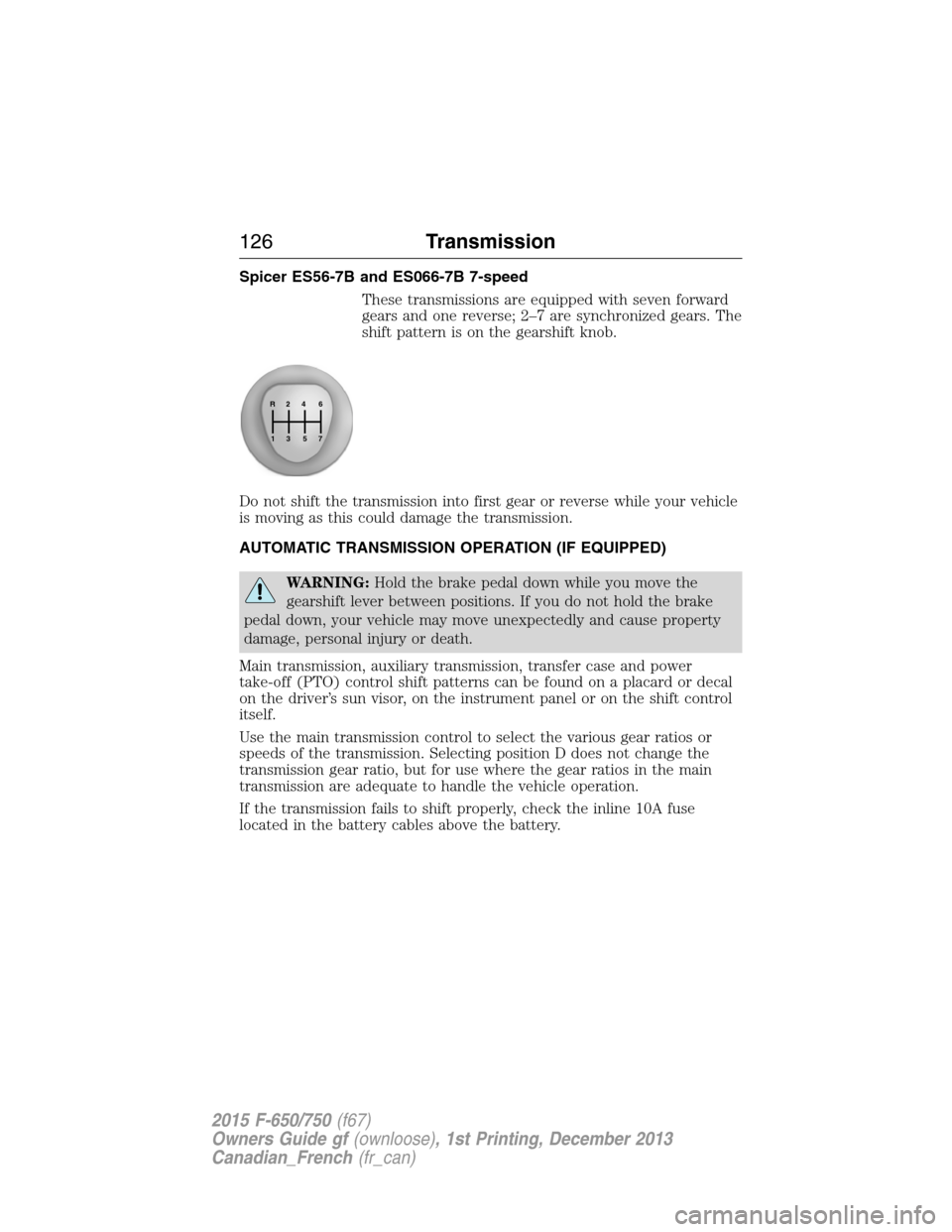
Spicer ES56-7B and ES066-7B 7-speed
These transmissions are equipped with seven forward
gears and one reverse; 2–7 are synchronized gears. The
shift pattern is on the gearshift knob.
Do not shift the transmission into first gear or reverse while your vehicle
is moving as this could damage the transmission.
AUTOMATIC TRANSMISSION OPERATION (IF EQUIPPED)
WARNING:Hold the brake pedal down while you move the
gearshift lever between positions. If you do not hold the brake
pedal down, your vehicle may move unexpectedly and cause property
damage, personal injury or death.
Main transmission, auxiliary transmission, transfer case and power
take-off (PTO) control shift patterns can be found on a placard or decal
on the driver’s sun visor, on the instrument panel or on the shift control
itself.
Use the main transmission control to select the various gear ratios or
speeds of the transmission. Selecting position D does not change the
transmission gear ratio, but for use where the gear ratios in the main
transmission are adequate to handle the vehicle operation.
If the transmission fails to shift properly, check the inline 10A fuse
located in the battery cables above the battery.
R24
576
3 1
126Transmission
2015 F-650/750(f67)
Owners Guide gf(ownloose), 1st Printing, December 2013
Canadian_French(fr_can)