brake FORD F650 2015 13.G Service Manual
[x] Cancel search | Manufacturer: FORD, Model Year: 2015, Model line: F650, Model: FORD F650 2015 13.GPages: 384, PDF Size: 4.95 MB
Page 140 of 384
Anti-lock Brake System (ABS)
This system helps you maintain steering control during emergency stops
by keeping the brakes from locking.
The ABS lamp momentarily illuminates when you switch on the
ignition. If the light does not illuminate during start-up, if it
remains on or flashes, the ABS may not be working and
requires servicing.
If the ABS is disabled, normal braking is still effective. If the
brake warning lamp illuminates, have your brake system
serviced immediately.
If you connect a PLC trailer with the ignition on, the trailer
ABS light also illuminates. If the light fails to illuminate, if it
remains on after you start the vehicle or continues to flash,
have the system serviced immediately.
FULL POWER BRAKE SYSTEM
WARNING:If the red BRAKE warning lamp in the instrument
cluster remains illuminated after engine start up, this indicates a
system failure in the Full Power Brake System. Stop the vehicle safely
as soon as possible and seek service immediately.
This system incorporates standard braking, an anti-lock braking system
(ABS) and optional Power Park Brake into one fully integrated hydraulic
brake system. With the Full Power Brake System, braking energy is
stored, similar to an air brake system, resulting in faster response times
and shorter stopping distances. This is accomplished using motor and
pump assemblies that pressurize the system by pumping brake fluid into
accumulators. This is similar to the air compressor of an air brake system
pressurizing the air tanks. The system includes a master cylinder that
provides the normal pedal feel and transfers the pedal force, via brake
fluid, to the main components of the system.
Note:The motor and pumps run momentarily with the ignition switch in
the on or run position, or in the off position with the brake pedal
pressed.
Note:During normal driving, you may hear the pump and motors
replenishing the accumulators. This is a normal function of the system.
AIR BRAKES
After starting the engine, give the air compressor time to build up the air
pressure to 60 psi (414 kPa) before moving your vehicle.
Brakes139
2015 F-650/750(f67)
Owners Guide gf(ownloose), 1st Printing, December 2013
Canadian_French(fr_can)
Page 141 of 384
WARNING:Do not drive or continue to drive if the low air
pressure buzzer is sounding or the brake warning light is lit.
These warnings indicate that air pressure is not to normal operating
level. Continued use of the vehicle could result in loss of braking ability.
WARNING:Avoid repeated light application of the brake pedal.
This depletes air pressure faster and could result in loss of
braking capability.
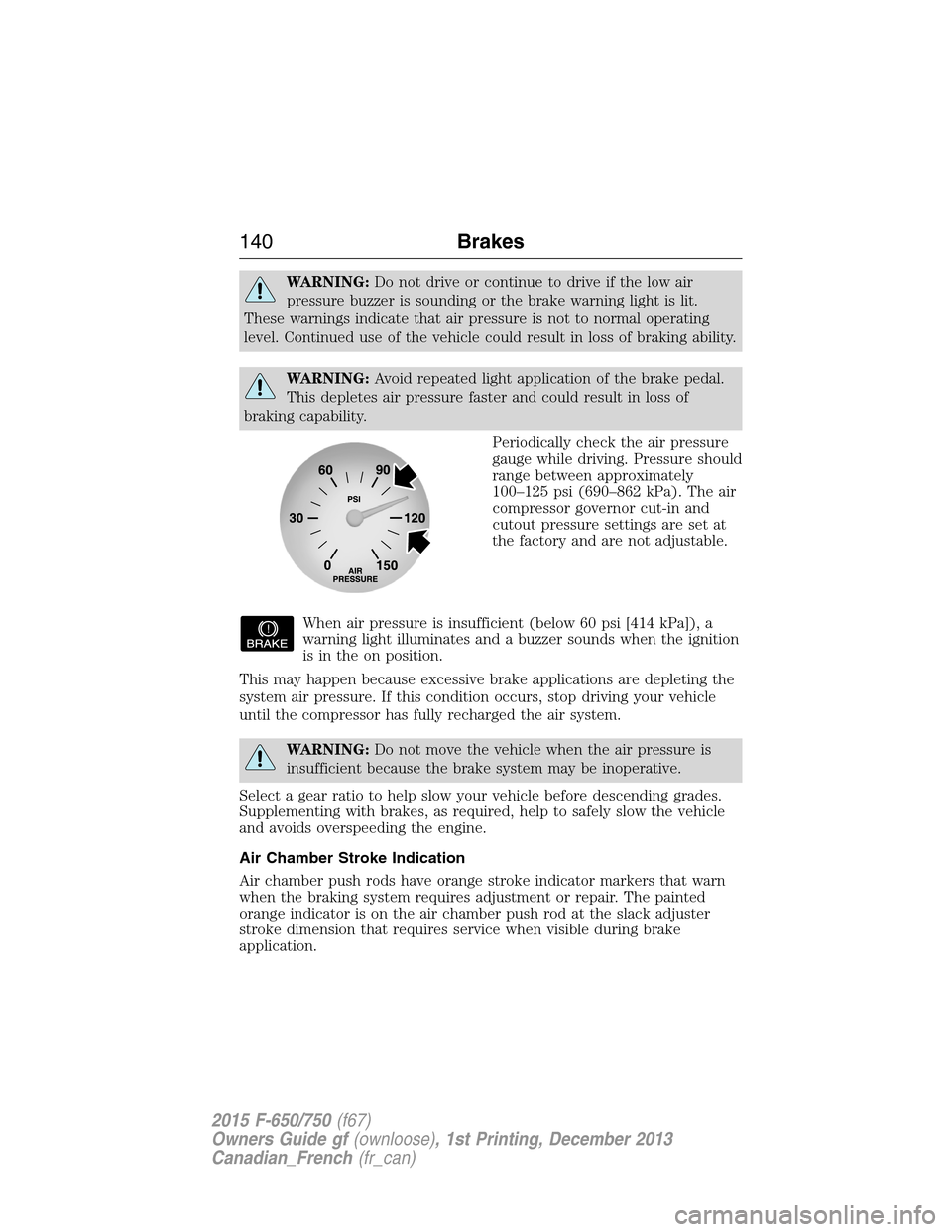
Periodically check the air pressure
gauge while driving. Pressure should
range between approximately
100–125 psi (690–862 kPa). The air
compressor governor cut-in and
cutout pressure settings are set at
the factory and are not adjustable.
When air pressure is insufficient (below 60 psi [414 kPa]), a
warning light illuminates and a buzzer sounds when the ignition
is in the on position.
This may happen because excessive brake applications are depleting the
system air pressure. If this condition occurs, stop driving your vehicle
until the compressor has fully recharged the air system.
WARNING:Do not move the vehicle when the air pressure is
insufficient because the brake system may be inoperative.
Select a gear ratio to help slow your vehicle before descending grades.
Supplementing with brakes, as required, help to safely slow the vehicle
and avoids overspeeding the engine.
Air Chamber Stroke Indication
Air chamber push rods have orange stroke indicator markers that warn
when the braking system requires adjustment or repair. The painted
orange indicator is on the air chamber push rod at the slack adjuster
stroke dimension that requires service when visible during brake
application.
140Brakes
2015 F-650/750(f67)
Owners Guide gf(ownloose), 1st Printing, December 2013
Canadian_French(fr_can)
Page 142 of 384
A qualified service technician should perform air brake inspection and
adjustment or repairs keeping to the instructions in the service manual.
Cam Brakes - Automatic Slack Adjusters
WARNING:Do not manually adjust the automatic slack adjusters
to correct excessive push rod stroke as it may result in reduced
brake effectiveness and a vehicle crash. Excessive push rod stroke
indicates that a problem exists with the automatic adjuster, with the
installation of the adjuster, or with foundation brake components that
manual adjustment does not remedy. Seek service from a qualified
facility for excessive push rod stroke.
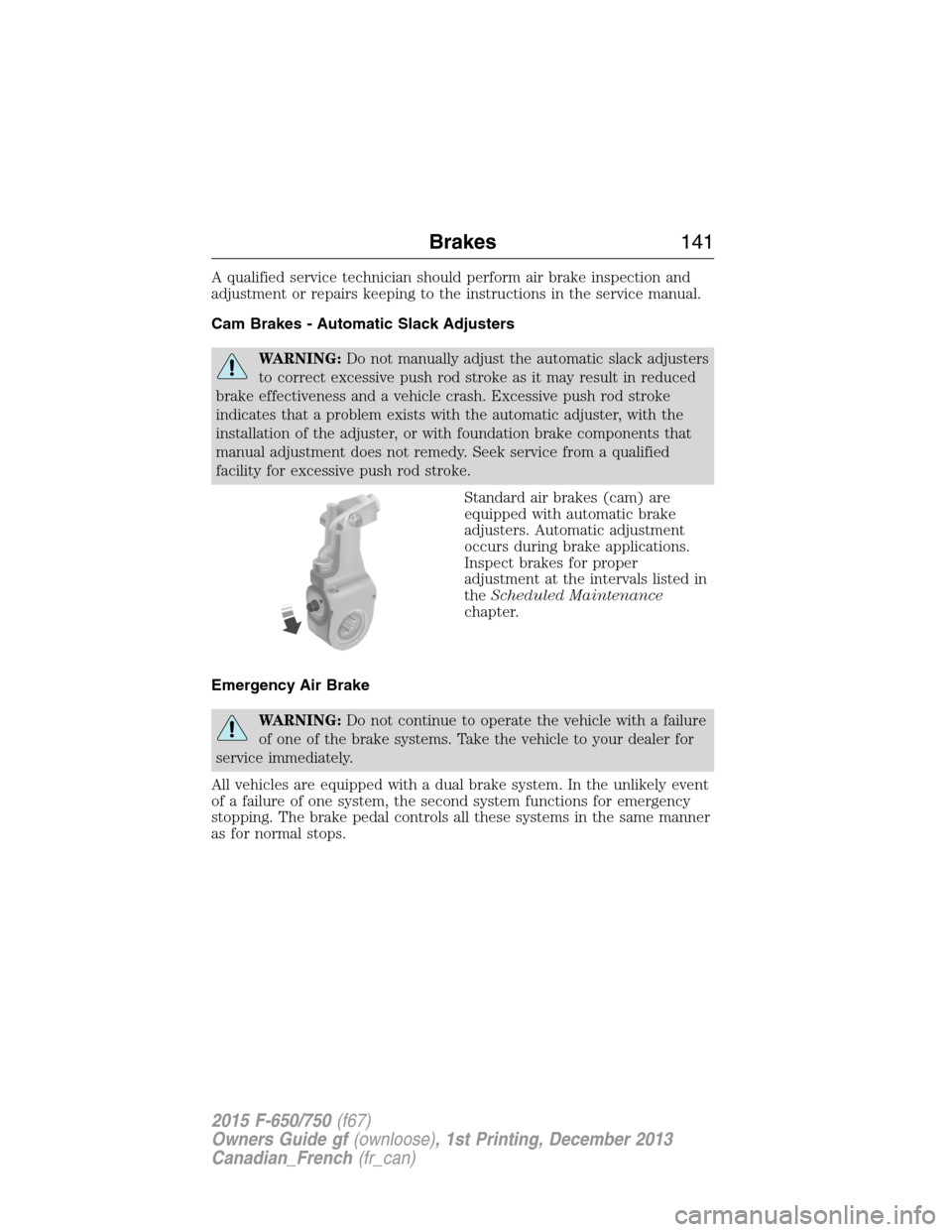
Standard air brakes (cam) are
equipped with automatic brake
adjusters. Automatic adjustment
occurs during brake applications.
Inspect brakes for proper
adjustment at the intervals listed in
theScheduled Maintenance
chapter.
Emergency Air Brake
WARNING:Do not continue to operate the vehicle with a failure
of one of the brake systems. Take the vehicle to your dealer for
service immediately.
All vehicles are equipped with a dual brake system. In the unlikely event
of a failure of one system, the second system functions for emergency
stopping. The brake pedal controls all these systems in the same manner
as for normal stops.
Brakes141
2015 F-650/750(f67)
Owners Guide gf(ownloose), 1st Printing, December 2013
Canadian_French(fr_can)
Page 143 of 384
HINTS ON DRIVING WITH ANTI-LOCK BRAKES
When the system is operating, the brake pedal pulses and may travel
further. Maintain pressure on the brake pedal. You may also hear a noise
from the system. This is normal.
The ABS does not eliminate the dangers inherent when:
•You drive too closely to the vehicle in front of you.
•Your vehicle is hydroplaning.
•You take corners too fast.
•The road surface is poor.
EXHAUST BRAKE (IF EQUIPPED)
WARNING:The exhaust brake is not recommended for use on
slippery or low traction road surfaces. Under these conditions a
loss of vehicle control could occur.
Note:Installing an exhaust or auxiliary brake does not necessarily
protect the engine from exceeding maximum governed speed. Use the
primary brakes to make sure the engine never exceeds maximum
governed speed under any conditions.
Note:Before starting the engine, make sure that the exhaust brake
switch is in the off position. Do not turn the exhaust brake on until the
engine has reached normal operating temperature.
Note:Maximum exhaust brake performance relates to the type of
transmission your vehicle has.
Note:Engine speed has a major influence of retarding performance.
When engine speed is stays at the maximum allowable level, the exhaust
brake operates at peak performance.
Note:Manual transmissions should be downshifted to the lowest gear
possible, without exceeding the maximum RPM limit of the engine. This
maximizes the exhaust brake’s retarding effect.
Note:Exhaust brakes operate effectively with automatic transmissions,
but performance varies with engine speed and the gear selected by the
transmission.
An exhaust brake is an auxiliary braking system that assists, but does
not replace, the primary service brake system. It helps control vehicle
speed; it is not a vehicle-stopping device.
142Brakes
2015 F-650/750(f67)
Owners Guide gf(ownloose), 1st Printing, December 2013
Canadian_French(fr_can)
Page 144 of 384
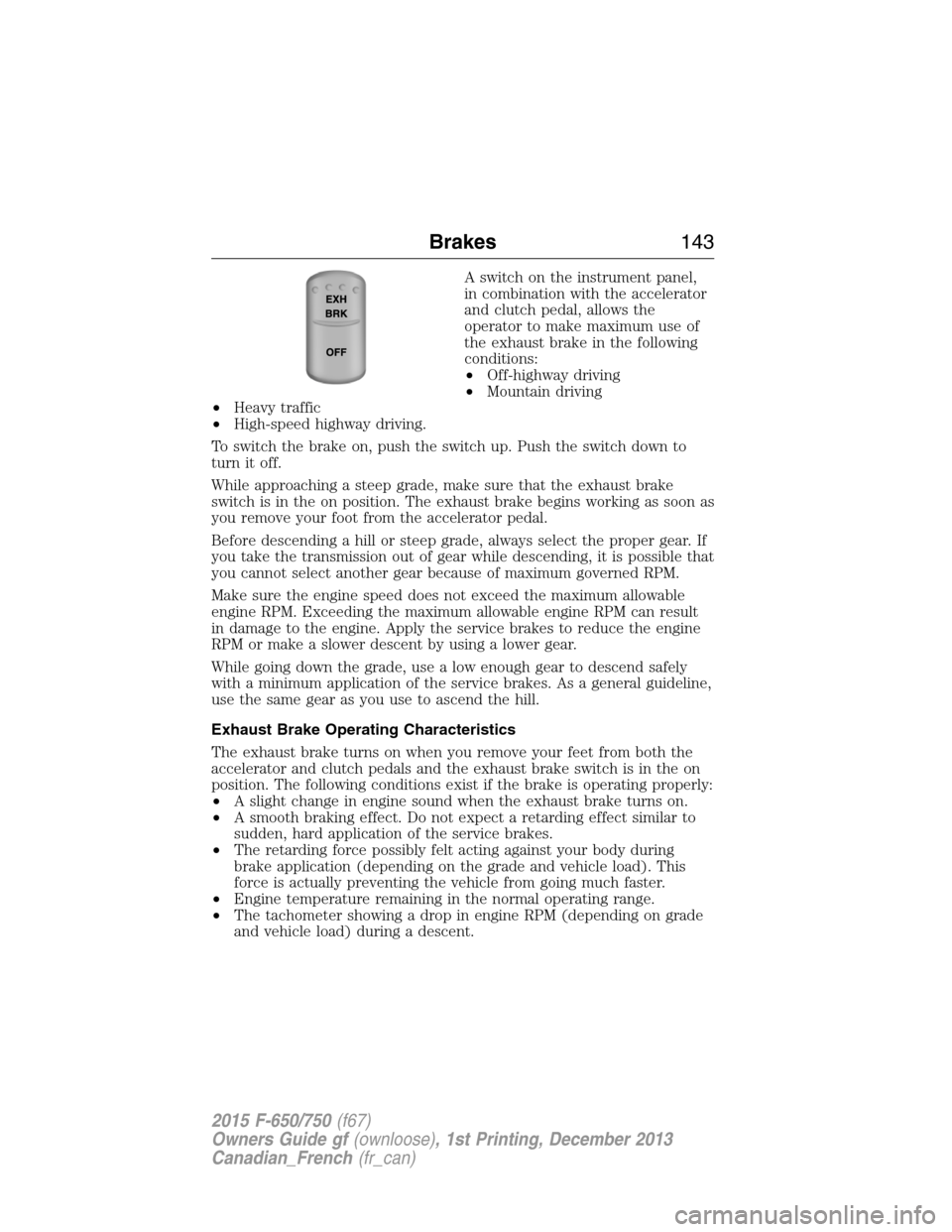
A switch on the instrument panel,
in combination with the accelerator
and clutch pedal, allows the
operator to make maximum use of
the exhaust brake in the following
conditions:
•Off-highway driving
•Mountain driving
•Heavy traffic
•High-speed highway driving.
To switch the brake on, push the switch up. Push the switch down to
turn it off.
While approaching a steep grade, make sure that the exhaust brake
switch is in the on position. The exhaust brake begins working as soon as
you remove your foot from the accelerator pedal.
Before descending a hill or steep grade, always select the proper gear. If
you take the transmission out of gear while descending, it is possible that
you cannot select another gear because of maximum governed RPM.
Make sure the engine speed does not exceed the maximum allowable
engine RPM. Exceeding the maximum allowable engine RPM can result
in damage to the engine. Apply the service brakes to reduce the engine
RPM or make a slower descent by using a lower gear.
While going down the grade, use a low enough gear to descend safely
with a minimum application of the service brakes. As a general guideline,
use the same gear as you use to ascend the hill.
Exhaust Brake Operating Characteristics
The exhaust brake turns on when you remove your feet from both the
accelerator and clutch pedals and the exhaust brake switch is in the on
position. The following conditions exist if the brake is operating properly:
•A slight change in engine sound when the exhaust brake turns on.
•A smooth braking effect. Do not expect a retarding effect similar to
sudden, hard application of the service brakes.
•The retarding force possibly felt acting against your body during
brake application (depending on the grade and vehicle load). This
force is actually preventing the vehicle from going much faster.
•Engine temperature remaining in the normal operating range.
•The tachometer showing a drop in engine RPM (depending on grade
and vehicle load) during a descent.
Brakes143
2015 F-650/750(f67)
Owners Guide gf(ownloose), 1st Printing, December 2013
Canadian_French(fr_can)
Page 145 of 384
•A decrease in road speed when applying the exhaust brake during a
descent, except when your vehicle is carrying a heavy load or the
grade is extremely steep. In these instances, you may need to apply
the service brakes occasionally.
TRAILER BRAKES
Trailer Brake Hand Control (If Equipped)
WARNING:The hand control should never be used to apply the
brakes when the tractor and trailer are parked unattended. Air
may leak from the system and the vehicle could possibly move,
resulting in possible property damage, personal injury or death.
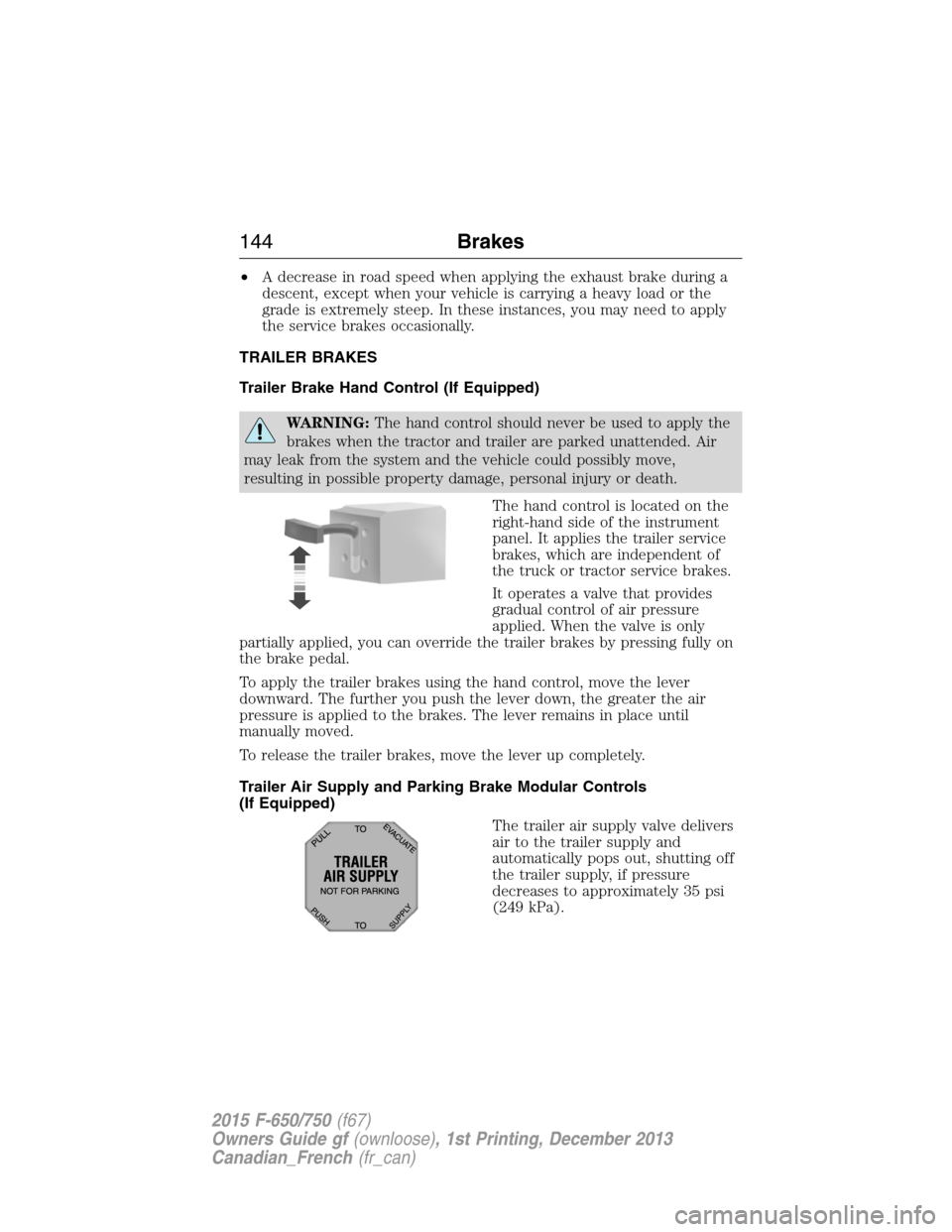
The hand control is located on the
right-hand side of the instrument
panel. It applies the trailer service
brakes, which are independent of
the truck or tractor service brakes.
It operates a valve that provides
gradual control of air pressure
applied. When the valve is only
partially applied, you can override the trailer brakes by pressing fully on
the brake pedal.
To apply the trailer brakes using the hand control, move the lever
downward. The further you push the lever down, the greater the air
pressure is applied to the brakes. The lever remains in place until
manually moved.
To release the trailer brakes, move the lever up completely.
Trailer Air Supply and Parking Brake Modular Controls
(If Equipped)
The trailer air supply valve delivers
air to the trailer supply and
automatically pops out, shutting off
the trailer supply, if pressure
decreases to approximately 35 psi
(249 kPa).
144Brakes
2015 F-650/750(f67)
Owners Guide gf(ownloose), 1st Printing, December 2013
Canadian_French(fr_can)
Page 146 of 384
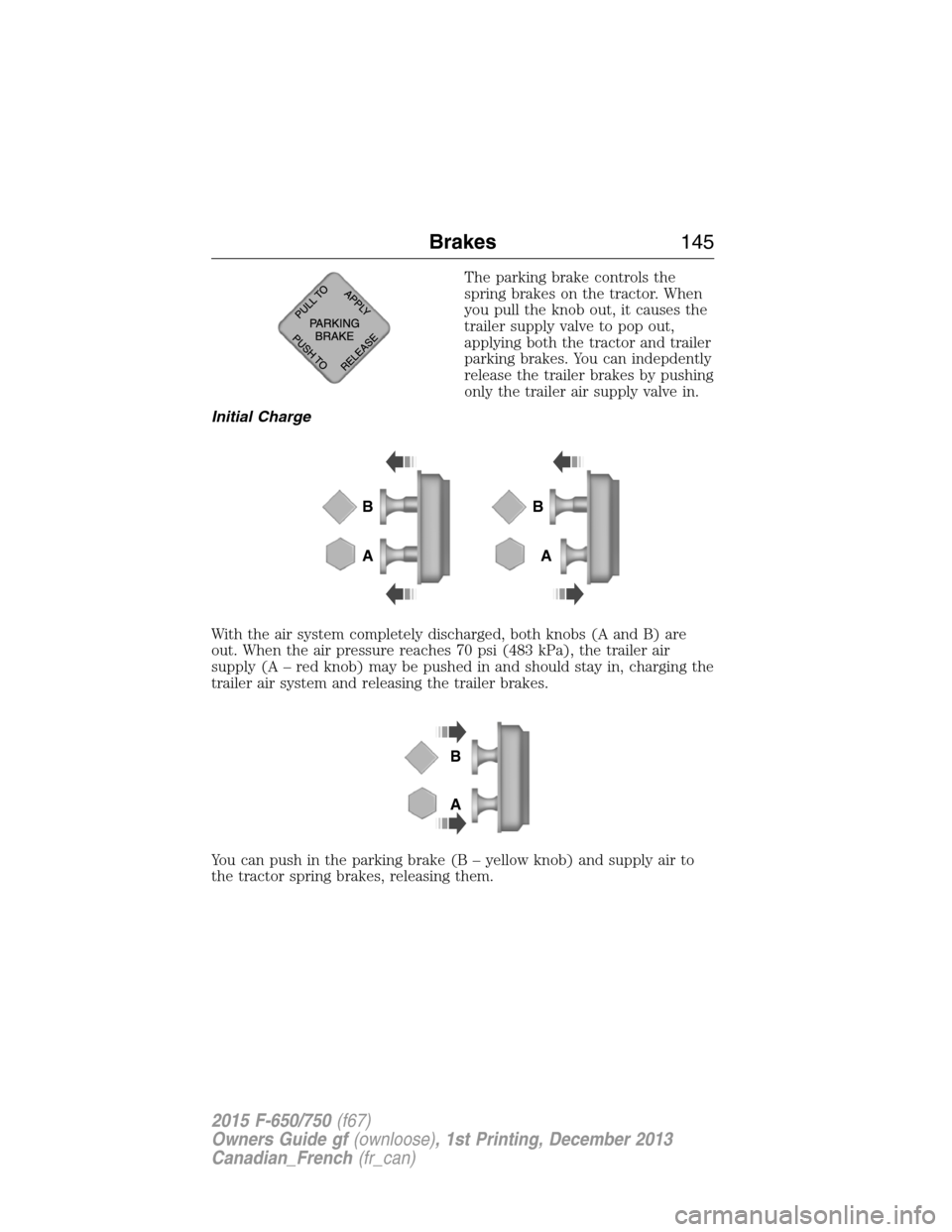
The parking brake controls the
spring brakes on the tractor. When
you pull the knob out, it causes the
trailer supply valve to pop out,
applying both the tractor and trailer
parking brakes. You can indepdently
release the trailer brakes by pushing
only the trailer air supply valve in.
Initial Charge
With the air system completely discharged, both knobs (A and B) are
out. When the air pressure reaches 70 psi (483 kPa), the trailer air
supply (A – red knob) may be pushed in and should stay in, charging the
trailer air system and releasing the trailer brakes.
You can push in the parking brake (B – yellow knob) and supply air to
the tractor spring brakes, releasing them.
B
AB
A
B
A
Brakes145
2015 F-650/750(f67)
Owners Guide gf(ownloose), 1st Printing, December 2013
Canadian_French(fr_can)
Page 147 of 384
Normal Driving Position
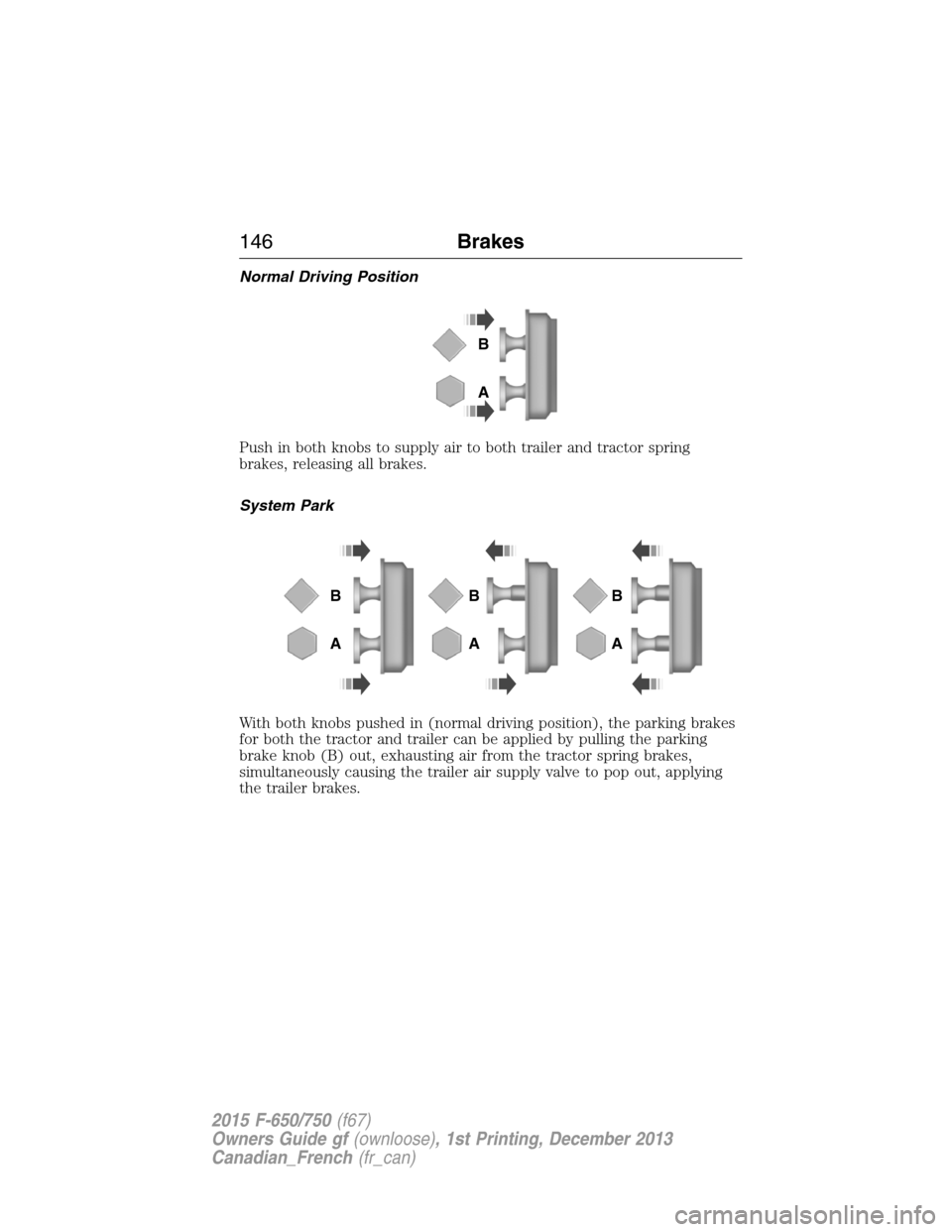
Push in both knobs to supply air to both trailer and tractor spring
brakes, releasing all brakes.
System Park
With both knobs pushed in (normal driving position), the parking brakes
for both the tractor and trailer can be applied by pulling the parking
brake knob (B) out, exhausting air from the tractor spring brakes,
simultaneously causing the trailer air supply valve to pop out, applying
the trailer brakes.
B
A
B
AB
AB
A
146Brakes
2015 F-650/750(f67)
Owners Guide gf(ownloose), 1st Printing, December 2013
Canadian_French(fr_can)
Page 148 of 384
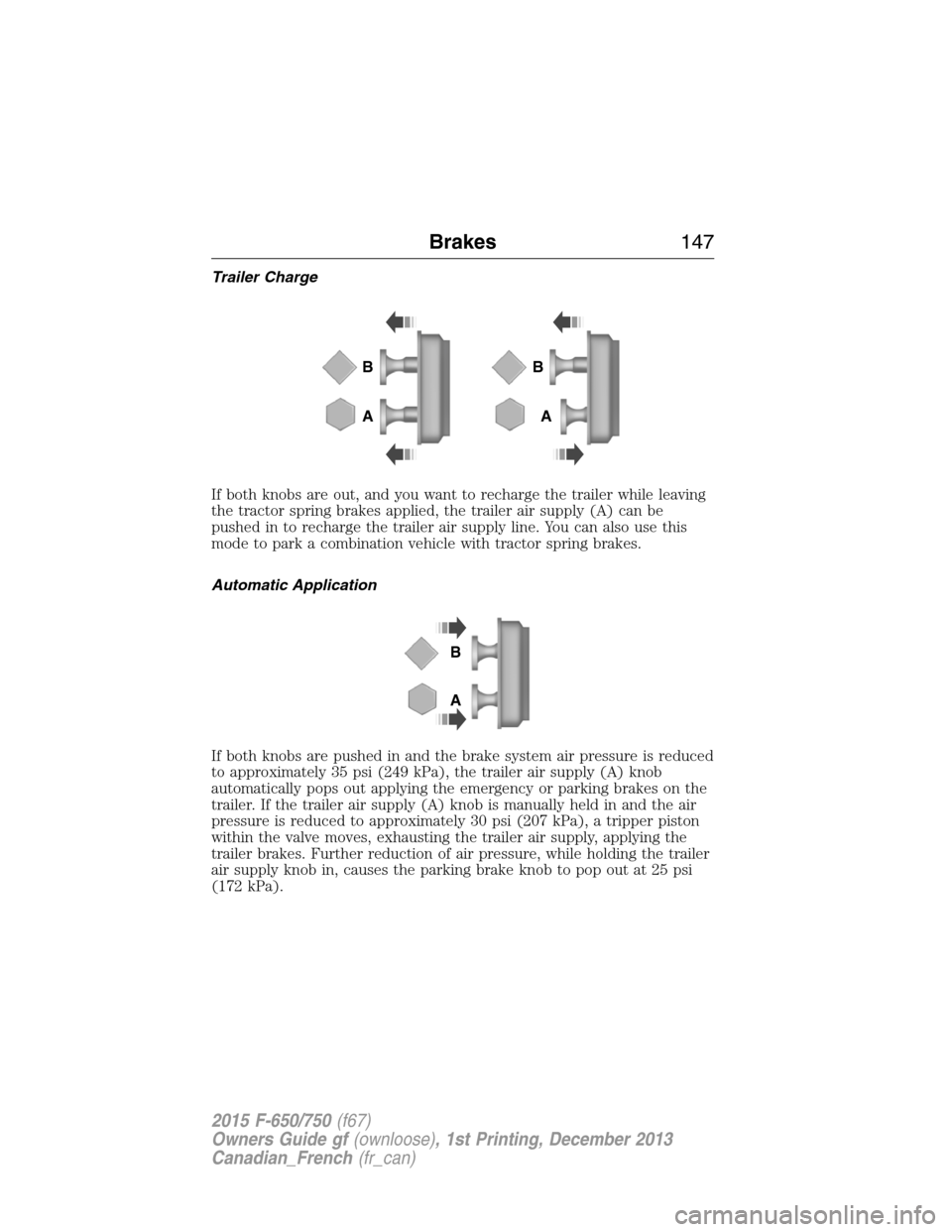
Trailer Charge
If both knobs are out, and you want to recharge the trailer while leaving
the tractor spring brakes applied, the trailer air supply (A) can be
pushed in to recharge the trailer air supply line. You can also use this
mode to park a combination vehicle with tractor spring brakes.
Automatic Application
If both knobs are pushed in and the brake system air pressure is reduced
to approximately 35 psi (249 kPa), the trailer air supply (A) knob
automatically pops out applying the emergency or parking brakes on the
trailer. If the trailer air supply (A) knob is manually held in and the air
pressure is reduced to approximately 30 psi (207 kPa), a tripper piston
within the valve moves, exhausting the trailer air supply, applying the
trailer brakes. Further reduction of air pressure, while holding the trailer
air supply knob in, causes the parking brake knob to pop out at 25 psi
(172 kPa).
B
AB
A
B
A
Brakes147
2015 F-650/750(f67)
Owners Guide gf(ownloose), 1st Printing, December 2013
Canadian_French(fr_can)
Page 149 of 384
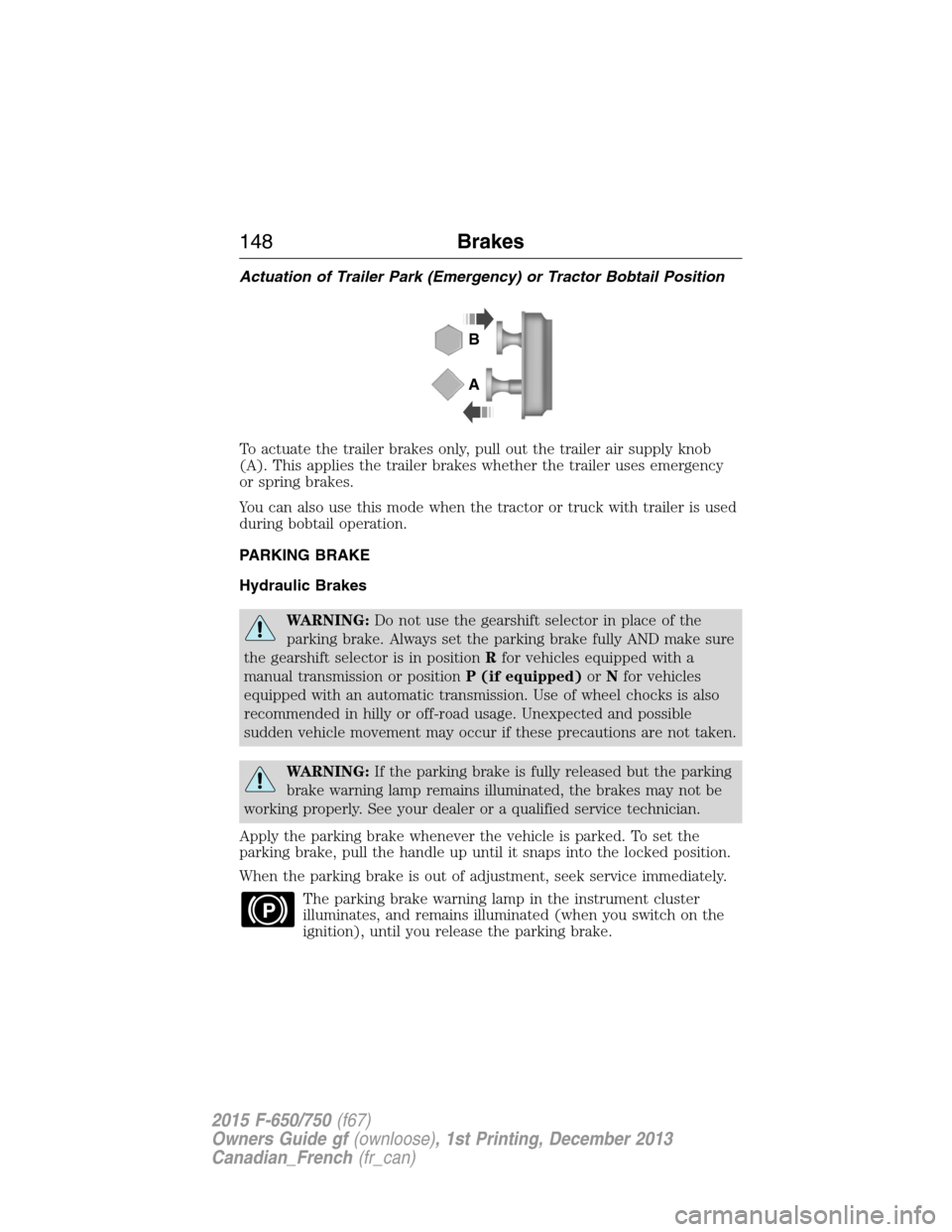
Actuation of Trailer Park (Emergency) or Tractor Bobtail Position
To actuate the trailer brakes only, pull out the trailer air supply knob
(A). This applies the trailer brakes whether the trailer uses emergency
or spring brakes.
You can also use this mode when the tractor or truck with trailer is used
during bobtail operation.
PARKING BRAKE
Hydraulic Brakes
WARNING:Do not use the gearshift selector in place of the
parking brake. Always set the parking brake fully AND make sure
the gearshift selector is in positionRfor vehicles equipped with a
manual transmission or positionP (if equipped)orNfor vehicles
equipped with an automatic transmission. Use of wheel chocks is also
recommended in hilly or off-road usage. Unexpected and possible
sudden vehicle movement may occur if these precautions are not taken.
WARNING:If the parking brake is fully released but the parking
brake warning lamp remains illuminated, the brakes may not be
working properly. See your dealer or a qualified service technician.
Apply the parking brake whenever the vehicle is parked. To set the
parking brake, pull the handle up until it snaps into the locked position.
When the parking brake is out of adjustment, seek service immediately.
The parking brake warning lamp in the instrument cluster
illuminates, and remains illuminated (when you switch on the
ignition), until you release the parking brake.
B
A
P
148Brakes
2015 F-650/750(f67)
Owners Guide gf(ownloose), 1st Printing, December 2013
Canadian_French(fr_can)